
Topic
Positioning
Presented by
Samya Bibi
Bint-e-Zahra
Sajida Bibi
Naqash Ali
Inam Ullah
Contents
 Positioning
 Concept of positioning
 Strategies for positioning
 Differentiating the product
 Steps of positioning
 Criteria for successful positioning
 Errors in positioning
 Conclusion
Positioning
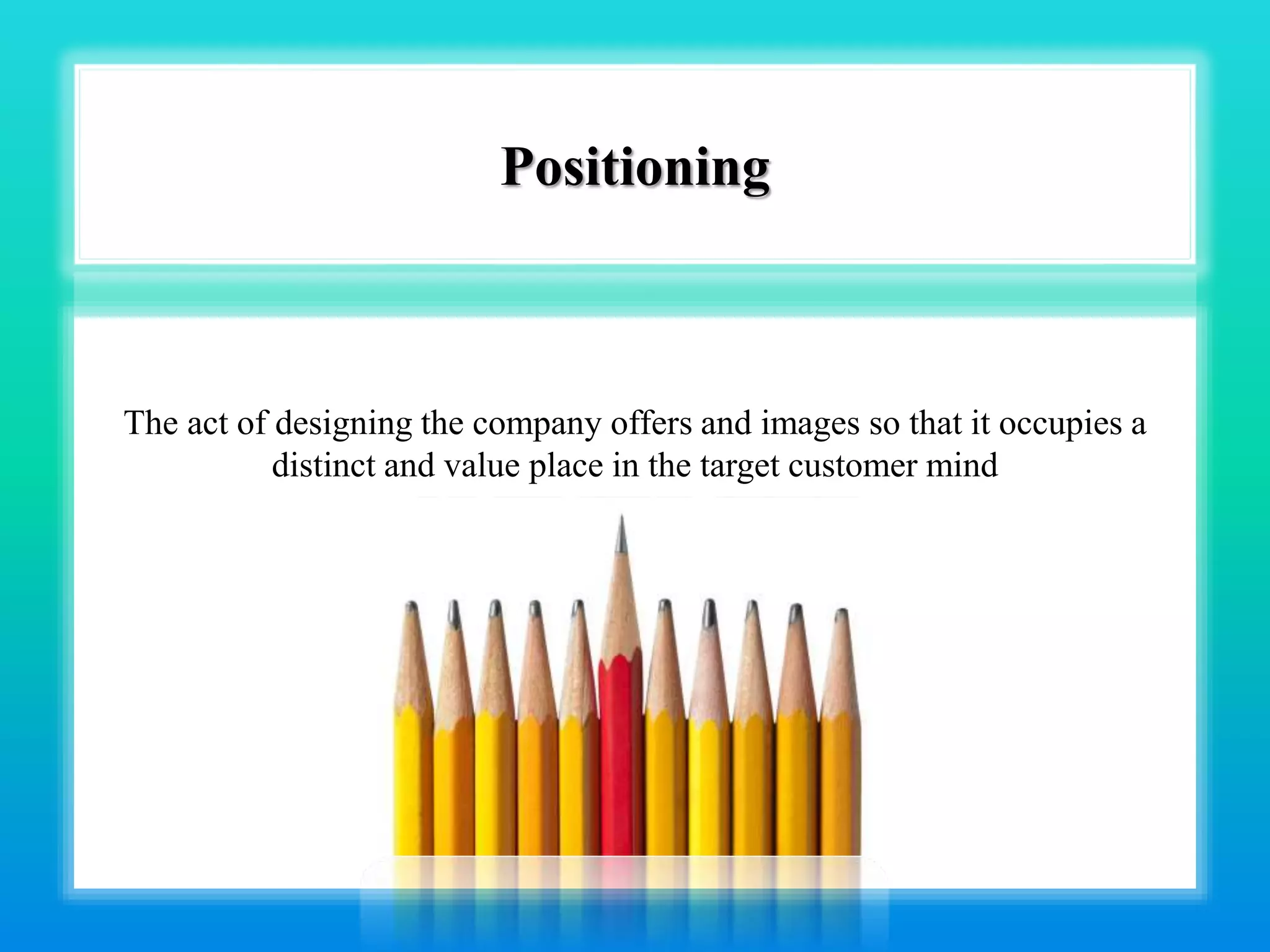
The act of designing the company offers and images so that it occupies a
distinct and value place in the target customer mind
Positioning (Cont.)
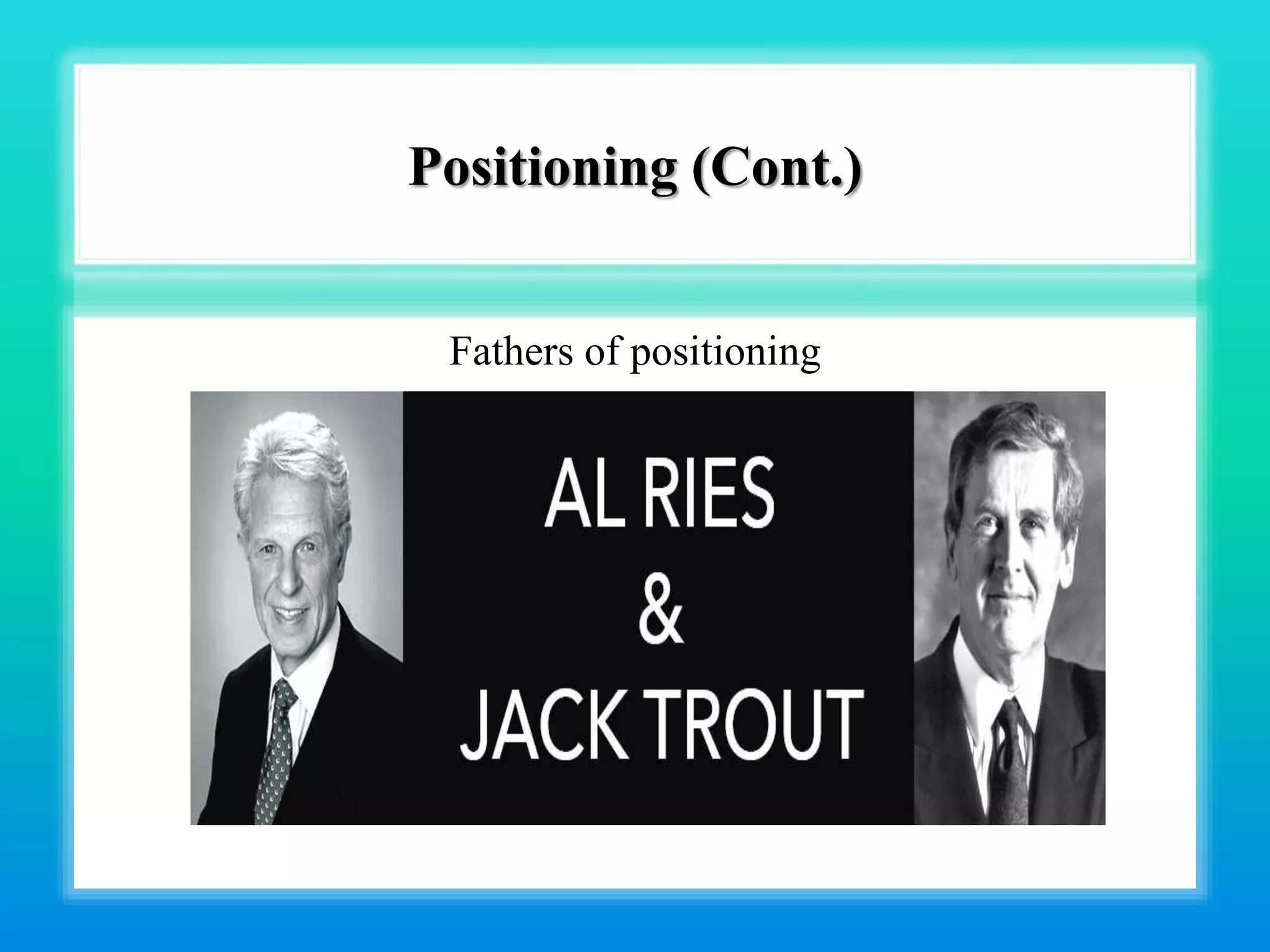
Fathers of positioning
Positioning (Cont.)
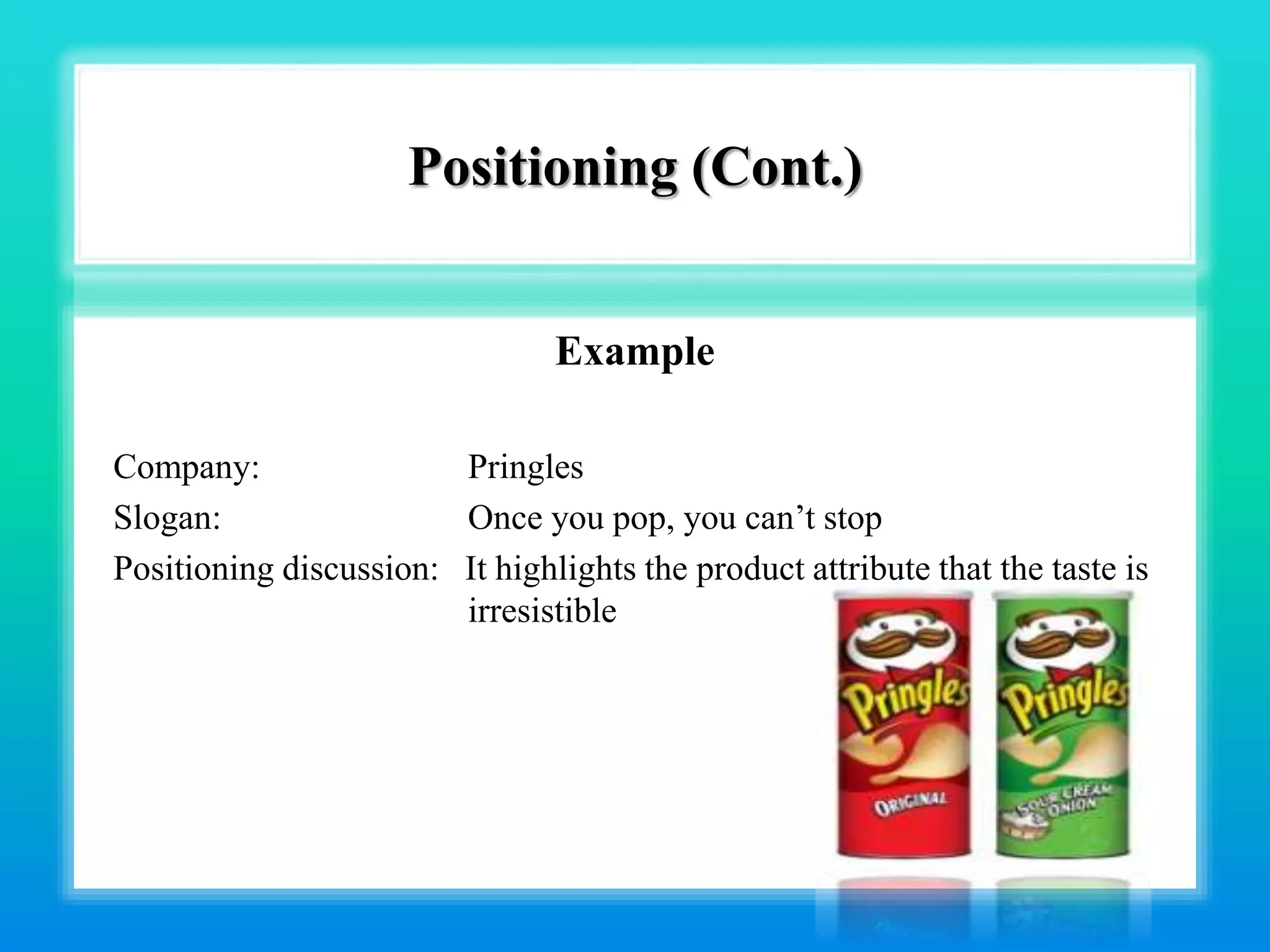
Example
Company: Pringles
Slogan: Once you pop, you can’t stop
Positioning discussion: It highlights the product attribute that the taste is
irresistible
Positioning (Cont.)
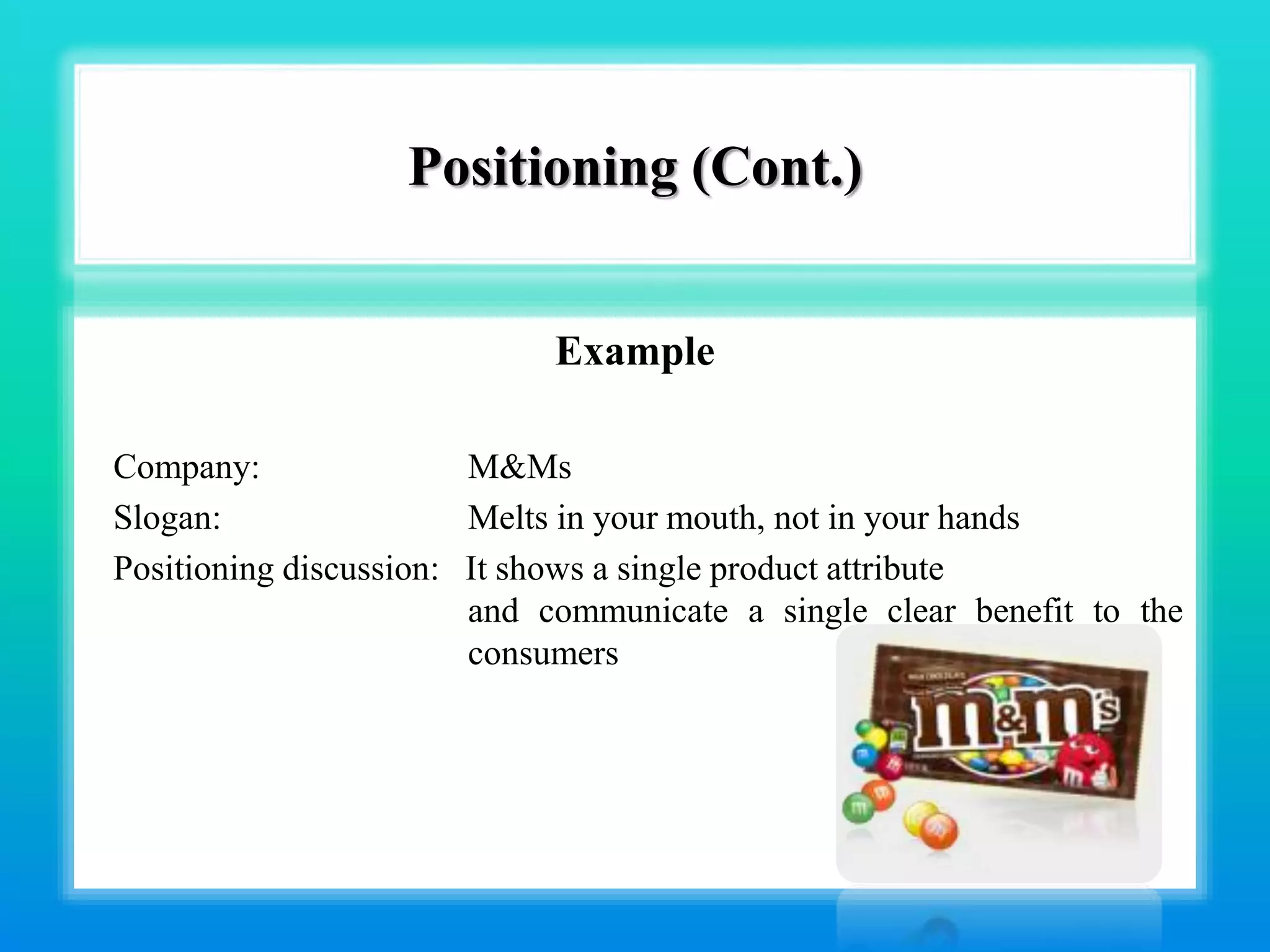
Example
Company: M&Ms
Slogan: Melts in your mouth, not in your hands
Positioning discussion: It shows a single product attribute
and communicate a single clear benefit to the
consumers
Concept of positioning
Two Dimensions:
1. What organization wishes to achieve or how it wants its products to be viewed by
consumer?
2. What consumers actually believe about a particular product or service?
Strategies for positioning
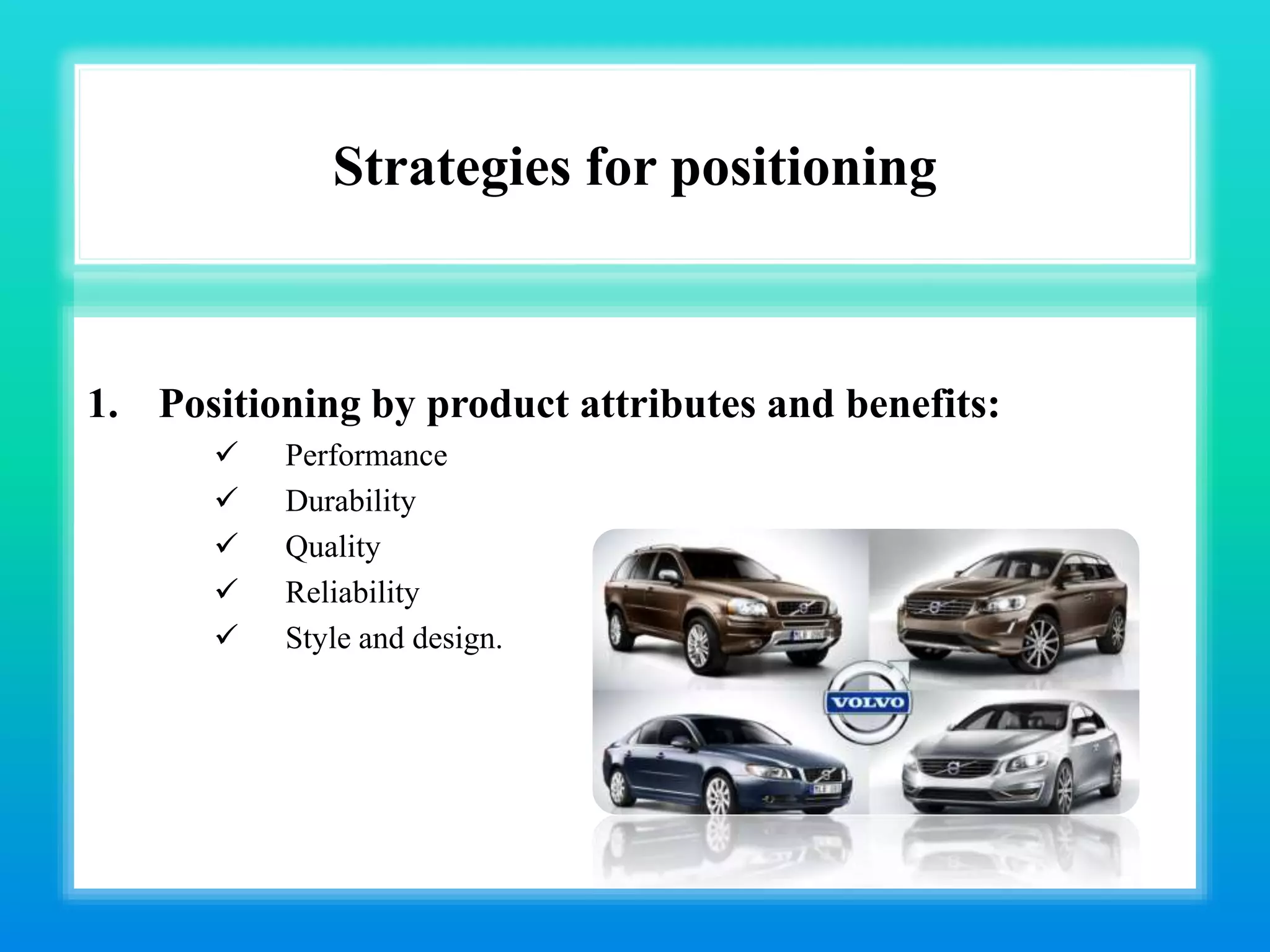
1. Positioning by product attributes and benefits:
 Performance
 Durability
 Quality
 Reliability
 Style and design.
Strategies for positioning (Cont.)
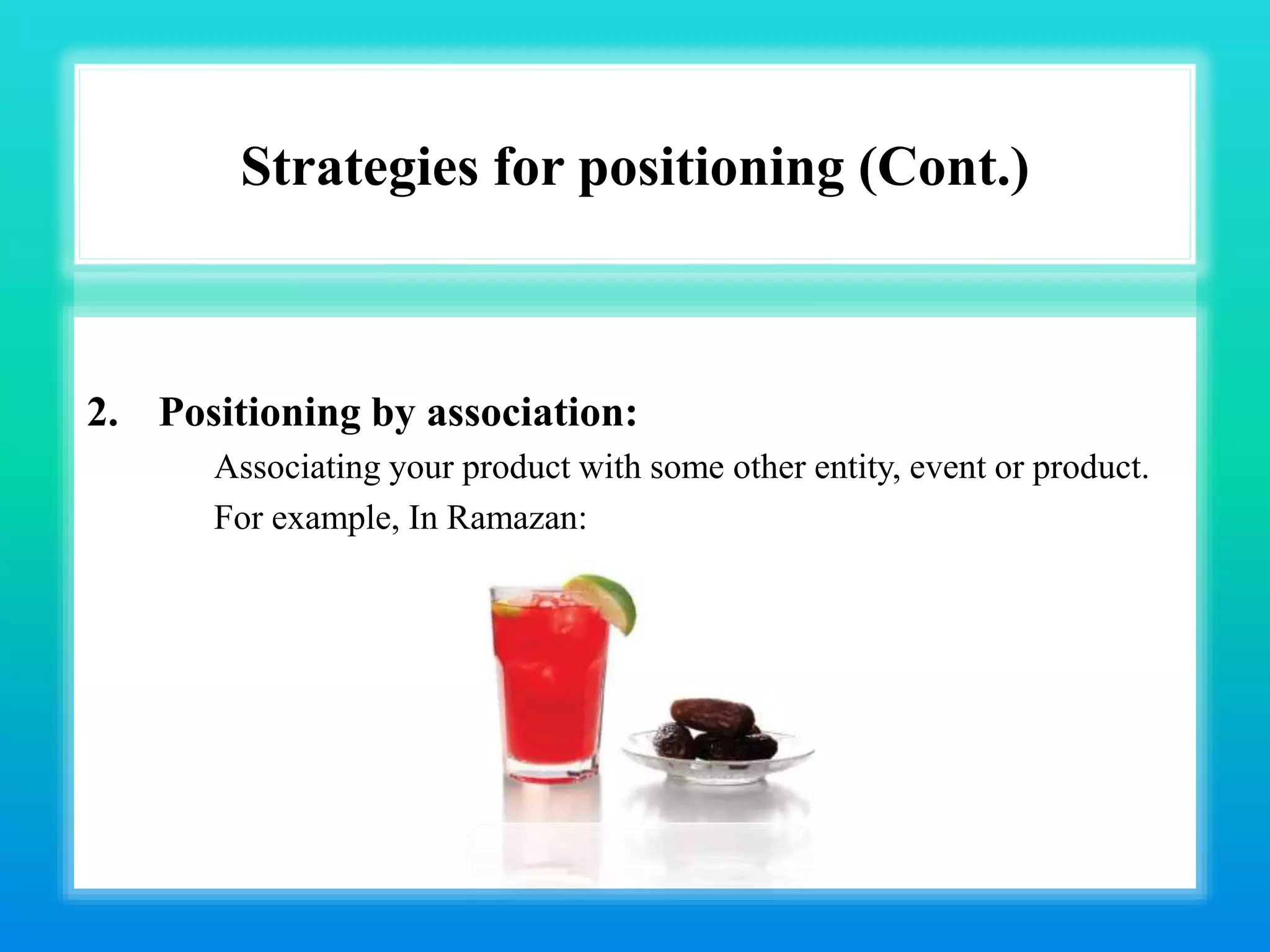
2. Positioning by association:
Associating your product with some other entity, event or product.
For example, In Ramazan:
Strategies for positioning (Cont.)
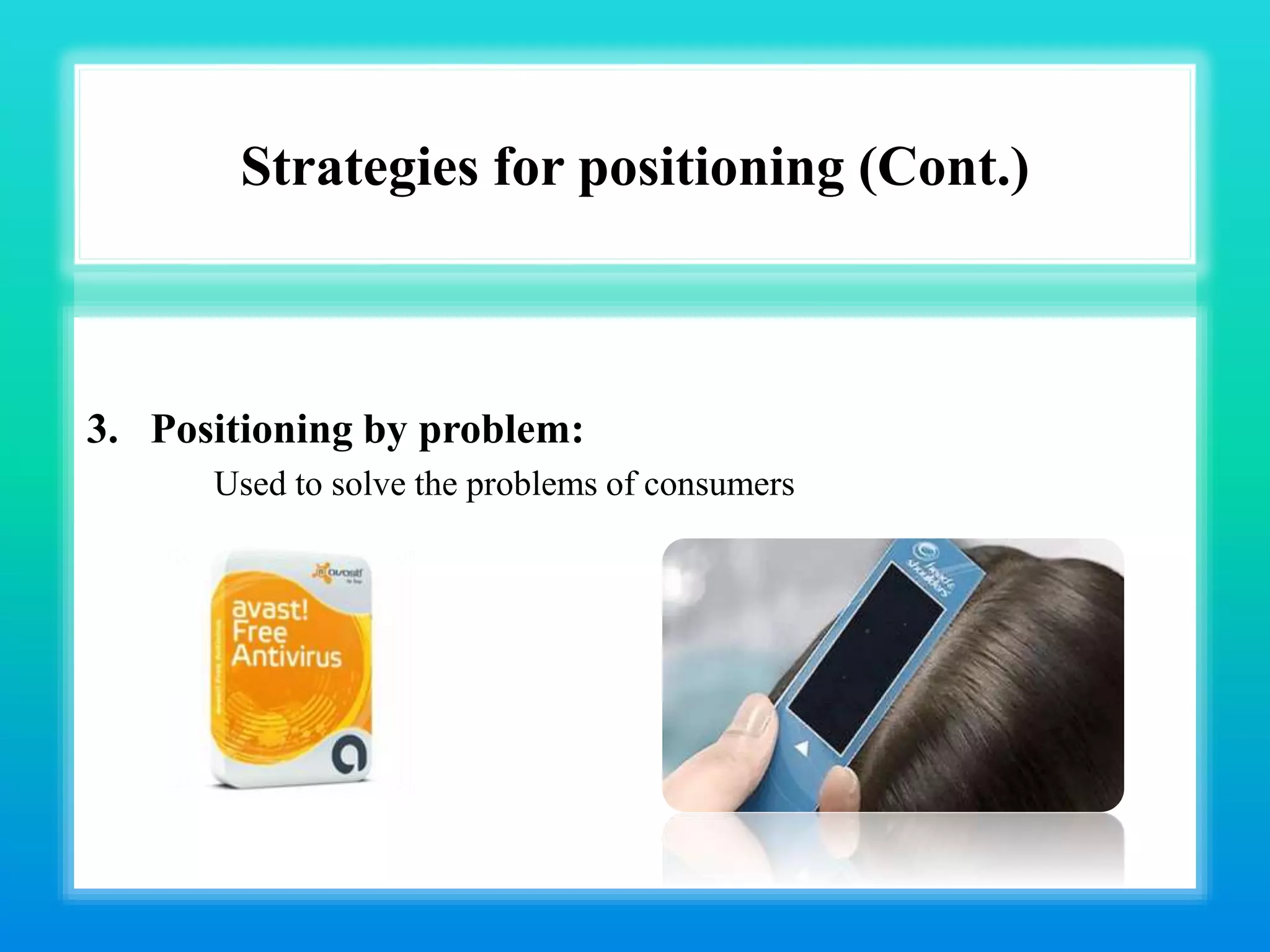
3. Positioning by problem:
Used to solve the problems of consumers
Strategies for positioning (Cont.)
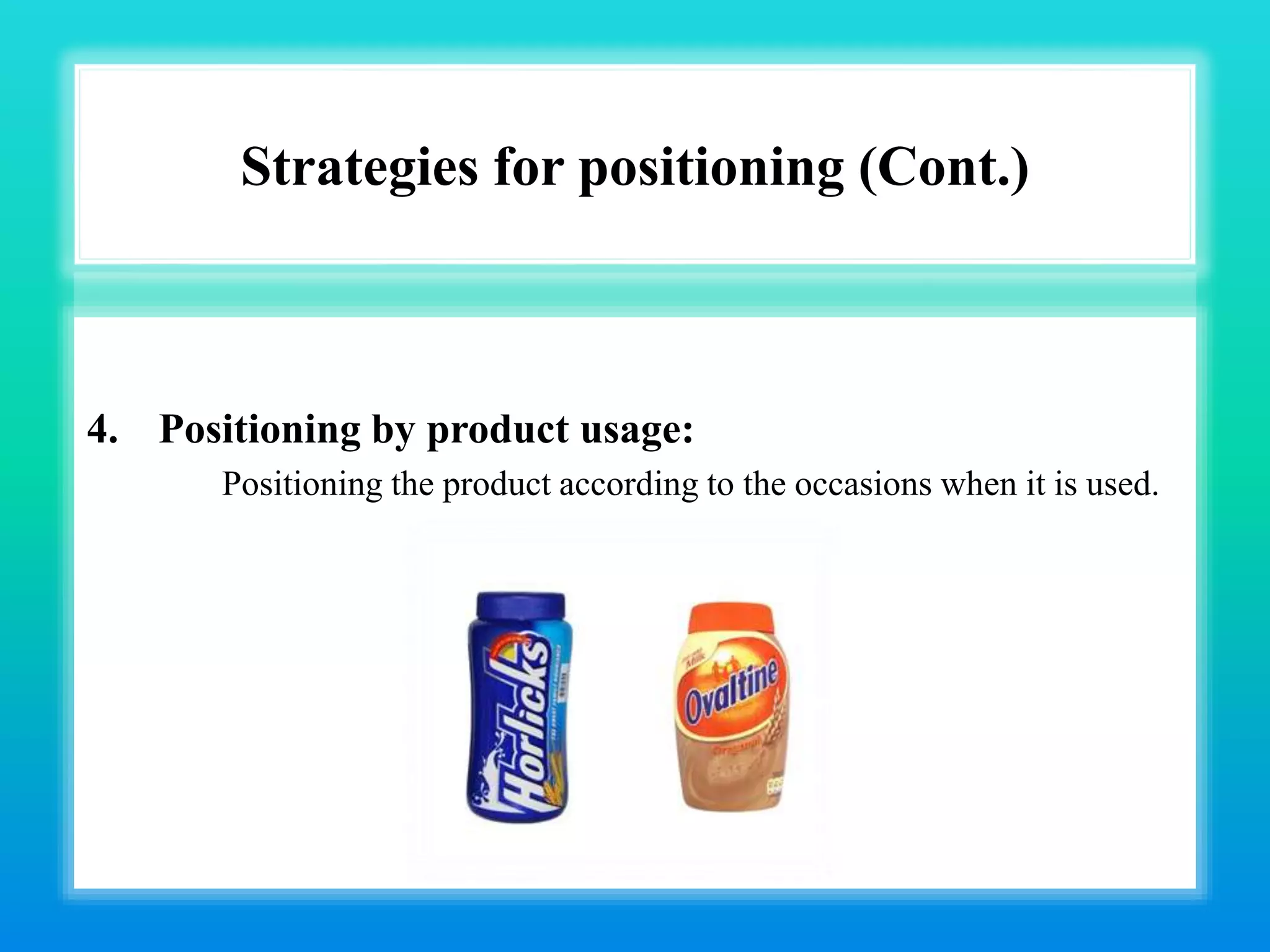
4. Positioning by product usage:
Positioning the product according to the occasions when it is used.
Strategies for positioning (Cont.)
5. Positioning by Competitors:
Uses the same of similar positioning strategies as used by the
competitors
Strategies for positioning (Cont.)
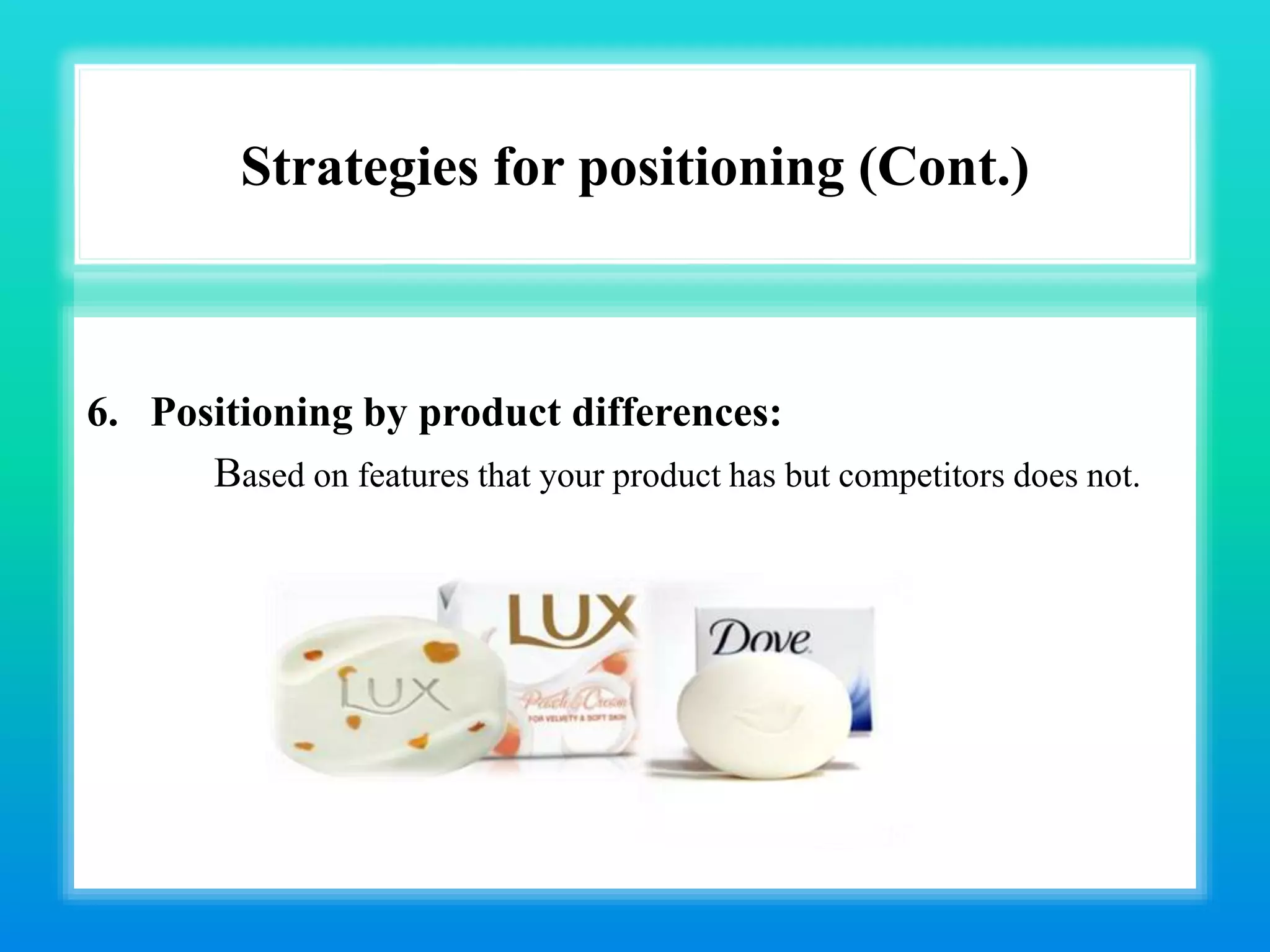
6. Positioning by product differences:
Based on features that your product has but competitors does not.
Differentiating the product
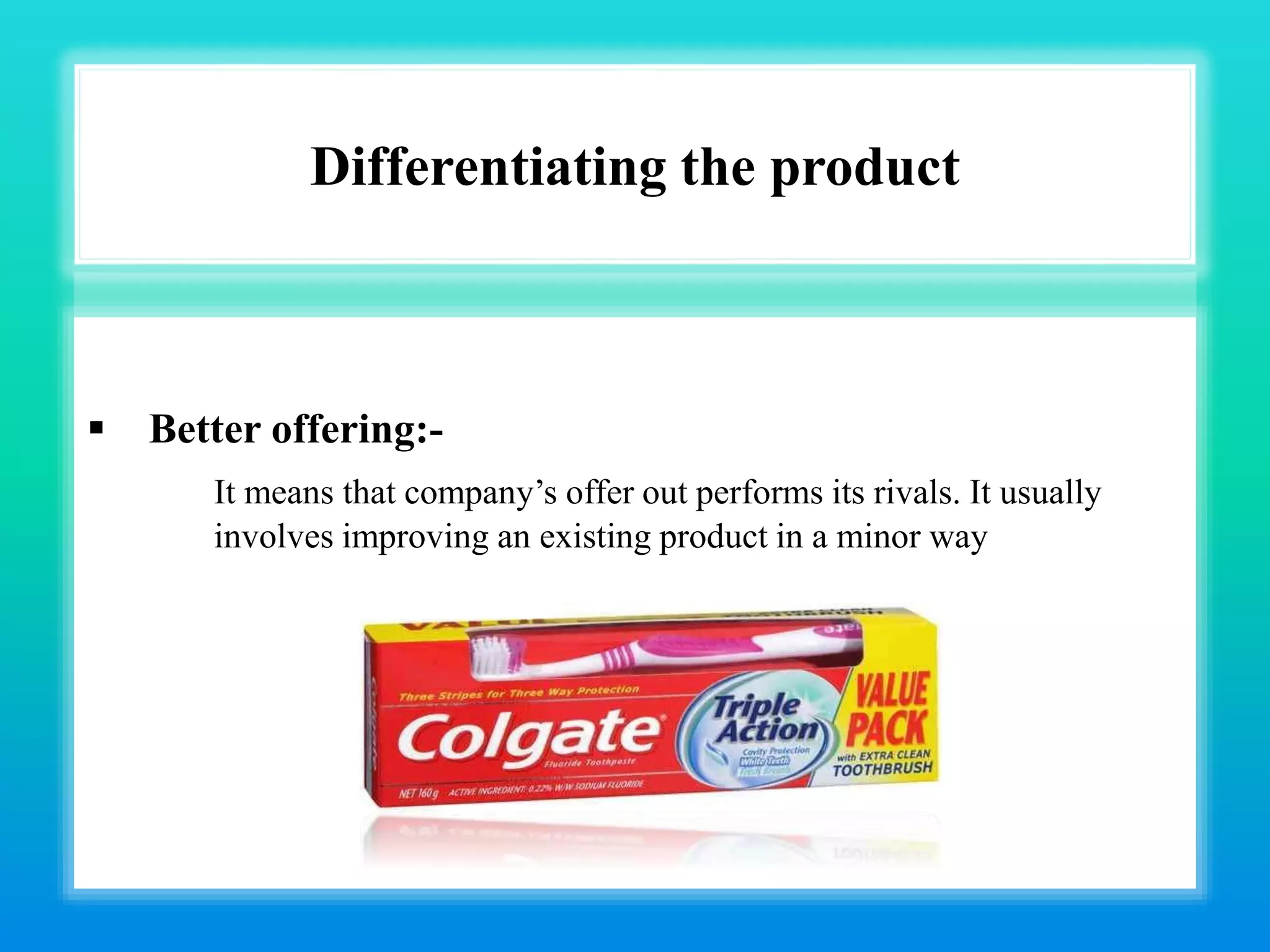
 Better offering:-
It means that company’s offer out performs its rivals. It usually
involves improving an existing product in a minor way
Differentiating the product (cont.)
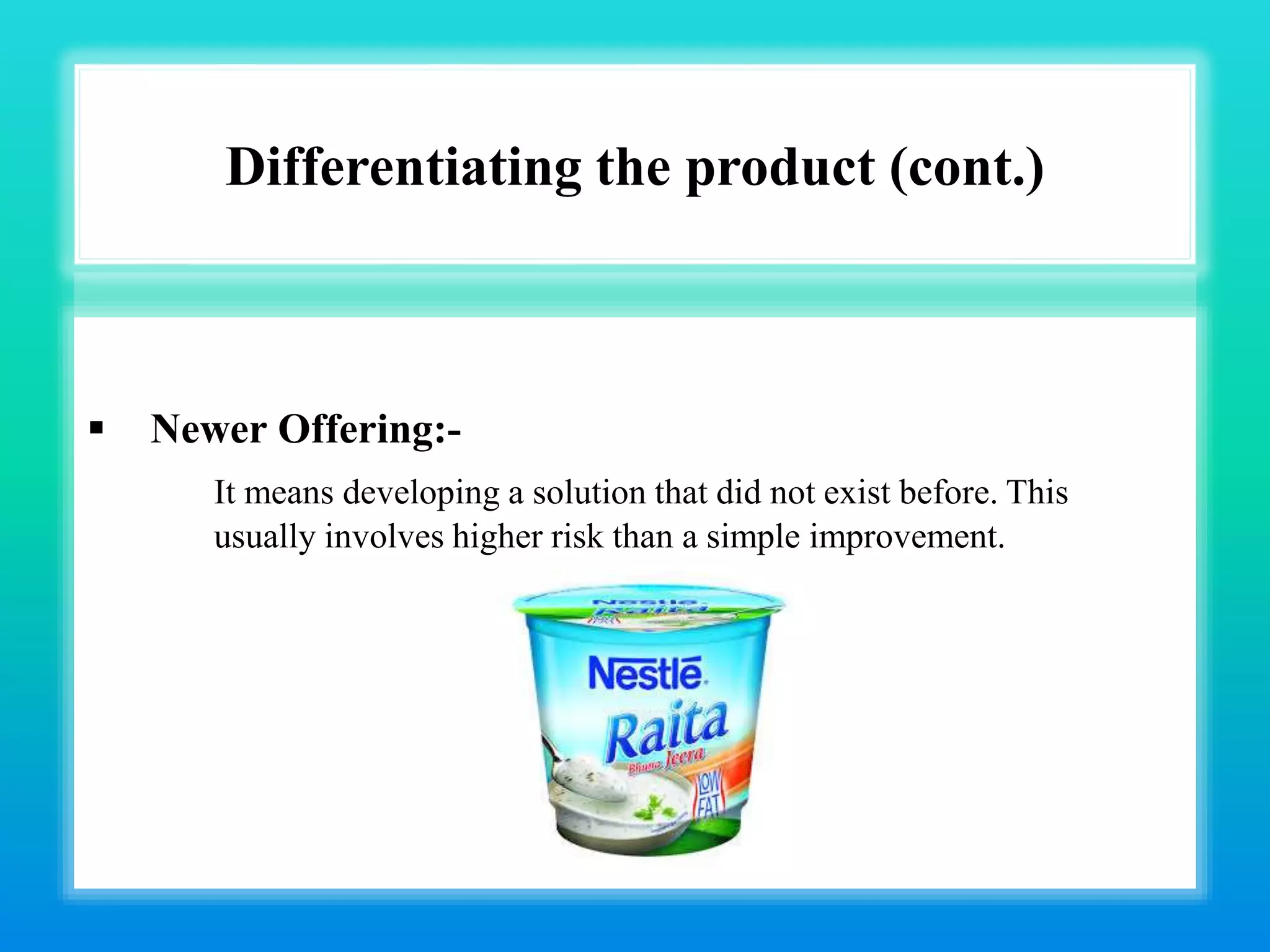
 Newer Offering:-
It means developing a solution that did not exist before. This
usually involves higher risk than a simple improvement.
Differentiating the product (cont.)
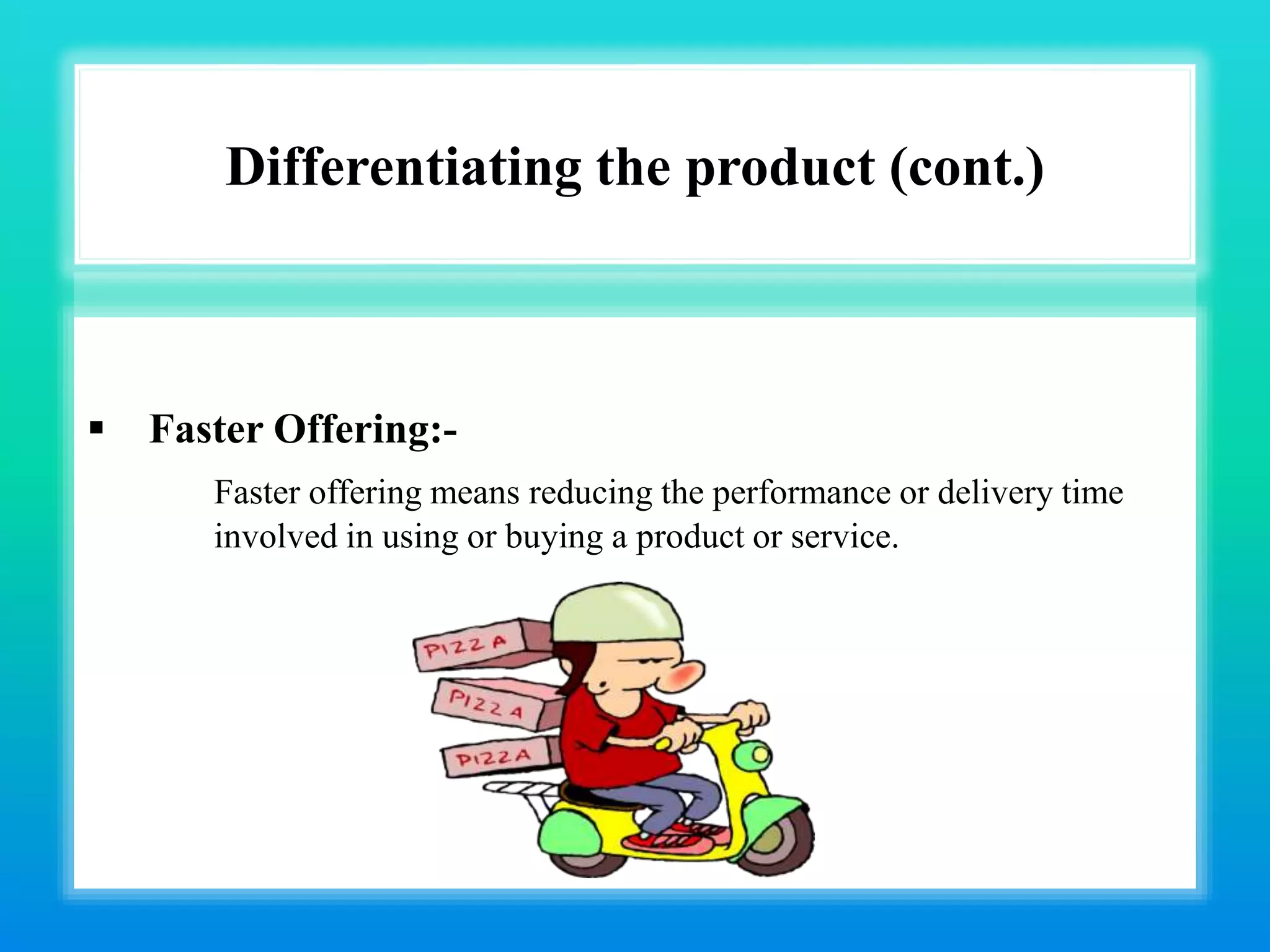
 Faster Offering:-
Faster offering means reducing the performance or delivery time
involved in using or buying a product or service.
Differentiating the product (cont.)
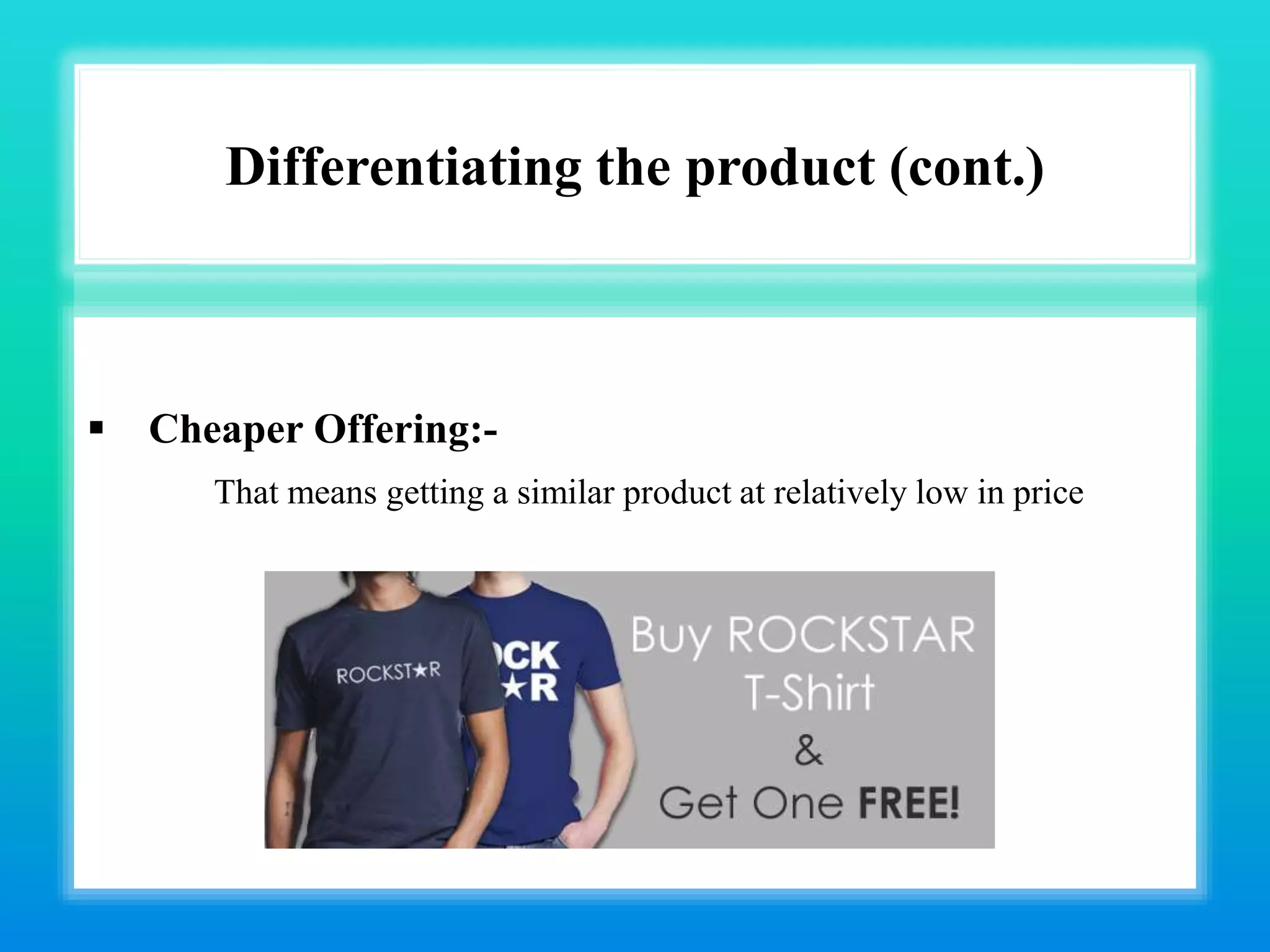
 Cheaper Offering:-
That means getting a similar product at relatively low in price
Steps of Product positioning
i. Define market segments
ii. Determine which segments to target
iii. Understand targeted customers' needs /expectations /priorities
iv. Develop (or modify) product/service to address these needs
v. Evaluate perceived positioning of competitors' products/ services/ brands
vi. Select positioning bases (criteria) for product/service with targeted customers' needs and
competitors' position in the market
vii. Communicate the selected positioning/ image/ proposition to the targeted customer
Criteria for successful positioning
 Clarity:
The value proposition which they are going to serve to target
consumers must be clear and easily understandable.
To be the family friendly low cost restaurant in the fast food business
Criteria for successful positioning (cont.)
 Consistency:
Using the same, carefully crafted message strategy in all of your
marketing communication which is easier to deliver the same message
across all marketing media
Soon there will be 2 kinds of people.
Those who use computers, and those
who use Apples.(1980s)
Think Different (1997)
Criteria for successful positioning (cont.)
 Credibility:
It shows the believability and trustworthiness in your message
For drivers who value auto performance, BMW provides luxury vehicle
that deliver joy through German engineering
Criteria for successful positioning (cont.)
 Competitiveness:
Any successful market position is dependent on having a
distinctive value proposition which is not being offered by the
competitors.
Errors in positioning
Basically two errors:
 Under positioning
 Over positioning
Errors in positioning (cont.)
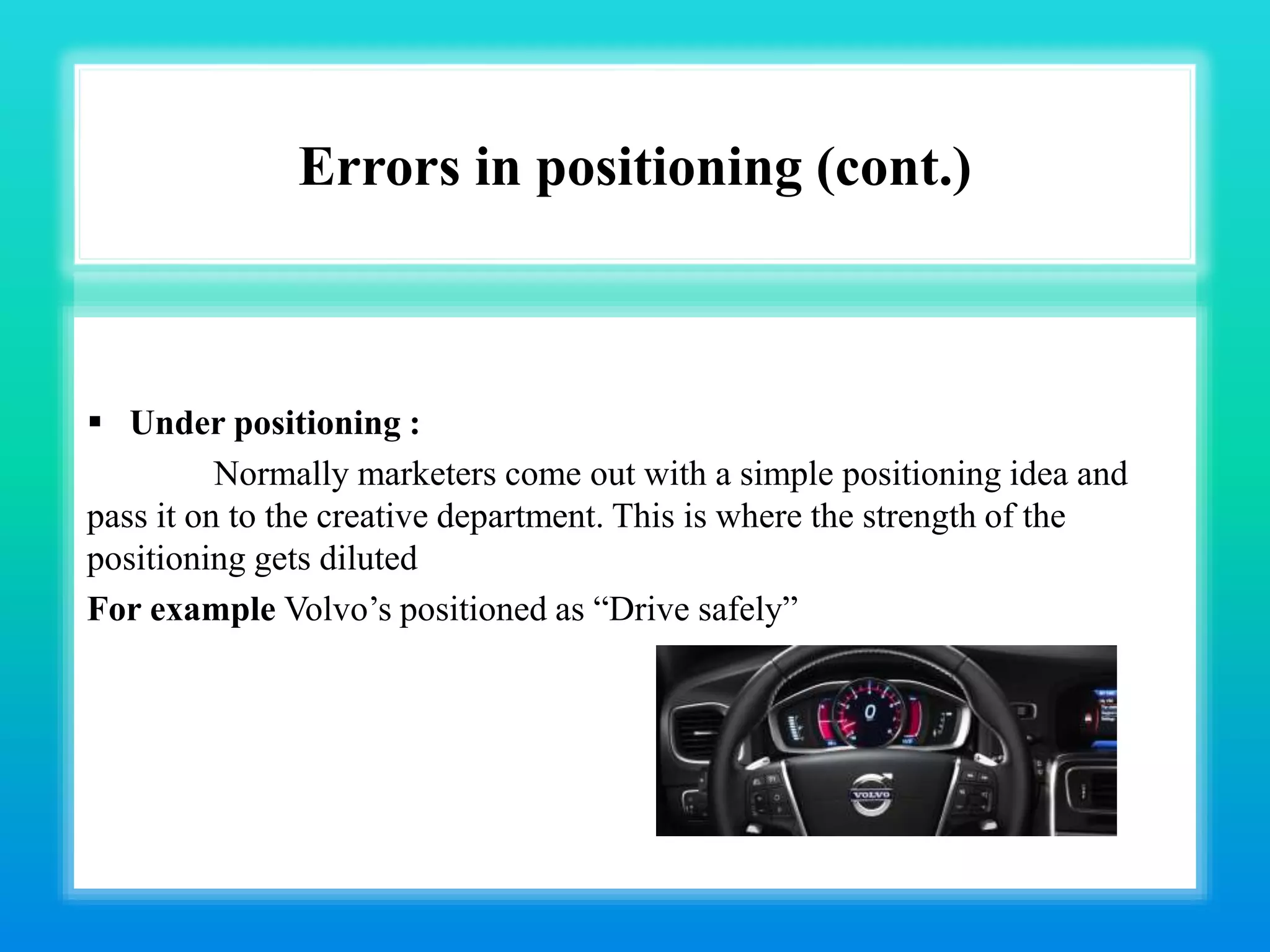
 Under positioning :
Normally marketers come out with a simple positioning idea and
pass it on to the creative department. This is where the strength of the
positioning gets diluted
For example Volvo’s positioned as “Drive safely”
Errors in positioning (cont.)
 Over positioning :
In this situation where the firm initially promotes its brand as a
premium brand.
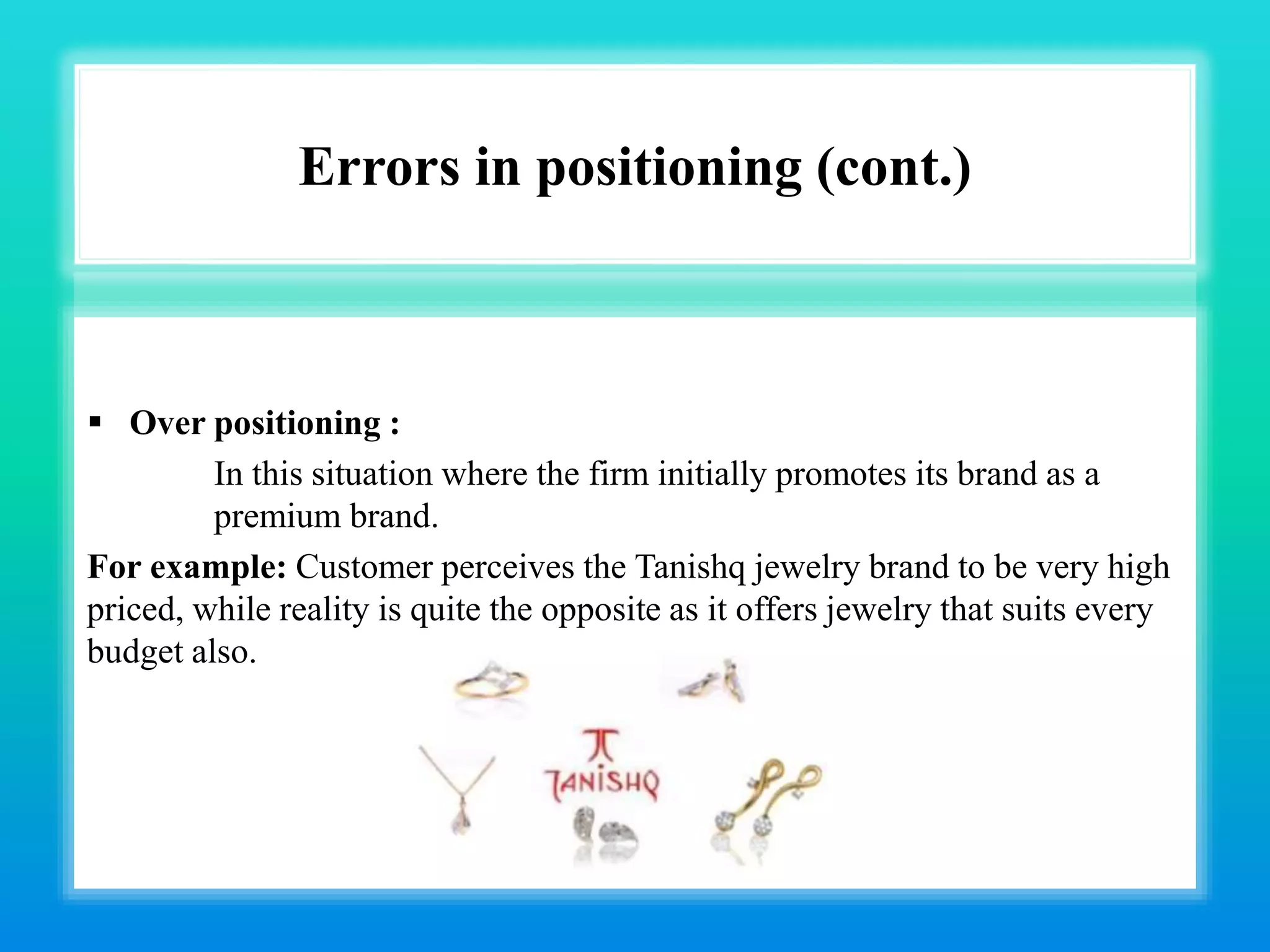
For example: Customer perceives the Tanishq jewelry brand to be very high
priced, while reality is quite the opposite as it offers jewelry that suits every
budget also.
Conclusion
Positioning is to connect product offering with target market
which provide the competitive advantage and also better serving
and covering the market.
Thank You
Any Question?

Topic: Positioning | Course: Marketing Management | BBA 4th semester

  • 1.
  • 2.
    Contents  Positioning  Conceptof positioning  Strategies for positioning  Differentiating the product  Steps of positioning  Criteria for successful positioning  Errors in positioning  Conclusion
  • 3.
    Positioning The act ofdesigning the company offers and images so that it occupies a distinct and value place in the target customer mind
  • 4.
  • 5.
    Positioning (Cont.) Example Company: Pringles Slogan:Once you pop, you can’t stop Positioning discussion: It highlights the product attribute that the taste is irresistible
  • 6.
    Positioning (Cont.) Example Company: M&Ms Slogan:Melts in your mouth, not in your hands Positioning discussion: It shows a single product attribute and communicate a single clear benefit to the consumers
  • 7.
    Concept of positioning TwoDimensions: 1. What organization wishes to achieve or how it wants its products to be viewed by consumer? 2. What consumers actually believe about a particular product or service?
  • 8.
    Strategies for positioning 1.Positioning by product attributes and benefits:  Performance  Durability  Quality  Reliability  Style and design.
  • 9.
    Strategies for positioning(Cont.) 2. Positioning by association: Associating your product with some other entity, event or product. For example, In Ramazan:
  • 10.
    Strategies for positioning(Cont.) 3. Positioning by problem: Used to solve the problems of consumers
  • 11.
    Strategies for positioning(Cont.) 4. Positioning by product usage: Positioning the product according to the occasions when it is used.
  • 12.
    Strategies for positioning(Cont.) 5. Positioning by Competitors: Uses the same of similar positioning strategies as used by the competitors
  • 13.
    Strategies for positioning(Cont.) 6. Positioning by product differences: Based on features that your product has but competitors does not.
  • 14.
    Differentiating the product Better offering:- It means that company’s offer out performs its rivals. It usually involves improving an existing product in a minor way
  • 15.
    Differentiating the product(cont.)  Newer Offering:- It means developing a solution that did not exist before. This usually involves higher risk than a simple improvement.
  • 16.
    Differentiating the product(cont.)  Faster Offering:- Faster offering means reducing the performance or delivery time involved in using or buying a product or service.
  • 17.
    Differentiating the product(cont.)  Cheaper Offering:- That means getting a similar product at relatively low in price
  • 18.
    Steps of Productpositioning i. Define market segments ii. Determine which segments to target iii. Understand targeted customers' needs /expectations /priorities iv. Develop (or modify) product/service to address these needs v. Evaluate perceived positioning of competitors' products/ services/ brands vi. Select positioning bases (criteria) for product/service with targeted customers' needs and competitors' position in the market vii. Communicate the selected positioning/ image/ proposition to the targeted customer
  • 19.
    Criteria for successfulpositioning  Clarity: The value proposition which they are going to serve to target consumers must be clear and easily understandable. To be the family friendly low cost restaurant in the fast food business
  • 20.
    Criteria for successfulpositioning (cont.)  Consistency: Using the same, carefully crafted message strategy in all of your marketing communication which is easier to deliver the same message across all marketing media Soon there will be 2 kinds of people. Those who use computers, and those who use Apples.(1980s) Think Different (1997)
  • 21.
    Criteria for successfulpositioning (cont.)  Credibility: It shows the believability and trustworthiness in your message For drivers who value auto performance, BMW provides luxury vehicle that deliver joy through German engineering
  • 22.
    Criteria for successfulpositioning (cont.)  Competitiveness: Any successful market position is dependent on having a distinctive value proposition which is not being offered by the competitors.
  • 23.
    Errors in positioning Basicallytwo errors:  Under positioning  Over positioning
  • 24.
    Errors in positioning(cont.)  Under positioning : Normally marketers come out with a simple positioning idea and pass it on to the creative department. This is where the strength of the positioning gets diluted For example Volvo’s positioned as “Drive safely”
  • 25.
    Errors in positioning(cont.)  Over positioning : In this situation where the firm initially promotes its brand as a premium brand. For example: Customer perceives the Tanishq jewelry brand to be very high priced, while reality is quite the opposite as it offers jewelry that suits every budget also.
  • 26.
    Conclusion Positioning is toconnect product offering with target market which provide the competitive advantage and also better serving and covering the market.
  • 27.
  • 28.