
CHALLENGES AND OPPORTUNITIES
FACED IN BRAND EXTENSION
ļ‚¢ The history of brand extension can be traced back to the
1960s.
ļ‚¢ It started to get popular in the 1980s, and keeps on
increasing in the 21th century.
ļ‚¢ Brand extension, also named as brand stretching, is using
an established brand name to enter a new product
category
ļ‚¢ Famous failure examples such as Virgin and Miller
provide learning experience in real cases.
ļ‚¢ In a word, it is very important for managers to know how
to reduce the risk of brand extension in order to achieve
success.
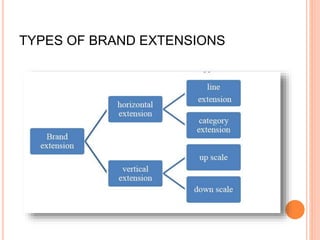
CLASSIFICATION
ļ‚¢ (Aaker, 1991; Keller, 1993; Peter, 1989),
some of them hold the opinion that brand
extension can be broadly classified into two
general categories
ļ‚— Vertical extension
ļ‚— Horizontal extension
ļ‚¢Horizontal extension includes
ļ‚¢Line extension
ļ‚¢Category extension
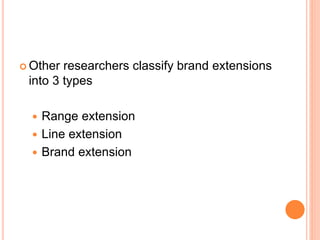
ļ‚¢ Other researchers classify brand extensions
into 3 types
ļ‚— Range extension
ļ‚— Line extension
ļ‚— Brand extension
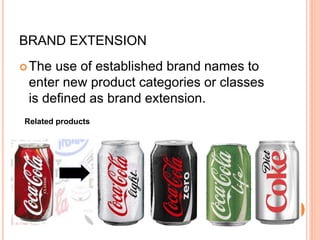
BRAND EXTENSION
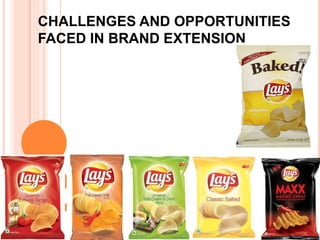
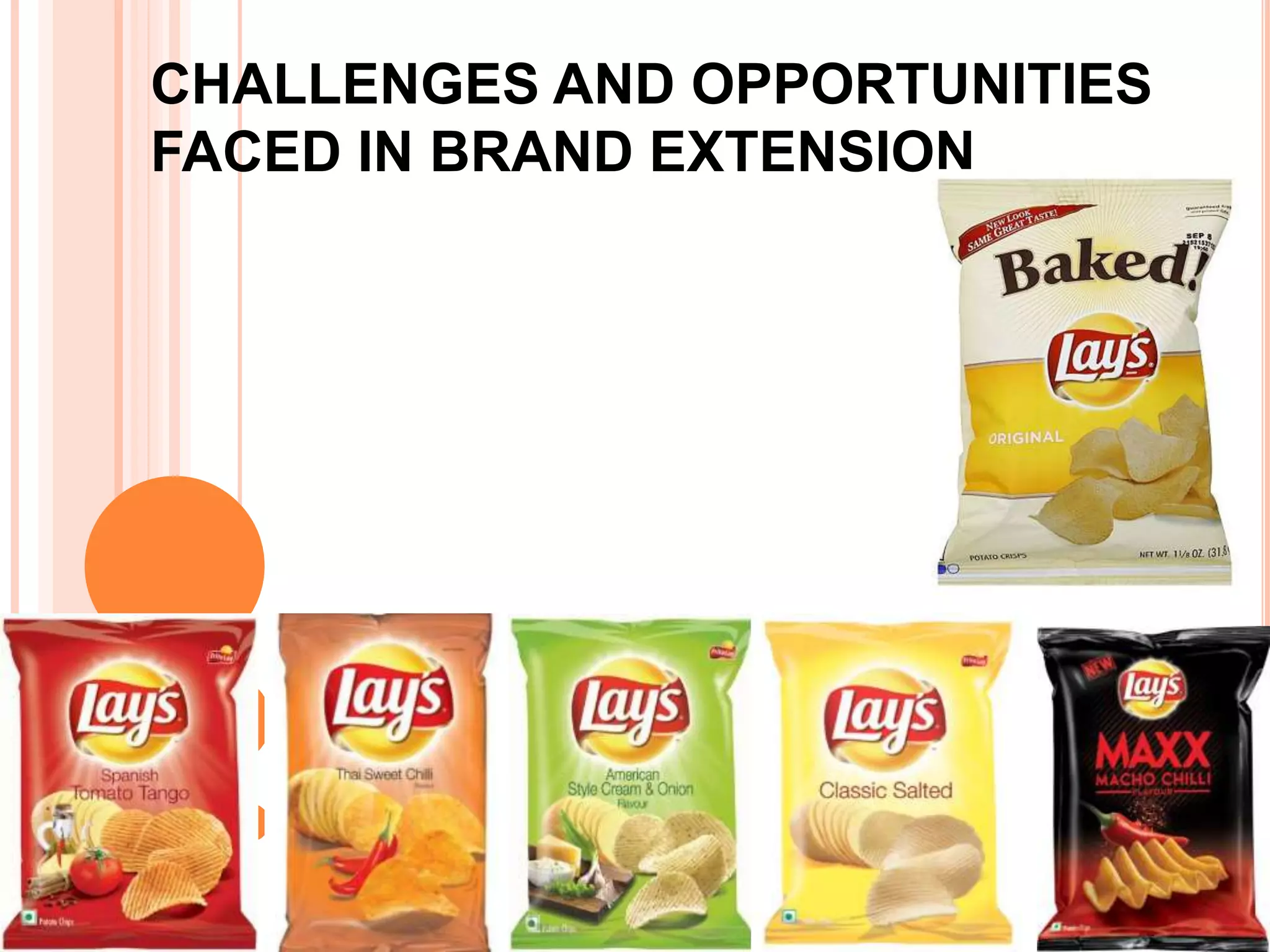
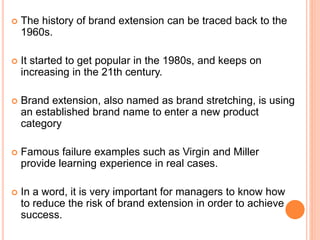
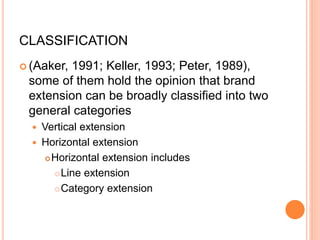
ļ‚¢The use of established brand names to
enter new product categories or classes
is defined as brand extension.
Related products
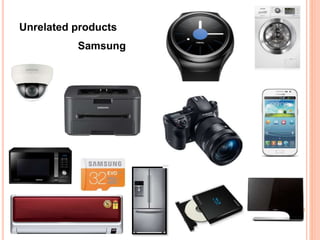
Unrelated products
Samsung
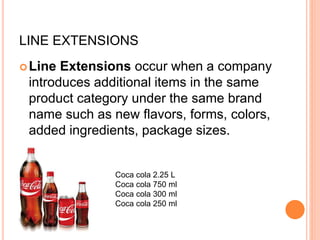
LINE EXTENSIONS
ļ‚¢Line Extensions occur when a company
introduces additional items in the same
product category under the same brand
name such as new flavors, forms, colors,
added ingredients, package sizes.
Coca cola 2.25 L
Coca cola 750 ml
Coca cola 300 ml
Coca cola 250 ml
ļ‚¢ Obviously, using an existing brand name can
substantially reduce the risk of introducing new product
and thus enhance the opportunity of fast profit growing.
ļ‚¢ According to Byron (1993), the reason why brand
extension is so popular is because
ļ‚— It can create growth in the cost leading competition,
ļ‚— Redefine a new direction of a business or firm
ļ‚— Gain economic scale in advertising
ļ‚— Introduce new products without advertising
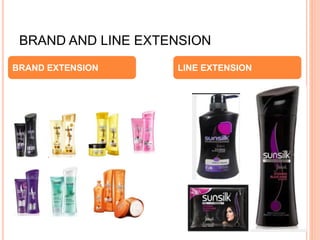
BRAND AND LINE EXTENSION
BRAND EXTENSION LINE EXTENSION
TYPES OF BRAND EXTENSIONS
HORIZONTAL EXTENSION
ļ‚¢ Horizontal extension includes line extension and
category extension (Peter, 1989).
ļ‚— In line extension, however, the parent brand is used to
introduce a new product within a product category
currently served by the parent brand.
ļ‚— In category extension, the parent brand is used to enter
a different product category from what currently served
by the parent brand.
VERTICAL EXTENSION
ļ‚¢ Vertical extension is defined as introducing a similar
brand to the same product category while being
different in quality and price
ļ‚¢ Additionally vertical brand extension can be divided
into
ļ‚— Up-scale
ļ‚¢ Up-scale extension refers to a higher quality and higher price
point as compared to the parent brand.
ļ‚— Down-scale brand extension.
ļ‚¢ Down-scale extension means extending a brand with lower
quality and price.
ADVANTAGES
Well-implemented extension is an easier way to compete with the
competitors.
ļ‚— Reduce the cost of developing a new brand.
ļ‚— Packaging and labeling efficiencies.
ļ‚— Reduce the cost of introductory and follow-up marketing programs.
ļ‚— Brand extension reduces the risk of the new brand.
ļ‚— If parent brand is famous and brand extension is applied, the new
product can earn market share and customers more easily with the
help parent’s reputation.
DISADVANTAGES
Aaker (1990) has pointed out that brand extension may bring serious
damage to company’s original products and result in a decrease in
growth.
ļ‚— It can hurt parent brand’s image.
ļ‚— Encounter retailer resistance as well.
ļ‚— An inappropriate brand extension could create damaging associations
that may be very difficult for a company to overcome.
ļ‚— The probability of success is uncertain and unpredictable.
ļ‚— A wide selection of extensions confuses consumers.
ļ‚— It will reduce the parent brand’s original image, consumers’ loyalty and
brand equity at the same time.
EXAMPLE
ļ‚¢ Take the example of Scott Company.
ļ‚¢ Kleenex was the strongest brand of toilet paper in American
during that time.
ļ‚¢ But the Scott introduced Kleenex facial tissue to the market
what made customers feel strange when using the tissue.
ļ‚¢ Famous American advertisement science expert, Al Ries, even
commented on the product as: Kleenex toilet paper and
Kleenex tissue, which one is for nose?
ļ‚¢ Later on, Procter & Gamble’s product, Charmin toilet paper
took place of Scott in the toilet paper.
ļ‚¢ For a new product, there will be a strong restriction
regarding the positioning.
ļ‚¢ The positioning of the new product should be close
to the parent brand to realize synergy effects,
otherwise, risks might appear.
BRAND EQUITY
ļ‚¢ Branding is all about creating differences.
ļ‚¢ Aaker (1991) defines brand equity as a set of brand
assets and liabilities linked to a brand, its name and
symbol, which add to or subtract from the value
provided by a product or service to a firm and/or that
firm’s customer.
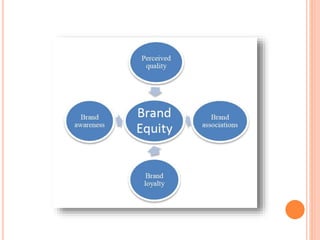
ļ‚¢ There are five categories in Aaker’s brand equity model
ļ‚— Brand loyalty
ļ‚— Brand awareness
ļ‚— Brand associations
ļ‚— Perceived quality and
ļ‚— Other proprietary brand assets.
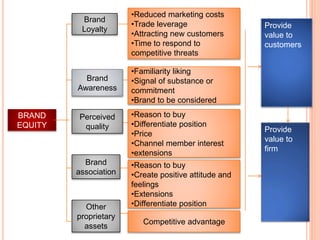
BRAND
EQUITY
Brand
Loyalty
Other
proprietary
assets
Brand
association
•Reduced marketing costs
•Trade leverage
•Attracting new customers
•Time to respond to
competitive threats
•Familiarity liking
•Signal of substance or
commitment
•Brand to be considered
•Reason to buy
•Differentiate position
•Price
•Channel member interest
•extensions
•Reason to buy
•Create positive attitude and
feelings
•Extensions
•Differentiate position
Competitive advantage
Provide
value to
firm
Provide
value to
customers
Brand
Awareness
Perceived
quality
BRAND AWARENESS
ļ‚¢ Brand awareness is defined as the ability of a buyer
to recognize that a brand is a member of a certain
product category.
ļ‚¢ Brand awareness reflects the presence of the brand
in the mind of customers.
ļ‚¢ Aaker argues that consumers in general turn their
attention towards a recognized brand rather than an
unfamiliar brand.
BRAND LOYALTY
ļ‚¢ Loyalty is a core dimension of brand equity which is
a measurement of the attachment that a customer
has to a brand.
ļ‚¢ Number of repeat purchases.
ļ‚¢ Brand loyalty also gives a company some
protection from competition and greater control in
planning their marketing programs.
BRAND ASSOCIATIONS
ļ‚¢ Brand association is defined by Aaker (1991) as
anything linked in memory to a brand. It also refers
to any brand knowledge relating to the brand in the
customer's mind.
ļ‚¢ Keller (1998) noted that brand association can
affect consumers' purchasing decisions based on
the recall of brand information.
ļ‚¢ Three types of brand associations are:
ļ‚— Attributes
ļ‚— Benefits, and
ļ‚— Attitudes
ļ‚¢ Brand attitudes are the consumers’ overall evaluations of
a brand. they often form the basis for actions and
behavior that consumers take with the brand.
ļ‚¢ Brand attitudes can be formed on the basis of benefits
about product-related attributes and functional benefits
and/or beliefs about non-product-related attributes and
symbolic and experiential benefits
PERCEIVED QUALITY
ļ‚¢ Perceived quality refers to the customer's
awareness of products' superior quality in relation
to other products.
ļ‚¢ A product considered of high quality can be
perceived by the consumer as poor quality
depending upon the consumer’s expectations of the
product and vice versa
THANK YOU
Deciding what not to do is as important as deciding what
to do.
Steve Jobs
THE CASE
Kindly solve both the cases on three categories
of Aakers Brand equity model
Those are…
1. Brand awareness
2. Brand loyalty
3. Brand perceived quality
Continued…

Challenges & opprtunities in brand extensions

  • 1.
  • 2.
    ļ‚¢ The historyof brand extension can be traced back to the 1960s. ļ‚¢ It started to get popular in the 1980s, and keeps on increasing in the 21th century. ļ‚¢ Brand extension, also named as brand stretching, is using an established brand name to enter a new product category ļ‚¢ Famous failure examples such as Virgin and Miller provide learning experience in real cases. ļ‚¢ In a word, it is very important for managers to know how to reduce the risk of brand extension in order to achieve success.
  • 3.
    CLASSIFICATION ļ‚¢ (Aaker, 1991;Keller, 1993; Peter, 1989), some of them hold the opinion that brand extension can be broadly classified into two general categories ļ‚— Vertical extension ļ‚— Horizontal extension ļ‚¢Horizontal extension includes ļ‚¢Line extension ļ‚¢Category extension
  • 4.
    ļ‚¢ Other researchersclassify brand extensions into 3 types ļ‚— Range extension ļ‚— Line extension ļ‚— Brand extension
  • 5.
    BRAND EXTENSION ļ‚¢The useof established brand names to enter new product categories or classes is defined as brand extension. Related products
  • 6.
  • 7.
    LINE EXTENSIONS ļ‚¢Line Extensionsoccur when a company introduces additional items in the same product category under the same brand name such as new flavors, forms, colors, added ingredients, package sizes. Coca cola 2.25 L Coca cola 750 ml Coca cola 300 ml Coca cola 250 ml
  • 8.
    ļ‚¢ Obviously, usingan existing brand name can substantially reduce the risk of introducing new product and thus enhance the opportunity of fast profit growing. ļ‚¢ According to Byron (1993), the reason why brand extension is so popular is because ļ‚— It can create growth in the cost leading competition, ļ‚— Redefine a new direction of a business or firm ļ‚— Gain economic scale in advertising ļ‚— Introduce new products without advertising
  • 9.
    BRAND AND LINEEXTENSION BRAND EXTENSION LINE EXTENSION
  • 10.
    TYPES OF BRANDEXTENSIONS
  • 11.
    HORIZONTAL EXTENSION ļ‚¢ Horizontalextension includes line extension and category extension (Peter, 1989). ļ‚— In line extension, however, the parent brand is used to introduce a new product within a product category currently served by the parent brand. ļ‚— In category extension, the parent brand is used to enter a different product category from what currently served by the parent brand.
  • 12.
    VERTICAL EXTENSION ļ‚¢ Verticalextension is defined as introducing a similar brand to the same product category while being different in quality and price ļ‚¢ Additionally vertical brand extension can be divided into ļ‚— Up-scale ļ‚¢ Up-scale extension refers to a higher quality and higher price point as compared to the parent brand. ļ‚— Down-scale brand extension. ļ‚¢ Down-scale extension means extending a brand with lower quality and price.
  • 13.
    ADVANTAGES Well-implemented extension isan easier way to compete with the competitors. ļ‚— Reduce the cost of developing a new brand. ļ‚— Packaging and labeling efficiencies. ļ‚— Reduce the cost of introductory and follow-up marketing programs. ļ‚— Brand extension reduces the risk of the new brand. ļ‚— If parent brand is famous and brand extension is applied, the new product can earn market share and customers more easily with the help parent’s reputation.
  • 14.
    DISADVANTAGES Aaker (1990) haspointed out that brand extension may bring serious damage to company’s original products and result in a decrease in growth. ļ‚— It can hurt parent brand’s image. ļ‚— Encounter retailer resistance as well. ļ‚— An inappropriate brand extension could create damaging associations that may be very difficult for a company to overcome. ļ‚— The probability of success is uncertain and unpredictable. ļ‚— A wide selection of extensions confuses consumers. ļ‚— It will reduce the parent brand’s original image, consumers’ loyalty and brand equity at the same time.
  • 15.
    EXAMPLE ļ‚¢ Take theexample of Scott Company. ļ‚¢ Kleenex was the strongest brand of toilet paper in American during that time. ļ‚¢ But the Scott introduced Kleenex facial tissue to the market what made customers feel strange when using the tissue. ļ‚¢ Famous American advertisement science expert, Al Ries, even commented on the product as: Kleenex toilet paper and Kleenex tissue, which one is for nose? ļ‚¢ Later on, Procter & Gamble’s product, Charmin toilet paper took place of Scott in the toilet paper.
  • 16.
    ļ‚¢ For anew product, there will be a strong restriction regarding the positioning. ļ‚¢ The positioning of the new product should be close to the parent brand to realize synergy effects, otherwise, risks might appear.
  • 17.
    BRAND EQUITY ļ‚¢ Brandingis all about creating differences. ļ‚¢ Aaker (1991) defines brand equity as a set of brand assets and liabilities linked to a brand, its name and symbol, which add to or subtract from the value provided by a product or service to a firm and/or that firm’s customer. ļ‚¢ There are five categories in Aaker’s brand equity model ļ‚— Brand loyalty ļ‚— Brand awareness ļ‚— Brand associations ļ‚— Perceived quality and ļ‚— Other proprietary brand assets.
  • 18.
    BRAND EQUITY Brand Loyalty Other proprietary assets Brand association •Reduced marketing costs •Tradeleverage •Attracting new customers •Time to respond to competitive threats •Familiarity liking •Signal of substance or commitment •Brand to be considered •Reason to buy •Differentiate position •Price •Channel member interest •extensions •Reason to buy •Create positive attitude and feelings •Extensions •Differentiate position Competitive advantage Provide value to firm Provide value to customers Brand Awareness Perceived quality
  • 20.
    BRAND AWARENESS ļ‚¢ Brandawareness is defined as the ability of a buyer to recognize that a brand is a member of a certain product category. ļ‚¢ Brand awareness reflects the presence of the brand in the mind of customers. ļ‚¢ Aaker argues that consumers in general turn their attention towards a recognized brand rather than an unfamiliar brand.
  • 21.
    BRAND LOYALTY ļ‚¢ Loyaltyis a core dimension of brand equity which is a measurement of the attachment that a customer has to a brand. ļ‚¢ Number of repeat purchases. ļ‚¢ Brand loyalty also gives a company some protection from competition and greater control in planning their marketing programs.
  • 22.
    BRAND ASSOCIATIONS ļ‚¢ Brandassociation is defined by Aaker (1991) as anything linked in memory to a brand. It also refers to any brand knowledge relating to the brand in the customer's mind. ļ‚¢ Keller (1998) noted that brand association can affect consumers' purchasing decisions based on the recall of brand information.
  • 23.
    ļ‚¢ Three typesof brand associations are: ļ‚— Attributes ļ‚— Benefits, and ļ‚— Attitudes ļ‚¢ Brand attitudes are the consumers’ overall evaluations of a brand. they often form the basis for actions and behavior that consumers take with the brand. ļ‚¢ Brand attitudes can be formed on the basis of benefits about product-related attributes and functional benefits and/or beliefs about non-product-related attributes and symbolic and experiential benefits
  • 24.
    PERCEIVED QUALITY ļ‚¢ Perceivedquality refers to the customer's awareness of products' superior quality in relation to other products. ļ‚¢ A product considered of high quality can be perceived by the consumer as poor quality depending upon the consumer’s expectations of the product and vice versa
  • 25.
    THANK YOU Deciding whatnot to do is as important as deciding what to do. Steve Jobs
  • 26.
    THE CASE Kindly solveboth the cases on three categories of Aakers Brand equity model Those are… 1. Brand awareness 2. Brand loyalty 3. Brand perceived quality Continued…

Editor's Notes

  • #6Ā (Keller and Aaker, 1992).
  • #10Ā Perfect Straight, Thick & Long, Strong & Abundant, Sunsilk Black Shine, Radiant shine, Soft & Smooth, Progressive damage reconstruction
  • #14Ā Reduce the cost of developing a new brand developing a new brand is of utmost importance in this growing competition but to doing so would result increased costs of R&D if it is an unrelated product, the cost of advertisement, the cost of making people aware that the product comes from the same house. On the other hand extending the same brand would reduce such costs.