NAZIYA AISHA
MBA IV SEMESTER
15MBAB22
AMUKC
CONTENTS
 Introduction
 Growth strategies
 New product Approaches
 Brand extension
 Categories of Brand Extension
 Advantages of Brand Extension
 Disadvantages of Brand Extension
INTRODUCTION
 With its awareness, perceived quality, associations and
customer loyalty, a brand is usually the most powerful
asset that a firm owns.
 Many firms seek to build ‘mega brands’ that
establishes a broad market footprint and appeals to
multiple customer segments.
 One recipe for strategic success is to create and
leverage assets through growth strategies adopted by
the firm.
GROWTH STRATEGIES
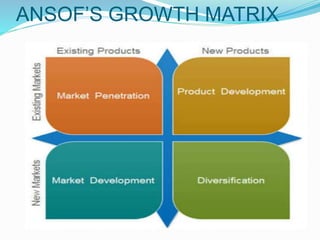
Igor Ansof outlined some important strategies for
business growth and identified 4 key approaches to
growing a business.
Market Penetration Strategy
Product Development Strategy
Market Development Strategy
Diversification Strategy
ANSOF’S GROWTH MATRIX
MARKET PENETRATION
STRATEGY
The firm seeks to achieve growth with existing
products in their current segments;
Aims to increase their market share.
When faced with challenging environment and global
health concerns McDonalds increased its market
penetration just by introducing hundreds of new
outlets each year.
Adopted a corporate motto of BETTER NOT BIGGER.
MARKET DEVELOPMENT
STRATEGY
 Targets its existing products to new market segments.
 McDonalds expanded globally through the years & has
33,000 restaurants worldwide in 119 countries today
with 1.7 million employees to serve 64 millionm
customers daily across the world.
Product Development
Strategy
 Firm develops new products targeted to its existing
market segments.
 Responding to global concerns related to obesity and
health issues from fast foods :
 McDonalds added healthier options such as a number
of fresh salads, healthier versions of Kids Meal and
adult versions that included salads;
DIVERSIFICATION
STRATEGY
 Firm grows by diversifying into new businesses by
developing new products for new markets.
 McDonalds extended in 2001 into:
Mc Café, a gourmet shop inspired by the success of
Starbucks &
Mc Treat, an ice-cream and dessert shop.
NEW PRODUCT
APPROACHES
 New product introductions are vital to the long run
success of a firm. When a firm introduces new
products, it has 3 choices of branding it.
It can develop a new brand, individually chosen for a
new product.
It can apply one of its existing brands.
It can use a combination of a new brand & an existing
brand.
BRAND EXTENSION
 A brand extension occurs when a firm uses an
established brand name to introduce a new product.
 The new category can be related or unrelated to the
existing product categories.
 A successful brand helps to launch products easily.
For example :
NIKE’s brand core product is shoes, but it is now
extended to sunglasses, soccer & basket balls, golf
equipments etc.
When a new brand is combined with an existing
brand, the brand extension is known as SUB-BRAND.
An existing brand that gives rise to a brand extension
is known as PARENT BRAND.
For example:
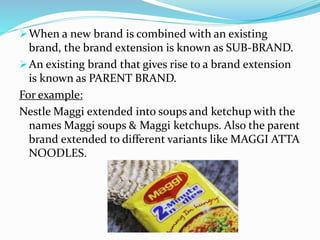
Nestle Maggi extended into soups and ketchup with the
names Maggi soups & Maggi ketchups. Also the parent
brand extended to different variants like MAGGI ATTA
NOODLES.
 If the parent brand is already associated with multiple
products through brand extensions, then its known as
FAMILY BRAND.
 A family brand or an Umbrella Brand involves the use
of a single brand name for the sale of two or more
related products.
For example :
APPLE ; all products are branded under the Apple name
and logo helping customers to easily identify & instill
faith in them.
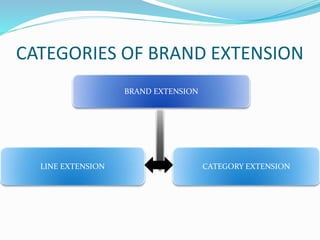
CATEGORIES OF BRAND EXTENSION
BRAND EXTENSION
LINE EXTENSION CATEGORY EXTENSION
LINE EXTENSION
 A multiproduct branding strategy when a firm markets
one or more new products under an already
established & well known brand names.
 Line Extensions occur when the company introduces
additional items; in the same product category under
the same brand name; such as new flavours, forms,
colors, added ingredients, package sizes.
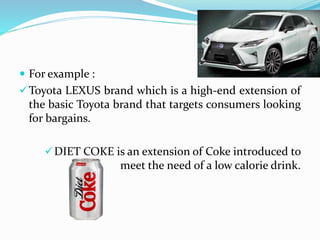
 For example :
Toyota LEXUS brand which is a high-end extension of
the basic Toyota brand that targets consumers looking
for bargains.
DIET COKE is an extension of Coke introduced to
meet the need of a low calorie drink.
CATEGORY EXTENSION
 Is a strategy by which a company uses the same brand
to enter into a completely unrelated product segment.
 The company leverages on the brand equity and the
success of its existing brand to introduce the new
product to increase market acceptance.
 For example :
GODREJ ; originally known for locks and cupboards;
entered into product segments like refrigerators,
furniture (GODREJ INTERIO) & real estate.
ITC
Classmate notebooks, pens, pencils, erasers, paints &
geometry boxes
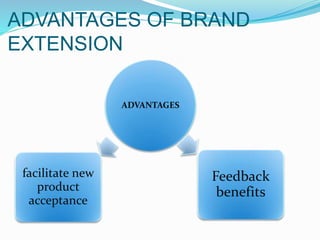
ADVANTAGES OF BRAND
EXTENSION
ADVANTAGES
facilitate new
product
acceptance
Feedback
benefits
BENEFITS THAT FACILITATE
NEW- PRODUCT
ACCEPTANCE
Increases brand image.
Risk perceived by the customers reduces.
Likelihood of distribution & trail increases.
Efficiency of promotional expenditure increases.
Cost of developing new brand is saved.
Consumers can seek for a variety of products.
Packaging and labeling efficiencies.
FEEDBACK BENEFITS
Image of the parent brand is enhanced.
It revives the brand.
Allows subsequent extension.
Brand meaning is clarified.
Increases market coverage.
Customers associate core brand to new products hence
they have quality associations.
DISADVANTAGES
Brand extension in unrelated markets can lead to loss
of reliability.
The new product can damage the image of the core
brand.
Chances of less awareness & trail as the management
may not invest in the new product; totally depending
on the core brands popularity.
If the brand extension has no competitive advantage; it
may fail.
Too many varieties can confuse the customers.
Thank You

NAMING NEW PRODUCTS & BRAND EXTENSIONS

  • 1.
    NAZIYA AISHA MBA IVSEMESTER 15MBAB22 AMUKC
  • 2.
    CONTENTS  Introduction  Growthstrategies  New product Approaches  Brand extension  Categories of Brand Extension  Advantages of Brand Extension  Disadvantages of Brand Extension
  • 3.
    INTRODUCTION  With itsawareness, perceived quality, associations and customer loyalty, a brand is usually the most powerful asset that a firm owns.  Many firms seek to build ‘mega brands’ that establishes a broad market footprint and appeals to multiple customer segments.  One recipe for strategic success is to create and leverage assets through growth strategies adopted by the firm.
  • 4.
    GROWTH STRATEGIES Igor Ansofoutlined some important strategies for business growth and identified 4 key approaches to growing a business. Market Penetration Strategy Product Development Strategy Market Development Strategy Diversification Strategy
  • 5.
  • 6.
    MARKET PENETRATION STRATEGY The firmseeks to achieve growth with existing products in their current segments; Aims to increase their market share. When faced with challenging environment and global health concerns McDonalds increased its market penetration just by introducing hundreds of new outlets each year. Adopted a corporate motto of BETTER NOT BIGGER.
  • 7.
    MARKET DEVELOPMENT STRATEGY  Targetsits existing products to new market segments.  McDonalds expanded globally through the years & has 33,000 restaurants worldwide in 119 countries today with 1.7 million employees to serve 64 millionm customers daily across the world.
  • 8.
    Product Development Strategy  Firmdevelops new products targeted to its existing market segments.  Responding to global concerns related to obesity and health issues from fast foods :  McDonalds added healthier options such as a number of fresh salads, healthier versions of Kids Meal and adult versions that included salads;
  • 9.
    DIVERSIFICATION STRATEGY  Firm growsby diversifying into new businesses by developing new products for new markets.  McDonalds extended in 2001 into: Mc Café, a gourmet shop inspired by the success of Starbucks & Mc Treat, an ice-cream and dessert shop.
  • 10.
    NEW PRODUCT APPROACHES  Newproduct introductions are vital to the long run success of a firm. When a firm introduces new products, it has 3 choices of branding it. It can develop a new brand, individually chosen for a new product. It can apply one of its existing brands. It can use a combination of a new brand & an existing brand.
  • 11.
    BRAND EXTENSION  Abrand extension occurs when a firm uses an established brand name to introduce a new product.  The new category can be related or unrelated to the existing product categories.  A successful brand helps to launch products easily. For example : NIKE’s brand core product is shoes, but it is now extended to sunglasses, soccer & basket balls, golf equipments etc.
  • 12.
    When a newbrand is combined with an existing brand, the brand extension is known as SUB-BRAND. An existing brand that gives rise to a brand extension is known as PARENT BRAND. For example: Nestle Maggi extended into soups and ketchup with the names Maggi soups & Maggi ketchups. Also the parent brand extended to different variants like MAGGI ATTA NOODLES.
  • 13.
     If theparent brand is already associated with multiple products through brand extensions, then its known as FAMILY BRAND.  A family brand or an Umbrella Brand involves the use of a single brand name for the sale of two or more related products. For example : APPLE ; all products are branded under the Apple name and logo helping customers to easily identify & instill faith in them.
  • 14.
    CATEGORIES OF BRANDEXTENSION BRAND EXTENSION LINE EXTENSION CATEGORY EXTENSION
  • 15.
    LINE EXTENSION  Amultiproduct branding strategy when a firm markets one or more new products under an already established & well known brand names.  Line Extensions occur when the company introduces additional items; in the same product category under the same brand name; such as new flavours, forms, colors, added ingredients, package sizes.
  • 16.
     For example: Toyota LEXUS brand which is a high-end extension of the basic Toyota brand that targets consumers looking for bargains. DIET COKE is an extension of Coke introduced to meet the need of a low calorie drink.
  • 17.
    CATEGORY EXTENSION  Isa strategy by which a company uses the same brand to enter into a completely unrelated product segment.  The company leverages on the brand equity and the success of its existing brand to introduce the new product to increase market acceptance.
  • 18.
     For example: GODREJ ; originally known for locks and cupboards; entered into product segments like refrigerators, furniture (GODREJ INTERIO) & real estate. ITC Classmate notebooks, pens, pencils, erasers, paints & geometry boxes
  • 19.
    ADVANTAGES OF BRAND EXTENSION ADVANTAGES facilitatenew product acceptance Feedback benefits
  • 20.
    BENEFITS THAT FACILITATE NEW-PRODUCT ACCEPTANCE Increases brand image. Risk perceived by the customers reduces. Likelihood of distribution & trail increases. Efficiency of promotional expenditure increases. Cost of developing new brand is saved. Consumers can seek for a variety of products. Packaging and labeling efficiencies.
  • 21.
    FEEDBACK BENEFITS Image ofthe parent brand is enhanced. It revives the brand. Allows subsequent extension. Brand meaning is clarified. Increases market coverage. Customers associate core brand to new products hence they have quality associations.
  • 22.
    DISADVANTAGES Brand extension inunrelated markets can lead to loss of reliability. The new product can damage the image of the core brand. Chances of less awareness & trail as the management may not invest in the new product; totally depending on the core brands popularity. If the brand extension has no competitive advantage; it may fail. Too many varieties can confuse the customers.
  • 23.