PRESENTED BY:
Arundhati P Dolas
Roll No.3
M.Sc-I RM-ERGO
2013-14
CONTENT
Definition
Thermo-regulation of the human body
Variables which affect thermal sensation
Heat stress
Heat acclimatization
Factors causing heat stress
Types of heat transfer
Health effects of heat stress
Methods for measuring heat stress
Control of heat stress
Prevention of heat stress
Conclusion
Saturday, March 08, 2014

THERMAL STRESS

2
Definition
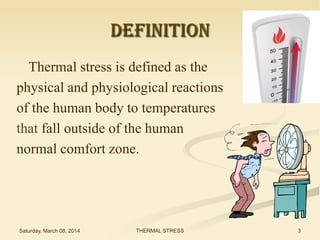
Thermal stress is defined as the
physical and physiological reactions
of the human body to temperatures
that fall outside of the human
normal comfort zone.

Saturday, March 08, 2014

THERMAL STRESS

3
Thermo-Regulation Of The
Human Body
•

•

•

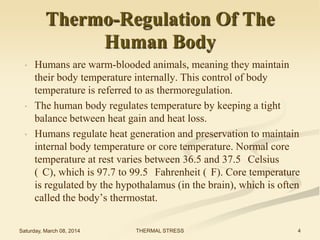
Humans are warm-blooded animals, meaning they maintain
their body temperature internally. This control of body
temperature is referred to as thermoregulation.
The human body regulates temperature by keeping a tight
balance between heat gain and heat loss.
Humans regulate heat generation and preservation to maintain
internal body temperature or core temperature. Normal core
temperature at rest varies between 36.5 and 37.5 Celsius
( C), which is 97.7 to 99.5 Fahrenheit ( F). Core temperature
is regulated by the hypothalamus (in the brain), which is often
called the body’s thermostat.

Saturday, March 08, 2014

THERMAL STRESS

4




Temperature Detection
When met with environments that threaten the internal temperature of
the body, such as cold or hot conditions, the human body is triggered into
response. For example, nerve endings in the skin detect temperature
changes in the environment outside the body and signal the brain to either
increase or decrease the heat inside the body.
Reactions to Hot Temperatures
When the body senses warm temperatures any number of reactions
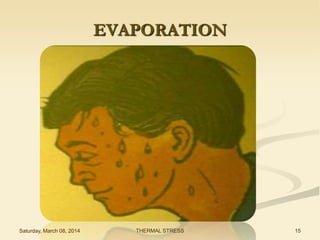
may occur. Sweating is one method for reducing body temperature. The
sweat glands in the skin excrete sweat, which contains water and some
nutrients. The process of evaporation then works to cool the body. The
drawback to perspiration is the loss of water. Maintaining water within the
body is especially important in high temperatures.

Saturday, March 08, 2014

THERMAL STRESS

5
Hypothalamus Regulation of
Temperature
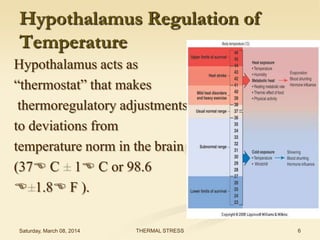
Hypothalamus acts as
“thermostat” that makes
thermoregulatory adjustments
to deviations from
temperature norm in the brain
(37 C 1 C or 98.6
 1.8 F ).
Saturday, March 08, 2014

THERMAL STRESS

6
Variables Which Affect Thermal
Sensation


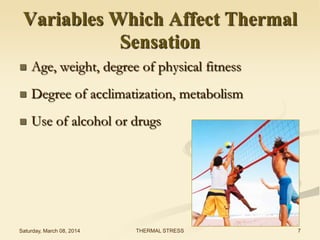
Age, weight, degree of physical fitness



Degree of acclimatization, metabolism



Use of alcohol or drugs

Saturday, March 08, 2014

THERMAL STRESS

7
HEAT STRESS






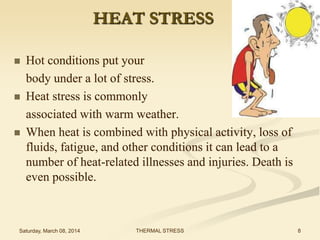
Hot conditions put your
body under a lot of stress.
Heat stress is commonly
associated with warm weather.
When heat is combined with physical activity, loss of
fluids, fatigue, and other conditions it can lead to a
number of heat-related illnesses and injuries. Death is
even possible.

Saturday, March 08, 2014

THERMAL STRESS

8
HEAT ACCLIMATIZATION
•
•

•
•
•

The body adapts to a new thermal environment by a process
called acclimatization.
Complete heat acclimatization generally takes six to seven
days, but some individuals may need longer. Loss of
acclimatization occurs gradually when a person is moved
permanently away from a hot environment.
Repeated exposure to heat stress during exercise improves
your ability to get rid of excess heat.
Muscle glycogen use is reduced to delay onset of fatigue.
Amount of heat acclimation depends on environmental
conditions and duration of exposure and intensity of exercise.

Saturday, March 08, 2014

THERMAL STRESS

9
FACTORS CAUSING HEAT
STRESS
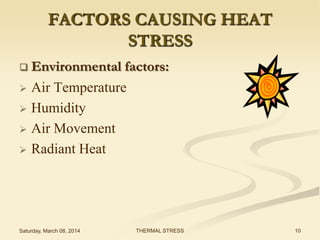
Environmental factors:
 Air Temperature
 Humidity
 Air Movement
 Radiant Heat


Saturday, March 08, 2014

THERMAL STRESS

10
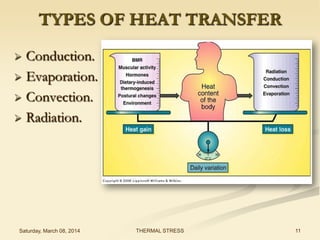
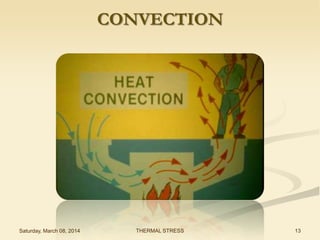
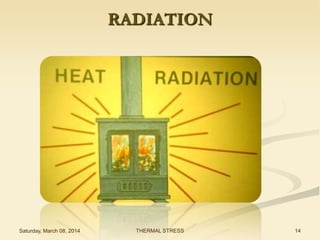
TYPES OF HEAT TRANSFER
Conduction.
 Evaporation.
 Convection.
 Radiation.


Saturday, March 08, 2014

THERMAL STRESS

11
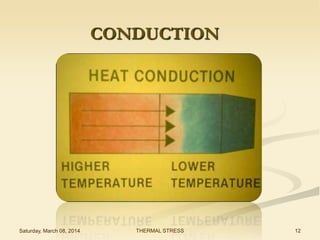
CONDUCTION

Saturday, March 08, 2014

THERMAL STRESS

12
CONVECTION

Saturday, March 08, 2014

THERMAL STRESS

13
RADIATION

Saturday, March 08, 2014

THERMAL STRESS

14
EVAPORATION

Saturday, March 08, 2014

THERMAL STRESS

15
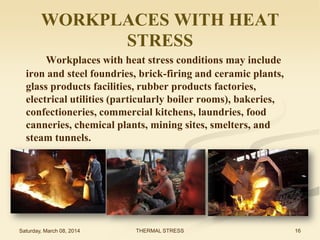
WORKPLACES WITH HEAT
STRESS
Workplaces with heat stress conditions may include
iron and steel foundries, brick-firing and ceramic plants,
glass products facilities, rubber products factories,
electrical utilities (particularly boiler rooms), bakeries,
confectioneries, commercial kitchens, laundries, food
canneries, chemical plants, mining sites, smelters, and
steam tunnels.

Saturday, March 08, 2014

THERMAL STRESS

16
Saturday, March 08, 2014

THERMAL STRESS

17
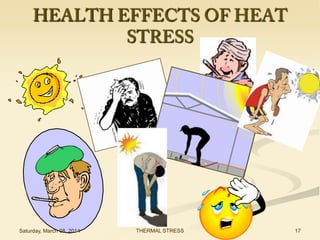
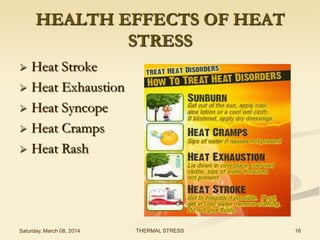
HEALTH EFFECTS OF HEAT
STRESS
Heat Stroke
 Heat Exhaustion
 Heat Syncope
 Heat Cramps
 Heat Rash


Saturday, March 08, 2014

THERMAL STRESS

18
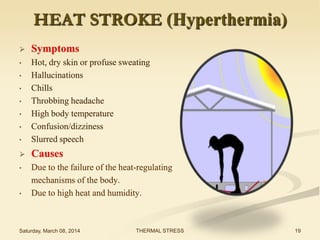
HEAT STROKE (Hyperthermia)


Symptoms

•

•

Hot, dry skin or profuse sweating
Hallucinations
Chills
Throbbing headache
High body temperature
Confusion/dizziness
Slurred speech



Causes

•

Due to the failure of the heat-regulating
mechanisms of the body.
Due to high heat and humidity.

•
•
•
•
•

•

Saturday, March 08, 2014

THERMAL STRESS

19


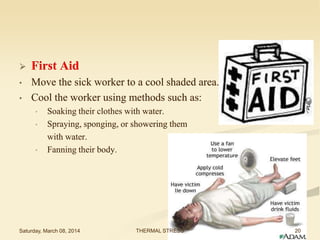
First Aid

•

Move the sick worker to a cool shaded area.
Cool the worker using methods such as:

•

•
•

•

Soaking their clothes with water.
Spraying, sponging, or showering them
with water.
Fanning their body.

Saturday, March 08, 2014

THERMAL STRESS

20
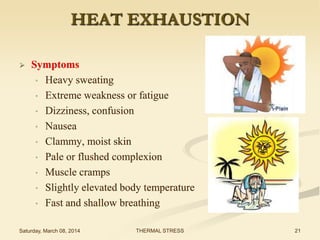
HEAT EXHAUSTION


Symptoms
• Heavy sweating
• Extreme weakness or fatigue
• Dizziness, confusion
• Nausea
• Clammy, moist skin
• Pale or flushed complexion
• Muscle cramps
• Slightly elevated body temperature
• Fast and shallow breathing

Saturday, March 08, 2014

THERMAL STRESS

21


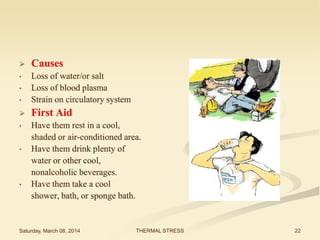
Causes

•

•

Loss of water/or salt
Loss of blood plasma
Strain on circulatory system



First Aid

•

Have them rest in a cool,
shaded or air-conditioned area.
Have them drink plenty of
water or other cool,
nonalcoholic beverages.
Have them take a cool
shower, bath, or sponge bath.

•

•

•

Saturday, March 08, 2014

THERMAL STRESS

22
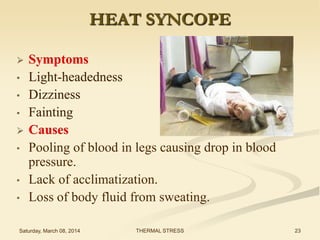
HEAT SYNCOPE

•
•
•

•
•

•

Symptoms
Light-headedness
Dizziness
Fainting
Causes
Pooling of blood in legs causing drop in blood
pressure.
Lack of acclimatization.
Loss of body fluid from sweating.

Saturday, March 08, 2014

THERMAL STRESS

23


•

•

First Aid
Sit or lie down in a cool place when they begin
to feel symptoms.
Slowly drink water, clear juice, or a sports
beverage.

Saturday, March 08, 2014

THERMAL STRESS

24
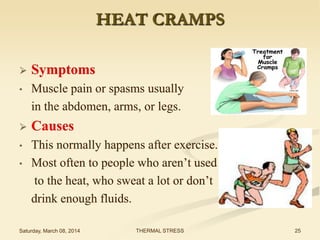
HEAT CRAMPS


Symptoms

•

Muscle pain or spasms usually
in the abdomen, arms, or legs.



Causes

•

This normally happens after exercise.
Most often to people who aren’t used
to the heat, who sweat a lot or don’t
drink enough fluids.

•

Saturday, March 08, 2014

THERMAL STRESS

25






First Aid
Stop all activity, and sit in a cool place.
Drink clear juice or a sports beverage.
Do not return to strenuous work for a few
hours after the cramps subside because further
exertion may lead to heat exhaustion or heat
stroke.

Saturday, March 08, 2014

THERMAL STRESS

26
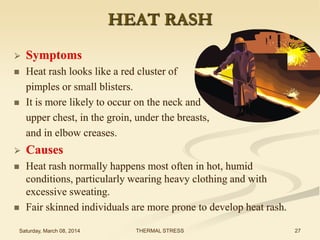
HEAT RASH


Symptoms





Heat rash looks like a red cluster of
pimples or small blisters.
It is more likely to occur on the neck and
upper chest, in the groin, under the breasts,
and in elbow creases.



Causes



Heat rash normally happens most often in hot, humid
conditions, particularly wearing heavy clothing and with
excessive sweating.
Fair skinned individuals are more prone to develop heat rash.



Saturday, March 08, 2014

THERMAL STRESS

27


First Aid

•

Try to work in a cooler, less humid environment
when possible.
Keep the affected area dry.
Dusting powder may be used to increase comfort.

•
•

Saturday, March 08, 2014

THERMAL STRESS

28
METHODS FOR MEASURING
HEAT STRESS


WBGT
The Wet-Bulb Globe Temperature device
(WBGT) takes into account four variables: air
temperature, humidity, radiant heat and air
movement. This reading gives a more
accurate measurement of heat stress than any
one reading alone.

Saturday, March 08, 2014

THERMAL STRESS

29
The WBGT is measured by a simple
three-temperature element device:


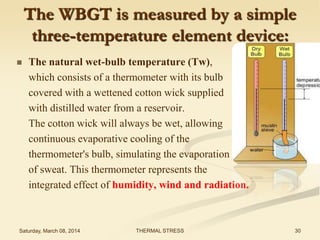
The natural wet-bulb temperature (Tw),
which consists of a thermometer with its bulb
covered with a wettened cotton wick supplied
with distilled water from a reservoir.
The cotton wick will always be wet, allowing
continuous evaporative cooling of the
thermometer's bulb, simulating the evaporation
of sweat. This thermometer represents the
integrated effect of humidity, wind and radiation.

Saturday, March 08, 2014

THERMAL STRESS

30




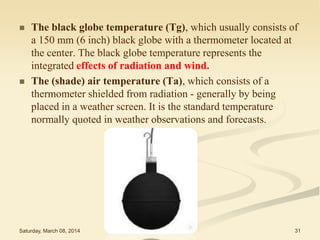
The black globe temperature (Tg), which usually consists of
a 150 mm (6 inch) black globe with a thermometer located at
the center. The black globe temperature represents the
integrated effects of radiation and wind.
The (shade) air temperature (Ta), which consists of a
thermometer shielded from radiation - generally by being
placed in a weather screen. It is the standard temperature
normally quoted in weather observations and forecasts.

Saturday, March 08, 2014

THERMAL STRESS

31
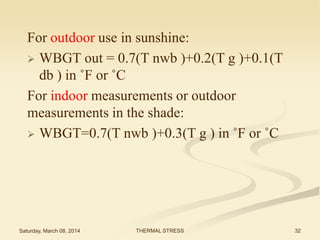
For outdoor use in sunshine:
 WBGT out = 0.7(T nwb )+0.2(T g )+0.1(T
db ) in ˚F or ˚C
For indoor measurements or outdoor
measurements in the shade:
 WBGT=0.7(T nwb )+0.3(T g ) in ˚F or ˚C

Saturday, March 08, 2014

THERMAL STRESS

32
HEAT STRESS INDEX






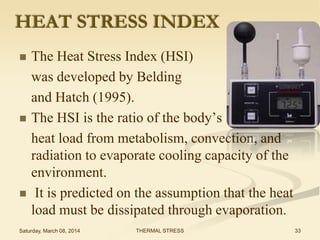
The Heat Stress Index (HSI)
was developed by Belding
and Hatch (1995).
The HSI is the ratio of the body’s
heat load from metabolism, convection, and
radiation to evaporate cooling capacity of the
environment.
It is predicted on the assumption that the heat
load must be dissipated through evaporation.

Saturday, March 08, 2014

THERMAL STRESS

33
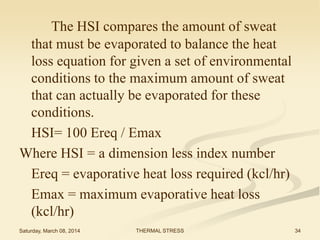
The HSI compares the amount of sweat
that must be evaporated to balance the heat
loss equation for given a set of environmental
conditions to the maximum amount of sweat
that can actually be evaporated for these
conditions.
HSI= 100 Ereq / Emax
Where HSI = a dimension less index number
Ereq = evaporative heat loss required (kcl/hr)
Emax = maximum evaporative heat loss
(kcl/hr)
Saturday, March 08, 2014

THERMAL STRESS

34
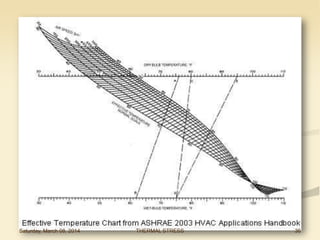
EFFECTIVE TEMPERATURE
OR CORRECTIVE EFFECTIVE
TEMPERATURE
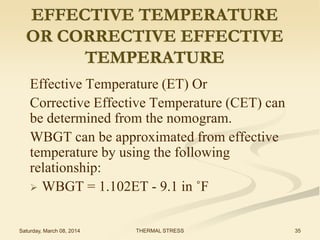
Effective Temperature (ET) Or
Corrective Effective Temperature (CET) can
be determined from the nomogram.
WBGT can be approximated from effective
temperature by using the following
relationship:
 WBGT = 1.102ET - 9.1 in ˚F
Saturday, March 08, 2014

THERMAL STRESS

35
Saturday, March 08, 2014

THERMAL STRESS

36
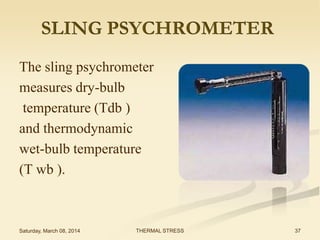
SLING PSYCHROMETER
The sling psychrometer
measures dry-bulb
temperature (Tdb )
and thermodynamic
wet-bulb temperature
(T wb ).

Saturday, March 08, 2014

THERMAL STRESS

37
PREDICTED FOUR HOUR
SWEAT RATE
The predicted four hour sweat rate (P4 SR)
index was developed by Mac Ardle et al (1947).
The index taken into account metabolic level and
two types of clothing (shorts and overall), in
addition to the climate factors.

Saturday, March 08, 2014

THERMAL STRESS

38
CONTROL OF HEAT STRESS
Reducing Metabolic Heat Production (heat
produced by the body)
 Reducing the Humidity
 Insulating Hot Surfaces
 Shielding
 Ventilation and Air Conditioning
 Reducing the Radiant Heat Emission from Hot
Surfaces


Saturday, March 08, 2014

THERMAL STRESS

39
 Changing

the rate of work
 Schedule hot jobs to cooler times of the day.
 Increase the frequency and length of rest breaks if possible
 Allow for slower-paced work during the hottest periods of
the day.
 Limiting duration of exposure time.
 Rotate work activities.
 Take breaks in cool shaded areas.
 Avoid eating large meals before working in hot
environments.
 Avoid caffeine and alcohol (these beverages make the body
lose water and increase your risk for heat illnesses).

Saturday, March 08, 2014

THERMAL STRESS

40
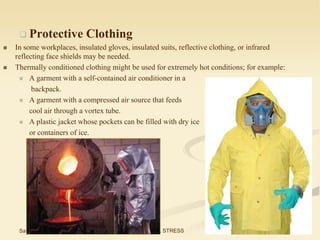
 Protective




Clothing

In some workplaces, insulated gloves, insulated suits, reflective clothing, or infrared
reflecting face shields may be needed.
Thermally conditioned clothing might be used for extremely hot conditions; for example:
 A garment with a self-contained air conditioner in a
backpack.
 A garment with a compressed air source that feeds
cool air through a vortex tube.
 A plastic jacket whose pockets can be filled with dry ice
or containers of ice.

Saturday, March 08, 2014

THERMAL STRESS

41
Prevention of Heat Stress
Learn to recognize the symptoms of heat stress. Change work
location, taking adequate rest periods (in shade or cooler
environment).
 Become familiar with the hazards associated with working in
hot environments
 Use adequate fans for ventilation and cooling, especially when
wearing personal protective equipment (PPE).
 Wear light colored, loose (unless working around equipment
with moving parts) clothing.
 Keep shaded from direct heat where possible (e.g., wear a hat
in direct sunlight).
 Drink plenty of water. In hot environments the body requires
more water than it takes to satisfy thirst.


Saturday, March 08, 2014

THERMAL STRESS

42
CONCLUSION







Heat stress cannot be eliminated completely.
Simple precautionary measures can
considerably reduce heat strain to acceptable
levels
Proper thermal control helps a long way in
success of missions.
There is a necessicity for maintaining a
suitable temperature to protect the health of
the workers and maximize efficiency and
productivity .

Saturday, March 08, 2014

THERMAL STRESS

43
BIBLIOGRAPHY






http://www.osha.gov
http:// www.cdc.gov
en.wikipedia.org/wiki
www.osach.ca
National workshop on Ergonomics retrospective and
prospective.
July 1993, Andhra University, Visakhapatnam.

Saturday, March 08, 2014

THERMAL STRESS

44
Saturday, March 08, 2014

THERMAL STRESS

45

Ergonomics (Thermal stress)

  • 1.
    PRESENTED BY: Arundhati PDolas Roll No.3 M.Sc-I RM-ERGO 2013-14
  • 2.
    CONTENT Definition Thermo-regulation of thehuman body Variables which affect thermal sensation Heat stress Heat acclimatization Factors causing heat stress Types of heat transfer Health effects of heat stress Methods for measuring heat stress Control of heat stress Prevention of heat stress Conclusion Saturday, March 08, 2014 THERMAL STRESS 2
  • 3.
    Definition Thermal stress isdefined as the physical and physiological reactions of the human body to temperatures that fall outside of the human normal comfort zone. Saturday, March 08, 2014 THERMAL STRESS 3
  • 4.
    Thermo-Regulation Of The HumanBody • • • Humans are warm-blooded animals, meaning they maintain their body temperature internally. This control of body temperature is referred to as thermoregulation. The human body regulates temperature by keeping a tight balance between heat gain and heat loss. Humans regulate heat generation and preservation to maintain internal body temperature or core temperature. Normal core temperature at rest varies between 36.5 and 37.5 Celsius ( C), which is 97.7 to 99.5 Fahrenheit ( F). Core temperature is regulated by the hypothalamus (in the brain), which is often called the body’s thermostat. Saturday, March 08, 2014 THERMAL STRESS 4
  • 5.
      Temperature Detection When metwith environments that threaten the internal temperature of the body, such as cold or hot conditions, the human body is triggered into response. For example, nerve endings in the skin detect temperature changes in the environment outside the body and signal the brain to either increase or decrease the heat inside the body. Reactions to Hot Temperatures When the body senses warm temperatures any number of reactions may occur. Sweating is one method for reducing body temperature. The sweat glands in the skin excrete sweat, which contains water and some nutrients. The process of evaporation then works to cool the body. The drawback to perspiration is the loss of water. Maintaining water within the body is especially important in high temperatures. Saturday, March 08, 2014 THERMAL STRESS 5
  • 6.
    Hypothalamus Regulation of Temperature Hypothalamusacts as “thermostat” that makes thermoregulatory adjustments to deviations from temperature norm in the brain (37 C 1 C or 98.6  1.8 F ). Saturday, March 08, 2014 THERMAL STRESS 6
  • 7.
    Variables Which AffectThermal Sensation  Age, weight, degree of physical fitness  Degree of acclimatization, metabolism  Use of alcohol or drugs Saturday, March 08, 2014 THERMAL STRESS 7
  • 8.
    HEAT STRESS    Hot conditionsput your body under a lot of stress. Heat stress is commonly associated with warm weather. When heat is combined with physical activity, loss of fluids, fatigue, and other conditions it can lead to a number of heat-related illnesses and injuries. Death is even possible. Saturday, March 08, 2014 THERMAL STRESS 8
  • 9.
    HEAT ACCLIMATIZATION • • • • • The bodyadapts to a new thermal environment by a process called acclimatization. Complete heat acclimatization generally takes six to seven days, but some individuals may need longer. Loss of acclimatization occurs gradually when a person is moved permanently away from a hot environment. Repeated exposure to heat stress during exercise improves your ability to get rid of excess heat. Muscle glycogen use is reduced to delay onset of fatigue. Amount of heat acclimation depends on environmental conditions and duration of exposure and intensity of exercise. Saturday, March 08, 2014 THERMAL STRESS 9
  • 10.
    FACTORS CAUSING HEAT STRESS Environmentalfactors:  Air Temperature  Humidity  Air Movement  Radiant Heat  Saturday, March 08, 2014 THERMAL STRESS 10
  • 11.
    TYPES OF HEATTRANSFER Conduction.  Evaporation.  Convection.  Radiation.  Saturday, March 08, 2014 THERMAL STRESS 11
  • 12.
    CONDUCTION Saturday, March 08,2014 THERMAL STRESS 12
  • 13.
    CONVECTION Saturday, March 08,2014 THERMAL STRESS 13
  • 14.
    RADIATION Saturday, March 08,2014 THERMAL STRESS 14
  • 15.
    EVAPORATION Saturday, March 08,2014 THERMAL STRESS 15
  • 16.
    WORKPLACES WITH HEAT STRESS Workplaceswith heat stress conditions may include iron and steel foundries, brick-firing and ceramic plants, glass products facilities, rubber products factories, electrical utilities (particularly boiler rooms), bakeries, confectioneries, commercial kitchens, laundries, food canneries, chemical plants, mining sites, smelters, and steam tunnels. Saturday, March 08, 2014 THERMAL STRESS 16
  • 17.
    Saturday, March 08,2014 THERMAL STRESS 17
  • 18.
    HEALTH EFFECTS OFHEAT STRESS Heat Stroke  Heat Exhaustion  Heat Syncope  Heat Cramps  Heat Rash  Saturday, March 08, 2014 THERMAL STRESS 18
  • 19.
    HEAT STROKE (Hyperthermia)  Symptoms • • Hot,dry skin or profuse sweating Hallucinations Chills Throbbing headache High body temperature Confusion/dizziness Slurred speech  Causes • Due to the failure of the heat-regulating mechanisms of the body. Due to high heat and humidity. • • • • • • Saturday, March 08, 2014 THERMAL STRESS 19
  • 20.
     First Aid • Move thesick worker to a cool shaded area. Cool the worker using methods such as: • • • • Soaking their clothes with water. Spraying, sponging, or showering them with water. Fanning their body. Saturday, March 08, 2014 THERMAL STRESS 20
  • 21.
    HEAT EXHAUSTION  Symptoms • Heavysweating • Extreme weakness or fatigue • Dizziness, confusion • Nausea • Clammy, moist skin • Pale or flushed complexion • Muscle cramps • Slightly elevated body temperature • Fast and shallow breathing Saturday, March 08, 2014 THERMAL STRESS 21
  • 22.
     Causes • • Loss of water/orsalt Loss of blood plasma Strain on circulatory system  First Aid • Have them rest in a cool, shaded or air-conditioned area. Have them drink plenty of water or other cool, nonalcoholic beverages. Have them take a cool shower, bath, or sponge bath. • • • Saturday, March 08, 2014 THERMAL STRESS 22
  • 23.
    HEAT SYNCOPE  • • •  • • • Symptoms Light-headedness Dizziness Fainting Causes Pooling ofblood in legs causing drop in blood pressure. Lack of acclimatization. Loss of body fluid from sweating. Saturday, March 08, 2014 THERMAL STRESS 23
  • 24.
     • • First Aid Sit orlie down in a cool place when they begin to feel symptoms. Slowly drink water, clear juice, or a sports beverage. Saturday, March 08, 2014 THERMAL STRESS 24
  • 25.
    HEAT CRAMPS  Symptoms • Muscle painor spasms usually in the abdomen, arms, or legs.  Causes • This normally happens after exercise. Most often to people who aren’t used to the heat, who sweat a lot or don’t drink enough fluids. • Saturday, March 08, 2014 THERMAL STRESS 25
  • 26.
        First Aid Stop allactivity, and sit in a cool place. Drink clear juice or a sports beverage. Do not return to strenuous work for a few hours after the cramps subside because further exertion may lead to heat exhaustion or heat stroke. Saturday, March 08, 2014 THERMAL STRESS 26
  • 27.
    HEAT RASH  Symptoms   Heat rashlooks like a red cluster of pimples or small blisters. It is more likely to occur on the neck and upper chest, in the groin, under the breasts, and in elbow creases.  Causes  Heat rash normally happens most often in hot, humid conditions, particularly wearing heavy clothing and with excessive sweating. Fair skinned individuals are more prone to develop heat rash.  Saturday, March 08, 2014 THERMAL STRESS 27
  • 28.
     First Aid • Try towork in a cooler, less humid environment when possible. Keep the affected area dry. Dusting powder may be used to increase comfort. • • Saturday, March 08, 2014 THERMAL STRESS 28
  • 29.
    METHODS FOR MEASURING HEATSTRESS  WBGT The Wet-Bulb Globe Temperature device (WBGT) takes into account four variables: air temperature, humidity, radiant heat and air movement. This reading gives a more accurate measurement of heat stress than any one reading alone. Saturday, March 08, 2014 THERMAL STRESS 29
  • 30.
    The WBGT ismeasured by a simple three-temperature element device:  The natural wet-bulb temperature (Tw), which consists of a thermometer with its bulb covered with a wettened cotton wick supplied with distilled water from a reservoir. The cotton wick will always be wet, allowing continuous evaporative cooling of the thermometer's bulb, simulating the evaporation of sweat. This thermometer represents the integrated effect of humidity, wind and radiation. Saturday, March 08, 2014 THERMAL STRESS 30
  • 31.
      The black globetemperature (Tg), which usually consists of a 150 mm (6 inch) black globe with a thermometer located at the center. The black globe temperature represents the integrated effects of radiation and wind. The (shade) air temperature (Ta), which consists of a thermometer shielded from radiation - generally by being placed in a weather screen. It is the standard temperature normally quoted in weather observations and forecasts. Saturday, March 08, 2014 THERMAL STRESS 31
  • 32.
    For outdoor usein sunshine:  WBGT out = 0.7(T nwb )+0.2(T g )+0.1(T db ) in ˚F or ˚C For indoor measurements or outdoor measurements in the shade:  WBGT=0.7(T nwb )+0.3(T g ) in ˚F or ˚C Saturday, March 08, 2014 THERMAL STRESS 32
  • 33.
    HEAT STRESS INDEX    TheHeat Stress Index (HSI) was developed by Belding and Hatch (1995). The HSI is the ratio of the body’s heat load from metabolism, convection, and radiation to evaporate cooling capacity of the environment. It is predicted on the assumption that the heat load must be dissipated through evaporation. Saturday, March 08, 2014 THERMAL STRESS 33
  • 34.
    The HSI comparesthe amount of sweat that must be evaporated to balance the heat loss equation for given a set of environmental conditions to the maximum amount of sweat that can actually be evaporated for these conditions. HSI= 100 Ereq / Emax Where HSI = a dimension less index number Ereq = evaporative heat loss required (kcl/hr) Emax = maximum evaporative heat loss (kcl/hr) Saturday, March 08, 2014 THERMAL STRESS 34
  • 35.
    EFFECTIVE TEMPERATURE OR CORRECTIVEEFFECTIVE TEMPERATURE Effective Temperature (ET) Or Corrective Effective Temperature (CET) can be determined from the nomogram. WBGT can be approximated from effective temperature by using the following relationship:  WBGT = 1.102ET - 9.1 in ˚F Saturday, March 08, 2014 THERMAL STRESS 35
  • 36.
    Saturday, March 08,2014 THERMAL STRESS 36
  • 37.
    SLING PSYCHROMETER The slingpsychrometer measures dry-bulb temperature (Tdb ) and thermodynamic wet-bulb temperature (T wb ). Saturday, March 08, 2014 THERMAL STRESS 37
  • 38.
    PREDICTED FOUR HOUR SWEATRATE The predicted four hour sweat rate (P4 SR) index was developed by Mac Ardle et al (1947). The index taken into account metabolic level and two types of clothing (shorts and overall), in addition to the climate factors. Saturday, March 08, 2014 THERMAL STRESS 38
  • 39.
    CONTROL OF HEATSTRESS Reducing Metabolic Heat Production (heat produced by the body)  Reducing the Humidity  Insulating Hot Surfaces  Shielding  Ventilation and Air Conditioning  Reducing the Radiant Heat Emission from Hot Surfaces  Saturday, March 08, 2014 THERMAL STRESS 39
  • 40.
     Changing the rateof work  Schedule hot jobs to cooler times of the day.  Increase the frequency and length of rest breaks if possible  Allow for slower-paced work during the hottest periods of the day.  Limiting duration of exposure time.  Rotate work activities.  Take breaks in cool shaded areas.  Avoid eating large meals before working in hot environments.  Avoid caffeine and alcohol (these beverages make the body lose water and increase your risk for heat illnesses). Saturday, March 08, 2014 THERMAL STRESS 40
  • 41.
     Protective   Clothing In someworkplaces, insulated gloves, insulated suits, reflective clothing, or infrared reflecting face shields may be needed. Thermally conditioned clothing might be used for extremely hot conditions; for example:  A garment with a self-contained air conditioner in a backpack.  A garment with a compressed air source that feeds cool air through a vortex tube.  A plastic jacket whose pockets can be filled with dry ice or containers of ice. Saturday, March 08, 2014 THERMAL STRESS 41
  • 42.
    Prevention of HeatStress Learn to recognize the symptoms of heat stress. Change work location, taking adequate rest periods (in shade or cooler environment).  Become familiar with the hazards associated with working in hot environments  Use adequate fans for ventilation and cooling, especially when wearing personal protective equipment (PPE).  Wear light colored, loose (unless working around equipment with moving parts) clothing.  Keep shaded from direct heat where possible (e.g., wear a hat in direct sunlight).  Drink plenty of water. In hot environments the body requires more water than it takes to satisfy thirst.  Saturday, March 08, 2014 THERMAL STRESS 42
  • 43.
    CONCLUSION     Heat stress cannotbe eliminated completely. Simple precautionary measures can considerably reduce heat strain to acceptable levels Proper thermal control helps a long way in success of missions. There is a necessicity for maintaining a suitable temperature to protect the health of the workers and maximize efficiency and productivity . Saturday, March 08, 2014 THERMAL STRESS 43
  • 44.
    BIBLIOGRAPHY      http://www.osha.gov http:// www.cdc.gov en.wikipedia.org/wiki www.osach.ca National workshopon Ergonomics retrospective and prospective. July 1993, Andhra University, Visakhapatnam. Saturday, March 08, 2014 THERMAL STRESS 44
  • 45.
    Saturday, March 08,2014 THERMAL STRESS 45