1 of 36
Lecture Outline
The Money Supply and
the Central Banking System
Private Banking System
How Banks Create Money
The Creation of Money
The Money Multiplier
The central banking System
Functions
Balance Sheet
How the Central Bank Controls
the Money Supply
The Required Reserve Ratio
The Discount Rate
Open Market Operations
The Private banking System
• Banks and other financial institutions borrow from
individuals or firms with excess funds and lend to those
who need funds.
• That is the reason they are called Financial intermediaries.
• The main types of financial intermediaries are: commercial
banks, non-banking financial intermediaries, life insurance
companies, pension funds etc..
• To understand how banks create money, consider the
origin of the modern banking system
• The origin of modern banking system is started with the
goldsmith in 15th
and 16th
century.
A Historical Perspective: Goldsmiths
• Because, gold is both inconvenient to carry and has risk,
people preferred to keep it with goldsmith.
• On receiving gold, goldsmith would issue a receipt and
charge a small amount for looking after his gold.
• These receipts act a form of paper money, making
unnecessary to go to goldsmith for withdrawals
• At this time the receipts issued by the goldsmith =
deposits of gold.
• Goldsmith gradually realized that they could lend out
some of the gold as loans.
• They started earning interest rate on the loans
• While giving loans they gave the receipts.
A Historical Perspective: Goldsmiths
• So, there are more receipts than the amount of gold with
goldsmith
 Small amount of Gold reserves were converted to huge amount
of money in circulation.
 Money creation by goldsmith is just a accounting procedure.
• As people were not in need for gold they deposited, the
Goldsmith issue multiple amount of “paper slips” and creates the
money in circulation.
• These receipts circulated as money and people used them to
make transaction without feeling the need of cash.
• This banking system works well as long as people remain
confident on the banking system. Otherwise there will be run on
a bank.
• As people wants deposits rather than money to hold, hard cash
or gold was necessary for transaction.
• Run on bank may arise out of fear.
store of value An asset that can be used to transport
purchasing power from one time period to another.
liquidity property of money The property of money that
makes it a good medium of exchange as well as a store of
value: It is portable and readily accepted and thus easily
exchanged for goods.
Unit of account A standard unit that provides a consistent
way of quoting prices.
An Overview of Money
What Is Money?
Medium of exchange: Eliminates the double-coincidence-of-
wants problem
Barter- Double coincidence of wants for trade .
Commodity monies Items used as money that also have intrinsic
value in some other use. (Prisoners of war made purchase with
cigarettes)
fiat, or token, money Items designated as money that are
intrinsically worthless.
legal tender Money that a government has required to be accepted in
settlement of debts.
currency debasement The decrease in the value of money that
occurs when its supply is increased rapidly.
An Overview of Money
Commodity and Fiat Monies
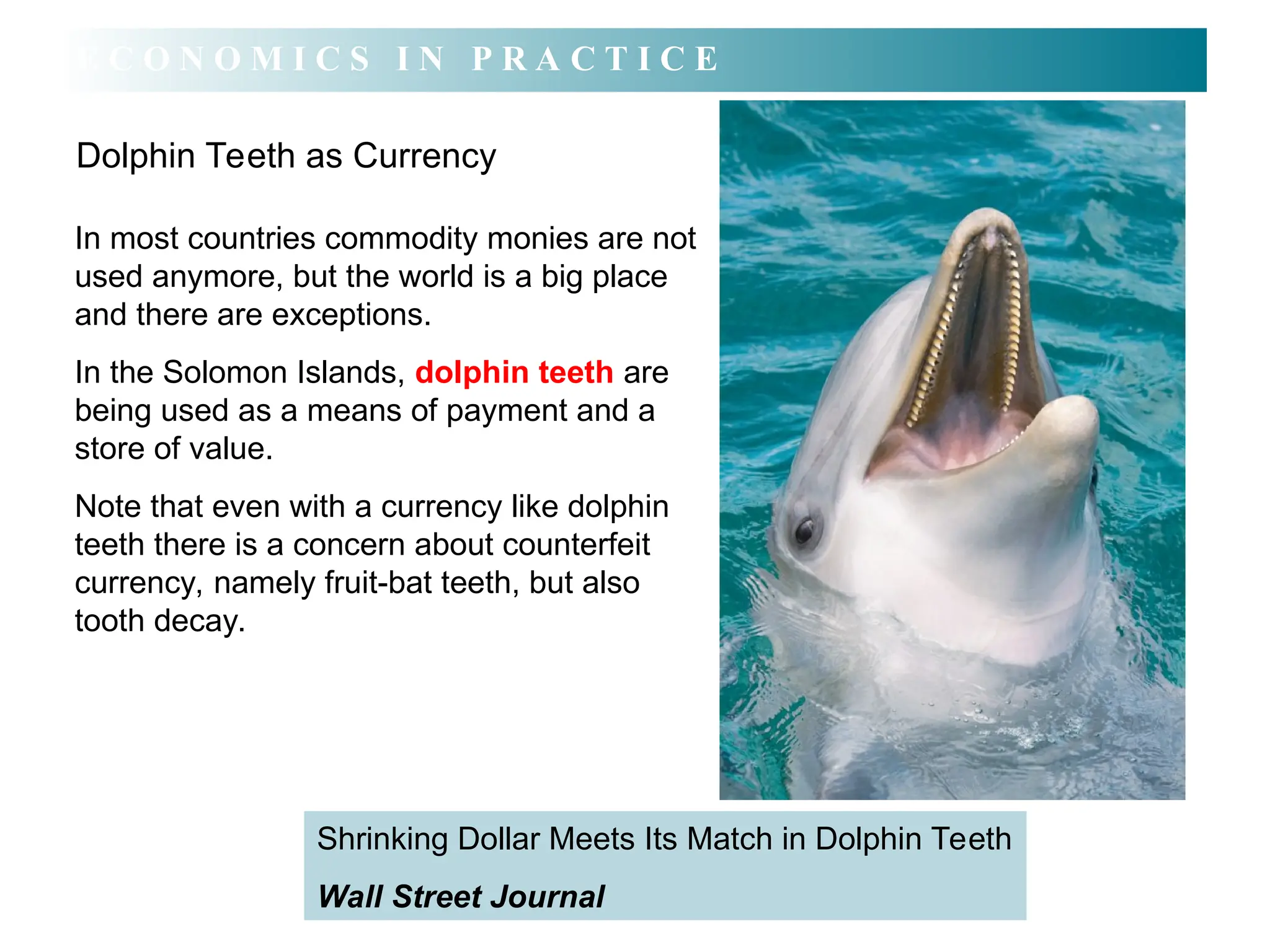
In most countries commodity monies are not
used anymore, but the world is a big place
and there are exceptions.
In the Solomon Islands, dolphin teeth are
being used as a means of payment and a
store of value.
Note that even with a currency like dolphin
teeth there is a concern about counterfeit
currency, namely fruit-bat teeth, but also
tooth decay.
Dolphin Teeth as Currency
E C O N O M I C S I N P R A C T I C E
Shrinking Dollar Meets Its Match in Dolphin Teeth
Wall Street Journal
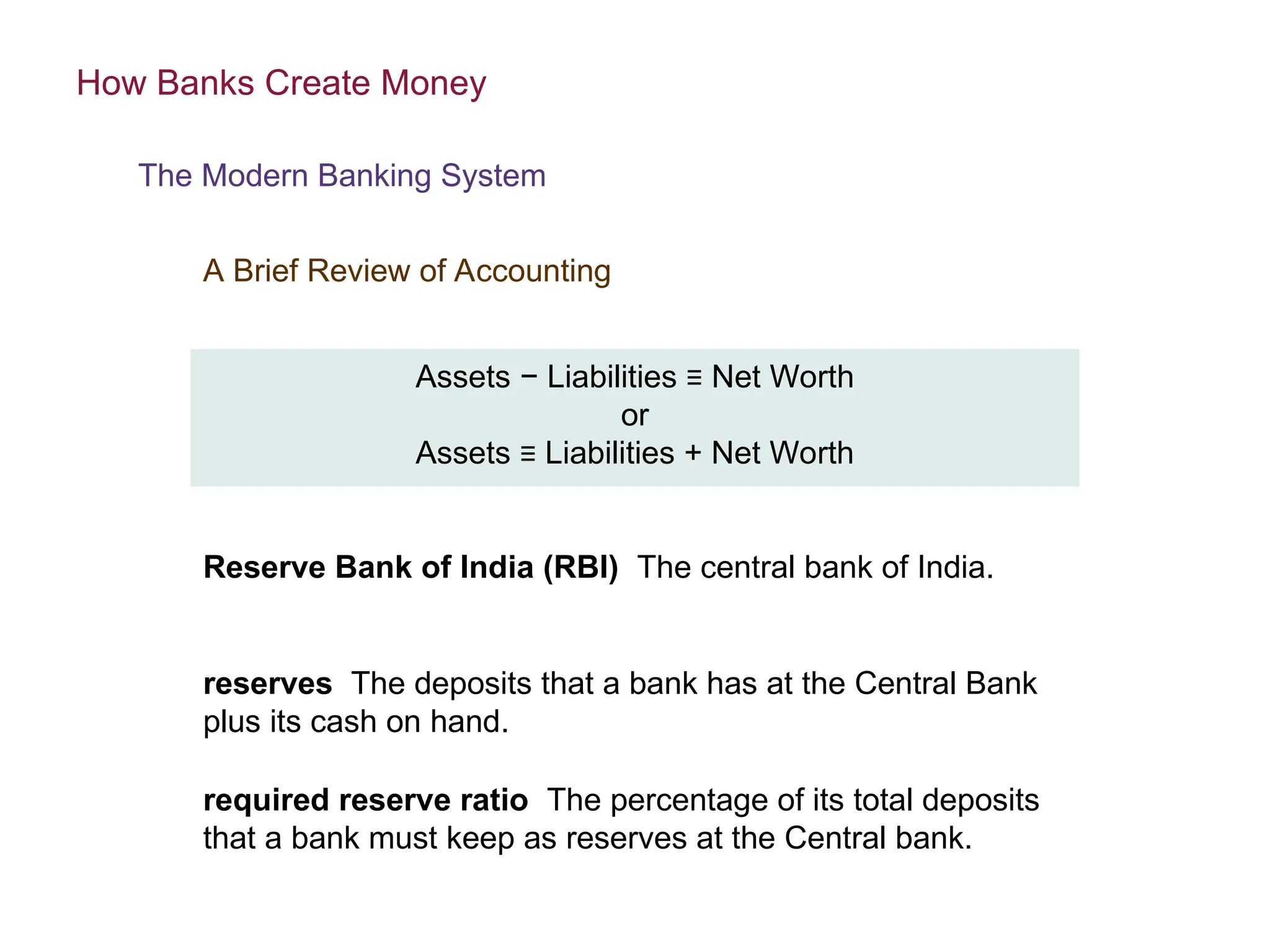
Assets − Liabilities ≡ Net Worth
or
Assets ≡ Liabilities + Net Worth
Reserve Bank of India (RBI) The central bank of India.
How Banks Create Money
The Modern Banking System
A Brief Review of Accounting
reserves The deposits that a bank has at the Central Bank
plus its cash on hand.
required reserve ratio The percentage of its total deposits
that a bank must keep as reserves at the Central bank.
•Assets are things that a firm owns something.
•A Banks asset are loans, cash, reserves, securities,
bonds
•Liabilities are firm’s debt – what it owes.
•Banks liabilities are deposits owed to customers
•Net Worth represents the value of the firms to its
stockholders/owners.
•Banks are legally required to hold a certain minimum
percentage of their deposit liabilities as reserves.
•The percentage is the required reserve ratio or cash
reserve ratio.
10 of 36
HOW BANKS CREATE MONEY
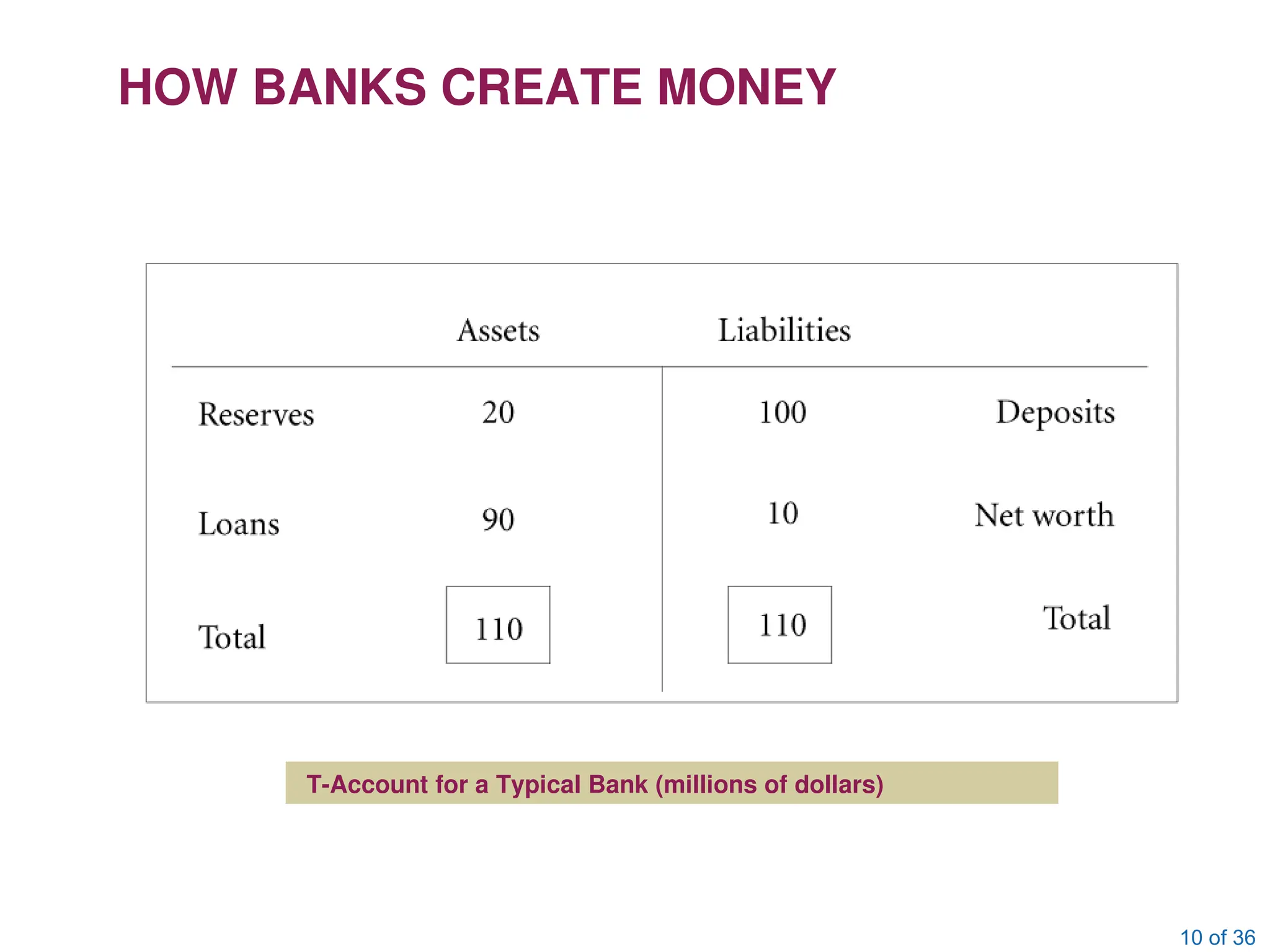
T-Account for a Typical Bank (millions of dollars)
11 of 36
HOW BANKS CREATE MONEY
Reserves The deposits that a bank has at the central
bank plus its cash on hand.
Required reserve ratio The percentage of its total
deposits that a bank must keep as reserves at the
central bank.
When some item on a bank’s balance sheet changes,
there must be at least one other change somewhere
else to maintain balance.
• If Bank’s reserve increases by 1 crore, the one of
the following may happen:
•1) loan decreased by 1 crore
•2) deposits increased by 1 crore
•3) net worth increased by 1 crore
12 of 36
HOW BANKS CREATE MONEY
Excess reserves The difference between a bank’s
actual reserves and its required reserves.
Banks usually make loans up to the point where they can no
longer do so because of the reserve requirement restriction.
THE CREATION OF MONEY
excess reserves ≡ actual reserves −
required reserves
13 of 36
HOW BANKS CREATE MONEY
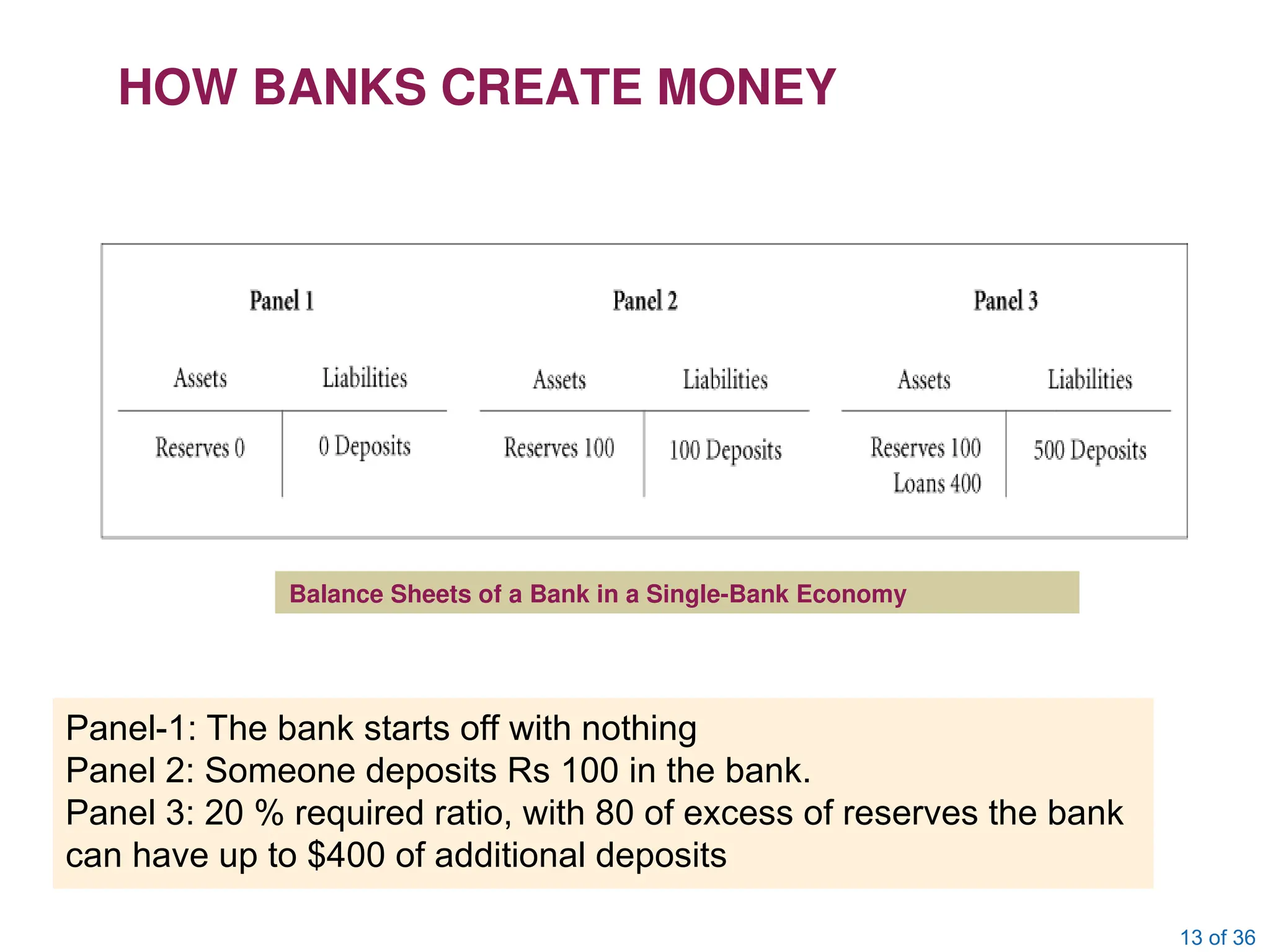
Balance Sheets of a Bank in a Single-Bank Economy
Panel-1: The bank starts off with nothing
Panel 2: Someone deposits Rs 100 in the bank.
Panel 3: 20 % required ratio, with 80 of excess of reserves the bank
can have up to $400 of additional deposits
14 of 36
HOW BANKS CREATE MONEY
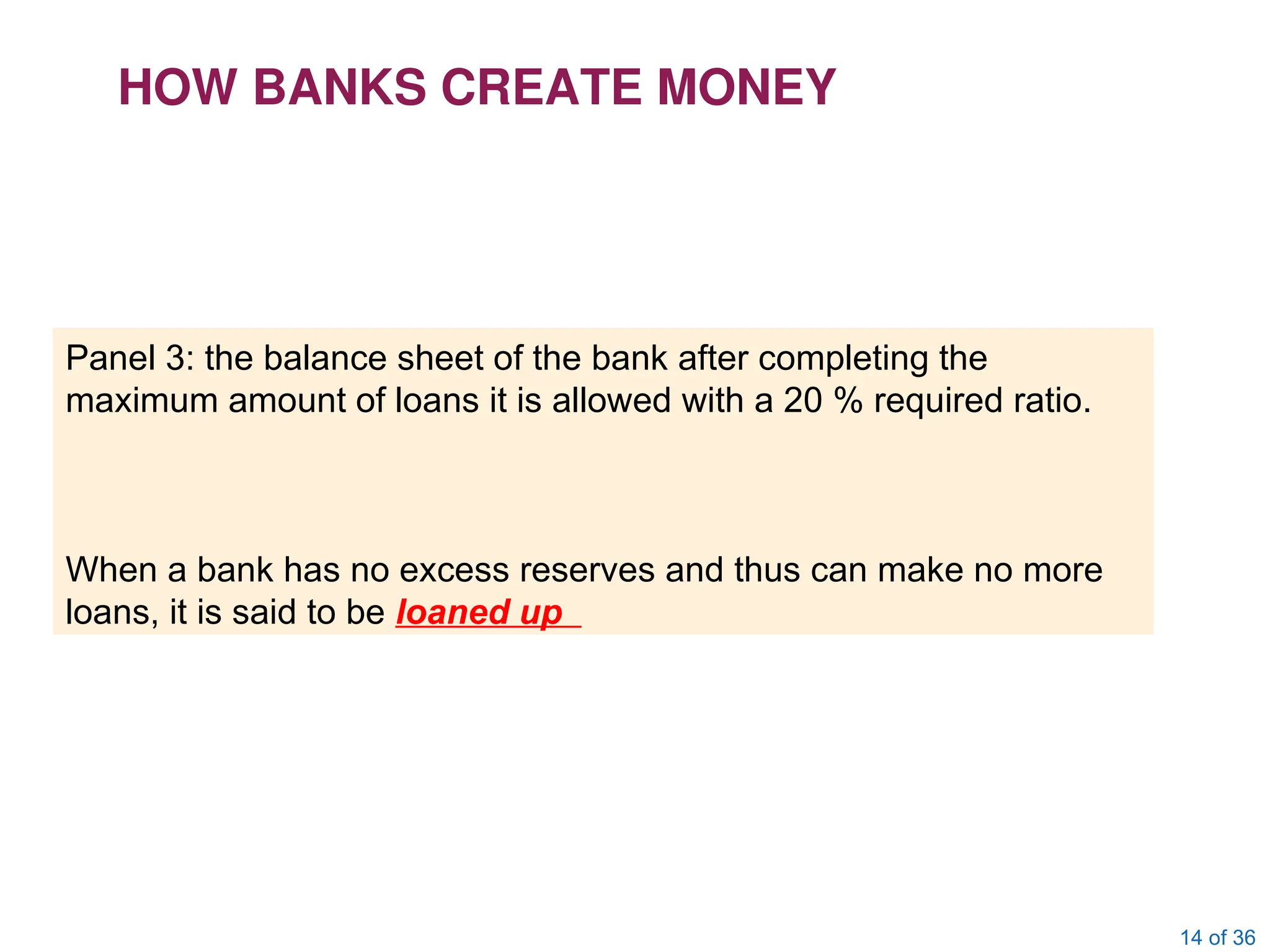
Panel 3: the balance sheet of the bank after completing the
maximum amount of loans it is allowed with a 20 % required ratio.
When a bank has no excess reserves and thus can make no more
loans, it is said to be loaned up
15 of 36
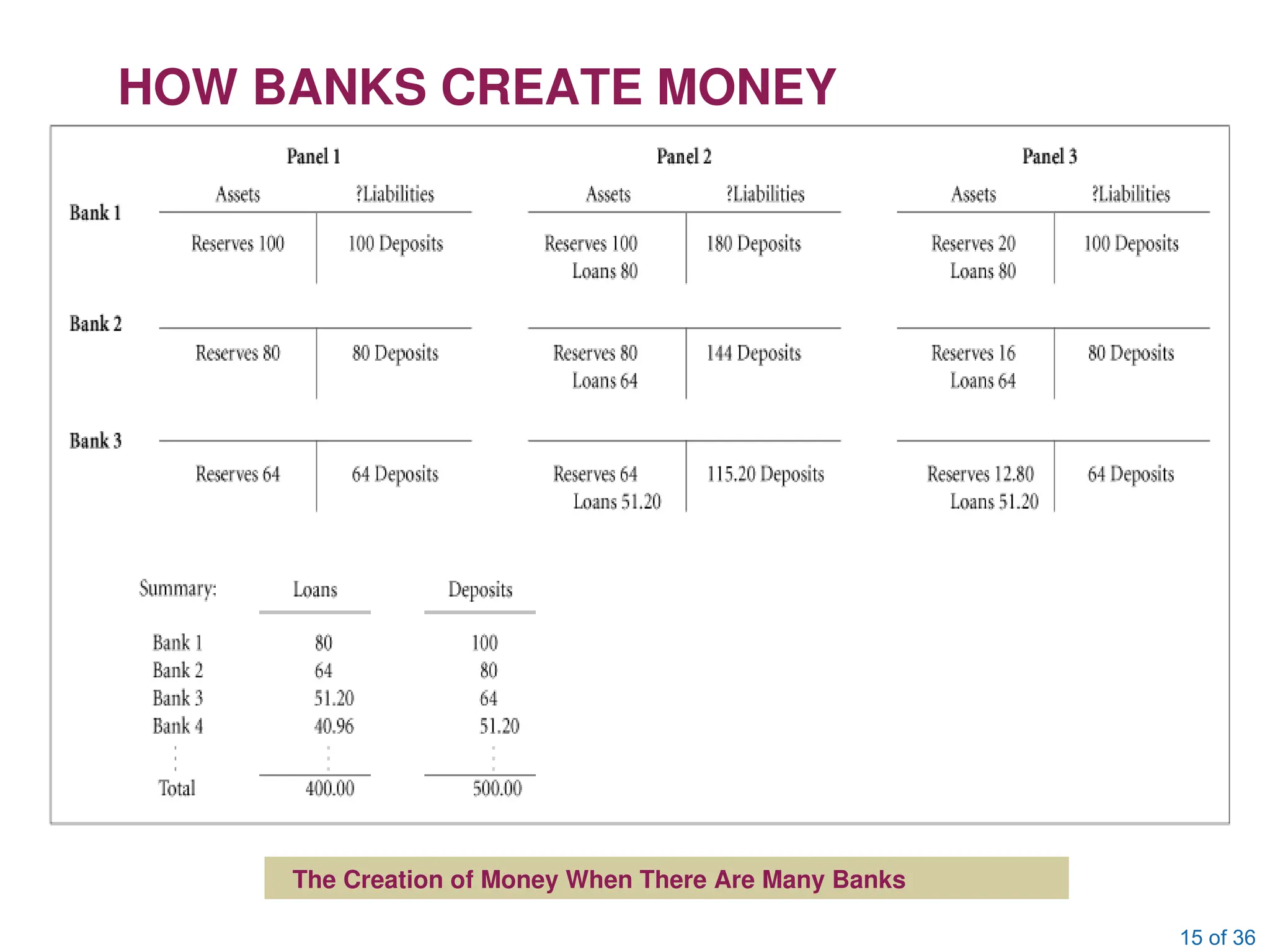
HOW BANKS CREATE MONEY
The Creation of Money When There Are Many Banks
16 of 36
HOW BANKS CREATE MONEY
Money multiplier The multiple by which deposits can
increase for every dollar increase in reserves; equal to 1
divided by the required reserve ratio.
• An increase in bank reserves leads to a greater than one-for-one
increase in the money supply.
•Economists call the relationship between the final change in deposits and
the change in reserves that caused this change the money
multiplier.
•Stated somewhat differently, the money multiplier is the multiple by which
deposits can increase for every dollar increase in reserves.
THE MONEY MULTIPLIER
ratio
reserve
required
1
multiplier
money 
17 of 36
The Central Banking System
The funds move at the speed of electricity from one
computer account to another.
FUNCTIONS
Clearing Interbank Payments
Functions of RBI:
1) Issue of currency notes
2) Banker to other banks (lender of last resort)
3) Banker to the Govt.
4) Exchange rate management
5) Credit control function through the commercial banks
18 of 36
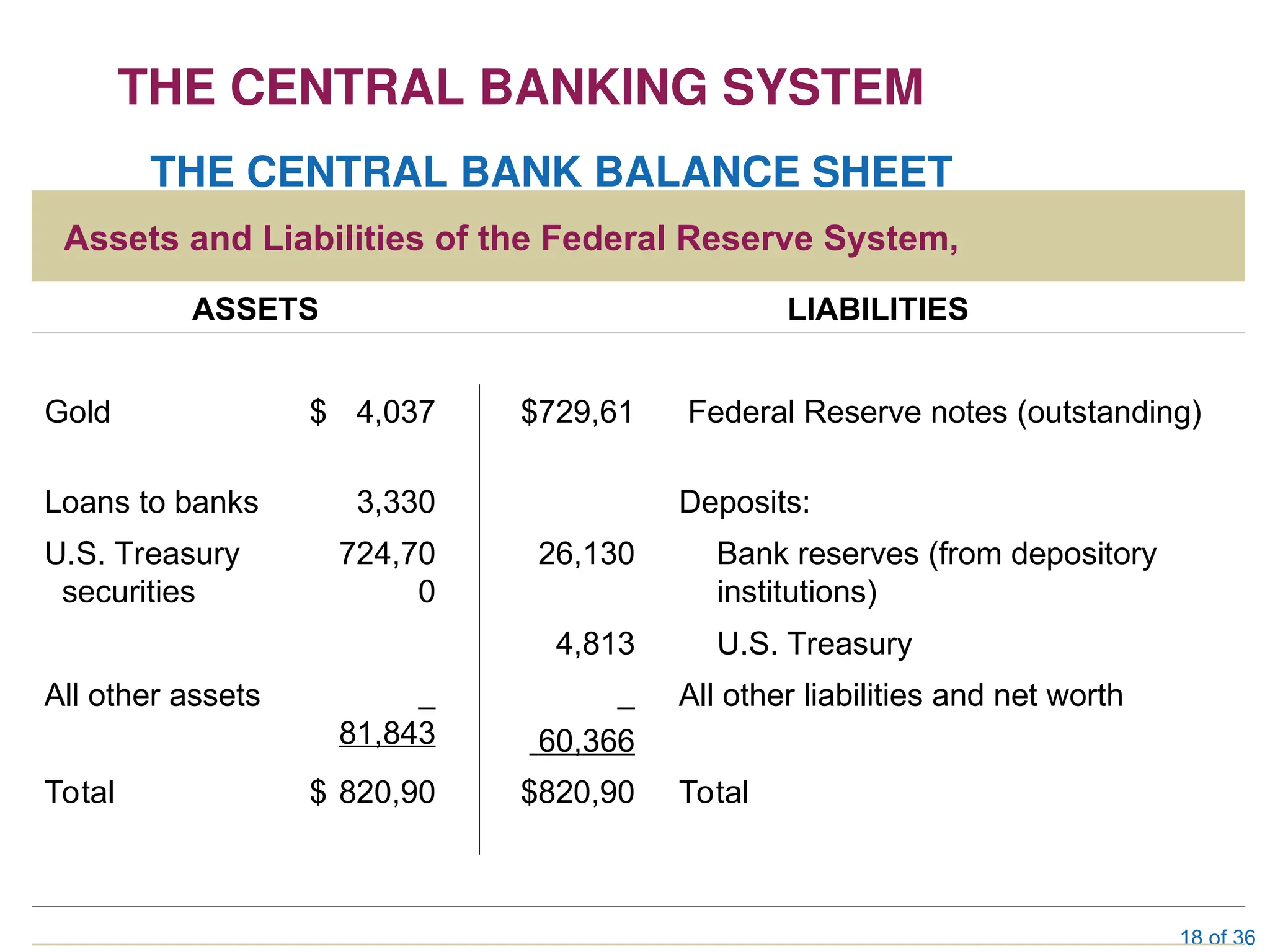
THE CENTRAL BANKING SYSTEM
THE CENTRAL BANK BALANCE SHEET
Assets and Liabilities of the Federal Reserve System,
ASSETS LIABILITIES
Gold $ 4,037 $729,61 Federal Reserve notes (outstanding)
Loans to banks 3,330 Deposits:
U.S. Treasury
securities
724,70
0
26,130 Bank reserves (from depository
institutions)
4,813 U.S. Treasury
All other assets
81,843 60,366
All other liabilities and net worth
Total $ 820,90 $820,90 Total
CONTROL OF MONEY SUPPLY
• RRR/CRR establishes a link between the
reserves of the commercial banks and
deposits that the bank allowed to keep.
• If rrr is 20%, each Rs.1 reserves can support
Rs.5 in deposits.
• (Reserves of Rs100000 can’t have more than
Rs 5,00,000 in deposits
• Again Money supply = Deposits inside the
banks + currency in circulation outside banks.
20 of 36
HOW THE CENTRAL BANK CONTROLS
THE MONEY SUPPLY
• If the Central Bank wants to increase the supply of
money, it creates more reserves, thereby freeing
banks to create additional deposits by making more
loans.
•If it wants to decrease the money supply, it reduces
reserves.
Three tools are available for changing the money supply:
(1) changing the required reserve ratio;
(2) changing the discount rate; and
(3) engaging in open market operations.
21 of 36
HOW THE CENTRAL BANK CONTROLS THE MONEY SUPPLY
A Decrease in the Required Reserve Ratio from 20 Percent to 12.5 Percent Increases the
Supply of Money
PANEL 1: REQUIRED RESERVE RATIO = 20%
Federal Reserve Commercial Banks
Assets Liabilities Assets Liabilities
Government $200 $100 Reserves Reserves $100 $500 Deposits
securities $100 Currency Loans $400
Note: Money supply (M1) = Currency + Deposits = $600.
PANEL 2: REQUIRED RESERVE RATIO = 12.5%
Federal Reserve Commercial Banks
Assets Liabilities Assets Liabilities
Government $200 $100 Reserves Reserves $100 $800 Deposits
securities $100 Currency Loans
(+ $300)
$700 (+ $300)
Note: Money supply (M1) = Currency + Deposits = $900.
THE REQUIRED RESERVE RATIO
22 of 36
HOW THE CENTRAL BANK CONTROLS
THE MONEY SUPPLY
Decreases in the required reserve ratio allow banks to have more
deposits with the existing volume of reserves.
As banks create more deposits by making loans, the supply of
money (currency + deposits) increases.
The reverse is also true: If the Fed wants to restrict the supply of
money, it can raise the required reserve ratio, in which case banks
will find that they have insufficient reserves and must therefore
reduce their deposits by “calling in” some of their loans.
The result is a decrease in the money supply.
23 of 36
HOW THE CENTRAL BANK CONTROLS
THE MONEY SUPPLY
THE DISCOUNT RATE
discount rate Interest rate that banks pay
to the central bank to borrow from it.
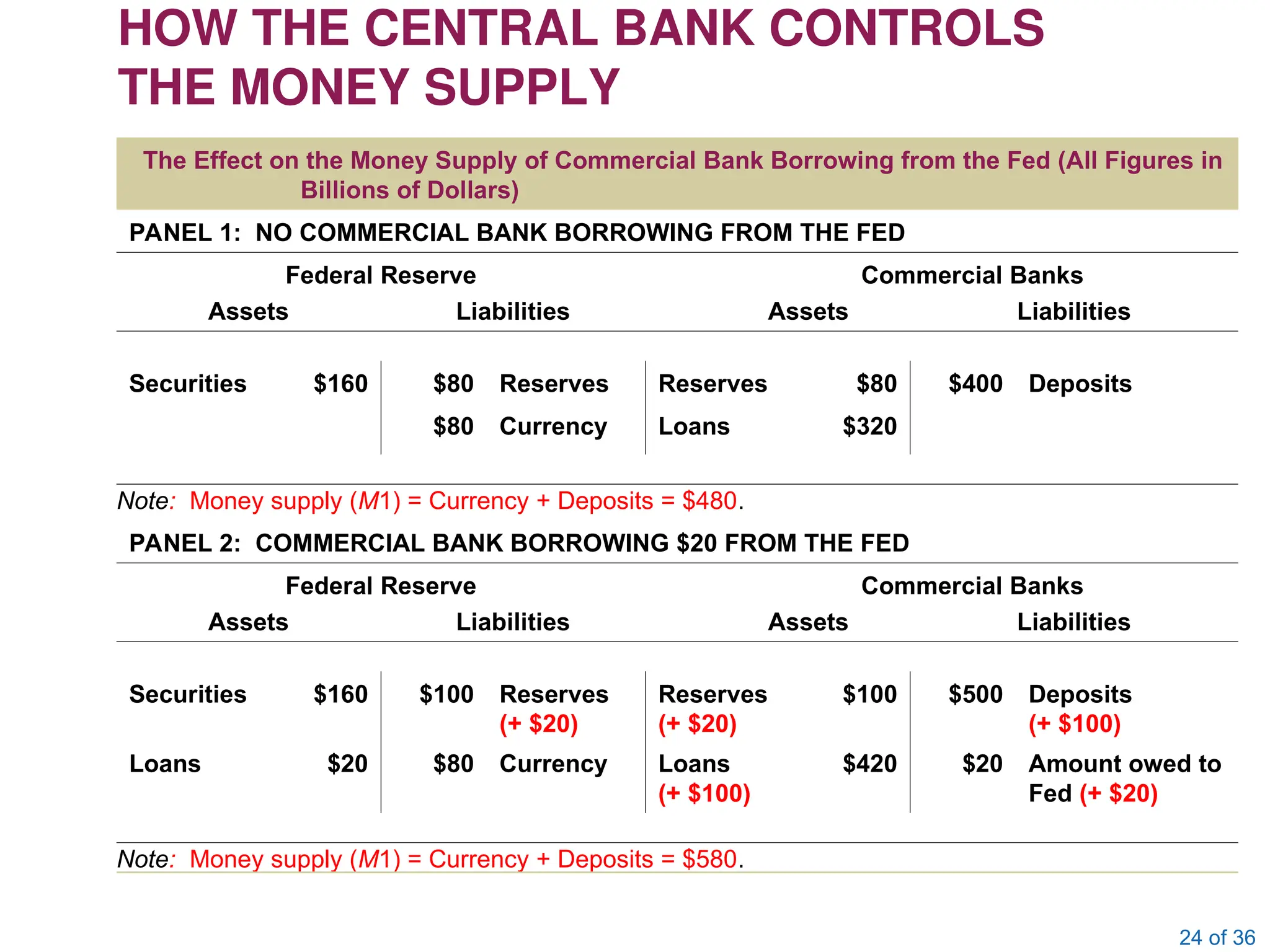
Bank borrowing from the Fed leads to an increase in the money supply.
24 of 36
HOW THE CENTRAL BANK CONTROLS
THE MONEY SUPPLY
The Effect on the Money Supply of Commercial Bank Borrowing from the Fed (All Figures in
Billions of Dollars)
PANEL 1: NO COMMERCIAL BANK BORROWING FROM THE FED
Federal Reserve Commercial Banks
Assets Liabilities Assets Liabilities
Securities $160 $80 Reserves Reserves $80 $400 Deposits
$80 Currency Loans $320
Note: Money supply (M1) = Currency + Deposits = $480.
PANEL 2: COMMERCIAL BANK BORROWING $20 FROM THE FED
Federal Reserve Commercial Banks
Assets Liabilities Assets Liabilities
Securities $160 $100 Reserves
(+ $20)
Reserves
(+ $20)
$100 $500 Deposits
(+ $100)
Loans $20 $80 Currency Loans
(+ $100)
$420 $20 Amount owed to
Fed (+ $20)
Note: Money supply (M1) = Currency + Deposits = $580.
25 of 36
HOW THE CENTRAL BANK CONTROLS
THE MONEY SUPPLY
The higher the discount rate, the higher the cost of borrowing, and the less borrowing
banks will want to do.
The Fed can influence bank borrowing, and thus the money
supply, through the discount rate:
moral suasion The pressure that in the past the Fed
exerted on member banks to discourage them from
borrowing heavily from the Fed.
26 of 36
HOW THE CENTRAL BANK CONTROLS
THE MONEY SUPPLY
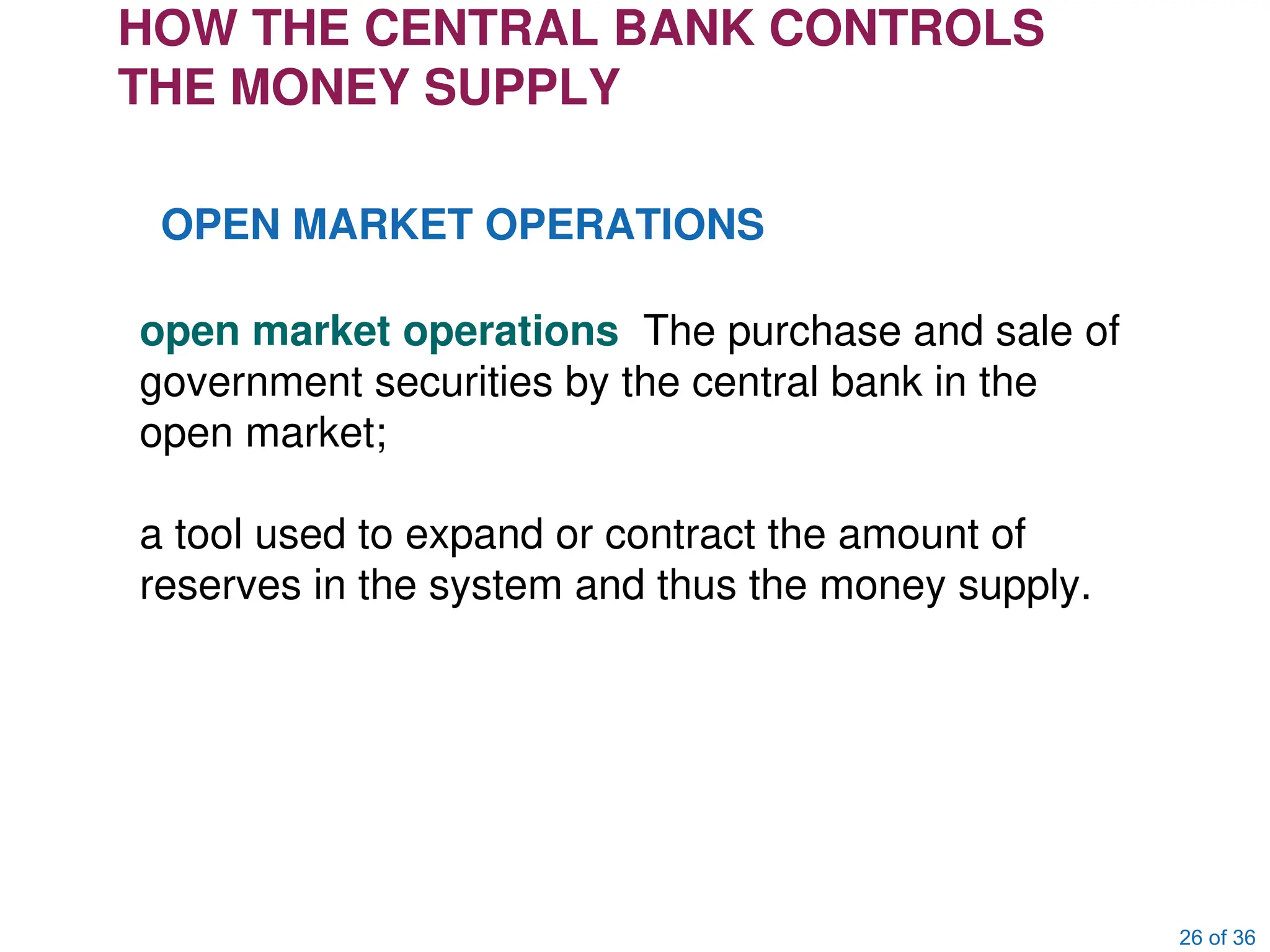
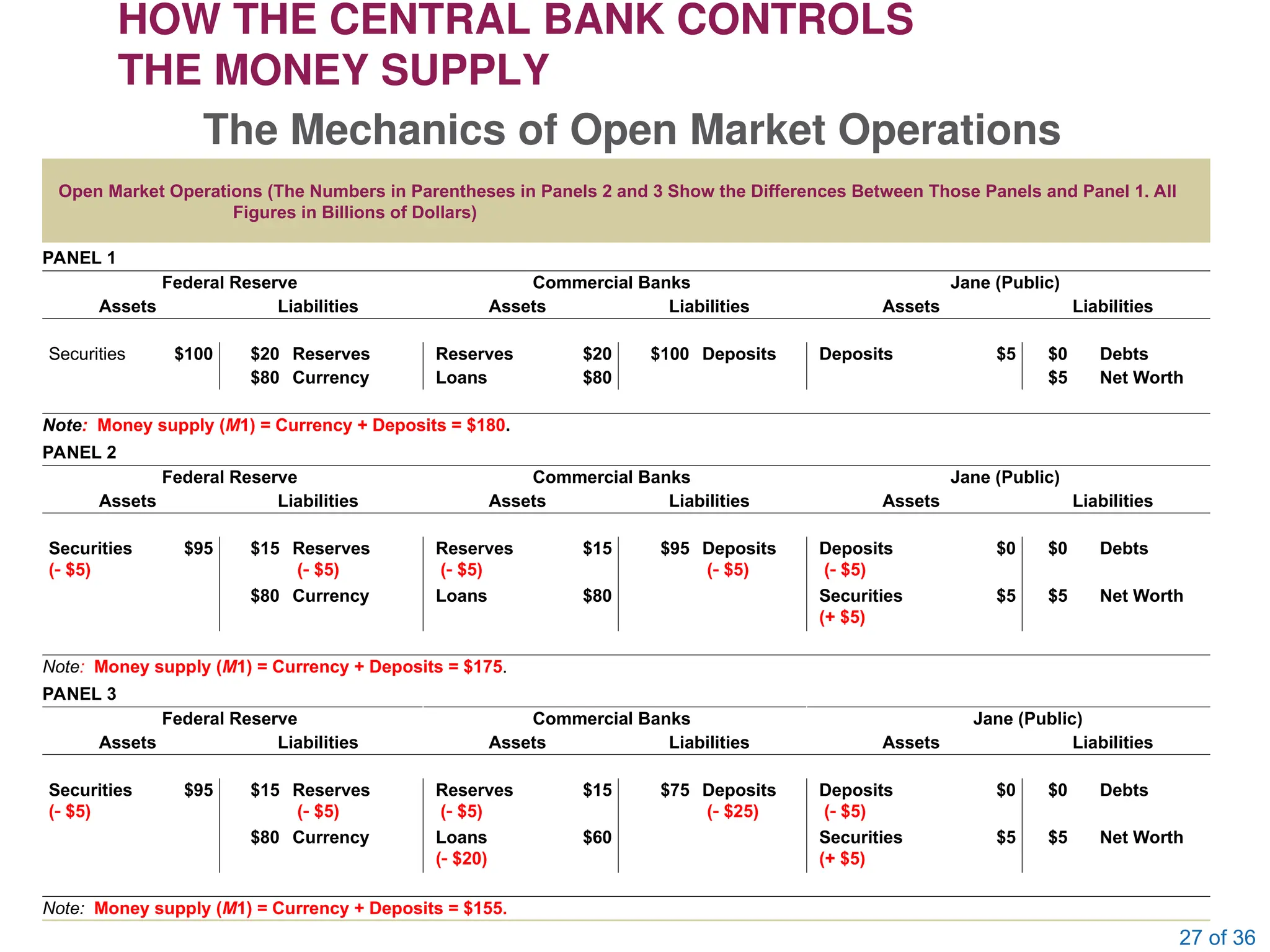
OPEN MARKET OPERATIONS
open market operations The purchase and sale of
government securities by the central bank in the
open market;
a tool used to expand or contract the amount of
reserves in the system and thus the money supply.
27 of 36
HOW THE CENTRAL BANK CONTROLS
THE MONEY SUPPLY
The Mechanics of Open Market Operations
Open Market Operations (The Numbers in Parentheses in Panels 2 and 3 Show the Differences Between Those Panels and Panel 1. All
Figures in Billions of Dollars)
PANEL 1
Federal Reserve Commercial Banks Jane (Public)
Assets Liabilities Assets Liabilities Assets Liabilities
Securities $100 $20 Reserves Reserves $20 $100 Deposits Deposits $5 $0 Debts
$80 Currency Loans $80 $5 Net Worth
Note: Money supply (M1) = Currency + Deposits = $180. $80 Currency
PANEL 2
Federal Reserve Commercial Banks Jane (Public)
Assets Liabilities Assets Liabilities Assets Liabilities
Securities
( $5)
$95 $15 Reserves
( $5)
Reserves
( $5)
$15 $95 Deposits
( $5)
Deposits
( $5)
$0 $0 Debts
$80 Currency Loans $80 Securities
(+ $5)
$5 $5 Net Worth
Note: Money supply (M1) = Currency + Deposits = $175.
PANEL 3
Federal Reserve Commercial Banks Jane (Public)
Assets Liabilities Assets Liabilities Assets Liabilities
Securities
( $5)
$95 $15 Reserves
( $5)
Reserves
( $5)
$15 $75 Deposits
( $25)
Deposits
( $5)
$0 $0 Debts
$80 Currency Loans
( $20)
$60 Securities
(+ $5)
$5 $5 Net Worth
Note: Money supply (M1) = Currency + Deposits = $155.
28 of 36
HOW THE CENTRAL BANK CONTROLS
THE MONEY SUPPLY
■ An open market purchase of securities by the Fed
results in an increase in reserves and an increase
in the supply of money by an amount equal to the
money multiplier times the change in reserves.
■ An open market sale of securities by the Fed
results in a decrease in reserves and a decrease in
the supply of money by an amount equal to the
money multiplier times the change in reserves.
We can sum up the effect of these open market operations this way:

Money_Supply_and_Central_Bank_FFinance.ppt

  • 1.
    1 of 36 LectureOutline The Money Supply and the Central Banking System Private Banking System How Banks Create Money The Creation of Money The Money Multiplier The central banking System Functions Balance Sheet How the Central Bank Controls the Money Supply The Required Reserve Ratio The Discount Rate Open Market Operations
  • 2.
    The Private bankingSystem • Banks and other financial institutions borrow from individuals or firms with excess funds and lend to those who need funds. • That is the reason they are called Financial intermediaries. • The main types of financial intermediaries are: commercial banks, non-banking financial intermediaries, life insurance companies, pension funds etc.. • To understand how banks create money, consider the origin of the modern banking system • The origin of modern banking system is started with the goldsmith in 15th and 16th century.
  • 3.
    A Historical Perspective:Goldsmiths • Because, gold is both inconvenient to carry and has risk, people preferred to keep it with goldsmith. • On receiving gold, goldsmith would issue a receipt and charge a small amount for looking after his gold. • These receipts act a form of paper money, making unnecessary to go to goldsmith for withdrawals • At this time the receipts issued by the goldsmith = deposits of gold. • Goldsmith gradually realized that they could lend out some of the gold as loans. • They started earning interest rate on the loans • While giving loans they gave the receipts.
  • 4.
    A Historical Perspective:Goldsmiths • So, there are more receipts than the amount of gold with goldsmith  Small amount of Gold reserves were converted to huge amount of money in circulation.  Money creation by goldsmith is just a accounting procedure. • As people were not in need for gold they deposited, the Goldsmith issue multiple amount of “paper slips” and creates the money in circulation. • These receipts circulated as money and people used them to make transaction without feeling the need of cash. • This banking system works well as long as people remain confident on the banking system. Otherwise there will be run on a bank. • As people wants deposits rather than money to hold, hard cash or gold was necessary for transaction. • Run on bank may arise out of fear.
  • 5.
    store of valueAn asset that can be used to transport purchasing power from one time period to another. liquidity property of money The property of money that makes it a good medium of exchange as well as a store of value: It is portable and readily accepted and thus easily exchanged for goods. Unit of account A standard unit that provides a consistent way of quoting prices. An Overview of Money What Is Money? Medium of exchange: Eliminates the double-coincidence-of- wants problem Barter- Double coincidence of wants for trade .
  • 6.
    Commodity monies Itemsused as money that also have intrinsic value in some other use. (Prisoners of war made purchase with cigarettes) fiat, or token, money Items designated as money that are intrinsically worthless. legal tender Money that a government has required to be accepted in settlement of debts. currency debasement The decrease in the value of money that occurs when its supply is increased rapidly. An Overview of Money Commodity and Fiat Monies
  • 7.
    In most countriescommodity monies are not used anymore, but the world is a big place and there are exceptions. In the Solomon Islands, dolphin teeth are being used as a means of payment and a store of value. Note that even with a currency like dolphin teeth there is a concern about counterfeit currency, namely fruit-bat teeth, but also tooth decay. Dolphin Teeth as Currency E C O N O M I C S I N P R A C T I C E Shrinking Dollar Meets Its Match in Dolphin Teeth Wall Street Journal
  • 8.
    Assets − Liabilities≡ Net Worth or Assets ≡ Liabilities + Net Worth Reserve Bank of India (RBI) The central bank of India. How Banks Create Money The Modern Banking System A Brief Review of Accounting reserves The deposits that a bank has at the Central Bank plus its cash on hand. required reserve ratio The percentage of its total deposits that a bank must keep as reserves at the Central bank.
  • 9.
    •Assets are thingsthat a firm owns something. •A Banks asset are loans, cash, reserves, securities, bonds •Liabilities are firm’s debt – what it owes. •Banks liabilities are deposits owed to customers •Net Worth represents the value of the firms to its stockholders/owners. •Banks are legally required to hold a certain minimum percentage of their deposit liabilities as reserves. •The percentage is the required reserve ratio or cash reserve ratio.
  • 10.
    10 of 36 HOWBANKS CREATE MONEY T-Account for a Typical Bank (millions of dollars)
  • 11.
    11 of 36 HOWBANKS CREATE MONEY Reserves The deposits that a bank has at the central bank plus its cash on hand. Required reserve ratio The percentage of its total deposits that a bank must keep as reserves at the central bank. When some item on a bank’s balance sheet changes, there must be at least one other change somewhere else to maintain balance. • If Bank’s reserve increases by 1 crore, the one of the following may happen: •1) loan decreased by 1 crore •2) deposits increased by 1 crore •3) net worth increased by 1 crore
  • 12.
    12 of 36 HOWBANKS CREATE MONEY Excess reserves The difference between a bank’s actual reserves and its required reserves. Banks usually make loans up to the point where they can no longer do so because of the reserve requirement restriction. THE CREATION OF MONEY excess reserves ≡ actual reserves − required reserves
  • 13.
    13 of 36 HOWBANKS CREATE MONEY Balance Sheets of a Bank in a Single-Bank Economy Panel-1: The bank starts off with nothing Panel 2: Someone deposits Rs 100 in the bank. Panel 3: 20 % required ratio, with 80 of excess of reserves the bank can have up to $400 of additional deposits
  • 14.
    14 of 36 HOWBANKS CREATE MONEY Panel 3: the balance sheet of the bank after completing the maximum amount of loans it is allowed with a 20 % required ratio. When a bank has no excess reserves and thus can make no more loans, it is said to be loaned up
  • 15.
    15 of 36 HOWBANKS CREATE MONEY The Creation of Money When There Are Many Banks
  • 16.
    16 of 36 HOWBANKS CREATE MONEY Money multiplier The multiple by which deposits can increase for every dollar increase in reserves; equal to 1 divided by the required reserve ratio. • An increase in bank reserves leads to a greater than one-for-one increase in the money supply. •Economists call the relationship between the final change in deposits and the change in reserves that caused this change the money multiplier. •Stated somewhat differently, the money multiplier is the multiple by which deposits can increase for every dollar increase in reserves. THE MONEY MULTIPLIER ratio reserve required 1 multiplier money 
  • 17.
    17 of 36 TheCentral Banking System The funds move at the speed of electricity from one computer account to another. FUNCTIONS Clearing Interbank Payments Functions of RBI: 1) Issue of currency notes 2) Banker to other banks (lender of last resort) 3) Banker to the Govt. 4) Exchange rate management 5) Credit control function through the commercial banks
  • 18.
    18 of 36 THECENTRAL BANKING SYSTEM THE CENTRAL BANK BALANCE SHEET Assets and Liabilities of the Federal Reserve System, ASSETS LIABILITIES Gold $ 4,037 $729,61 Federal Reserve notes (outstanding) Loans to banks 3,330 Deposits: U.S. Treasury securities 724,70 0 26,130 Bank reserves (from depository institutions) 4,813 U.S. Treasury All other assets 81,843 60,366 All other liabilities and net worth Total $ 820,90 $820,90 Total
  • 19.
    CONTROL OF MONEYSUPPLY • RRR/CRR establishes a link between the reserves of the commercial banks and deposits that the bank allowed to keep. • If rrr is 20%, each Rs.1 reserves can support Rs.5 in deposits. • (Reserves of Rs100000 can’t have more than Rs 5,00,000 in deposits • Again Money supply = Deposits inside the banks + currency in circulation outside banks.
  • 20.
    20 of 36 HOWTHE CENTRAL BANK CONTROLS THE MONEY SUPPLY • If the Central Bank wants to increase the supply of money, it creates more reserves, thereby freeing banks to create additional deposits by making more loans. •If it wants to decrease the money supply, it reduces reserves. Three tools are available for changing the money supply: (1) changing the required reserve ratio; (2) changing the discount rate; and (3) engaging in open market operations.
  • 21.
    21 of 36 HOWTHE CENTRAL BANK CONTROLS THE MONEY SUPPLY A Decrease in the Required Reserve Ratio from 20 Percent to 12.5 Percent Increases the Supply of Money PANEL 1: REQUIRED RESERVE RATIO = 20% Federal Reserve Commercial Banks Assets Liabilities Assets Liabilities Government $200 $100 Reserves Reserves $100 $500 Deposits securities $100 Currency Loans $400 Note: Money supply (M1) = Currency + Deposits = $600. PANEL 2: REQUIRED RESERVE RATIO = 12.5% Federal Reserve Commercial Banks Assets Liabilities Assets Liabilities Government $200 $100 Reserves Reserves $100 $800 Deposits securities $100 Currency Loans (+ $300) $700 (+ $300) Note: Money supply (M1) = Currency + Deposits = $900. THE REQUIRED RESERVE RATIO
  • 22.
    22 of 36 HOWTHE CENTRAL BANK CONTROLS THE MONEY SUPPLY Decreases in the required reserve ratio allow banks to have more deposits with the existing volume of reserves. As banks create more deposits by making loans, the supply of money (currency + deposits) increases. The reverse is also true: If the Fed wants to restrict the supply of money, it can raise the required reserve ratio, in which case banks will find that they have insufficient reserves and must therefore reduce their deposits by “calling in” some of their loans. The result is a decrease in the money supply.
  • 23.
    23 of 36 HOWTHE CENTRAL BANK CONTROLS THE MONEY SUPPLY THE DISCOUNT RATE discount rate Interest rate that banks pay to the central bank to borrow from it. Bank borrowing from the Fed leads to an increase in the money supply.
  • 24.
    24 of 36 HOWTHE CENTRAL BANK CONTROLS THE MONEY SUPPLY The Effect on the Money Supply of Commercial Bank Borrowing from the Fed (All Figures in Billions of Dollars) PANEL 1: NO COMMERCIAL BANK BORROWING FROM THE FED Federal Reserve Commercial Banks Assets Liabilities Assets Liabilities Securities $160 $80 Reserves Reserves $80 $400 Deposits $80 Currency Loans $320 Note: Money supply (M1) = Currency + Deposits = $480. PANEL 2: COMMERCIAL BANK BORROWING $20 FROM THE FED Federal Reserve Commercial Banks Assets Liabilities Assets Liabilities Securities $160 $100 Reserves (+ $20) Reserves (+ $20) $100 $500 Deposits (+ $100) Loans $20 $80 Currency Loans (+ $100) $420 $20 Amount owed to Fed (+ $20) Note: Money supply (M1) = Currency + Deposits = $580.
  • 25.
    25 of 36 HOWTHE CENTRAL BANK CONTROLS THE MONEY SUPPLY The higher the discount rate, the higher the cost of borrowing, and the less borrowing banks will want to do. The Fed can influence bank borrowing, and thus the money supply, through the discount rate: moral suasion The pressure that in the past the Fed exerted on member banks to discourage them from borrowing heavily from the Fed.
  • 26.
    26 of 36 HOWTHE CENTRAL BANK CONTROLS THE MONEY SUPPLY OPEN MARKET OPERATIONS open market operations The purchase and sale of government securities by the central bank in the open market; a tool used to expand or contract the amount of reserves in the system and thus the money supply.
  • 27.
    27 of 36 HOWTHE CENTRAL BANK CONTROLS THE MONEY SUPPLY The Mechanics of Open Market Operations Open Market Operations (The Numbers in Parentheses in Panels 2 and 3 Show the Differences Between Those Panels and Panel 1. All Figures in Billions of Dollars) PANEL 1 Federal Reserve Commercial Banks Jane (Public) Assets Liabilities Assets Liabilities Assets Liabilities Securities $100 $20 Reserves Reserves $20 $100 Deposits Deposits $5 $0 Debts $80 Currency Loans $80 $5 Net Worth Note: Money supply (M1) = Currency + Deposits = $180. $80 Currency PANEL 2 Federal Reserve Commercial Banks Jane (Public) Assets Liabilities Assets Liabilities Assets Liabilities Securities ( $5) $95 $15 Reserves ( $5) Reserves ( $5) $15 $95 Deposits ( $5) Deposits ( $5) $0 $0 Debts $80 Currency Loans $80 Securities (+ $5) $5 $5 Net Worth Note: Money supply (M1) = Currency + Deposits = $175. PANEL 3 Federal Reserve Commercial Banks Jane (Public) Assets Liabilities Assets Liabilities Assets Liabilities Securities ( $5) $95 $15 Reserves ( $5) Reserves ( $5) $15 $75 Deposits ( $25) Deposits ( $5) $0 $0 Debts $80 Currency Loans ( $20) $60 Securities (+ $5) $5 $5 Net Worth Note: Money supply (M1) = Currency + Deposits = $155.
  • 28.
    28 of 36 HOWTHE CENTRAL BANK CONTROLS THE MONEY SUPPLY ■ An open market purchase of securities by the Fed results in an increase in reserves and an increase in the supply of money by an amount equal to the money multiplier times the change in reserves. ■ An open market sale of securities by the Fed results in a decrease in reserves and a decrease in the supply of money by an amount equal to the money multiplier times the change in reserves. We can sum up the effect of these open market operations this way: