



DEMAND FOR
MONEY(The Speculative Motive and The Influence Of
Interest Rates On The Demand or Money)
3. The Speculative Motive
• Whereas the transactions and
precautionary motives emphasize
money’s role as a medium of exchange,
the speculative motive emphasizes its role
as a store of its wealth.
• A household or firm can hold its wealth in
money or in such interest-earning
assets as bonds.
• Speculative Balance — are
balances held in anticipation of fall in
the price of assets.
• This applies to anything that is bought
and sold, including stocks and
bonds.
4. The Influence Of Interest Rates
On The Demand For Money
• The interest rate affects each one.
• The market rate of interest reflects the
opportunity cost of money holdings (the money
could be lent to and earn the market rate)
• The higher the rate of interest, the higher
the cost of holding money and the less
money will be held for transactions and
precautionary purposes.
• The rate of interest also influences
decisions whether to hold money for
speculative purposes.
• This occurs because of the inverse
relationship between bonds and stocks.
• Liquidity preference thus refers to the
demand to hold assets in form of money
rather than as interest-earning wealth.
• Liquidity preference schedule is the
schedule relating the demand for money
to the interest rate.
THE ROOTS OF
BERNANKEISM
• A pair of economic breakthroughs that
emerged after the crisis ended has played
a huge role in how officials respond to
crisis today. One came from Irving Fisher
of Yale, the other from John Maynard
Keynes of Cambridge.
• Fisher believed the economy had become
stuck in a cycle of debt and deflation.
• Keynes, though he didn’t disagree with
Fisher’s account, he just didn’t think such
monetary action alone was powerful
enough to lift an economy out of the
Depression.
• Irving Fisher of
Yale
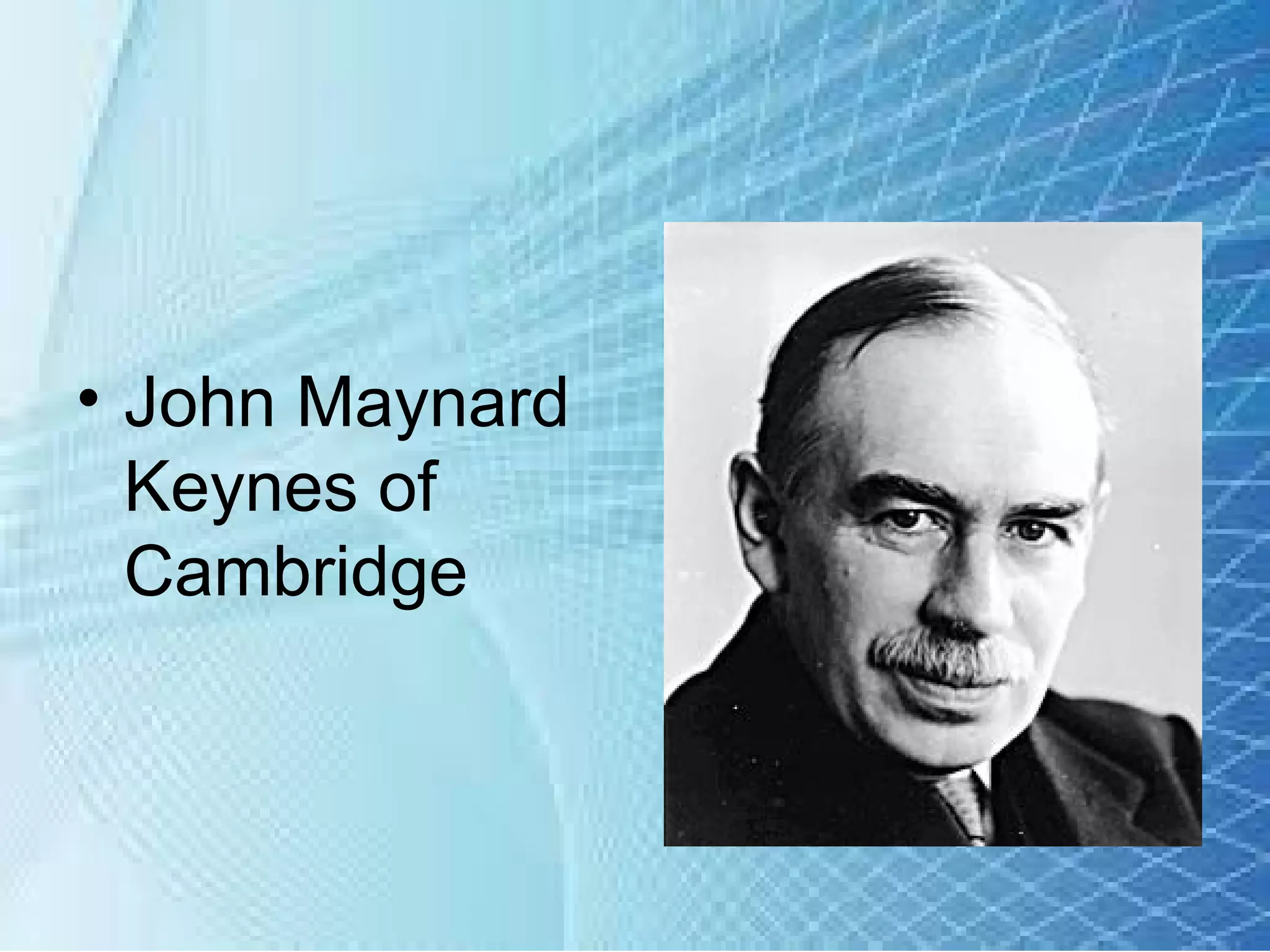
• John Maynard
Keynes of
Cambridge
Report in Finance I

Report in Finance I

  • 1.
    DEMAND FOR MONEY(The SpeculativeMotive and The Influence Of Interest Rates On The Demand or Money)
  • 2.
    3. The SpeculativeMotive • Whereas the transactions and precautionary motives emphasize money’s role as a medium of exchange, the speculative motive emphasizes its role as a store of its wealth. • A household or firm can hold its wealth in money or in such interest-earning assets as bonds.
  • 3.
    • Speculative Balance— are balances held in anticipation of fall in the price of assets. • This applies to anything that is bought and sold, including stocks and bonds.
  • 4.
    4. The InfluenceOf Interest Rates On The Demand For Money • The interest rate affects each one. • The market rate of interest reflects the opportunity cost of money holdings (the money could be lent to and earn the market rate) • The higher the rate of interest, the higher the cost of holding money and the less money will be held for transactions and precautionary purposes.
  • 5.
    • The rateof interest also influences decisions whether to hold money for speculative purposes. • This occurs because of the inverse relationship between bonds and stocks. • Liquidity preference thus refers to the demand to hold assets in form of money rather than as interest-earning wealth. • Liquidity preference schedule is the schedule relating the demand for money to the interest rate.
  • 6.
  • 7.
    • A pairof economic breakthroughs that emerged after the crisis ended has played a huge role in how officials respond to crisis today. One came from Irving Fisher of Yale, the other from John Maynard Keynes of Cambridge.
  • 8.
    • Fisher believedthe economy had become stuck in a cycle of debt and deflation. • Keynes, though he didn’t disagree with Fisher’s account, he just didn’t think such monetary action alone was powerful enough to lift an economy out of the Depression.
  • 9.
  • 10.