Child Welfare Services
Nuzhath Alam
Associate Professor
1
Alam Nuzhathalam
UNIT - VII Child Health Nursing
 Child Welfare Services and Agencies
ICDS
Mid Day Meal Program
Balwadi
Anganwadi
Day Care Centre's
NPSP
2
Alam Nuzhathalam
ICDS
3
Alam Nuzhathalam
INTRODUCTION
Integrated Child Development Service:
Scheme represents one of the world’s largest and
most unique programmes for early childhood
development. ICDS is the foremost symbol of India’s
commitment to her children. The main beneficiaries
of the programme were aimed to be the girl child
up to her adolescence, all children below 6 years of
age, pregnant and lactating mothers.
4
Alam Nuzhathalam
PURPOSE
 Routine MCH services not reaching target
population.
 Nutritional component not covered by
health services.
 Need for community participation
5
Alam Nuzhathalam
OBJECTIVES
 To improve the nutritional status of preschool children 0-6
years of age group.
 To lay the foundation of proper psychological
development of the child
 To reduce the incidence of mortality, morbidity malnutrition
and school drop out
 To achieve effective coordination of policy and
implementation in various departments to promote child
development
 To enhance the capability of the mother to look after the
normal health and nutritional needs of the child through
proper nutrition and health education
6
Alam Nuzhathalam
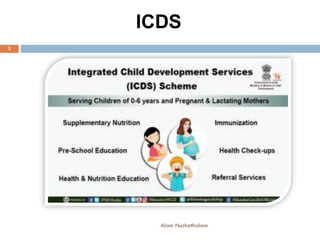
PACKAGE OF SERVICES
 Beneficiaries Services Pregnant women Health check up,
immunization, supplementary nutrition, health and nutrition
education.
 Nursing mothers Health check up, supplementary nutrition,
health and nutrition education
 Other women 15 – 45 years Nutrition and health education
Children less than 3 yrs Health check up, immunization,
supplementary nutrition, referral services
 Children in age 3 -6 yrs Health check up, immunization,
supplementary nutrition, referral services, non formal
education Adolescent girls 11 – 18 yrs.
 Supplementary nutrition and health education
7
Alam Nuzhathalam
COMPONENT OF ICDS
 Health Check-ups.
 Immunization.
 Growth Promotion and Supplementary
Feeding.
 Referral Services.
 Early Childhood Care and Pre-school
Education.
 Nutrition and Health Education.
8
Alam Nuzhathalam
IMMUNIZATION
 Immunization of children against 6 vaccine
preventable disease is being done, while for
expectant mothers, immunization against
tetanus is recommended.
9
Alam Nuzhathalam
HEALTH CHECK UP
 Record of weight and height of children at periodical
intervals
 Watch over milestones
 Immunization
 General check up for detection of disease
 Treatment of diseases like diarrhea, ARI
 Prophylaxis against vitamin A deficiency and anemia
 Referral of serious cases
 Antenatal care of expectant mothers
 Post natal care of nursing mothers and care of new born
infants
10
Alam Nuzhathalam
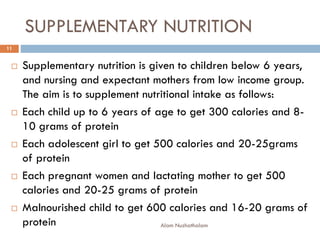
SUPPLEMENTARY NUTRITION
 Supplementary nutrition is given to children below 6 years,
and nursing and expectant mothers from low income group.
The aim is to supplement nutritional intake as follows:
 Each child up to 6 years of age to get 300 calories and 8-
10 grams of protein
 Each adolescent girl to get 500 calories and 20-25grams
of protein
 Each pregnant women and lactating mother to get 500
calories and 20-25 grams of protein
 Malnourished child to get 600 calories and 16-20 grams of
protein
11
Alam Nuzhathalam
Referral Services
 During health check-ups and growth monitoring,
sick or malnourished children, in need of prompt
medical attention, are referred to the Primary
Health Centre or its sub-centre. Nutrition and
Health Education: Health education is given to
women's so that they can look after their own
health, nutrition and development needs as well as
that of their children and families.
12
Alam Nuzhathalam
Non-formal Pre-School Education
 Children between the ages 3-6 years are imparted
non- formal pre-school education in an Anganwadi
in each village with about 1000 population. The
objective is to provide opportunities to develop
desirable attitude, values and behaviour pattern
among children. Locally produced inexpensive toys
and material are used in organizing play and
creative activity.
 NUTRITION & HEALTH EDUCATION
13
Alam Nuzhathalam
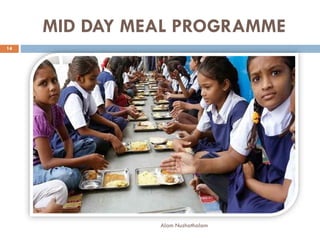
MID DAY MEAL PROGRAMME
14
Alam Nuzhathalam
MID DAY MEAL PROGRAMME
Introduction
Objectives
Advantages
Status
Achievement
15
Alam Nuzhathalam
INTRODUCTION
 In 1925, Mid day meal programme was introduced in
Madras, Tamilnadu.
 In 1980s three states viz Gujarat, Kerala, Tamil Nadu
and Pondicherry has cooked Mid day meal programme
with their own resources
 In 1990-91 the number of states implemented the mid
day meal programme with their own resources.
 15th August 1995 initially 2408 blocks in the country.
16
Alam Nuzhathalam
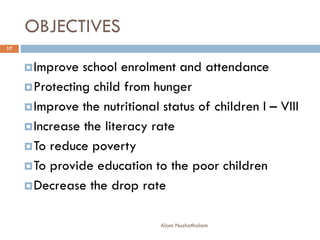
OBJECTIVES
Improve school enrolment and attendance
Protecting child from hunger
Improve the nutritional status of children I – VIII
Increase the literacy rate
To reduce poverty
To provide education to the poor children
Decrease the drop rate
17
Alam Nuzhathalam
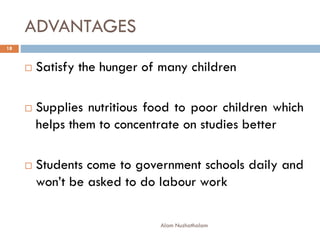
ADVANTAGES
 Satisfy the hunger of many children
 Supplies nutritious food to poor children which
helps them to concentrate on studies better
 Students come to government schools daily and
won’t be asked to do labour work
18
Alam Nuzhathalam
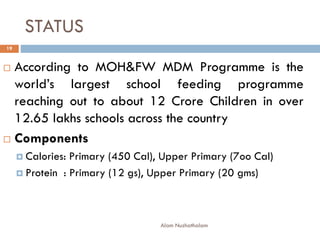
STATUS
 According to MOH&FW MDM Programme is the
world’s largest school feeding programme
reaching out to about 12 Crore Children in over
12.65 lakhs schools across the country
 Components
 Calories: Primary (450 Cal), Upper Primary (7oo Cal)
 Protein : Primary (12 gs), Upper Primary (20 gms)
19
Alam Nuzhathalam
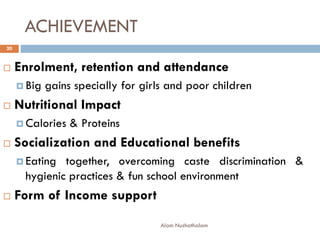
ACHIEVEMENT
 Enrolment, retention and attendance
 Big gains specially for girls and poor children
 Nutritional Impact
 Calories & Proteins
 Socialization and Educational benefits
 Eating together, overcoming caste discrimination &
hygienic practices & fun school environment
 Form of Income support
20
Alam Nuzhathalam
BALWADI PROGRAMME
 It is a health care and educational programme launched
by the GOI to provide food supplements at Balwadi to
the children of the age group 3-6 years in rural areas.
 The program was started in 1970 under the department
of social welfare, GOI.
 The food supplement provides 300 kilocalories of
energy and 10 grams of protein per day.
 It is being phased out because of the implementation of
ICDS programme.
21
Alam Nuzhathalam
ANGANWADI PROGRAM
 It is a type of rural child care centre in India. GOI
started in 1975 as a part of ICDS program to combat
child hunger and malnutrition.
 Benefits:
 Proper psychological, physical and social development of
the child
 To reduce the incidence of mortality, morbidity, malnutrition
and school drop out
 To achieve effective coordination of policy and
implementation against various departments to promote
child development.
22
Alam Nuzhathalam
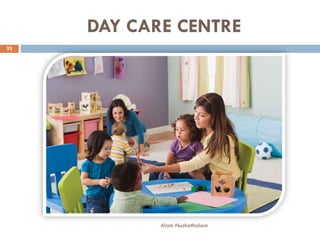
DAY CARE CENTRE
23
Alam Nuzhathalam
Day Care
 Child care, otherwise known as day care, is the care
and supervision of a child or multiple children at a
time.
 Day care refers to the care provided for infants and
toddlers, preschoolers, and school-aged children, either
in their own homes, in the home of a relative or other
caregiver, or in a center-based facility.
24
Alam Nuzhathalam
Types
 Child based care
 Family child care provider
 In-Home care givers
25
Alam Nuzhathalam
Center-based care
 Center-based care may also be labeled child or daycare
centers, nursery schools, or preschools.
 These facilities care for children in groups. They may have
different sponsors, including universities, schools, churches,
social service agencies, independent owners or chains, and
employers.
 Many parents choose center-based care because they
believe the presence of multiple caregivers, larger groups of
children, and state inspections make them both safer and
more dependable.
 Some parents also consider these types of centers a better
learning environment for their children.
26
Alam Nuzhathalam
Family childcare providers
 Family childcare providers offer care for children in the
provider's home.
 Requirements differ from state to state. However, the majority
of states require that providers be regulated if they are
watching more than four children.
 Many states may have a voluntary regulation process in
place for those providers caring for four or fewer children.
 Regulations usually require providers to meet minimum
health, safety and nutrition standards.
27
Alam Nuzhathalam
In-home caregivers
 In-home care occurs in the child's own home. This care
includes both live-in and live-out nannies and baby-sitters .
 Most in-home caregivers are not state-regulated.
 If in-home caregivers receive childcare subsidy payments,
they may be required by many states to have a criminal
background check done, and a very few states have
minimal health and safety training requirements.
28
Alam Nuzhathalam
New Parent Support Program (NPSP)
 The New Parent Support Program (NPSP) is a professional
team of social workers and nurses who focus on providing
one-on-one support for new parents. The
program helps parents, including expecting parents,
develop the skills they need to provide a nurturing
environment for their children.
 The New Parent Support Program (NPSP) offers parental
support through a variety of programs, services, and
referrals for parents and parents-to-be for a happy and
healthy including:
29
Alam Nuzhathalam
Cont….
Home Visits
Parenting classes for children up to 4 years of age
Strategies for dealing with the everyday
challenges of parenthood
Physical, social and emotional growth and
development
Coping with stresses of parenthood
Potty training
Lactation support
30
Alam Nuzhathalam
THANK YOU
31 Alam Nuzhathalam

Child Welfare Services

  • 1.
    Child Welfare Services NuzhathAlam Associate Professor 1 Alam Nuzhathalam
  • 2.
    UNIT - VIIChild Health Nursing  Child Welfare Services and Agencies ICDS Mid Day Meal Program Balwadi Anganwadi Day Care Centre's NPSP 2 Alam Nuzhathalam
  • 3.
  • 4.
    INTRODUCTION Integrated Child DevelopmentService: Scheme represents one of the world’s largest and most unique programmes for early childhood development. ICDS is the foremost symbol of India’s commitment to her children. The main beneficiaries of the programme were aimed to be the girl child up to her adolescence, all children below 6 years of age, pregnant and lactating mothers. 4 Alam Nuzhathalam
  • 5.
    PURPOSE  Routine MCHservices not reaching target population.  Nutritional component not covered by health services.  Need for community participation 5 Alam Nuzhathalam
  • 6.
    OBJECTIVES  To improvethe nutritional status of preschool children 0-6 years of age group.  To lay the foundation of proper psychological development of the child  To reduce the incidence of mortality, morbidity malnutrition and school drop out  To achieve effective coordination of policy and implementation in various departments to promote child development  To enhance the capability of the mother to look after the normal health and nutritional needs of the child through proper nutrition and health education 6 Alam Nuzhathalam
  • 7.
    PACKAGE OF SERVICES Beneficiaries Services Pregnant women Health check up, immunization, supplementary nutrition, health and nutrition education.  Nursing mothers Health check up, supplementary nutrition, health and nutrition education  Other women 15 – 45 years Nutrition and health education Children less than 3 yrs Health check up, immunization, supplementary nutrition, referral services  Children in age 3 -6 yrs Health check up, immunization, supplementary nutrition, referral services, non formal education Adolescent girls 11 – 18 yrs.  Supplementary nutrition and health education 7 Alam Nuzhathalam
  • 8.
    COMPONENT OF ICDS Health Check-ups.  Immunization.  Growth Promotion and Supplementary Feeding.  Referral Services.  Early Childhood Care and Pre-school Education.  Nutrition and Health Education. 8 Alam Nuzhathalam
  • 9.
    IMMUNIZATION  Immunization ofchildren against 6 vaccine preventable disease is being done, while for expectant mothers, immunization against tetanus is recommended. 9 Alam Nuzhathalam
  • 10.
    HEALTH CHECK UP Record of weight and height of children at periodical intervals  Watch over milestones  Immunization  General check up for detection of disease  Treatment of diseases like diarrhea, ARI  Prophylaxis against vitamin A deficiency and anemia  Referral of serious cases  Antenatal care of expectant mothers  Post natal care of nursing mothers and care of new born infants 10 Alam Nuzhathalam
  • 11.
    SUPPLEMENTARY NUTRITION  Supplementarynutrition is given to children below 6 years, and nursing and expectant mothers from low income group. The aim is to supplement nutritional intake as follows:  Each child up to 6 years of age to get 300 calories and 8- 10 grams of protein  Each adolescent girl to get 500 calories and 20-25grams of protein  Each pregnant women and lactating mother to get 500 calories and 20-25 grams of protein  Malnourished child to get 600 calories and 16-20 grams of protein 11 Alam Nuzhathalam
  • 12.
    Referral Services  Duringhealth check-ups and growth monitoring, sick or malnourished children, in need of prompt medical attention, are referred to the Primary Health Centre or its sub-centre. Nutrition and Health Education: Health education is given to women's so that they can look after their own health, nutrition and development needs as well as that of their children and families. 12 Alam Nuzhathalam
  • 13.
    Non-formal Pre-School Education Children between the ages 3-6 years are imparted non- formal pre-school education in an Anganwadi in each village with about 1000 population. The objective is to provide opportunities to develop desirable attitude, values and behaviour pattern among children. Locally produced inexpensive toys and material are used in organizing play and creative activity.  NUTRITION & HEALTH EDUCATION 13 Alam Nuzhathalam
  • 14.
    MID DAY MEALPROGRAMME 14 Alam Nuzhathalam
  • 15.
    MID DAY MEALPROGRAMME Introduction Objectives Advantages Status Achievement 15 Alam Nuzhathalam
  • 16.
    INTRODUCTION  In 1925,Mid day meal programme was introduced in Madras, Tamilnadu.  In 1980s three states viz Gujarat, Kerala, Tamil Nadu and Pondicherry has cooked Mid day meal programme with their own resources  In 1990-91 the number of states implemented the mid day meal programme with their own resources.  15th August 1995 initially 2408 blocks in the country. 16 Alam Nuzhathalam
  • 17.
    OBJECTIVES Improve school enrolmentand attendance Protecting child from hunger Improve the nutritional status of children I – VIII Increase the literacy rate To reduce poverty To provide education to the poor children Decrease the drop rate 17 Alam Nuzhathalam
  • 18.
    ADVANTAGES  Satisfy thehunger of many children  Supplies nutritious food to poor children which helps them to concentrate on studies better  Students come to government schools daily and won’t be asked to do labour work 18 Alam Nuzhathalam
  • 19.
    STATUS  According toMOH&FW MDM Programme is the world’s largest school feeding programme reaching out to about 12 Crore Children in over 12.65 lakhs schools across the country  Components  Calories: Primary (450 Cal), Upper Primary (7oo Cal)  Protein : Primary (12 gs), Upper Primary (20 gms) 19 Alam Nuzhathalam
  • 20.
    ACHIEVEMENT  Enrolment, retentionand attendance  Big gains specially for girls and poor children  Nutritional Impact  Calories & Proteins  Socialization and Educational benefits  Eating together, overcoming caste discrimination & hygienic practices & fun school environment  Form of Income support 20 Alam Nuzhathalam
  • 21.
    BALWADI PROGRAMME  Itis a health care and educational programme launched by the GOI to provide food supplements at Balwadi to the children of the age group 3-6 years in rural areas.  The program was started in 1970 under the department of social welfare, GOI.  The food supplement provides 300 kilocalories of energy and 10 grams of protein per day.  It is being phased out because of the implementation of ICDS programme. 21 Alam Nuzhathalam
  • 22.
    ANGANWADI PROGRAM  Itis a type of rural child care centre in India. GOI started in 1975 as a part of ICDS program to combat child hunger and malnutrition.  Benefits:  Proper psychological, physical and social development of the child  To reduce the incidence of mortality, morbidity, malnutrition and school drop out  To achieve effective coordination of policy and implementation against various departments to promote child development. 22 Alam Nuzhathalam
  • 23.
  • 24.
    Day Care  Childcare, otherwise known as day care, is the care and supervision of a child or multiple children at a time.  Day care refers to the care provided for infants and toddlers, preschoolers, and school-aged children, either in their own homes, in the home of a relative or other caregiver, or in a center-based facility. 24 Alam Nuzhathalam
  • 25.
    Types  Child basedcare  Family child care provider  In-Home care givers 25 Alam Nuzhathalam
  • 26.
    Center-based care  Center-basedcare may also be labeled child or daycare centers, nursery schools, or preschools.  These facilities care for children in groups. They may have different sponsors, including universities, schools, churches, social service agencies, independent owners or chains, and employers.  Many parents choose center-based care because they believe the presence of multiple caregivers, larger groups of children, and state inspections make them both safer and more dependable.  Some parents also consider these types of centers a better learning environment for their children. 26 Alam Nuzhathalam
  • 27.
    Family childcare providers Family childcare providers offer care for children in the provider's home.  Requirements differ from state to state. However, the majority of states require that providers be regulated if they are watching more than four children.  Many states may have a voluntary regulation process in place for those providers caring for four or fewer children.  Regulations usually require providers to meet minimum health, safety and nutrition standards. 27 Alam Nuzhathalam
  • 28.
    In-home caregivers  In-homecare occurs in the child's own home. This care includes both live-in and live-out nannies and baby-sitters .  Most in-home caregivers are not state-regulated.  If in-home caregivers receive childcare subsidy payments, they may be required by many states to have a criminal background check done, and a very few states have minimal health and safety training requirements. 28 Alam Nuzhathalam
  • 29.
    New Parent SupportProgram (NPSP)  The New Parent Support Program (NPSP) is a professional team of social workers and nurses who focus on providing one-on-one support for new parents. The program helps parents, including expecting parents, develop the skills they need to provide a nurturing environment for their children.  The New Parent Support Program (NPSP) offers parental support through a variety of programs, services, and referrals for parents and parents-to-be for a happy and healthy including: 29 Alam Nuzhathalam
  • 30.
    Cont…. Home Visits Parenting classesfor children up to 4 years of age Strategies for dealing with the everyday challenges of parenthood Physical, social and emotional growth and development Coping with stresses of parenthood Potty training Lactation support 30 Alam Nuzhathalam
  • 31.
    THANK YOU 31 AlamNuzhathalam