COMPLICATIONS OF TONSILLITIS
INDICATIONS/ CONTRAINDICATIONS
TO TONSILLECTOMY
Dr.Usha MS,DLO
ANATOMY
• Palatine tonsils are 2 in number and
ovoid in shape
• Situated in the Tonsillar fossa in lateral
wall of oropharynx
• Tonsillar fossa- composed of 3 muscles
• Palatoglossus- anterior pillar
• Palatopharyngeal muscle- posterior pillar
• Superior constrictor muscle- laterally-
forms larger part of tonsillar bed
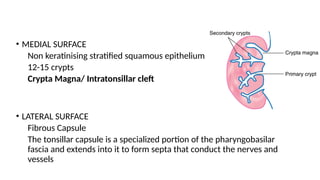
• MEDIAL SURFACE
Non keratinising stratified squamous epithelium
12-15 crypts
Crypta Magna/ Intratonsillar cleft
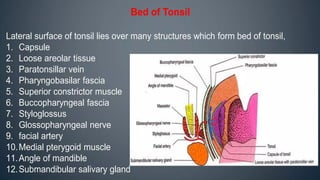
• LATERAL SURFACE
Fibrous Capsule
The tonsillar capsule is a specialized portion of the pharyngobasilar
fascia and extends into it to form septa that conduct the nerves and
vessels
• UPPER POLE:
Extends into the soft palate
Supratonsillar fossa- potential space enclosed in a semilunar fold,
extending between anterior and posterior pillar
Webers glands- tubular mucous glands located at the superior pole
of the tonsil. The glands send a common duct to the tonsil and
secrete saliva on to the surface of the tonsillar crypts. The glnds
maybe left behind. Following a tonsillectomy and are therefore a
potential source of Quincy after tonsillectomy
• LOWER POLE:
Attached to the tongue
Anterior tonsillar space- triangular fold of mucosa extends from
anterior pillar to anteroinferior part of tonsil enclosing a potential
space
Separated from the tongue by Tonsillolingual sulcus (Maybe a seat
of carcinoma)
• VENOUS DRAINAGE- Paratonsillar vein -> facial vein and pharyngeal
venous plexus
• LYMPHATIC DRAINAGE- Jugulodigastric Nodes
• NERVE SUPPLY- Lesser palatine branches of Sphenopalatine Ganglion,
Glossopharyngeal nerve
Referred Otalgia
Waldeyers Ring
ACUTE TONSILLITIS
• Acute infection and inflammation of palatine tonsils
• More common in school going children
AETIOLOGY
• BACTERIAL- Most common Group A beta hemolytic Streptococci
Staphylococci
Pneumococci
H. Influenza
• VIRAL- Influenza, Parainfluenza, Rhinovirus, Adenovirus, RSV,
Echovirus
CLASSIFICATION
• Acute catarrhal or
superficial tonsillitis-
When tonsils are inflamed as
part of the generalized
infection of the
oropharyngeal mucosa
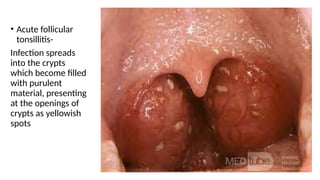
• Acute follicular
tonsillitis-
Infection spreads
into the crypts
which become filled
with purulent
material, presenting
at the openings of
crypts as yellowish
spots
• Acute parenchymatous tonsillitis-
When the whole tonsil is uniformly congested and swollen
• Acute membranous
tonsillitis-
Exudation from the
crypts coalesces to
form a membrane on
the surface of tonsil.
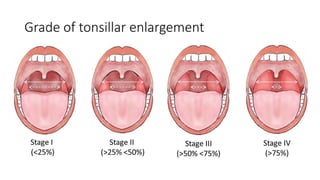
Grade of tonsillar enlargement
BRODSKY CLASSIFICATION
DD of unilateral tonsillar
enlargement
• Tonsillar causes
• Tonsillar malignancy
• Peritonsillar abscess
• Tonsillolith
• Tonsillar cyst
• Vincents angina
• Extra Tonsillar Causes
• Parapharyngeal abscess
• Parapharyngeal tumors
• Tumors of deep parotid lobe
• ICA aneurysm
• Cervical lymphadenopathy
Complications of tonsillitis
1. Chronic tonsillitis –
• Due to recurrent attacks
Types:
• Chronic Follicular Tonsillitis- tonsillar crypts are full of infected material, seen as
yellow spots on the surface
• Chronic Parenchymatous Tonsillitis- Hyperplasia of lymphoid tissue. Tonsils are
enlarged and may interfere with speech and deglutition. Sleep apnea may occur.
Long standing cases develop cor pulmonale
• Chronic Fibroid Tonsillitis- tonsils are small but infected, with h/o repeated sore
throat
Clinical Features:
• Recurrent attacks of sore throat
• Chronic cough
• Halitosis
• Thick speech, difficulty swallowing
4 cardinal signs of Chronic Tonsillitis:
• Flushing of anterior pillar
• Enlarged tonsils
• Irwin Moore sign
• Non tender JD nodes
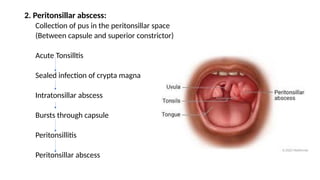
2. Peritonsillar abscess:
Collection of pus in the peritonsillar space
(Between capsule and superior constrictor)
Acute Tonsilltis
Sealed infection of crypta magna
Intratonsillar abscess
Bursts through capsule
Peritonsillitis
Peritonsillar abscess
• Organisms- Strep pyogens, Staph aureus, Anaerobic organisms
• Symptoms- Fever with chills and rigors
Malaise, Headache, Nausea, Constipation
Severe unilateral throat pain
Odynophagia
Hot potato voice
Foul breath
Ipsilatreal referred ear pain
Trismus- Spasm of pterygoid
• Signs:
Tonsillar pillars, tonsil, soft palate-
congestion
Uvula- swollen, pushed to
opposite side
Bugging soft palate
Mucous covering tonsillar region
Cervical lymphadenopathy
Torticollis
Treatment
• Hospitalization
• Iv fluids
• I’ve antibiotics
• Analgesics
• Incision and Drainage
• Interval tonsillectomy
• Hot tonsillectomy
3. Parapharyngeal abscess
• Also known as abscess of
pharyngomaxillary or lateral
pharyngeal space
• Due to acute/ chronic tonsillitis or
peritonsillar abscess
• Severe trismus
• Possibility of airway compression
• USG/ CT neck
• Treatment- IV antibiotics, Hydration, Analgesics, External drainage
4. Retropharyngeal abscess:
• Mainly in infants/ young children
• Infection tracks to lymphoid tissue
between posterior pharyngeal and
prevertebral fascia
• Systemically ill/ Airway compromise
• Investigations- X ray neck, USG, CT neck
• Treatment- High dose antibiotics
Urgent I&D, with airway protection
Usually drained per orally, but external drainage can be done
Tracheostomy maybe required
5. Cervical Abscess
Due to suppuration of JD node
6. Lemierre’s Syndrome
Rare, potentially fatal
Septic thrombophlebitis of IJV
Organism- Fusiform Bacillus
Severe neck pain, Septicemia
Investigations- USG neck- thrombus in neck
veins
Treatment- Prolonged antibiotics (6 weeks),
Anticoagulants
7. Immune complex disorders
• Acute Rheumatic fever- Joint pain, rashes, jerky body movement
• Acute Glomerulonephritis
• Subacute Bacterial Endocarditis- in patients with valvular heart
disease. Due to Strep viridans.
8. Grisels Syndrome- Subluxation of atlantoaxial joint from
inflammatory ligamentous laxity following an infectious process
9. Acute Otitis Media
10. Exacerbation of Psoriasis
12. Sleep Apnea-
Walls of the throat relax during sleep which causes breathing difficulties
and poor sleep
13. Scarlet Fever
Causes distinctive pink red skin rash
DD for white patch over tonsil
• Membranous tonsillitis
• Faucial diphtheria
• Infectious mononucleosis
• Candidiasis
• Vincents angina
• Leukemia
• Agranulocytosis
• Traumatic ulcer
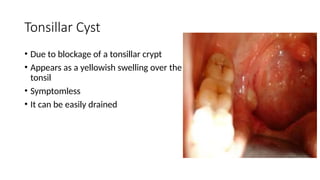
Tonsillar Cyst
• Due to blockage of a tonsillar crypt
• Appears as a yellowish swelling over the
tonsil
• Symptomless
• It can be easily drained
TONSILLECTOMY
SCOTTISH INTERCOLLEGIATE GUIDANCE NETWORK CRITERIA
Patient should meet all the criteria
• Sore throat due to Tonsilltis
• 5 or more episodes per year
• Symptoms for at least a year
• Episodes of disabling throat pain which prevents normal functioning
AMERICAN ACADEMY OF OTORHINOLARYNGOLOGISTS- HEAD AND
NECK SURGEONS (AAO HNS) GUIDELINES
• Tonsillectomy should be considered in all children with 3 or more
infections of tonsillitis/ adenoiditis per year despite adequate medical
therapy
Absolute Indications
• Recurrent infections of throat (Paradise Criteria)
• Peritonsillar abscess-
4-6 weeks after abscess is treated
2nd
attack is an absolute indication
• Tonsillitis which causes febrile seizures
• Hypertrophy of tonsils causing
Airway obstruction
Difficulty in deglutition
Interference with speech
• Suspicion of Malignancy-
Unilateral enlarged tonsil maybe lymphoma in children or
epidermoid carcinoma in adults
Relative Indications
• Diphtheria carriers not responding to antibiotics
• Streptococcal carriers
• Chronic Tonsilltis with bad taste/ halitosis unresponsive to medical
management
• Recurrent Streptococcal tonsillitis in patients with valvular disease
As a Part of Another Operation
• Palatopharyngoplasty- done for sleep apnea
• Glossopharyngeal Neurectomy
• Removal of styloid process
CONTRAINDICATIONS
• Hb level less than 10g%
• Presence of acute respiratory tract infection- Higher risk of bleeding
• Children under 3 year of age
• Overt or submucous cleft palate
• Bleeding disorder-
Von Willebrand disease, Lymphoma, Purpura, Aplastic aneamia,
Hemophilia, Sickle cell disease
• Epidemic of polio
• Uncontrolled systemic disease
• During period of menses
Thank you …

Tonsil ............... .

  • 1.
    COMPLICATIONS OF TONSILLITIS INDICATIONS/CONTRAINDICATIONS TO TONSILLECTOMY Dr.Usha MS,DLO
  • 2.
    ANATOMY • Palatine tonsilsare 2 in number and ovoid in shape • Situated in the Tonsillar fossa in lateral wall of oropharynx • Tonsillar fossa- composed of 3 muscles • Palatoglossus- anterior pillar • Palatopharyngeal muscle- posterior pillar • Superior constrictor muscle- laterally- forms larger part of tonsillar bed
  • 3.
    • MEDIAL SURFACE Nonkeratinising stratified squamous epithelium 12-15 crypts Crypta Magna/ Intratonsillar cleft • LATERAL SURFACE Fibrous Capsule The tonsillar capsule is a specialized portion of the pharyngobasilar fascia and extends into it to form septa that conduct the nerves and vessels
  • 6.
    • UPPER POLE: Extendsinto the soft palate Supratonsillar fossa- potential space enclosed in a semilunar fold, extending between anterior and posterior pillar Webers glands- tubular mucous glands located at the superior pole of the tonsil. The glands send a common duct to the tonsil and secrete saliva on to the surface of the tonsillar crypts. The glnds maybe left behind. Following a tonsillectomy and are therefore a potential source of Quincy after tonsillectomy
  • 7.
    • LOWER POLE: Attachedto the tongue Anterior tonsillar space- triangular fold of mucosa extends from anterior pillar to anteroinferior part of tonsil enclosing a potential space Separated from the tongue by Tonsillolingual sulcus (Maybe a seat of carcinoma)
  • 9.
    • VENOUS DRAINAGE-Paratonsillar vein -> facial vein and pharyngeal venous plexus • LYMPHATIC DRAINAGE- Jugulodigastric Nodes • NERVE SUPPLY- Lesser palatine branches of Sphenopalatine Ganglion, Glossopharyngeal nerve Referred Otalgia
  • 10.
  • 12.
    ACUTE TONSILLITIS • Acuteinfection and inflammation of palatine tonsils • More common in school going children
  • 13.
    AETIOLOGY • BACTERIAL- Mostcommon Group A beta hemolytic Streptococci Staphylococci Pneumococci H. Influenza • VIRAL- Influenza, Parainfluenza, Rhinovirus, Adenovirus, RSV, Echovirus
  • 15.
    CLASSIFICATION • Acute catarrhalor superficial tonsillitis- When tonsils are inflamed as part of the generalized infection of the oropharyngeal mucosa
  • 16.
    • Acute follicular tonsillitis- Infectionspreads into the crypts which become filled with purulent material, presenting at the openings of crypts as yellowish spots
  • 17.
    • Acute parenchymatoustonsillitis- When the whole tonsil is uniformly congested and swollen
  • 18.
    • Acute membranous tonsillitis- Exudationfrom the crypts coalesces to form a membrane on the surface of tonsil.
  • 21.
    Grade of tonsillarenlargement
  • 22.
  • 25.
    DD of unilateraltonsillar enlargement • Tonsillar causes • Tonsillar malignancy • Peritonsillar abscess • Tonsillolith • Tonsillar cyst • Vincents angina • Extra Tonsillar Causes • Parapharyngeal abscess • Parapharyngeal tumors • Tumors of deep parotid lobe • ICA aneurysm • Cervical lymphadenopathy
  • 26.
    Complications of tonsillitis 1.Chronic tonsillitis – • Due to recurrent attacks Types: • Chronic Follicular Tonsillitis- tonsillar crypts are full of infected material, seen as yellow spots on the surface • Chronic Parenchymatous Tonsillitis- Hyperplasia of lymphoid tissue. Tonsils are enlarged and may interfere with speech and deglutition. Sleep apnea may occur. Long standing cases develop cor pulmonale • Chronic Fibroid Tonsillitis- tonsils are small but infected, with h/o repeated sore throat
  • 27.
    Clinical Features: • Recurrentattacks of sore throat • Chronic cough • Halitosis • Thick speech, difficulty swallowing 4 cardinal signs of Chronic Tonsillitis: • Flushing of anterior pillar • Enlarged tonsils • Irwin Moore sign • Non tender JD nodes
  • 31.
    2. Peritonsillar abscess: Collectionof pus in the peritonsillar space (Between capsule and superior constrictor) Acute Tonsilltis Sealed infection of crypta magna Intratonsillar abscess Bursts through capsule Peritonsillitis Peritonsillar abscess
  • 32.
    • Organisms- Streppyogens, Staph aureus, Anaerobic organisms • Symptoms- Fever with chills and rigors Malaise, Headache, Nausea, Constipation Severe unilateral throat pain Odynophagia Hot potato voice Foul breath Ipsilatreal referred ear pain Trismus- Spasm of pterygoid
  • 33.
    • Signs: Tonsillar pillars,tonsil, soft palate- congestion Uvula- swollen, pushed to opposite side Bugging soft palate Mucous covering tonsillar region Cervical lymphadenopathy Torticollis
  • 34.
    Treatment • Hospitalization • Ivfluids • I’ve antibiotics • Analgesics • Incision and Drainage • Interval tonsillectomy • Hot tonsillectomy
  • 35.
    3. Parapharyngeal abscess •Also known as abscess of pharyngomaxillary or lateral pharyngeal space • Due to acute/ chronic tonsillitis or peritonsillar abscess • Severe trismus • Possibility of airway compression
  • 39.
    • USG/ CTneck • Treatment- IV antibiotics, Hydration, Analgesics, External drainage
  • 41.
    4. Retropharyngeal abscess: •Mainly in infants/ young children • Infection tracks to lymphoid tissue between posterior pharyngeal and prevertebral fascia • Systemically ill/ Airway compromise
  • 44.
    • Investigations- Xray neck, USG, CT neck • Treatment- High dose antibiotics Urgent I&D, with airway protection Usually drained per orally, but external drainage can be done Tracheostomy maybe required
  • 47.
    5. Cervical Abscess Dueto suppuration of JD node 6. Lemierre’s Syndrome Rare, potentially fatal Septic thrombophlebitis of IJV Organism- Fusiform Bacillus Severe neck pain, Septicemia Investigations- USG neck- thrombus in neck veins Treatment- Prolonged antibiotics (6 weeks), Anticoagulants
  • 48.
    7. Immune complexdisorders • Acute Rheumatic fever- Joint pain, rashes, jerky body movement • Acute Glomerulonephritis • Subacute Bacterial Endocarditis- in patients with valvular heart disease. Due to Strep viridans. 8. Grisels Syndrome- Subluxation of atlantoaxial joint from inflammatory ligamentous laxity following an infectious process 9. Acute Otitis Media 10. Exacerbation of Psoriasis
  • 49.
    12. Sleep Apnea- Wallsof the throat relax during sleep which causes breathing difficulties and poor sleep 13. Scarlet Fever Causes distinctive pink red skin rash
  • 51.
    DD for whitepatch over tonsil • Membranous tonsillitis • Faucial diphtheria • Infectious mononucleosis • Candidiasis • Vincents angina • Leukemia • Agranulocytosis • Traumatic ulcer
  • 52.
    Tonsillar Cyst • Dueto blockage of a tonsillar crypt • Appears as a yellowish swelling over the tonsil • Symptomless • It can be easily drained
  • 54.
    TONSILLECTOMY SCOTTISH INTERCOLLEGIATE GUIDANCENETWORK CRITERIA Patient should meet all the criteria • Sore throat due to Tonsilltis • 5 or more episodes per year • Symptoms for at least a year • Episodes of disabling throat pain which prevents normal functioning
  • 55.
    AMERICAN ACADEMY OFOTORHINOLARYNGOLOGISTS- HEAD AND NECK SURGEONS (AAO HNS) GUIDELINES • Tonsillectomy should be considered in all children with 3 or more infections of tonsillitis/ adenoiditis per year despite adequate medical therapy
  • 57.
    Absolute Indications • Recurrentinfections of throat (Paradise Criteria) • Peritonsillar abscess- 4-6 weeks after abscess is treated 2nd attack is an absolute indication • Tonsillitis which causes febrile seizures
  • 58.
    • Hypertrophy oftonsils causing Airway obstruction Difficulty in deglutition Interference with speech • Suspicion of Malignancy- Unilateral enlarged tonsil maybe lymphoma in children or epidermoid carcinoma in adults
  • 59.
    Relative Indications • Diphtheriacarriers not responding to antibiotics • Streptococcal carriers • Chronic Tonsilltis with bad taste/ halitosis unresponsive to medical management • Recurrent Streptococcal tonsillitis in patients with valvular disease
  • 60.
    As a Partof Another Operation • Palatopharyngoplasty- done for sleep apnea • Glossopharyngeal Neurectomy • Removal of styloid process
  • 61.
    CONTRAINDICATIONS • Hb levelless than 10g% • Presence of acute respiratory tract infection- Higher risk of bleeding • Children under 3 year of age • Overt or submucous cleft palate
  • 62.
    • Bleeding disorder- VonWillebrand disease, Lymphoma, Purpura, Aplastic aneamia, Hemophilia, Sickle cell disease • Epidemic of polio • Uncontrolled systemic disease • During period of menses
  • 63.