TONGUE
Dr Gangaprasad Waghmare
MS
Tongue
• derived from 1st-4th branchial arches
• manipulates food for chewing and swallowing
• contains no bony supports for the muscles
• the extrinsic muscles of the tongue anchor the tongue firmly
to surrounding bones and prevent the mythical possibility of
'swallowing' the tongue
• sensitive and kept moist by saliva, and is richly
supplied with nerves and blood vessels to help it
move
Anatomy
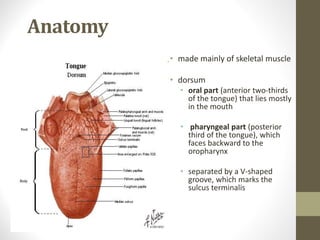
• made mainly of skeletal muscle
• dorsum
• oral part (anterior two-thirds
of the tongue) that lies mostly
in the mouth
• pharyngeal part (posterior
third of the tongue), which
faces backward to the
oropharynx
• separated by a V-shaped
groove, which marks the
sulcus terminalis
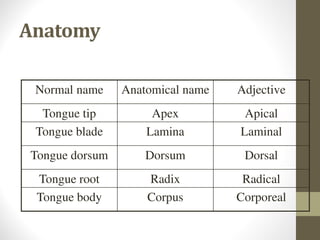
Anatomy
Normal name Anatomical name Adjective
Tongue tip Apex Apical
Tongue blade Lamina Laminal
Tongue dorsum Dorsum Dorsal
Tongue root Radix Radical
Tongue body Corpus Corporeal
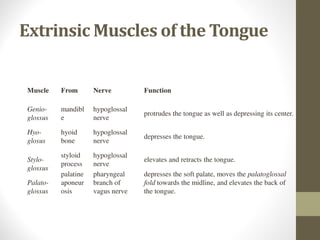
Muscle From Nerve Function
Genio-
glossus
mandibl
e
hypoglossal
nerve
protrudes the tongue as well as depressing its center.
Hyo-
glosus
hyoid
bone
hypoglossal
nerve
depresses the tongue.
Stylo-
glossus
styloid
process
hypoglossal
nerve
elevates and retracts the tongue.
Palato-
glossus
palatine
aponeur
osis
pharyngeal
branch of
vagus nerve
depresses the soft palate, moves the palatoglossal
fold towards the midline, and elevates the back of
the tongue.
Extrinsic Muscles of the Tongue
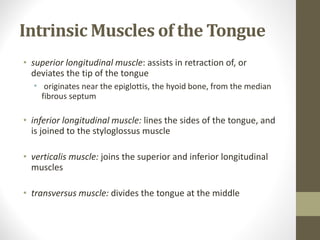
Intrinsic Muscles of the Tongue
• superior longitudinal muscle: assists in retraction of, or
deviates the tip of the tongue
• originates near the epiglottis, the hyoid bone, from the median
fibrous septum
• inferior longitudinal muscle: lines the sides of the tongue, and
is joined to the styloglossus muscle
• verticalis muscle: joins the superior and inferior longitudinal
muscles
• transversus muscle: divides the tongue at the middle
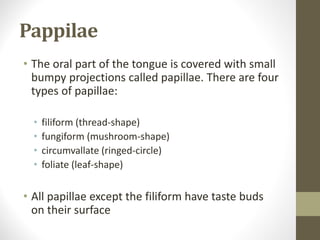
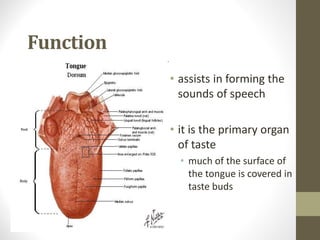
Pappilae
• The oral part of the tongue is covered with small
bumpy projections called papillae. There are four
types of papillae:
• filiform (thread-shape)
• fungiform (mushroom-shape)
• circumvallate (ringed-circle)
• foliate (leaf-shape)
• All papillae except the filiform have taste buds
on their surface
Blood Supply
• primarily from the lingual artery, a branch of the external
carotid artery.
• secondary blood supply to the tongue from the tonsillar
branch of the facial artery and the ascending pharyngeal
artery
Nerve Supply
• Motor innervation: hypoglossal nerve
• the palatoglossal muscle is innervated by the pharyngeal
branch of vagus nerve
• Sensory Innervation
• somatic sensations: lingual nerve, a major branch of the
mandibular nerve; also carries general sensation from areas
of the oral mucosa and gingiva of the lower teeth.
• taste sensation: facial nerve via the chorda tympani; also
carries parasympathetic fibers from the facial nerve to the
submandibular ganglion
• posterior one-third of the tounge: glossopharyngeal nerve
Function
• assists in forming the
sounds of speech
• it is the primary organ
of taste
• much of the surface of
the tongue is covered in
taste buds

tongue

  • 1.
  • 2.
    Tongue • derived from1st-4th branchial arches • manipulates food for chewing and swallowing • contains no bony supports for the muscles • the extrinsic muscles of the tongue anchor the tongue firmly to surrounding bones and prevent the mythical possibility of 'swallowing' the tongue • sensitive and kept moist by saliva, and is richly supplied with nerves and blood vessels to help it move
  • 3.
    Anatomy • made mainlyof skeletal muscle • dorsum • oral part (anterior two-thirds of the tongue) that lies mostly in the mouth • pharyngeal part (posterior third of the tongue), which faces backward to the oropharynx • separated by a V-shaped groove, which marks the sulcus terminalis
  • 4.
    Anatomy Normal name Anatomicalname Adjective Tongue tip Apex Apical Tongue blade Lamina Laminal Tongue dorsum Dorsum Dorsal Tongue root Radix Radical Tongue body Corpus Corporeal
  • 5.
    Muscle From NerveFunction Genio- glossus mandibl e hypoglossal nerve protrudes the tongue as well as depressing its center. Hyo- glosus hyoid bone hypoglossal nerve depresses the tongue. Stylo- glossus styloid process hypoglossal nerve elevates and retracts the tongue. Palato- glossus palatine aponeur osis pharyngeal branch of vagus nerve depresses the soft palate, moves the palatoglossal fold towards the midline, and elevates the back of the tongue. Extrinsic Muscles of the Tongue
  • 6.
    Intrinsic Muscles ofthe Tongue • superior longitudinal muscle: assists in retraction of, or deviates the tip of the tongue • originates near the epiglottis, the hyoid bone, from the median fibrous septum • inferior longitudinal muscle: lines the sides of the tongue, and is joined to the styloglossus muscle • verticalis muscle: joins the superior and inferior longitudinal muscles • transversus muscle: divides the tongue at the middle
  • 7.
    Pappilae • The oralpart of the tongue is covered with small bumpy projections called papillae. There are four types of papillae: • filiform (thread-shape) • fungiform (mushroom-shape) • circumvallate (ringed-circle) • foliate (leaf-shape) • All papillae except the filiform have taste buds on their surface
  • 8.
    Blood Supply • primarilyfrom the lingual artery, a branch of the external carotid artery. • secondary blood supply to the tongue from the tonsillar branch of the facial artery and the ascending pharyngeal artery
  • 9.
    Nerve Supply • Motorinnervation: hypoglossal nerve • the palatoglossal muscle is innervated by the pharyngeal branch of vagus nerve • Sensory Innervation • somatic sensations: lingual nerve, a major branch of the mandibular nerve; also carries general sensation from areas of the oral mucosa and gingiva of the lower teeth. • taste sensation: facial nerve via the chorda tympani; also carries parasympathetic fibers from the facial nerve to the submandibular ganglion • posterior one-third of the tounge: glossopharyngeal nerve
  • 10.
    Function • assists informing the sounds of speech • it is the primary organ of taste • much of the surface of the tongue is covered in taste buds