
![The Architecture Should Evolve On different levels [Architectural Levels: used FEA
as template.]
1. Enterprise architecture [e.gatHAADlevel].: identifying common or shared assets – whether
they are strategies, business processes, investments, data, systems, or technologies.
EA should work with [Strategy Department/ Digital Transformation head] which will help to
identify whether its resources are properly aligned to the agency mission and strategic goals
and objectives
E.g. Based on present state Following transformations can be done to reach optimized
Future state:
a. Mobile Service Components:
IdentifyCommonOrSharedAssetsLike unifiedMEAPbasedmobileAppcomponents
whichcan be reusedacrossLOB vizHPL,HFL andIPC etc..
b. StrategicforCustomerServicesNomore Than5 minswaittime forBirth Certificate
customerinqueue.
Whichwill drive otherrelatedmetricstechnologyandKPItobe tracked forService.
c. Common/SharedBusinessprocessfromeachservice shouldbe identifiedandreusedat
serviceslevel.
d. InvestmentSharingForToolslike BI,BPMand CMS not structured.
e. Data: Data issuesare identified.[There Complete Slide CoveringTheseinformation]
f. Systems:
g. Technologies:
2. SegmentArchitecture [ e.gat Line of Businessleveli.e (HPL,HFL,IPCandPublicServices).
a. RoadMap for core missionArea(improvedRegulation&bechmarking) ,
b. BusinessServices( E.garound HPL TransformationRoadmap)](https://image.slidesharecdn.com/thearchitectureshouldevolveondifferentlevels-170326090538/85/TOGAF-FEA-Transitional-Architecture-1-320.jpg)
![The Architecture Should Evolve On different levels [Architectural Levels: used FEA
as template.]
1. Enterprise architecture [e.gatHAADlevel].: identifying common or shared assets – whether
they are strategies, business processes, investments, data, systems, or technologies.
EA should work with [Strategy Department/ Digital Transformation head] which will help to
identify whether its resources are properly aligned to the agency mission and strategic goals
and objectives
E.g. Based on present state Following transformations can be done to reach optimized
Future state:
a. Mobile Service Components:
IdentifyCommonOrSharedAssetsLike unifiedMEAPbasedmobileAppcomponents
whichcan be reusedacrossLOB vizHPL,HFL andIPC etc..
b. StrategicforCustomerServicesNomore Than5 minswaittime forBirth Certificate
customerinqueue.
Whichwill drive otherrelatedmetricstechnologyandKPItobe tracked forService.
c. Common/SharedBusinessprocessfromeachservice shouldbe identifiedandreusedat
serviceslevel.
d. InvestmentSharingForToolslike BI,BPMand CMS not structured.
e. Data: Data issuesare identified.[There Complete Slide CoveringTheseinformation]
f. Systems:
g. Technologies:
2. SegmentArchitecture [ e.gat Line of Businessleveli.e (HPL,HFL,IPCandPublicServices).
a. RoadMap for core missionArea(improvedRegulation&bechmarking) ,
b. BusinessServices( E.garound HPL TransformationRoadmap)](https://image.slidesharecdn.com/thearchitectureshouldevolveondifferentlevels-170326090538/75/TOGAF-FEA-Transitional-Architecture-1-2048.jpg)
![c. Enterprise Service :IntegrationServicescomponentstoshare informationtoExternal
Entities
3. Solution Architecture[ e.gat particularbusinessProblemathandlike Architecture forClinical
ReviewandInvestigationCRImodulesetc..]
Level Scope Detail Impact Audience
Line Item 8:
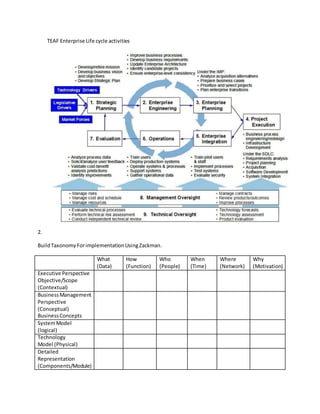
1. The TransformationExercise isnotcentrictoEnterprise Architecture orProjectManagement
Frameworkusedmybe any here :
a. Strategicplanning:drivingDigital Transformationmaygetsinfluence from:
i. Market forces:BusinessEnvironment,
ii. LegislativeDriverslike Regulation,
iii. TechnologyDrivers](https://image.slidesharecdn.com/thearchitectureshouldevolveondifferentlevels-170326090538/85/TOGAF-FEA-Transitional-Architecture-2-320.jpg)
![COTS/GOTS
FunctioningEnterprise
Operational Instances
ZackMan Model For Digital Transformation:Tryto define steps[Re-inventmodel]
[NoReinventingThe Wheel]
What
(Data)
(Flexible
()
Control)
How
(Function)
Digital
Platform
Who
(People)
Digital
Transformation
Org Structure
When
(Time)
BusinessServices&
BusinessObjectives
(new/optimized/Obsolete)
services
Where
(Network)
Why
(Motivation)
Digital
Transformation
Mission/Vision
Strategy
Governance
Structure
[Strategy]
Resources:7 M for
[G2G,G2B,G2P,G2C]
Man, Money,Machine,
Method,Material,
Measurement,Monitoring
Regulation &Law
[Issue/Scope]
Operational Model
Departmental View
Like CustomerServices](https://image.slidesharecdn.com/thearchitectureshouldevolveondifferentlevels-170326090538/85/TOGAF-FEA-Transitional-Architecture-4-320.jpg)
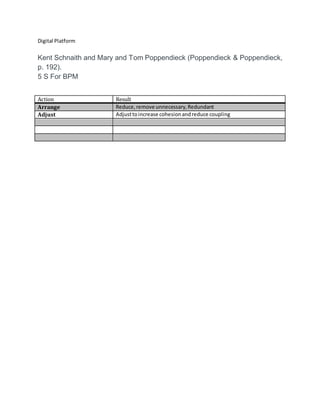
The document discusses three levels of architectural evolution: 1) Enterprise architecture identifies shared assets across the organization, 2) Segment architecture focuses on lines of business, and 3) Solution architecture addresses specific business problems. It provides examples of transformations at each level, such as developing shared mobile app components, improving customer service wait times, and identifying common business processes. The document also discusses using frameworks like the Zachman Framework and five principles (arrange, adjust, automate, apply, advance) to guide the architectural evolution and digital transformation.


