TOYOTA PRODUCTIONTOYOTA PRODUCTION
SYSTEM (TPS)SYSTEM (TPS)
Submitted by:
Sagar A Hasmanis (R. No. 36)
Tamanna Yadav (R. No. 46)
Chander Shekhar (R. No. 10)
Abhishek Gopal (R. No. 01)
INDEX
Toyota story
Essence of TPS
TPS
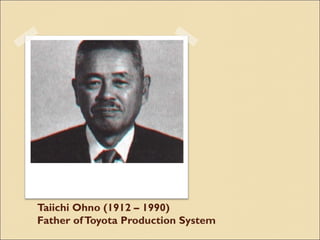
Taiichi Ohno (1912 – 1990)
Father ofToyota Production System
History
 Moving assembly line was the ideal model on which Toyota
based their production system back in the 1940s
 Started lean manufacturing on the shop floor, after World
War II as a solution to a very real and pressing problem
 After World War II when Japanese industry was decimated,
the Toyoda family decided to extend Toyota Automatic
Loom company to start an automotive company. They had
some cash but did not have the infrastructure
 Under these conditions, Taiichi Ohno was given the
assignment of catching up with American companies in
productivity at a time when they were behind
HistoryHistory
Ohno drew upon a number of ideas from the West
and a lot of experimentation to ultimately develop
TPS
Quality problem at Toyota led to introduction of
concept of “JIDOKA” – built in quality
After the 1973 oil crisis, Japan’s economy collapsed
to zero growth. Even Toyota Motor Company
suffered losses greater earnings were sustained in
1975, 1976 and 1977 than at other Japanese
companies – which made Japan follow Toyota’s style
naming it as Toyota Production System
Taiichi Ohno, Shigeo Shingo and Eiji Toyoda
developed the system between 1948 and 1975
TPS Concepts
TPS ConceptsTPS Concepts
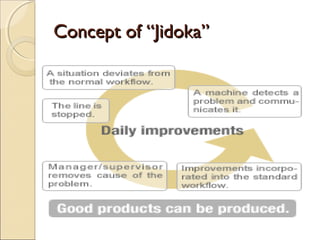
1. JIDOKA: highlighting problems
 Means that a machine safely stops when the
normal processing is completed
 Since a machine automatically stops when
processing is completed / when a problem
arises and is communicated via the "andon
(problem display board)," operators can
confidently continue performing work at
another machine, as well as easily identify the
problem cause and prevent its recurrence.
Concept of “Jidoka”Concept of “Jidoka”
TPS ConceptsTPS Concepts
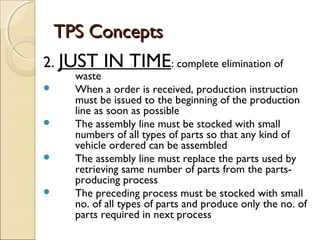
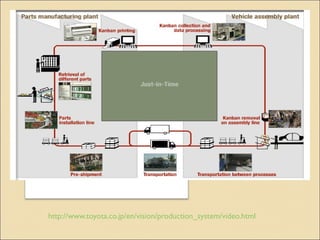
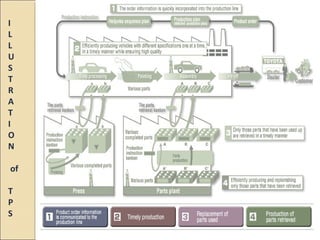
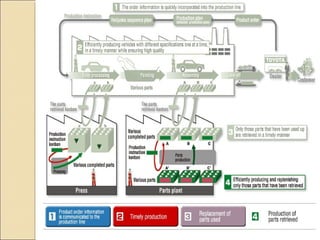
2. JUST IN TIME: complete elimination of
waste
 When a order is received, production instruction
must be issued to the beginning of the production
line as soon as possible
 The assembly line must be stocked with small
numbers of all types of parts so that any kind of
vehicle ordered can be assembled
 The assembly line must replace the parts used by
retrieving same number of parts from the parts-
producing process
 The preceding process must be stocked with small
no. of all types of parts and produce only the no. of
parts required in next process
http://www.toyota.co.jp/en/vision/production_system/video.html
Kanban systemKanban system
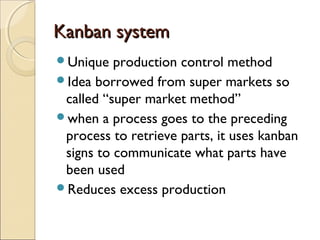
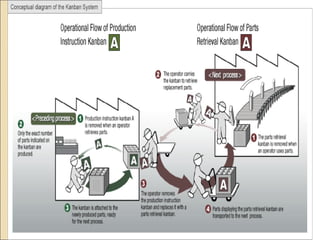
Unique production control method
Idea borrowed from super markets so
called “super market method”
when a process goes to the preceding
process to retrieve parts, it uses kanban
signs to communicate what parts have
been used
Reduces excess production
I
L
L
U
S
T
R
A
T
I
O
N
of
T
P
S
GOALS OF TPSGOALS OF TPS
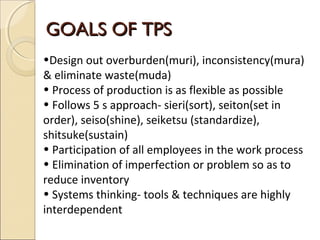
•Design out overburden(muri), inconsistency(mura)
& eliminate waste(muda)
• Process of production is as flexible as possible
• Follows 5 s approach- sieri(sort), seiton(set in
order), seiso(shine), seiketsu (standardize),
shitsuke(sustain)
• Participation of all employees in the work process
• Elimination of imperfection or problem so as to
reduce inventory
• Systems thinking- tools & techniques are highly
interdependent
OUTCOME OF TPSOUTCOME OF TPS
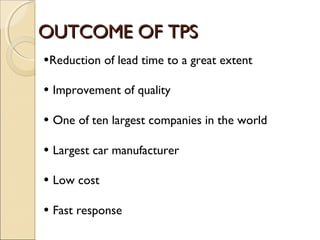
•Reduction of lead time to a great extent
• Improvement of quality
• One of ten largest companies in the world
• Largest car manufacturer
• Low cost
• Fast response
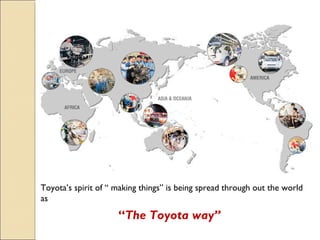
Toyota’s spirit of “ making things” is being spread through out the world
as
“The Toyota way”

Toyota production system

  • 1.
    TOYOTA PRODUCTIONTOYOTA PRODUCTION SYSTEM(TPS)SYSTEM (TPS) Submitted by: Sagar A Hasmanis (R. No. 36) Tamanna Yadav (R. No. 46) Chander Shekhar (R. No. 10) Abhishek Gopal (R. No. 01)
  • 2.
  • 3.
    Taiichi Ohno (1912– 1990) Father ofToyota Production System
  • 4.
    History  Moving assemblyline was the ideal model on which Toyota based their production system back in the 1940s  Started lean manufacturing on the shop floor, after World War II as a solution to a very real and pressing problem  After World War II when Japanese industry was decimated, the Toyoda family decided to extend Toyota Automatic Loom company to start an automotive company. They had some cash but did not have the infrastructure  Under these conditions, Taiichi Ohno was given the assignment of catching up with American companies in productivity at a time when they were behind
  • 5.
    HistoryHistory Ohno drew upona number of ideas from the West and a lot of experimentation to ultimately develop TPS Quality problem at Toyota led to introduction of concept of “JIDOKA” – built in quality After the 1973 oil crisis, Japan’s economy collapsed to zero growth. Even Toyota Motor Company suffered losses greater earnings were sustained in 1975, 1976 and 1977 than at other Japanese companies – which made Japan follow Toyota’s style naming it as Toyota Production System Taiichi Ohno, Shigeo Shingo and Eiji Toyoda developed the system between 1948 and 1975
  • 6.
  • 7.
    TPS ConceptsTPS Concepts 1.JIDOKA: highlighting problems  Means that a machine safely stops when the normal processing is completed  Since a machine automatically stops when processing is completed / when a problem arises and is communicated via the "andon (problem display board)," operators can confidently continue performing work at another machine, as well as easily identify the problem cause and prevent its recurrence.
  • 8.
  • 9.
    TPS ConceptsTPS Concepts 2.JUST IN TIME: complete elimination of waste  When a order is received, production instruction must be issued to the beginning of the production line as soon as possible  The assembly line must be stocked with small numbers of all types of parts so that any kind of vehicle ordered can be assembled  The assembly line must replace the parts used by retrieving same number of parts from the parts- producing process  The preceding process must be stocked with small no. of all types of parts and produce only the no. of parts required in next process
  • 10.
  • 11.
    Kanban systemKanban system Uniqueproduction control method Idea borrowed from super markets so called “super market method” when a process goes to the preceding process to retrieve parts, it uses kanban signs to communicate what parts have been used Reduces excess production
  • 13.
  • 18.
    GOALS OF TPSGOALSOF TPS •Design out overburden(muri), inconsistency(mura) & eliminate waste(muda) • Process of production is as flexible as possible • Follows 5 s approach- sieri(sort), seiton(set in order), seiso(shine), seiketsu (standardize), shitsuke(sustain) • Participation of all employees in the work process • Elimination of imperfection or problem so as to reduce inventory • Systems thinking- tools & techniques are highly interdependent
  • 19.
    OUTCOME OF TPSOUTCOMEOF TPS •Reduction of lead time to a great extent • Improvement of quality • One of ten largest companies in the world • Largest car manufacturer • Low cost • Fast response
  • 20.
    Toyota’s spirit of“ making things” is being spread through out the world as “The Toyota way”