DOJO Training Concept
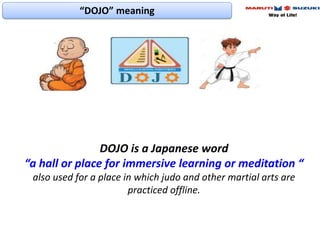
DOJO is a Japanese word
“a hall or place for immersive learning or meditation “
also used for a place in which judo and other martial arts are
practiced offline.
“DOJO” meaning
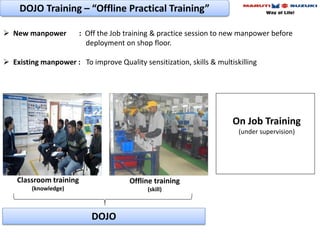
DOJO Training – “Offline Practical Training”
 New manpower : Off the Job training & practice session to new manpower before
deployment on shop floor.
 Existing manpower : To improve Quality sensitization, skills & multiskilling
Classroom training
(knowledge)
Offline training
(skill)
On Job Training
(under supervision)
DOJO
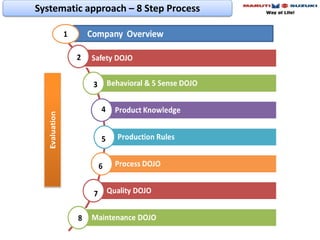
Systematic approach – 8 Step Process
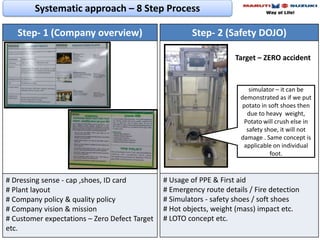
Step- 2 (Safety DOJO)
# Usage of PPE & First aid
# Emergency route details / Fire detection
# Simulators - safety shoes / soft shoes
# Hot objects, weight (mass) impact etc.
# LOTO concept etc.
Step- 1 (Company overview)
# Dressing sense - cap ,shoes, ID card
# Plant layout
# Company policy & quality policy
# Company vision & mission
# Customer expectations – Zero Defect Target
etc.
Systematic approach – 8 Step Process
Target – ZERO accident
simulator – it can be
demonstrated as if we put
potato in soft shoes then
due to heavy weight,
Potato will crush else in
safety shoe, it will not
damage . Same concept is
applicable on individual
foot.
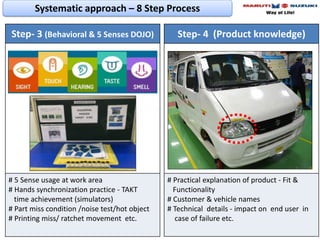
Step- 3 (Behavioral & 5 Senses DOJO)
# 5 Sense usage at work area
# Hands synchronization practice - TAKT
time achievement (simulators)
# Part miss condition /noise test/hot object
# Printing miss/ ratchet movement etc.
Step- 4 (Product knowledge)
# Practical explanation of product - Fit &
Functionality
# Customer & vehicle names
# Technical details - impact on end user in
case of failure etc.
Systematic approach – 8 Step Process
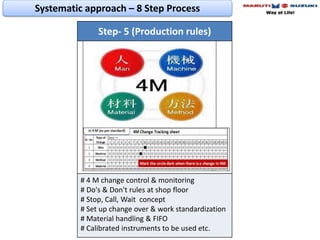
Step- 5 (Production rules)
# 4 M change control & monitoring
# Do's & Don't rules at shop floor
# Stop, Call, Wait concept
# Set up change over & work standardization
# Material handling & FIFO
# Calibrated instruments to be used etc.
Systematic approach – 8 Step Process
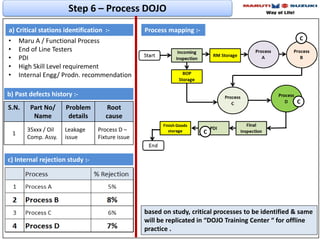
Step 6 – Process DOJO
b) Past defects history :-
c) Internal rejection study :-
a) Critical stations identification :-
• Maru A / Functional Process
• End of Line Testers
• PDI
• High Skill Level requirement
• Internal Engg/ Prodn. recommendation
S.N. Part No/
Name
Problem
details
Root
cause
1
35xxx / Oil
Comp. Assy.
Leakage
issue
Process D –
Fixture issue
Process mapping :-
based on study, critical processes to be identified & same
will be replicated in “DOJO Training Center “ for offline
practice .
C
C
C
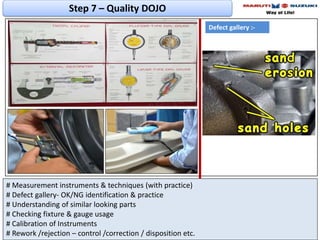
Step 7 – Quality DOJO
# Measurement instruments & techniques (with practice)
# Defect gallery- OK/NG identification & practice
# Understanding of similar looking parts
# Checking fixture & gauge usage
# Calibration of Instruments
# Rework /rejection – control /correction / disposition etc.
Defect gallery :-
Systematic approach – 8 Step Process
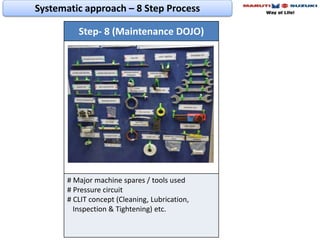
Step- 8 (Maintenance DOJO)
# Major machine spares / tools used
# Pressure circuit
# CLIT concept (Cleaning, Lubrication,
Inspection & Tightening) etc.
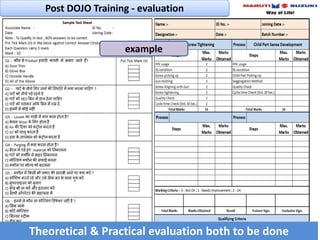
Post DOJO Training - evaluation
Theoretical & Practical evaluation both to be done
example
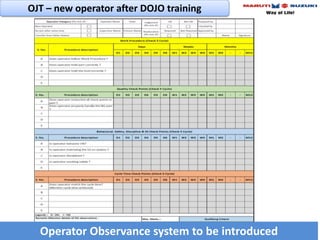
OJT – new operator after DOJO training
Operator Observance system to be introduced
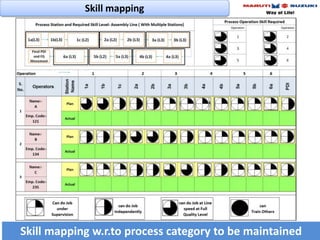
Skill mapping
Skill mapping w.r.to process category to be maintained
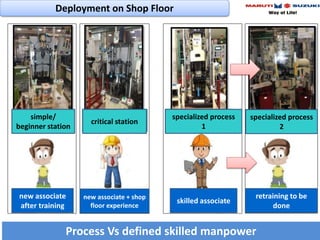
Process Vs defined skilled manpower
simple/
beginner station
critical station
new associate
after training
new associate + shop
floor experience
skilled associate
specialized process
1
specialized process
2
retraining to be
done
Deployment on Shop Floor
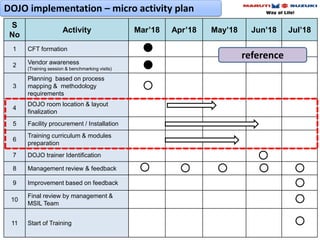
DOJO implementation – micro activity plan
S
No
Activity Mar’18 Apr’18 May’18 Jun’18 Jul’18
1 CFT formation
2 Vendor awareness
(Training session & benchmarking visits)
3
Planning based on process
mapping & methodology
requirements
4
DOJO room location & layout
finalization
5 Facility procurement / Installation
6
Training curriculum & modules
preparation
7 DOJO trainer Identification
8 Management review & feedback
9 Improvement based on feedback
10
Final review by management &
MSIL Team
11 Start of Training
reference
Thank You

DOJO Slide.pdf

  • 1.
  • 2.
    DOJO is aJapanese word “a hall or place for immersive learning or meditation “ also used for a place in which judo and other martial arts are practiced offline. “DOJO” meaning
  • 3.
    DOJO Training –“Offline Practical Training”  New manpower : Off the Job training & practice session to new manpower before deployment on shop floor.  Existing manpower : To improve Quality sensitization, skills & multiskilling Classroom training (knowledge) Offline training (skill) On Job Training (under supervision) DOJO
  • 4.
  • 5.
    Step- 2 (SafetyDOJO) # Usage of PPE & First aid # Emergency route details / Fire detection # Simulators - safety shoes / soft shoes # Hot objects, weight (mass) impact etc. # LOTO concept etc. Step- 1 (Company overview) # Dressing sense - cap ,shoes, ID card # Plant layout # Company policy & quality policy # Company vision & mission # Customer expectations – Zero Defect Target etc. Systematic approach – 8 Step Process Target – ZERO accident simulator – it can be demonstrated as if we put potato in soft shoes then due to heavy weight, Potato will crush else in safety shoe, it will not damage . Same concept is applicable on individual foot.
  • 6.
    Step- 3 (Behavioral& 5 Senses DOJO) # 5 Sense usage at work area # Hands synchronization practice - TAKT time achievement (simulators) # Part miss condition /noise test/hot object # Printing miss/ ratchet movement etc. Step- 4 (Product knowledge) # Practical explanation of product - Fit & Functionality # Customer & vehicle names # Technical details - impact on end user in case of failure etc. Systematic approach – 8 Step Process
  • 7.
    Step- 5 (Productionrules) # 4 M change control & monitoring # Do's & Don't rules at shop floor # Stop, Call, Wait concept # Set up change over & work standardization # Material handling & FIFO # Calibrated instruments to be used etc. Systematic approach – 8 Step Process
  • 8.
    Step 6 –Process DOJO b) Past defects history :- c) Internal rejection study :- a) Critical stations identification :- • Maru A / Functional Process • End of Line Testers • PDI • High Skill Level requirement • Internal Engg/ Prodn. recommendation S.N. Part No/ Name Problem details Root cause 1 35xxx / Oil Comp. Assy. Leakage issue Process D – Fixture issue Process mapping :- based on study, critical processes to be identified & same will be replicated in “DOJO Training Center “ for offline practice . C C C
  • 9.
    Step 7 –Quality DOJO # Measurement instruments & techniques (with practice) # Defect gallery- OK/NG identification & practice # Understanding of similar looking parts # Checking fixture & gauge usage # Calibration of Instruments # Rework /rejection – control /correction / disposition etc. Defect gallery :-
  • 10.
    Systematic approach –8 Step Process Step- 8 (Maintenance DOJO) # Major machine spares / tools used # Pressure circuit # CLIT concept (Cleaning, Lubrication, Inspection & Tightening) etc.
  • 11.
    Post DOJO Training- evaluation Theoretical & Practical evaluation both to be done example
  • 12.
    OJT – newoperator after DOJO training Operator Observance system to be introduced
  • 13.
    Skill mapping Skill mappingw.r.to process category to be maintained
  • 14.
    Process Vs definedskilled manpower simple/ beginner station critical station new associate after training new associate + shop floor experience skilled associate specialized process 1 specialized process 2 retraining to be done Deployment on Shop Floor
  • 15.
    DOJO implementation –micro activity plan S No Activity Mar’18 Apr’18 May’18 Jun’18 Jul’18 1 CFT formation 2 Vendor awareness (Training session & benchmarking visits) 3 Planning based on process mapping & methodology requirements 4 DOJO room location & layout finalization 5 Facility procurement / Installation 6 Training curriculum & modules preparation 7 DOJO trainer Identification 8 Management review & feedback 9 Improvement based on feedback 10 Final review by management & MSIL Team 11 Start of Training reference
  • 16.