4 Steps to Building Smart Compensation Structure 
Jennifer Ferris, CCP 
Compensation Professional 
Ian Englund, CCP 
Compensation Professional 
www.payscale.com
www.payscale.com 
14,000 Positions 3000 Customers 11 Countries 
250 Compensable Factors 
40 Million Salary Profiles
www.payscale.com 
Agenda 
Why have pay structure Requirements for building structure Building Structure 
•Step 1: Identify pay schedules 
•Step 2: Determine pay grades 
•Step 3: Develop ranges 
•Step 4: Assign grades to positions & adjust for internal equity Using Pay Ranges Immediate Actions
Why have pay structure 
4 
•Clarifies the market and internal value for each job, and provides a way to manage employee pay effectively 
•Quantifies compensation costs & enables budget decisions 
•Validates compensation strategy & aligns to business goals 
•Provides a tool to talk with employees about development 
•Ensures pay equity 
•Determines pay for non-benchmark jobs 
•Allows ease of administration
REQUIREMENTS FOR BUILDING PAY STRUCTURE 
Develop a compensation philosophy & strategy 
Know your jobs 
Conduct a market analysis
 Pay Schedules 
 Pay Grades 
 Pay Ranges 
Pay Structure Elements
Building Structure 
Step 1: Identify Pay Schedules
Identify Pay Schedules 
oGroups like geographies together with the same set of pay grades 
oStreamlines pay structure 
oConsider how complex your organization is 
oIndustries and/or lines of business 
oRetail & Social Services 
oSales 
oEngineers vs Admin 
oLocations
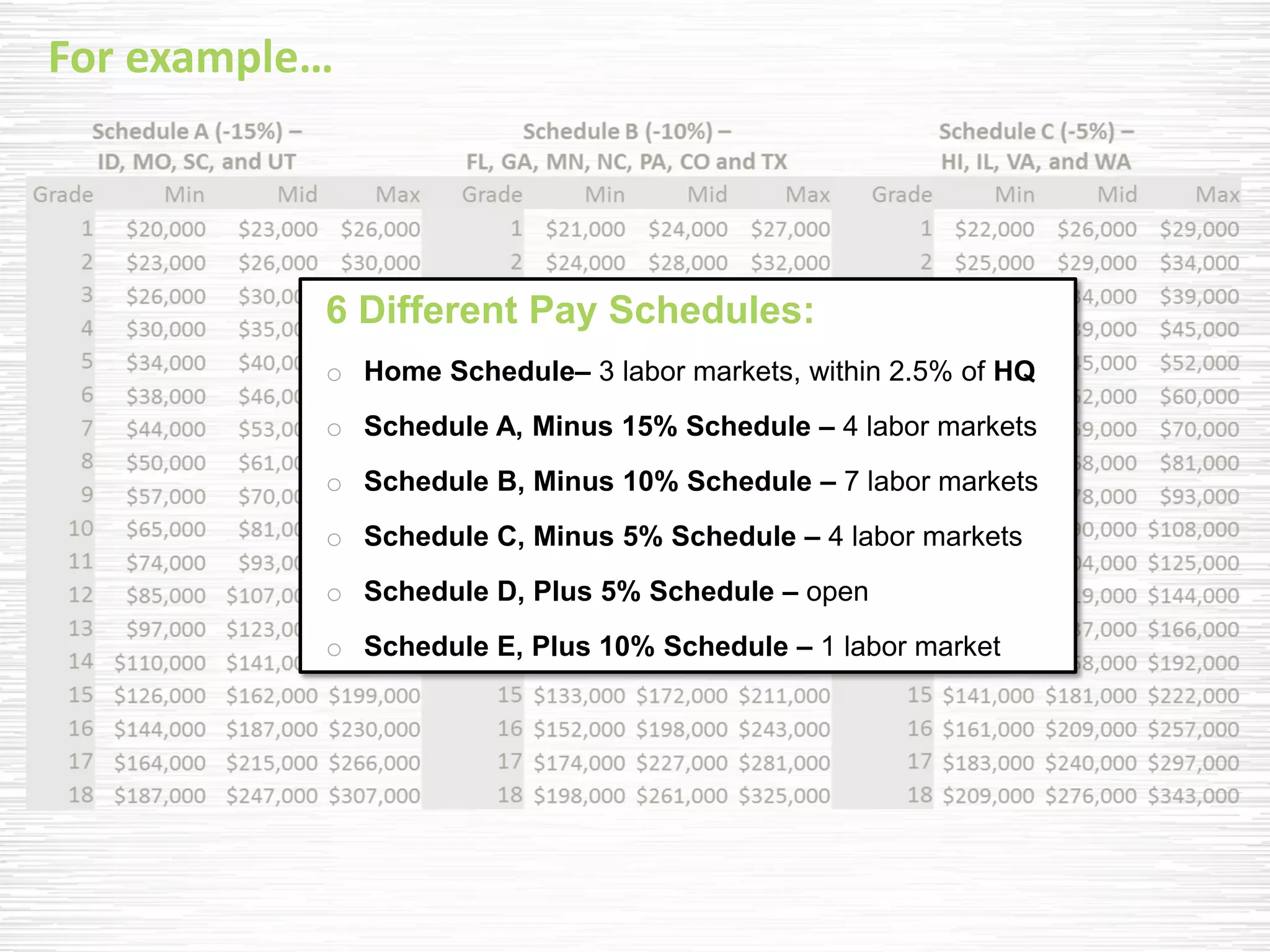
6 Different Pay Schedules: 
oHome Schedule– 3 labor markets, within 2.5% of HQ 
oSchedule A, Minus 15% Schedule – 4 labor markets 
oSchedule B, Minus 10% Schedule – 7 labor markets 
oSchedule C, Minus 5% Schedule – 4 labor markets 
oSchedule D, Plus 5% Schedule – open 
oSchedule E, Plus 10% Schedule – 1 labor market 
For example…
Building Structure Step 2: Determine Pay Grades
Determine Pay Grades 
oNumber of pay grades varies in response to: 
oSize of the organization 
oDistance between the highest and lowest level job 
oHow differentiated are the jobs (i.e. levels) 
oThe pay increase and promotion policy of the organization 
oDetermine the definition or label for each grade
Building Structure 
Step 3: Develop Ranges
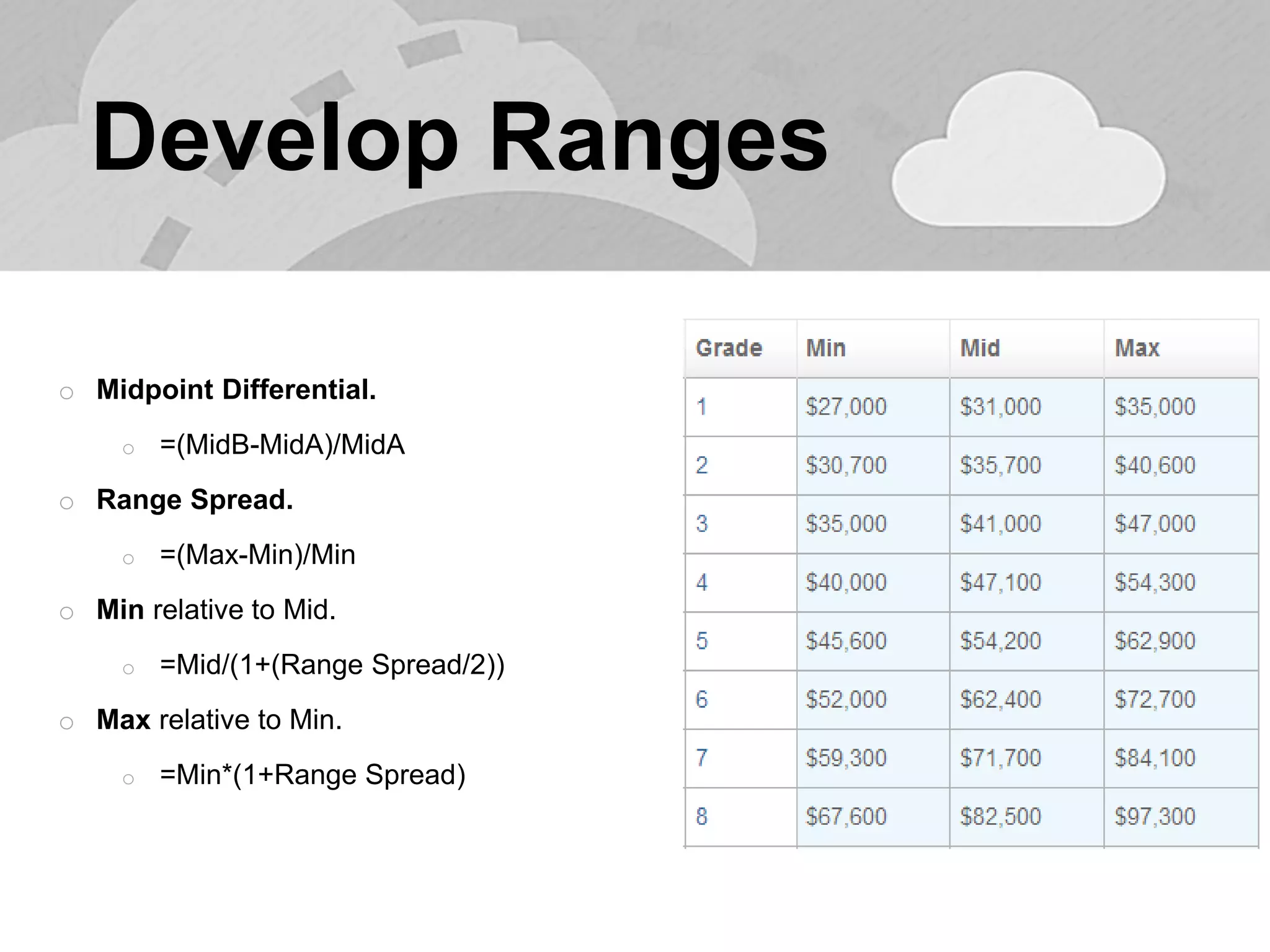
oMidpoint Differential. 
o=(MidB-MidA)/MidA 
oRange Spread. 
o=(Max-Min)/Min 
oMin relative to Mid. 
o=Mid/(1+(Range Spread/2)) 
oMax relative to Min. 
o=Min*(1+Range Spread) 
Develop Ranges
Considerations 
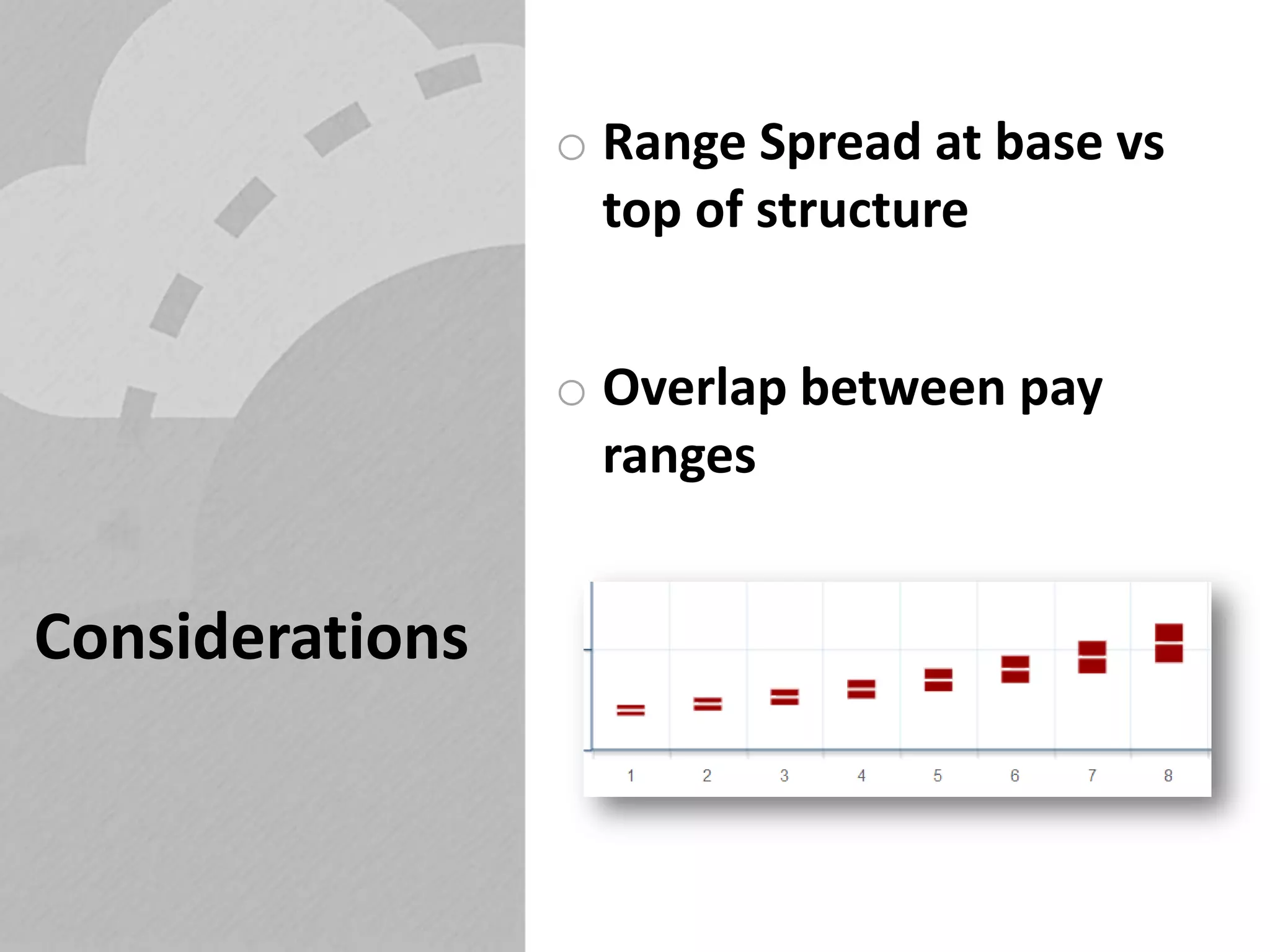
oRange Spread at base vs top of structure 
oOverlap between pay ranges
Building Structure 
Step 4: Assign grades to positions and adjust for internal alignment
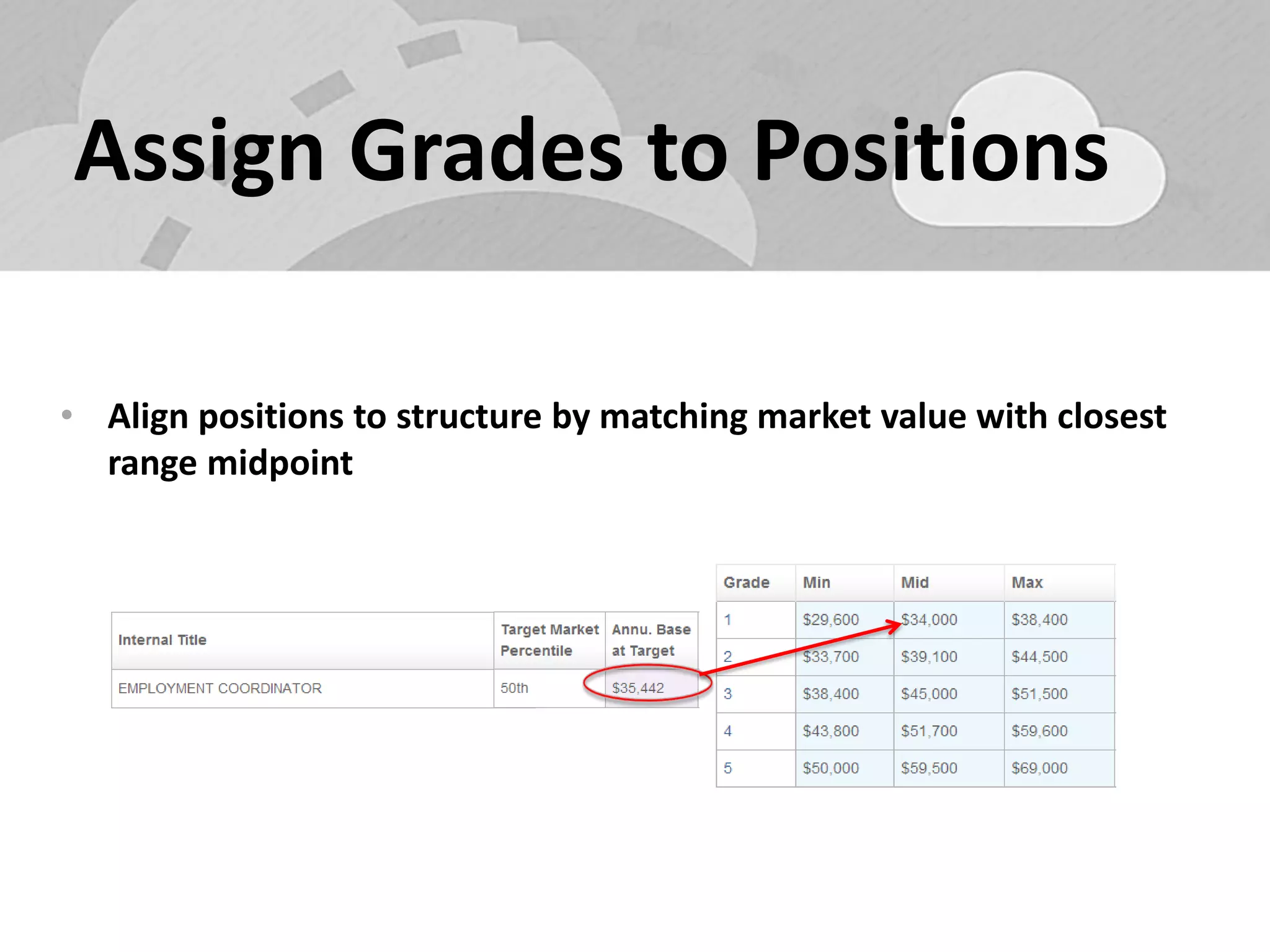
•Align positions to structure by matching market value with closest range midpoint 
Assign Grades to Positions
Adjust for Internal Alignment 
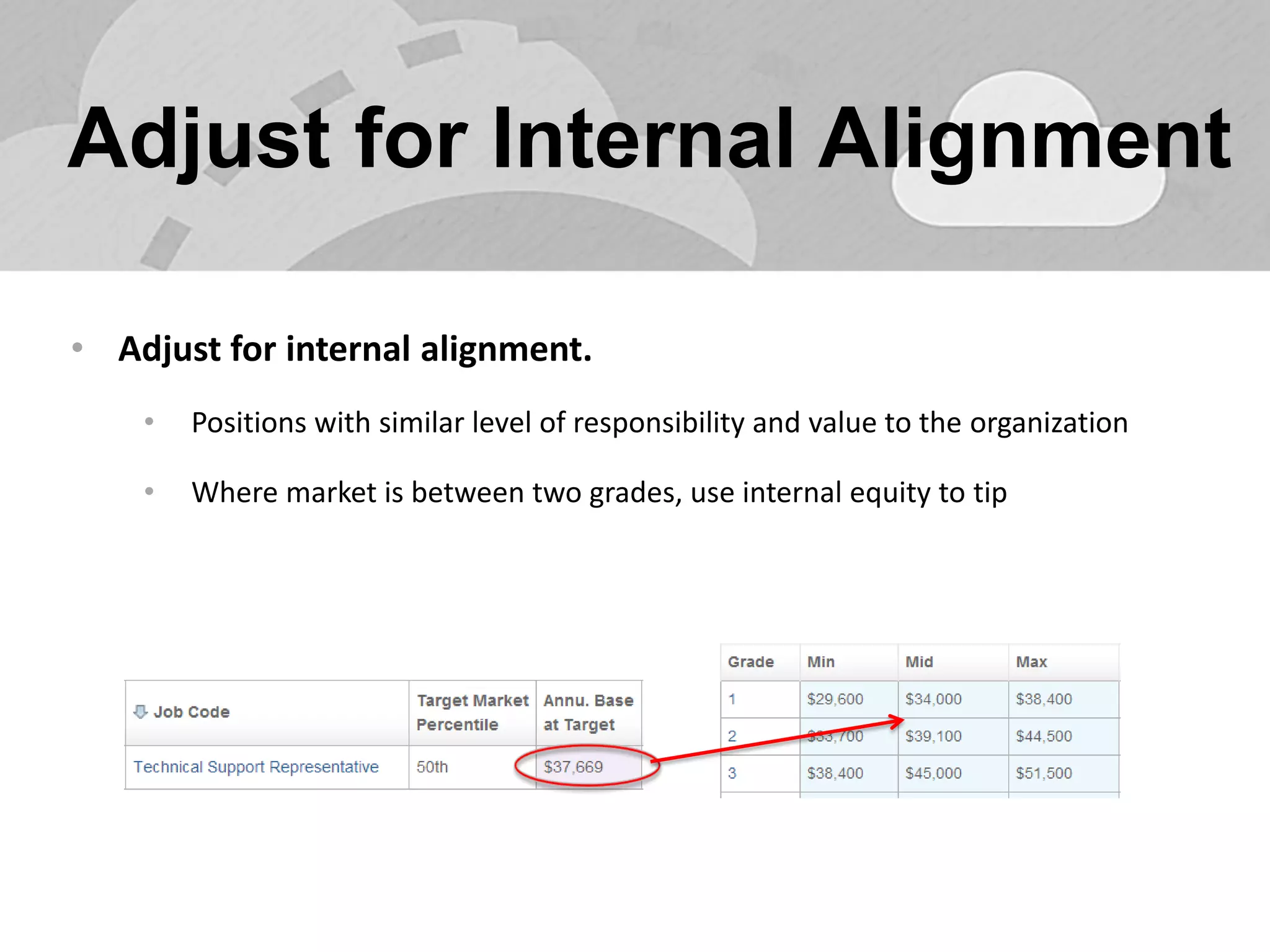
•Adjust for internal alignment. 
•Positions with similar level of responsibility and value to the organization 
•Where market is between two grades, use internal equity to tip
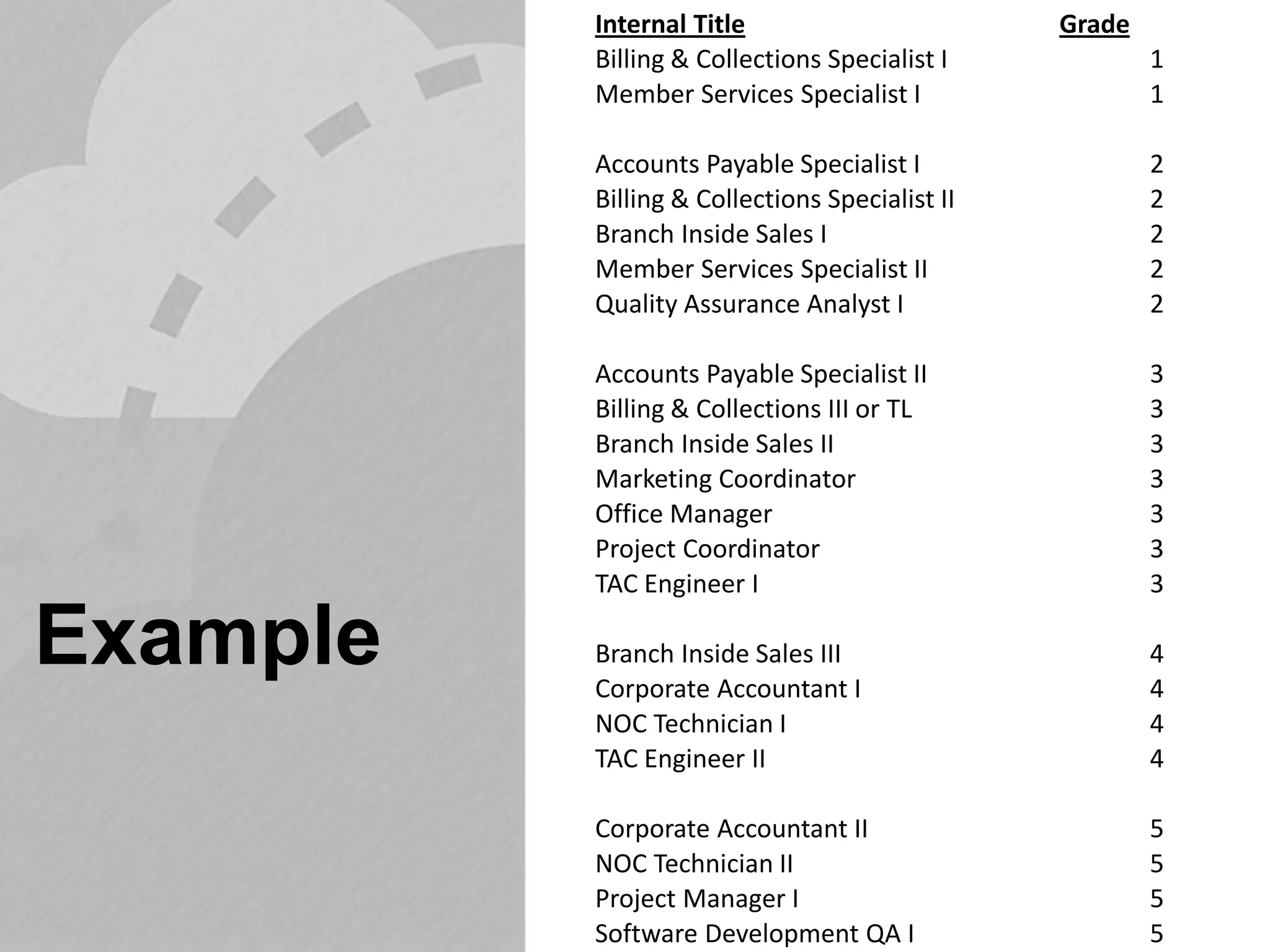
Example 
Internal Title 
Grade 
Billing & Collections Specialist I 
1 
Member Services Specialist I 
1 
Accounts Payable Specialist I 
2 
Billing & Collections Specialist II 
2 
Branch Inside Sales I 
2 
Member Services Specialist II 
2 
Quality Assurance Analyst I 
2 
Accounts Payable Specialist II 
3 
Billing & Collections III or TL 
3 
Branch Inside Sales II 
3 
Marketing Coordinator 
3 
Office Manager 
3 
Project Coordinator 
3 
TAC Engineer I 
3 
Branch Inside Sales III 
4 
Corporate Accountant I 
4 
NOC Technician I 
4 
TAC Engineer II 
4 
Corporate Accountant II 
5 
NOC Technician II 
5 
Project Manager I 
5 
Software Development QA I 
5
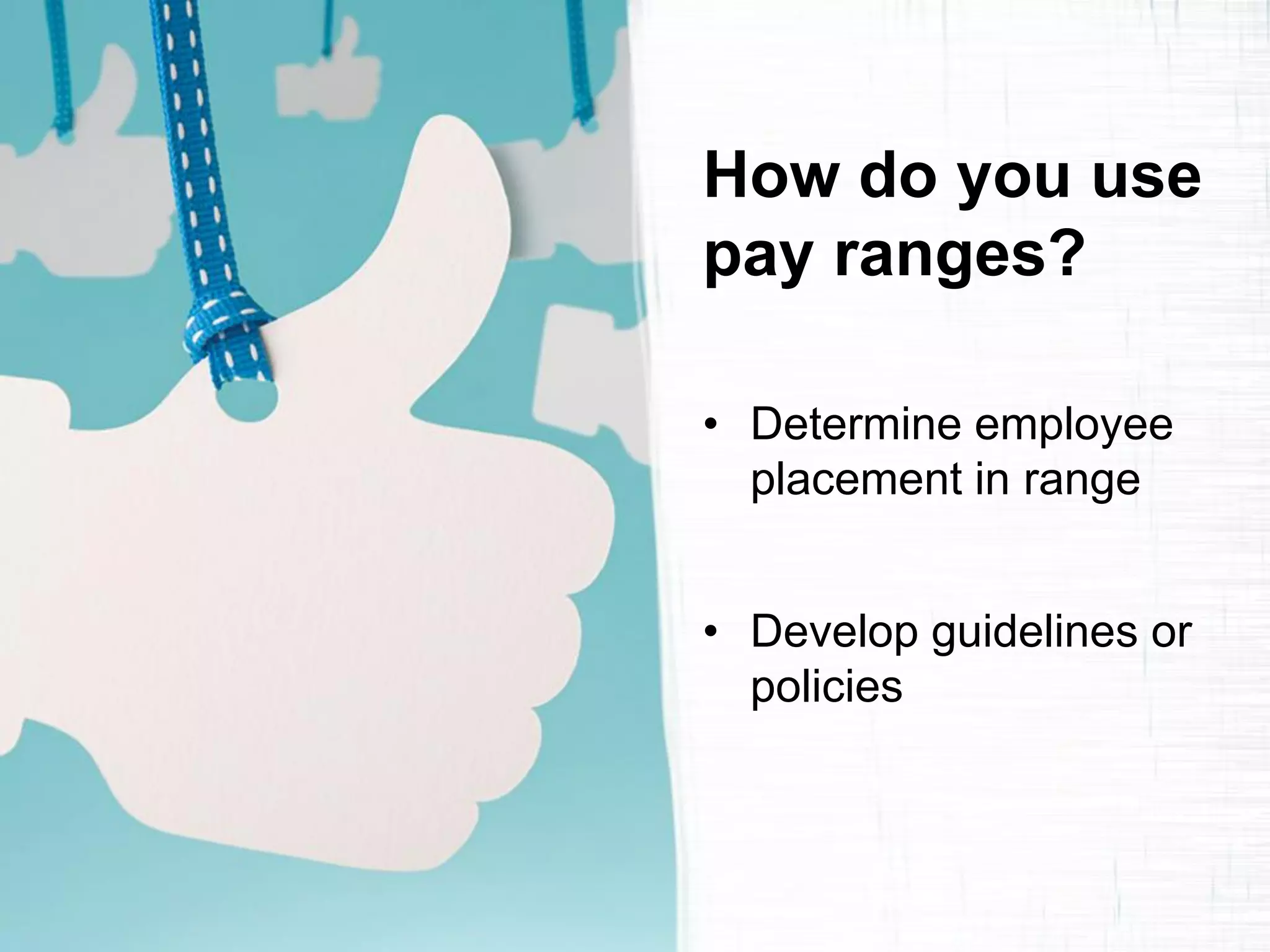
How do you use pay ranges? 
•Determine employee placement in range 
•Develop guidelines or policies
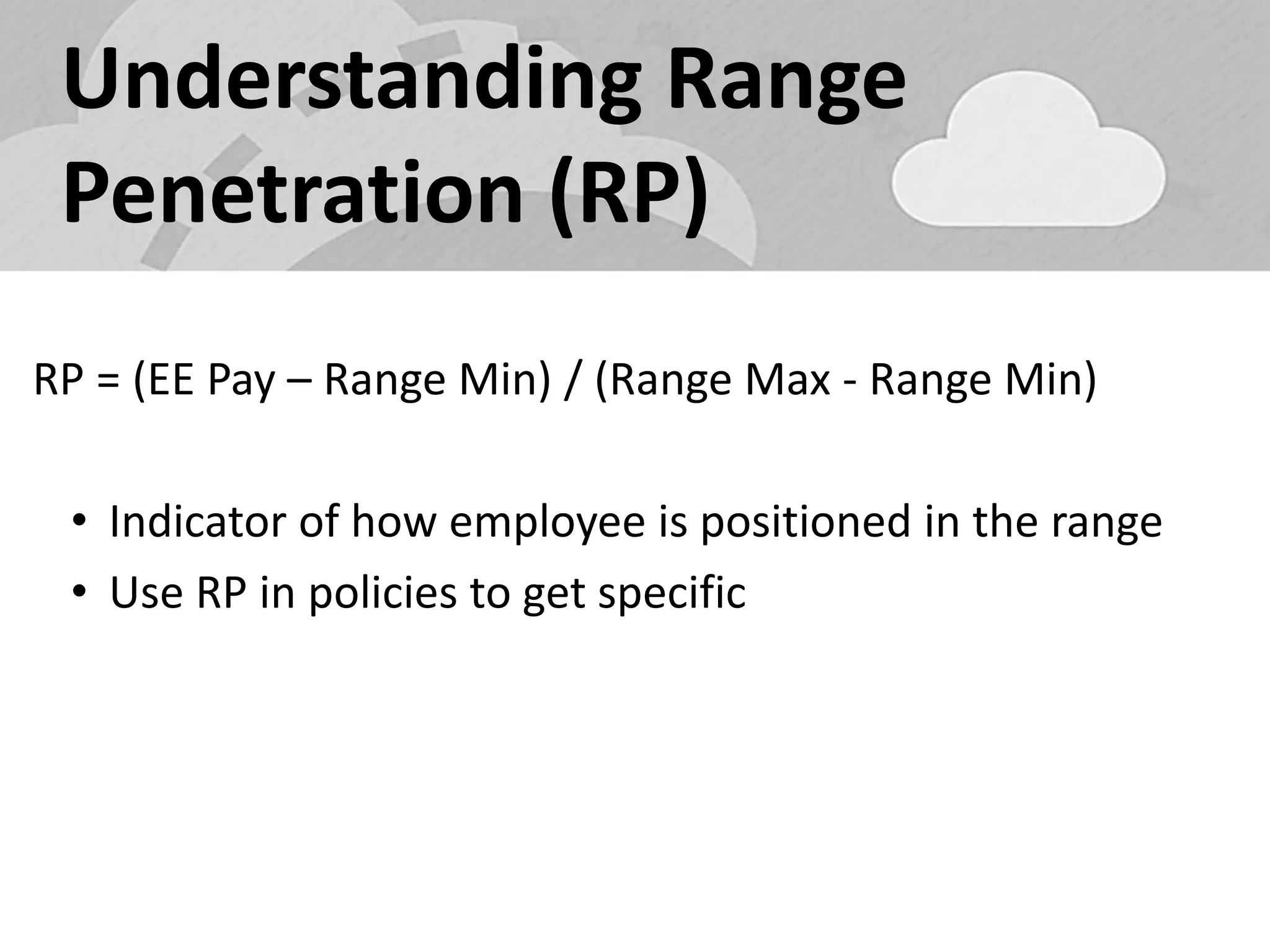
Understanding Range Penetration (RP) 
RP = (EE Pay – Range Min) / (Range Max - Range Min) 
•Indicator of how employee is positioned in the range 
•Use RP in policies to get specific
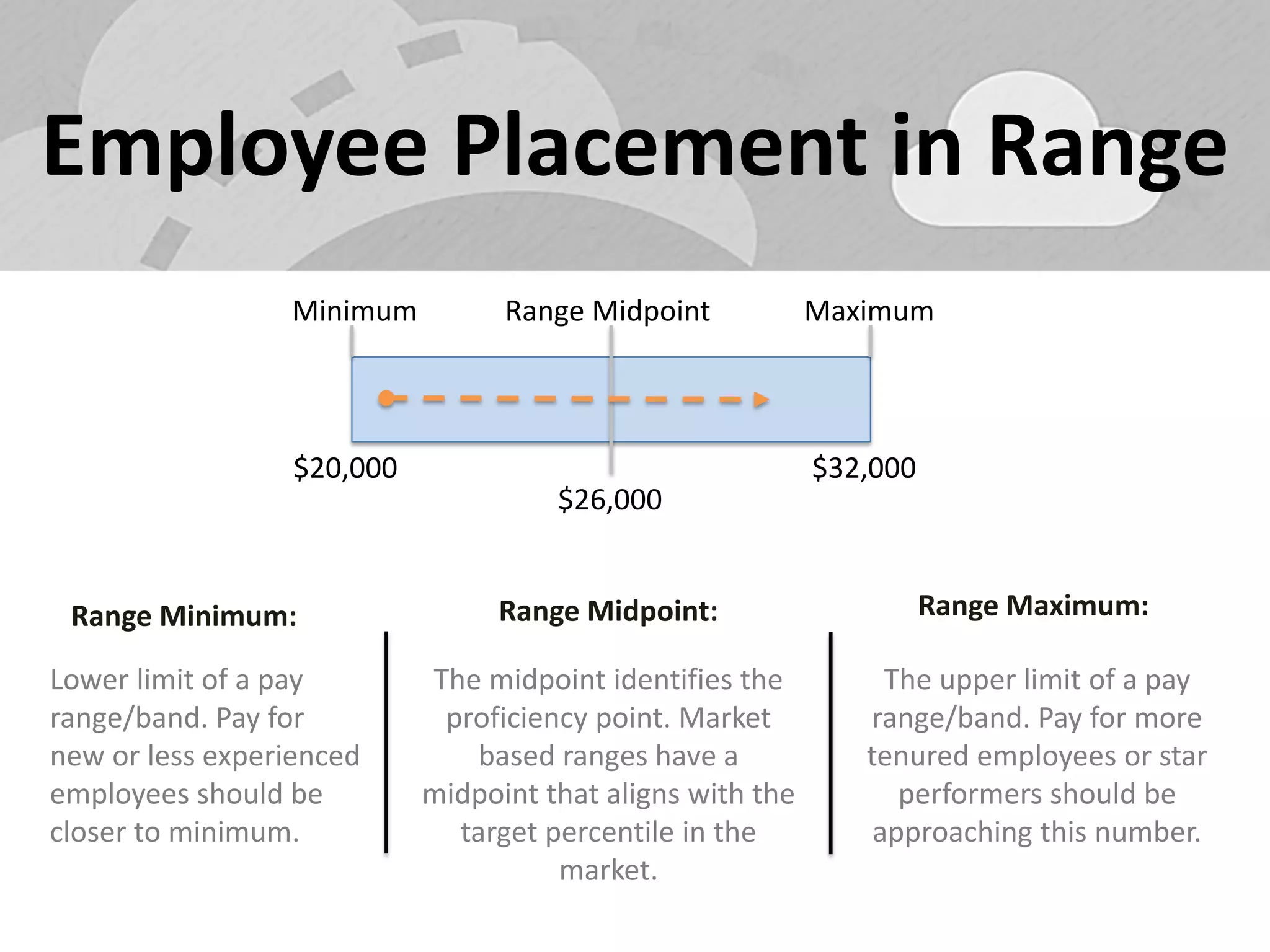
Employee Placement in Range 
Range Midpoint 
Minimum 
Maximum 
$20,000 
$32,000 
$26,000 
Range Midpoint: 
Range Minimum: 
Range Maximum: 
Lower limit of a pay range/band. Pay for new or less experienced employees should be closer to minimum. 
The midpoint identifies the proficiency point. Market based ranges have a midpoint that aligns with the target percentile in the market. 
The upper limit of a pay range/band. Pay for more tenured employees or star performers should be approaching this number.
Employee Placement in Range 
Range Midpoint 
Minimum 
Maximum 
$20,000 
$32,000 
$26,000 
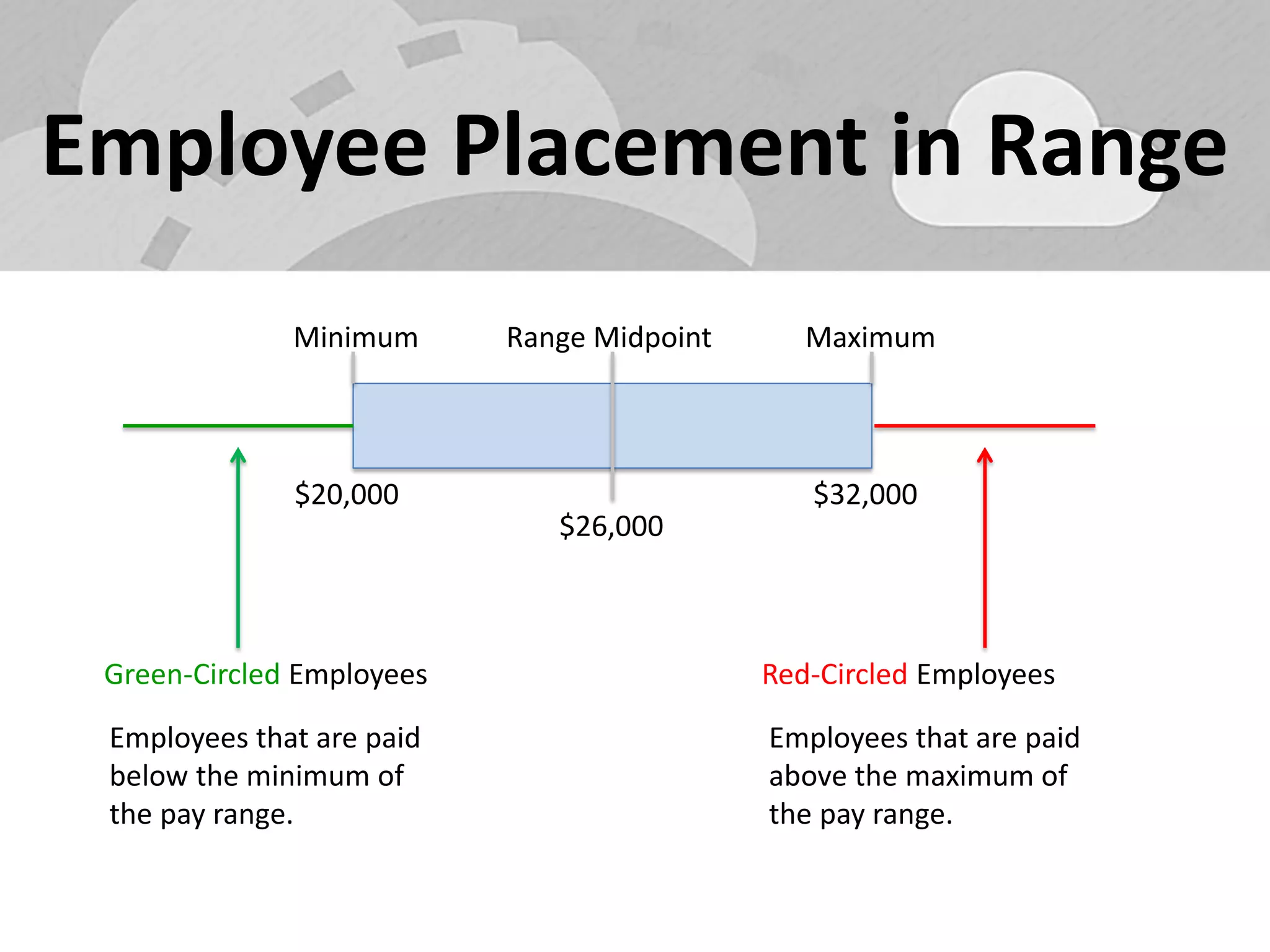
Green-Circled Employees 
Red-Circled Employees 
Employees that are paid below the minimum of the pay range. 
Employees that are paid above the maximum of the pay range.
Comparing Employee Pay to Ranges 
Range Midpoint 
Minimum 
Maximum 
$20,000 
$32,000 
$26,000 
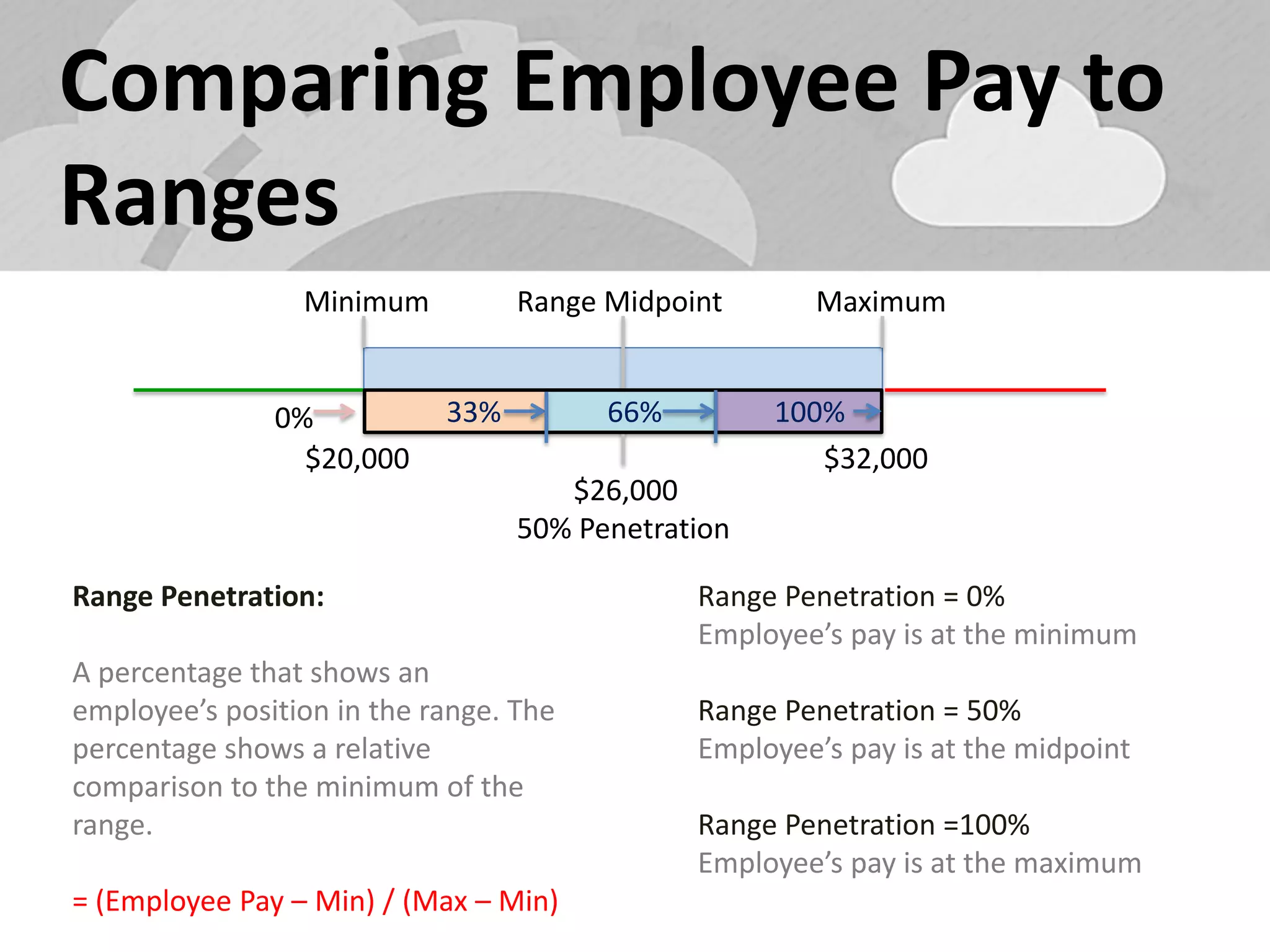
50% Penetration 
33% 
66% 
100% 
0% 
Range Penetration: 
A percentage that shows an employee’s position in the range. The percentage shows a relative comparison to the minimum of the range. 
= (Employee Pay – Min) / (Max – Min) 
Range Penetration = 0% 
Employee’s pay is at the minimum 
Range Penetration = 50% 
Employee’s pay is at the midpoint 
Range Penetration =100% 
Employee’s pay is at the maximum
Immediate Actions 
Gather information about your jobs 
oWhat are the key skills, experience, and education required? 
oWhat are the top 3 responsibilities? 
Talk with managers and executives 
oWhere are you recruiting (or losing) your talent? 
oBegin to explain the usefulness of pay ranges 
Obtain accurate market data for your positions
PayScale Delivers Where Other Compensation Providers Fall Short 
PayScale leads the world in compensation knowledge with the freshest and most detailed data from over 40 million salary profiles. More than 3000 organizations use PayScale’s software and intelligence to get the greatest return on their talent. Smart businesses use PayScale Insight to recruit, retain and motivate their people. 
Visit our blog: www.payscale.com/compensation-today 
Join our Group on LinkedIn: Compensation Today: HR Best Practices 
Jennifer Ferris, CCP 
Compensation Professional 
Ian Englund, CCP 
Compensation Professional 
www.payscale.com

4 Steps to Building a Smart Compensation Structure

  • 1.
    4 Steps toBuilding Smart Compensation Structure Jennifer Ferris, CCP Compensation Professional Ian Englund, CCP Compensation Professional www.payscale.com
  • 2.
    www.payscale.com 14,000 Positions3000 Customers 11 Countries 250 Compensable Factors 40 Million Salary Profiles
  • 3.
    www.payscale.com Agenda Whyhave pay structure Requirements for building structure Building Structure •Step 1: Identify pay schedules •Step 2: Determine pay grades •Step 3: Develop ranges •Step 4: Assign grades to positions & adjust for internal equity Using Pay Ranges Immediate Actions
  • 4.
    Why have paystructure 4 •Clarifies the market and internal value for each job, and provides a way to manage employee pay effectively •Quantifies compensation costs & enables budget decisions •Validates compensation strategy & aligns to business goals •Provides a tool to talk with employees about development •Ensures pay equity •Determines pay for non-benchmark jobs •Allows ease of administration
  • 5.
    REQUIREMENTS FOR BUILDINGPAY STRUCTURE Develop a compensation philosophy & strategy Know your jobs Conduct a market analysis
  • 6.
     Pay Schedules  Pay Grades  Pay Ranges Pay Structure Elements
  • 7.
    Building Structure Step1: Identify Pay Schedules
  • 8.
    Identify Pay Schedules oGroups like geographies together with the same set of pay grades oStreamlines pay structure oConsider how complex your organization is oIndustries and/or lines of business oRetail & Social Services oSales oEngineers vs Admin oLocations
  • 9.
    6 Different PaySchedules: oHome Schedule– 3 labor markets, within 2.5% of HQ oSchedule A, Minus 15% Schedule – 4 labor markets oSchedule B, Minus 10% Schedule – 7 labor markets oSchedule C, Minus 5% Schedule – 4 labor markets oSchedule D, Plus 5% Schedule – open oSchedule E, Plus 10% Schedule – 1 labor market For example…
  • 10.
    Building Structure Step2: Determine Pay Grades
  • 11.
    Determine Pay Grades oNumber of pay grades varies in response to: oSize of the organization oDistance between the highest and lowest level job oHow differentiated are the jobs (i.e. levels) oThe pay increase and promotion policy of the organization oDetermine the definition or label for each grade
  • 12.
    Building Structure Step3: Develop Ranges
  • 13.
    oMidpoint Differential. o=(MidB-MidA)/MidA oRange Spread. o=(Max-Min)/Min oMin relative to Mid. o=Mid/(1+(Range Spread/2)) oMax relative to Min. o=Min*(1+Range Spread) Develop Ranges
  • 14.
    Considerations oRange Spreadat base vs top of structure oOverlap between pay ranges
  • 15.
    Building Structure Step4: Assign grades to positions and adjust for internal alignment
  • 16.
    •Align positions tostructure by matching market value with closest range midpoint Assign Grades to Positions
  • 17.
    Adjust for InternalAlignment •Adjust for internal alignment. •Positions with similar level of responsibility and value to the organization •Where market is between two grades, use internal equity to tip
  • 18.
    Example Internal Title Grade Billing & Collections Specialist I 1 Member Services Specialist I 1 Accounts Payable Specialist I 2 Billing & Collections Specialist II 2 Branch Inside Sales I 2 Member Services Specialist II 2 Quality Assurance Analyst I 2 Accounts Payable Specialist II 3 Billing & Collections III or TL 3 Branch Inside Sales II 3 Marketing Coordinator 3 Office Manager 3 Project Coordinator 3 TAC Engineer I 3 Branch Inside Sales III 4 Corporate Accountant I 4 NOC Technician I 4 TAC Engineer II 4 Corporate Accountant II 5 NOC Technician II 5 Project Manager I 5 Software Development QA I 5
  • 19.
    How do youuse pay ranges? •Determine employee placement in range •Develop guidelines or policies
  • 20.
    Understanding Range Penetration(RP) RP = (EE Pay – Range Min) / (Range Max - Range Min) •Indicator of how employee is positioned in the range •Use RP in policies to get specific
  • 21.
    Employee Placement inRange Range Midpoint Minimum Maximum $20,000 $32,000 $26,000 Range Midpoint: Range Minimum: Range Maximum: Lower limit of a pay range/band. Pay for new or less experienced employees should be closer to minimum. The midpoint identifies the proficiency point. Market based ranges have a midpoint that aligns with the target percentile in the market. The upper limit of a pay range/band. Pay for more tenured employees or star performers should be approaching this number.
  • 22.
    Employee Placement inRange Range Midpoint Minimum Maximum $20,000 $32,000 $26,000 Green-Circled Employees Red-Circled Employees Employees that are paid below the minimum of the pay range. Employees that are paid above the maximum of the pay range.
  • 23.
    Comparing Employee Payto Ranges Range Midpoint Minimum Maximum $20,000 $32,000 $26,000 50% Penetration 33% 66% 100% 0% Range Penetration: A percentage that shows an employee’s position in the range. The percentage shows a relative comparison to the minimum of the range. = (Employee Pay – Min) / (Max – Min) Range Penetration = 0% Employee’s pay is at the minimum Range Penetration = 50% Employee’s pay is at the midpoint Range Penetration =100% Employee’s pay is at the maximum
  • 24.
    Immediate Actions Gatherinformation about your jobs oWhat are the key skills, experience, and education required? oWhat are the top 3 responsibilities? Talk with managers and executives oWhere are you recruiting (or losing) your talent? oBegin to explain the usefulness of pay ranges Obtain accurate market data for your positions
  • 25.
    PayScale Delivers WhereOther Compensation Providers Fall Short PayScale leads the world in compensation knowledge with the freshest and most detailed data from over 40 million salary profiles. More than 3000 organizations use PayScale’s software and intelligence to get the greatest return on their talent. Smart businesses use PayScale Insight to recruit, retain and motivate their people. Visit our blog: www.payscale.com/compensation-today Join our Group on LinkedIn: Compensation Today: HR Best Practices Jennifer Ferris, CCP Compensation Professional Ian Englund, CCP Compensation Professional www.payscale.com