Syed Saqib Javed Shah
CLASSIFICATION OF COMPUTERS
BRIEF HISTORY OF COMPUTER
• The abacus, shown in below, is a calculator; its first recorded use was circa 500
B.C. The Chinese used it to add, subtract, multiply, and divide.
BRIEF HISTORY OF COMPUTER
1. In 17th Century BLAISE PASCAL a mathematician and scientist of France
developed the first mechanical calculator, which he called the “Pascalins”.
2. CHARLES BABBAGE a mathematician of UK in 1822 designed a special
type of calculator called “difference Engine” and in 1833 he developed a
machine called “ANALYTICAL ENGINE”.
3. Later on American Scientists Working at Howard University developed a
computer between 1937 and 1943 called “Howard Mark-I”.
4. First electronic computer was developed in 1946 at the University of
Pennsylvania USA.
5. First Personal computer (PC) was developed in 1981.
CLASSIFICATION OF COMPUTERS
• Computer is classified according to their size, Technology and the working
principal into different categories.
1) Depending upon their size
2) Depending upon Working Principle
3) Depending upon Technology
CLASSIFICATION OF COMPUTER
DEPENDING ON SIZE
• Computers are divided into four main types depending on their sizes.
 Super Computers
 Mainframe Computers
 Mini Computers
 Micro Computers
SUPER COMPUTER:
SUPER COMPUTER:
• These are Fastest, Most Powerful and Most expensive computers
• These computers are Large in size and Memory.
• These are Multi –User computers. And many users can work at once on them
• The CDC 6600, released in 1964, is generally considered the first supercomputer.
• These computers are mostly used in Research laboratories
• “IBM Blue Gene P supercomputer” is shown in picture.
MAINFRAME COMPUTER
MAINFRAME COMPUTER
• These computers are Less powerful than Super Computers.
• These computers are also Large in size and memory.
• These computers are also Multi –user.
• These computers are also very Expensive.
• Several manufacturers produced mainframe computers from the late 1950s
through the 1970s.
• IBM 700/7000 series, IBM 360 Series RE Examples of mainframes
• These are mostly used as Servers in Big organizations
MINI COMPUTERS:
MINI COMPUTERS:
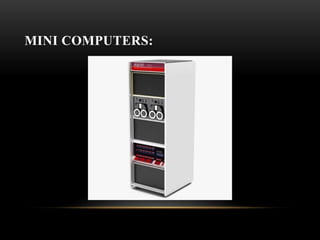
• These computers are Less powerful than Mainframe.
• These are Medium Sized computers.
• These are also Multi-user computers.
• These are very expansive computers.
• These were introduced in 1960s.
• These are mostly used as servers and medical field.
• IBM 7400 series, PDP-5, MITS Altair 8800 are examples of mainframes.
MICROCOMPUTER:
MICROCOMPUTER:
• These are Single user computers.
• These computers are Powerful Enough so that can supports single user work.
• These computers are very In-expensive as low as RS: 5000 per computer.
• These computers are called Personal Computer.
• These computers are used for home or small office work widely.
CLASSIFICATION OF COMPUTER
ACCORDING TO WORKING PRINCIPAL
• Computers are divided into three main classes depending on their working
principal (i.e. how they take input and how give out results)
a) Analogue Computers
b) Digital Computers
c) Hybrid Computers
ANALOGUE COMPUTERS
• Such a type of computer in which input is given in the form of digits but the
output is receiving in graphical form. This output is correct 90% to 95% (i.e. Wall
Clock, Thermometer, Magnetic Needle etc.)
DIGITAL COMPUTERS
• Digital computer that in which input is given in the form of digits and output is
also received in form of digits (Digital Watch, Calculator etc.)
HYBRID COMPUTERS
• These computers have both properties analog and digital. Hybrid Computer given
output in both digits and graphs all PC are the Hybrid computers having both
properties.
CLASSIFICATION OF COMPUTERS
BASED ON TECHNOLOGY
• The computers can be classified into five generations according to used
technologies.
 First Generation (1939-1956)
 Second Generation (1956-1963)
 Third Generation (1964-1971)
 Fourth Generation (1971-Present)
 Fifth Generation (Present-Future)
FIRST GENERATION (1939-1956)
• The Vacuum tubes were used in first generation of computers.
• Theses computers used magnetic drums for storage.
• These computers were very large in size. About 100 feet long and 30 ton weight.
• These computers used a very large amount of electricity.
• These computers produce an enormous amount of heat.
• The UNIVAC and ENIAC are examples of first generation computers.
SECOND GENERATION (1956-1963)
• The transistor was discovered in 1947 but were first used in computers in 1950s
• The transistors were superior to vacuum tube due to less in size, fast in working
and producing small amount of heat.
• Still Computers were large in size and produce a large amount of heat.
• Computers of this generation used punched card for input and output.
• These computer used assembly language, FORTRAN and COBOL.
• IBM 1620, IBM 7094, CDC 1604, CDC 3600 and UNIVAC 1108 are examples of
second generation computers.
THIRD GENERATION (1964-1971)
• The development of integrated circuit (IC) was a hallmark in the history of
computer.
• The Third generation of computers started with use of IC in computers.
• These computers were very fast than previous generation computers.
• These computers also generate very less amount of heat.
• These computers were equipped with keyboard, monitors and Operating system.
• These computers can run many program at one time.
• These computers were mass produced for peoples due to cheap in price.
• IBM 360 series, Honeywell 6000 series, IBM 370/168 and TDC 316 are examples
of third generation of computers.s
FOURTH GENERATION OF
COMPUTERS(1971-PRESENT)
• The fourth generation of computer started with development of micro processors.
• These computers uses a Central processing unit (CPU) built on single chip.
• These computers are very small in size.
• These computers produce very small amount of heat.
• The computers become personal in this generation.
• Today computers are multipurpose machines.
• High level languages make programming easy to do. Even children can program a
computer using these languages.
• Peripheral Devices such as keyboard, mouse, LCDs and much more make it easy
to use a computer.
• Personal Computers, Laptops, Hand Held are examples of modern computers.
FIFTH GENERATION (PRESENT-
FUTURE)
• The fifth generation computers are now in lab research process.
• The ULSI (Ultra large scale integration) and quantum computing will be the
future of computers.
• Some experimental devises are now in wide spread use today such as tablet PCs.
• The fifth generation computers are and will be able to understand each day
language.
• Voice input and touch input are already in process of developments.
• Many quantum computers are also serving mankind at this stage.
• The major break through of fifth generation is virtual reality and artificial
intelligence. But both technologies are still under development.
01  classification of computer

01 classification of computer

  • 1.
    Syed Saqib JavedShah CLASSIFICATION OF COMPUTERS
  • 2.
    BRIEF HISTORY OFCOMPUTER • The abacus, shown in below, is a calculator; its first recorded use was circa 500 B.C. The Chinese used it to add, subtract, multiply, and divide.
  • 3.
    BRIEF HISTORY OFCOMPUTER 1. In 17th Century BLAISE PASCAL a mathematician and scientist of France developed the first mechanical calculator, which he called the “Pascalins”. 2. CHARLES BABBAGE a mathematician of UK in 1822 designed a special type of calculator called “difference Engine” and in 1833 he developed a machine called “ANALYTICAL ENGINE”. 3. Later on American Scientists Working at Howard University developed a computer between 1937 and 1943 called “Howard Mark-I”. 4. First electronic computer was developed in 1946 at the University of Pennsylvania USA. 5. First Personal computer (PC) was developed in 1981.
  • 4.
    CLASSIFICATION OF COMPUTERS •Computer is classified according to their size, Technology and the working principal into different categories. 1) Depending upon their size 2) Depending upon Working Principle 3) Depending upon Technology
  • 5.
    CLASSIFICATION OF COMPUTER DEPENDINGON SIZE • Computers are divided into four main types depending on their sizes.  Super Computers  Mainframe Computers  Mini Computers  Micro Computers
  • 6.
  • 7.
    SUPER COMPUTER: • Theseare Fastest, Most Powerful and Most expensive computers • These computers are Large in size and Memory. • These are Multi –User computers. And many users can work at once on them • The CDC 6600, released in 1964, is generally considered the first supercomputer. • These computers are mostly used in Research laboratories • “IBM Blue Gene P supercomputer” is shown in picture.
  • 8.
  • 9.
    MAINFRAME COMPUTER • Thesecomputers are Less powerful than Super Computers. • These computers are also Large in size and memory. • These computers are also Multi –user. • These computers are also very Expensive. • Several manufacturers produced mainframe computers from the late 1950s through the 1970s. • IBM 700/7000 series, IBM 360 Series RE Examples of mainframes • These are mostly used as Servers in Big organizations
  • 10.
  • 11.
    MINI COMPUTERS: • Thesecomputers are Less powerful than Mainframe. • These are Medium Sized computers. • These are also Multi-user computers. • These are very expansive computers. • These were introduced in 1960s. • These are mostly used as servers and medical field. • IBM 7400 series, PDP-5, MITS Altair 8800 are examples of mainframes.
  • 12.
  • 13.
    MICROCOMPUTER: • These areSingle user computers. • These computers are Powerful Enough so that can supports single user work. • These computers are very In-expensive as low as RS: 5000 per computer. • These computers are called Personal Computer. • These computers are used for home or small office work widely.
  • 14.
    CLASSIFICATION OF COMPUTER ACCORDINGTO WORKING PRINCIPAL • Computers are divided into three main classes depending on their working principal (i.e. how they take input and how give out results) a) Analogue Computers b) Digital Computers c) Hybrid Computers
  • 15.
    ANALOGUE COMPUTERS • Sucha type of computer in which input is given in the form of digits but the output is receiving in graphical form. This output is correct 90% to 95% (i.e. Wall Clock, Thermometer, Magnetic Needle etc.)
  • 16.
    DIGITAL COMPUTERS • Digitalcomputer that in which input is given in the form of digits and output is also received in form of digits (Digital Watch, Calculator etc.)
  • 17.
    HYBRID COMPUTERS • Thesecomputers have both properties analog and digital. Hybrid Computer given output in both digits and graphs all PC are the Hybrid computers having both properties.
  • 18.
    CLASSIFICATION OF COMPUTERS BASEDON TECHNOLOGY • The computers can be classified into five generations according to used technologies.  First Generation (1939-1956)  Second Generation (1956-1963)  Third Generation (1964-1971)  Fourth Generation (1971-Present)  Fifth Generation (Present-Future)
  • 19.
    FIRST GENERATION (1939-1956) •The Vacuum tubes were used in first generation of computers. • Theses computers used magnetic drums for storage. • These computers were very large in size. About 100 feet long and 30 ton weight. • These computers used a very large amount of electricity. • These computers produce an enormous amount of heat. • The UNIVAC and ENIAC are examples of first generation computers.
  • 20.
    SECOND GENERATION (1956-1963) •The transistor was discovered in 1947 but were first used in computers in 1950s • The transistors were superior to vacuum tube due to less in size, fast in working and producing small amount of heat. • Still Computers were large in size and produce a large amount of heat. • Computers of this generation used punched card for input and output. • These computer used assembly language, FORTRAN and COBOL. • IBM 1620, IBM 7094, CDC 1604, CDC 3600 and UNIVAC 1108 are examples of second generation computers.
  • 21.
    THIRD GENERATION (1964-1971) •The development of integrated circuit (IC) was a hallmark in the history of computer. • The Third generation of computers started with use of IC in computers. • These computers were very fast than previous generation computers. • These computers also generate very less amount of heat. • These computers were equipped with keyboard, monitors and Operating system. • These computers can run many program at one time. • These computers were mass produced for peoples due to cheap in price. • IBM 360 series, Honeywell 6000 series, IBM 370/168 and TDC 316 are examples of third generation of computers.s
  • 22.
    FOURTH GENERATION OF COMPUTERS(1971-PRESENT) •The fourth generation of computer started with development of micro processors. • These computers uses a Central processing unit (CPU) built on single chip. • These computers are very small in size. • These computers produce very small amount of heat. • The computers become personal in this generation. • Today computers are multipurpose machines. • High level languages make programming easy to do. Even children can program a computer using these languages. • Peripheral Devices such as keyboard, mouse, LCDs and much more make it easy to use a computer. • Personal Computers, Laptops, Hand Held are examples of modern computers.
  • 23.
    FIFTH GENERATION (PRESENT- FUTURE) •The fifth generation computers are now in lab research process. • The ULSI (Ultra large scale integration) and quantum computing will be the future of computers. • Some experimental devises are now in wide spread use today such as tablet PCs. • The fifth generation computers are and will be able to understand each day language. • Voice input and touch input are already in process of developments. • Many quantum computers are also serving mankind at this stage. • The major break through of fifth generation is virtual reality and artificial intelligence. But both technologies are still under development.