Chapter 1- Preliminaries
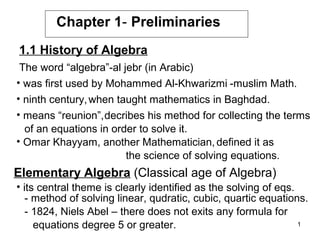
1.1 History of Algebra
The word “algebra”-al jebr (in Arabic)
• was first used by Mohammed Al-Khwarizmi -muslim Math.
• ninth century, when taught mathematics in Baghdad.
• means “reunion”,decribes his method for collecting the terms
of an equations in order to solve it.
• Omar Khayyam, another Mathematician, defined it as
the science of solving equations.

Elementary Algebra (Classical age of Algebra)
• its central theme is clearly identified as the solving of eqs.
- method of solving linear, qudratic, cubic, quartic equations.
- 1824, Niels Abel – there does not exits any formula for
1
equations degree 5 or greater.
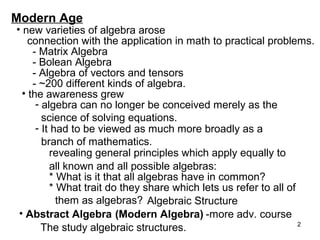
Modern Age

• new varieties of algebra arose
connection with the application in math to practical problems.
- Matrix Algebra
- Bolean Algebra
- Algebra of vectors and tensors
- ~200 different kinds of algebra.
• the awareness grew
- algebra can no longer be conceived merely as the
science of solving equations.
- It had to be viewed as much more broadly as a
branch of mathematics.
revealing general principles which apply equally to
all known and all possible algebras:
* What is it that all algebras have in common?
* What trait do they share which lets us refer to all of
them as algebras? Algebraic Structure
• Abstract Algebra (Modern Algebra) -more adv. course
2
The study algebraic structures.
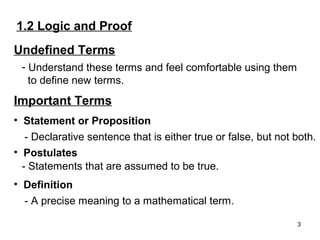
1.2 Logic and Proof
Undefined Terms
- Understand these terms and feel comfortable using them
to define new terms.

Important Terms
• Statement or Proposition
- Declarative sentence that is either true or false, but not both.
• Postulates
- Statements that are assumed to be true.
• Definition
- A precise meaning to a mathematical term.
3
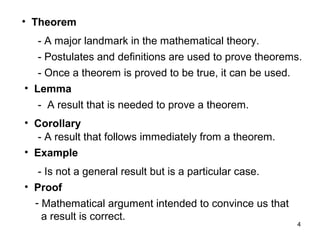
• Theorem
- A major landmark in the mathematical theory.
- Postulates and definitions are used to prove theorems.
- Once a theorem is proved to be true, it can be used.
• Lemma
- A result that is needed to prove a theorem.
• Corollary
- A result that follows immediately from a theorem.
• Example
- Is not a general result but is a particular case.
• Proof
- Mathematical argument intended to convince us that
a result is correct.

4
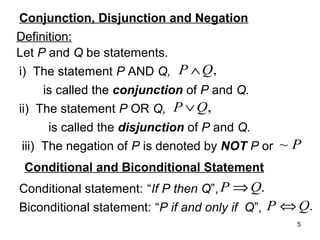
Conjunction, Disjunction and Negation
Definition:
Let P and Q be statements.
i) The statement P AND Q, P ∧ Q,
is called the conjunction of P and Q.
ii) The statement P OR Q, P ∨ Q,
is called the disjunction of P and Q.
iii) The negation of P is denoted by NOT P or ~ P
Conditional and Biconditional Statement
Conditional statement: “If P then Q”, P ⇒ Q.
Biconditional statement: “P if and only if Q”, P ⇔ Q.
5
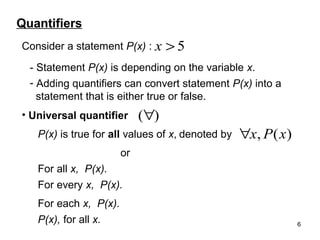
Quantifiers
Consider a statement P(x) :

x >5

- Statement P(x) is depending on the variable x.
- Adding quantifiers can convert statement P(x) into a
statement that is either true or false.
• Universal quantifier

(∀)

P(x) is true for all values of x, denoted by

∀x, P ( x)

or
For all x, P(x).
For every x, P(x).
For each x, P(x).
P(x), for all x.

6
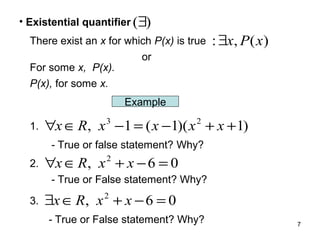
• Existential quantifier (∃)
There exist an x for which P(x) is true
or
For some x, P(x).
P(x), for some x.

: ∃x, P ( x)

Example
1.

∀x ∈ R, x −1 = ( x −1)( x + x + 1)
3

2

- True or false statement? Why?
2.

∀x ∈ R, x + x − 6 = 0
2

- True or False statement? Why?
3.

∃x ∈ R, x + x − 6 = 0
2

- True or False statement? Why?

7
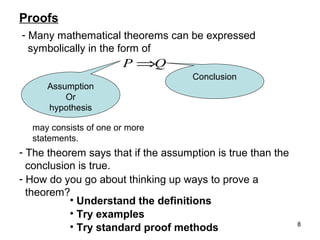
Proofs
- Many mathematical theorems can be expressed
symbolically in the form of

P ⇒Q
Assumption
Or
hypothesis

Conclusion

may consists of one or more
statements.

- The theorem says that if the assumption is true than the
conclusion is true.
- How do you go about thinking up ways to prove a
theorem?
• Understand the definitions
• Try examples
• Try standard proof methods

8
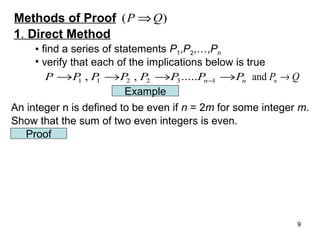
Methods of Proof ( P ⇒ Q)
1. Direct Method
• find a series of statements P1,P2,…,Pn
• verify that each of the implications below is true
P →P , P →P2 , P2 →P3 .....Pn −1 →Pn and Pn → Q
1
1
Example
An integer n is defined to be even if n = 2m for some integer m.
Show that the sum of two even integers is even.
Proof

9
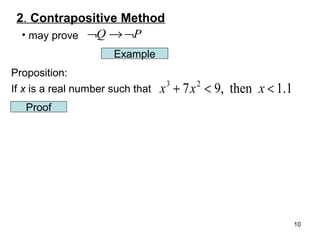
2. Contrapositive Method
• may prove ¬Q → ¬P
Example
Proposition:
If x is a real number such that

x + 7 x < 9, then x < 1.1
3

2

Proof

10
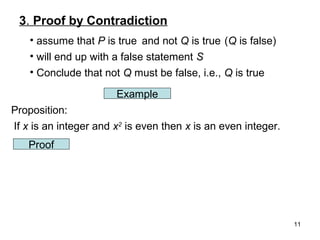
3. Proof by Contradiction
• assume that P is true and not Q is true (Q is false)
• will end up with a false statement S
• Conclude that not Q must be false, i.e., Q is true
Example
Proposition:
If x is an integer and x2 is even then x is an even integer.
Proof

11
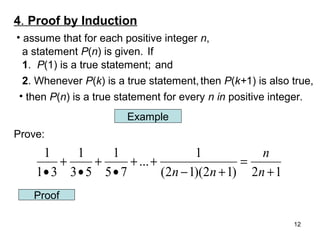
4. Proof by Induction
• assume that for each positive integer n,
a statement P(n) is given. If
1. P(1) is a true statement; and
2. Whenever P(k) is a true statement, then P(k+1) is also true,
• then P(n) is a true statement for every n in positive integer.
Example
Prove:

1
1
1
1
n
+
+
+ ... +
=
1• 3 3 • 5 5 • 7
(2n − 1)(2n + 1) 2n + 1
Proof
12
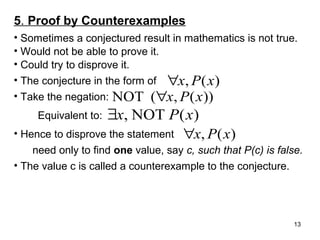
5. Proof by Counterexamples
• Sometimes a conjectured result in mathematics is not true.
• Would not be able to prove it.
• Could try to disprove it.
• The conjecture in the form of ∀x, P ( x )
• Take the negation: NOT (∀x, P ( x ))
Equivalent to:

∃x, NOT P ( x)

• Hence to disprove the statement

∀x, P ( x)

need only to find one value, say c, such that P(c) is false.
• The value c is called a counterexample to the conjecture.

13
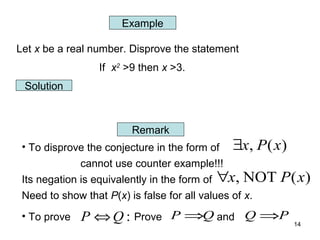
Example
Let x be a real number. Disprove the statement
If x2 >9 then x >3.
Solution

Remark
• To disprove the conjecture in the form of

∃x, P ( x)

cannot use counter example!!!
Its negation is equivalently in the form of ∀x, NOT
Need to show that P(x) is false for all values of x.
• To prove

P ( x)

P ⇔ Q : Prove P ⇒Q and Q ⇒P

14

Tma2033 chap1.1&1.2handout

  • 1.
    Chapter 1- Preliminaries 1.1History of Algebra The word “algebra”-al jebr (in Arabic) • was first used by Mohammed Al-Khwarizmi -muslim Math. • ninth century, when taught mathematics in Baghdad. • means “reunion”,decribes his method for collecting the terms of an equations in order to solve it. • Omar Khayyam, another Mathematician, defined it as the science of solving equations. Elementary Algebra (Classical age of Algebra) • its central theme is clearly identified as the solving of eqs. - method of solving linear, qudratic, cubic, quartic equations. - 1824, Niels Abel – there does not exits any formula for 1 equations degree 5 or greater.
  • 2.
    Modern Age • newvarieties of algebra arose connection with the application in math to practical problems. - Matrix Algebra - Bolean Algebra - Algebra of vectors and tensors - ~200 different kinds of algebra. • the awareness grew - algebra can no longer be conceived merely as the science of solving equations. - It had to be viewed as much more broadly as a branch of mathematics. revealing general principles which apply equally to all known and all possible algebras: * What is it that all algebras have in common? * What trait do they share which lets us refer to all of them as algebras? Algebraic Structure • Abstract Algebra (Modern Algebra) -more adv. course 2 The study algebraic structures.
  • 3.
    1.2 Logic andProof Undefined Terms - Understand these terms and feel comfortable using them to define new terms. Important Terms • Statement or Proposition - Declarative sentence that is either true or false, but not both. • Postulates - Statements that are assumed to be true. • Definition - A precise meaning to a mathematical term. 3
  • 4.
    • Theorem - Amajor landmark in the mathematical theory. - Postulates and definitions are used to prove theorems. - Once a theorem is proved to be true, it can be used. • Lemma - A result that is needed to prove a theorem. • Corollary - A result that follows immediately from a theorem. • Example - Is not a general result but is a particular case. • Proof - Mathematical argument intended to convince us that a result is correct. 4
  • 5.
    Conjunction, Disjunction andNegation Definition: Let P and Q be statements. i) The statement P AND Q, P ∧ Q, is called the conjunction of P and Q. ii) The statement P OR Q, P ∨ Q, is called the disjunction of P and Q. iii) The negation of P is denoted by NOT P or ~ P Conditional and Biconditional Statement Conditional statement: “If P then Q”, P ⇒ Q. Biconditional statement: “P if and only if Q”, P ⇔ Q. 5
  • 6.
    Quantifiers Consider a statementP(x) : x >5 - Statement P(x) is depending on the variable x. - Adding quantifiers can convert statement P(x) into a statement that is either true or false. • Universal quantifier (∀) P(x) is true for all values of x, denoted by ∀x, P ( x) or For all x, P(x). For every x, P(x). For each x, P(x). P(x), for all x. 6
  • 7.
    • Existential quantifier(∃) There exist an x for which P(x) is true or For some x, P(x). P(x), for some x. : ∃x, P ( x) Example 1. ∀x ∈ R, x −1 = ( x −1)( x + x + 1) 3 2 - True or false statement? Why? 2. ∀x ∈ R, x + x − 6 = 0 2 - True or False statement? Why? 3. ∃x ∈ R, x + x − 6 = 0 2 - True or False statement? Why? 7
  • 8.
    Proofs - Many mathematicaltheorems can be expressed symbolically in the form of P ⇒Q Assumption Or hypothesis Conclusion may consists of one or more statements. - The theorem says that if the assumption is true than the conclusion is true. - How do you go about thinking up ways to prove a theorem? • Understand the definitions • Try examples • Try standard proof methods 8
  • 9.
    Methods of Proof( P ⇒ Q) 1. Direct Method • find a series of statements P1,P2,…,Pn • verify that each of the implications below is true P →P , P →P2 , P2 →P3 .....Pn −1 →Pn and Pn → Q 1 1 Example An integer n is defined to be even if n = 2m for some integer m. Show that the sum of two even integers is even. Proof 9
  • 10.
    2. Contrapositive Method •may prove ¬Q → ¬P Example Proposition: If x is a real number such that x + 7 x < 9, then x < 1.1 3 2 Proof 10
  • 11.
    3. Proof byContradiction • assume that P is true and not Q is true (Q is false) • will end up with a false statement S • Conclude that not Q must be false, i.e., Q is true Example Proposition: If x is an integer and x2 is even then x is an even integer. Proof 11
  • 12.
    4. Proof byInduction • assume that for each positive integer n, a statement P(n) is given. If 1. P(1) is a true statement; and 2. Whenever P(k) is a true statement, then P(k+1) is also true, • then P(n) is a true statement for every n in positive integer. Example Prove: 1 1 1 1 n + + + ... + = 1• 3 3 • 5 5 • 7 (2n − 1)(2n + 1) 2n + 1 Proof 12
  • 13.
    5. Proof byCounterexamples • Sometimes a conjectured result in mathematics is not true. • Would not be able to prove it. • Could try to disprove it. • The conjecture in the form of ∀x, P ( x ) • Take the negation: NOT (∀x, P ( x )) Equivalent to: ∃x, NOT P ( x) • Hence to disprove the statement ∀x, P ( x) need only to find one value, say c, such that P(c) is false. • The value c is called a counterexample to the conjecture. 13
  • 14.
    Example Let x bea real number. Disprove the statement If x2 >9 then x >3. Solution Remark • To disprove the conjecture in the form of ∃x, P ( x) cannot use counter example!!! Its negation is equivalently in the form of ∀x, NOT Need to show that P(x) is false for all values of x. • To prove P ( x) P ⇔ Q : Prove P ⇒Q and Q ⇒P 14