   Articulation:
       Posterior surface of the patella
       Femoral sulcus or patellar surface of femur
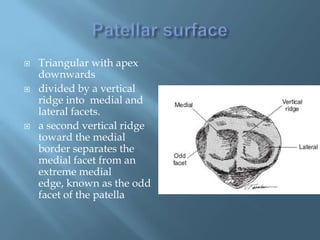
   Triangular with apex
    downwards
   divided by a vertical
    ridge into medial and
    lateral facets.
   a second vertical ridge
    toward the medial
    border separates the
    medial facet from an
    extreme medial
    edge, known as the odd
    facet of the patella
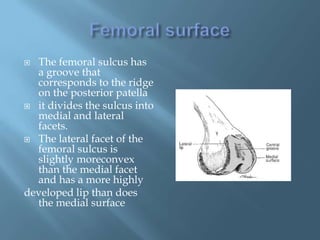
 The femoral sulcus has
  a groove that
  corresponds to the ridge
  on the posterior patella
 it divides the sulcus into
  medial and lateral
  facets.
 The lateral facet of the
  femoral sulcus is
  slightly moreconvex
  than the medial facet
  and has a more highly
developed lip than does
  the medial surface
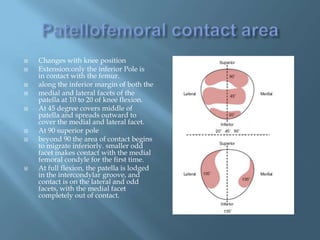
   Changes with knee position
   Extension:only the inferior Pole is
    in contact with the femur.
   along the inferior margin of both the
   medial and lateral facets of the
    patella at 10 to 20 of knee flexion.
   At 45 degree covers middle of
    patella and spreads outward to
    cover the medial and lateral facet.
   At 90 superior pole
   beyond 90 the area of contact begins
    to migrate inferiorly. smaller odd
    facet makes contact with the medial
    femoral condyle for the first time.
   At full flexion, the patella is lodged
    in the intercondylar groove, and
    contact is on the lateral and odd
    facets, with the medial facet
    completely out of contact.
   Muscles crossing knee are basically flexors or
    extensors, and have additional function of
    rotation/ abdn addn
  7 muscles flex the knee:
3Hamstrings:
the semimembranosus, semitendinosus, biceps
   femoris(long and short heads)
 sartorius
gracilis
 popliteus
gastrocnemius muscles
Plantaris also flexes the knee when present
Other than short head of biceps femoris and
  popliteus all other are two joint muscles, thus
  their flexing ability depends on angle of the
  other joint where it is attached.
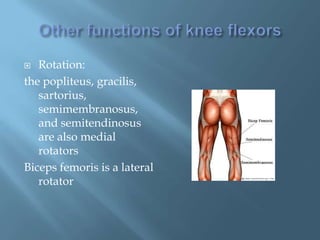
  Rotation:
the popliteus, gracilis,
   sartorius,
   semimembranosus,
   and semitendinosus
   are also medial
   rotators
Biceps femoris is a lateral
   rotator
   Varus & valgus moment:
   The lateral muscles
   (biceps femoris, lateral head of the gastrocnemius,
   and the popliteus) are capable of producing valgus
    moments
   Muscles on the medial side of
   the joint
    (semimembranosus, semitendinosus, medial
   head of the gastrocnemius, sartorius, and gracilis)
    can
   generate varus moments.
   Popliteus is known as the unlocking muscle
    although without it also locking will take place.
   active assistance of the semimembranosus and
    popliteus muscles ensures that tibio femoral
    congruence is maximized throughout the range
    of knee flexion by acting on menisci
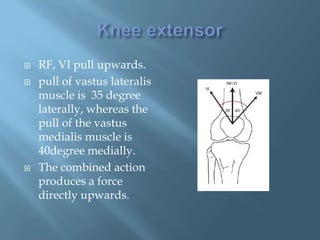
   RF, VI pull upwards.
   pull of vastus lateralis
    muscle is 35 degree
    laterally, whereas the
    pull of the vastus
    medialis muscle is
    40degree medially.
   The combined action
    produces a force
    directly upwards.
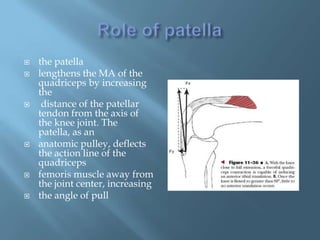
   the patella
   lengthens the MA of the
    quadriceps by increasing
    the
    distance of the patellar
    tendon from the axis of
    the knee joint. The
    patella, as an
   anatomic pulley, deflects
    the action line of the
    quadriceps
   femoris muscle away from
    the joint center, increasing
   the angle of pull
    at semi flexion, the patella is primarily responsible
    for increasing the quadriceps angle of pull.

   In full knee flexion, the patella is fixed firmly
    inside the intercondylar notch of the femur, which
    reduces the pulley action of patella. Still the
    quadriceps maintains a fairly large MA because
    the rounded contour of the femoral condyles
    deflects the muscle’s action line and because the
    axis of rotation has shifted posteriorly into the
    femoral condyle.
in the final stages of knee extension, patella’s
   effect on the quadriceps’ MA is diminished but
   the small improvement in joint torque
   provided by the patella is important.
 because near end range extension, the
   quadriceps is in a shortened position, which
   reduces its ability to generate active tension.
   If there is substantial quadriceps weakness or if the
   patella has been removed because of trauma (a
    procedure
   known as a patellectomy), the quadriceps may
   not be able to produce adequate torque to
    complete
   the last 15degree of non–weight-bearing knee
    extension.
   This is called as “quadriceps lag” or “extensor
    lag.”
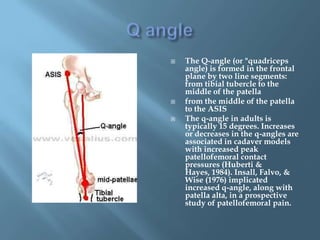
   The Q-angle (or "quadriceps
    angle) is formed in the frontal
    plane by two line segments:
    from tibial tubercle to the
    middle of the patella
   from the middle of the patella
    to the ASIS
   The q-angle in adults is
    typically 15 degrees. Increases
    or decreases in the q-angles are
    associated in cadaver models
    with increased peak
    patellofemoral contact
    pressures (Huberti &
    Hayes, 1984). Insall, Falvo, &
    Wise (1976) implicated
    increased q-angle, along with
    patella alta, in a prospective
    study of patellofemoral pain.
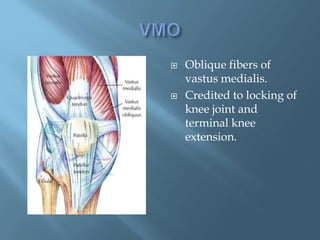
   Oblique fibers of
    vastus medialis.
   Credited to locking of
    knee joint and
    terminal knee
    extension.
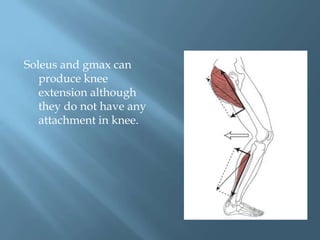
Soleus and gmax can
   produce knee
   extension although
   they do not have any
   attachment in knee.

Knee biomechanics

  • 2.
    Articulation:  Posterior surface of the patella  Femoral sulcus or patellar surface of femur
  • 3.
    Triangular with apex downwards  divided by a vertical ridge into medial and lateral facets.  a second vertical ridge toward the medial border separates the medial facet from an extreme medial edge, known as the odd facet of the patella
  • 4.
     The femoralsulcus has a groove that corresponds to the ridge on the posterior patella  it divides the sulcus into medial and lateral facets.  The lateral facet of the femoral sulcus is slightly moreconvex than the medial facet and has a more highly developed lip than does the medial surface
  • 5.
    Changes with knee position  Extension:only the inferior Pole is in contact with the femur.  along the inferior margin of both the  medial and lateral facets of the patella at 10 to 20 of knee flexion.  At 45 degree covers middle of patella and spreads outward to cover the medial and lateral facet.  At 90 superior pole  beyond 90 the area of contact begins to migrate inferiorly. smaller odd facet makes contact with the medial femoral condyle for the first time.  At full flexion, the patella is lodged in the intercondylar groove, and contact is on the lateral and odd facets, with the medial facet completely out of contact.
  • 6.
    Muscles crossing knee are basically flexors or extensors, and have additional function of rotation/ abdn addn
  • 7.
     7muscles flex the knee: 3Hamstrings: the semimembranosus, semitendinosus, biceps femoris(long and short heads) sartorius gracilis popliteus gastrocnemius muscles Plantaris also flexes the knee when present
  • 8.
    Other than shorthead of biceps femoris and popliteus all other are two joint muscles, thus their flexing ability depends on angle of the other joint where it is attached.
  • 9.
     Rotation: thepopliteus, gracilis, sartorius, semimembranosus, and semitendinosus are also medial rotators Biceps femoris is a lateral rotator
  • 10.
    Varus & valgus moment:  The lateral muscles  (biceps femoris, lateral head of the gastrocnemius,  and the popliteus) are capable of producing valgus moments  Muscles on the medial side of  the joint (semimembranosus, semitendinosus, medial  head of the gastrocnemius, sartorius, and gracilis) can  generate varus moments.
  • 11.
    Popliteus is known as the unlocking muscle although without it also locking will take place.  active assistance of the semimembranosus and popliteus muscles ensures that tibio femoral congruence is maximized throughout the range of knee flexion by acting on menisci
  • 12.
    RF, VI pull upwards.  pull of vastus lateralis muscle is 35 degree laterally, whereas the pull of the vastus medialis muscle is 40degree medially.  The combined action produces a force directly upwards.
  • 13.
    the patella  lengthens the MA of the quadriceps by increasing the  distance of the patellar tendon from the axis of the knee joint. The patella, as an  anatomic pulley, deflects the action line of the quadriceps  femoris muscle away from the joint center, increasing  the angle of pull
  • 14.
    at semi flexion, the patella is primarily responsible for increasing the quadriceps angle of pull.  In full knee flexion, the patella is fixed firmly inside the intercondylar notch of the femur, which reduces the pulley action of patella. Still the quadriceps maintains a fairly large MA because the rounded contour of the femoral condyles deflects the muscle’s action line and because the axis of rotation has shifted posteriorly into the femoral condyle.
  • 15.
    in the finalstages of knee extension, patella’s effect on the quadriceps’ MA is diminished but the small improvement in joint torque provided by the patella is important.  because near end range extension, the quadriceps is in a shortened position, which reduces its ability to generate active tension.
  • 16.
    If there is substantial quadriceps weakness or if the  patella has been removed because of trauma (a procedure  known as a patellectomy), the quadriceps may  not be able to produce adequate torque to complete  the last 15degree of non–weight-bearing knee extension.  This is called as “quadriceps lag” or “extensor lag.”
  • 17.
    The Q-angle (or "quadriceps angle) is formed in the frontal plane by two line segments: from tibial tubercle to the middle of the patella  from the middle of the patella to the ASIS  The q-angle in adults is typically 15 degrees. Increases or decreases in the q-angles are associated in cadaver models with increased peak patellofemoral contact pressures (Huberti & Hayes, 1984). Insall, Falvo, & Wise (1976) implicated increased q-angle, along with patella alta, in a prospective study of patellofemoral pain.
  • 18.
    Oblique fibers of vastus medialis.  Credited to locking of knee joint and terminal knee extension.
  • 19.
    Soleus and gmaxcan produce knee extension although they do not have any attachment in knee.