Shruti G Lakkumane
 The patella is the largest sesamoid bone in the
body, developed in the quadriceps tendon.
 The patella has an apex, three
borders(superior,lateral, medial) and two
surfaces(anterior and posterior)
 The base of the patella provides insertion to
rectus femoris in front and vastus intermedius
behind.
 The lateral border provides insertion to vastus
lateralis and medial border to vastus medialis.
 On the posterior aspect there is non articular
area which provides attachment to patellar
ligamentum.
 Ligaments involved are:
 Lateral collateral ligament
 Medial collateral ligament
 Anterior cruciate ligament
 Posterior cruciate ligament
 It also involves the meniscal attachment they
are lateral meniscus and medial meniscus.
 The IT band provides the lateral support to
knee joint.
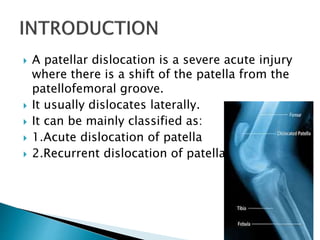
 A patellar dislocation is a severe acute injury
where there is a shift of the patella from the
patellofemoral groove.
 It usually dislocates laterally.
 It can be mainly classified as:
 1.Acute dislocation of patella
 2.Recurrent dislocation of patella
 MECHANISM OF INJURY:
 Traumatic dislocation due to indirect force:
sudden, severe, contraction of quadriceps
muscle while knee is stretched in valgus and
external rotation.
 Predisposing factors like anatomical variation
such as genu valgum, tibial torsion, high
ridding patellar.
 Patellar hypermobility due to generalized
laxity or localized muscle weakness.
 Instability
 Swelling
 Pain
 Weakness
 Training errors
 Aggravating activites
 Night pain
 Physical examination should include the evaluation of :
 Generalized ligamentum laxity
 Gait pattern
 Extensor mechanism alignment:
 - Q angle
 -genu valgum, varum
 -tibial torsion
 -patellar glide test- lateral glide, medial glide
 -J sign
 Flexibility : hamstrings, quadriceps and IT band(Obers test)
 Lateral pull test
 Local palpation
 Soft tissue point tenderness
 Hip and knee ROM
 Q angle- it is the angle formed between a line
connecting the anterior superior iliac spine to
the midpoint of the patella and a line
connecting the tibial tuberosity and the
midpoint of the patella.
 Normally in male-10 degree
 in female-15degree
 Soft tissue stabilizers: There are medial and
lateral soft tissue restraints the patella.
 The medial restraints consist of medial
retinaculum, medial patellofemoral ligament and
vastus medialis oblique.
 The vastus medialis oblique is the most
important dynamic stabilizers of the patella to
resist lateral displacement.
 The fibers in VMO is oriented about 50-55
degree.
 The lateral restrains consist of lateral
retinaculum, vastus lateralis and IT band.
 Standing alignment of extensor mechanism:
evaluation of lower extremity to asses the
alignment.
 Also look for genu valgum, varum, tibial
torsion or limb length discrepancy.
 Should be evaluated in standing position.
 Observation of gait pattern
 Muscle atrophy measurement
 Flexibility: flexibility of lower extremity must
be evaluated.
 Quadriceps, hamstrings and IT band
tightness contributes patellofemoral
symptoms..
 Quadriceps flexibility cab be tested with
patient in a prone position. The hip is
extended and knee slightly flexed.
 Limitation of knee flexion indicate quadriceps
tightness.
 Hamstring flexibility: the hip is flexed with
the leg extended, until pelvis begins to move
and knee begins to flex, the angle formed
between the leg and table indicates the
flexibility of hamstrings.
 Ober test: to asses IT band flexibility
 It is useful to asses the medial and lateral
patellar restraints
 In extension, the patella lies above the
trochlear groove and should be freely mobile
on both side.
 As knee is flexed to 20 degree the patella
should center to the trochlear groove.
 The lateral glide test evaluates the integrity of
the medial restraints.
 Translation of patellar width:
 25%- normal
 greater than 50%-laxity within medial restraints
 53%- stabilizing force to resist lateral dislocation
 Increase patients symptoms with passive lateral
translation of the patella pulling on medial
structure refers a positive lateral apprehension
test.
 It is performed in knee in full extension.
 The patella is centered on the trochlear
groove and medial translation is measured in
millimeters.
 6-10mm is considered normal.
 Greater than 10mm is abnormal.
 Less than 6mm medially indicates a tight
lateral restraints.
 Evaluation of patellar instability begins with
the knee in full extension.
 As the knee moves into flexion at around 10-
15 degree.
 The patellar centers into trochlear groove and
proceeds in the straight path.
 A sharp jump of the patella into trochlear
groove refers to J sign.
 A tight lateral restraints leads to patellar tilt.
 It is evaluated when knee is brought to an full
extension and made to elevate lateral border
of patella.
 Normally it should elevate 0-20 degree above
the medial border.
 Less than 0 degree indicates tightness of
lateral retinaculum, vastus lateralis or IT
band.
 X-ray: three views are taken
 A.P view, lateral, axial image.
 The A.P view can asses for presence of any
fracture and also alignment.
 The lateral view evaluate for joint space
 An axial image is the most important used to
asses the patellar tilt and patellar
subluxation.
 MRI: soft tissue lesion and bone damage.
 Goals- phase 1
 decrease the symptoms and instability
 Increase quadriceps strength
 Enhance patellar instability.
 Decrease pain and avoid recurrent dislocation.
 Limit ROM to protect healing tissue.
PT management:
 cryotherapy
 Avoid the activities that aggravates the symptoms.
 Partial weight bearing with crutches.
 Electrical stimulation to promote quadriceps activity.
 Patellar stabilizing brace
 Gradual stretching for IT band, quadriceps, hamstrings.
 Passive ROM
 Isometrics for hamstrings
 Supine SLR
 GOAL- phase 2
 Improve quadriceps muscle function.
 Obtain full ROM
 Avoid patellofemoral symptoms or instability
 Begin with low level activites
 PT management:
 Continuation of electrical stimulation
 Continue with supine SLR
 Modalities needed.
 Continue patellar bracing.
 Closed kinetic chain exercise
 Low level endurance training.
 Goal- PHASE 3:
 Good to normal quadriceps function.
 Full active ROM.
 Improve functional capabilities
 Gradual return to sports activity
PT management:
 Four way hip exercise.
 Wean from patellar brace as quadriceps strength
improves.
 Proprioceptive training
 Sports and skill specific training.
 Patient education.
 Operative management:
• Conservative- an attempt can be made for
closed reduction under GA.
• An above knee POP cast is applied for 12
weeks.
• Surgery-
• Indications: open reduction may be required
if closed reduction fails or if there is severe
ligamentus injury.
• Finally the knee is immobilized in POP.
 In recurrent dislocation of patella the patient
has repeated episodes of dislocation.
 The main cause of dislocation include laxity
of ligaments, weak muscle atropy or
abnormal placed patella.
 It can be direct or indirect injury
 CLINICAL FEATURES-
 Pain
 Swelling
 Tenderness
 Lateral view and axial view
 Lateral view shows high riding patellla
 Axial view can be used to measure sulcus
angle and congurence angle.
 Surgical management: Patellectomy
 indication:
 1.inabilty to reduce the patella
 2. presence of large displaced osteochondral
fragments
 PT management:
1. during immobilization:
1.Strong Toe movements and active hip
movements as early as possible.
2. On the second postoperative day NWB
Crutch walking can be initiated.
3. Indirect Isometric to the quadriceps should
be initiated and direct with isometric to the
quadriceps should be begin inside the caste
within the limit of disconpaired.
 2.After immobilization
 Mobilization
 1. Gradual knee mobilization begun in a small
range ideally by CPM.
 Assisted SLR to be initiated.
 Partial weight bearing can be initiated.

PATELLA DISLOCATION (1).pptx. .

  • 1.
  • 2.
     The patellais the largest sesamoid bone in the body, developed in the quadriceps tendon.  The patella has an apex, three borders(superior,lateral, medial) and two surfaces(anterior and posterior)  The base of the patella provides insertion to rectus femoris in front and vastus intermedius behind.  The lateral border provides insertion to vastus lateralis and medial border to vastus medialis.  On the posterior aspect there is non articular area which provides attachment to patellar ligamentum.
  • 3.
     Ligaments involvedare:  Lateral collateral ligament  Medial collateral ligament  Anterior cruciate ligament  Posterior cruciate ligament  It also involves the meniscal attachment they are lateral meniscus and medial meniscus.  The IT band provides the lateral support to knee joint.
  • 5.
     A patellardislocation is a severe acute injury where there is a shift of the patella from the patellofemoral groove.  It usually dislocates laterally.  It can be mainly classified as:  1.Acute dislocation of patella  2.Recurrent dislocation of patella
  • 6.
     MECHANISM OFINJURY:  Traumatic dislocation due to indirect force: sudden, severe, contraction of quadriceps muscle while knee is stretched in valgus and external rotation.  Predisposing factors like anatomical variation such as genu valgum, tibial torsion, high ridding patellar.  Patellar hypermobility due to generalized laxity or localized muscle weakness.
  • 7.
     Instability  Swelling Pain  Weakness  Training errors  Aggravating activites  Night pain
  • 8.
     Physical examinationshould include the evaluation of :  Generalized ligamentum laxity  Gait pattern  Extensor mechanism alignment:  - Q angle  -genu valgum, varum  -tibial torsion  -patellar glide test- lateral glide, medial glide  -J sign  Flexibility : hamstrings, quadriceps and IT band(Obers test)  Lateral pull test  Local palpation  Soft tissue point tenderness  Hip and knee ROM
  • 9.
     Q angle-it is the angle formed between a line connecting the anterior superior iliac spine to the midpoint of the patella and a line connecting the tibial tuberosity and the midpoint of the patella.  Normally in male-10 degree  in female-15degree
  • 10.
     Soft tissuestabilizers: There are medial and lateral soft tissue restraints the patella.  The medial restraints consist of medial retinaculum, medial patellofemoral ligament and vastus medialis oblique.  The vastus medialis oblique is the most important dynamic stabilizers of the patella to resist lateral displacement.  The fibers in VMO is oriented about 50-55 degree.  The lateral restrains consist of lateral retinaculum, vastus lateralis and IT band.
  • 11.
     Standing alignmentof extensor mechanism: evaluation of lower extremity to asses the alignment.  Also look for genu valgum, varum, tibial torsion or limb length discrepancy.  Should be evaluated in standing position.  Observation of gait pattern  Muscle atrophy measurement
  • 12.
     Flexibility: flexibilityof lower extremity must be evaluated.  Quadriceps, hamstrings and IT band tightness contributes patellofemoral symptoms..  Quadriceps flexibility cab be tested with patient in a prone position. The hip is extended and knee slightly flexed.  Limitation of knee flexion indicate quadriceps tightness.
  • 13.
     Hamstring flexibility:the hip is flexed with the leg extended, until pelvis begins to move and knee begins to flex, the angle formed between the leg and table indicates the flexibility of hamstrings.  Ober test: to asses IT band flexibility
  • 15.
     It isuseful to asses the medial and lateral patellar restraints  In extension, the patella lies above the trochlear groove and should be freely mobile on both side.  As knee is flexed to 20 degree the patella should center to the trochlear groove.
  • 17.
     The lateralglide test evaluates the integrity of the medial restraints.  Translation of patellar width:  25%- normal  greater than 50%-laxity within medial restraints  53%- stabilizing force to resist lateral dislocation  Increase patients symptoms with passive lateral translation of the patella pulling on medial structure refers a positive lateral apprehension test.
  • 19.
     It isperformed in knee in full extension.  The patella is centered on the trochlear groove and medial translation is measured in millimeters.  6-10mm is considered normal.  Greater than 10mm is abnormal.  Less than 6mm medially indicates a tight lateral restraints.
  • 20.
     Evaluation ofpatellar instability begins with the knee in full extension.  As the knee moves into flexion at around 10- 15 degree.  The patellar centers into trochlear groove and proceeds in the straight path.  A sharp jump of the patella into trochlear groove refers to J sign.
  • 21.
     A tightlateral restraints leads to patellar tilt.  It is evaluated when knee is brought to an full extension and made to elevate lateral border of patella.  Normally it should elevate 0-20 degree above the medial border.  Less than 0 degree indicates tightness of lateral retinaculum, vastus lateralis or IT band.
  • 23.
     X-ray: threeviews are taken  A.P view, lateral, axial image.  The A.P view can asses for presence of any fracture and also alignment.  The lateral view evaluate for joint space  An axial image is the most important used to asses the patellar tilt and patellar subluxation.  MRI: soft tissue lesion and bone damage.
  • 27.
     Goals- phase1  decrease the symptoms and instability  Increase quadriceps strength  Enhance patellar instability.  Decrease pain and avoid recurrent dislocation.  Limit ROM to protect healing tissue. PT management:  cryotherapy  Avoid the activities that aggravates the symptoms.  Partial weight bearing with crutches.  Electrical stimulation to promote quadriceps activity.  Patellar stabilizing brace  Gradual stretching for IT band, quadriceps, hamstrings.  Passive ROM  Isometrics for hamstrings  Supine SLR
  • 29.
     GOAL- phase2  Improve quadriceps muscle function.  Obtain full ROM  Avoid patellofemoral symptoms or instability  Begin with low level activites  PT management:  Continuation of electrical stimulation  Continue with supine SLR  Modalities needed.  Continue patellar bracing.  Closed kinetic chain exercise  Low level endurance training.
  • 30.
     Goal- PHASE3:  Good to normal quadriceps function.  Full active ROM.  Improve functional capabilities  Gradual return to sports activity PT management:  Four way hip exercise.  Wean from patellar brace as quadriceps strength improves.  Proprioceptive training  Sports and skill specific training.  Patient education.
  • 31.
     Operative management: •Conservative- an attempt can be made for closed reduction under GA. • An above knee POP cast is applied for 12 weeks. • Surgery- • Indications: open reduction may be required if closed reduction fails or if there is severe ligamentus injury. • Finally the knee is immobilized in POP.
  • 32.
     In recurrentdislocation of patella the patient has repeated episodes of dislocation.  The main cause of dislocation include laxity of ligaments, weak muscle atropy or abnormal placed patella.  It can be direct or indirect injury  CLINICAL FEATURES-  Pain  Swelling  Tenderness
  • 33.
     Lateral viewand axial view  Lateral view shows high riding patellla  Axial view can be used to measure sulcus angle and congurence angle.
  • 34.
     Surgical management:Patellectomy  indication:  1.inabilty to reduce the patella  2. presence of large displaced osteochondral fragments
  • 35.
     PT management: 1.during immobilization: 1.Strong Toe movements and active hip movements as early as possible. 2. On the second postoperative day NWB Crutch walking can be initiated. 3. Indirect Isometric to the quadriceps should be initiated and direct with isometric to the quadriceps should be begin inside the caste within the limit of disconpaired.
  • 36.
     2.After immobilization Mobilization  1. Gradual knee mobilization begun in a small range ideally by CPM.  Assisted SLR to be initiated.  Partial weight bearing can be initiated.