Minimizing Grey Zones
 in Thyroid Pathology


  Sylvia L. Asa, MD, PhD
        Pathologist-in-Chief
         Medical Director
 Laboratory Medicine Program
University Health Network, Toronto
Controversies
• Nodules in Thyroiditis
• Sporadic Nodular Goitre/Follicular nodular disease
• Papillary adenomas
• Follicular Variant Papillary Carcinoma/Follicular
  carcinoma
• Capsular Invasion
• Extrathyroidal Extension
• Vascular invasion
Controversies
• Nodules in Thyroiditis
• Sporadic Nodular Goitre/Follicular nodular disease
• Papillary adenomas
• Follicular Variant Papillary Carcinoma/Follicular
  carcinoma
• Capsular Invasion
• Extrathyroidal Extension
• Vascular invasion
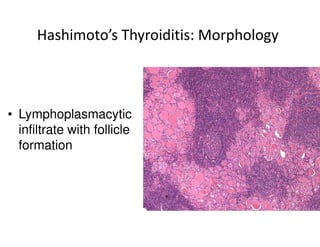
Hashimoto’s Thyroiditis: Morphology


• Lymphoplasmacytic
  infiltrate with follicle
  formation
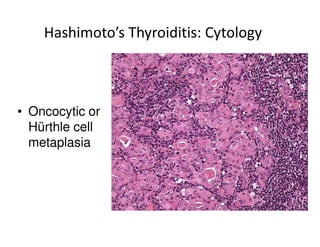
Hashimoto’s Thyroiditis: Cytology


• Oncocytic or
  Hürthle cell
  metaplasia
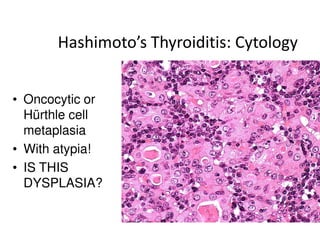
Hashimoto’s Thyroiditis: Cytology


• Oncocytic or
  Hürthle cell
  metaplasia
• With atypia!
• IS THIS
  DYSPLASIA?
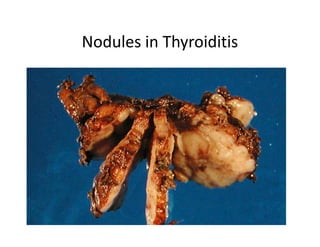
Nodules in Thyroiditis
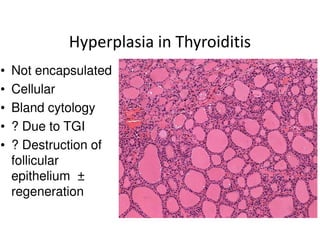
Hyperplasia in Thyroiditis
•   Not encapsulated
•   Cellular
•   Bland cytology
•   ? Due to TGI
•   ? Destruction of
    follicular
    epithelium ±
    regeneration
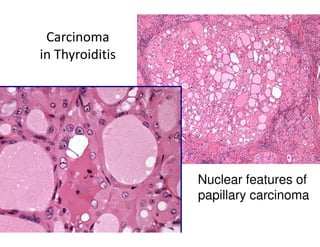
Carcinoma
in Thyroiditis


                 Nuclear features of
                 papillary carcinoma
Controversies
• Nodules in Thyroiditis
• Sporadic Nodular Goitre/Follicular nodular disease
• Papillary adenomas
• Follicular Variant Papillary Carcinoma/Follicular
  carcinoma
• Capsular Invasion
• Extrathyroidal Extension
• Vascular invasion
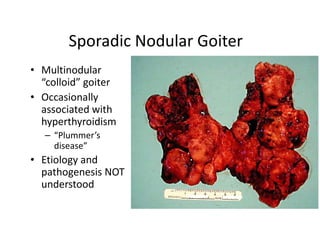
Sporadic Nodular Goiter
• Multinodular
  ā€œcolloidā€ goiter
• Occasionally
  associated with
  hyperthyroidism
   – ā€œPlummer’s
     diseaseā€
• Etiology and
  pathogenesis NOT
  understood
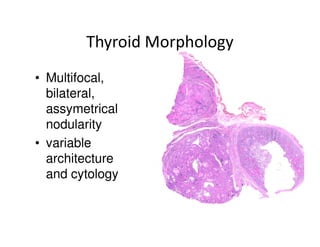
Thyroid Morphology
• Multifocal,
  bilateral,       1
  assymetrical
  nodularity
• variable
  architecture         3     2
  and cytology
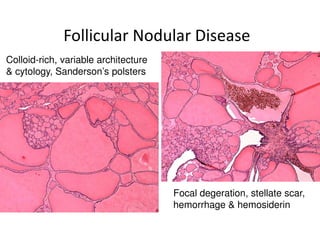
Follicular Nodular Disease
Colloid-rich, variable architecture
& cytology, Sanderson’s polsters


                                      Focal degeration, stellate scar,
                                      hemorrhage & hemosiderin
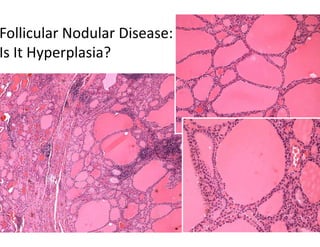
Follicular Nodular Disease:
Is It Hyperplasia?
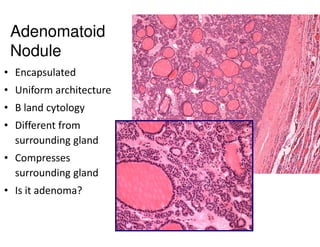
Adenomatoid
 Nodule
• Encapsulated
• Uniform architecture
• B land cytology
• Different from
  surrounding gland
• Compresses
  surrounding gland
• Is it adenoma?
Definitions:
         Hyperplasia vs Neoplasia

• An increase in the        • A proliferation of cells that
  number of cells in an       exceeds and is
  organ or tissue that is     uncoordinated with that of
  induced by known            normal tissues
  stimuli                   • An uncontrolled process
• A controlled process        that persists independent of
  that stops when the         environmental stimulation
  environmental
  stimulus is removed
Classical Criteria:
      Hyperplasia vs Neoplasia
• Multiple                      • Solitary
• Poorly encapsulated           • Encapsulated
• Architectural heterogeneity   • Uniform architecture
• Cytological heterogeneity     • Cytological homogeneity
• Comparable areas in           • Different from
  adjacent gland                  surrounding gland
• No compression of             • Compresses surrounding
  surrounding gland               gland
Clonality Patterns in
    Sporadic Nodular Goiter:
    Multiple Monoclonal Nodules


Apel et al; Diagn. Mol. Pathol. 1995; 42:113-121
Clonality of Nodules in
       Sporadic Nodular Goiter
• Polyclonal OR Monoclonal
  i.e. hyperplastic OR neoplastic
• Nodules may show LOH or aberrant methylation
  i.e. features of neoplasia
• Multiple nodules from a single goiter exhibit
  activation of the same allele ? predisposition

   ?Diagnostic criteria
   ? Hyperplasia-neoplasia sequence
 Apel et al; Diagn. Mol. Pathol. 1995; 42:113-121
Terminology When Not Goiter:
  Follicular Nodular Disease

   • Avoids controversy
   • Avoids misunderstanding
   • Clarifies lack of understanding
Follicular Nodular Disease: Pearls

• Follicular nodular disease is common
• Some may be hyperplasia, but much is
  multifocal neoplasia
• Nodules in FND/SNG are usually benign
• Nodules in FND/SNG may be malignant!
• Watch out for generation, but …..
• Watch out for cancer!
Controversies
• Nodules in Thyroiditis
• Sporadic Nodular Goitre/Follicular nodular disease
• Papillary adenomas
• Follicular Variant Papillary Carcinoma/Follicular
  carcinoma
• Capsular Invasion
• Extrathyroidal Extension
• Vascular invasion
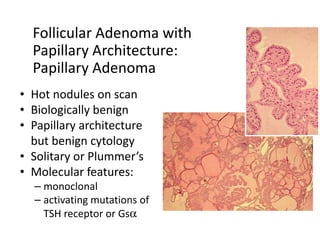
Follicular Adenoma with
  Papillary Architecture:
  Papillary Adenoma
• Hot nodules on scan
• Biologically benign
• Papillary architecture
  but benign cytology
• Solitary or Plummer’s
• Molecular features:
  – monoclonal
  – activating mutations of
    TSH receptor or Gsα
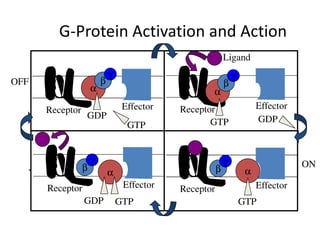
G-Protein Activation and Action
                                                            Ligand
                             γ                                  γ
OFF                      β                                  β
                     α                              α
      Receptor                    Effector   Receptor                    Effector
                 GDP                                                     GDP
                                   GTP              GTP


                     γ                                      γ                       ON
                 β                                      β            α
                             α
      Receptor                    Effector   Receptor                    Effector
                 GDP             GTP                                GTP
Controversies
• Nodules in Thyroiditis
• Sporadic Nodular Goitre/Follicular nodular disease
• Papillary adenomas
• Follicular Variant Papillary Carcinoma/Follicular
  carcinoma
• Capsular Invasion
• Extrathyroidal Extension
• Vascular invasion
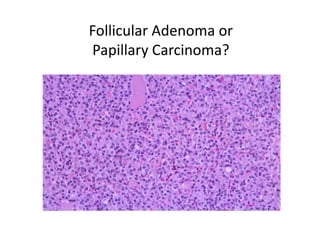
Follicular Adenoma or
Papillary Carcinoma?
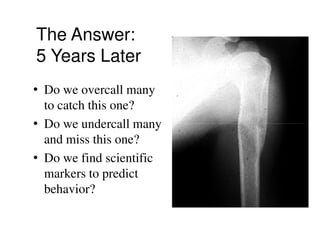
The Answer:
5 Years Later
• Do we overcall many
  to catch this one?
• Do we undercall many
  and miss this one?
• Do we find scientific
  markers to predict
  behavior?
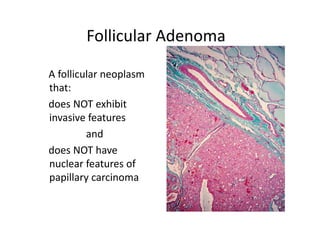
Follicular Adenoma

A follicular neoplasm
that:
does NOT exhibit
invasive features
         and
does NOT have
nuclear features of
papillary carcinoma
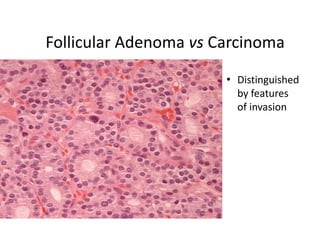
Follicular Adenoma vs Carcinoma
                       • Distinguished
                         by features
                         of invasion
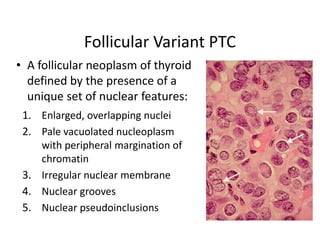
Follicular Variant PTC
• A follicular neoplasm of thyroid
  defined by the presence of a
  unique set of nuclear features:
 1. Enlarged, overlapping nuclei
 2. Pale vacuolated nucleoplasm
    with peripheral margination of
    chromatin
 3. Irregular nuclear membrane
 4. Nuclear grooves
 5. Nuclear pseudoinclusions
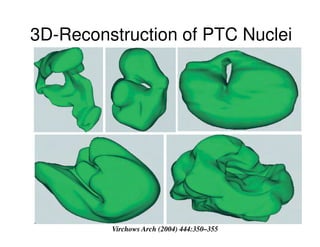
3D-Reconstruction of PTC Nuclei


         Virchows Arch (2004) 444:350
                              444:350–355
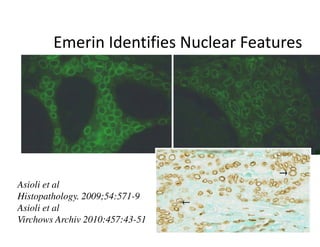
Emerin Identifies Nuclear Features


Asioli et al
Histopathology. 2009;54:571-9
Asioli et al
Virchows Archiv 2010:457:43-51
FVPTC vs Follicular Carcinoma
•   Both differentiated thyroid malignancy
•   Both follicular architecture
•   Similar biologic behavior
•   Similar genetic profiles

• Are they really the same thing?
• Are the criteria wrong?
• Does the distinction matter?
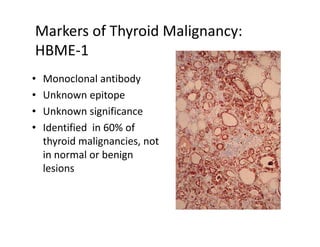
Markers of Thyroid Malignancy:
HBME-1
•   Monoclonal antibody
•   Unknown epitope
•   Unknown significance
•   Identified in 60% of
    thyroid malignancies, not
    in normal or benign
    lesions
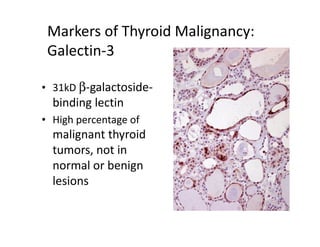
Markers of Thyroid Malignancy:
 Galectin-3

• 31kD β-galactoside-
  binding lectin
• High percentage of
  malignant thyroid
  tumors, not in
  normal or benign
  lesions
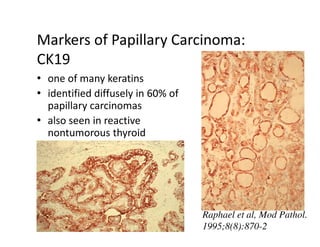
Markers of Papillary Carcinoma:
CK19
• one of many keratins
• identified diffusely in 60% of
  papillary carcinomas
• also seen in reactive
  nontumorous thyroid


                                   Raphael et al, Mod Pathol.
                                   1995;8(8):870-2
Controversies
• Nodules in Thyroiditis
• Sporadic Nodular Goitre/Follicular nodular disease
• Papillary adenomas
• Follicular Variant Papillary Carcinoma/Follicular
  carcinoma
• Capsular Invasion
• Extrathyroidal Extension
• Vascular invasion
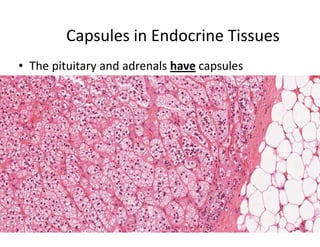
Capsules in Endocrine Tissues
• The pituitary and adrenals have capsules
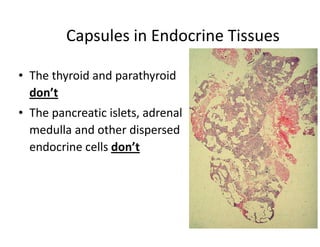
Capsules in Endocrine Tissues

• The thyroid and parathyroid
  don’t
• The pancreatic islets, adrenal
  medulla and other dispersed
  endocrine cells don’t
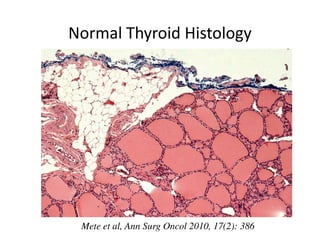
Normal Thyroid Histology


 Mete et al, Ann Surg Oncol 2010, 17(2): 386
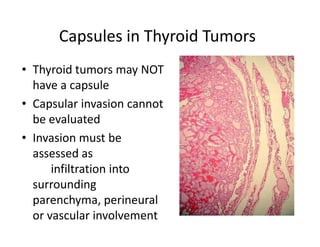
Capsules in Thyroid Tumors
• Thyroid tumors may NOT
  have a capsule
• Capsular invasion cannot
  be evaluated
• Invasion must be
  assessed as
      infiltration into
  surrounding
  parenchyma, perineural
  or vascular involvement
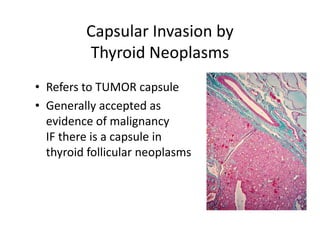
Capsular Invasion by
         Thyroid Neoplasms
• Refers to TUMOR capsule
• Generally accepted as
  evidence of malignancy
  IF there is a capsule in
  thyroid follicular neoplasms
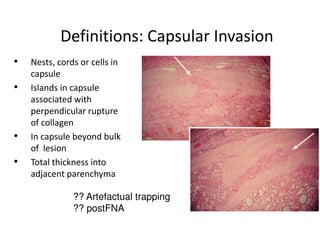
Definitions: Capsular Invasion
•   Nests, cords or cells in
    capsule
•   Islands in capsule
    associated with
    perpendicular rupture
    of collagen
•   In capsule beyond bulk
    of lesion
•   Total thickness into
    adjacent parenchyma

               ?? Artefactual trapping
               ?? postFNA
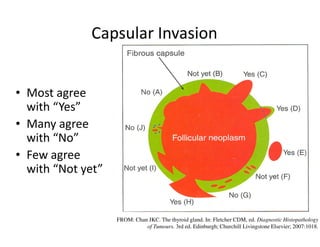
Capsular Invasion


• Most agree
  with ā€œYesā€
• Many agree
  with ā€œNoā€
• Few agree
  with ā€œNot yetā€


                   FROM: Chan JKC. The thyroid gland. In: Fletcher CDM, ed. Diagnostic Histopathology
                             of Tumours. 3rd ed. Edinburgh; Churchill Livingstone Elsevier; 2007:1018.
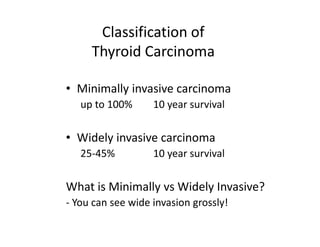
Classification of
     Thyroid Carcinoma

• Minimally invasive carcinoma
   up to 100%      10 year survival

• Widely invasive carcinoma
   25-45%          10 year survival

What is Minimally vs Widely Invasive?
- You can see wide invasion grossly!
Controversies
• Nodules in Thyroiditis
• Sporadic Nodular Goitre/Follicular nodular disease
• Papillary adenomas
• Follicular Variant Papillary Carcinoma/Follicular
  carcinoma
• Capsular Invasion
• Extrathyroidal Extension
• Vascular invasion
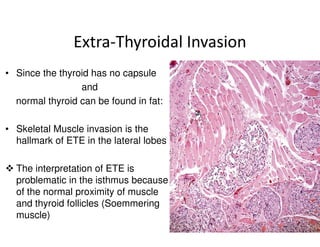
Extra-Thyroidal Invasion
• Since the thyroid has no capsule
                 and
  normal thyroid can be found in fat:

• Skeletal Muscle invasion is the
  hallmark of ETE in the lateral lobes

  The interpretation of ETE is
  problematic in the isthmus because
  of the normal proximity of muscle
  and thyroid follicles (Soemmering
  muscle)
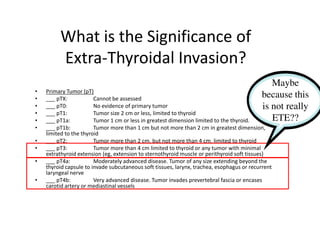
What is the Significance of
         Extra-Thyroidal Invasion?
                                                                                              Maybe
•   Primary Tumor (pT)
•   ___ pTX:            Cannot be assessed
                                                                                           because this
•   ___ pT0:            No evidence of primary tumor                                       is not really
•   ___ pT1:            Tumor size 2 cm or less, limited to thyroid
•   ___ pT1a:           Tumor 1 cm or less in greatest dimension limited to the thyroid.      ETE??
•   ___ pT1b:           Tumor more than 1 cm but not more than 2 cm in greatest dimension,
    limited to the thyroid
•   ___ pT2:            Tumor more than 2 cm, but not more than 4 cm, limited to thyroid
•   ___ pT3:            Tumor more than 4 cm limited to thyroid or any tumor with minimal
    extrathyroid extension (eg, extension to sternothyroid muscle or perithyroid soft tissues)
•   ___ pT4a:           Moderately advanced disease. Tumor of any size extending beyond the
    thyroid capsule to invade subcutaneous soft tissues, larynx, trachea, esophagus or recurrent
    laryngeal nerve
•   ___ pT4b:           Very advanced disease. Tumor invades prevertebral fascia or encases
    carotid artery or mediastinal vessels
Controversies
• Nodules in Thyroiditis
• Sporadic Nodular Goitre/Follicular nodular disease
• Papillary adenomas
• Follicular Variant Papillary Carcinoma/Follicular
  carcinoma
• Capsular Invasion
• Extrathyroidal Extension
• Vascular invasion
1
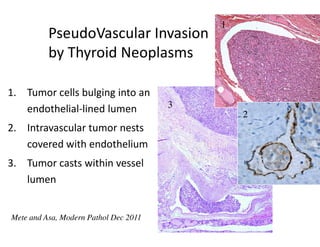
          PseudoVascular Invasion
          by Thyroid Neoplasms

1. Tumor cells bulging into an
   endothelial-lined lumen             3
                                                          2
2. Intravascular tumor nests
   covered with endothelium                ? artificial
                                           implantation
3. Tumor casts within vessel
   lumen


Mete and Asa, Modern Pathol Dec 2011
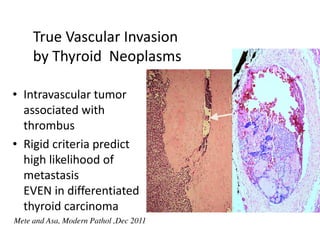
True Vascular Invasion
     by Thyroid Neoplasms

• Intravascular tumor
  associated with
  thrombus
• Rigid criteria predict
  high likelihood of
  metastasis
  EVEN in differentiated
  thyroid carcinoma
Mete and Asa, Modern Pathol ,Dec 2011
Angioinvasion in
  Differentiated Thyroid Carcinoma

• Must be defined properly
• Must be distinguished from lymphatic
  invasion
  – The term ā€œlymphovascular invasionā€ should be
    discarded in this field! *
• Is predictive of aggressive behavior

* the CAP worksheets need to be revised
Controversies in Thyroid Pathology

             Controversy is a state of
     prolonged public dispute or debate,
    usually concerning a matter of opinion

         It is time for some science!

Tireoide zona cinzenta.

  • 1.
    Minimizing Grey Zones in Thyroid Pathology Sylvia L. Asa, MD, PhD Pathologist-in-Chief Medical Director Laboratory Medicine Program University Health Network, Toronto
  • 2.
    Controversies • Nodules inThyroiditis • Sporadic Nodular Goitre/Follicular nodular disease • Papillary adenomas • Follicular Variant Papillary Carcinoma/Follicular carcinoma • Capsular Invasion • Extrathyroidal Extension • Vascular invasion
  • 3.
    Controversies • Nodules inThyroiditis • Sporadic Nodular Goitre/Follicular nodular disease • Papillary adenomas • Follicular Variant Papillary Carcinoma/Follicular carcinoma • Capsular Invasion • Extrathyroidal Extension • Vascular invasion
  • 4.
    Hashimoto’s Thyroiditis: Morphology •Lymphoplasmacytic infiltrate with follicle formation
  • 5.
    Hashimoto’s Thyroiditis: Cytology •Oncocytic or Hürthle cell metaplasia
  • 6.
    Hashimoto’s Thyroiditis: Cytology •Oncocytic or Hürthle cell metaplasia • With atypia! • IS THIS DYSPLASIA?
  • 7.
  • 8.
    Hyperplasia in Thyroiditis • Not encapsulated • Cellular • Bland cytology • ? Due to TGI • ? Destruction of follicular epithelium ± regeneration
  • 9.
    Carcinoma in Thyroiditis Nuclear features of papillary carcinoma
  • 10.
    Controversies • Nodules inThyroiditis • Sporadic Nodular Goitre/Follicular nodular disease • Papillary adenomas • Follicular Variant Papillary Carcinoma/Follicular carcinoma • Capsular Invasion • Extrathyroidal Extension • Vascular invasion
  • 11.
    Sporadic Nodular Goiter •Multinodular ā€œcolloidā€ goiter • Occasionally associated with hyperthyroidism – ā€œPlummer’s diseaseā€ • Etiology and pathogenesis NOT understood
  • 12.
    Thyroid Morphology • Multifocal, bilateral, 1 assymetrical nodularity • variable architecture 3 2 and cytology
  • 13.
    Follicular Nodular Disease Colloid-rich,variable architecture & cytology, Sanderson’s polsters Focal degeration, stellate scar, hemorrhage & hemosiderin
  • 14.
  • 15.
    Adenomatoid Nodule • Encapsulated •Uniform architecture • B land cytology • Different from surrounding gland • Compresses surrounding gland • Is it adenoma?
  • 16.
    Definitions: Hyperplasia vs Neoplasia • An increase in the • A proliferation of cells that number of cells in an exceeds and is organ or tissue that is uncoordinated with that of induced by known normal tissues stimuli • An uncontrolled process • A controlled process that persists independent of that stops when the environmental stimulation environmental stimulus is removed
  • 17.
    Classical Criteria: Hyperplasia vs Neoplasia • Multiple • Solitary • Poorly encapsulated • Encapsulated • Architectural heterogeneity • Uniform architecture • Cytological heterogeneity • Cytological homogeneity • Comparable areas in • Different from adjacent gland surrounding gland • No compression of • Compresses surrounding surrounding gland gland
  • 18.
    Clonality Patterns in Sporadic Nodular Goiter: Multiple Monoclonal Nodules Apel et al; Diagn. Mol. Pathol. 1995; 42:113-121
  • 19.
    Clonality of Nodulesin Sporadic Nodular Goiter • Polyclonal OR Monoclonal i.e. hyperplastic OR neoplastic • Nodules may show LOH or aberrant methylation i.e. features of neoplasia • Multiple nodules from a single goiter exhibit activation of the same allele ? predisposition ?Diagnostic criteria ? Hyperplasia-neoplasia sequence Apel et al; Diagn. Mol. Pathol. 1995; 42:113-121
  • 20.
    Terminology When NotGoiter: Follicular Nodular Disease • Avoids controversy • Avoids misunderstanding • Clarifies lack of understanding
  • 21.
    Follicular Nodular Disease:Pearls • Follicular nodular disease is common • Some may be hyperplasia, but much is multifocal neoplasia • Nodules in FND/SNG are usually benign • Nodules in FND/SNG may be malignant! • Watch out for generation, but ….. • Watch out for cancer!
  • 22.
    Controversies • Nodules inThyroiditis • Sporadic Nodular Goitre/Follicular nodular disease • Papillary adenomas • Follicular Variant Papillary Carcinoma/Follicular carcinoma • Capsular Invasion • Extrathyroidal Extension • Vascular invasion
  • 23.
    Follicular Adenoma with Papillary Architecture: Papillary Adenoma • Hot nodules on scan • Biologically benign • Papillary architecture but benign cytology • Solitary or Plummer’s • Molecular features: – monoclonal – activating mutations of TSH receptor or Gsα
  • 24.
    G-Protein Activation andAction Ligand γ γ OFF β β α α Receptor Effector Receptor Effector GDP GDP GTP GTP γ γ ON β β α α Receptor Effector Receptor Effector GDP GTP GTP
  • 25.
    Controversies • Nodules inThyroiditis • Sporadic Nodular Goitre/Follicular nodular disease • Papillary adenomas • Follicular Variant Papillary Carcinoma/Follicular carcinoma • Capsular Invasion • Extrathyroidal Extension • Vascular invasion
  • 26.
  • 27.
    The Answer: 5 YearsLater • Do we overcall many to catch this one? • Do we undercall many and miss this one? • Do we find scientific markers to predict behavior?
  • 28.
    Follicular Adenoma A follicularneoplasm that: does NOT exhibit invasive features and does NOT have nuclear features of papillary carcinoma
  • 29.
    Follicular Adenoma vsCarcinoma • Distinguished by features of invasion
  • 30.
    Follicular Variant PTC •A follicular neoplasm of thyroid defined by the presence of a unique set of nuclear features: 1. Enlarged, overlapping nuclei 2. Pale vacuolated nucleoplasm with peripheral margination of chromatin 3. Irregular nuclear membrane 4. Nuclear grooves 5. Nuclear pseudoinclusions
  • 31.
    3D-Reconstruction of PTCNuclei Virchows Arch (2004) 444:350 444:350–355
  • 32.
    Emerin Identifies NuclearFeatures Asioli et al Histopathology. 2009;54:571-9 Asioli et al Virchows Archiv 2010:457:43-51
  • 33.
    FVPTC vs FollicularCarcinoma • Both differentiated thyroid malignancy • Both follicular architecture • Similar biologic behavior • Similar genetic profiles • Are they really the same thing? • Are the criteria wrong? • Does the distinction matter?
  • 34.
    Markers of ThyroidMalignancy: HBME-1 • Monoclonal antibody • Unknown epitope • Unknown significance • Identified in 60% of thyroid malignancies, not in normal or benign lesions
  • 35.
    Markers of ThyroidMalignancy: Galectin-3 • 31kD β-galactoside- binding lectin • High percentage of malignant thyroid tumors, not in normal or benign lesions
  • 36.
    Markers of PapillaryCarcinoma: CK19 • one of many keratins • identified diffusely in 60% of papillary carcinomas • also seen in reactive nontumorous thyroid Raphael et al, Mod Pathol. 1995;8(8):870-2
  • 37.
    Controversies • Nodules inThyroiditis • Sporadic Nodular Goitre/Follicular nodular disease • Papillary adenomas • Follicular Variant Papillary Carcinoma/Follicular carcinoma • Capsular Invasion • Extrathyroidal Extension • Vascular invasion
  • 38.
    Capsules in EndocrineTissues • The pituitary and adrenals have capsules
  • 39.
    Capsules in EndocrineTissues • The thyroid and parathyroid don’t • The pancreatic islets, adrenal medulla and other dispersed endocrine cells don’t
  • 40.
    Normal Thyroid Histology Mete et al, Ann Surg Oncol 2010, 17(2): 386
  • 41.
    Capsules in ThyroidTumors • Thyroid tumors may NOT have a capsule • Capsular invasion cannot be evaluated • Invasion must be assessed as infiltration into surrounding parenchyma, perineural or vascular involvement
  • 42.
    Capsular Invasion by Thyroid Neoplasms • Refers to TUMOR capsule • Generally accepted as evidence of malignancy IF there is a capsule in thyroid follicular neoplasms
  • 43.
    Definitions: Capsular Invasion • Nests, cords or cells in capsule • Islands in capsule associated with perpendicular rupture of collagen • In capsule beyond bulk of lesion • Total thickness into adjacent parenchyma ?? Artefactual trapping ?? postFNA
  • 44.
    Capsular Invasion • Mostagree with ā€œYesā€ • Many agree with ā€œNoā€ • Few agree with ā€œNot yetā€ FROM: Chan JKC. The thyroid gland. In: Fletcher CDM, ed. Diagnostic Histopathology of Tumours. 3rd ed. Edinburgh; Churchill Livingstone Elsevier; 2007:1018.
  • 45.
    Classification of Thyroid Carcinoma • Minimally invasive carcinoma up to 100% 10 year survival • Widely invasive carcinoma 25-45% 10 year survival What is Minimally vs Widely Invasive? - You can see wide invasion grossly!
  • 46.
    Controversies • Nodules inThyroiditis • Sporadic Nodular Goitre/Follicular nodular disease • Papillary adenomas • Follicular Variant Papillary Carcinoma/Follicular carcinoma • Capsular Invasion • Extrathyroidal Extension • Vascular invasion
  • 47.
    Extra-Thyroidal Invasion • Sincethe thyroid has no capsule and normal thyroid can be found in fat: • Skeletal Muscle invasion is the hallmark of ETE in the lateral lobes The interpretation of ETE is problematic in the isthmus because of the normal proximity of muscle and thyroid follicles (Soemmering muscle)
  • 48.
    What is theSignificance of Extra-Thyroidal Invasion? Maybe • Primary Tumor (pT) • ___ pTX: Cannot be assessed because this • ___ pT0: No evidence of primary tumor is not really • ___ pT1: Tumor size 2 cm or less, limited to thyroid • ___ pT1a: Tumor 1 cm or less in greatest dimension limited to the thyroid. ETE?? • ___ pT1b: Tumor more than 1 cm but not more than 2 cm in greatest dimension, limited to the thyroid • ___ pT2: Tumor more than 2 cm, but not more than 4 cm, limited to thyroid • ___ pT3: Tumor more than 4 cm limited to thyroid or any tumor with minimal extrathyroid extension (eg, extension to sternothyroid muscle or perithyroid soft tissues) • ___ pT4a: Moderately advanced disease. Tumor of any size extending beyond the thyroid capsule to invade subcutaneous soft tissues, larynx, trachea, esophagus or recurrent laryngeal nerve • ___ pT4b: Very advanced disease. Tumor invades prevertebral fascia or encases carotid artery or mediastinal vessels
  • 49.
    Controversies • Nodules inThyroiditis • Sporadic Nodular Goitre/Follicular nodular disease • Papillary adenomas • Follicular Variant Papillary Carcinoma/Follicular carcinoma • Capsular Invasion • Extrathyroidal Extension • Vascular invasion
  • 50.
    1 PseudoVascular Invasion by Thyroid Neoplasms 1. Tumor cells bulging into an endothelial-lined lumen 3 2 2. Intravascular tumor nests covered with endothelium ? artificial implantation 3. Tumor casts within vessel lumen Mete and Asa, Modern Pathol Dec 2011
  • 51.
    True Vascular Invasion by Thyroid Neoplasms • Intravascular tumor associated with thrombus • Rigid criteria predict high likelihood of metastasis EVEN in differentiated thyroid carcinoma Mete and Asa, Modern Pathol ,Dec 2011
  • 52.
    Angioinvasion in Differentiated Thyroid Carcinoma • Must be defined properly • Must be distinguished from lymphatic invasion – The term ā€œlymphovascular invasionā€ should be discarded in this field! * • Is predictive of aggressive behavior * the CAP worksheets need to be revised
  • 53.
    Controversies in ThyroidPathology Controversy is a state of prolonged public dispute or debate, usually concerning a matter of opinion It is time for some science!