CERVIX-CYTOLOGY
BETHESDA SYSTEM
Dr. Sobia Khalid
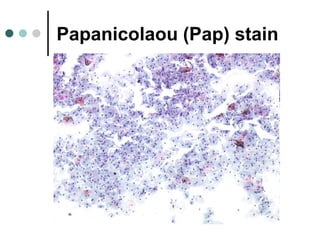
Papanicolaou (Pap) stain
 Alcohol dried; better for nuclear detail
 Stains ribosomes blue green, particularly in parabasal
cells, mesothelial cells and metaplastic squamous
cells
 Stains metabolically inactive cells pink, such as
superficial cells
 Stains keratinized cells or thick specimens orange
(benign or malignant)
Papanicolaou (Pap) stain
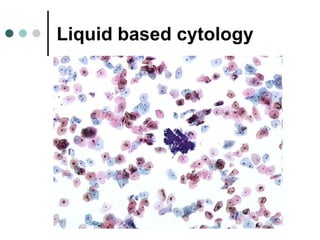
Liquid based cytology
 Head of spatula, where cells are lodged, is broken off
into small glass vial containing preservative fluid, or
rinsed directly into preservative fluid
 Sample is sent to lab, then spun and treated to
remove mucus, pus or other obscuring material
 Random sample of remaining cells is taken and
deposited onto a slide
 Reduces number of inadequate smears and need for
repeat smears
Liquid based cytology
Diff-Quik stain
 An air dried, Giemsa-type stain
 Better for background material or to assess adequacy
of endocervical smears to detect C. trachomatis
 Used for fine needle aspirates, not for cervical smears
CERVIX - Normal cells
 Basal cells
 Parabasal cells
 Intermediate cells
 Superficial cells
 Endocervical cells
Basal Cells
 Small undifferentiated cells
 Seldom identified in pap smears
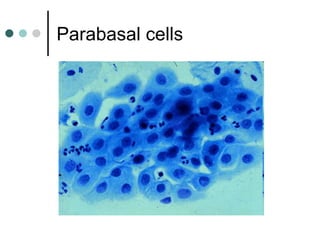
Parabasal cells
 Cytoplasm is round, dense, basophilic
 Nucleus is vesicular, central, round and relatively
large (50μm²)
 May see naked nuclei
 Higher N/C ratio and smaller size than intermediate
cells
Parabasal cells
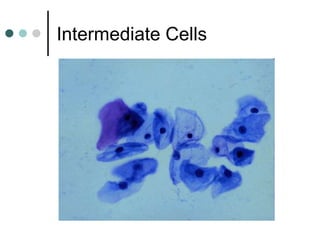
Intermediate Cells
 Cytoplasm is polygonal, transparent, basophilic
 Nucleus is about the size of a red blood cell (35 μm²),
is vesicular, round/oval
 Nuclear texture and size is reference for dysplasia
Intermediate Cells
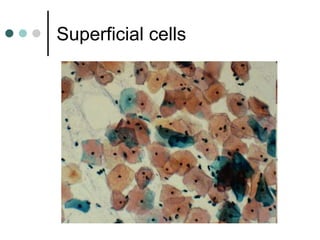
Superficial cells
 Cytoplasm is polygonal, transparent, eosinophilic
 Nucleus is pyknotic, round/oval
Superficial cells
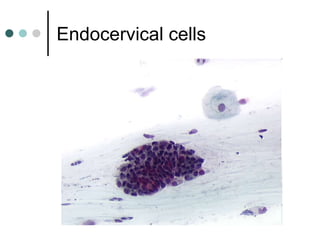
Endocervical cells
 Columnar cells
 Vacuolated or granular cytoplasm
 Prominent cell borders
 Basal nuclei with fine granular chromatin
 Occasional nucleoli
 Honeycomb appearance
 Ciliated if tubal metaplasia
Endocervical cells
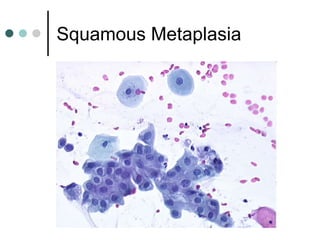
Squamous Metaplasia
 Single cells, loosely cohesive groups or sheets
 Variable cell size and shape
 Cell borders are more defined with maturity
 Cytoplasm is variable with occasional vacuoles
 Nuclei is slightly larger than intermediate cell nuclei,
has finely granular and evenly distributed chromatin,
nuclear membrane is smooth, no prominent nucleoli
Squamous Metaplasia
BETHESDA
SYSTEM
BETHESDA SYSTEM
 Uniform terminology introduced in 1988 and revised
in 1991 and 2001
 To establish uniform terminology and standardize
diagnostic reports.
 In addition, it introduced a standardized approach
for reporting if an individual specimen is adequate
for evaluation.
BETHESDA SYSTEM, 2001
 Specimen adequacy
 General categorization (optional)
 Interpretation/result
 Automated review and ancillary testing (include if
appropriate)
 Educational notes and suggestions (optional)
Adequacy
 Satisfactory for evaluation (describe presence or
absence of endocervical/transformation zone
component and all other quality indicators, such as
partially obscuring blood, inflammation, etc.)
 Unsatisfactory for evaluation (indicate reason)
 Specimen rejected/not processed (indicate reason)
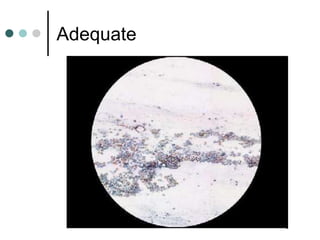
Assessment of adequacy
 Adequate number of squamous cells (conventional
smear should have 8000-12000 cells, liquid-based
preparation should have 5000 cells)
 The presence or absence of endocervical cells should
be reported; an adequate number of endocervical
cells (at least 10 well-preserved endocervical or
metaplastic cells) confirms sampling of transition zone
 Specimen with more than 75% of cells obscured by
inflammation and bacteria is unsatisfactory (however,
should still report presence of abnormal cells)
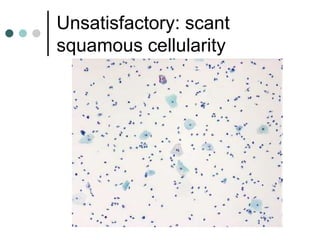
Unsatisfactory: scant
squamous cellularity
Adequate
Interpretation/result
 Negative for Intraepithelial Lesion or Malignancy
(NILM)
 Epithelial Cell Abnormality
 Other malignant neoplasm (Specify)
Negative for Intraepithelial
Lesion or Malignancy (NILM)
 Organisms
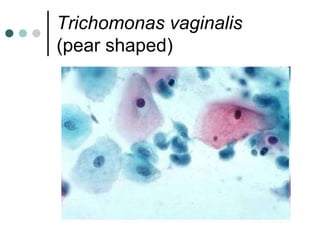
 Trichomonas vaginalis
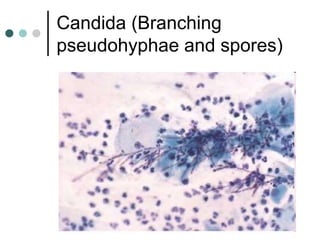
 Fungal organisms morphologically
consistent with Candida species
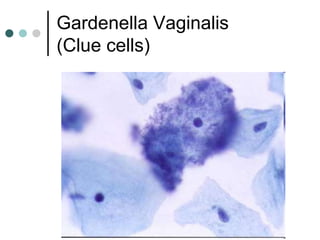
 Shift in flora suggestive of bacterial
vaginosis
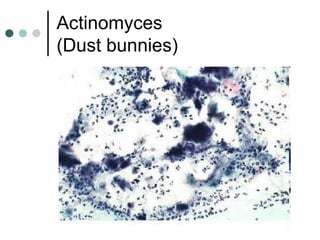
 Bacteria morphologically consistent with
Actinomyces species
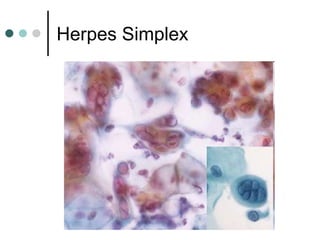
 Cellular changes associated with Herpes
simplex virus
Trichomonas vaginalis
(pear shaped)
Candida (Branching
pseudohyphae and spores)
Gardenella Vaginalis
(Clue cells)
Actinomyces
(Dust bunnies)
Herpes Simplex
 Other non-neoplastic findings (optional to
report, list is not inclusive)
 Reactive cellular changes associated with:
• inflammation (includes typical repair)
• irradiation
• Intrauterine contraceptive device (IUD)
 Glandular cells status post hysterectomy
 Atrophy
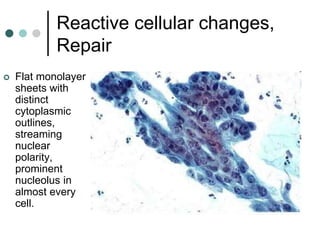
Reactive cellular changes,
Repair
 Flat monolayer
sheets with
distinct
cytoplasmic
outlines,
streaming
nuclear
polarity,
prominent
nucleolus in
almost every
cell.
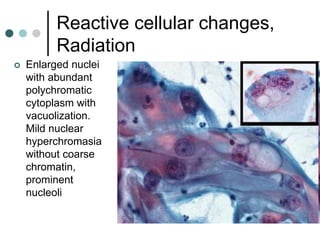
Reactive cellular changes,
Radiation
 Enlarged nuclei
with abundant
polychromatic
cytoplasm with
vacuolization.
Mild nuclear
hyperchromasia
without coarse
chromatin,
prominent
nucleoli
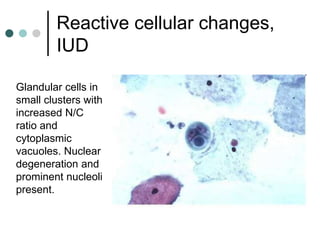
Reactive cellular changes,
IUD
Glandular cells in
small clusters with
increased N/C
ratio and
cytoplasmic
vacuoles. Nuclear
degeneration and
prominent nucleoli
present.
Glandular cells status post
hysterectomy
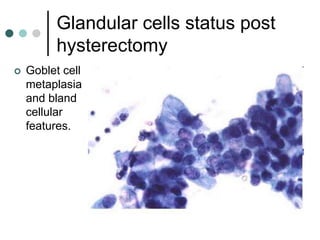
 Goblet cell
metaplasia
and bland
cellular
features.
Atrophy
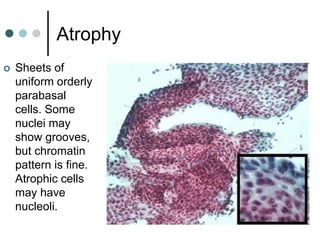
 Sheets of
uniform orderly
parabasal
cells. Some
nuclei may
show grooves,
but chromatin
pattern is fine.
Atrophic cells
may have
nucleoli.
 Other
 Endometrial cells (in a woman greater than
or equal to 40 years of age; specify if
“negative for squamous intraepithelial
lesion”)
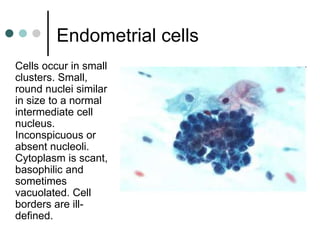
Endometrial cells
Cells occur in small
clusters. Small,
round nuclei similar
in size to a normal
intermediate cell
nucleus.
Inconspicuous or
absent nucleoli.
Cytoplasm is scant,
basophilic and
sometimes
vacuolated. Cell
borders are ill-
defined.
Epithelial Cell Abnormality
 SQUAMOUS CELL
 Atypical squamous cells
 - of undetermined significance (ASC-US)
 - cannot exclude HSIL (ASC-H)
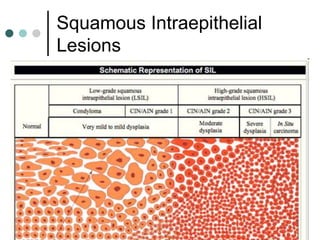
 Low grade squamous intraepithelial lesion (LSIL)
 - encompassing HPV/mild dysplasia/CIN I
 High grade squamous intraepithelial lesion (HSIL)
 - encompassing: moderate and severe
dysplasia/CIN2/CIN3/CIS
 - with features suspicious for invasion (if invasion
suspected)
 Squamous cell carcinoma
Atypical squamous cells of
undetermined significance (ASC-
US)
 May be neoplastic (HPV related, LSIL, HSIL) or
reactive
 Nuclear changes more marked than reactive, less
than LSIL; nucleus is 2.5-3x size of intermediate cell
nucleus
 In perimenopausal women (40-55 years), cells with
bland nuclear enlargement (2-3x size of intermediate
cell nuclei), smooth nuclear membranes and fine
chromatin are likely to be negative for SIL/malignancy
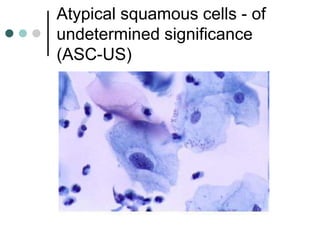
Atypical squamous cells - of
undetermined significance
(ASC-US)
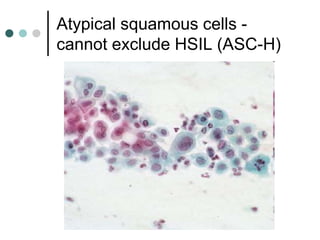
Atypical squamous cells -
cannot exclude HSIL (ASC-H)
Squamous Intraepithelial
Lesions
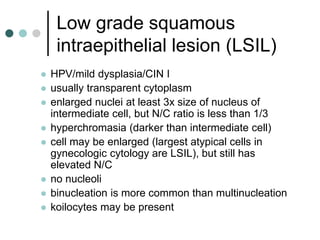
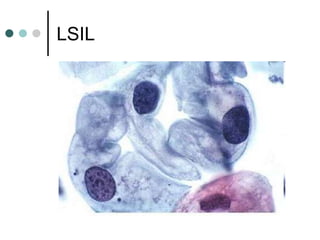
Low grade squamous
intraepithelial lesion (LSIL)
 HPV/mild dysplasia/CIN I
 usually transparent cytoplasm
 enlarged nuclei at least 3x size of nucleus of
intermediate cell, but N/C ratio is less than 1/3
 hyperchromasia (darker than intermediate cell)
 cell may be enlarged (largest atypical cells in
gynecologic cytology are LSIL), but still has
elevated N/C
 no nucleoli
 binucleation is more common than multinucleation
 koilocytes may be present
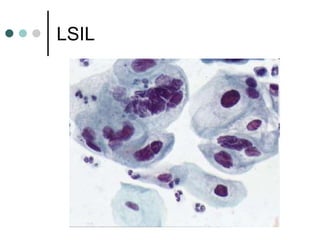
LSIL
LSIL
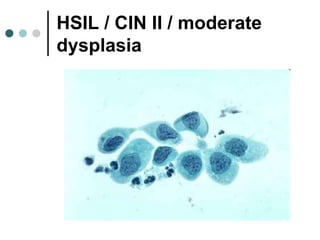
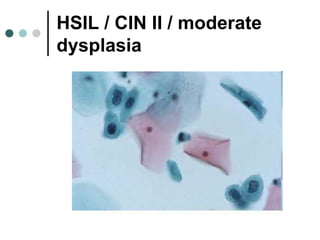
HSIL / CIN II / moderate
dysplasia
 N/C ratio is 1/3 to ½
 cell size is same as squamous metaplastic or
parabasal cells
 polygonal shape (like intermediate or superficial cell)
 denser cytoplasm
 enlarged and hyperchromatic nucleus
 nuclear membranes may be irregular (crinkled paper)
 no nucleoli
HSIL / CIN II / moderate
dysplasia
HSIL / CIN II / moderate
dysplasia
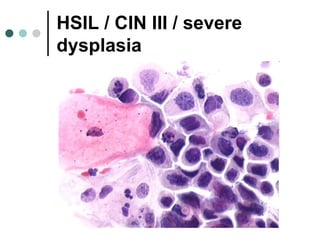
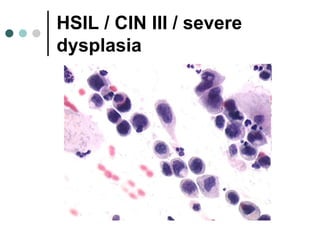
HSIL / CIN III / severe
dysplasia
 Usually single, small, round/oval cells
 scant cytoplasm
 nuclei same size as dysplastic cells but increased N/C
ratio (greater than 1/2) since only minimal rim of
cytoplasm
 nuclei vary markedly in contour and have irregular
coarsely clumped chromatin
 no macronucleoli
 no tumor diathesis
HSIL / CIN III / severe
dysplasia
HSIL / CIN III / severe
dysplasia
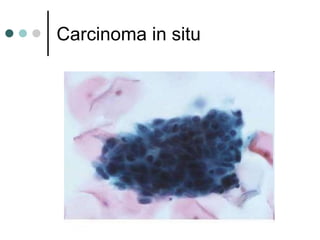
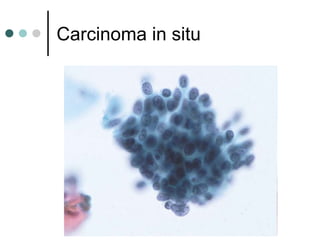
HSIL-Carcinoma in Situ
 Hyperchromatic crowded groups
 Undifferentiated cytoplasm
 Ill-defined cell borders
 Loss of nuclear polarity
Carcinoma in situ
Carcinoma in situ
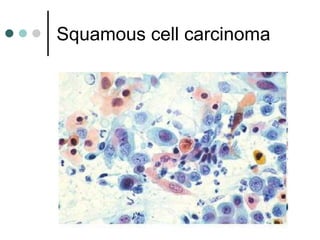
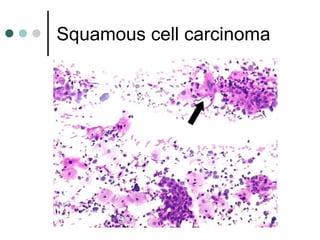
Squamous cell carcinoma
 Highly irregular shaped cells (tadpole, caudate)
 Keratinized are orange, often with squamous pearls
 Non-keratinized cells have dense, hard, basophilic
cytoplasm; also cannibalism (tumor cells surround
other cells)
 Tumor diathesis in background (necrosis,
hemorrhage, inflammatory cells) is suggestive of
malignancy
Squamous cell carcinoma
EPITHELIAL ABNORMALITIES
- GLANDULAR
 Atypical
 Endocervical cells, NOS or specify in comments
 Endometrial cells, NOS or specify in comments
 Glandular cells, NOS or specify in comments
 Atypical
 Endocervical cells, favor neoplastic
 Glandular cells, favor neoplastic
 Endocervical adenocarcinoma in situ
 Adenocarcinoma
 Endocervical
 Endometrial
 Extrauterine
 Not otherwise specified (NOS)
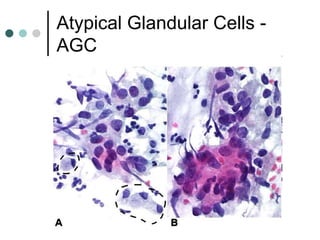
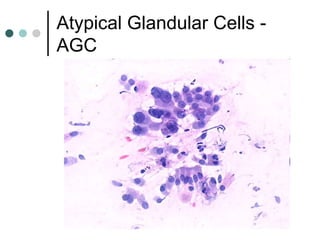
Atypical Glandular Cells -
AGC
 Morphological changes of glandular cells which are
too pronounced for inflammatory or reactive origin,
but insufficient to diagnose an adenocarcinoma
 More likely to be neoplastic if decreased cytoplasm,
irregular nuclear membranes and nucleoli present
Atypical Glandular Cells -
AGC
Atypical Glandular Cells -
AGC
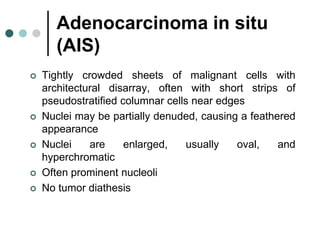
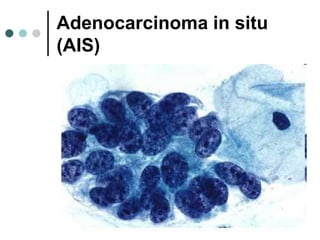
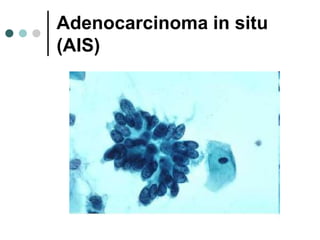
Adenocarcinoma in situ
(AIS)
 Tightly crowded sheets of malignant cells with
architectural disarray, often with short strips of
pseudostratified columnar cells near edges
 Nuclei may be partially denuded, causing a feathered
appearance
 Nuclei are enlarged, usually oval, and
hyperchromatic
 Often prominent nucleoli
 No tumor diathesis
Adenocarcinoma in situ
(AIS)
Adenocarcinoma in situ
(AIS)
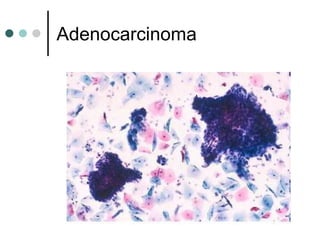
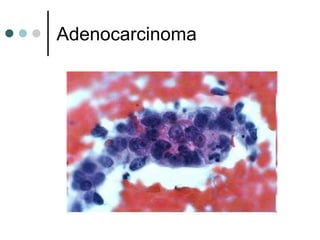
Adenocarcinoma
 Multilayering
 May form glandular structures with central lumina or
acinar formations with peripheral nuclei
 Cells are large or small with pleomorphism; have fluffy
cytoplasm, cytoplasmic vacuolization, loss of nuclear
polarity, true nuclear crowding, nuclei with clumped
chromatin, marked variation of nucleoli, occasional
mitotic figures; invasion is often characterized by
heavy blood with abundant glandular material
Adenocarcinoma
Adenocarcinoma
ANCILLARY TESTING
 Describe briefly the test method(s) and report the result
so that it is easily understood by the clinician
AUTOMATED REVIEW
 If case is examined by automated device, specify
the device and result
EDUCATIONAL
NOTES/SUGGESTIONS
 If provided, should be concise and consistent with
clinical guidelines published by professional
organizations.
THANK YOU

Cervix bethesda system

  • 1.
  • 2.
    Papanicolaou (Pap) stain Alcohol dried; better for nuclear detail  Stains ribosomes blue green, particularly in parabasal cells, mesothelial cells and metaplastic squamous cells  Stains metabolically inactive cells pink, such as superficial cells  Stains keratinized cells or thick specimens orange (benign or malignant)
  • 3.
  • 4.
    Liquid based cytology Head of spatula, where cells are lodged, is broken off into small glass vial containing preservative fluid, or rinsed directly into preservative fluid  Sample is sent to lab, then spun and treated to remove mucus, pus or other obscuring material  Random sample of remaining cells is taken and deposited onto a slide  Reduces number of inadequate smears and need for repeat smears
  • 5.
  • 6.
    Diff-Quik stain  Anair dried, Giemsa-type stain  Better for background material or to assess adequacy of endocervical smears to detect C. trachomatis  Used for fine needle aspirates, not for cervical smears
  • 7.
    CERVIX - Normalcells  Basal cells  Parabasal cells  Intermediate cells  Superficial cells  Endocervical cells
  • 8.
    Basal Cells  Smallundifferentiated cells  Seldom identified in pap smears
  • 9.
    Parabasal cells  Cytoplasmis round, dense, basophilic  Nucleus is vesicular, central, round and relatively large (50μm²)  May see naked nuclei  Higher N/C ratio and smaller size than intermediate cells
  • 10.
  • 11.
    Intermediate Cells  Cytoplasmis polygonal, transparent, basophilic  Nucleus is about the size of a red blood cell (35 μm²), is vesicular, round/oval  Nuclear texture and size is reference for dysplasia
  • 12.
  • 13.
    Superficial cells  Cytoplasmis polygonal, transparent, eosinophilic  Nucleus is pyknotic, round/oval
  • 14.
  • 15.
    Endocervical cells  Columnarcells  Vacuolated or granular cytoplasm  Prominent cell borders  Basal nuclei with fine granular chromatin  Occasional nucleoli  Honeycomb appearance  Ciliated if tubal metaplasia
  • 16.
  • 17.
    Squamous Metaplasia  Singlecells, loosely cohesive groups or sheets  Variable cell size and shape  Cell borders are more defined with maturity  Cytoplasm is variable with occasional vacuoles  Nuclei is slightly larger than intermediate cell nuclei, has finely granular and evenly distributed chromatin, nuclear membrane is smooth, no prominent nucleoli
  • 18.
  • 19.
  • 20.
    BETHESDA SYSTEM  Uniformterminology introduced in 1988 and revised in 1991 and 2001  To establish uniform terminology and standardize diagnostic reports.  In addition, it introduced a standardized approach for reporting if an individual specimen is adequate for evaluation.
  • 21.
    BETHESDA SYSTEM, 2001 Specimen adequacy  General categorization (optional)  Interpretation/result  Automated review and ancillary testing (include if appropriate)  Educational notes and suggestions (optional)
  • 22.
    Adequacy  Satisfactory forevaluation (describe presence or absence of endocervical/transformation zone component and all other quality indicators, such as partially obscuring blood, inflammation, etc.)  Unsatisfactory for evaluation (indicate reason)  Specimen rejected/not processed (indicate reason)
  • 23.
    Assessment of adequacy Adequate number of squamous cells (conventional smear should have 8000-12000 cells, liquid-based preparation should have 5000 cells)  The presence or absence of endocervical cells should be reported; an adequate number of endocervical cells (at least 10 well-preserved endocervical or metaplastic cells) confirms sampling of transition zone  Specimen with more than 75% of cells obscured by inflammation and bacteria is unsatisfactory (however, should still report presence of abnormal cells)
  • 24.
  • 25.
  • 26.
    Interpretation/result  Negative forIntraepithelial Lesion or Malignancy (NILM)  Epithelial Cell Abnormality  Other malignant neoplasm (Specify)
  • 27.
    Negative for Intraepithelial Lesionor Malignancy (NILM)  Organisms  Trichomonas vaginalis  Fungal organisms morphologically consistent with Candida species  Shift in flora suggestive of bacterial vaginosis  Bacteria morphologically consistent with Actinomyces species  Cellular changes associated with Herpes simplex virus
  • 28.
  • 29.
  • 30.
  • 31.
  • 32.
  • 33.
     Other non-neoplasticfindings (optional to report, list is not inclusive)  Reactive cellular changes associated with: • inflammation (includes typical repair) • irradiation • Intrauterine contraceptive device (IUD)  Glandular cells status post hysterectomy  Atrophy
  • 34.
    Reactive cellular changes, Repair Flat monolayer sheets with distinct cytoplasmic outlines, streaming nuclear polarity, prominent nucleolus in almost every cell.
  • 35.
    Reactive cellular changes, Radiation Enlarged nuclei with abundant polychromatic cytoplasm with vacuolization. Mild nuclear hyperchromasia without coarse chromatin, prominent nucleoli
  • 36.
    Reactive cellular changes, IUD Glandularcells in small clusters with increased N/C ratio and cytoplasmic vacuoles. Nuclear degeneration and prominent nucleoli present.
  • 37.
    Glandular cells statuspost hysterectomy  Goblet cell metaplasia and bland cellular features.
  • 38.
    Atrophy  Sheets of uniformorderly parabasal cells. Some nuclei may show grooves, but chromatin pattern is fine. Atrophic cells may have nucleoli.
  • 39.
     Other  Endometrialcells (in a woman greater than or equal to 40 years of age; specify if “negative for squamous intraepithelial lesion”)
  • 40.
    Endometrial cells Cells occurin small clusters. Small, round nuclei similar in size to a normal intermediate cell nucleus. Inconspicuous or absent nucleoli. Cytoplasm is scant, basophilic and sometimes vacuolated. Cell borders are ill- defined.
  • 41.
    Epithelial Cell Abnormality SQUAMOUS CELL  Atypical squamous cells  - of undetermined significance (ASC-US)  - cannot exclude HSIL (ASC-H)  Low grade squamous intraepithelial lesion (LSIL)  - encompassing HPV/mild dysplasia/CIN I  High grade squamous intraepithelial lesion (HSIL)  - encompassing: moderate and severe dysplasia/CIN2/CIN3/CIS  - with features suspicious for invasion (if invasion suspected)  Squamous cell carcinoma
  • 42.
    Atypical squamous cellsof undetermined significance (ASC- US)  May be neoplastic (HPV related, LSIL, HSIL) or reactive  Nuclear changes more marked than reactive, less than LSIL; nucleus is 2.5-3x size of intermediate cell nucleus  In perimenopausal women (40-55 years), cells with bland nuclear enlargement (2-3x size of intermediate cell nuclei), smooth nuclear membranes and fine chromatin are likely to be negative for SIL/malignancy
  • 43.
    Atypical squamous cells- of undetermined significance (ASC-US)
  • 44.
    Atypical squamous cells- cannot exclude HSIL (ASC-H)
  • 45.
  • 46.
    Low grade squamous intraepitheliallesion (LSIL)  HPV/mild dysplasia/CIN I  usually transparent cytoplasm  enlarged nuclei at least 3x size of nucleus of intermediate cell, but N/C ratio is less than 1/3  hyperchromasia (darker than intermediate cell)  cell may be enlarged (largest atypical cells in gynecologic cytology are LSIL), but still has elevated N/C  no nucleoli  binucleation is more common than multinucleation  koilocytes may be present
  • 47.
  • 48.
  • 49.
    HSIL / CINII / moderate dysplasia  N/C ratio is 1/3 to ½  cell size is same as squamous metaplastic or parabasal cells  polygonal shape (like intermediate or superficial cell)  denser cytoplasm  enlarged and hyperchromatic nucleus  nuclear membranes may be irregular (crinkled paper)  no nucleoli
  • 50.
    HSIL / CINII / moderate dysplasia
  • 51.
    HSIL / CINII / moderate dysplasia
  • 52.
    HSIL / CINIII / severe dysplasia  Usually single, small, round/oval cells  scant cytoplasm  nuclei same size as dysplastic cells but increased N/C ratio (greater than 1/2) since only minimal rim of cytoplasm  nuclei vary markedly in contour and have irregular coarsely clumped chromatin  no macronucleoli  no tumor diathesis
  • 53.
    HSIL / CINIII / severe dysplasia
  • 54.
    HSIL / CINIII / severe dysplasia
  • 55.
    HSIL-Carcinoma in Situ Hyperchromatic crowded groups  Undifferentiated cytoplasm  Ill-defined cell borders  Loss of nuclear polarity
  • 56.
  • 57.
  • 58.
    Squamous cell carcinoma Highly irregular shaped cells (tadpole, caudate)  Keratinized are orange, often with squamous pearls  Non-keratinized cells have dense, hard, basophilic cytoplasm; also cannibalism (tumor cells surround other cells)  Tumor diathesis in background (necrosis, hemorrhage, inflammatory cells) is suggestive of malignancy
  • 59.
  • 60.
  • 61.
    EPITHELIAL ABNORMALITIES - GLANDULAR Atypical  Endocervical cells, NOS or specify in comments  Endometrial cells, NOS or specify in comments  Glandular cells, NOS or specify in comments  Atypical  Endocervical cells, favor neoplastic  Glandular cells, favor neoplastic  Endocervical adenocarcinoma in situ  Adenocarcinoma  Endocervical  Endometrial  Extrauterine  Not otherwise specified (NOS)
  • 62.
    Atypical Glandular Cells- AGC  Morphological changes of glandular cells which are too pronounced for inflammatory or reactive origin, but insufficient to diagnose an adenocarcinoma  More likely to be neoplastic if decreased cytoplasm, irregular nuclear membranes and nucleoli present
  • 63.
  • 64.
  • 65.
    Adenocarcinoma in situ (AIS) Tightly crowded sheets of malignant cells with architectural disarray, often with short strips of pseudostratified columnar cells near edges  Nuclei may be partially denuded, causing a feathered appearance  Nuclei are enlarged, usually oval, and hyperchromatic  Often prominent nucleoli  No tumor diathesis
  • 66.
  • 67.
  • 68.
    Adenocarcinoma  Multilayering  Mayform glandular structures with central lumina or acinar formations with peripheral nuclei  Cells are large or small with pleomorphism; have fluffy cytoplasm, cytoplasmic vacuolization, loss of nuclear polarity, true nuclear crowding, nuclei with clumped chromatin, marked variation of nucleoli, occasional mitotic figures; invasion is often characterized by heavy blood with abundant glandular material
  • 69.
  • 70.
  • 71.
    ANCILLARY TESTING  Describebriefly the test method(s) and report the result so that it is easily understood by the clinician
  • 72.
    AUTOMATED REVIEW  Ifcase is examined by automated device, specify the device and result
  • 73.
    EDUCATIONAL NOTES/SUGGESTIONS  If provided,should be concise and consistent with clinical guidelines published by professional organizations.
  • 74.