

1
Time Series Analysis 101
- Tarun Abichandani
© 2020 ThoughtWorks
Agenda
- What is a Time Series?
- How is it different from regular tabular data ?
- Time Series Forecasting
- Forecasting Techniques
- ACF plots & PACF plots
- Stationary vs Non Stationary Time Series
- ARIMA family of models
- AR,
- MA,
- ARMA,
- ARIMA,
- SARIMA
2© 2020 ThoughtWorks
Before we start,
● The aim of this talk is to get you a introduced to Time Series
Analysis and get into the details of ARIMA set of models.
● Although we will cover everything from the basics, context of
what a ML model is, would be useful.
● Everything is linked.
● For simplicity, some concepts have been abstracted.
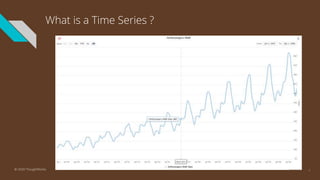
What is a Time Series ?
4© 2020 ThoughtWorks
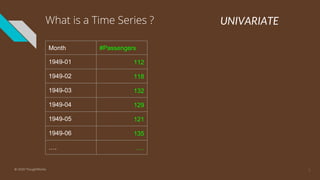
What is a Time Series ?
Month #Passengers
1949-01 112
1949-02 118
1949-03 132
1949-04 129
1949-05 121
1949-06 135
…. ….
UNIVARIATE
5© 2020 ThoughtWorks
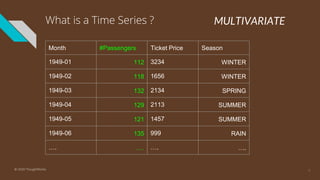
What is a Time Series ?
Month #Passengers
1949-01 112
1949-02 118
1949-03 132
1949-04 129
1949-05 121
1949-06 135
…. ….
Ticket Price Season
3234 WINTER
1656 WINTER
2134 SPRING
2113 SUMMER
1457 SUMMER
999 RAIN
…. ….
MULTIVARIATE
6© 2020 ThoughtWorks
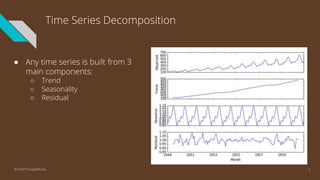
Time Series Decomposition
● Any time series is built from 3
main components:
○ Trend
○ Seasonality
○ Residual
7© 2020 ThoughtWorks
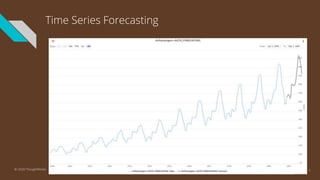
Time Series Forecasting
8© 2020 ThoughtWorks
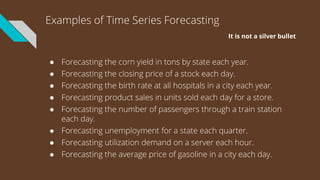
Examples of Time Series Forecasting
● Forecasting the corn yield in tons by state each year.
● Forecasting the closing price of a stock each day.
● Forecasting the birth rate at all hospitals in a city each year.
● Forecasting product sales in units sold each day for a store.
● Forecasting the number of passengers through a train station
each day.
● Forecasting unemployment for a state each quarter.
● Forecasting utilization demand on a server each hour.
● Forecasting the average price of gasoline in a city each day.
It is not a silver bullet
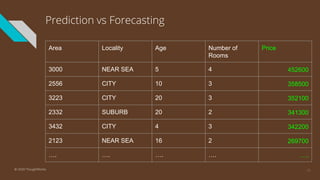
Prediction vs Forecasting
Area Locality Age Number of
Rooms
Price
3000 NEAR SEA 5 4 452600
2556 CITY 10 3 358500
3223 CITY 20 3 352100
2332 SUBURB 20 2 341300
3432 CITY 4 3 342200
2123 NEAR SEA 16 2 269700
…. …. …. …. ….
10© 2020 ThoughtWorks
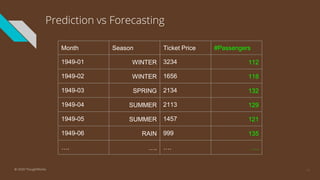
Prediction vs Forecasting
Month Season
1949-01 WINTER
1949-02 WINTER
1949-03 SPRING
1949-04 SUMMER
1949-05 SUMMER
1949-06 RAIN
…. ….
Ticket Price #Passengers
3234 112
1656 118
2134 132
2113 129
1457 121
999 135
…. ….
11© 2020 ThoughtWorks
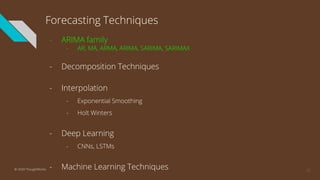
Forecasting Techniques
- ARIMA family
- AR, MA, ARMA, ARIMA, SARIMA, SARIMAX
- Decomposition Techniques
- Interpolation
- Exponential Smoothing
- Holt Winters
- Deep Learning
- CNNs, LSTMs
- Machine Learning Techniques 12© 2020 ThoughtWorks
ARIMA Family
13© 2020 ThoughtWorks
Some Terminologies
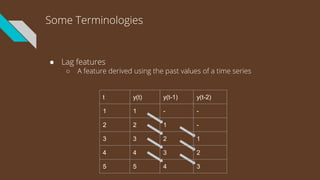
● Lag features
○ A feature derived using the past values of a time series
t y(t)
1 1
2 2
3 3
4 4
5 5
y(t-2)
-
-
1
2
3
y(t-1)
-
1
2
3
4
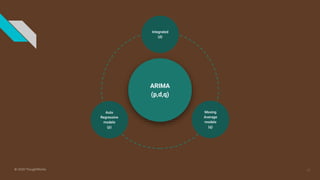
ARIMA
(p,d,q)
Integrated
(d)
Auto
Regressive
models
(p)
Moving
Average
models
(q)
15© 2020 ThoughtWorks
Auto Regressive Models
Day Forecasted (y)
1
2
3
4
5
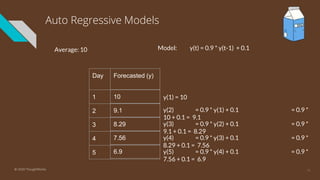
Average: 10 Model: y(t) = 0.9 * y(t-1) + 0.1
10
9.1
8.29
7.56
6.9
16© 2020 ThoughtWorks
y(1) = 10
y(2) = 0.9 * y(1) + 0.1 = 0.9 *
10 + 0.1 = 9.1
y(3) = 0.9 * y(2) + 0.1 = 0.9 *
9.1 + 0.1 = 8.29
y(4) = 0.9 * y(3) + 0.1 = 0.9 *
8.29 + 0.1 = 7.56
y(5) = 0.9 * y(4) + 0.1 = 0.9 *
7.56 + 0.1 = 6.9
Auto Regressive Models
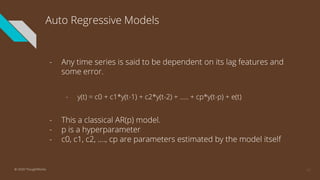
- Any time series is said to be dependent on its lag features and
some error.
- y(t) = c0 + c1*y(t-1) + c2*y(t-2) + ….. + cp*y(t-p) + e(t)
- This a classical AR(p) model.
- p is a hyperparameter
- c0, c1, c2, …., cp are parameters estimated by the model itself
17© 2020 ThoughtWorks
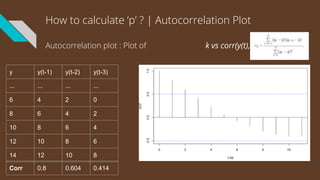
How to calculate ‘p’ ? | Autocorrelation Plot
Autocorrelation plot : Plot of k vs corr(y(t), y(t-k))
y
...
6
8
10
12
14
y(t-2) y(t-3)
... ...
2 0
4 2
6 4
8 6
10 8
y(t-1)
...
4
6
8
10
12
Corr 0.8 0.604 0.414
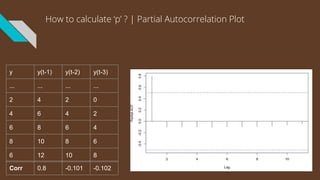
How to calculate ‘p’ ? | Partial Autocorrelation Plot
y
...
2
4
6
8
6
y(t-2) y(t-3)
... ...
2 0
4 2
6 4
8 6
10 8
y(t-1)
...
4
6
8
10
12
Corr 0.8 -0.101 -0.102
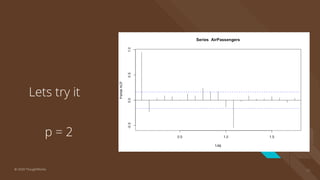
Lets try it
p = 2
20© 2020 ThoughtWorks
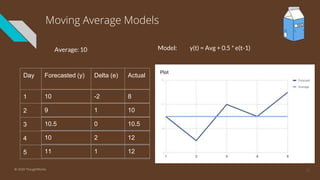
Moving Average Models
Day Forecasted (y) Delta (e) Actual
1
2
3
4
5
Average: 10 Model: y(t) = Avg + 0.5 * e(t-1)
10 -2 8
9 1 10
10.5 0 10.5
10 2 12
11 1 12
21© 2020 ThoughtWorks
Moving Average Models
- Any time series is said to be dependent on the error of its lag
terms.
- y(t) = c0 + c1*e(t-1) + c2*e(t-2) + ….. + cp*e(t-q)
- This a classical MA(q) model.
- q is a hyperparameter
- c0, c1, c2, …., cq are parameters estimated by the model itself
22© 2020 ThoughtWorks
Moving Average Models
- Any time series is said to be dependent on the error of its lag
terms.
- y(t) = c0 + c1*e(t-1) + c2*e(t-2) + ….. + cp*e(t-q)
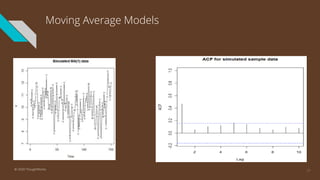
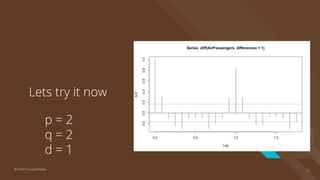
- The value of q is determined using the ACF Plot
23© 2020 ThoughtWorks
Moving Average Models
24© 2020 ThoughtWorks
Lets try it
25© 2020 ThoughtWorks
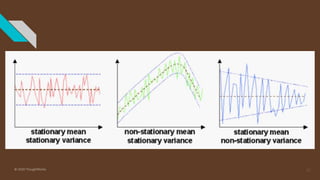
Taking a step back : Stationarity
- All of these models assume that the time series should be
stationery
- A stationary time series is one with constant behaviour over
time. This behaviour is defined by:
- Constant Mean
- Constant Variance
- Constant Autocorrelation
- Why ?
- In practice this is not possible, but there are ways to make a
model stationary
26© 2020 ThoughtWorks
27© 2020 ThoughtWorks
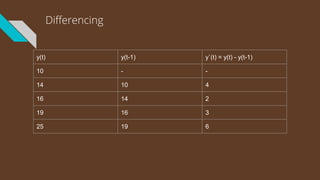
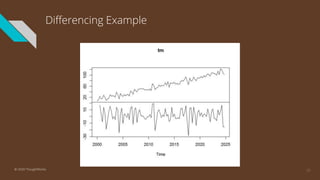
Differencing
y(t) y(t-1)
10 -
14 10
16 14
19 16
25 19
y`(t) = y(t) - y(t-1)
-
4
2
3
6
Differencing
- Differencing is one of the ways to convert a non-stationary time
series into a stationary time series
- It simply translates the time series into:
- y’(t) = y(t) - y(t-1) : First Order
differencing
- y’’(t) = y’(t) - y’(t-1) : Second Order
differencing
29© 2020 ThoughtWorks
Differencing Example
30© 2020 ThoughtWorks
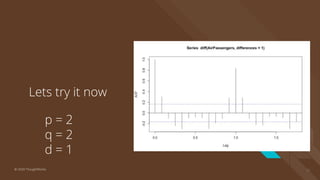
Lets try it now
p = 2
q = 2
d = 1
31© 2020 ThoughtWorks
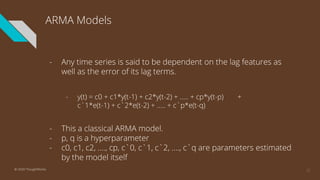
ARMA Models
- Any time series is said to be dependent on the lag features as
well as the error of its lag terms.
- y(t) = c0 + c1*y(t-1) + c2*y(t-2) + ….. + cp*y(t-p) +
c`1*e(t-1) + c`2*e(t-2) + ….. + c`p*e(t-q)
- This a classical ARMA model.
- p, q is a hyperparameter
- c0, c1, c2, …., cp, c`0, c`1, c`2, …., c`q are parameters estimated
by the model itself
32© 2020 ThoughtWorks
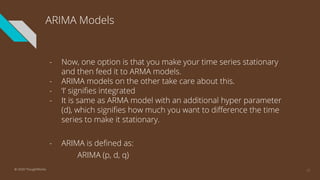
ARIMA Models
- Now, one option is that you make your time series stationary
and then feed it to ARMA models.
- ARIMA models on the other take care about this.
- ‘I’ signifies integrated
- It is same as ARMA model with an additional hyper parameter
(d), which signifies how much you want to difference the time
series to make it stationary.
- ARIMA is defined as:
ARIMA (p, d, q)
33© 2020 ThoughtWorks
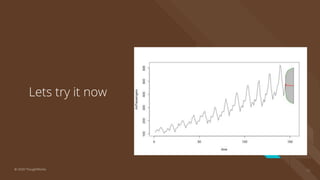
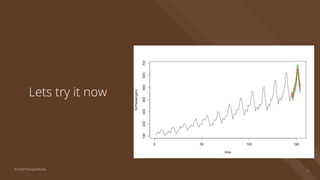
Lets try it now
34© 2020 ThoughtWorks
Lets try it now
p = 2
q = 2
d = 1
35© 2020 ThoughtWorks
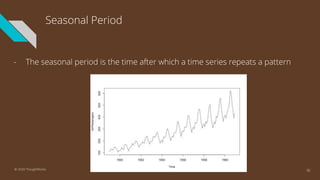
Seasonal Period
- The seasonal period is the time after which a time series repeats a pattern
36© 2020 ThoughtWorks
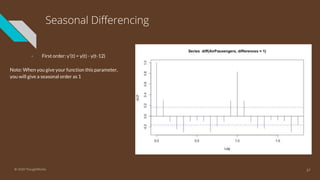
Seasonal Differencing
- First order: y’(t) = y(t) - y(t-12)
Note: When you give your function this parameter,
you will give a seasonal order as 1
37© 2020 ThoughtWorks
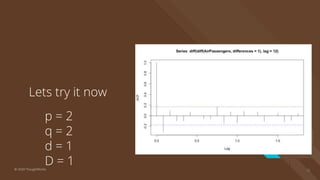
Lets try it now
p = 2
q = 2
d = 1
D = 1
38© 2020 ThoughtWorks
Seasonal-AR Model
- Any time series is said to be dependent on its seasonal lag
features and some error.
- y(t) = c0 + c1*y(t-12) + c2*y(t-24) + ….. + cp*y(t-P*12) + e(t)
- This a seasonal AR(p`) model.
- P is a hyperparameter
- c0, c1, c2, …., cP are parameters estimated by the model itself
39© 2020 ThoughtWorks
Seasonal-MA Model
- Any time series is said to be dependent on its seasonal error.
- y(t) = c0 + c1*e(t-12) + c2*e(t-24) + ….. + cq*e(t-Q*12) + e(t)
- This a seasonal MA(q`) model.
- Q is a hyperparameter
- c0, c1, c2, …., cQ are parameters estimated by the model itself
40© 2020 ThoughtWorks
SARIMA Models
- A SARIMA model is a model which captures Seasonal AR,
Seasonal MA and Seasonal Differencing in the model
- ARIMA is defined as:
ARIMA (p, d, q, P, D, Q)
41© 2020 ThoughtWorks
Lets try it now
42© 2020 ThoughtWorks
Further reading
● https://www.otexts.org/fpp
● https://online.stat.psu.edu/stat510/
● https://www.youtube.com/channel/UCUcpVoi5KkJmnE3bvEhHR0Q
43© 2020 ThoughtWorks
References
● https://www.otexts.org/fpp
● https://online.stat.psu.edu/stat501/lesson/14/14.1
● https://online.stat.psu.edu/stat510/lesson/2/2.1
● https://towardsdatascience.com/stationarity-in-time-series-analysis-90c94f27322
● https://www.youtube.com/channel/UCUcpVoi5KkJmnE3bvEhHR0Q
44© 2020 ThoughtWorks
Thank You
Q&A
45© 2020 ThoughtWorks

Time series analysis 101

  • 1.
    1 Time Series Analysis101 - Tarun Abichandani © 2020 ThoughtWorks
  • 2.
    Agenda - What isa Time Series? - How is it different from regular tabular data ? - Time Series Forecasting - Forecasting Techniques - ACF plots & PACF plots - Stationary vs Non Stationary Time Series - ARIMA family of models - AR, - MA, - ARMA, - ARIMA, - SARIMA 2© 2020 ThoughtWorks
  • 3.
    Before we start, ●The aim of this talk is to get you a introduced to Time Series Analysis and get into the details of ARIMA set of models. ● Although we will cover everything from the basics, context of what a ML model is, would be useful. ● Everything is linked. ● For simplicity, some concepts have been abstracted.
  • 4.
    What is aTime Series ? 4© 2020 ThoughtWorks
  • 5.
    What is aTime Series ? Month #Passengers 1949-01 112 1949-02 118 1949-03 132 1949-04 129 1949-05 121 1949-06 135 …. …. UNIVARIATE 5© 2020 ThoughtWorks
  • 6.
    What is aTime Series ? Month #Passengers 1949-01 112 1949-02 118 1949-03 132 1949-04 129 1949-05 121 1949-06 135 …. …. Ticket Price Season 3234 WINTER 1656 WINTER 2134 SPRING 2113 SUMMER 1457 SUMMER 999 RAIN …. …. MULTIVARIATE 6© 2020 ThoughtWorks
  • 7.
    Time Series Decomposition ●Any time series is built from 3 main components: ○ Trend ○ Seasonality ○ Residual 7© 2020 ThoughtWorks
  • 8.
    Time Series Forecasting 8©2020 ThoughtWorks
  • 9.
    Examples of TimeSeries Forecasting ● Forecasting the corn yield in tons by state each year. ● Forecasting the closing price of a stock each day. ● Forecasting the birth rate at all hospitals in a city each year. ● Forecasting product sales in units sold each day for a store. ● Forecasting the number of passengers through a train station each day. ● Forecasting unemployment for a state each quarter. ● Forecasting utilization demand on a server each hour. ● Forecasting the average price of gasoline in a city each day. It is not a silver bullet
  • 10.
    Prediction vs Forecasting AreaLocality Age Number of Rooms Price 3000 NEAR SEA 5 4 452600 2556 CITY 10 3 358500 3223 CITY 20 3 352100 2332 SUBURB 20 2 341300 3432 CITY 4 3 342200 2123 NEAR SEA 16 2 269700 …. …. …. …. …. 10© 2020 ThoughtWorks
  • 11.
    Prediction vs Forecasting MonthSeason 1949-01 WINTER 1949-02 WINTER 1949-03 SPRING 1949-04 SUMMER 1949-05 SUMMER 1949-06 RAIN …. …. Ticket Price #Passengers 3234 112 1656 118 2134 132 2113 129 1457 121 999 135 …. …. 11© 2020 ThoughtWorks
  • 12.
    Forecasting Techniques - ARIMAfamily - AR, MA, ARMA, ARIMA, SARIMA, SARIMAX - Decomposition Techniques - Interpolation - Exponential Smoothing - Holt Winters - Deep Learning - CNNs, LSTMs - Machine Learning Techniques 12© 2020 ThoughtWorks
  • 13.
  • 14.
    Some Terminologies ● Lagfeatures ○ A feature derived using the past values of a time series t y(t) 1 1 2 2 3 3 4 4 5 5 y(t-2) - - 1 2 3 y(t-1) - 1 2 3 4
  • 15.
  • 16.
    Auto Regressive Models DayForecasted (y) 1 2 3 4 5 Average: 10 Model: y(t) = 0.9 * y(t-1) + 0.1 10 9.1 8.29 7.56 6.9 16© 2020 ThoughtWorks y(1) = 10 y(2) = 0.9 * y(1) + 0.1 = 0.9 * 10 + 0.1 = 9.1 y(3) = 0.9 * y(2) + 0.1 = 0.9 * 9.1 + 0.1 = 8.29 y(4) = 0.9 * y(3) + 0.1 = 0.9 * 8.29 + 0.1 = 7.56 y(5) = 0.9 * y(4) + 0.1 = 0.9 * 7.56 + 0.1 = 6.9
  • 17.
    Auto Regressive Models -Any time series is said to be dependent on its lag features and some error. - y(t) = c0 + c1*y(t-1) + c2*y(t-2) + ….. + cp*y(t-p) + e(t) - This a classical AR(p) model. - p is a hyperparameter - c0, c1, c2, …., cp are parameters estimated by the model itself 17© 2020 ThoughtWorks
  • 18.
    How to calculate‘p’ ? | Autocorrelation Plot Autocorrelation plot : Plot of k vs corr(y(t), y(t-k)) y ... 6 8 10 12 14 y(t-2) y(t-3) ... ... 2 0 4 2 6 4 8 6 10 8 y(t-1) ... 4 6 8 10 12 Corr 0.8 0.604 0.414
  • 19.
    How to calculate‘p’ ? | Partial Autocorrelation Plot y ... 2 4 6 8 6 y(t-2) y(t-3) ... ... 2 0 4 2 6 4 8 6 10 8 y(t-1) ... 4 6 8 10 12 Corr 0.8 -0.101 -0.102
  • 20.
    Lets try it p= 2 20© 2020 ThoughtWorks
  • 21.
    Moving Average Models DayForecasted (y) Delta (e) Actual 1 2 3 4 5 Average: 10 Model: y(t) = Avg + 0.5 * e(t-1) 10 -2 8 9 1 10 10.5 0 10.5 10 2 12 11 1 12 21© 2020 ThoughtWorks
  • 22.
    Moving Average Models -Any time series is said to be dependent on the error of its lag terms. - y(t) = c0 + c1*e(t-1) + c2*e(t-2) + ….. + cp*e(t-q) - This a classical MA(q) model. - q is a hyperparameter - c0, c1, c2, …., cq are parameters estimated by the model itself 22© 2020 ThoughtWorks
  • 23.
    Moving Average Models -Any time series is said to be dependent on the error of its lag terms. - y(t) = c0 + c1*e(t-1) + c2*e(t-2) + ….. + cp*e(t-q) - The value of q is determined using the ACF Plot 23© 2020 ThoughtWorks
  • 24.
    Moving Average Models 24©2020 ThoughtWorks
  • 25.
    Lets try it 25©2020 ThoughtWorks
  • 26.
    Taking a stepback : Stationarity - All of these models assume that the time series should be stationery - A stationary time series is one with constant behaviour over time. This behaviour is defined by: - Constant Mean - Constant Variance - Constant Autocorrelation - Why ? - In practice this is not possible, but there are ways to make a model stationary 26© 2020 ThoughtWorks
  • 27.
  • 28.
    Differencing y(t) y(t-1) 10 - 1410 16 14 19 16 25 19 y`(t) = y(t) - y(t-1) - 4 2 3 6
  • 29.
    Differencing - Differencing isone of the ways to convert a non-stationary time series into a stationary time series - It simply translates the time series into: - y’(t) = y(t) - y(t-1) : First Order differencing - y’’(t) = y’(t) - y’(t-1) : Second Order differencing 29© 2020 ThoughtWorks
  • 30.
  • 31.
    Lets try itnow p = 2 q = 2 d = 1 31© 2020 ThoughtWorks
  • 32.
    ARMA Models - Anytime series is said to be dependent on the lag features as well as the error of its lag terms. - y(t) = c0 + c1*y(t-1) + c2*y(t-2) + ….. + cp*y(t-p) + c`1*e(t-1) + c`2*e(t-2) + ….. + c`p*e(t-q) - This a classical ARMA model. - p, q is a hyperparameter - c0, c1, c2, …., cp, c`0, c`1, c`2, …., c`q are parameters estimated by the model itself 32© 2020 ThoughtWorks
  • 33.
    ARIMA Models - Now,one option is that you make your time series stationary and then feed it to ARMA models. - ARIMA models on the other take care about this. - ‘I’ signifies integrated - It is same as ARMA model with an additional hyper parameter (d), which signifies how much you want to difference the time series to make it stationary. - ARIMA is defined as: ARIMA (p, d, q) 33© 2020 ThoughtWorks
  • 34.
    Lets try itnow 34© 2020 ThoughtWorks
  • 35.
    Lets try itnow p = 2 q = 2 d = 1 35© 2020 ThoughtWorks
  • 36.
    Seasonal Period - Theseasonal period is the time after which a time series repeats a pattern 36© 2020 ThoughtWorks
  • 37.
    Seasonal Differencing - Firstorder: y’(t) = y(t) - y(t-12) Note: When you give your function this parameter, you will give a seasonal order as 1 37© 2020 ThoughtWorks
  • 38.
    Lets try itnow p = 2 q = 2 d = 1 D = 1 38© 2020 ThoughtWorks
  • 39.
    Seasonal-AR Model - Anytime series is said to be dependent on its seasonal lag features and some error. - y(t) = c0 + c1*y(t-12) + c2*y(t-24) + ….. + cp*y(t-P*12) + e(t) - This a seasonal AR(p`) model. - P is a hyperparameter - c0, c1, c2, …., cP are parameters estimated by the model itself 39© 2020 ThoughtWorks
  • 40.
    Seasonal-MA Model - Anytime series is said to be dependent on its seasonal error. - y(t) = c0 + c1*e(t-12) + c2*e(t-24) + ….. + cq*e(t-Q*12) + e(t) - This a seasonal MA(q`) model. - Q is a hyperparameter - c0, c1, c2, …., cQ are parameters estimated by the model itself 40© 2020 ThoughtWorks
  • 41.
    SARIMA Models - ASARIMA model is a model which captures Seasonal AR, Seasonal MA and Seasonal Differencing in the model - ARIMA is defined as: ARIMA (p, d, q, P, D, Q) 41© 2020 ThoughtWorks
  • 42.
    Lets try itnow 42© 2020 ThoughtWorks
  • 43.
    Further reading ● https://www.otexts.org/fpp ●https://online.stat.psu.edu/stat510/ ● https://www.youtube.com/channel/UCUcpVoi5KkJmnE3bvEhHR0Q 43© 2020 ThoughtWorks
  • 44.
    References ● https://www.otexts.org/fpp ● https://online.stat.psu.edu/stat501/lesson/14/14.1 ●https://online.stat.psu.edu/stat510/lesson/2/2.1 ● https://towardsdatascience.com/stationarity-in-time-series-analysis-90c94f27322 ● https://www.youtube.com/channel/UCUcpVoi5KkJmnE3bvEhHR0Q 44© 2020 ThoughtWorks
  • 45.

Editor's Notes

  • #5 Any data with respect to time.
  • #6 Any data with respect to time.
  • #7 Any data with respect to time.
  • #11 Any data with respect to time.
  • #12 Any data with respect to time.
  • #19 library(forecast) d = c(2,4,6,8,10,12,14,16,18,20,22,24,26,28,30) acf(d)
  • #20 pacf(d, plot=F) pacf(d)
  • #21 data("AirPassengers") plot(AirPassengers) pacf(AirPassengers)
  • #23 In some ts, the observations are not dependant on the lag features directly, but are dependant on an error of the lag features, for example assume a case where y(t) and y(t-2) are dependant on each other but independent of
  • #24 In some ts, the observations are not dependant on the lag features directly, but are dependant on an error of the lag features, for example assume a case where y(t) and y(t-2) are dependant on each other but independent of
  • #26 acf(AirPassengers)
  • #27 Because, you can’t have the same model capturing diff patterns in a time series Like one place you cant have 2 * y(t-1) and later 3*y(y-1)
  • #32 acf(AirPassengers)
  • #34 model = arima(AirPassengers, c(2,1,2)) forecast(model, lead = 10)
  • #35 forecast(arima(AirPassengers, c(2,1,2)), lead = 10)
  • #36 acf(AirPassengers)
  • #38 acf(diff(diff(AirPassengers, differences = 1), lag=12))
  • #39 acf(AirPassengers)
  • #42 model = arima(AirPassengers, c(2,1,2), , seasonal = c(0,1,0)) forecast(model, lead = 10)
  • #43 forecast(arima(AirPassengers, c(2,1,2), seasonal = c(0,1,0)), lead = 10)