1
Parametrized complexity of Graph
MOTIF
By: Amr Koura
2
Agenda
● Problem definition
● Preliminaries
● FPT algorithms
● Parameters for which graph MOTIF is hard
● References
3
Problem Definition
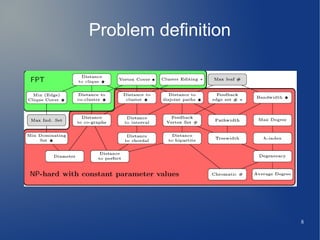
4
Problem definition
● Input: A triple (G,c,M) where G=(V,E) is graph,
c:V-->C is coloration function of V on |C|
colors, and M is multiset of Colors of C.
● Output: A subset such that G(P) is
connected and c(P)=M.
P⊂V
5
Example
M={red,blue,red,yellow,black,orange,green}
6
Solution
M={red,blue,red,yellow,black,orange,green}
7
Problem Definition
● The problem is NP-hard.
● Application: Biological,social and technical
Networks.
8
Problem definition
9
Preliminaries
10
Some Definitions
•
For any vertex , the set of neighbors of V is
N(v) and for , ,
and .
•
Vertex v dominate S if ,set R dominate
S if .
•
Denote the multiplicity of x in multiset M,
and .
v∈V
S⊂V N (S)=∪
v∈S
N (v)∖ S
S⊆N (v)
S⊆N (R)
mM x
∣M∣= ∑
x∈M
mM x
N [v]=N (v)∪{v}
N [S ]=N (S)∪S
11
Some Definitions
•
clique is a graph where each two distinct
vertices are connected.
•
cluster is a graph set of disjoint union of
cliques.
•
(I,K) is fixed parameter traceable “FPT” if it can
be solved in where f is computable
function and c is constant.
•
If C is graph class , distance of graph G to C is
number of vertices to be removed from G to get
C.
f (K).∣I∣
c
12
FPT algorithms
13
FPT Algorithm parameter
● Cluster editing.
● Distance to clique.
● Vertex cover number.
14
Cluster editing
parameter
15
Cluster editing
•
Definition:Definition: number of edge deletion or additionnumber of edge deletion or addition
requited to get cluster.requited to get cluster.
• Theorem: Graph MOTIF can be solved in
with cluster editing K.
• Proof:
use parameter “neighborhood diversity”.
O
∗
(8
k
)
16
Neighborhood diversity
Definition:
● Graph G has neighborhood diversity K if its
vertices can be partitioned into at most K sets
such that all vertices in the set have the same
type.
● Two vertices u,v have the same type if N(u)
{v}=N(v){u}.
17
Neighborhood diversity
http://www.sofsem.cz/sofsem12/files/presentations/Wednesday/SRF/Ganian.pdf
18
Cluster editing
• Theorem: graph MOTIF can be solved in on graph with
neighborhood diversity K [1].
➢ Compute neighborhood diversity:
- G is input graph, G' graph obtained after k edition on G.
- let X is set of vertices that are endpoints of the edit edges.
- Then
- Let is L cliques of G'.
- ,so number of neighborhood
diversity of G is bounded by .
- applying the above theorem , Graph MOTIF can be solved in
O
∗
(2
k
)
∣x∣≤2k
C1,. .. ,C L
∀i∈[L]∀v∈Ci ∖ X , N [v]=Ci
∣x∣+ l≤2k+ k=3k
O∗
(23k
)=O∗
(8k
)
19
Distance to Clique
20
Distance to clique
• Theorem: graph MOTIF can be solved in
where k is distance of input graph to clique.
• Proof: Algorithm:
- Find vertex cover S of size k in in time [2].
- S is also the distance to clique in G.
- let R be solution, trying all subset of S, guess subset of
S, which is in R.
- ,then vertices of the clique C with colors
should complete the solution.
- Problem: finding a minimal (inclusion wise) set such
that and G[ ] is connected.
O
∗
(2
klogk
)
G 1.2738k
2k
S '=S∩R
c(S ')⊆M ∣M∣−∣S '∣
M '=M ∖c(S ')
R'⊆C
c(R')⊆M ' R'∪S '
21
Distance to clique
• Proof: Algorithm “continue”:
- Let be connected components of G[S'],
- build graph G'=(V',E') from graph G:
+Keep the clique C as it is.
+ contract into single vertex and draw
and edge from to iff and
+ a minimal (inclusion wise) in a dominating
vertex in G',
+ try out all l-partitions of denoted by
st: dominate . note that .
+ number of partitions : “Bell number”.
C1, C2,. .. ,Ck ' k '< k
∀Ci ,i∈[k ' ] Ci vi
vi v∈C ∃u∈Ci {u ,v}∈E
Rd ⊂R∖ S '
Rd =r1 ,... ,rl
{v1 ,... ,vk ' } {A1 ,... , Al }
ri Ai
Bk '
l≤k '≤k
22
Distance to clique
• Proof: Algorithm “continue”:
- From G' ,build bipartite graph , H=( ,B)
where and where
there is an edge between and all
iff such that c(v)=x, v dominate and there
is no ,v dominate .
- H has vertices and in
can decided if H has perfect matching in
size l if exists [3].
H1∪H2
H1={uAi
,i∈[l]} H2= ∪
x∈M '
{ux
1
,ux
2
,... ,ux
mM ' x
}
uAi {ux
1,
ux
2,.
.. ,ux
mM ' x
}
∃v∈V ' Ai
i≠ j Aj
l+∣M '∣≤k+∣M∣ (k+ M )2.376
23
Distance to clique
● Proof “continue”:
- Build a match from to where j is
smallest integer not yet in the match.
- Because ,j will not exceed .
U Ai
uc(ri)
j
c(R' )⊆M ' mM ' (c(ri))
24
Distance to clique
• Proof: Algorithm “continue”:
- from perfect matching in H, graph MOTIF
solution built:
- there , namely ,
and dominate .
- set , G[Z] is connected and
and then we extend z by adding subset
such that c(Z')=M'c(Z).
∀i∈l {uAi
,ux
ji
}∈B ∃wi ∈V ' c(wi)=x
wi Ai
Z=S '∪∪
i∈l
wi c(Z )⊆M '
Z '⊆C ∖ Z
25
Distance to clique
• Theorem: graph MOTIF can be solved in
where k is distance of input graph to clique.
• Proof: Algorithm “continue”:
- The algorithm needs:
- to compute vertex cover
- to build G' from G.
- to build H from G'.
- to check perfect matching in H.
- to build perfect matching in H.
- all together:
- As ,so the algorithm fulfill the above theorem.
O
∗
(2
klogk
)
(1.2738k
)
p1(n)
p2(n)
(k+∣M∣)
2.376
p3(n)
1.2738k
+ 2k
( p1(n)+ Bk ( p2(n)+ (k+∣M∣)
2.376
+ p3(n)))
BK < (
0.792k
ln(k+ 1)
)
k
26
Vertex cover number
27
Vertex cover number
● Theorem: Graph MOTIF can be solved in
on graph with vertex cover of size k.
● Proof: Algorithm:
-same previous algorithm but computing the vertex cover in G,
up to computing .
-we guess in time , compute the order pair
such that (1) dominate , (2) has at least one neighbor in
, (3) has no neighbor in .
O
∗
(2
2klog k
)
Rd =r1 ,... ,rl
O∗
(k ! Bk ) < A1, A2, .. , Al >
riAi
∪
1≤ j< i
Aj
ri
∪
i< j≤l
Aj
ri
28
Vertex cover number
● Theorem: Graph MOTIF can be solved in
on graph with vertex cover of size k.
Proof: continue:
-in H={ } there is an edge between and
iff ,c(v)=x,v dominate , And v has one neighbor in
.
-if H has perfect matching, then we can build MOTIF solution.
- and , then the complexity is
O
∗
(2
2klog k
)
H1∪H 2 , B uAi {ux
1,
ux
2,.
.. ,ux
mM ' (x)
}
∃v∈V ' Ai
∪
1≤ j< i
Aj
k !≤k
k
Bk≤k
k O∗
(kk
∗kk
)=O∗
(22klogk
)
29
Parameters which Graph
MOTIF is Hard
30
Parameters which Graph MOTIF is
Hard
● Graph MOTIF problem still NP-Hard even if
provided with some parameters.
-Deletion set Number.
31
Deletion set Number
Parameter
32
Deletion set Number Parameter
● Definition:
minimum number of vertices to remove to make
graph belong to restricted class.
● Theorem:
Graph MOTIF is NP-Hard for graph with
distance 1 to disjoint paths and colorful motif.
33
Deletion set Number Parameter
● Proof:
-Relation with X3C.
Given X={ },S={ }, find ,st.
each element in X exists only once in T.
From I=(X,S), construct I'=(G=(V,E),c,M) ,M
motif, by:
one root r , , two paths are built, first
including , three elements of , .second
includes .
x1, x2,.... , x3q S1, S2,.... ,S∣S∣ T ⊂S
∀Si ∈S
ai
1
Si
ai
2
,bi
2
bi
1
34
Deletion set Number Parameter
C={1,2,...,2|S|+3q+1}.c( )=c( )=i. c( )=c( )=|S|+i for .
colors are assigned to nodes vertices according
to x,c(r)= .the construction is done in polynomial time.
ai
1 ai
2
ai
1 bi
1
bi
2
1≤i≤∣S∣
2∣S∣+ 1,... ,2∣S∣+ 3q
3q+ 2∣S∣+ 1
35
Deletion set Number Parameter
C={1,2,...,2|S|+3q+1}.c( )=c( )=i. c( )=c( )=|S|+i for .
colors are assigned to nodes vertices according
to x,c(r)= .the construction is done in polynomial time.
ai
1 ai
2
ai
1 bi
1
bi
2
1≤i≤∣S∣
2∣S∣+ 1,... ,2∣S∣+ 3q
3q+ 2∣S∣+ 1
36
Deletion set Number Parameter
• :
given is solution for I, build solution P for I':
-take root node.
- take the full path from to .
- take the path .
- all colors are taken only once.
T ⊂S
∀Si ∈T ai
1
bi
1
∀Si ∉T ai
2
bi
2
X3C ⇒ MOTIF
37
Deletion set Number Parameter
• :
Given solution P for I' ,build solution for I.
- Root node is taken.
- For each either or is taken, same
for and .
- To add , should be added due to
connectivity constraint.
MOTIF ⇒ X3C
1≤i≤∣S∣ ai
1
ai
2
bi
1
bi
2
bi
2
ai
2
T ⊂S
38
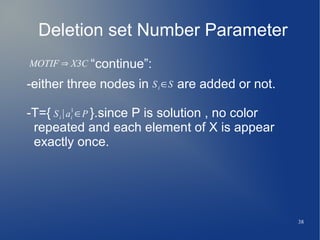
Deletion set Number Parameter
“continue”:
-either three nodes in are added or not.
-T={ }.since P is solution , no color
repeated and each element of X is appear
exactly once.
Si ∈S
Si∣ai
1
∈P
MOTIF ⇒ X3C
39
Refrences
● [1] “R. Ganian. Using neighborhood diversity to solve hard
problems. CoRR, abs/1201.3091,2012.”.
● [2]M. Mucha and P. Sankowski. Maximum Matchings via
Gaussian Elimination. In 45th Sym-posium on Foundations of
Computer Science (FOCS 2004), pages 248–255. IEEE
ComputerSociety, 2004.
● [3] “J. Chen, I. A. Kanj, and G. Xia. Improved upper bounds for
vertex cover. Theoretical Computer Science, 411(4042):3736 –
3756, 2010.”
40
Thank you for your
attention

parameterized complexity for graph Motif

  • 1.
    1 Parametrized complexity ofGraph MOTIF By: Amr Koura
  • 2.
    2 Agenda ● Problem definition ●Preliminaries ● FPT algorithms ● Parameters for which graph MOTIF is hard ● References
  • 3.
  • 4.
    4 Problem definition ● Input:A triple (G,c,M) where G=(V,E) is graph, c:V-->C is coloration function of V on |C| colors, and M is multiset of Colors of C. ● Output: A subset such that G(P) is connected and c(P)=M. P⊂V
  • 5.
  • 6.
  • 7.
    7 Problem Definition ● Theproblem is NP-hard. ● Application: Biological,social and technical Networks.
  • 8.
  • 9.
  • 10.
    10 Some Definitions • For anyvertex , the set of neighbors of V is N(v) and for , , and . • Vertex v dominate S if ,set R dominate S if . • Denote the multiplicity of x in multiset M, and . v∈V S⊂V N (S)=∪ v∈S N (v)∖ S S⊆N (v) S⊆N (R) mM x ∣M∣= ∑ x∈M mM x N [v]=N (v)∪{v} N [S ]=N (S)∪S
  • 11.
    11 Some Definitions • clique isa graph where each two distinct vertices are connected. • cluster is a graph set of disjoint union of cliques. • (I,K) is fixed parameter traceable “FPT” if it can be solved in where f is computable function and c is constant. • If C is graph class , distance of graph G to C is number of vertices to be removed from G to get C. f (K).∣I∣ c
  • 12.
  • 13.
    13 FPT Algorithm parameter ●Cluster editing. ● Distance to clique. ● Vertex cover number.
  • 14.
  • 15.
    15 Cluster editing • Definition:Definition: numberof edge deletion or additionnumber of edge deletion or addition requited to get cluster.requited to get cluster. • Theorem: Graph MOTIF can be solved in with cluster editing K. • Proof: use parameter “neighborhood diversity”. O ∗ (8 k )
  • 16.
    16 Neighborhood diversity Definition: ● GraphG has neighborhood diversity K if its vertices can be partitioned into at most K sets such that all vertices in the set have the same type. ● Two vertices u,v have the same type if N(u) {v}=N(v){u}.
  • 17.
  • 18.
    18 Cluster editing • Theorem:graph MOTIF can be solved in on graph with neighborhood diversity K [1]. ➢ Compute neighborhood diversity: - G is input graph, G' graph obtained after k edition on G. - let X is set of vertices that are endpoints of the edit edges. - Then - Let is L cliques of G'. - ,so number of neighborhood diversity of G is bounded by . - applying the above theorem , Graph MOTIF can be solved in O ∗ (2 k ) ∣x∣≤2k C1,. .. ,C L ∀i∈[L]∀v∈Ci ∖ X , N [v]=Ci ∣x∣+ l≤2k+ k=3k O∗ (23k )=O∗ (8k )
  • 19.
  • 20.
    20 Distance to clique •Theorem: graph MOTIF can be solved in where k is distance of input graph to clique. • Proof: Algorithm: - Find vertex cover S of size k in in time [2]. - S is also the distance to clique in G. - let R be solution, trying all subset of S, guess subset of S, which is in R. - ,then vertices of the clique C with colors should complete the solution. - Problem: finding a minimal (inclusion wise) set such that and G[ ] is connected. O ∗ (2 klogk ) G 1.2738k 2k S '=S∩R c(S ')⊆M ∣M∣−∣S '∣ M '=M ∖c(S ') R'⊆C c(R')⊆M ' R'∪S '
  • 21.
    21 Distance to clique •Proof: Algorithm “continue”: - Let be connected components of G[S'], - build graph G'=(V',E') from graph G: +Keep the clique C as it is. + contract into single vertex and draw and edge from to iff and + a minimal (inclusion wise) in a dominating vertex in G', + try out all l-partitions of denoted by st: dominate . note that . + number of partitions : “Bell number”. C1, C2,. .. ,Ck ' k '< k ∀Ci ,i∈[k ' ] Ci vi vi v∈C ∃u∈Ci {u ,v}∈E Rd ⊂R∖ S ' Rd =r1 ,... ,rl {v1 ,... ,vk ' } {A1 ,... , Al } ri Ai Bk ' l≤k '≤k
  • 22.
    22 Distance to clique •Proof: Algorithm “continue”: - From G' ,build bipartite graph , H=( ,B) where and where there is an edge between and all iff such that c(v)=x, v dominate and there is no ,v dominate . - H has vertices and in can decided if H has perfect matching in size l if exists [3]. H1∪H2 H1={uAi ,i∈[l]} H2= ∪ x∈M ' {ux 1 ,ux 2 ,... ,ux mM ' x } uAi {ux 1, ux 2,. .. ,ux mM ' x } ∃v∈V ' Ai i≠ j Aj l+∣M '∣≤k+∣M∣ (k+ M )2.376
  • 23.
    23 Distance to clique ●Proof “continue”: - Build a match from to where j is smallest integer not yet in the match. - Because ,j will not exceed . U Ai uc(ri) j c(R' )⊆M ' mM ' (c(ri))
  • 24.
    24 Distance to clique •Proof: Algorithm “continue”: - from perfect matching in H, graph MOTIF solution built: - there , namely , and dominate . - set , G[Z] is connected and and then we extend z by adding subset such that c(Z')=M'c(Z). ∀i∈l {uAi ,ux ji }∈B ∃wi ∈V ' c(wi)=x wi Ai Z=S '∪∪ i∈l wi c(Z )⊆M ' Z '⊆C ∖ Z
  • 25.
    25 Distance to clique •Theorem: graph MOTIF can be solved in where k is distance of input graph to clique. • Proof: Algorithm “continue”: - The algorithm needs: - to compute vertex cover - to build G' from G. - to build H from G'. - to check perfect matching in H. - to build perfect matching in H. - all together: - As ,so the algorithm fulfill the above theorem. O ∗ (2 klogk ) (1.2738k ) p1(n) p2(n) (k+∣M∣) 2.376 p3(n) 1.2738k + 2k ( p1(n)+ Bk ( p2(n)+ (k+∣M∣) 2.376 + p3(n))) BK < ( 0.792k ln(k+ 1) ) k
  • 26.
  • 27.
    27 Vertex cover number ●Theorem: Graph MOTIF can be solved in on graph with vertex cover of size k. ● Proof: Algorithm: -same previous algorithm but computing the vertex cover in G, up to computing . -we guess in time , compute the order pair such that (1) dominate , (2) has at least one neighbor in , (3) has no neighbor in . O ∗ (2 2klog k ) Rd =r1 ,... ,rl O∗ (k ! Bk ) < A1, A2, .. , Al > riAi ∪ 1≤ j< i Aj ri ∪ i< j≤l Aj ri
  • 28.
    28 Vertex cover number ●Theorem: Graph MOTIF can be solved in on graph with vertex cover of size k. Proof: continue: -in H={ } there is an edge between and iff ,c(v)=x,v dominate , And v has one neighbor in . -if H has perfect matching, then we can build MOTIF solution. - and , then the complexity is O ∗ (2 2klog k ) H1∪H 2 , B uAi {ux 1, ux 2,. .. ,ux mM ' (x) } ∃v∈V ' Ai ∪ 1≤ j< i Aj k !≤k k Bk≤k k O∗ (kk ∗kk )=O∗ (22klogk )
  • 29.
  • 30.
    30 Parameters which GraphMOTIF is Hard ● Graph MOTIF problem still NP-Hard even if provided with some parameters. -Deletion set Number.
  • 31.
  • 32.
    32 Deletion set NumberParameter ● Definition: minimum number of vertices to remove to make graph belong to restricted class. ● Theorem: Graph MOTIF is NP-Hard for graph with distance 1 to disjoint paths and colorful motif.
  • 33.
    33 Deletion set NumberParameter ● Proof: -Relation with X3C. Given X={ },S={ }, find ,st. each element in X exists only once in T. From I=(X,S), construct I'=(G=(V,E),c,M) ,M motif, by: one root r , , two paths are built, first including , three elements of , .second includes . x1, x2,.... , x3q S1, S2,.... ,S∣S∣ T ⊂S ∀Si ∈S ai 1 Si ai 2 ,bi 2 bi 1
  • 34.
    34 Deletion set NumberParameter C={1,2,...,2|S|+3q+1}.c( )=c( )=i. c( )=c( )=|S|+i for . colors are assigned to nodes vertices according to x,c(r)= .the construction is done in polynomial time. ai 1 ai 2 ai 1 bi 1 bi 2 1≤i≤∣S∣ 2∣S∣+ 1,... ,2∣S∣+ 3q 3q+ 2∣S∣+ 1
  • 35.
    35 Deletion set NumberParameter C={1,2,...,2|S|+3q+1}.c( )=c( )=i. c( )=c( )=|S|+i for . colors are assigned to nodes vertices according to x,c(r)= .the construction is done in polynomial time. ai 1 ai 2 ai 1 bi 1 bi 2 1≤i≤∣S∣ 2∣S∣+ 1,... ,2∣S∣+ 3q 3q+ 2∣S∣+ 1
  • 36.
    36 Deletion set NumberParameter • : given is solution for I, build solution P for I': -take root node. - take the full path from to . - take the path . - all colors are taken only once. T ⊂S ∀Si ∈T ai 1 bi 1 ∀Si ∉T ai 2 bi 2 X3C ⇒ MOTIF
  • 37.
    37 Deletion set NumberParameter • : Given solution P for I' ,build solution for I. - Root node is taken. - For each either or is taken, same for and . - To add , should be added due to connectivity constraint. MOTIF ⇒ X3C 1≤i≤∣S∣ ai 1 ai 2 bi 1 bi 2 bi 2 ai 2 T ⊂S
  • 38.
    38 Deletion set NumberParameter “continue”: -either three nodes in are added or not. -T={ }.since P is solution , no color repeated and each element of X is appear exactly once. Si ∈S Si∣ai 1 ∈P MOTIF ⇒ X3C
  • 39.
    39 Refrences ● [1] “R.Ganian. Using neighborhood diversity to solve hard problems. CoRR, abs/1201.3091,2012.”. ● [2]M. Mucha and P. Sankowski. Maximum Matchings via Gaussian Elimination. In 45th Sym-posium on Foundations of Computer Science (FOCS 2004), pages 248–255. IEEE ComputerSociety, 2004. ● [3] “J. Chen, I. A. Kanj, and G. Xia. Improved upper bounds for vertex cover. Theoretical Computer Science, 411(4042):3736 – 3756, 2010.”
  • 40.
    40 Thank you foryour attention