APPLIED DATA SCIENCE
ARIMA Model
OBJECTIVE
“
“
To demonstrate ARIMA model.
14-07-2024 7
8
9
14-07-2024 10
14-07-2024 11
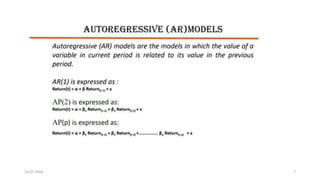
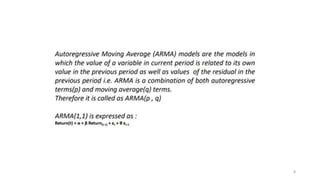
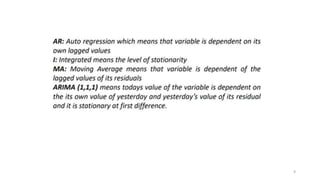
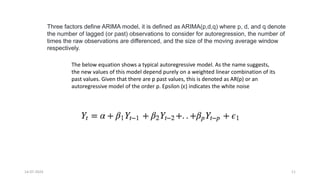
Three factors define ARIMA model, it is defined as ARIMA(p,d,q) where p, d, and q denote
the number of lagged (or past) observations to consider for autoregression, the number of
times the raw observations are differenced, and the size of the moving average window
respectively.
The below equation shows a typical autoregressive model. As the name suggests,
the new values of this model depend purely on a weighted linear combination of its
past values. Given that there are p past values, this is denoted as AR(p) or an
autoregressive model of the order p. Epsilon (ε) indicates the white noise
14-07-2024 12
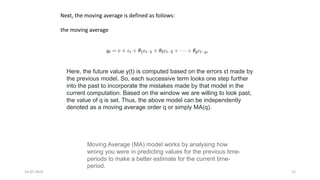
Next, the moving average is defined as follows:
the moving average
Here, the future value y(t) is computed based on the errors εt made by
the previous model. So, each successive term looks one step further
into the past to incorporate the mistakes made by that model in the
current computation. Based on the window we are willing to look past,
the value of q is set. Thus, the above model can be independently
denoted as a moving average order q or simply MA(q).
Moving Average (MA) model works by analysing how
wrong you were in predicting values for the previous time-
periods to make a better estimate for the current time-
period.
Why does ARIMA need Stationary Time-Series Data?
Stationarity
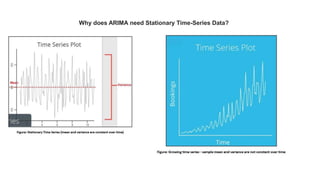
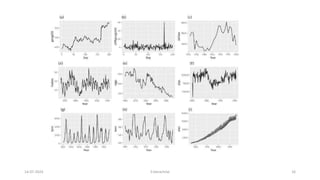
A stationary time series data is one whose properties do not depend on the time, That is why
time series with trends, or with seasonality, are not stationary. the trend and seasonality will
affect the value of the time series at different times,
A stationary time series is one whose statistical properties such as mean, variance,
autocorrelation, etc. are all constant over time.
On the other hand for stationarity it does not matter when you observe it, it should look
much the same at any point in time. In general, a stationary time series will have no
predictable patterns in the long-term.
Why does ARIMA need Stationary Time-Series Data?
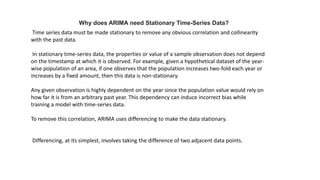
Time series data must be made stationary to remove any obvious correlation and collinearity
with the past data.
In stationary time-series data, the properties or value of a sample observation does not depend
on the timestamp at which it is observed. For example, given a hypothetical dataset of the year-
wise population of an area, if one observes that the population increases two-fold each year or
increases by a fixed amount, then this data is non-stationary.
Any given observation is highly dependent on the year since the population value would rely on
how far it is from an arbitrary past year. This dependency can induce incorrect bias while
training a model with time-series data.
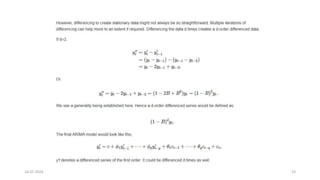
To remove this correlation, ARIMA uses differencing to make the data stationary.
Differencing, at its simplest, involves taking the difference of two adjacent data points.
14-07-2024 S.Vairachilai 16
14-07-2024 17
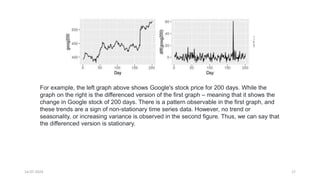
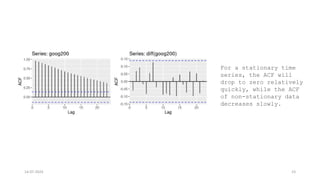
For example, the left graph above shows Google's stock price for 200 days. While the
graph on the right is the differenced version of the first graph – meaning that it shows the
change in Google stock of 200 days. There is a pattern observable in the first graph, and
these trends are a sign of non-stationary time series data. However, no trend or
seasonality, or increasing variance is observed in the second figure. Thus, we can say that
the differenced version is stationary.
14-07-2024 18
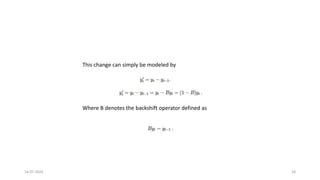
This change can simply be modeled by
Where B denotes the backshift operator defined as
14-07-2024 19
14-07-2024 20
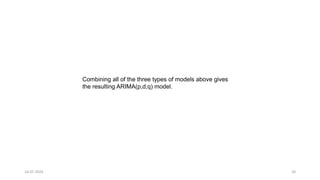
Combining all of the three types of models above gives
the resulting ARIMA(p,d,q) model.
14-07-2024 21
In general, it is a good practice to follow the next steps when doing time-series forecasting:
•Step 1 — Check Stationarity: If a time series has a trend or seasonality component, it
must be made stationary.
•Step 2 — Determine the d value: If the time series is not stationary, it needs to be
stationarized through differencing.
•Step 3 — Select AR and MA terms: Use the ACF and PACF to decide whether to include
an AR term, MA term, (or) ARMA.
•Step 4 — Build the model
14-07-2024 22
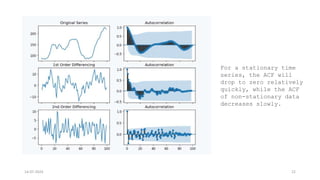
For a stationary time
series, the ACF will
drop to zero relatively
quickly, while the ACF
of non-stationary data
decreases slowly.
14-07-2024 23
For a stationary time
series, the ACF will
drop to zero relatively
quickly, while the ACF
of non-stationary data
decreases slowly.
14-07-2024 24
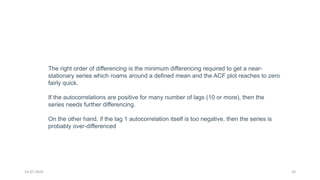
The right order of differencing is the minimum differencing required to get a near-
stationary series which roams around a defined mean and the ACF plot reaches to zero
fairly quick.
If the autocorrelations are positive for many number of lags (10 or more), then the
series needs further differencing.
On the other hand, if the lag 1 autocorrelation itself is too negative, then the series is
probably over-differenced
14-07-2024 25
Check if the series is stationary using the Augmented Dickey
Fuller test (adfuller()), from the statsmodels package.
Why?
Because, you need differencing only if the series is non-
stationary. Else, no differencing is needed, that is, d=0.
The null hypothesis of the ADF test is that the time series is
non-stationary. So, if the p-value of the test is less than the
significance level (0.05) then you reject the null hypothesis and
infer that the time series is indeed stationary.
So, in our case, if P Value > 0.05 we go ahead with finding the
order of differencing.
14-07-2024 26
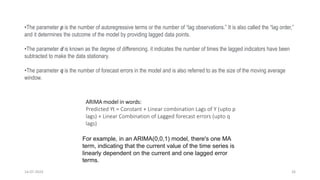
•The parameter p is the number of autoregressive terms or the number of “lag observations.” It is also called the “lag order,”
and it determines the outcome of the model by providing lagged data points.
•The parameter d is known as the degree of differencing. it indicates the number of times the lagged indicators have been
subtracted to make the data stationary.
•The parameter q is the number of forecast errors in the model and is also referred to as the size of the moving average
window.
ARIMA model in words:
Predicted Yt = Constant + Linear combination Lags of Y (upto p
lags) + Linear Combination of Lagged forecast errors (upto q
lags)
For example, in an ARIMA(0,0,1) model, there's one MA
term, indicating that the current value of the time series is
linearly dependent on the current and one lagged error
terms.
Thank you

ARIMA MODEL USED FOR TIME SERIES FORECASTING

  • 1.
  • 2.
  • 7.
  • 8.
  • 9.
  • 10.
  • 11.
    14-07-2024 11 Three factorsdefine ARIMA model, it is defined as ARIMA(p,d,q) where p, d, and q denote the number of lagged (or past) observations to consider for autoregression, the number of times the raw observations are differenced, and the size of the moving average window respectively. The below equation shows a typical autoregressive model. As the name suggests, the new values of this model depend purely on a weighted linear combination of its past values. Given that there are p past values, this is denoted as AR(p) or an autoregressive model of the order p. Epsilon (ε) indicates the white noise
  • 12.
    14-07-2024 12 Next, themoving average is defined as follows: the moving average Here, the future value y(t) is computed based on the errors εt made by the previous model. So, each successive term looks one step further into the past to incorporate the mistakes made by that model in the current computation. Based on the window we are willing to look past, the value of q is set. Thus, the above model can be independently denoted as a moving average order q or simply MA(q). Moving Average (MA) model works by analysing how wrong you were in predicting values for the previous time- periods to make a better estimate for the current time- period.
  • 13.
    Why does ARIMAneed Stationary Time-Series Data? Stationarity A stationary time series data is one whose properties do not depend on the time, That is why time series with trends, or with seasonality, are not stationary. the trend and seasonality will affect the value of the time series at different times, A stationary time series is one whose statistical properties such as mean, variance, autocorrelation, etc. are all constant over time. On the other hand for stationarity it does not matter when you observe it, it should look much the same at any point in time. In general, a stationary time series will have no predictable patterns in the long-term.
  • 14.
    Why does ARIMAneed Stationary Time-Series Data?
  • 15.
    Why does ARIMAneed Stationary Time-Series Data? Time series data must be made stationary to remove any obvious correlation and collinearity with the past data. In stationary time-series data, the properties or value of a sample observation does not depend on the timestamp at which it is observed. For example, given a hypothetical dataset of the year- wise population of an area, if one observes that the population increases two-fold each year or increases by a fixed amount, then this data is non-stationary. Any given observation is highly dependent on the year since the population value would rely on how far it is from an arbitrary past year. This dependency can induce incorrect bias while training a model with time-series data. To remove this correlation, ARIMA uses differencing to make the data stationary. Differencing, at its simplest, involves taking the difference of two adjacent data points.
  • 16.
  • 17.
    14-07-2024 17 For example,the left graph above shows Google's stock price for 200 days. While the graph on the right is the differenced version of the first graph – meaning that it shows the change in Google stock of 200 days. There is a pattern observable in the first graph, and these trends are a sign of non-stationary time series data. However, no trend or seasonality, or increasing variance is observed in the second figure. Thus, we can say that the differenced version is stationary.
  • 18.
    14-07-2024 18 This changecan simply be modeled by Where B denotes the backshift operator defined as
  • 19.
  • 20.
    14-07-2024 20 Combining allof the three types of models above gives the resulting ARIMA(p,d,q) model.
  • 21.
    14-07-2024 21 In general,it is a good practice to follow the next steps when doing time-series forecasting: •Step 1 — Check Stationarity: If a time series has a trend or seasonality component, it must be made stationary. •Step 2 — Determine the d value: If the time series is not stationary, it needs to be stationarized through differencing. •Step 3 — Select AR and MA terms: Use the ACF and PACF to decide whether to include an AR term, MA term, (or) ARMA. •Step 4 — Build the model
  • 22.
    14-07-2024 22 For astationary time series, the ACF will drop to zero relatively quickly, while the ACF of non-stationary data decreases slowly.
  • 23.
    14-07-2024 23 For astationary time series, the ACF will drop to zero relatively quickly, while the ACF of non-stationary data decreases slowly.
  • 24.
    14-07-2024 24 The rightorder of differencing is the minimum differencing required to get a near- stationary series which roams around a defined mean and the ACF plot reaches to zero fairly quick. If the autocorrelations are positive for many number of lags (10 or more), then the series needs further differencing. On the other hand, if the lag 1 autocorrelation itself is too negative, then the series is probably over-differenced
  • 25.
    14-07-2024 25 Check ifthe series is stationary using the Augmented Dickey Fuller test (adfuller()), from the statsmodels package. Why? Because, you need differencing only if the series is non- stationary. Else, no differencing is needed, that is, d=0. The null hypothesis of the ADF test is that the time series is non-stationary. So, if the p-value of the test is less than the significance level (0.05) then you reject the null hypothesis and infer that the time series is indeed stationary. So, in our case, if P Value > 0.05 we go ahead with finding the order of differencing.
  • 26.
    14-07-2024 26 •The parameterp is the number of autoregressive terms or the number of “lag observations.” It is also called the “lag order,” and it determines the outcome of the model by providing lagged data points. •The parameter d is known as the degree of differencing. it indicates the number of times the lagged indicators have been subtracted to make the data stationary. •The parameter q is the number of forecast errors in the model and is also referred to as the size of the moving average window. ARIMA model in words: Predicted Yt = Constant + Linear combination Lags of Y (upto p lags) + Linear Combination of Lagged forecast errors (upto q lags) For example, in an ARIMA(0,0,1) model, there's one MA term, indicating that the current value of the time series is linearly dependent on the current and one lagged error terms.
  • 27.