TIMBER
BY.
PROF.SABERA CHAUS
INIFD BORIVALI

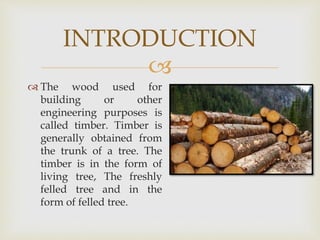
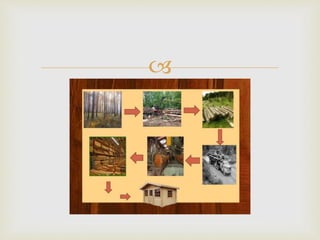
 The wood used for
building or other
engineering purposes is
called timber. Timber is
generally obtained from
the trunk of a tree. The
timber is in the form of
living tree, The freshly
felled tree and in the
form of felled tree.
INTRODUCTION

 Standing timber: The timber in the form of living tree.
 Green timber: The freshly felled tree which has not lost moisture.
 Rough timber: The timber in the form of felled tree.
 Converted timber: The timber when sawn into various market sizes
such as beams, battens,
 planks etc.
 Dressed timber: The timber which has been sawn, placed and worked
to the exact required
 condition.
 Structural timber: The timber used in framing and load bearing
structures.
 Clear Timber: Timber free from defects and stains.
Important Technical Terms:

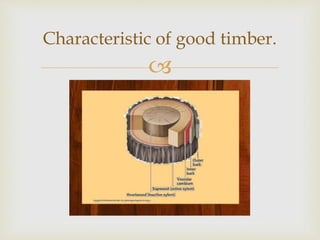
Characteristic of good timber.

 Uniform color.
 Sweet smell if fresh cut.
 Regular annual ring.
 Sonorous when struck.
 Straight and close fibres.
 Heavy in weight.
 Free from shakes, flaws, dead knots or blemishes of any kind.
 Firm adhesion of fibres and compact medullary rays.
 The cellular tissue of the medullary rays should be hard and compact.
 When planed, its surface should present a firm bright appearance with
a silky lustre.
Characteristic of good timber.

 Durable and Hard.
 Resisting the actions of fungi insects, chemicals, physical agencies and
mechanical agencies.
 The property of elasticity.
 Fire-resistant. (Wood having dense texture offers great resistance to
fire.)
 Strong for working as structural member such as joint, beam, rafter,
etc. It should be capable of taking loads slowly or suddenly.
 Note: The heavier and dark coloured timber is usually strong.
Characteristic of good timber.

 Stronger than other materials.
 Easily worked to any size and shape.
 Can be joined to the required form easily.
 Structural connections can be easily made in timberwork.
 Used for furniture and other decorative fittings.
 Timber construction is economical as the wastage is
minimum.
 Durable.
 Re-sale value is good
 A non-conductor of heat and sound.
Advantages of Timber over Other
Materials:

 The disadvantages of timber are few, but serious.
These are:
 The greatest disadvantage is its ready combustibility, which can be
diminished but not eliminated even by expensive treatment.
 Frame buildings built closely together present a serious conflagration
hazard.
 Destroyed by decay induced by fungi, and by insects that feed upon
the timber under favourable conditions.
 Timber swells and undergoes shrinkage with changing atmospheric
humidity.
Disadvantages:


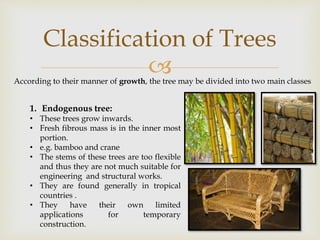
Classification of Trees
According to their manner of growth, the tree may be divided into two main classes
1. Endogenous tree:
• These trees grow inwards.
• Fresh fibrous mass is in the inner most
portion.
• e.g. bamboo and crane
• The stems of these trees are too flexible
and thus they are not much suitable for
engineering and structural works.
• They are found generally in tropical
countries .
• They have their own limited
applications for temporary
construction.

2. Exogenous trees:
 These trees grow outwards and
increase in bulk by the formation of
successive annular rings on the
outside under the bark.
 Each annual ring represents a layer
of wood, deposited every year.
 The timber that is used for building
and engineering purposes belongs
to this variety.
 Examples: Deodar, chir, sal, kail,
shishum, teak, etc
Classification of Trees

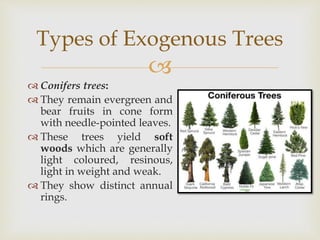
 Conifers trees:
 They remain evergreen and
bear fruits in cone form
with needle-pointed leaves.
 These trees yield soft
woods which are generally
light coloured, resinous,
light in weight and weak.
 They show distinct annual
rings.
Types of Exogenous Trees

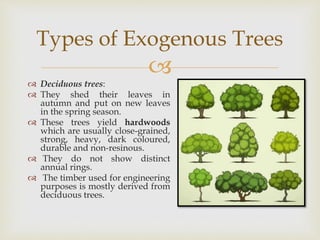
 Deciduous trees:
 They shed their leaves in
autumn and put on new leaves
in the spring season.
 These trees yield hardwoods
which are usually close-grained,
strong, heavy, dark coloured,
durable and non-resinous.
 They do not show distinct
annual rings.
 The timber used for engineering
purposes is mostly derived from
deciduous trees.
Types of Exogenous Trees

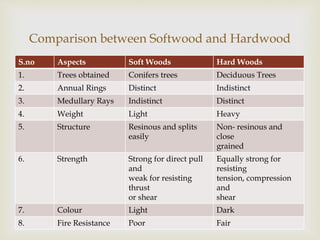
Comparison between Softwood and Hardwood
S.no Aspects Soft Woods Hard Woods
1. Trees obtained Conifers trees Deciduous Trees
2. Annual Rings Distinct Indistinct
3. Medullary Rays Indistinct Distinct
4. Weight Light Heavy
5. Structure Resinous and splits
easily
Non- resinous and
close
grained
6. Strength Strong for direct pull
and
weak for resisting
thrust
or shear
Equally strong for
resisting
tension, compression
and
shear
7. Colour Light Dark
8. Fire Resistance Poor Fair

 A defect is an irregularity or abnormality occurring
in or on wood which is responsible for its.
 Strength reduction.
 Lowering of durability.
 Lowering of utility
 Poor appearance
 Decay
Defects in Timbers

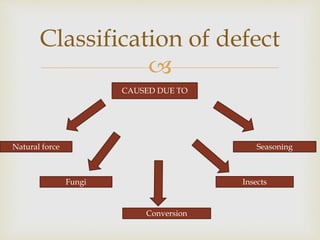
Classification of defect
CAUSED DUE TO
Natural force
Fungi
Conversion
Seasoning
Insects

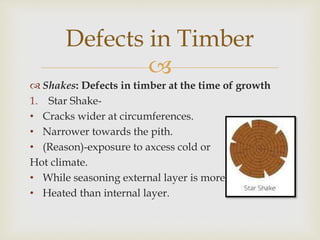
 Shakes: Defects in timber at the time of growth
1. Star Shake-
• Cracks wider at circumferences.
• Narrower towards the pith.
• (Reason)-exposure to axcess cold or
Hot climate.
• While seasoning external layer is more
• Heated than internal layer.
Defects in Timber

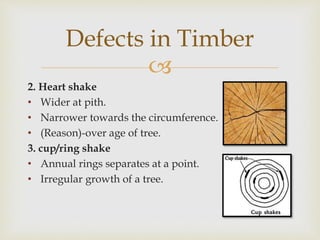
2. Heart shake
• Wider at pith.
• Narrower towards the circumference.
• (Reason)-over age of tree.
3. cup/ring shake
• Annual rings separates at a point.
• Irregular growth of a tree.
Defects in Timber

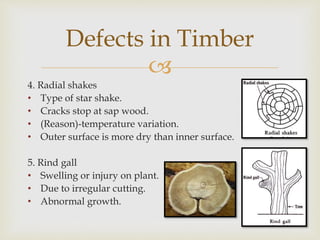
4. Radial shakes
• Type of star shake.
• Cracks stop at sap wood.
• (Reason)-temperature variation.
• Outer surface is more dry than inner surface.
5. Rind gall
• Swelling or injury on plant.
• Due to irregular cutting.
• Abnormal growth.
Defects in Timber

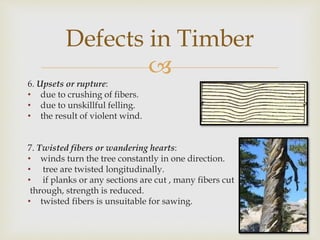
6. Upsets or rupture:
• due to crushing of fibers.
• due to unskillful felling.
• the result of violent wind.
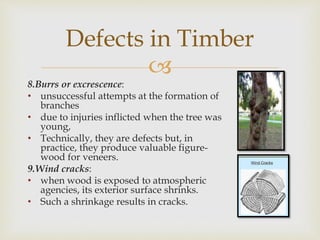
7. Twisted fibers or wandering hearts:
• winds turn the tree constantly in one direction.
• tree are twisted longitudinally.
• if planks or any sections are cut , many fibers cut
through, strength is reduced.
• twisted fibers is unsuitable for sawing.
Defects in Timber

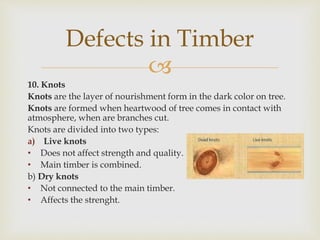
8.Burrs or excrescence:
• unsuccessful attempts at the formation of
branches
• due to injuries inflicted when the tree was
young,
• Technically, they are defects but, in
practice, they produce valuable figure-
wood for veneers.
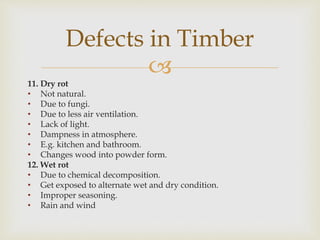
9.Wind cracks:
• when wood is exposed to atmospheric
agencies, its exterior surface shrinks.
• Such a shrinkage results in cracks.
Defects in Timber

10. Knots
Knots are the layer of nourishment form in the dark color on tree.
Knots are formed when heartwood of tree comes in contact with
atmosphere, when are branches cut.
Knots are divided into two types:
a) Live knots
• Does not affect strength and quality.
• Main timber is combined.
b) Dry knots
• Not connected to the main timber.
• Affects the strenght.
Defects in Timber

11. Dry rot
• Not natural.
• Due to fungi.
• Due to less air ventilation.
• Lack of light.
• Dampness in atmosphere.
• E.g. kitchen and bathroom.
• Changes wood into powder form.
12. Wet rot
• Due to chemical decomposition.
• Get exposed to alternate wet and dry condition.
• Improper seasoning.
• Rain and wind
Defects in Timber

13. Heart rot
• Fungi affecting on heartwood
• Changes into powder form.
• Make the wood hallow.
• Reduces the strength.
• Damp sound when struck hammer
Defects in Timber



Wood material and timber

  • 1.
  • 2.
      The woodused for building or other engineering purposes is called timber. Timber is generally obtained from the trunk of a tree. The timber is in the form of living tree, The freshly felled tree and in the form of felled tree. INTRODUCTION
  • 3.
      Standing timber:The timber in the form of living tree.  Green timber: The freshly felled tree which has not lost moisture.  Rough timber: The timber in the form of felled tree.  Converted timber: The timber when sawn into various market sizes such as beams, battens,  planks etc.  Dressed timber: The timber which has been sawn, placed and worked to the exact required  condition.  Structural timber: The timber used in framing and load bearing structures.  Clear Timber: Timber free from defects and stains. Important Technical Terms:
  • 4.
  • 5.
      Uniform color. Sweet smell if fresh cut.  Regular annual ring.  Sonorous when struck.  Straight and close fibres.  Heavy in weight.  Free from shakes, flaws, dead knots or blemishes of any kind.  Firm adhesion of fibres and compact medullary rays.  The cellular tissue of the medullary rays should be hard and compact.  When planed, its surface should present a firm bright appearance with a silky lustre. Characteristic of good timber.
  • 6.
      Durable andHard.  Resisting the actions of fungi insects, chemicals, physical agencies and mechanical agencies.  The property of elasticity.  Fire-resistant. (Wood having dense texture offers great resistance to fire.)  Strong for working as structural member such as joint, beam, rafter, etc. It should be capable of taking loads slowly or suddenly.  Note: The heavier and dark coloured timber is usually strong. Characteristic of good timber.
  • 7.
      Stronger thanother materials.  Easily worked to any size and shape.  Can be joined to the required form easily.  Structural connections can be easily made in timberwork.  Used for furniture and other decorative fittings.  Timber construction is economical as the wastage is minimum.  Durable.  Re-sale value is good  A non-conductor of heat and sound. Advantages of Timber over Other Materials:
  • 8.
      The disadvantagesof timber are few, but serious. These are:  The greatest disadvantage is its ready combustibility, which can be diminished but not eliminated even by expensive treatment.  Frame buildings built closely together present a serious conflagration hazard.  Destroyed by decay induced by fungi, and by insects that feed upon the timber under favourable conditions.  Timber swells and undergoes shrinkage with changing atmospheric humidity. Disadvantages:
  • 9.
  • 10.
     Classification of Trees Accordingto their manner of growth, the tree may be divided into two main classes 1. Endogenous tree: • These trees grow inwards. • Fresh fibrous mass is in the inner most portion. • e.g. bamboo and crane • The stems of these trees are too flexible and thus they are not much suitable for engineering and structural works. • They are found generally in tropical countries . • They have their own limited applications for temporary construction.
  • 11.
     2. Exogenous trees: These trees grow outwards and increase in bulk by the formation of successive annular rings on the outside under the bark.  Each annual ring represents a layer of wood, deposited every year.  The timber that is used for building and engineering purposes belongs to this variety.  Examples: Deodar, chir, sal, kail, shishum, teak, etc Classification of Trees
  • 12.
      Conifers trees: They remain evergreen and bear fruits in cone form with needle-pointed leaves.  These trees yield soft woods which are generally light coloured, resinous, light in weight and weak.  They show distinct annual rings. Types of Exogenous Trees
  • 13.
      Deciduous trees: They shed their leaves in autumn and put on new leaves in the spring season.  These trees yield hardwoods which are usually close-grained, strong, heavy, dark coloured, durable and non-resinous.  They do not show distinct annual rings.  The timber used for engineering purposes is mostly derived from deciduous trees. Types of Exogenous Trees
  • 14.
     Comparison between Softwoodand Hardwood S.no Aspects Soft Woods Hard Woods 1. Trees obtained Conifers trees Deciduous Trees 2. Annual Rings Distinct Indistinct 3. Medullary Rays Indistinct Distinct 4. Weight Light Heavy 5. Structure Resinous and splits easily Non- resinous and close grained 6. Strength Strong for direct pull and weak for resisting thrust or shear Equally strong for resisting tension, compression and shear 7. Colour Light Dark 8. Fire Resistance Poor Fair
  • 15.
      A defectis an irregularity or abnormality occurring in or on wood which is responsible for its.  Strength reduction.  Lowering of durability.  Lowering of utility  Poor appearance  Decay Defects in Timbers
  • 16.
     Classification of defect CAUSEDDUE TO Natural force Fungi Conversion Seasoning Insects
  • 17.
      Shakes: Defectsin timber at the time of growth 1. Star Shake- • Cracks wider at circumferences. • Narrower towards the pith. • (Reason)-exposure to axcess cold or Hot climate. • While seasoning external layer is more • Heated than internal layer. Defects in Timber
  • 18.
     2. Heart shake •Wider at pith. • Narrower towards the circumference. • (Reason)-over age of tree. 3. cup/ring shake • Annual rings separates at a point. • Irregular growth of a tree. Defects in Timber
  • 19.
     4. Radial shakes •Type of star shake. • Cracks stop at sap wood. • (Reason)-temperature variation. • Outer surface is more dry than inner surface. 5. Rind gall • Swelling or injury on plant. • Due to irregular cutting. • Abnormal growth. Defects in Timber
  • 20.
     6. Upsets orrupture: • due to crushing of fibers. • due to unskillful felling. • the result of violent wind. 7. Twisted fibers or wandering hearts: • winds turn the tree constantly in one direction. • tree are twisted longitudinally. • if planks or any sections are cut , many fibers cut through, strength is reduced. • twisted fibers is unsuitable for sawing. Defects in Timber
  • 21.
     8.Burrs or excrescence: •unsuccessful attempts at the formation of branches • due to injuries inflicted when the tree was young, • Technically, they are defects but, in practice, they produce valuable figure- wood for veneers. 9.Wind cracks: • when wood is exposed to atmospheric agencies, its exterior surface shrinks. • Such a shrinkage results in cracks. Defects in Timber
  • 22.
     10. Knots Knots arethe layer of nourishment form in the dark color on tree. Knots are formed when heartwood of tree comes in contact with atmosphere, when are branches cut. Knots are divided into two types: a) Live knots • Does not affect strength and quality. • Main timber is combined. b) Dry knots • Not connected to the main timber. • Affects the strenght. Defects in Timber
  • 23.
     11. Dry rot •Not natural. • Due to fungi. • Due to less air ventilation. • Lack of light. • Dampness in atmosphere. • E.g. kitchen and bathroom. • Changes wood into powder form. 12. Wet rot • Due to chemical decomposition. • Get exposed to alternate wet and dry condition. • Improper seasoning. • Rain and wind Defects in Timber
  • 24.
     13. Heart rot •Fungi affecting on heartwood • Changes into powder form. • Make the wood hallow. • Reduces the strength. • Damp sound when struck hammer Defects in Timber
  • 25.
  • 26.