Rohil kumar
17M713
INDEX
 State policies for solar power, small hydro power, wind power and
biomass power (tripura, mizoram, meghalaya, manipur)
1. Eligible producer
2. Sale of power and tariff
3. Wheeling
4. Power evacuation and grid interfacing
5. Land allotment water royalty
6. Incentives and general
 State policies for small hydro power (Arunachal Pradesh, Assam)
1. Land allotment
2. Operative period
3. Sale of power and tariff
4. Wheeling
5. Power evacuation and grid interfacing
6. Incentives and general
 References
STATE POLICIES FOR
SOLAR POWER,
SMALL HYDRO POWER PROJECTS, WIND POWER
PROJECTS AND BIOMASS POWER PROJECTS
Tripura, Mizoram, Meghalaya, Manipur
Eligible Producer
 All power producers generating grid-grade electricity with installed
capacity between 10 kW and 25 MW.
 Power producing entrepreneur Companies, cooperative, partnership
individuals etc.
Sale of Power and Tariff
• Power Department to purchase electricity at a minimum rate of Rs.2.25 per
unit to be increased 5% every year for 10 operational years.
• Thereafter the rate of increase to be mutually settled between Power Dept.
and developer.
• PPA for 20 years unless Developer wants shorter period.
• It shall not be compulsory for power producer to sell power to Department.
• Developers with concurrence of the Department may sell the electricity to a
third party within and outside the State, at a rate to be mutually settled
between them.
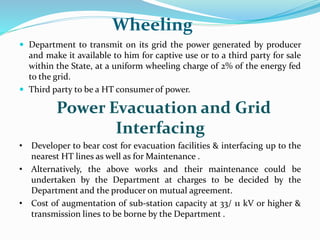
Wheeling
 Department to transmit on its grid the power generated by producer
and make it available to him for captive use or to a third party for sale
within the State, at a uniform wheeling charge of 2% of the energy fed
to the grid.
 Third party to be a HT consumer of power.
Power Evacuation and Grid
Interfacing
• Developer to bear cost for evacuation facilities & interfacing up to the
nearest HT lines as well as for Maintenance .
• Alternatively, the above works and their maintenance could be
undertaken by the Department at charges to be decided by the
Department and the producer on mutual agreement.
• Cost of augmentation of sub-station capacity at 33/ 11 kV or higher &
transmission lines to be borne by the Department .
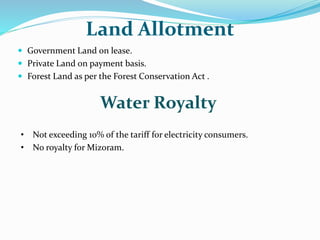
Land Allotment
 Government Land on lease.
 Private Land on payment basis.
 Forest Land as per the Forest Conservation Act .
Water Royalty
• Not exceeding 10% of the tariff for electricity consumers.
• No royalty for Mizoram.
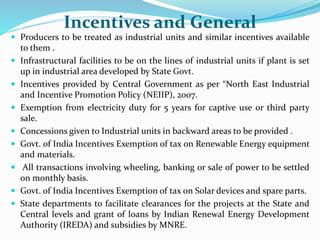
Incentives and General
 Producers to be treated as industrial units and similar incentives available
to them .
 Infrastructural facilities to be on the lines of industrial units if plant is set
up in industrial area developed by State Govt.
 Incentives provided by Central Government as per “North East Industrial
and Incentive Promotion Policy (NEIIP), 2007.
 Exemption from electricity duty for 5 years for captive use or third party
sale.
 Concessions given to Industrial units in backward areas to be provided .
 Govt. of India Incentives Exemption of tax on Renewable Energy equipment
and materials.
 All transactions involving wheeling, banking or sale of power to be settled
on monthly basis.
 Govt. of India Incentives Exemption of tax on Solar devices and spare parts.
 State departments to facilitate clearances for the projects at the State and
Central levels and grant of loans by Indian Renewal Energy Development
Authority (IREDA) and subsidies by MNRE.
Arunachal Pradesh, Assam
STATE POLICIES FOR
SMALL HYDRO POWER PROJECTS
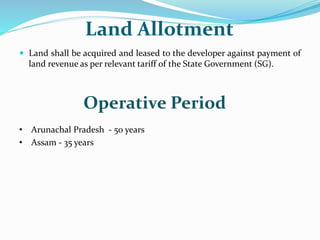
Land Allotment
 Land shall be acquired and leased to the developer against payment of
land revenue as per relevant tariff of the State Government (SG).
Operative Period
• Arunachal Pradesh - 50 years
• Assam - 35 years
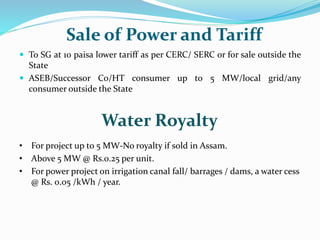
Sale of Power and Tariff
 To SG at 10 paisa lower tariff as per CERC/ SERC or for sale outside the
State
 ASEB/Successor Co/HT consumer up to 5 MW/local grid/any
consumer outside the State
Water Royalty
• For project up to 5 MW-No royalty if sold in Assam.
• Above 5 MW @ Rs.0.25 per unit.
• For power project on irrigation canal fall/ barrages / dams, a water cess
@ Rs. 0.05 /kWh / year.
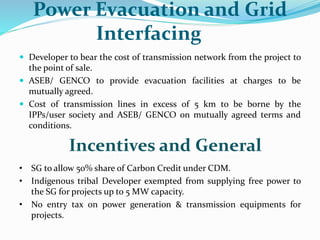
Power Evacuation and Grid
Interfacing
 Developer to bear the cost of transmission network from the project to
the point of sale.
 ASEB/ GENCO to provide evacuation facilities at charges to be
mutually agreed.
 Cost of transmission lines in excess of 5 km to be borne by the
IPPs/user society and ASEB/ GENCO on mutually agreed terms and
conditions.
Incentives and General
• SG to allow 50% share of Carbon Credit under CDM.
• Indigenous tribal Developer exempted from supplying free power to
the SG for projects up to 5 MW capacity.
• No entry tax on power generation & transmission equipments for
projects.
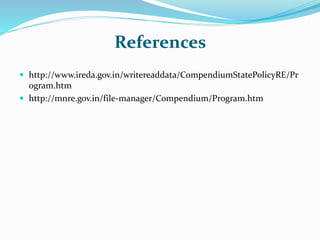
References
 http://www.ireda.gov.in/writereaddata/CompendiumStatePolicyRE/Pr
ogram.htm
 http://mnre.gov.in/file-manager/Compendium/Program.htm

Energy policy northeast

  • 1.
  • 2.
    INDEX  State policiesfor solar power, small hydro power, wind power and biomass power (tripura, mizoram, meghalaya, manipur) 1. Eligible producer 2. Sale of power and tariff 3. Wheeling 4. Power evacuation and grid interfacing 5. Land allotment water royalty 6. Incentives and general  State policies for small hydro power (Arunachal Pradesh, Assam) 1. Land allotment 2. Operative period 3. Sale of power and tariff 4. Wheeling 5. Power evacuation and grid interfacing 6. Incentives and general  References
  • 3.
    STATE POLICIES FOR SOLARPOWER, SMALL HYDRO POWER PROJECTS, WIND POWER PROJECTS AND BIOMASS POWER PROJECTS Tripura, Mizoram, Meghalaya, Manipur
  • 4.
    Eligible Producer  Allpower producers generating grid-grade electricity with installed capacity between 10 kW and 25 MW.  Power producing entrepreneur Companies, cooperative, partnership individuals etc. Sale of Power and Tariff • Power Department to purchase electricity at a minimum rate of Rs.2.25 per unit to be increased 5% every year for 10 operational years. • Thereafter the rate of increase to be mutually settled between Power Dept. and developer. • PPA for 20 years unless Developer wants shorter period. • It shall not be compulsory for power producer to sell power to Department. • Developers with concurrence of the Department may sell the electricity to a third party within and outside the State, at a rate to be mutually settled between them.
  • 5.
    Wheeling  Department totransmit on its grid the power generated by producer and make it available to him for captive use or to a third party for sale within the State, at a uniform wheeling charge of 2% of the energy fed to the grid.  Third party to be a HT consumer of power. Power Evacuation and Grid Interfacing • Developer to bear cost for evacuation facilities & interfacing up to the nearest HT lines as well as for Maintenance . • Alternatively, the above works and their maintenance could be undertaken by the Department at charges to be decided by the Department and the producer on mutual agreement. • Cost of augmentation of sub-station capacity at 33/ 11 kV or higher & transmission lines to be borne by the Department .
  • 6.
    Land Allotment  GovernmentLand on lease.  Private Land on payment basis.  Forest Land as per the Forest Conservation Act . Water Royalty • Not exceeding 10% of the tariff for electricity consumers. • No royalty for Mizoram.
  • 7.
    Incentives and General Producers to be treated as industrial units and similar incentives available to them .  Infrastructural facilities to be on the lines of industrial units if plant is set up in industrial area developed by State Govt.  Incentives provided by Central Government as per “North East Industrial and Incentive Promotion Policy (NEIIP), 2007.  Exemption from electricity duty for 5 years for captive use or third party sale.  Concessions given to Industrial units in backward areas to be provided .  Govt. of India Incentives Exemption of tax on Renewable Energy equipment and materials.  All transactions involving wheeling, banking or sale of power to be settled on monthly basis.  Govt. of India Incentives Exemption of tax on Solar devices and spare parts.  State departments to facilitate clearances for the projects at the State and Central levels and grant of loans by Indian Renewal Energy Development Authority (IREDA) and subsidies by MNRE.
  • 8.
    Arunachal Pradesh, Assam STATEPOLICIES FOR SMALL HYDRO POWER PROJECTS
  • 9.
    Land Allotment  Landshall be acquired and leased to the developer against payment of land revenue as per relevant tariff of the State Government (SG). Operative Period • Arunachal Pradesh - 50 years • Assam - 35 years
  • 10.
    Sale of Powerand Tariff  To SG at 10 paisa lower tariff as per CERC/ SERC or for sale outside the State  ASEB/Successor Co/HT consumer up to 5 MW/local grid/any consumer outside the State Water Royalty • For project up to 5 MW-No royalty if sold in Assam. • Above 5 MW @ Rs.0.25 per unit. • For power project on irrigation canal fall/ barrages / dams, a water cess @ Rs. 0.05 /kWh / year.
  • 11.
    Power Evacuation andGrid Interfacing  Developer to bear the cost of transmission network from the project to the point of sale.  ASEB/ GENCO to provide evacuation facilities at charges to be mutually agreed.  Cost of transmission lines in excess of 5 km to be borne by the IPPs/user society and ASEB/ GENCO on mutually agreed terms and conditions. Incentives and General • SG to allow 50% share of Carbon Credit under CDM. • Indigenous tribal Developer exempted from supplying free power to the SG for projects up to 5 MW capacity. • No entry tax on power generation & transmission equipments for projects.
  • 12.