1
Tick Borne
Infections
Daniel J Anderson, MD
Epidemiology
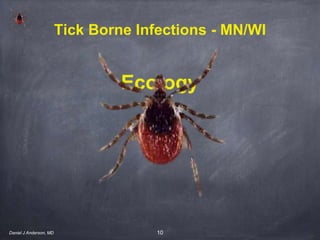
Ecology
Clinical Characteristics
Diagnosis
Treatment
Prevention
2
Tick-Borne Infections
Challenges
Expanding / changing geography of ticks / infections
New infections / newly recognized “old” infections
Newly identified -- new Ehrlichia species 2011
Old infections | new to MN -- Powassan fever, RMSF
Clinical clues that might suggest tick-borne infection
Fever plus [rash, severe headache, mild hepatitis]
low blood cell counts [esp platelets]]
Diagnostic tests -- blood smear, serology, PCR
Daniel J Anderson, MD
3
Epidemiology
Ecology
Clinical
Diagnosis
Differential Diagnosis
Daniel J Anderson, MD
4
EPIDEMIOLOGY
Tick Borne Infections - MN/WI
Daniel J Anderson, MD
5
Lyme disease
Anaplasmosis
Ehrlichiosis
Babesiosis
Powassan Fever
RMSF (Rocky Mountain Spotted Fever)
Tick Borne Infections - MN/WI
Daniel J Anderson, MD
6
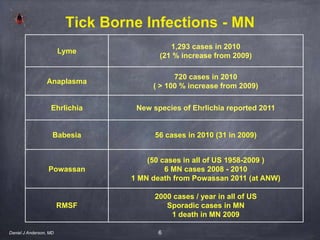
Tick Borne Infections - MN
Daniel J Anderson, MD
Lyme
1,293 cases in 2010
(21 % increase from 2009)
Anaplasma
720 cases in 2010
( > 100 % increase from 2009)
Ehrlichia New species of Ehrlichia reported 2011
Babesia 56 cases in 2010 (31 in 2009)
Powassan
(50 cases in all of US 1958-2009 )
6 MN cases 2008 - 2010
1 MN death from Powassan 2011 (at ANW)
RMSF
2000 cases / year in all of US
Sporadic cases in MN
1 death in MN 2009
7Daniel J Anderson, MD
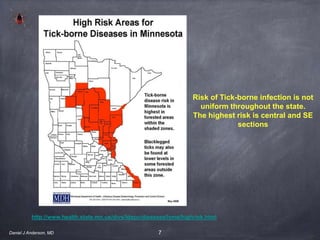
http://www.health.state.mn.us/divs/idepc/diseases/lyme/highrisk.html
Risk of Tick-borne infection is not
uniform throughout the state.
The highest risk is central and SE
sections
8Daniel J Anderson, MD
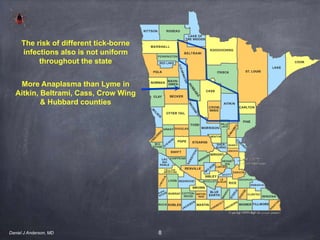
More Anaplasma than Lyme in
Aitkin, Beltrami, Cass, Crow Wing
& Hubbard counties
The risk of different tick-borne
infections also is not uniform
throughout the state
9
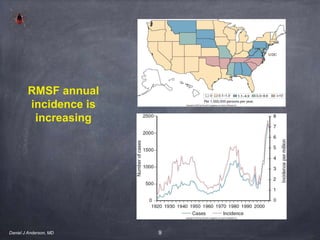
RMSF annual
incidence is
increasing
Daniel J Anderson, MD
10
Ecology
Tick Borne Infections - MN/WI
Daniel J Anderson, MD
11
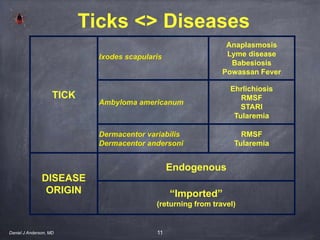
Ticks <> Diseases
Daniel J Anderson, MD
TICK
Ixodes scapularis
Anaplasmosis
Lyme disease
Babesiosis
Powassan Fever
Ambyloma americanum
Ehrlichiosis
RMSF
STARI
Tularemia
Dermacentor variabilis
Dermacentor andersoni
RMSF
Tularemia
DISEASE
ORIGIN
Endogenous
“Imported”
(returning from travel)
12
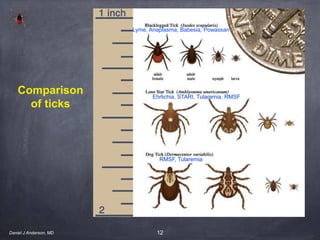
Comparison
of ticks
Lyme, Anaplasma, Babesia, Powassan
Ehrlichia, STARI, Tularemia, RMSF
RMSF, Tularemia
Daniel J Anderson, MD
13
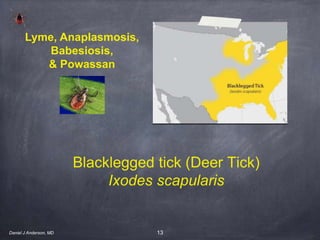
Blacklegged tick (Deer Tick)
Ixodes scapularis
Lyme, Anaplasmosis,
Babesiosis,
& Powassan
Daniel J Anderson, MD
14
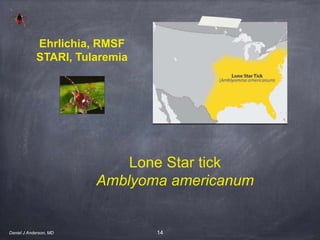
Lone Star tick
Amblyoma americanum
Ehrlichia, RMSF
STARI, Tularemia
Daniel J Anderson, MD
15
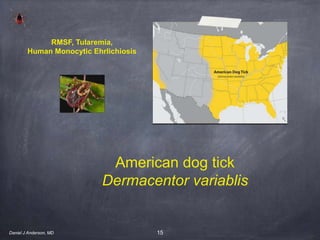
American dog tick
Dermacentor variablis
RMSF, Tularemia,
Human Monocytic Ehrlichiosis
Daniel J Anderson, MD
16
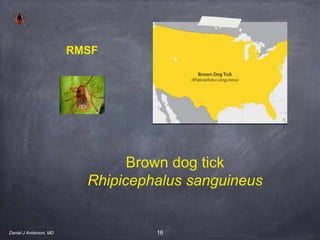
Brown dog tick
Rhipicephalus sanguineus
RMSF
Daniel J Anderson, MD
17
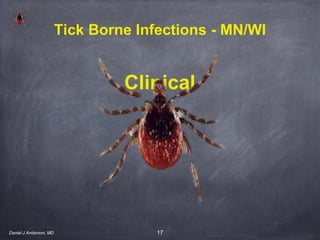
Clinical
Tick Borne Infections - MN/WI
Daniel J Anderson, MD
18
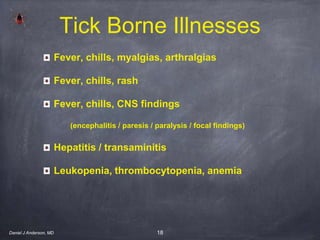
Tick Borne Illnesses
Fever, chills, myalgias, arthralgias
Fever, chills, rash
Fever, chills, CNS findings
(encephalitis / paresis / paralysis / focal findings)
Hepatitis / transaminitis
Leukopenia, thrombocytopenia, anemia
Daniel J Anderson, MD
19
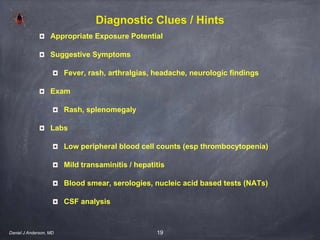
Diagnostic Clues / Hints
Appropriate Exposure Potential
Suggestive Symptoms
Fever, rash, arthralgias, headache, neurologic findings
Exam
Rash, splenomegaly
Labs
Low peripheral blood cell counts (esp thrombocytopenia)
Mild transaminitis / hepatitis
Blood smear, serologies, nucleic acid based tests (NATs)
CSF analysis
Daniel J Anderson, MD
20
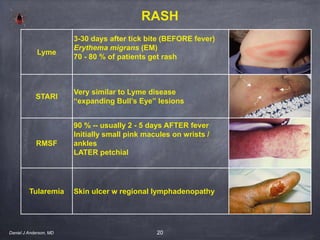
Lyme
3-30 days after tick bite (BEFORE fever)
Erythema migrans (EM)
70 - 80 % of patients get rash
STARI
Very similar to Lyme disease
“expanding Bull’s Eye” lesions
RMSF
90 % -- usually 2 - 5 days AFTER fever
Initially small pink macules on wrists /
ankles
LATER petchial
Tularemia Skin ulcer w regional lymphadenopathy
RASH
Daniel J Anderson, MD
21
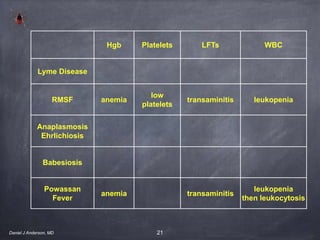
Hgb Platelets LFTs WBC
Lyme Disease
RMSF anemia
low
platelets
transaminitis leukopenia
Anaplasmosis
Ehrlichiosis
Babesiosis
Powassan
Fever
anemia transaminitis
leukopenia
then leukocytosis
Daniel J Anderson, MD
22
Lyme Disease
Daniel J Anderson, MD
23
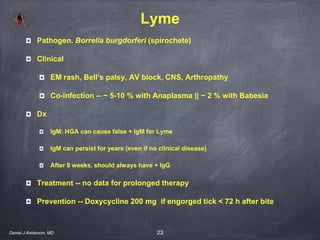
Lyme
Pathogen. Borrelia burgdorferi (spirochete)
Clinical
EM rash, Bell’s palsy, AV block, CNS, Arthropathy
Co-infection -- ~ 5-10 % with Anaplasma || ~ 2 % with Babesia
Dx
IgM: HGA can cause false + IgM for Lyme
IgM can persist for years (even if no clinical disease)
After 8 weeks, should always have + IgG
Treatment -- no data for prolonged therapy
Prevention -- Doxycycline 200 mg if engorged tick < 72 h after bite
Daniel J Anderson, MD
24
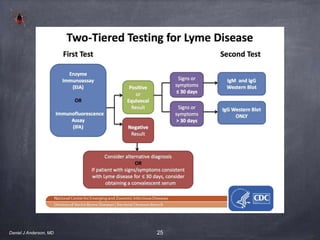
Lyme Diagnosis
Clinical diagnosis (ie no serology needed) if exposure to deer tick AND
Bilateral Bell’s Palsy
III ° AV block or complete heart block [CHB]
Characteristic erythema migrans [EM] rash
Daniel J Anderson, MD
25Daniel J Anderson, MD
26
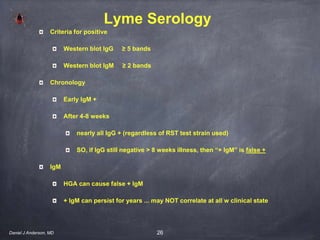
Lyme Serology
Criteria for positive
Western blot IgG ≥ 5 bands
Western blot IgM ≥ 2 bands
Chronology
Early IgM +
After 4-8 weeks
nearly all IgG + (regardless of RST test strain used)
SO, if IgG still negative > 8 weeks illness, then “+ IgM” is false +
IgM
HGA can cause false + IgM
+ IgM can persist for years ... may NOT correlate at all w clinical state
Daniel J Anderson, MD
27
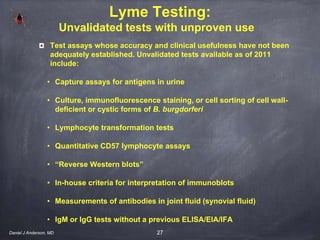
Lyme Testing:
Unvalidated tests with unproven use
Test assays whose accuracy and clinical usefulness have not been
adequately established. Unvalidated tests available as of 2011
include:
• Capture assays for antigens in urine
• Culture, immunofluorescence staining, or cell sorting of cell wall-
deficient or cystic forms of B. burgdorferi
• Lymphocyte transformation tests
• Quantitative CD57 lymphocyte assays
• “Reverse Western blots”
• In-house criteria for interpretation of immunoblots
• Measurements of antibodies in joint fluid (synovial fluid)
• IgM or IgG tests without a previous ELISA/EIA/IFA
Daniel J Anderson, MD
28
Lyme PCR
Most useful for late arthritis if
done on synovial fluid
Limited use in CSF
Daniel J Anderson, MD
29
Lyme Disease Treatment
Oral Therapy for all except neurological / late
arthritis or initially for high degree AV block
IV therapy: for meningitis, late arthritis or initially
for high degree AV block
Daniel J Anderson, MD
30
Lyme Disease Rx Duration
2-3 weeks for most early infections - tho’
some data suggest 10 days sufficient
2-4 weeks for meningitis / arthritis
4-8 weeks for late arthritis
Prolonged courses of therapy? .
No proven benefit
There are proven adverse consequences
(C diff, death, IV clots, ...)
Daniel J Anderson, MD
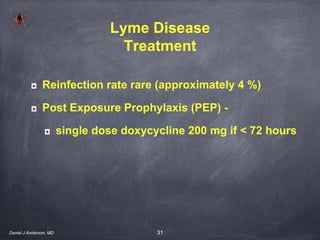
31
Lyme Disease
Treatment
Reinfection rate rare (approximately 4 %)
Post Exposure Prophylaxis (PEP) -
single dose doxycycline 200 mg if < 72 hours
Daniel J Anderson, MD
32
Anaplasmosis
Daniel J Anderson, MD
33
Human Granulocytic Anaplasomsis [HGA]
Pathogen Anaplasma phagocytophilum
Clinical
up to 35 % coinfected with Lyme and/or Babesia
fever, chills, headache, myalgia, and malaise,cough, diarrhea, confusion,
and lymphadenopathy,
17 % severe multisystem organ failure / SIRS / even death (Lyme does not
do this)
rash is not common
Data
leukopenia, thrombocytopenia,
mild hepatitis / transaminitis
Daniel J Anderson, MD
34
Human Granulocytic Anaplasomsis [HGA]
Dx
Peripheral blood smear (in WBCs)
30 - 80 % + morulae
seen in granulocytes
Serology
NATs (PCR)
Treatment
Doxycycline (will also cover potential Lyme coinfection)
Daniel J Anderson, MD
35
Ehrlichiosis
Daniel J Anderson, MD
36
Human Monocytotropic Ehrlichiosis
[HME]
Pathogens
E canis / E chaffeensis / / E muris
Clinical
< 50 % with rash (but more often than with HGA)
More common farther south than Anaplasmosis (HGA)
Data -- Lymphopenia, morulae RARE on blood smear (vs HGA)
Dx -- Serology, PCR
Treatment - doxycycline
Daniel J Anderson, MD
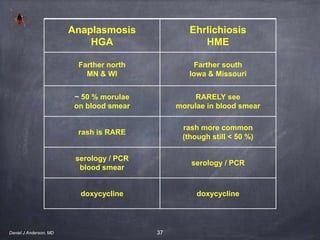
37Daniel J Anderson, MD
Anaplasmosis
HGA
Ehrlichiosis
HME
Farther north
MN & WI
Farther south
Iowa & Missouri
~ 50 % morulae
on blood smear
RARELY see
morulae in blood smear
rash is RARE
rash more common
(though still < 50 %)
serology / PCR
blood smear
serology / PCR
doxycycline doxycycline
38
Babesiosis
Daniel J Anderson, MD
39
Babesiosis
Pathogen Babesia microtii (MN, WI, East coast), B divergens & B
duncani in other locations
Clinical
fatigue/weakness/malaise followed within days by fever
(>38° C) and one or more of the following: shaking chills,
sweats, headache, myalgia, arthralgia, and anorexia
Malaise, myalgia, arthralgia, and shortness of breath
differentiate babesiosis from other febrile illnesses
fatigue and malaise persist for several months
Daniel J Anderson, MD
40
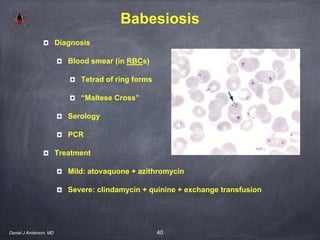
Babesiosis
Diagnosis
Blood smear (in RBCs)
Tetrad of ring forms
“Maltese Cross”
Serology
PCR
Treatment
Mild: atovaquone + azithromycin
Severe: clindamycin + quinine + exchange transfusion
Daniel J Anderson, MD
41
Less Common
Daniel J Anderson, MD
42
Powassan Encephalitis
Pathogen: Flavivirus
Same viral family as Dengue, Yellow Fever, West Nile
Clinical
50 % w focal neurologic signs / symptoms
Olfactory hallucinations & temporal lobe seizures (DDx Herpes
encephalitis)
Daniel J Anderson, MD
43
Powassan Encephalitis
Data
Leukopenia first (the high WBC), thrombocytopenia,
transaminitis
CSF lymphocytosis (usually < 100 cells)
MRI => thalamic, basal ganglia lesions
Dx => IgM (serum / CSF) /4 x increase serum IgG
Treatment => supportive
Dx => serologic (some cross reactivity with other flaviviruses (for
example Dengue fever)
Daniel J Anderson, MD
44
RMSF
Pathogen Rickettsiae rickettsii
Clinical (2 - 14 day [median 7] incubation)
fever, headache, nausea / emesis / diarrhea
rash usually ~ 3 days AFTER other signs
begins wrists / ankles
Data
thrombocytopenia (sometimes anemia) WBC often nl
coagulopathy, DIC, CXR changes
Dx serology (? PCR on clinical specimens)
Treatment
doxycycline early in course illness
Daniel J Anderson, MD
45
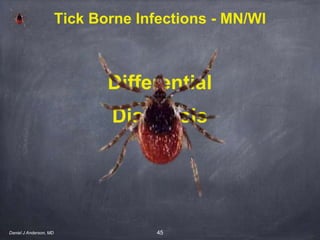
Differential
Diagnosis
Tick Borne Infections - MN/WI
Daniel J Anderson, MD
46
Differential Diagnoses
Paralytic illnesses
Polio, Tick Paralysis, Guillain-Barré, Cervical cord lesion
Encephalitidies
Herpes simplex encephalitis (HSE) -- critical diagnosis because
of the urgent need for intravenous acyclovir for HSE
Febrile illnesses with rash
Parvovirus B19, Measles, Meningococcal disease, others
Fever with transaminitis
Lyme, HGA, Babesiosis, Acute hepatitis (HBV, HAV, HCV)
Daniel J Anderson, MD
47
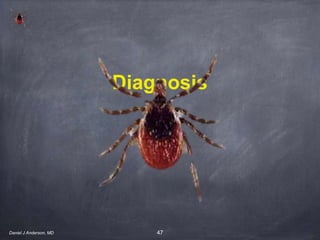
Diagnosis
Daniel J Anderson, MD
48
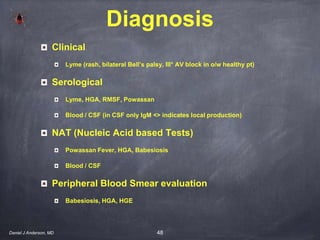
Diagnosis
Clinical
Lyme (rash, bilateral Bell’s palsy, III° AV block in o/w healthy pt)
Serological
Lyme, HGA, RMSF, Powassan
Blood / CSF (in CSF only IgM <> indicates local production)
NAT (Nucleic Acid based Tests)
Powassan Fever, HGA, Babesiosis
Blood / CSF
Peripheral Blood Smear evaluation
Babesiosis, HGA, HGE
Daniel J Anderson, MD
49
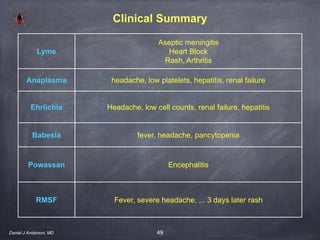
Clinical Summary
Daniel J Anderson, MD
Lyme
Aseptic meningitis
Heart Block
Rash, Arthritis
Anaplasma headache, low platelets, hepatitis, renal failure
Ehrlichia Headache, low cell counts, renal failure, hepatitis
Babesia fever, headache, pancytopenia
Powassan Encephalitis
RMSF Fever, severe headache, ... 3 days later rash
50
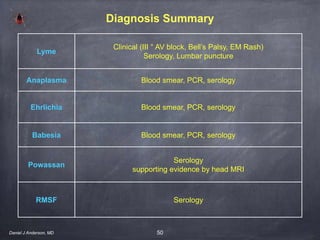
Diagnosis Summary
Daniel J Anderson, MD
Lyme
Clinical (III ° AV block, Bell’s Palsy, EM Rash)
Serology, Lumbar puncture
Anaplasma Blood smear, PCR, serology
Ehrlichia Blood smear, PCR, serology
Babesia Blood smear, PCR, serology
Powassan
Serology
supporting evidence by head MRI
RMSF Serology
51
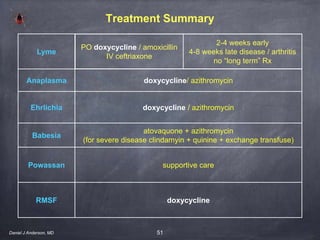
Treatment Summary
Daniel J Anderson, MD
Lyme
Anaplasma doxycycline/ azithromycin
Ehrlichia doxycycline / azithromycin
Babesia
atovaquone + azithromycin
(for severe disease clindamyin + quinine + exchange transfuse)
Powassan supportive care
RMSF doxycycline
PO doxycycline / amoxicillin
IV ceftriaxone
2-4 weeks early
4-8 weeks late disease / arthritis
no “long term” Rx
52
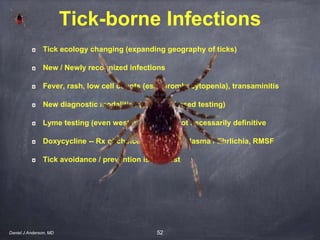
Tick-borne Infections
Tick ecology changing (expanding geography of ticks)
New / Newly recognized infections
Fever, rash, low cell counts (esp thrombocytopenia), transaminitis
New diagnostic modalities (esp NAT-based testing)
Lyme testing (even western blot IgM) not necessarily definitive
Doxycycline -- Rx of choice - Lyme, Anaplasma / Ehrlichia, RMSF
Tick avoidance / prevention is the best
Daniel J Anderson, MD
53
Tick Removal
Grab Tick with tweezers close to skin
Pull steadily straight up
Clean area [alcohol, iodine, soap & H20]
Daniel J Anderson, MD
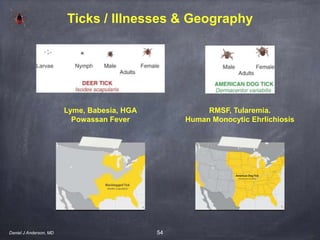
54Daniel J Anderson, MD
Lyme, Babesia, HGA
Powassan Fever
RMSF, Tularemia.
Human Monocytic Ehrlichiosis
Ticks / Illnesses & Geography
55
References
The Clinical Assessment, Treatment, and Prevention of Lyme
Disease, Human Granulocytic Anaplasmosis, and Babesiosis:
Clinical Practice Guidelines by the Infectious Diseases Society of
America. Clin Infect Dis. (2006) 43 (9): 1089-1134
http://cid.oxfordjournals.org/content/43/9/1089.full
National Institue of Allergy and Infectious Diseases. Tickborne
Diseases website.
http://www.niaid.nih.gov/topics/tickborne/pages/default.aspx

Tick borne infections

  • 1.
    1 Tick Borne Infections Daniel JAnderson, MD Epidemiology Ecology Clinical Characteristics Diagnosis Treatment Prevention
  • 2.
    2 Tick-Borne Infections Challenges Expanding /changing geography of ticks / infections New infections / newly recognized “old” infections Newly identified -- new Ehrlichia species 2011 Old infections | new to MN -- Powassan fever, RMSF Clinical clues that might suggest tick-borne infection Fever plus [rash, severe headache, mild hepatitis] low blood cell counts [esp platelets]] Diagnostic tests -- blood smear, serology, PCR Daniel J Anderson, MD
  • 3.
  • 4.
    4 EPIDEMIOLOGY Tick Borne Infections- MN/WI Daniel J Anderson, MD
  • 5.
    5 Lyme disease Anaplasmosis Ehrlichiosis Babesiosis Powassan Fever RMSF(Rocky Mountain Spotted Fever) Tick Borne Infections - MN/WI Daniel J Anderson, MD
  • 6.
    6 Tick Borne Infections- MN Daniel J Anderson, MD Lyme 1,293 cases in 2010 (21 % increase from 2009) Anaplasma 720 cases in 2010 ( > 100 % increase from 2009) Ehrlichia New species of Ehrlichia reported 2011 Babesia 56 cases in 2010 (31 in 2009) Powassan (50 cases in all of US 1958-2009 ) 6 MN cases 2008 - 2010 1 MN death from Powassan 2011 (at ANW) RMSF 2000 cases / year in all of US Sporadic cases in MN 1 death in MN 2009
  • 7.
    7Daniel J Anderson,MD http://www.health.state.mn.us/divs/idepc/diseases/lyme/highrisk.html Risk of Tick-borne infection is not uniform throughout the state. The highest risk is central and SE sections
  • 8.
    8Daniel J Anderson,MD More Anaplasma than Lyme in Aitkin, Beltrami, Cass, Crow Wing & Hubbard counties The risk of different tick-borne infections also is not uniform throughout the state
  • 9.
  • 10.
    10 Ecology Tick Borne Infections- MN/WI Daniel J Anderson, MD
  • 11.
    11 Ticks <> Diseases DanielJ Anderson, MD TICK Ixodes scapularis Anaplasmosis Lyme disease Babesiosis Powassan Fever Ambyloma americanum Ehrlichiosis RMSF STARI Tularemia Dermacentor variabilis Dermacentor andersoni RMSF Tularemia DISEASE ORIGIN Endogenous “Imported” (returning from travel)
  • 12.
    12 Comparison of ticks Lyme, Anaplasma,Babesia, Powassan Ehrlichia, STARI, Tularemia, RMSF RMSF, Tularemia Daniel J Anderson, MD
  • 13.
    13 Blacklegged tick (DeerTick) Ixodes scapularis Lyme, Anaplasmosis, Babesiosis, & Powassan Daniel J Anderson, MD
  • 14.
    14 Lone Star tick Amblyomaamericanum Ehrlichia, RMSF STARI, Tularemia Daniel J Anderson, MD
  • 15.
    15 American dog tick Dermacentorvariablis RMSF, Tularemia, Human Monocytic Ehrlichiosis Daniel J Anderson, MD
  • 16.
    16 Brown dog tick Rhipicephalussanguineus RMSF Daniel J Anderson, MD
  • 17.
    17 Clinical Tick Borne Infections- MN/WI Daniel J Anderson, MD
  • 18.
    18 Tick Borne Illnesses Fever,chills, myalgias, arthralgias Fever, chills, rash Fever, chills, CNS findings (encephalitis / paresis / paralysis / focal findings) Hepatitis / transaminitis Leukopenia, thrombocytopenia, anemia Daniel J Anderson, MD
  • 19.
    19 Diagnostic Clues /Hints Appropriate Exposure Potential Suggestive Symptoms Fever, rash, arthralgias, headache, neurologic findings Exam Rash, splenomegaly Labs Low peripheral blood cell counts (esp thrombocytopenia) Mild transaminitis / hepatitis Blood smear, serologies, nucleic acid based tests (NATs) CSF analysis Daniel J Anderson, MD
  • 20.
    20 Lyme 3-30 days aftertick bite (BEFORE fever) Erythema migrans (EM) 70 - 80 % of patients get rash STARI Very similar to Lyme disease “expanding Bull’s Eye” lesions RMSF 90 % -- usually 2 - 5 days AFTER fever Initially small pink macules on wrists / ankles LATER petchial Tularemia Skin ulcer w regional lymphadenopathy RASH Daniel J Anderson, MD
  • 21.
    21 Hgb Platelets LFTsWBC Lyme Disease RMSF anemia low platelets transaminitis leukopenia Anaplasmosis Ehrlichiosis Babesiosis Powassan Fever anemia transaminitis leukopenia then leukocytosis Daniel J Anderson, MD
  • 22.
  • 23.
    23 Lyme Pathogen. Borrelia burgdorferi(spirochete) Clinical EM rash, Bell’s palsy, AV block, CNS, Arthropathy Co-infection -- ~ 5-10 % with Anaplasma || ~ 2 % with Babesia Dx IgM: HGA can cause false + IgM for Lyme IgM can persist for years (even if no clinical disease) After 8 weeks, should always have + IgG Treatment -- no data for prolonged therapy Prevention -- Doxycycline 200 mg if engorged tick < 72 h after bite Daniel J Anderson, MD
  • 24.
    24 Lyme Diagnosis Clinical diagnosis(ie no serology needed) if exposure to deer tick AND Bilateral Bell’s Palsy III ° AV block or complete heart block [CHB] Characteristic erythema migrans [EM] rash Daniel J Anderson, MD
  • 25.
  • 26.
    26 Lyme Serology Criteria forpositive Western blot IgG ≥ 5 bands Western blot IgM ≥ 2 bands Chronology Early IgM + After 4-8 weeks nearly all IgG + (regardless of RST test strain used) SO, if IgG still negative > 8 weeks illness, then “+ IgM” is false + IgM HGA can cause false + IgM + IgM can persist for years ... may NOT correlate at all w clinical state Daniel J Anderson, MD
  • 27.
    27 Lyme Testing: Unvalidated testswith unproven use Test assays whose accuracy and clinical usefulness have not been adequately established. Unvalidated tests available as of 2011 include: • Capture assays for antigens in urine • Culture, immunofluorescence staining, or cell sorting of cell wall- deficient or cystic forms of B. burgdorferi • Lymphocyte transformation tests • Quantitative CD57 lymphocyte assays • “Reverse Western blots” • In-house criteria for interpretation of immunoblots • Measurements of antibodies in joint fluid (synovial fluid) • IgM or IgG tests without a previous ELISA/EIA/IFA Daniel J Anderson, MD
  • 28.
    28 Lyme PCR Most usefulfor late arthritis if done on synovial fluid Limited use in CSF Daniel J Anderson, MD
  • 29.
    29 Lyme Disease Treatment OralTherapy for all except neurological / late arthritis or initially for high degree AV block IV therapy: for meningitis, late arthritis or initially for high degree AV block Daniel J Anderson, MD
  • 30.
    30 Lyme Disease RxDuration 2-3 weeks for most early infections - tho’ some data suggest 10 days sufficient 2-4 weeks for meningitis / arthritis 4-8 weeks for late arthritis Prolonged courses of therapy? . No proven benefit There are proven adverse consequences (C diff, death, IV clots, ...) Daniel J Anderson, MD
  • 31.
    31 Lyme Disease Treatment Reinfection raterare (approximately 4 %) Post Exposure Prophylaxis (PEP) - single dose doxycycline 200 mg if < 72 hours Daniel J Anderson, MD
  • 32.
  • 33.
    33 Human Granulocytic Anaplasomsis[HGA] Pathogen Anaplasma phagocytophilum Clinical up to 35 % coinfected with Lyme and/or Babesia fever, chills, headache, myalgia, and malaise,cough, diarrhea, confusion, and lymphadenopathy, 17 % severe multisystem organ failure / SIRS / even death (Lyme does not do this) rash is not common Data leukopenia, thrombocytopenia, mild hepatitis / transaminitis Daniel J Anderson, MD
  • 34.
    34 Human Granulocytic Anaplasomsis[HGA] Dx Peripheral blood smear (in WBCs) 30 - 80 % + morulae seen in granulocytes Serology NATs (PCR) Treatment Doxycycline (will also cover potential Lyme coinfection) Daniel J Anderson, MD
  • 35.
  • 36.
    36 Human Monocytotropic Ehrlichiosis [HME] Pathogens Ecanis / E chaffeensis / / E muris Clinical < 50 % with rash (but more often than with HGA) More common farther south than Anaplasmosis (HGA) Data -- Lymphopenia, morulae RARE on blood smear (vs HGA) Dx -- Serology, PCR Treatment - doxycycline Daniel J Anderson, MD
  • 37.
    37Daniel J Anderson,MD Anaplasmosis HGA Ehrlichiosis HME Farther north MN & WI Farther south Iowa & Missouri ~ 50 % morulae on blood smear RARELY see morulae in blood smear rash is RARE rash more common (though still < 50 %) serology / PCR blood smear serology / PCR doxycycline doxycycline
  • 38.
  • 39.
    39 Babesiosis Pathogen Babesia microtii(MN, WI, East coast), B divergens & B duncani in other locations Clinical fatigue/weakness/malaise followed within days by fever (>38° C) and one or more of the following: shaking chills, sweats, headache, myalgia, arthralgia, and anorexia Malaise, myalgia, arthralgia, and shortness of breath differentiate babesiosis from other febrile illnesses fatigue and malaise persist for several months Daniel J Anderson, MD
  • 40.
    40 Babesiosis Diagnosis Blood smear (inRBCs) Tetrad of ring forms “Maltese Cross” Serology PCR Treatment Mild: atovaquone + azithromycin Severe: clindamycin + quinine + exchange transfusion Daniel J Anderson, MD
  • 41.
  • 42.
    42 Powassan Encephalitis Pathogen: Flavivirus Sameviral family as Dengue, Yellow Fever, West Nile Clinical 50 % w focal neurologic signs / symptoms Olfactory hallucinations & temporal lobe seizures (DDx Herpes encephalitis) Daniel J Anderson, MD
  • 43.
    43 Powassan Encephalitis Data Leukopenia first(the high WBC), thrombocytopenia, transaminitis CSF lymphocytosis (usually < 100 cells) MRI => thalamic, basal ganglia lesions Dx => IgM (serum / CSF) /4 x increase serum IgG Treatment => supportive Dx => serologic (some cross reactivity with other flaviviruses (for example Dengue fever) Daniel J Anderson, MD
  • 44.
    44 RMSF Pathogen Rickettsiae rickettsii Clinical(2 - 14 day [median 7] incubation) fever, headache, nausea / emesis / diarrhea rash usually ~ 3 days AFTER other signs begins wrists / ankles Data thrombocytopenia (sometimes anemia) WBC often nl coagulopathy, DIC, CXR changes Dx serology (? PCR on clinical specimens) Treatment doxycycline early in course illness Daniel J Anderson, MD
  • 45.
  • 46.
    46 Differential Diagnoses Paralytic illnesses Polio,Tick Paralysis, Guillain-Barré, Cervical cord lesion Encephalitidies Herpes simplex encephalitis (HSE) -- critical diagnosis because of the urgent need for intravenous acyclovir for HSE Febrile illnesses with rash Parvovirus B19, Measles, Meningococcal disease, others Fever with transaminitis Lyme, HGA, Babesiosis, Acute hepatitis (HBV, HAV, HCV) Daniel J Anderson, MD
  • 47.
  • 48.
    48 Diagnosis Clinical Lyme (rash, bilateralBell’s palsy, III° AV block in o/w healthy pt) Serological Lyme, HGA, RMSF, Powassan Blood / CSF (in CSF only IgM <> indicates local production) NAT (Nucleic Acid based Tests) Powassan Fever, HGA, Babesiosis Blood / CSF Peripheral Blood Smear evaluation Babesiosis, HGA, HGE Daniel J Anderson, MD
  • 49.
    49 Clinical Summary Daniel JAnderson, MD Lyme Aseptic meningitis Heart Block Rash, Arthritis Anaplasma headache, low platelets, hepatitis, renal failure Ehrlichia Headache, low cell counts, renal failure, hepatitis Babesia fever, headache, pancytopenia Powassan Encephalitis RMSF Fever, severe headache, ... 3 days later rash
  • 50.
    50 Diagnosis Summary Daniel JAnderson, MD Lyme Clinical (III ° AV block, Bell’s Palsy, EM Rash) Serology, Lumbar puncture Anaplasma Blood smear, PCR, serology Ehrlichia Blood smear, PCR, serology Babesia Blood smear, PCR, serology Powassan Serology supporting evidence by head MRI RMSF Serology
  • 51.
    51 Treatment Summary Daniel JAnderson, MD Lyme Anaplasma doxycycline/ azithromycin Ehrlichia doxycycline / azithromycin Babesia atovaquone + azithromycin (for severe disease clindamyin + quinine + exchange transfuse) Powassan supportive care RMSF doxycycline PO doxycycline / amoxicillin IV ceftriaxone 2-4 weeks early 4-8 weeks late disease / arthritis no “long term” Rx
  • 52.
    52 Tick-borne Infections Tick ecologychanging (expanding geography of ticks) New / Newly recognized infections Fever, rash, low cell counts (esp thrombocytopenia), transaminitis New diagnostic modalities (esp NAT-based testing) Lyme testing (even western blot IgM) not necessarily definitive Doxycycline -- Rx of choice - Lyme, Anaplasma / Ehrlichia, RMSF Tick avoidance / prevention is the best Daniel J Anderson, MD
  • 53.
    53 Tick Removal Grab Tickwith tweezers close to skin Pull steadily straight up Clean area [alcohol, iodine, soap & H20] Daniel J Anderson, MD
  • 54.
    54Daniel J Anderson,MD Lyme, Babesia, HGA Powassan Fever RMSF, Tularemia. Human Monocytic Ehrlichiosis Ticks / Illnesses & Geography
  • 55.
    55 References The Clinical Assessment,Treatment, and Prevention of Lyme Disease, Human Granulocytic Anaplasmosis, and Babesiosis: Clinical Practice Guidelines by the Infectious Diseases Society of America. Clin Infect Dis. (2006) 43 (9): 1089-1134 http://cid.oxfordjournals.org/content/43/9/1089.full National Institue of Allergy and Infectious Diseases. Tickborne Diseases website. http://www.niaid.nih.gov/topics/tickborne/pages/default.aspx