Lyme Disease:  The Great Masquerader Presented by Mitchell Kidd, Ph.D. AEP WPEC/IH Meeting, Abilene, TX April 10-11, 2007
The Right to Remain Silent . . .
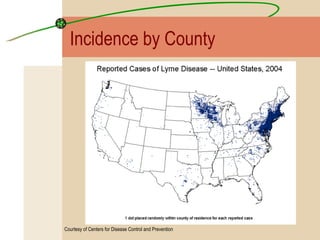
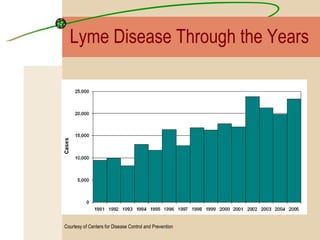
Lyme Disease In mid-1970s, a geographic clustering of an unusual rheumatoid, arthritis-like condition reported around Lyme, Connecticut.  Termed Lyme disease. Lyme disease occurs in every State in the union, with highest incidence occurring in the northeast,  the Midwest, the Mid-Atlantic States, and Wisconsin  Most common and fastest growing tick-transmitted illness in the United States. Case number estimated to increase by 1/3 to 2/3 by 2012 and this may be a low estimate. Cases reported to CDC may only be 10% of actual infections. Estimated to have been present in the US for 100 years, boasting 100 different strains. Recognized in Europe in the early 20 th  century; 300 strains worldwide
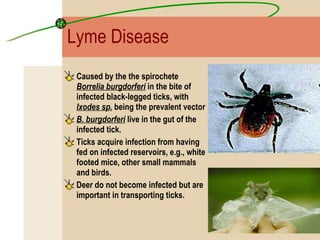
Lyme Disease Caused by the the spirochete  Borrelia burgdorferi  in the bite of infected black-legged ticks, with  Ixodes sp.  being the prevalent vector B. burgdorferi  live in the gut of the infected tick. Ticks acquire infection from having fed on infected reservoirs, e.g., white footed mice, other small mammals and birds. Deer do not become infected but are important in transporting ticks.
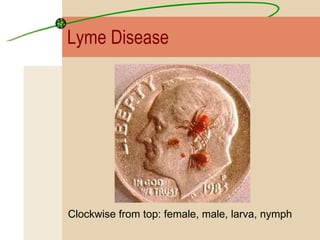
Clockwise from top: female, male, larva, nymph Lyme Disease
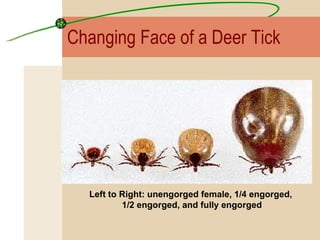
Left to Right: unengorged female, 1/4 engorged, 1/2 engorged, and fully engorged Changing Face of a Deer Tick
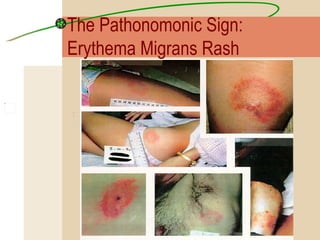
Diagnosis Clinical and laboratory diagnosis Clinical diagnosis Endemic area + erythema migrans = no testing needed Laboratory diagnosis Biopsy and culture of leading margin of erythema migrans lesion for organism; 60% to 80% successful Immunologic tests performed with appropriate minimum pretest probability of 0.20
Early Clinical Manifestations Erythema migrans – 37% Chills – 30-40% Fever – 30-40% Flu-like symptoms – 50% Headache – 40-50% Stiff neck – 30-40% Myalgias (muscle aches) – 40-50% Fatigue – 40-50%
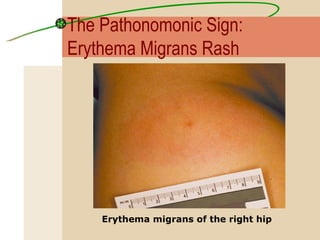
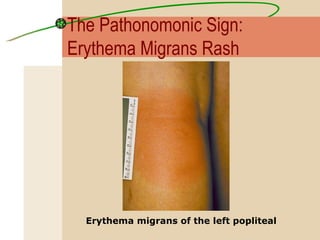
The Pathonomonic Sign:  Erythema Migrans Rash
Erythema migrans of the right hip   The Pathonomonic Sign:  Erythema Migrans Rash
Erythema migrans of the left popliteal The Pathonomonic Sign:  Erythema Migrans Rash
Mid-Term Manifestations Meningitis – overall central nervous system (CNS) or peripheral nervous system (PNS) involvement in 10-20% Cranial neuropathy (numbness, abnormal sensation, possibly pain) – overall CNS or PNS involvement in 10-20% Radiculoneuropathy (spinal nerve roots) – overall CNS or PNS involvement in 10-20% A-V nodal block (fault in heart’s electrical system) – overall cardiac involvement 4-10% Pericarditis (inflammation of sac around heart) – overall cardiac involvement in 4-10% Myocarditis (inflammation of heart muscle) – overall cardiac involvement in 4-10% Eye Involvement – relatively uncommon
Late Clinical Manifestations Arthritis – up to 60% of untreated patients Encephalopathy – subtle cognitive dysfunction  Polyneuropathy – distal paresthesias or radicular pain
Systemic Presentations Musculoskeletal Neurological Visual Auditory Gastro-Intestinal Respiratory Cardiac Chronic Fatigue  Psychological
Incidence by County Courtesy of Centers for Disease Control and Prevention
Lyme Disease Through the Years Courtesy of Centers for Disease Control and Prevention                                                                                                                                                                                            
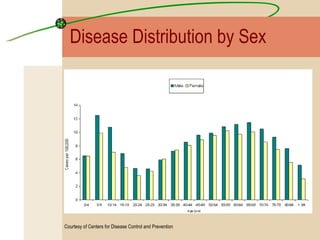
Disease Distribution by Sex Courtesy of Centers for Disease Control and Prevention                                                                                                                                                                                            
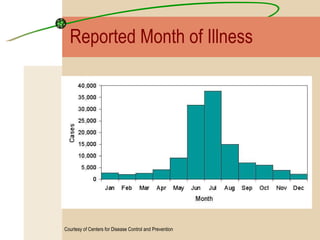
Reported Month of Illness Courtesy of Centers for Disease Control and Prevention                                                                                                                                                                                            
Treatment Various antibiotics (esp. doxycycline, amoxicillin, or cefuroxime axetil) Dependent upon drug allergies and tolerance Immunosupportive supplements and modalities Complications: Bacterial mutations Immunocompetency of patient Co-infections with other bacteria
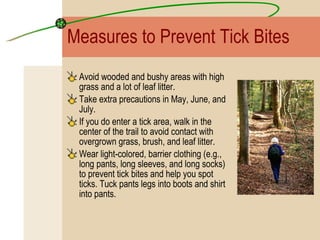
Measures to Prevent Tick Bites Avoid wooded and bushy areas with high grass and a lot of leaf litter. Take extra precautions in May, June, and July. If you do enter a tick area, walk in the center of the trail to avoid contact with overgrown grass, brush, and leaf litter. Wear light-colored, barrier clothing (e.g., long pants, long sleeves, and long socks) to prevent tick bites and help you spot ticks. Tuck pants legs into boots and shirt into pants.
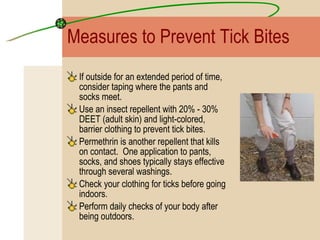
Measures to Prevent Tick Bites If outside for an extended period of time, consider taping where the pants and socks meet. Use an insect repellent with 20% - 30% DEET (adult skin) and light-colored, barrier clothing to prevent tick bites.  Permethrin is another repellent that kills on contact.  One application to pants, socks, and shoes typically stays effective through several washings. Check your clothing for ticks before going indoors.  Perform daily checks of your body after being outdoors.
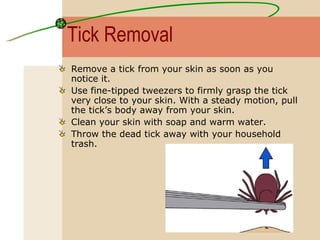
Tick Removal Remove a tick from your skin as soon as you notice it.  Use fine-tipped tweezers to firmly grasp the tick very close to your skin. With a steady motion, pull the tick’s body away from your skin.  Clean your skin with soap and warm water.  Throw the dead tick away with your household trash.
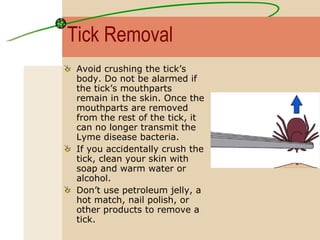
Tick Removal Avoid crushing the tick’s body. Do not be alarmed if the tick’s mouthparts remain in the skin. Once the mouthparts are removed from the rest of the tick, it can no longer transmit the Lyme disease bacteria.  If you accidentally crush the tick, clean your skin with soap and warm water or alcohol. Don’t use petroleum jelly, a hot match, nail polish, or other products to remove a tick.
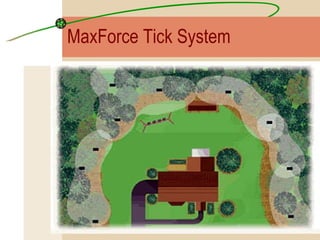
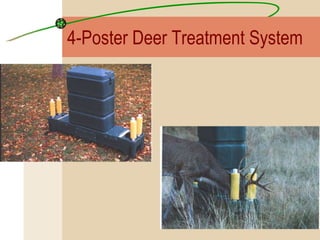
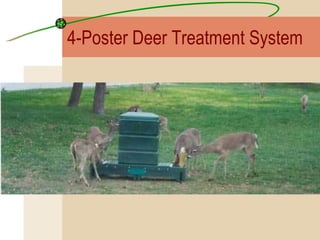
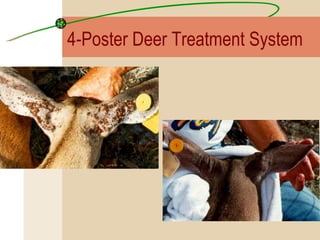
Prevention Controls Engineering Controls Lawn treatment (permethrin insecticide) Deer fence Separation of lawn and woods Rodent control or treatment (e.g., MaxForce) “ Four Poster Deer Treatment System” Clearing of brush, wood piles, rock walls, etc.
Acorns, Biodiversity and Lyme Disease Tick larvae feed on mice which carry  Borrelia burgdorferi Acorns are an important food source for many animals, including mice and another important host, deer Genetic and climatic factors cause oak forests to vary in the number of acorns produced year to year Large crops of acorns produce booming mice populations the following summer; up to 100-fold more mice More mice increase the number of infected ticks by providing tick larvae more opportunities to pick up  Borrelia  during feeding. Passenger pigeons (extinct) theoretically used to eat acorns and out-compete other species.  With the passenger pigeon gone, more acorns are left for other species (e.g., mice and deer).  Could the disappearance of one species give rise to a dramatic incidence in Lyme disease? Recent research shows that a bumper acorn crop (called a “mast year”) leads to an increased risk of Lyme Disease in suburban and rural area in subsequent years (2 year cycle)
MaxForce Tick System
4-Poster Deer Treatment System
Resources www.cdc.gov www.lyme.org www.lymediseaseassociation www.lymenet.org

Lyme Disease For PECs

  • 1.
    Lyme Disease: The Great Masquerader Presented by Mitchell Kidd, Ph.D. AEP WPEC/IH Meeting, Abilene, TX April 10-11, 2007
  • 2.
    The Right toRemain Silent . . .
  • 3.
    Lyme Disease Inmid-1970s, a geographic clustering of an unusual rheumatoid, arthritis-like condition reported around Lyme, Connecticut. Termed Lyme disease. Lyme disease occurs in every State in the union, with highest incidence occurring in the northeast, the Midwest, the Mid-Atlantic States, and Wisconsin Most common and fastest growing tick-transmitted illness in the United States. Case number estimated to increase by 1/3 to 2/3 by 2012 and this may be a low estimate. Cases reported to CDC may only be 10% of actual infections. Estimated to have been present in the US for 100 years, boasting 100 different strains. Recognized in Europe in the early 20 th century; 300 strains worldwide
  • 4.
    Lyme Disease Causedby the the spirochete Borrelia burgdorferi in the bite of infected black-legged ticks, with Ixodes sp. being the prevalent vector B. burgdorferi live in the gut of the infected tick. Ticks acquire infection from having fed on infected reservoirs, e.g., white footed mice, other small mammals and birds. Deer do not become infected but are important in transporting ticks.
  • 5.
    Clockwise from top:female, male, larva, nymph Lyme Disease
  • 6.
    Left to Right:unengorged female, 1/4 engorged, 1/2 engorged, and fully engorged Changing Face of a Deer Tick
  • 7.
    Diagnosis Clinical andlaboratory diagnosis Clinical diagnosis Endemic area + erythema migrans = no testing needed Laboratory diagnosis Biopsy and culture of leading margin of erythema migrans lesion for organism; 60% to 80% successful Immunologic tests performed with appropriate minimum pretest probability of 0.20
  • 8.
    Early Clinical ManifestationsErythema migrans – 37% Chills – 30-40% Fever – 30-40% Flu-like symptoms – 50% Headache – 40-50% Stiff neck – 30-40% Myalgias (muscle aches) – 40-50% Fatigue – 40-50%
  • 9.
    The Pathonomonic Sign: Erythema Migrans Rash
  • 10.
    Erythema migrans ofthe right hip The Pathonomonic Sign: Erythema Migrans Rash
  • 11.
    Erythema migrans ofthe left popliteal The Pathonomonic Sign: Erythema Migrans Rash
  • 12.
    Mid-Term Manifestations Meningitis– overall central nervous system (CNS) or peripheral nervous system (PNS) involvement in 10-20% Cranial neuropathy (numbness, abnormal sensation, possibly pain) – overall CNS or PNS involvement in 10-20% Radiculoneuropathy (spinal nerve roots) – overall CNS or PNS involvement in 10-20% A-V nodal block (fault in heart’s electrical system) – overall cardiac involvement 4-10% Pericarditis (inflammation of sac around heart) – overall cardiac involvement in 4-10% Myocarditis (inflammation of heart muscle) – overall cardiac involvement in 4-10% Eye Involvement – relatively uncommon
  • 13.
    Late Clinical ManifestationsArthritis – up to 60% of untreated patients Encephalopathy – subtle cognitive dysfunction Polyneuropathy – distal paresthesias or radicular pain
  • 14.
    Systemic Presentations MusculoskeletalNeurological Visual Auditory Gastro-Intestinal Respiratory Cardiac Chronic Fatigue Psychological
  • 15.
    Incidence by CountyCourtesy of Centers for Disease Control and Prevention
  • 16.
    Lyme Disease Throughthe Years Courtesy of Centers for Disease Control and Prevention                                                                                                                                                                                            
  • 17.
    Disease Distribution bySex Courtesy of Centers for Disease Control and Prevention                                                                                                                                                                                            
  • 18.
    Reported Month ofIllness Courtesy of Centers for Disease Control and Prevention                                                                                                                                                                                            
  • 19.
    Treatment Various antibiotics(esp. doxycycline, amoxicillin, or cefuroxime axetil) Dependent upon drug allergies and tolerance Immunosupportive supplements and modalities Complications: Bacterial mutations Immunocompetency of patient Co-infections with other bacteria
  • 20.
    Measures to PreventTick Bites Avoid wooded and bushy areas with high grass and a lot of leaf litter. Take extra precautions in May, June, and July. If you do enter a tick area, walk in the center of the trail to avoid contact with overgrown grass, brush, and leaf litter. Wear light-colored, barrier clothing (e.g., long pants, long sleeves, and long socks) to prevent tick bites and help you spot ticks. Tuck pants legs into boots and shirt into pants.
  • 21.
    Measures to PreventTick Bites If outside for an extended period of time, consider taping where the pants and socks meet. Use an insect repellent with 20% - 30% DEET (adult skin) and light-colored, barrier clothing to prevent tick bites. Permethrin is another repellent that kills on contact. One application to pants, socks, and shoes typically stays effective through several washings. Check your clothing for ticks before going indoors. Perform daily checks of your body after being outdoors.
  • 22.
    Tick Removal Removea tick from your skin as soon as you notice it. Use fine-tipped tweezers to firmly grasp the tick very close to your skin. With a steady motion, pull the tick’s body away from your skin. Clean your skin with soap and warm water. Throw the dead tick away with your household trash.
  • 23.
    Tick Removal Avoidcrushing the tick’s body. Do not be alarmed if the tick’s mouthparts remain in the skin. Once the mouthparts are removed from the rest of the tick, it can no longer transmit the Lyme disease bacteria. If you accidentally crush the tick, clean your skin with soap and warm water or alcohol. Don’t use petroleum jelly, a hot match, nail polish, or other products to remove a tick.
  • 24.
    Prevention Controls EngineeringControls Lawn treatment (permethrin insecticide) Deer fence Separation of lawn and woods Rodent control or treatment (e.g., MaxForce) “ Four Poster Deer Treatment System” Clearing of brush, wood piles, rock walls, etc.
  • 25.
    Acorns, Biodiversity andLyme Disease Tick larvae feed on mice which carry Borrelia burgdorferi Acorns are an important food source for many animals, including mice and another important host, deer Genetic and climatic factors cause oak forests to vary in the number of acorns produced year to year Large crops of acorns produce booming mice populations the following summer; up to 100-fold more mice More mice increase the number of infected ticks by providing tick larvae more opportunities to pick up Borrelia during feeding. Passenger pigeons (extinct) theoretically used to eat acorns and out-compete other species. With the passenger pigeon gone, more acorns are left for other species (e.g., mice and deer). Could the disappearance of one species give rise to a dramatic incidence in Lyme disease? Recent research shows that a bumper acorn crop (called a “mast year”) leads to an increased risk of Lyme Disease in suburban and rural area in subsequent years (2 year cycle)
  • 26.
  • 27.
  • 28.
  • 29.
  • 30.
  • 31.
    Resources www.cdc.gov www.lyme.orgwww.lymediseaseassociation www.lymenet.org

Editor's Notes