Lyme Disease
EDUCATIONAL MATERIALS PROVIDED BY THE LOCHHEAD LAB AND LYME MCW (2019)
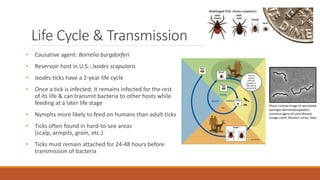
Life Cycle & Transmission
• Causative agent: Borrelia burgdorferi
• Reservoir host in U.S.: Ixodes scapularis
• Ixodes ticks have a 2-year life cycle
• Once a tick is infected, it remains infected for the rest
of its life & can transmit bacteria to other hosts while
feeding at a later life stage
• Nymphs more likely to feed on humans than adult ticks
• Ticks often found in hard-to-see areas
(scalp, armpits, groin, etc.)
• Ticks must remain attached for 24-48 hours before
transmission of bacteria
Epidemiology
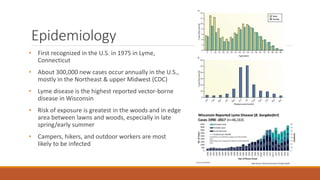
• First recognized in the U.S. in 1975 in Lyme,
Connecticut
• About 300,000 new cases occur annually in the U.S.,
mostly in the Northeast & upper Midwest (CDC)
• Lyme disease is the highest reported vector-borne
disease in Wisconsin
• Risk of exposure is greatest in the woods and in edge
area between lawns and woods, especially in late
spring/early summer
• Campers, hikers, and outdoor workers are most
likely to be infected
Epidemiology
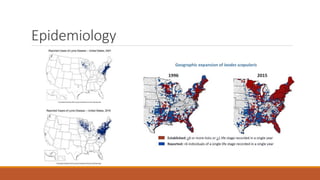
Geographic expansion of Ixodes scapularis
Clinical Features
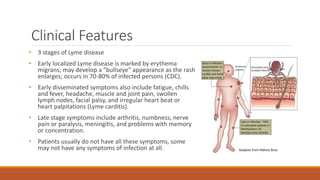
• 3 stages of Lyme disease
• Early localized Lyme disease is marked by erythema
migrans; may develop a "bullseye" appearance as the rash
enlarges; occurs in 70-80% of infected persons (CDC).
• Early disseminated symptoms also include fatigue, chills
and fever, headache, muscle and joint pain, swollen
lymph nodes, facial palsy, and irregular heart beat or
heart palpitations (Lyme carditis).
• Late stage symptoms include arthritis, numbness, nerve
pain or paralysis, meningitis, and problems with memory
or concentration.
• Patients usually do not have all these symptoms, some
may not have any symptoms of infection at all.
Clinical Features
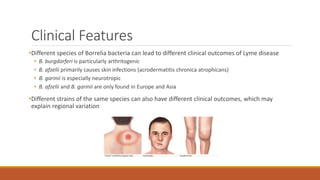
•Different species of Borrelia bacteria can lead to different clinical outcomes of Lyme disease
• B. burgdorferi is particularly arthritogenic
• B. afzelii primarily causes skin infections (acrodermatitis chronica atrophicans)
• B. garinii is especially neurotropic
• B. afzelii and B. garinii are only found in Europe and Asia
•Different strains of the same species can also have different clinical outcomes, which may
explain regional variation
Diagnosis
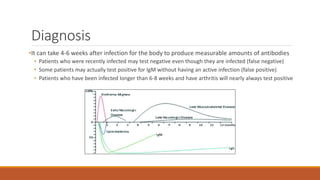
•It can take 4-6 weeks after infection for the body to produce measurable amounts of antibodies
• Patients who were recently infected may test negative even though they are infected (false negative)
• Some patients may actually test positive for IgM without having an active infection (false positive)
• Patients who have been infected longer than 6-8 weeks and have arthritis will nearly always test positive
Treatment & Public Health Costs
•Positive diagnosis can be treated with antibiotics, given by mouth or intravenously
•Persistent symptoms may require an additional course of antibiotic treatment
•Treatments not recommended (Steere et al. 2016)
◦ Long-term antibiotic therapy
◦ Combinations of antibiotics
◦ Hyperbaric oxygen or ozone therapy
◦ Radiation-based therapies
◦ Fever therapy
◦ Intravenous immunoglobulin
◦ Stem cell transplants
•Misdiagnosis & inappropriate treatment increase the cost of Lyme disease
Natural History of Lyme Disease
•Without antibiotic treatment, the symptoms of Lyme disease generally resolve within weeks to
months, but infection can last for years
•Spirochetes might survive in localized niches in untreated patients for several more years
(Steere et al. 2016)
•Episodic symptoms may be a result of Borrelia escaping from protected niches and can lead to
worsening symptoms over time
• Around 50-60% of untreated patients in the U.S. will develop arthritis 6-18 months later
•Antibiotic therapy for 1 month is usually effective at clearing infection, although infection can be
cleared over time by the immune system without antibiotics
Post-Treatment Lyme Disease Symptoms (PTLDS)
•Even after appropriate treatment and spirochetal killing, symptoms of Lyme disease can persist
•Patients
• Do not have any evidence of an active infection
• Ongoing symptoms are thought to be related to unresolved immune responses to prior infection
•Subjective symptoms following an infection are not unique to Lyme
•Why does PTLDS develop?
◦ Patients with a longer duration of symptoms before treatment tend to have a higher risk
◦ Polymorphism in TLR1 is associated with persistent arthritis after antibiotic therapy (Strle et al. 2012)
“Chronic Lyme Disease” Controversy
•Clinicians & scientists generally do not consider “chronic Lyme” an appropriate diagnosis
•CLD diagnosis often based on subjective symptoms, including myalgias, arthralgias, headache,
fatigue, irritability, and cognitive dysfunction (Lantos 2015)
•Insurance companies do not cover long-term antibiotic therapy for “chronic Lyme” treatment
• Treatment is not effective in resolving symptoms
•Alternative “chronic Lyme” diagnosis results in patients not being treated for other potential
diseases that are causing symptoms
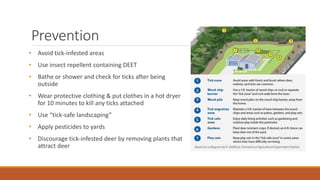
Prevention
• Avoid tick-infested areas
• Use insect repellent containing DEET
• Bathe or shower and check for ticks after being
outside
• Wear protective clothing & put clothes in a hot dryer
for 10 minutes to kill any ticks attached
• Use “tick-safe landscaping”
• Apply pesticides to yards
• Discourage tick-infested deer by removing plants that
attract deer
Additional Resources
Follow us @LymeMCW
and visit us at
www.lymemcw.org
Lyme MCW is an educational and outreach program founded by the Lochhead Lab at the Medical
College of Wisconsin. Our goal is to serve as a trusted source of information on Lyme & other tick-
borne diseases endemic to the state of Wisconsin.
References
Lantos, Paul M. “Chronic Lyme Disease.” Infectious disease clinics of North America 29.2 (2015): pp. 325–340. PMC. Web.
Accessed 23 Oct 2018.
“Lyme Disease.” Centers for Disease Control and Prevention. 15 Oct 2018. https://www.cdc.gov/lyme/index.html.
Accessed 17 Oct 2018.
“Lyme Disease.” Wisconsin Department of Health Services. 7 Aug 2018. https://www.dhs.wisconsin.gov/tickborne/
lyme/index.htm. Accessed 17 Oct 2018.
Steere, Allen, et al. 15 Dec 2016. “Lyme borreliosis.” Nature Reviews: Disease Primers, vol. 2, pp. 1-18,
https://www.nature.com/articles/nrdp201690. Accessed 17 Oct 2018.
Weaver, Jane. 16 July 2013. “More people search for health online.” NBC, http://www.nbcnews.com/id/3077086/t/more-
people-search-health-online/#.W8d15fZRfIU. Accessed 17 Oct 2018.

Lyme MCW- Lyme Disease

  • 1.
    Lyme Disease EDUCATIONAL MATERIALSPROVIDED BY THE LOCHHEAD LAB AND LYME MCW (2019)
  • 2.
    Life Cycle &Transmission • Causative agent: Borrelia burgdorferi • Reservoir host in U.S.: Ixodes scapularis • Ixodes ticks have a 2-year life cycle • Once a tick is infected, it remains infected for the rest of its life & can transmit bacteria to other hosts while feeding at a later life stage • Nymphs more likely to feed on humans than adult ticks • Ticks often found in hard-to-see areas (scalp, armpits, groin, etc.) • Ticks must remain attached for 24-48 hours before transmission of bacteria
  • 3.
    Epidemiology • First recognizedin the U.S. in 1975 in Lyme, Connecticut • About 300,000 new cases occur annually in the U.S., mostly in the Northeast & upper Midwest (CDC) • Lyme disease is the highest reported vector-borne disease in Wisconsin • Risk of exposure is greatest in the woods and in edge area between lawns and woods, especially in late spring/early summer • Campers, hikers, and outdoor workers are most likely to be infected
  • 4.
  • 5.
    Clinical Features • 3stages of Lyme disease • Early localized Lyme disease is marked by erythema migrans; may develop a "bullseye" appearance as the rash enlarges; occurs in 70-80% of infected persons (CDC). • Early disseminated symptoms also include fatigue, chills and fever, headache, muscle and joint pain, swollen lymph nodes, facial palsy, and irregular heart beat or heart palpitations (Lyme carditis). • Late stage symptoms include arthritis, numbness, nerve pain or paralysis, meningitis, and problems with memory or concentration. • Patients usually do not have all these symptoms, some may not have any symptoms of infection at all.
  • 6.
    Clinical Features •Different speciesof Borrelia bacteria can lead to different clinical outcomes of Lyme disease • B. burgdorferi is particularly arthritogenic • B. afzelii primarily causes skin infections (acrodermatitis chronica atrophicans) • B. garinii is especially neurotropic • B. afzelii and B. garinii are only found in Europe and Asia •Different strains of the same species can also have different clinical outcomes, which may explain regional variation
  • 7.
    Diagnosis •It can take4-6 weeks after infection for the body to produce measurable amounts of antibodies • Patients who were recently infected may test negative even though they are infected (false negative) • Some patients may actually test positive for IgM without having an active infection (false positive) • Patients who have been infected longer than 6-8 weeks and have arthritis will nearly always test positive
  • 8.
    Treatment & PublicHealth Costs •Positive diagnosis can be treated with antibiotics, given by mouth or intravenously •Persistent symptoms may require an additional course of antibiotic treatment •Treatments not recommended (Steere et al. 2016) ◦ Long-term antibiotic therapy ◦ Combinations of antibiotics ◦ Hyperbaric oxygen or ozone therapy ◦ Radiation-based therapies ◦ Fever therapy ◦ Intravenous immunoglobulin ◦ Stem cell transplants •Misdiagnosis & inappropriate treatment increase the cost of Lyme disease
  • 9.
    Natural History ofLyme Disease •Without antibiotic treatment, the symptoms of Lyme disease generally resolve within weeks to months, but infection can last for years •Spirochetes might survive in localized niches in untreated patients for several more years (Steere et al. 2016) •Episodic symptoms may be a result of Borrelia escaping from protected niches and can lead to worsening symptoms over time • Around 50-60% of untreated patients in the U.S. will develop arthritis 6-18 months later •Antibiotic therapy for 1 month is usually effective at clearing infection, although infection can be cleared over time by the immune system without antibiotics
  • 10.
    Post-Treatment Lyme DiseaseSymptoms (PTLDS) •Even after appropriate treatment and spirochetal killing, symptoms of Lyme disease can persist •Patients • Do not have any evidence of an active infection • Ongoing symptoms are thought to be related to unresolved immune responses to prior infection •Subjective symptoms following an infection are not unique to Lyme •Why does PTLDS develop? ◦ Patients with a longer duration of symptoms before treatment tend to have a higher risk ◦ Polymorphism in TLR1 is associated with persistent arthritis after antibiotic therapy (Strle et al. 2012)
  • 11.
    “Chronic Lyme Disease”Controversy •Clinicians & scientists generally do not consider “chronic Lyme” an appropriate diagnosis •CLD diagnosis often based on subjective symptoms, including myalgias, arthralgias, headache, fatigue, irritability, and cognitive dysfunction (Lantos 2015) •Insurance companies do not cover long-term antibiotic therapy for “chronic Lyme” treatment • Treatment is not effective in resolving symptoms •Alternative “chronic Lyme” diagnosis results in patients not being treated for other potential diseases that are causing symptoms
  • 12.
    Prevention • Avoid tick-infestedareas • Use insect repellent containing DEET • Bathe or shower and check for ticks after being outside • Wear protective clothing & put clothes in a hot dryer for 10 minutes to kill any ticks attached • Use “tick-safe landscaping” • Apply pesticides to yards • Discourage tick-infested deer by removing plants that attract deer
  • 13.
    Additional Resources Follow us@LymeMCW and visit us at www.lymemcw.org Lyme MCW is an educational and outreach program founded by the Lochhead Lab at the Medical College of Wisconsin. Our goal is to serve as a trusted source of information on Lyme & other tick- borne diseases endemic to the state of Wisconsin.
  • 14.
    References Lantos, Paul M.“Chronic Lyme Disease.” Infectious disease clinics of North America 29.2 (2015): pp. 325–340. PMC. Web. Accessed 23 Oct 2018. “Lyme Disease.” Centers for Disease Control and Prevention. 15 Oct 2018. https://www.cdc.gov/lyme/index.html. Accessed 17 Oct 2018. “Lyme Disease.” Wisconsin Department of Health Services. 7 Aug 2018. https://www.dhs.wisconsin.gov/tickborne/ lyme/index.htm. Accessed 17 Oct 2018. Steere, Allen, et al. 15 Dec 2016. “Lyme borreliosis.” Nature Reviews: Disease Primers, vol. 2, pp. 1-18, https://www.nature.com/articles/nrdp201690. Accessed 17 Oct 2018. Weaver, Jane. 16 July 2013. “More people search for health online.” NBC, http://www.nbcnews.com/id/3077086/t/more- people-search-health-online/#.W8d15fZRfIU. Accessed 17 Oct 2018.

Editor's Notes

  • #3 LD is caused by a bacterium called Borrelia burgdorferi. This type of bacterium is a spirochete (spiral shape), and one interesting fact is that different species of the bacteria can cause different clinical outcomes, which we’ll discuss later. In order to infect humans & other mammals, the bacteria must use a reservoir host, which, in this case, is Ixodes scapularis, otherwise known as the deer tick. Ixodes ticks have a 2 year life cycle. Ticks are laid in the spring, hatch as larvae in summer. Larvae feed on mice, birds, and other small animals. Larvae can become infected with Lyme disease bacteria while feeding on these animals. Once a tick becomes infected, it remains infected for the rest of its life and can transmit the bacteria to other hosts, including humans, while feeding at a later life stage. You are most likely to be bitten by a nymph rather than an adult tick. Nymphs are about 2mm in size (difficult to see) and are most active in spring and summer. Adults are larger in size and tend to be more active in the fall. Ticks can attach to any part of the human body, but are often found in hard-to-see areas (scalp, armpits, groin, etc.). Ticks must remain attached for 24-48 hours before the bacterium can be transmitted (because the bacteria must express a different set of genes in order to establish infection—for example, outer-surface protein A [OspA] is expressed during tick colonization, but outer-surface protein C [OspC] is expressed during early infection of the mammal).
  • #5 Geographic expansion of Ixodes scapularis due to global warming & climate change
  • #8 As previously mentioned, one of the most common clinical manifestations of LD is erythema migrans (70-80%). If you have erythema migrans, you are not required to undergo serological testing, as long as you are in a Lyme endemic region In the case where you do need blood tests, the tests will detect whether the patient has antibodies to Lyme disease bacteria 1. Enzyme immunoassay (EIA) or indirect immunofluorescence assay (IFA) followed by 2. Western immunoblot of samples that tested positive Problem: it can take 4-6 weeks after infection for the body to produce measurable amounts of antibodies (cannot detect active infection) Patients who were recently infected may test negative even though they are infected (false negative) Patients who have been infected longer than 6-8 weeks and have arthritis will test positive (This is because IgG and even IgM antibodies against B. burgdorferi can remain for months or years after near or complete spi­rochetal elimination with antibiotics. Thus, if patients with past or asympto­matic Borrelia infection develop another illness, par­ticularly one with neurological or joint symptoms, the symptoms might be attributed incorrectly to Lyme disease)
  • #9 After an accurate diagnosis has been confirmed, antibiotics can be given by mouth or intravenously (in more severe cases); treatment usually involves a 10-21 day course of oral doxycycline or amoxicillin
  • #11 Even after appropriate treatment has been given, symptoms of Lyme disease can persist. This is referred to as Post-Lyme Disease Symptoms (PTLDS). Patients with PTLDS often present with subjective symptoms, such as pain, fatigue, or behavioral and cognitive changes. Subjective post-Lyme symptoms are not unique to Lyme disease but, rather, are common to the recovery from many systemic illnesses. In fact, one study found that, after 12 months, patients treated for erythema migrans were no more likely to have subjective symptoms than an uninfected control group (Lantos 2015). Why does PTLDS develop? Patients with a longer duration of symptoms before treatment are more likely to develop post-treatment symptoms Additionally, a polymorphism that is thought to decrease the expression of TLR1 is associated with increased levels of pro-inflammatory cytokines and persistent arthritis after antibiotic therapy (Steere et al. 2016). Lyme arthritis is a major concern of PTLDS because it can lead to persistent synovitis for several years. If Lyme arthritis does not respond to antibiotics, it can be treated in a variety of ways, including the use of NSAIDs, DMARDs, or intra-articular injections of corticosteroids (Steere et al. 2016)
  • #12 Insurance companies do not cover “chronic Lyme” treatment Treatments can cost tens of thousands of dollars per year Can have serious adverse effects, including antibiotic-induced colitis, MRSA infections, GI dysbiosis, light sensitivity, sepsis, etc.