RISC vs. CISC Rui Wang Tibor Horvath
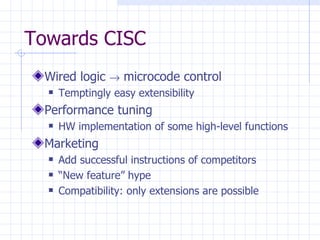
Towards CISC Wired logic    microcode control Temptingly easy extensibility Performance tuning HW implementation of some high-level functions Marketing Add successful instructions of competitors “ New feature” hype Compatibility: only extensions are possible
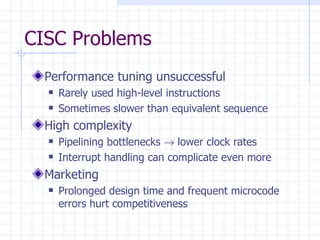
CISC Problems Performance tuning unsuccessful Rarely used high-level instructions Sometimes slower than equivalent sequence High complexity Pipelining bottlenecks    lower clock rates Interrupt handling can complicate even more Marketing Prolonged design time and frequent microcode errors hurt competitiveness
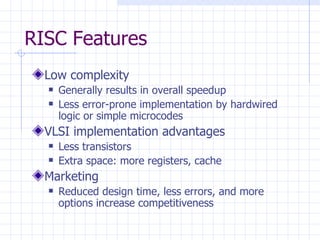
RISC Features Low complexity Generally results in overall speedup Less error-prone implementation by hardwired logic or simple microcodes VLSI implementation advantages Less transistors Extra space: more registers, cache Marketing Reduced design time, less errors, and more options increase competitiveness
RISC Compiler Issues The compilers themselves Computationally more complex More portable The compiler writer Less instructions    probably easier job Simpler instructions    probably less bugs Can reuse optimization techniques
RISC vs. CISC  misconceptions Arguments favoring RISC: simple design, short design time, speed, price… Study of RISC should include hardware/software tradeoffs, factors influencing computer performance and industry-side evaluation.
RISC vs. CISC  misconceptions Incorrect implication from the two acronyms: RISC and CISC. They are not bifurcations between which designers have to choose Carelessly leaving out the ‘participation’ of Operating System
RISC vs. CISC  misconceptions Reduced design time? academic <-> industrial Performance claims of RISC proponent do not decouple design features like MRSs. MRSs can have a remarkable effect on program execution
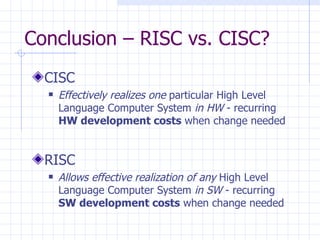
Conclusion – RISC vs. CISC? CISC Effectively realizes one  particular High Level Language Computer System  in HW  - recurring  HW development costs  when change needed RISC Allows effective realization of any  High Level Language Computer System  in SW  - recurring  SW development costs  when change needed
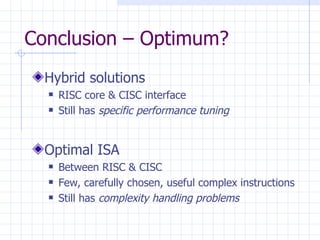
Conclusion – Optimum? Hybrid solutions RISC core & CISC interface Still has  specific performance tuning Optimal ISA Between RISC & CISC Few, carefully chosen, useful complex instructions Still has  complexity handling problems

Tibor

  • 1.
    RISC vs. CISCRui Wang Tibor Horvath
  • 2.
    Towards CISC Wiredlogic  microcode control Temptingly easy extensibility Performance tuning HW implementation of some high-level functions Marketing Add successful instructions of competitors “ New feature” hype Compatibility: only extensions are possible
  • 3.
    CISC Problems Performancetuning unsuccessful Rarely used high-level instructions Sometimes slower than equivalent sequence High complexity Pipelining bottlenecks  lower clock rates Interrupt handling can complicate even more Marketing Prolonged design time and frequent microcode errors hurt competitiveness
  • 4.
    RISC Features Lowcomplexity Generally results in overall speedup Less error-prone implementation by hardwired logic or simple microcodes VLSI implementation advantages Less transistors Extra space: more registers, cache Marketing Reduced design time, less errors, and more options increase competitiveness
  • 5.
    RISC Compiler IssuesThe compilers themselves Computationally more complex More portable The compiler writer Less instructions  probably easier job Simpler instructions  probably less bugs Can reuse optimization techniques
  • 6.
    RISC vs. CISC misconceptions Arguments favoring RISC: simple design, short design time, speed, price… Study of RISC should include hardware/software tradeoffs, factors influencing computer performance and industry-side evaluation.
  • 7.
    RISC vs. CISC misconceptions Incorrect implication from the two acronyms: RISC and CISC. They are not bifurcations between which designers have to choose Carelessly leaving out the ‘participation’ of Operating System
  • 8.
    RISC vs. CISC misconceptions Reduced design time? academic <-> industrial Performance claims of RISC proponent do not decouple design features like MRSs. MRSs can have a remarkable effect on program execution
  • 9.
    Conclusion – RISCvs. CISC? CISC Effectively realizes one particular High Level Language Computer System in HW - recurring HW development costs when change needed RISC Allows effective realization of any High Level Language Computer System in SW - recurring SW development costs when change needed
  • 10.
    Conclusion – Optimum?Hybrid solutions RISC core & CISC interface Still has specific performance tuning Optimal ISA Between RISC & CISC Few, carefully chosen, useful complex instructions Still has complexity handling problems