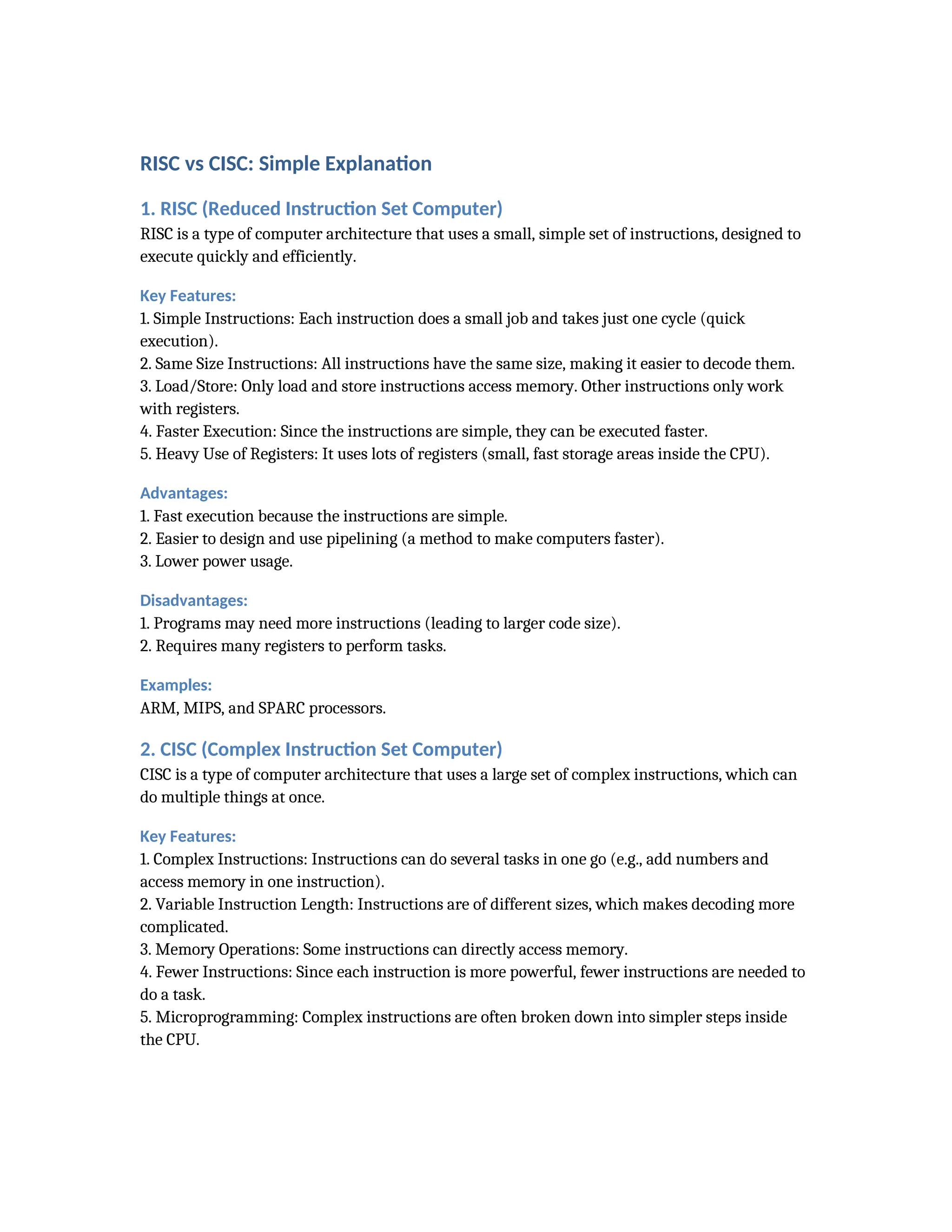
RISC vs CISC:Simple Explanation
1. RISC (Reduced Instruction Set Computer)
RISC is a type of computer architecture that uses a small, simple set of instructions, designed to
execute quickly and efficiently.
Key Features:
1. Simple Instructions: Each instruction does a small job and takes just one cycle (quick
execution).
2. Same Size Instructions: All instructions have the same size, making it easier to decode them.
3. Load/Store: Only load and store instructions access memory. Other instructions only work
with registers.
4. Faster Execution: Since the instructions are simple, they can be executed faster.
5. Heavy Use of Registers: It uses lots of registers (small, fast storage areas inside the CPU).
Advantages:
1. Fast execution because the instructions are simple.
2. Easier to design and use pipelining (a method to make computers faster).
3. Lower power usage.
Disadvantages:
1. Programs may need more instructions (leading to larger code size).
2. Requires many registers to perform tasks.
Examples:
ARM, MIPS, and SPARC processors.
2. CISC (Complex Instruction Set Computer)
CISC is a type of computer architecture that uses a large set of complex instructions, which can
do multiple things at once.
Key Features:
1. Complex Instructions: Instructions can do several tasks in one go (e.g., add numbers and
access memory in one instruction).
2. Variable Instruction Length: Instructions are of different sizes, which makes decoding more
complicated.
3. Memory Operations: Some instructions can directly access memory.
4. Fewer Instructions: Since each instruction is more powerful, fewer instructions are needed to
do a task.
5. Microprogramming: Complex instructions are often broken down into simpler steps inside
the CPU.
2.
Advantages:
1. Programs canbe smaller because one instruction does more work.
2. Easier for programmers since there are more powerful instructions.
Disadvantages:
1. Instructions can take more time to execute.
2. Harder to design for speed (pipelining is more difficult).
3. Requires more power and complex hardware.
Examples:
x86 processors (like Intel and AMD).
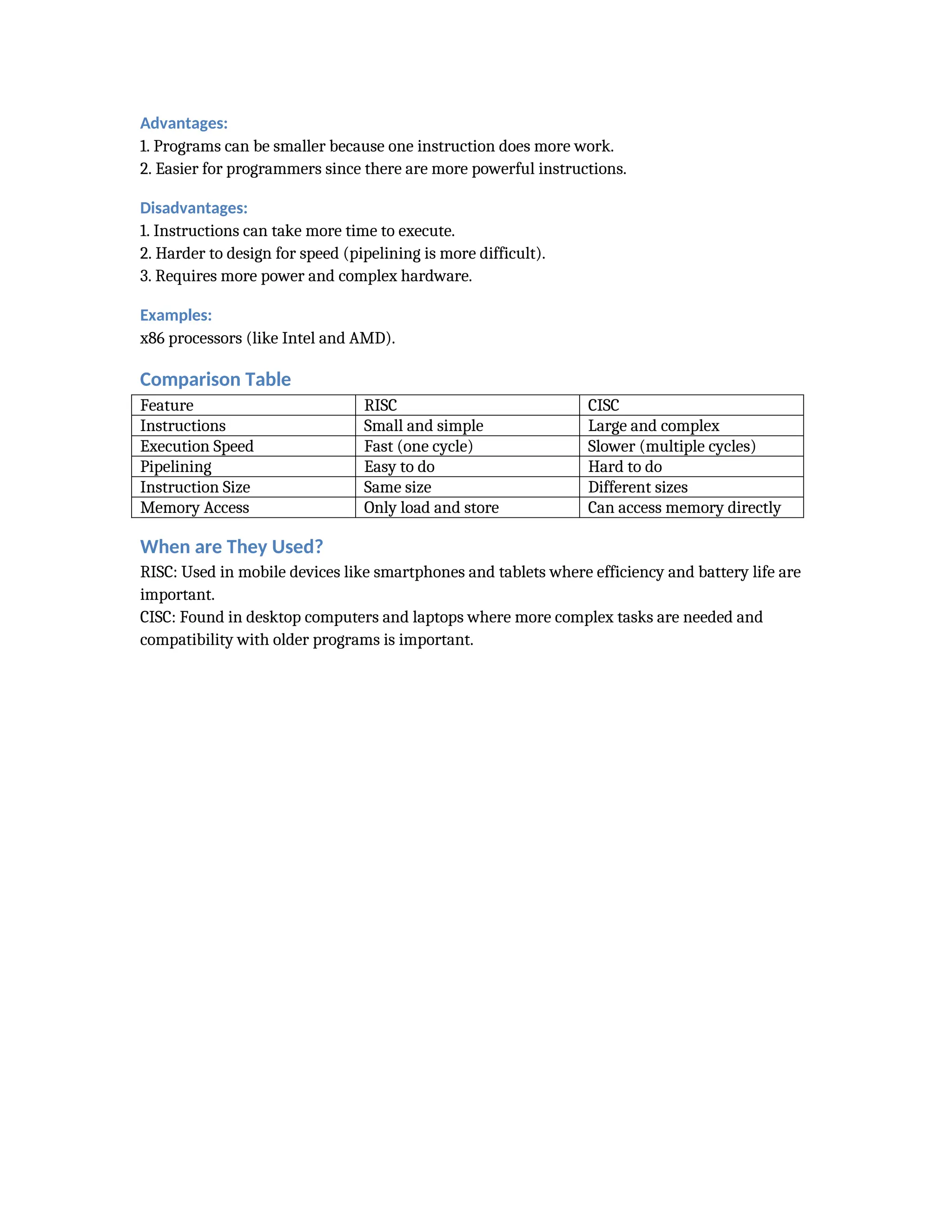
Comparison Table
Feature RISC CISC
Instructions Small and simple Large and complex
Execution Speed Fast (one cycle) Slower (multiple cycles)
Pipelining Easy to do Hard to do
Instruction Size Same size Different sizes
Memory Access Only load and store Can access memory directly
When are They Used?
RISC: Used in mobile devices like smartphones and tablets where efficiency and battery life are
important.
CISC: Found in desktop computers and laptops where more complex tasks are needed and
compatibility with older programs is important.