Thromboembolism
DR MUHAMMAD ALI BASHIR.
PATHALOGY DEPT.
EMBOLISM
 An

embolus is an intravascular solid,
liquid, or gaseous mass that is carried by
the blood to a site distant from its point of
origin.
 The vast majority of emboli derive from a
dislodged thrombus—hence the term
thromboembolism.
Key Terms
Emboli
● Thrombosis
● Deep vein thrombosis
●
• Emboli
Clots or other substances that
travel through the blood stream and
get stuck in a blood vessel, blocking
circulation.
• Thrombosis
The development of a blood clot
inside a blood vessel.
•Deep vein thrombosis
The development of a blood clot
in the calf's deep vein. This frequently
leads to pulmonary embolism if
untreated.
 Most

common is pulmonary embolism.
 Less common types include: fat embolism,air
embolism,amniotic fluid embolism.
• Pulmonary embolism
The occlusion of one or more
vessels in the pulmonary arterial tree
by matter from a source extrinsic to
the lung. The process is almost
invariably acuate but may on
occasion be chronic.
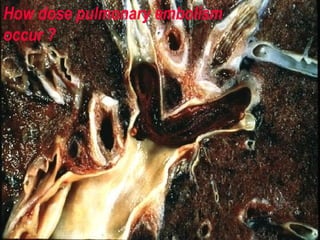
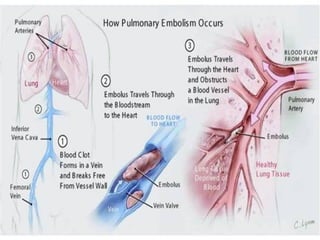
How dose pulmonary embolism
occur ?
Prevalence & Incidence
of P.E
The term 'prevalence' of pulmonary
embolism usually refers to the estimated
population of people who are managing
pulmonary embolism at any given time.
●

The term 'incidence’ of pulmonary
embolism refers to the annual diagnosis rate,
or the number of new cases of pulmonary
embolism diagnosed each year.
●
Incidence (annual): approximately
650,000 cases in the USA
Incidence Rate: approx 1 in 418 or
0.24% in USA
Etiology
Pulmonary embolism is caused by emboli
that travel through the blood stream to the
lungs and block a pulmonary artery. When
this occurs, circulation and oxygenation of
blood is compromised. The emboli are usually
formed from blood clots but are occasionally
comprised of air, fat, amniotic fluid, tumor
tissue, or particulate matter from intravenous
injection, etc.
Common risk factors for pulmonary embolism:
congestive heart
failure;
leukemia;
polycythemia;
sickle cell anemia;
dysproteinemias;
massive obesity;
immobility;
cancer;
pregnancy;

oral contraceptives;
the early postpartum
period;
surgery;
DVT;
hypercoagulable
states;
right heart failure;
fractures of the pelvic
and lower extremities
etc.
Risk factors for pulmonary thromboembolism
include:
any cause of venous stasis
such as: ① venous valvular insufficiency
② right-side HF
③ the postoperative period
④ prolonged bed rest
Pathophysiology
Pulmonary embolism can have the following
pathophysiological effects:

Increased pulmonary vascular resistance due
to vascular obstruction, neurohumoral agents,
or pulmonary artery baroreceptors.

 Alveolar hyperventilation due to reflex
stimulation of irritant receptors.
Impaired gas exchange due to increased
alveolar dead space from vascular obstruction
and hypoxemia, V/Q mismatch.

Increased airway resistance due to bronchoconstriction.

Decreased pulmonary compliance due to lung
edema, lung hemorrhage,and loss of surfactant.
Symptoms

Each individual may experience
symptoms differently, which depend
on the size and number of emboli.
chest pain
● labored breathing, dyspnea, cyanosis
● cough
● syncope
● anxiety
● a rapid pulse.
● a low fever
● hypotension, shock
● fluid build-up in the lungs
●
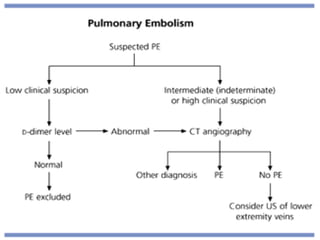
Diagnosis

The diagnosis of pulmonary embolism
should be based on the patient's history,
physical exam, and diagnostic tests.
Symptoms & Signs
● Plasma D-dimer levels
● ECG
● Arterial Blood Gas
● Chest Radiograph
● Ventilation/Perfusion Lung Scanning
● Pulmonary Angiography
●
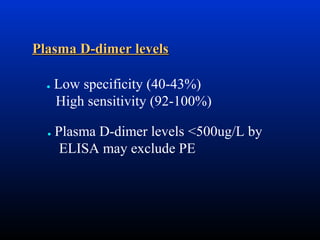
Plasma D-dimer levels
●

●

Low specificity (40-43%)
High sensitivity (92-100%)
Plasma D-dimer levels <500ug/L by
ELISA may exclude PE
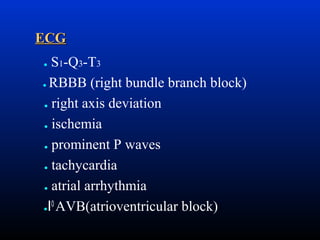
ECG
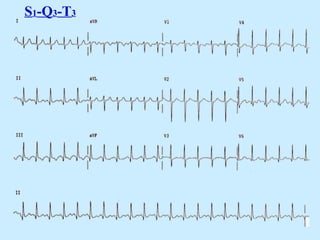
S1-Q3-T3
● RBBB (right bundle branch block)
● right axis deviation
● ischemia
● prominent P waves
● tachycardia
● atrial arrhythmia
0
●Ⅰ AVB(atrioventricular block)
●
S1-Q3-T3
Arterial Blood Gas
● hypoxemia ( Po )
2
●

●

respiratory alkalosis ( Pco2 )
increased A-a(Alveoli-artery) gradient
Chest Radiograph
can be normal
● pulmonary infiltrate
● pleural effusion
● elevated hemidiaphragm
● atelectasis
● Hampton’s hump ( a pleural-based,
wedge-shaped infiltrate )

●
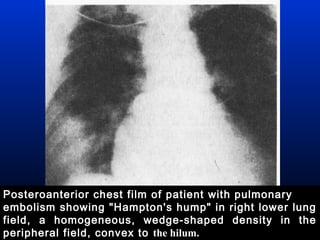
Posteroanterior chest film of patient with pulmonary
embolism showing "Hampton's hump" in right lower lung
field, a homogeneous, wedge-shaped density in the
peripheral field, convex to the hilum.
Ventilation/Perfusion Lung Scanning
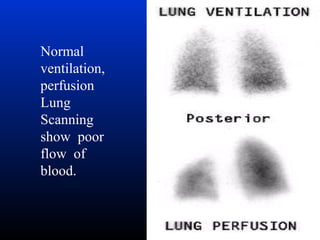
Ventilation Lung Scanning is normal,
and perfusion Lung Scanning can show
poor flow of blood in areas beyond
blocked arteries.
Normal
ventilation,
perfusion
Lung
Scanning
show poor
flow of
blood.
Pulmonary Angiography
The most reliable test for diagnosing
pulmonary embolism (“gold standard”)
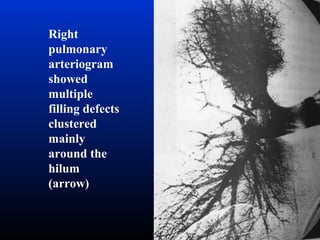
Right
pulmonary
arteriogram
showed
multiple
filling defects
clustered
mainly
around the
hilum
(arrow)
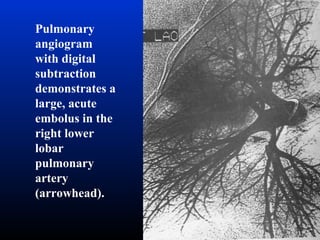
Pulmonary
angiogram
with digital
subtraction
demonstrates a
large, acute
embolus in the
right lower
lobar
pulmonary
artery
(arrowhead).
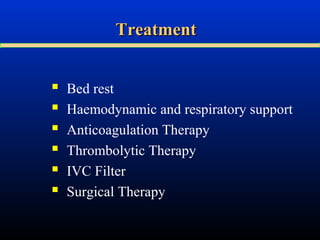
Treatment







Bed rest
Haemodynamic and respiratory support
Anticoagulation Therapy
Thrombolytic Therapy
IVC Filter
Surgical Therapy
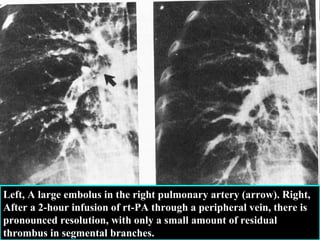
Left, A large embolus in the right pulmonary artery (arrow). Right,
After a 2-hour infusion of rt-PA through a peripheral vein, there is
pronounced resolution, with only a small amount of residual
thrombus in segmental branches.
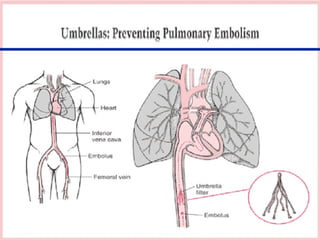
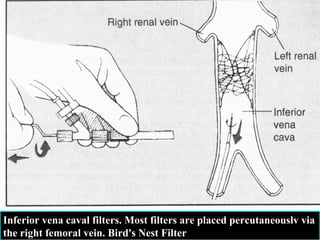
Inferior vena caval filters. Most filters are placed percutaneouslv via
the right femoral vein. Bird's Nest Filter
Prognosis
About 10% of patients with pulmonary
embolism die suddenly within the first hour of
onset of the condition. The outcome for all
other patients is generally good; only 3% of
patients who are properly diagnosed and
treated die. In cases of undiagnosed pulmonary
embolism, about 30% of patients die.
Prevention
Pulmonary embolism risk can be
reduced in certain patients through
judicious use of antithrombotic drugs
such as heparin, venous interruption,
gradient elastic stockings and/or
intermittent pneumatic compression of
the legs.
Fat embolism
 Soft

tissue crush injury or rupture of
marrow vascular sinusoids (long bone
fracture) releases microscopic fat globules
into the circulation.
 fat and marrow embolism occurs in some
90% of individuals with severe skeletal
injuries but less than 10% show any clinical
findings.
 The

pathogenesis of fat emboli syndrome
involves both mechanical obstruction and
biochemical injury. Fat microemboli
occlude pulmonary and cerebral
microvasculature, both directly and by
triggering platelet aggregation.
Air embolism
 Gas

bubbles within the circulation can
obstruct vascular flow and cause distal
ischemic injury.
 a small volume of air trapped in a coronary
artery during bypass surgery or introduced
into the cerebral arterial circulation by
neurosurgery performed in an upright
“sitting position” can occlude flow, with
dire consequences


A particular form of gas embolism called decompression
sickness is caused by sudden changes in atmospheric
pressure. Thus, scuba divers, underwater construction
workers, and persons in unpressurized aircraft who
undergo rapid ascent are at risk. When air is breathed at
high pressure (e.g., during a deep sea dive), increased
amounts of gas (particularly nitrogen) become dissolved in
the blood and tissues. If the diver then ascends
(depressurizes) too rapidly, the nitrogen expands in the
tissues and bubbles out of solution in the blood to form gas
emboli, which cause tissue ischemia.
Amniotic fluid embolism
 The

underlying cause is entry of amniotic
fluid (and its contents) into the maternal
circulation via tears in the placental
membranes and/or uterine vein rupture.
Thromboembolism,pulmonary embolism,general pathology

Thromboembolism,pulmonary embolism,general pathology

  • 1.
    Thromboembolism DR MUHAMMAD ALIBASHIR. PATHALOGY DEPT.
  • 2.
    EMBOLISM  An embolus isan intravascular solid, liquid, or gaseous mass that is carried by the blood to a site distant from its point of origin.  The vast majority of emboli derive from a dislodged thrombus—hence the term thromboembolism.
  • 3.
    Key Terms Emboli ● Thrombosis ●Deep vein thrombosis ●
  • 4.
    • Emboli Clots orother substances that travel through the blood stream and get stuck in a blood vessel, blocking circulation.
  • 5.
    • Thrombosis The developmentof a blood clot inside a blood vessel.
  • 6.
    •Deep vein thrombosis Thedevelopment of a blood clot in the calf's deep vein. This frequently leads to pulmonary embolism if untreated.
  • 7.
     Most common ispulmonary embolism.  Less common types include: fat embolism,air embolism,amniotic fluid embolism.
  • 8.
    • Pulmonary embolism Theocclusion of one or more vessels in the pulmonary arterial tree by matter from a source extrinsic to the lung. The process is almost invariably acuate but may on occasion be chronic.
  • 9.
    How dose pulmonaryembolism occur ?
  • 10.
    Prevalence & Incidence ofP.E The term 'prevalence' of pulmonary embolism usually refers to the estimated population of people who are managing pulmonary embolism at any given time. ● The term 'incidence’ of pulmonary embolism refers to the annual diagnosis rate, or the number of new cases of pulmonary embolism diagnosed each year. ●
  • 11.
    Incidence (annual): approximately 650,000cases in the USA Incidence Rate: approx 1 in 418 or 0.24% in USA
  • 12.
    Etiology Pulmonary embolism iscaused by emboli that travel through the blood stream to the lungs and block a pulmonary artery. When this occurs, circulation and oxygenation of blood is compromised. The emboli are usually formed from blood clots but are occasionally comprised of air, fat, amniotic fluid, tumor tissue, or particulate matter from intravenous injection, etc.
  • 14.
    Common risk factorsfor pulmonary embolism: congestive heart failure; leukemia; polycythemia; sickle cell anemia; dysproteinemias; massive obesity; immobility; cancer; pregnancy; oral contraceptives; the early postpartum period; surgery; DVT; hypercoagulable states; right heart failure; fractures of the pelvic and lower extremities etc.
  • 15.
    Risk factors forpulmonary thromboembolism include: any cause of venous stasis such as: ① venous valvular insufficiency ② right-side HF ③ the postoperative period ④ prolonged bed rest
  • 16.
    Pathophysiology Pulmonary embolism canhave the following pathophysiological effects: Increased pulmonary vascular resistance due to vascular obstruction, neurohumoral agents, or pulmonary artery baroreceptors.  Alveolar hyperventilation due to reflex stimulation of irritant receptors.
  • 17.
    Impaired gas exchangedue to increased alveolar dead space from vascular obstruction and hypoxemia, V/Q mismatch. Increased airway resistance due to bronchoconstriction. Decreased pulmonary compliance due to lung edema, lung hemorrhage,and loss of surfactant.
  • 18.
    Symptoms Each individual mayexperience symptoms differently, which depend on the size and number of emboli.
  • 19.
    chest pain ● laboredbreathing, dyspnea, cyanosis ● cough ● syncope ● anxiety ● a rapid pulse. ● a low fever ● hypotension, shock ● fluid build-up in the lungs ●
  • 20.
    Diagnosis The diagnosis ofpulmonary embolism should be based on the patient's history, physical exam, and diagnostic tests.
  • 21.
    Symptoms & Signs ●Plasma D-dimer levels ● ECG ● Arterial Blood Gas ● Chest Radiograph ● Ventilation/Perfusion Lung Scanning ● Pulmonary Angiography ●
  • 22.
    Plasma D-dimer levels ● ● Lowspecificity (40-43%) High sensitivity (92-100%) Plasma D-dimer levels <500ug/L by ELISA may exclude PE
  • 23.
    ECG S1-Q3-T3 ● RBBB (rightbundle branch block) ● right axis deviation ● ischemia ● prominent P waves ● tachycardia ● atrial arrhythmia 0 ●Ⅰ AVB(atrioventricular block) ●
  • 24.
  • 25.
    Arterial Blood Gas ●hypoxemia ( Po ) 2 ● ● respiratory alkalosis ( Pco2 ) increased A-a(Alveoli-artery) gradient
  • 26.
    Chest Radiograph can benormal ● pulmonary infiltrate ● pleural effusion ● elevated hemidiaphragm ● atelectasis ● Hampton’s hump ( a pleural-based, wedge-shaped infiltrate ) ●
  • 27.
    Posteroanterior chest filmof patient with pulmonary embolism showing "Hampton's hump" in right lower lung field, a homogeneous, wedge-shaped density in the peripheral field, convex to the hilum.
  • 28.
    Ventilation/Perfusion Lung Scanning VentilationLung Scanning is normal, and perfusion Lung Scanning can show poor flow of blood in areas beyond blocked arteries.
  • 29.
  • 30.
    Pulmonary Angiography The mostreliable test for diagnosing pulmonary embolism (“gold standard”)
  • 31.
  • 32.
    Pulmonary angiogram with digital subtraction demonstrates a large,acute embolus in the right lower lobar pulmonary artery (arrowhead).
  • 34.
    Treatment       Bed rest Haemodynamic andrespiratory support Anticoagulation Therapy Thrombolytic Therapy IVC Filter Surgical Therapy
  • 35.
    Left, A largeembolus in the right pulmonary artery (arrow). Right, After a 2-hour infusion of rt-PA through a peripheral vein, there is pronounced resolution, with only a small amount of residual thrombus in segmental branches.
  • 37.
    Inferior vena cavalfilters. Most filters are placed percutaneouslv via the right femoral vein. Bird's Nest Filter
  • 38.
    Prognosis About 10% ofpatients with pulmonary embolism die suddenly within the first hour of onset of the condition. The outcome for all other patients is generally good; only 3% of patients who are properly diagnosed and treated die. In cases of undiagnosed pulmonary embolism, about 30% of patients die.
  • 39.
    Prevention Pulmonary embolism riskcan be reduced in certain patients through judicious use of antithrombotic drugs such as heparin, venous interruption, gradient elastic stockings and/or intermittent pneumatic compression of the legs.
  • 40.
    Fat embolism  Soft tissuecrush injury or rupture of marrow vascular sinusoids (long bone fracture) releases microscopic fat globules into the circulation.  fat and marrow embolism occurs in some 90% of individuals with severe skeletal injuries but less than 10% show any clinical findings.
  • 41.
     The pathogenesis offat emboli syndrome involves both mechanical obstruction and biochemical injury. Fat microemboli occlude pulmonary and cerebral microvasculature, both directly and by triggering platelet aggregation.
  • 42.
    Air embolism  Gas bubbleswithin the circulation can obstruct vascular flow and cause distal ischemic injury.  a small volume of air trapped in a coronary artery during bypass surgery or introduced into the cerebral arterial circulation by neurosurgery performed in an upright “sitting position” can occlude flow, with dire consequences
  • 43.
     A particular formof gas embolism called decompression sickness is caused by sudden changes in atmospheric pressure. Thus, scuba divers, underwater construction workers, and persons in unpressurized aircraft who undergo rapid ascent are at risk. When air is breathed at high pressure (e.g., during a deep sea dive), increased amounts of gas (particularly nitrogen) become dissolved in the blood and tissues. If the diver then ascends (depressurizes) too rapidly, the nitrogen expands in the tissues and bubbles out of solution in the blood to form gas emboli, which cause tissue ischemia.
  • 44.
    Amniotic fluid embolism The underlying cause is entry of amniotic fluid (and its contents) into the maternal circulation via tears in the placental membranes and/or uterine vein rupture.