A few short notes in forensic
medicine
M. Harini Priyadharshini
II MBBS
JUDICIAL HANGING
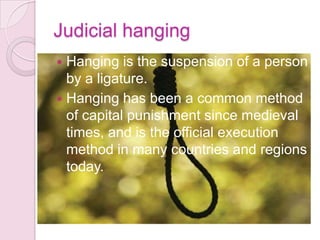
Judicial hanging
๏‚— Hanging is the suspension of a person
by a ligature.
๏‚— Hanging has been a common method
of capital punishment since medieval
times, and is the official execution
method in many countries and regions
today.
๏‚— In India legal death sentence is carried
out by hanging the criminal.
๏‚— A rope to allow a drop of 5 to 7 meters
(according to the personโ€™s build and
age) is looped around the neck.
๏‚— The placement of the knot in the sub-
mental position is said to be more
effective
๏‚— Death is usually by a fracture
dislocation noramlly at the leve of C2
and C3 or C3 and C4 vertebrae.
Contd.,
๏‚— With proper judicial hanging there is a
rupture of brainstem between Pons
and medulla.
๏‚— This results :
1. Instantaneous and irreversible loss of
consciousness
2. Irreversible apnea.
๏‚— Heart beats and respiratory
movements may continue for 15 min
approx.
๏‚— The victim is found to have a
epileptic attack due to a sudden and
Classification of hanging
Complete
โ€ข When the whole
body hangs off the
ground and the
entire weight of the
victim is suspended
at the neck, the
hanging is said to
be complete
Incomplete
โ€ข Incomplete
hangings imply that
some part of the
body is touching the
ground and that the
weight of the victim
is not fully
supported by the
neck
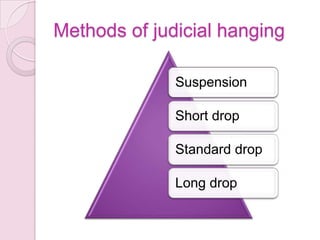
Methods of judicial hanging
Suspension
Short drop
Standard drop
Long drop
Suspension
๏‚— Suspension, like the short
drop, causes death by using the
weight of the body to tighten the
trachea with the noose.
Short drop
๏‚— The short drop is performed by placing
the condemned prisoner on the back
of a cart, horse, or other vehicle, with
the noose around the neck.
๏‚— The object is then moved away,
leaving the person dangling from the
rope
Death by hanging -
Mechanisms
๏‚— Closure of carotid arteries causing
cerebral ischemia
๏‚— Closure of the jugular veins
๏‚— Induction of carotid sinus reflex
death, which reduces heartbeat when
the pressure in the carotid arteries is
high, causing cardiac arrest
๏‚— Breaking of the neck (cervical fracture)
causing traumatic spinal cord injury or
even decapitation
๏‚— Closure of the airway
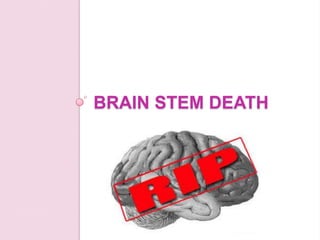
BRAIN STEM DEATH
Brain stem death ?
๏‚— Brain stem death is a clinical
syndrome defined by the absence of
reflexes with pathways through the
brain stem in a deeply comatose,
ventilator-dependent, patient.
The concept of brain stem death
legally accepted in India
๏‚— permits the diagnosis and certification
of death on the premise that a person
is dead when consciousness and the
ability to breathe are permanently
lost, regardless of continuing life in the
body and parts of the brain, and that
death of the brain stem alone is
sufficient to produce this state
Transplantation of Human Organ
Act of 1994
๏‚— to make a diagnosis of brainstem death
requires a panel of four doctors
consisting of:
1. the doctor in charge of the patient,
2. the doctor in charge of the hospital where the
patient was treated
3. independent specialist of unspecified specialty
4. neurologist or a neurosurgeon
๏‚— The burden of proof rests with the
specialist of the neurosciences, with the
other members confirming the
diagnosis
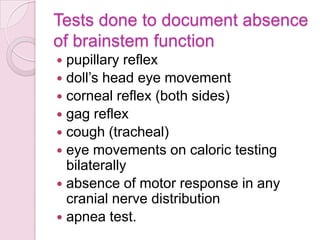
Tests done to document absence
of brainstem function
๏‚— pupillary reflex
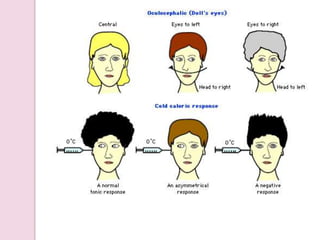
๏‚— dollโ€™s head eye movement
๏‚— corneal reflex (both sides)
๏‚— gag reflex
๏‚— cough (tracheal)
๏‚— eye movements on caloric testing
bilaterally
๏‚— absence of motor response in any
cranial nerve distribution
๏‚— apnea test.
SECTION 84 IPC
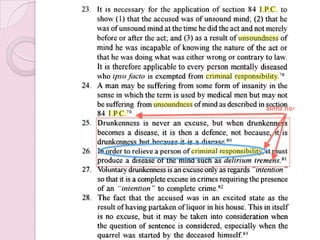
Section 84 IPC
๏‚— Act of a person of unsound mind.--
Nothing is an offence which is done by
a person who, at the time of doing
it, by reason of unsoundness of
mind, is incapable of knowing the
nature of the act, or that he is doing
what is either wrong or contrary to law.
TEST FOR LIVE BIRTH
Live birth ?
๏‚— In human reproduction, a live birth
occurs when a fetus, whatever its
gestational age, exits the maternal
body and subsequently shows any
sign of life, such as voluntary
movement, heartbeat, or pulsation of
the umbilical cord, for however brief a
time and regardless of whether the
umbilical cord or placenta are intact.
Tests for live birth
๏‚— Shape of chest :
before respiration the chest is
flat, after respiration the chest
becomes arched of drum shaped
๏‚— Position of the diaphragm
4th or 5th rib โ€“ before respiration
6th or 7th rib after respiration
๏‚— Lungs:
๏ƒ˜ Volume: unrespired lungs appear smaller
๏ƒ˜ Margin: before respiration margins are sharp
๏ƒ˜ Consistency: before respiration lungs are
dense and firm
๏ƒ˜ Colour and expansion of air vesicles
๏ƒ˜ Gas
๏ƒ˜ Blood in the lung beds
๏ƒ˜ Weight
๏‚— Changes in the stomach and intestine:
they float in water if respiration has
taken place.
๏‚— Changes in the middle ear:
before birth the middle ear
contains gelatinous embryonic
connective tissue
๏‚— Other signs:
๏ฑBlood: nucleated RBC usually
disappear within 24 hrs
๏ฑMeconium: completely excreted within
24 to 48 hrs
๏ฑCaput succedaneum: gradually
disappears within a week after birth
๏ฑSkin: skin becomes darker on 2nd or 3rd
day
๏ฑUmbilical cord: blood clots in the cut
end 2hrs after birth
๏ฑCirculation: contraction of umbilical
arteries starts in 10 hours and are
completely closed by 3rd day.
Live birth is probable when
๏‚— All lobes of lung are fully expanded
๏‚— There is edema of lung especially
gross
๏‚— An alveolar duct membrane is present
and has widespread distribution in the
lungs.
๏‚— Contusions of the lung are present
A few short notes in forensic medicine

A few short notes in forensic medicine

  • 1.
    A few shortnotes in forensic medicine M. Harini Priyadharshini II MBBS
  • 2.
  • 3.
    Judicial hanging ๏‚— Hangingis the suspension of a person by a ligature. ๏‚— Hanging has been a common method of capital punishment since medieval times, and is the official execution method in many countries and regions today.
  • 4.
    ๏‚— In Indialegal death sentence is carried out by hanging the criminal. ๏‚— A rope to allow a drop of 5 to 7 meters (according to the personโ€™s build and age) is looped around the neck. ๏‚— The placement of the knot in the sub- mental position is said to be more effective ๏‚— Death is usually by a fracture dislocation noramlly at the leve of C2 and C3 or C3 and C4 vertebrae.
  • 5.
    Contd., ๏‚— With properjudicial hanging there is a rupture of brainstem between Pons and medulla. ๏‚— This results : 1. Instantaneous and irreversible loss of consciousness 2. Irreversible apnea. ๏‚— Heart beats and respiratory movements may continue for 15 min approx. ๏‚— The victim is found to have a epileptic attack due to a sudden and
  • 6.
    Classification of hanging Complete โ€ขWhen the whole body hangs off the ground and the entire weight of the victim is suspended at the neck, the hanging is said to be complete Incomplete โ€ข Incomplete hangings imply that some part of the body is touching the ground and that the weight of the victim is not fully supported by the neck
  • 7.
    Methods of judicialhanging Suspension Short drop Standard drop Long drop
  • 8.
    Suspension ๏‚— Suspension, likethe short drop, causes death by using the weight of the body to tighten the trachea with the noose.
  • 9.
    Short drop ๏‚— Theshort drop is performed by placing the condemned prisoner on the back of a cart, horse, or other vehicle, with the noose around the neck. ๏‚— The object is then moved away, leaving the person dangling from the rope
  • 10.
    Death by hanging- Mechanisms ๏‚— Closure of carotid arteries causing cerebral ischemia ๏‚— Closure of the jugular veins ๏‚— Induction of carotid sinus reflex death, which reduces heartbeat when the pressure in the carotid arteries is high, causing cardiac arrest ๏‚— Breaking of the neck (cervical fracture) causing traumatic spinal cord injury or even decapitation ๏‚— Closure of the airway
  • 11.
  • 12.
    Brain stem death? ๏‚— Brain stem death is a clinical syndrome defined by the absence of reflexes with pathways through the brain stem in a deeply comatose, ventilator-dependent, patient.
  • 13.
    The concept ofbrain stem death legally accepted in India ๏‚— permits the diagnosis and certification of death on the premise that a person is dead when consciousness and the ability to breathe are permanently lost, regardless of continuing life in the body and parts of the brain, and that death of the brain stem alone is sufficient to produce this state
  • 14.
    Transplantation of HumanOrgan Act of 1994 ๏‚— to make a diagnosis of brainstem death requires a panel of four doctors consisting of: 1. the doctor in charge of the patient, 2. the doctor in charge of the hospital where the patient was treated 3. independent specialist of unspecified specialty 4. neurologist or a neurosurgeon ๏‚— The burden of proof rests with the specialist of the neurosciences, with the other members confirming the diagnosis
  • 15.
    Tests done todocument absence of brainstem function ๏‚— pupillary reflex ๏‚— dollโ€™s head eye movement ๏‚— corneal reflex (both sides) ๏‚— gag reflex ๏‚— cough (tracheal) ๏‚— eye movements on caloric testing bilaterally ๏‚— absence of motor response in any cranial nerve distribution ๏‚— apnea test.
  • 17.
  • 18.
    Section 84 IPC ๏‚—Act of a person of unsound mind.-- Nothing is an offence which is done by a person who, at the time of doing it, by reason of unsoundness of mind, is incapable of knowing the nature of the act, or that he is doing what is either wrong or contrary to law.
  • 20.
  • 21.
    Live birth ? ๏‚—In human reproduction, a live birth occurs when a fetus, whatever its gestational age, exits the maternal body and subsequently shows any sign of life, such as voluntary movement, heartbeat, or pulsation of the umbilical cord, for however brief a time and regardless of whether the umbilical cord or placenta are intact.
  • 22.
    Tests for livebirth ๏‚— Shape of chest : before respiration the chest is flat, after respiration the chest becomes arched of drum shaped ๏‚— Position of the diaphragm 4th or 5th rib โ€“ before respiration 6th or 7th rib after respiration
  • 23.
    ๏‚— Lungs: ๏ƒ˜ Volume:unrespired lungs appear smaller ๏ƒ˜ Margin: before respiration margins are sharp ๏ƒ˜ Consistency: before respiration lungs are dense and firm ๏ƒ˜ Colour and expansion of air vesicles ๏ƒ˜ Gas ๏ƒ˜ Blood in the lung beds ๏ƒ˜ Weight
  • 24.
    ๏‚— Changes inthe stomach and intestine: they float in water if respiration has taken place. ๏‚— Changes in the middle ear: before birth the middle ear contains gelatinous embryonic connective tissue
  • 25.
    ๏‚— Other signs: ๏ฑBlood:nucleated RBC usually disappear within 24 hrs ๏ฑMeconium: completely excreted within 24 to 48 hrs ๏ฑCaput succedaneum: gradually disappears within a week after birth ๏ฑSkin: skin becomes darker on 2nd or 3rd day ๏ฑUmbilical cord: blood clots in the cut end 2hrs after birth ๏ฑCirculation: contraction of umbilical arteries starts in 10 hours and are completely closed by 3rd day.
  • 26.
    Live birth isprobable when ๏‚— All lobes of lung are fully expanded ๏‚— There is edema of lung especially gross ๏‚— An alveolar duct membrane is present and has widespread distribution in the lungs. ๏‚— Contusions of the lung are present