CONVERSATION SKILLS
BY
RANJIT THOMAS
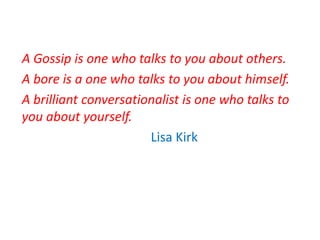
A Gossip is one who talks to you about others.
A bore is a one who talks to you about himself.
A brilliant conversationalist is one who talks to
you about yourself.
Lisa Kirk
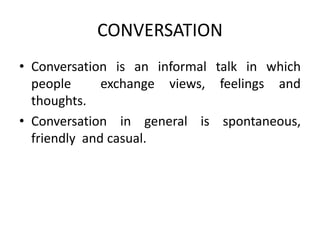
CONVERSATION
• Conversation is an informal talk in which
people exchange views, feelings and
thoughts.
• Conversation in general is spontaneous,
friendly and casual.
Social Conversation
• Social conversation, also known as chit-chat or
small talk attempts to establish a sociable
atmosphere.
• At a tea-party or social gathering, the
conversation reveals feelings of togetherness,
rather than communicating ideas or any specific
meaning.
• Words are used in symbolic ways as verbal social
gestures. This social use of words is known as
phatic communion.
Examples
• It was a pleasure meeting you.
• Do come again.
• How is your family?
Effective Conversation-Features
• It takes place face- to- face and the
participants can see and hear each other at
the same time.
• It is sensitive and flexible in that it can change
quickly according to the participant’s
reactions.
Conversation Control
• Conversation control refers to the skills of
listening and talking in a positive and
meaningful way at an appropriate time.
• Conversation control helps participants
conclude and conclude their conversation
effectively and satisfactorily with mutual
understanding and agreement.
Applications of Conversation Control
skills in Business
• Selling and buying
• Negotiating
• Interviewing
• Participating in meetings
• Disagreeing without being rude
• Protesting without offending
• Complimentary/ praising
• Responding to personal criticism
Situations where conversational skills
are useful
• Interacting with people in meetings in a
convincing way.
• Handling objections to a proposal.
• Being able to react to criticism in a confident
manner.
• Developing skills in interviewing.
• Learning how to get correct information
quickly.
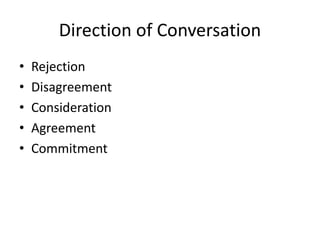
Direction of Conversation
• Rejection
• Disagreement
• Consideration
• Agreement
• Commitment
Managing negative responses
• Show that you do not doubt the positive
intentions of the other person.
• Use expressions such as “ You are right about
that, but “Avoid completely rejecting the other
person’s arguments.
• Do not use negative expressions. Instead of
saying “ Perhaps you do not know” try
Perhaps you know.
Techniques of Conversation Control
• Recognising cues and clues.
• Interpreting signs and signals
• Avoiding Parallel Conversation
• Practising Sequential Conversation
• Using Reflection and Empathy
• Cultivate a sense of timing
Noticing and Recognising Cues and
Clues
• A cue is a keyword or phrase a speaker uses
when he or she wants to indicate that
something is important to him or her.
• A clue is a word or set of words that someone
says to us.
• For Example – Let us discuss the teaching-
learning function of the case study method in
management studies.
Interpreting signs and Signals
• Conversation is composed of verbal and visual
indicators.
• Verbal Indicators involve cues given and clues
received.
• Visual indicators consists of signs given and
signals received.
• Signs consist of visual indicators such as smiles,
eye movements and so on.
For Ex- Drinking water every 10 minutes is a sign
of thirst.
Avoiding Parallel Conversation
• Parallel conversation is a type of conversation
where there is an exchange of information
without either speaker listening to the other.
ARE YOU LISTENING?
Most of us engage in PARALLEL conversations
Example:
1st Speaker: I have a dog.
2nd Speaker: I have a dog too.
1st Speaker: My dog is a Border Collie.
2nd Speaker: My dog is a Shepherd.
1st Speaker: My dog is really smart like its owner.
2nd Speaker: My dog is considered the smartest
breed.
1st Speaker and 2nd speaker are not listening to
each other.
Practising Sequential Conversation
• Sequential Conversation is a kind of
conversation where the listener carries
forward the conversation in a connected and
sequential manner.
• There is a logical link between the statements
given by the speaker and the listener.
An Example
• 1st Speaker: I have a dog.
• 2nd Speaker: Really? What kind of dog?
• 1st Speaker: My dog is a Border Collie.
• 2nd Speaker: That's a cool breed. How old is s/he?
• 1st Speaker: She is 10.
• 2nd Speaker: Where does she stay, inside or outside?
• 1st Speaker: Oh, both. She sleeps inside but loves to
be outside
Using Reflection and Empathy
• In verbal communication, the most important
skill is to demonstrate a genuine interest in
the other person.
• Both participants should be able to pick up
cues and reflect upon their meaning.
• The purpose of reflecting on something is to
help the other person understand his/her
feelings with greater clarity and precision.
• One may repeat the feelings expressed by the
other person- this should be done objectively
without changing, adding their statements.
• It is important to make eye contact, lean
forward and speak with genuine concern for
the other person.
An Example
• Anuj says to Bharat: I am not sure if I am
required here any longer.
• Bharat says to Anuj: You feel your contribution
is not recognised. What can be done to
change this?
This would allow Anuj to explore his own feelings
with greater clarity and understanding.
Cultivate a sense of timing
• The speaker should always keep in mind the
time taken to communicate.
• The time limits announced in formal oral
activities should be strictly observed.
Summarizing
• Summarizing is the best form of expressing
comprehension.
• To summarize is to pick out the central
thought – the main theme or the essential
idea – at the core of the whole argument.
• The speaker should summarize the content of
talk at the end and ask feedback from the
audience.
Applications of Conversation Control
• Meetings
• The Agenda as a Control
• Chairperson
• Being assertive without being aggressive
• Controlled response to conversational attacks
• Negotiating through conversational control

Conversation control

  • 1.
  • 2.
    A Gossip isone who talks to you about others. A bore is a one who talks to you about himself. A brilliant conversationalist is one who talks to you about yourself. Lisa Kirk
  • 3.
    CONVERSATION • Conversation isan informal talk in which people exchange views, feelings and thoughts. • Conversation in general is spontaneous, friendly and casual.
  • 4.
    Social Conversation • Socialconversation, also known as chit-chat or small talk attempts to establish a sociable atmosphere. • At a tea-party or social gathering, the conversation reveals feelings of togetherness, rather than communicating ideas or any specific meaning. • Words are used in symbolic ways as verbal social gestures. This social use of words is known as phatic communion.
  • 5.
    Examples • It wasa pleasure meeting you. • Do come again. • How is your family?
  • 6.
    Effective Conversation-Features • Ittakes place face- to- face and the participants can see and hear each other at the same time. • It is sensitive and flexible in that it can change quickly according to the participant’s reactions.
  • 7.
    Conversation Control • Conversationcontrol refers to the skills of listening and talking in a positive and meaningful way at an appropriate time. • Conversation control helps participants conclude and conclude their conversation effectively and satisfactorily with mutual understanding and agreement.
  • 8.
    Applications of ConversationControl skills in Business • Selling and buying • Negotiating • Interviewing • Participating in meetings • Disagreeing without being rude • Protesting without offending • Complimentary/ praising • Responding to personal criticism
  • 9.
    Situations where conversationalskills are useful • Interacting with people in meetings in a convincing way. • Handling objections to a proposal. • Being able to react to criticism in a confident manner. • Developing skills in interviewing. • Learning how to get correct information quickly.
  • 10.
    Direction of Conversation •Rejection • Disagreement • Consideration • Agreement • Commitment
  • 11.
    Managing negative responses •Show that you do not doubt the positive intentions of the other person. • Use expressions such as “ You are right about that, but “Avoid completely rejecting the other person’s arguments. • Do not use negative expressions. Instead of saying “ Perhaps you do not know” try Perhaps you know.
  • 12.
    Techniques of ConversationControl • Recognising cues and clues. • Interpreting signs and signals • Avoiding Parallel Conversation • Practising Sequential Conversation • Using Reflection and Empathy • Cultivate a sense of timing
  • 13.
    Noticing and RecognisingCues and Clues • A cue is a keyword or phrase a speaker uses when he or she wants to indicate that something is important to him or her. • A clue is a word or set of words that someone says to us. • For Example – Let us discuss the teaching- learning function of the case study method in management studies.
  • 14.
    Interpreting signs andSignals • Conversation is composed of verbal and visual indicators. • Verbal Indicators involve cues given and clues received. • Visual indicators consists of signs given and signals received. • Signs consist of visual indicators such as smiles, eye movements and so on. For Ex- Drinking water every 10 minutes is a sign of thirst.
  • 15.
    Avoiding Parallel Conversation •Parallel conversation is a type of conversation where there is an exchange of information without either speaker listening to the other.
  • 16.
    ARE YOU LISTENING? Mostof us engage in PARALLEL conversations Example: 1st Speaker: I have a dog. 2nd Speaker: I have a dog too. 1st Speaker: My dog is a Border Collie. 2nd Speaker: My dog is a Shepherd. 1st Speaker: My dog is really smart like its owner. 2nd Speaker: My dog is considered the smartest breed. 1st Speaker and 2nd speaker are not listening to each other.
  • 17.
    Practising Sequential Conversation •Sequential Conversation is a kind of conversation where the listener carries forward the conversation in a connected and sequential manner. • There is a logical link between the statements given by the speaker and the listener.
  • 18.
    An Example • 1stSpeaker: I have a dog. • 2nd Speaker: Really? What kind of dog? • 1st Speaker: My dog is a Border Collie. • 2nd Speaker: That's a cool breed. How old is s/he? • 1st Speaker: She is 10. • 2nd Speaker: Where does she stay, inside or outside? • 1st Speaker: Oh, both. She sleeps inside but loves to be outside
  • 19.
    Using Reflection andEmpathy • In verbal communication, the most important skill is to demonstrate a genuine interest in the other person. • Both participants should be able to pick up cues and reflect upon their meaning.
  • 20.
    • The purposeof reflecting on something is to help the other person understand his/her feelings with greater clarity and precision. • One may repeat the feelings expressed by the other person- this should be done objectively without changing, adding their statements. • It is important to make eye contact, lean forward and speak with genuine concern for the other person.
  • 21.
    An Example • Anujsays to Bharat: I am not sure if I am required here any longer. • Bharat says to Anuj: You feel your contribution is not recognised. What can be done to change this? This would allow Anuj to explore his own feelings with greater clarity and understanding.
  • 22.
    Cultivate a senseof timing • The speaker should always keep in mind the time taken to communicate. • The time limits announced in formal oral activities should be strictly observed.
  • 23.
    Summarizing • Summarizing isthe best form of expressing comprehension. • To summarize is to pick out the central thought – the main theme or the essential idea – at the core of the whole argument. • The speaker should summarize the content of talk at the end and ask feedback from the audience.
  • 24.
    Applications of ConversationControl • Meetings • The Agenda as a Control • Chairperson • Being assertive without being aggressive • Controlled response to conversational attacks • Negotiating through conversational control