LESSON FOR WEEK THREE
Chapter 3

PLANNING THE BUSINESS MESSAGE
Step 1 - Planning
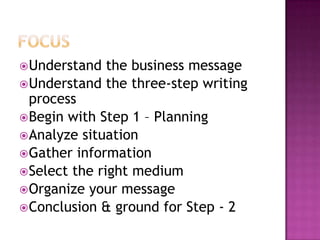
 Understand

the business message
 Understand the three-step writing
process
 Begin with Step 1 – Planning
 Analyze situation
 Gather information
 Select the right medium
 Organize your message
 Conclusion & ground for Step - 2
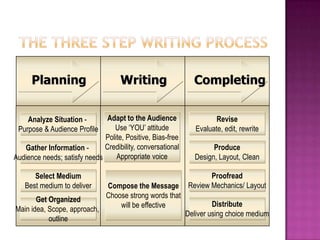
Planning

Writing

Adapt to the Audience
Use ‘YOU’ attitude
Polite, Positive, Bias-free
Credibility, conversational
Gather Information Appropriate voice
Audience needs; satisfy needs
Analyze Situation Purpose & Audience Profile

Select Medium
Best medium to deliver
Get Organized
Main idea, Scope, approach,
outline

Compose the Message
Choose strong words that
will be effective

Completing
Revise
Evaluate, edit, rewrite
Produce
Design, Layout, Clean
Proofread
Review Mechanics/ Layout
Distribute
Deliver using choice medium
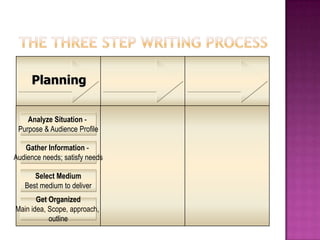
Planning
Analyze Situation Purpose & Audience Profile
Gather Information Audience needs; satisfy needs
Select Medium
Best medium to deliver
Get Organized
Main idea, Scope, approach,
outline
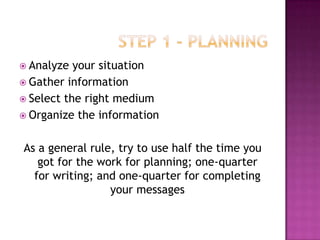
 Analyze

your situation
 Gather information
 Select the right medium
 Organize the information
As a general rule, try to use half the time you
got for the work for planning; one-quarter
for writing; and one-quarter for completing
your messages
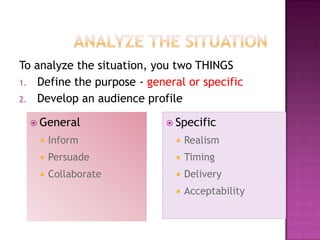
To analyze the situation, you two THINGS
1. Define the purpose - general or specific
2. Develop an audience profile
 General

 Specific



Inform



Realism



Persuade



Timing



Collaborate



Delivery



Acceptability
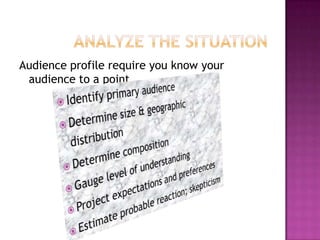
Audience profile require you know your
audience to a point
Gathering information is a herculean task that
demands tact and time. Techniques that could
help include:
 Seek viewpoints of others


Read reports and other company documents



Interview supervisors, colleagues, customers



Ask your audience for input



Informal chat with customers, employees

In so doing you will be able to uncover audience
need and satisfy same by providing required
information
Uncovering audience needs


Sometimes needs are known, apparent; then act
on them and advice



Most times they are not clear; then ask questions
and be suggestive

Providing required information


Be sure information is accurate



Be sure information is ethical



Be sure information is complete



Be sure information is pertinent
 Selecting

the best medium can make the
difference between effective & ineffective
communication

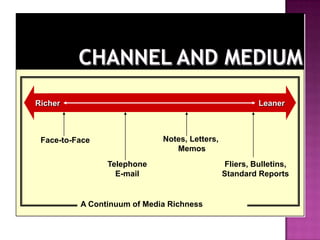
 Media



Leaner




leanness & richness

Fliers, bulletins, and reports

Richer


Conversations, meetings, presentations

 Thus

your medium could be oral, written,
visual or electronic
Richer

Leaner

Notes, Letters,
Memos

Face-to-Face
Telephone
E-mail

A Continuum of Media Richness

Fliers, Bulletins,
Standard Reports
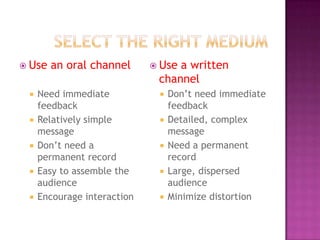
 Use







an oral channel

Need immediate
feedback
Relatively simple
message
Don’t need a
permanent record
Easy to assemble the
audience
Encourage interaction

 Use

a written
channel







Don’t need immediate
feedback
Detailed, complex
message
Need a permanent
record
Large, dispersed
audience
Minimize distortion


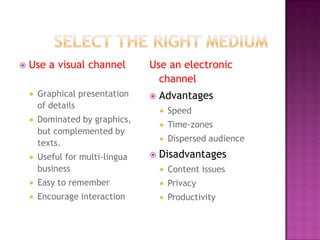
Use a visual channel






Graphical presentation
of details

Use an electronic
channel




Time-zones





Speed



Dominated by graphics,
but complemented by
texts.
Useful for multi-lingua
business

Advantages

Dispersed audience

Disadvantages


Content issues



Easy to remember



Privacy



Encourage interaction



Productivity
WRITTEN






Memo
Letters
Proposals
Reports
ELECTRONIC


Oral – phone calls,
teleconferencing, internet
telephony, VoIP [skype, Tango]



Written – IM, email, hangout, blogs,
websites, wikis
Visual - PPT, computer animation,
video [vidcasts, vblogs],
multimedia


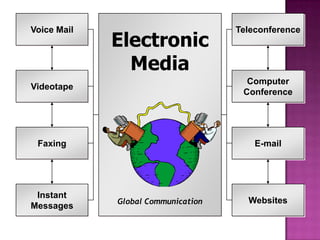
Voice Mail

Electronic
Media

Teleconference

Videotape

Computer
Conference

Faxing

E-mail

Instant
Messages

Global Communication

Websites
Factors to consider when choosing media
 Media

richness
 Message formality
 Media limitations
 Sender intentions
 Urgency and costs
 Audience preferences
Organizing the message helps your audience:




Understand the message
Accept the message
Save time in following your ideas

Therefore you could achieve good organization
through:
 Defining your main idea
 Limiting your scope
 Choosing between direct/indirect approaches
 Outlining your content
Defining your main idea.
 In defining your main idea, you should focus on
crafting the topic as a summary to the
communication
 Make sure the idea establishes good relationship
with customers/audience
 The following guide could help







Brainstorming
Journalistic approach – 5W & H
Question & answer chain – ask questions from audience
view
Storyteller’s tour – talk it out, record yourself
Mind mapping – start with main & then branch out to
connect other ideas that come to mind
 Limit

your scope
 Scope is the range, length & level of
information to be presented
 Some message have preset length limit
 Always limit supporting points to a maximum
of six through categorization/ grouping
 Make it brief but not too brief
 You need fewer words to present routine
message to a knowledgeable audience and
more words to build consensus on new/
complex/ controversial subject
 Choose

between direct/indirect approaches
 Use direct when audience is positive,
receptive; start with main idea
[recommendation, conclusion, request] and
follow with supporting facts]; deductive.
 Use indirect when audience is skeptical,
resistant, negative; start with supporting
evidences first and build up to your main
idea; inductive.
 Choices is dependent on purpose and
message and medium.
 Outline

your content
 Outlining helps you to save time as well as
provide logical & effective way to deliver
your message
 Your word processor can help, but you need
to understand the mechanics
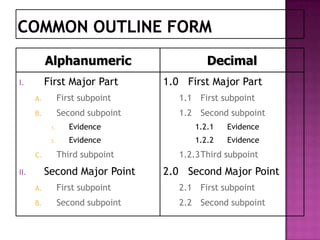
 A good outline divides the topic into major
parts, sub-points, evidence and details.
Anything beyond this is clumsy
 The extent of proof for the subject may
require more evidence
 Outline

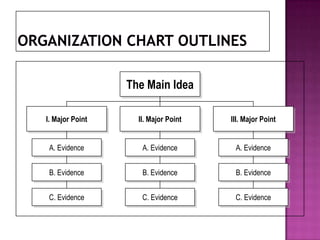
Therefore do three things
 Start with the main idea.
 State the major points
 Illustrate with evidence.
See the diagram below

your content
Alphanumeric
First Major Part

I.

Decimal
1.0 First Major Part

A.

First subpoint

1.1 First subpoint

B.

Second subpoint

1.2 Second subpoint

1.

1.2.1

Evidence

2.

C.

Evidence

Evidence

1.2.2

Evidence

Third subpoint

Second Major Point

II.

1.2.3Third subpoint

2.0 Second Major Point

A.

First subpoint

2.1 First subpoint

B.

Second subpoint

2.2 Second subpoint
The Main Idea
I. Major Point

II. Major Point

III. Major Point

A. Evidence

A. Evidence

A. Evidence

B. Evidence

B. Evidence

B. Evidence

C. Evidence

C. Evidence

C. Evidence
 In

conclusion understand that analyzing the
situation, gathering information, selecting
the right medium and organizing the
information are prerequisite proper writing
of the business communication.
 Thank you.
1. Identify the advantages and disadvantages of
the following medium – oral, written, visual,
electronic.
2. Which medium is most suited for business
communication?
3. Prepare an outline on the just completed topic
4. Which approach will be better to address the
following?
An email asking about the availability of specific
car.
b. A letter turning down a job applicant
c. Application for a job
a.

Cmd 225 3

  • 1.
    LESSON FOR WEEKTHREE Chapter 3 PLANNING THE BUSINESS MESSAGE Step 1 - Planning
  • 2.
     Understand the businessmessage  Understand the three-step writing process  Begin with Step 1 – Planning  Analyze situation  Gather information  Select the right medium  Organize your message  Conclusion & ground for Step - 2
  • 3.
    Planning Writing Adapt to theAudience Use ‘YOU’ attitude Polite, Positive, Bias-free Credibility, conversational Gather Information Appropriate voice Audience needs; satisfy needs Analyze Situation Purpose & Audience Profile Select Medium Best medium to deliver Get Organized Main idea, Scope, approach, outline Compose the Message Choose strong words that will be effective Completing Revise Evaluate, edit, rewrite Produce Design, Layout, Clean Proofread Review Mechanics/ Layout Distribute Deliver using choice medium
  • 4.
    Planning Analyze Situation Purpose& Audience Profile Gather Information Audience needs; satisfy needs Select Medium Best medium to deliver Get Organized Main idea, Scope, approach, outline
  • 5.
     Analyze your situation Gather information  Select the right medium  Organize the information As a general rule, try to use half the time you got for the work for planning; one-quarter for writing; and one-quarter for completing your messages
  • 6.
    To analyze thesituation, you two THINGS 1. Define the purpose - general or specific 2. Develop an audience profile  General  Specific  Inform  Realism  Persuade  Timing  Collaborate  Delivery  Acceptability
  • 7.
    Audience profile requireyou know your audience to a point
  • 8.
    Gathering information isa herculean task that demands tact and time. Techniques that could help include:  Seek viewpoints of others  Read reports and other company documents  Interview supervisors, colleagues, customers  Ask your audience for input  Informal chat with customers, employees In so doing you will be able to uncover audience need and satisfy same by providing required information
  • 9.
    Uncovering audience needs  Sometimesneeds are known, apparent; then act on them and advice  Most times they are not clear; then ask questions and be suggestive Providing required information  Be sure information is accurate  Be sure information is ethical  Be sure information is complete  Be sure information is pertinent
  • 11.
     Selecting the bestmedium can make the difference between effective & ineffective communication  Media  Leaner   leanness & richness Fliers, bulletins, and reports Richer  Conversations, meetings, presentations  Thus your medium could be oral, written, visual or electronic
  • 12.
    Richer Leaner Notes, Letters, Memos Face-to-Face Telephone E-mail A Continuumof Media Richness Fliers, Bulletins, Standard Reports
  • 13.
     Use      an oralchannel Need immediate feedback Relatively simple message Don’t need a permanent record Easy to assemble the audience Encourage interaction  Use a written channel      Don’t need immediate feedback Detailed, complex message Need a permanent record Large, dispersed audience Minimize distortion
  • 14.
     Use a visualchannel    Graphical presentation of details Use an electronic channel   Time-zones   Speed  Dominated by graphics, but complemented by texts. Useful for multi-lingua business Advantages Dispersed audience Disadvantages  Content issues  Easy to remember  Privacy  Encourage interaction  Productivity
  • 15.
    WRITTEN     Memo Letters Proposals Reports ELECTRONIC  Oral – phonecalls, teleconferencing, internet telephony, VoIP [skype, Tango]  Written – IM, email, hangout, blogs, websites, wikis Visual - PPT, computer animation, video [vidcasts, vblogs], multimedia 
  • 16.
  • 17.
    Factors to considerwhen choosing media  Media richness  Message formality  Media limitations  Sender intentions  Urgency and costs  Audience preferences
  • 18.
    Organizing the messagehelps your audience:    Understand the message Accept the message Save time in following your ideas Therefore you could achieve good organization through:  Defining your main idea  Limiting your scope  Choosing between direct/indirect approaches  Outlining your content
  • 19.
    Defining your mainidea.  In defining your main idea, you should focus on crafting the topic as a summary to the communication  Make sure the idea establishes good relationship with customers/audience  The following guide could help      Brainstorming Journalistic approach – 5W & H Question & answer chain – ask questions from audience view Storyteller’s tour – talk it out, record yourself Mind mapping – start with main & then branch out to connect other ideas that come to mind
  • 20.
     Limit your scope Scope is the range, length & level of information to be presented  Some message have preset length limit  Always limit supporting points to a maximum of six through categorization/ grouping  Make it brief but not too brief  You need fewer words to present routine message to a knowledgeable audience and more words to build consensus on new/ complex/ controversial subject
  • 21.
     Choose between direct/indirectapproaches  Use direct when audience is positive, receptive; start with main idea [recommendation, conclusion, request] and follow with supporting facts]; deductive.  Use indirect when audience is skeptical, resistant, negative; start with supporting evidences first and build up to your main idea; inductive.  Choices is dependent on purpose and message and medium.
  • 22.
     Outline your content Outlining helps you to save time as well as provide logical & effective way to deliver your message  Your word processor can help, but you need to understand the mechanics  A good outline divides the topic into major parts, sub-points, evidence and details. Anything beyond this is clumsy  The extent of proof for the subject may require more evidence
  • 23.
     Outline Therefore dothree things  Start with the main idea.  State the major points  Illustrate with evidence. See the diagram below your content
  • 24.
    Alphanumeric First Major Part I. Decimal 1.0First Major Part A. First subpoint 1.1 First subpoint B. Second subpoint 1.2 Second subpoint 1. 1.2.1 Evidence 2. C. Evidence Evidence 1.2.2 Evidence Third subpoint Second Major Point II. 1.2.3Third subpoint 2.0 Second Major Point A. First subpoint 2.1 First subpoint B. Second subpoint 2.2 Second subpoint
  • 25.
    The Main Idea I.Major Point II. Major Point III. Major Point A. Evidence A. Evidence A. Evidence B. Evidence B. Evidence B. Evidence C. Evidence C. Evidence C. Evidence
  • 26.
     In conclusion understandthat analyzing the situation, gathering information, selecting the right medium and organizing the information are prerequisite proper writing of the business communication.  Thank you.
  • 27.
    1. Identify theadvantages and disadvantages of the following medium – oral, written, visual, electronic. 2. Which medium is most suited for business communication? 3. Prepare an outline on the just completed topic 4. Which approach will be better to address the following? An email asking about the availability of specific car. b. A letter turning down a job applicant c. Application for a job a.