3D
Geographic
Information
System
Wellington T Gwavava
2

9:34 AM

What is 3D GIS?
A

system that is able to
model, represent, manage, manipulate, a
nalyze and support decisions based upon
information associated with threedimensional phenomena (Worboys, 1995)
3

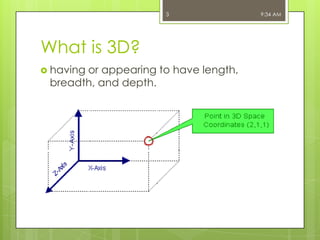
What is 3D?
 having

or appearing to have length,
breadth, and depth.

9:34 AM
4

9:34 AM

What is GIS?
 “Geographic

Information System (GIS) is
an integrated system of computer
hardware, software, and trained
personnel linking topographic,
demographic, utility, facility, image and
other resource data that is geographically
referenced.” ~ NASA
5

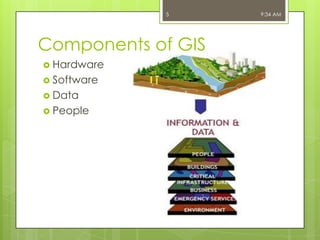
Components of GIS
 Hardware
 Software
 Data
 People

9:34 AM
6

GIS functions
 Capture

/Data Acquisition
 Structuring /Data Storage
 Manipulation
 Analysis
 Presentation

9:34 AM
7

9:34 AM

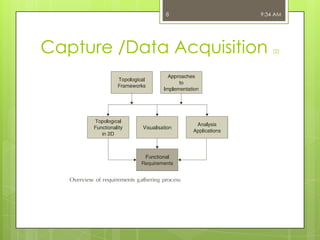
Capture /Data Acquisition
 is

inputting spatial data to the system.
 Many different techniques and devices
are available for both geometric and
attribute data.
 The devices in frequent use for collecting
spatial data can be classified as
manual, semiautomatic or automatic and
the output either vector or raster format.
8

9:34 AM

Capture /Data Acquisition

(2)
9

9:34 AM

Structuring /Data Storage
 This

is a crucial stage in creating a spatial
database using a GIS.
 This is because it determines the range of
functions, which can be used for
manipulation and analysis.
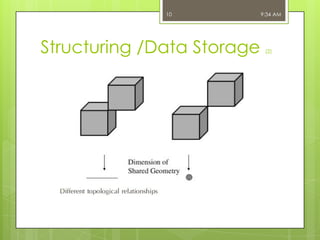
 3D system have different structuring
capabilities (complex topology and
object-oriented).
10

Structuring /Data Storage

9:34 AM

(2)
11

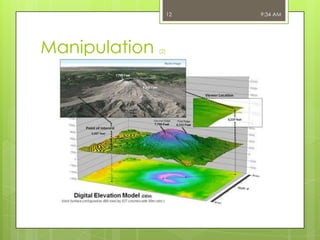
Manipulation
 Important

manipulation operations are
generalization and transformation.
 Generalisation is applied for reducing
data complexity or to make the data
presentation more legible.
 Transformation includes coordinate
transformation to a specified map
projection and scaling

9:34 AM
12

Manipulation

(2)

9:34 AM
13

9:34 AM

Analysis






This is the core of a GIS system.
It involves metric, topological and/or order
operations on geometric and attribute data.
Primarily, analysis in GIS concerns operations
on more than one set of data, which
generates new spatial information of the
data.
Terrain analysis (e.g. intervisibility), geometric
computations
(volume, area, etc), overlay, buffering, zoning
, sorting are among typical analysis functions
in G IS.
14

Analysis




(2)

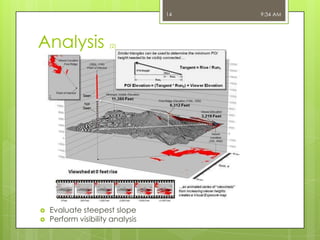
Evaluate steepest slope
Perform visibility analysis

9:34 AM
15

Analysis





(3)

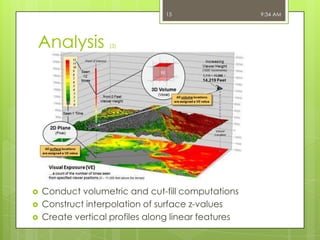
Conduct volumetric and cut-fill computations
Construct interpolation of surface z-values
Create vertical profiles along linear features

9:34 AM
16

9:34 AM

Presentation
 This

is a final task in GIS.
 That is to present all the generated
information or results in the form of maps,
graphs, tables, reports
 This may also include Visualization,
navigation, user interface and internet
access
17

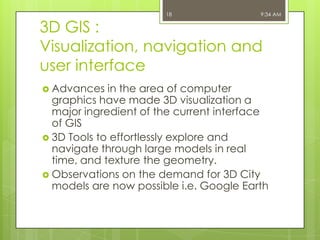
Presentation

Aerial view (2D)

9:34 AM

(3)

3D non-textured view
18

9:34 AM

3D GIS :
Visualization, navigation and
user interface
 Advances

in the area of computer
graphics have made 3D visualization a
major ingredient of the current interface
of GIS
 3D Tools to effortlessly explore and
navigate through large models in real
time, and texture the geometry.
 Observations on the demand for 3D City
models are now possible i.e. Google Earth
19

9:34 AM

Why do we need 3D GIS?
 Simulation

of complex systems provide
understanding on how the system
operates different perspectives, aided by
high quality visualization and interaction
 Observation of system feature that would
be to small or too large to be seen on a
normal scale system
 Access to situation that would otherwise
be dangerous or too remote or
inaccessible
20

Why do we need 3D GIS?
 Enable

9:34 AM

(2)

high degree of interaction which is
important to aid understanding
 Provide a sense of immersion of the
environment where the user can
appreciate the scale of change and
visualize the impact of a building design
on the external environment and the
inhabitants
21

Why do we need 3D GIS?


9:34 AM

(3)

Allows export to popular multimedia such as
video (.avi or .mpeg) or VRML (.vrl or .vrml) that
provide the following benefits





Do not need to know 3D GIS, simply use intuitive
and easy to use interface to operate the 3D model
Inherent flexibility/adaptability – these multimedia
are 3D cross-platform display and non-browser
specific which enable expensive data to be used
more widely
Fast and slow time simulation – ability to control
timescale by incorporating a sequence of
captured events into the key frames (or snapshots)
of the motion video
22

Applications 3D GIS















ecological studies
3D urban mapping
environmental monitoring
landscape planning
geological analysis
Architecture
civil engineering
automatic vehicle navigation
mining exploration
archeology
hydrographic surveying
marine biology

9:34 AM
23

9:34 AM

3D GIS: Challenges
 Data

collection – cost of 3D modeling and
time to acquire consistent geometric and
textural data
 Spatial analysis – there is a need for
formalism for detecting spatial relationships
based on set topology notions
 Internet access – remote access to 3D on
demand spatial information has high
computational and network overhead
24

3D GIS: Challenges
 Conceptual

9:34 AM

(2)

model - The design of a
conceptual model is a subject of intensive
i.e. describing real-world objects and
spatial relationships between them
25

9:34 AM

Efforts by Major GIS Vendors
 ArcView

3D Analyst
 Imagine VirtualGIS
 GeoMedia Terrain
 PAMAP GIS Topographer
 3dvia
 SPACEYES
 MS Virtual Earth
 Google Earth
26

9:34 AM

Future Developments
 Real

time 3D GIS, providing visualization of
3D GIS at a whole city scale always faces
the challenge of dynamic data loading
with high-efficiency.
 4D GIS, with a time defined analytics GIS
aid in disaster management urban
planning by predictive models of 3D
states
27

9:34 AM

Summary







3D GIS has the same basic definition as 2D GIS
3D GIS provides the most efficient technology
for spatial data management
3D GIS faces few implementation challenges,
overcome by technological advances
3D GIS the next generation of GIS, it is still yet
to become mainstream
3D GIS has vast number of applications, it is
currently used in specialized fields
The evolution of GIS is cyclical as it revisits self
concepts
28

References

















[1] Coors, V., 2002, 3D GIS in Networking environments, CEUS (to be published), 17 p.
[2] Oosterom. P.J.M. van, J.E. Stoter, S. Zlatanova, W.C. Quak, 2002, The balance between
Geometry and Topology, Advances in Spatial Data handling, D.Richardson, P.van Oosterom
(Eds.), Ottawa, Canada, 9-12 July
[3] Coors, V. and V. Jung, 1998, Using VRML as an Interface to the 3D data warehouse, in:
Proceedings of VRML'98, New York
[4] Abdul-Rahman, A., 2000. The design and implementation of two and three-dimensional
triangular irregular network (TIN) based GIS. PhD thesis, University of Glasgow, Scotland,
United Kingdom, 250 p. [5] P. Vessen, “wireless Power transmission,” Leonardo energy; briefing
paper.
[6] http://www.innovativegis.com/basis/mapanalysis/Topic27/Topic27.htm
[7] http://proceedings.esri.com/library/userconf/proc01/professional.../papers/pap565/p565.htm
[8] Deren Li, Qing Zhu Qiang, Liu Peng Xu., From 2D to 3D GIS for CYBERCITY ,State Key
Laboratory of Information Engineering in Surveying, Mapping and Remote Sensing, Wuhan
Universit
[9] Claire Ellul, Muki Haklay. 2006 Requirements for Topology in 3D GIS
[10] Billen R., S. Zlatanova, P. Mathonet and F. Boniver, 2002, The Dimensional Model: a framework
to distinguish spatial relationships, in: Advances in Spatial Data handling, D.Richardson, P.van
Oosterom (Eds.), Springer, Ottawa, Canada, 9-12 July, pp. 285-298
[11] Alias Abdul Rahman1, Sisi Zlatanova2, Morakot Pilouk, The 3D GIS Software Development:
global efforts from researchers and vendors
Thank you!

Three dimensional (3D) GIS

  • 1.
  • 2.
    2 9:34 AM What is3D GIS? A system that is able to model, represent, manage, manipulate, a nalyze and support decisions based upon information associated with threedimensional phenomena (Worboys, 1995)
  • 3.
    3 What is 3D? having or appearing to have length, breadth, and depth. 9:34 AM
  • 4.
    4 9:34 AM What isGIS?  “Geographic Information System (GIS) is an integrated system of computer hardware, software, and trained personnel linking topographic, demographic, utility, facility, image and other resource data that is geographically referenced.” ~ NASA
  • 5.
    5 Components of GIS Hardware  Software  Data  People 9:34 AM
  • 6.
    6 GIS functions  Capture /DataAcquisition  Structuring /Data Storage  Manipulation  Analysis  Presentation 9:34 AM
  • 7.
    7 9:34 AM Capture /DataAcquisition  is inputting spatial data to the system.  Many different techniques and devices are available for both geometric and attribute data.  The devices in frequent use for collecting spatial data can be classified as manual, semiautomatic or automatic and the output either vector or raster format.
  • 8.
    8 9:34 AM Capture /DataAcquisition (2)
  • 9.
    9 9:34 AM Structuring /DataStorage  This is a crucial stage in creating a spatial database using a GIS.  This is because it determines the range of functions, which can be used for manipulation and analysis.  3D system have different structuring capabilities (complex topology and object-oriented).
  • 10.
  • 11.
    11 Manipulation  Important manipulation operationsare generalization and transformation.  Generalisation is applied for reducing data complexity or to make the data presentation more legible.  Transformation includes coordinate transformation to a specified map projection and scaling 9:34 AM
  • 12.
  • 13.
    13 9:34 AM Analysis     This isthe core of a GIS system. It involves metric, topological and/or order operations on geometric and attribute data. Primarily, analysis in GIS concerns operations on more than one set of data, which generates new spatial information of the data. Terrain analysis (e.g. intervisibility), geometric computations (volume, area, etc), overlay, buffering, zoning , sorting are among typical analysis functions in G IS.
  • 14.
  • 15.
    15 Analysis    (3) Conduct volumetric andcut-fill computations Construct interpolation of surface z-values Create vertical profiles along linear features 9:34 AM
  • 16.
    16 9:34 AM Presentation  This isa final task in GIS.  That is to present all the generated information or results in the form of maps, graphs, tables, reports  This may also include Visualization, navigation, user interface and internet access
  • 17.
    17 Presentation Aerial view (2D) 9:34AM (3) 3D non-textured view
  • 18.
    18 9:34 AM 3D GIS: Visualization, navigation and user interface  Advances in the area of computer graphics have made 3D visualization a major ingredient of the current interface of GIS  3D Tools to effortlessly explore and navigate through large models in real time, and texture the geometry.  Observations on the demand for 3D City models are now possible i.e. Google Earth
  • 19.
    19 9:34 AM Why dowe need 3D GIS?  Simulation of complex systems provide understanding on how the system operates different perspectives, aided by high quality visualization and interaction  Observation of system feature that would be to small or too large to be seen on a normal scale system  Access to situation that would otherwise be dangerous or too remote or inaccessible
  • 20.
    20 Why do weneed 3D GIS?  Enable 9:34 AM (2) high degree of interaction which is important to aid understanding  Provide a sense of immersion of the environment where the user can appreciate the scale of change and visualize the impact of a building design on the external environment and the inhabitants
  • 21.
    21 Why do weneed 3D GIS?  9:34 AM (3) Allows export to popular multimedia such as video (.avi or .mpeg) or VRML (.vrl or .vrml) that provide the following benefits    Do not need to know 3D GIS, simply use intuitive and easy to use interface to operate the 3D model Inherent flexibility/adaptability – these multimedia are 3D cross-platform display and non-browser specific which enable expensive data to be used more widely Fast and slow time simulation – ability to control timescale by incorporating a sequence of captured events into the key frames (or snapshots) of the motion video
  • 22.
    22 Applications 3D GIS             ecologicalstudies 3D urban mapping environmental monitoring landscape planning geological analysis Architecture civil engineering automatic vehicle navigation mining exploration archeology hydrographic surveying marine biology 9:34 AM
  • 23.
    23 9:34 AM 3D GIS:Challenges  Data collection – cost of 3D modeling and time to acquire consistent geometric and textural data  Spatial analysis – there is a need for formalism for detecting spatial relationships based on set topology notions  Internet access – remote access to 3D on demand spatial information has high computational and network overhead
  • 24.
    24 3D GIS: Challenges Conceptual 9:34 AM (2) model - The design of a conceptual model is a subject of intensive i.e. describing real-world objects and spatial relationships between them
  • 25.
    25 9:34 AM Efforts byMajor GIS Vendors  ArcView 3D Analyst  Imagine VirtualGIS  GeoMedia Terrain  PAMAP GIS Topographer  3dvia  SPACEYES  MS Virtual Earth  Google Earth
  • 26.
    26 9:34 AM Future Developments Real time 3D GIS, providing visualization of 3D GIS at a whole city scale always faces the challenge of dynamic data loading with high-efficiency.  4D GIS, with a time defined analytics GIS aid in disaster management urban planning by predictive models of 3D states
  • 27.
    27 9:34 AM Summary       3D GIShas the same basic definition as 2D GIS 3D GIS provides the most efficient technology for spatial data management 3D GIS faces few implementation challenges, overcome by technological advances 3D GIS the next generation of GIS, it is still yet to become mainstream 3D GIS has vast number of applications, it is currently used in specialized fields The evolution of GIS is cyclical as it revisits self concepts
  • 28.
    28 References              [1] Coors, V.,2002, 3D GIS in Networking environments, CEUS (to be published), 17 p. [2] Oosterom. P.J.M. van, J.E. Stoter, S. Zlatanova, W.C. Quak, 2002, The balance between Geometry and Topology, Advances in Spatial Data handling, D.Richardson, P.van Oosterom (Eds.), Ottawa, Canada, 9-12 July [3] Coors, V. and V. Jung, 1998, Using VRML as an Interface to the 3D data warehouse, in: Proceedings of VRML'98, New York [4] Abdul-Rahman, A., 2000. The design and implementation of two and three-dimensional triangular irregular network (TIN) based GIS. PhD thesis, University of Glasgow, Scotland, United Kingdom, 250 p. [5] P. Vessen, “wireless Power transmission,” Leonardo energy; briefing paper. [6] http://www.innovativegis.com/basis/mapanalysis/Topic27/Topic27.htm [7] http://proceedings.esri.com/library/userconf/proc01/professional.../papers/pap565/p565.htm [8] Deren Li, Qing Zhu Qiang, Liu Peng Xu., From 2D to 3D GIS for CYBERCITY ,State Key Laboratory of Information Engineering in Surveying, Mapping and Remote Sensing, Wuhan Universit [9] Claire Ellul, Muki Haklay. 2006 Requirements for Topology in 3D GIS [10] Billen R., S. Zlatanova, P. Mathonet and F. Boniver, 2002, The Dimensional Model: a framework to distinguish spatial relationships, in: Advances in Spatial Data handling, D.Richardson, P.van Oosterom (Eds.), Springer, Ottawa, Canada, 9-12 July, pp. 285-298 [11] Alias Abdul Rahman1, Sisi Zlatanova2, Morakot Pilouk, The 3D GIS Software Development: global efforts from researchers and vendors
  • 29.

Editor's Notes

  • #4 Our physical environment is three-dimensional and we move around in 3D every day
  • #7 Capture is inputting spatial data to the system. Structuring determines the range of functions, which can be used for manipulation and analysis.Manipulation, among important manipulation operations are generalisation and transformation. Analysis, is the core of a GIS system. It involves metric, topological and/or order operations on geometric and attribute data. Terrainanalysis (e.g. intervisibility), geometric computations (volume, area, etc), overlay, buffering, zoning, sorting are among typical analysis functions in G IS.Presentation, is to present all the generated information or results such as in the form of maps, graphs, tables, reports, etc.
  • #19 Specific functions of objects modelled in VR systems, and referred to as behaviours, gain an increased popularity as tools for walking through the model, exploring particular phenomena and improving the cognitive perception (see Kraak 1998,
  • #25 Spatial data can be modelled in different ways. The conceptual 3D model integratesinformation about semantics, 3D geometry and 3D spatial relationships (3D topology). Theconceptual model provides the methods for.