Introdu
ction to
GIS
Let's consider
a problem !
Ground
Water
Depletion
!
Reasons could be??
More demand of water
Less recharge of GW
resources
• Irregular rainfall patterns
• High Living standards-high water demand
• Urbanization- More runoff than infiltration
• Irrigation
Can you guess How many
litres of water is required to
make a pair of jeans?
7600 Lt !
What's the solution?
As An
administra
tor
•Make sure whatever
rainfall we are having ,
as much as possible of
it infilters into ground
surface and do not
flow as runoff (which
is a waste as from our
problem standpoint)
•How to do that ?
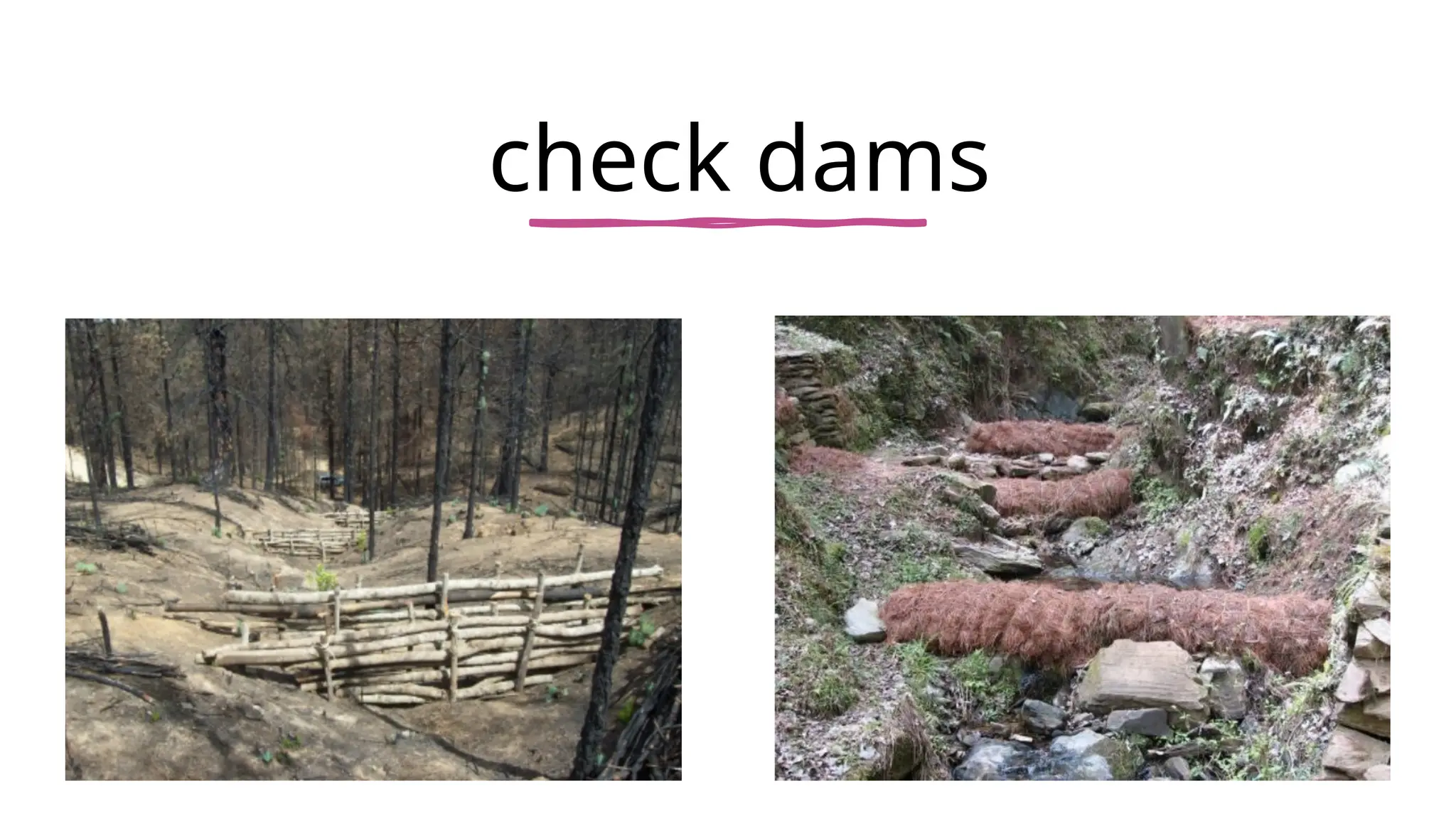
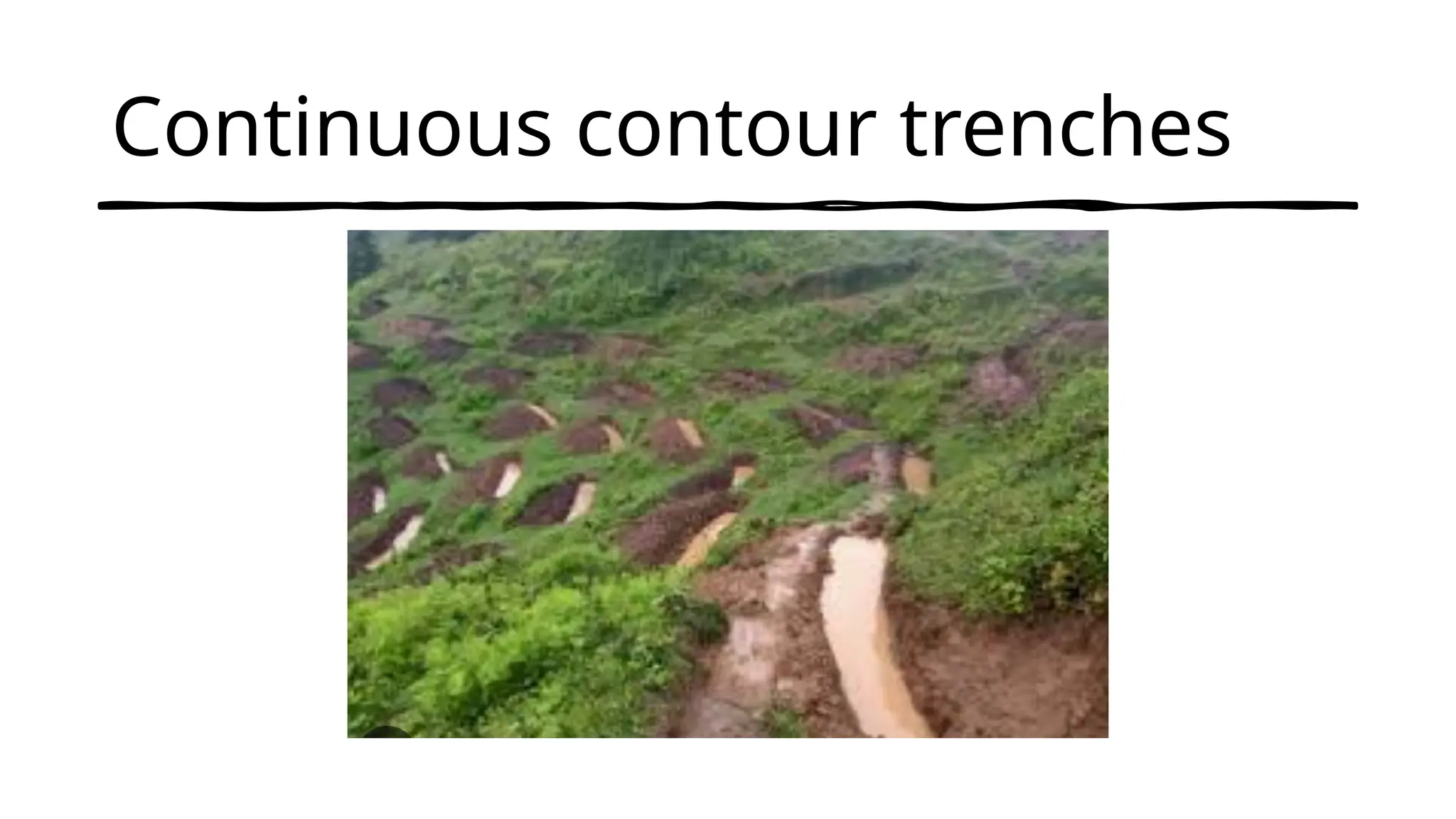
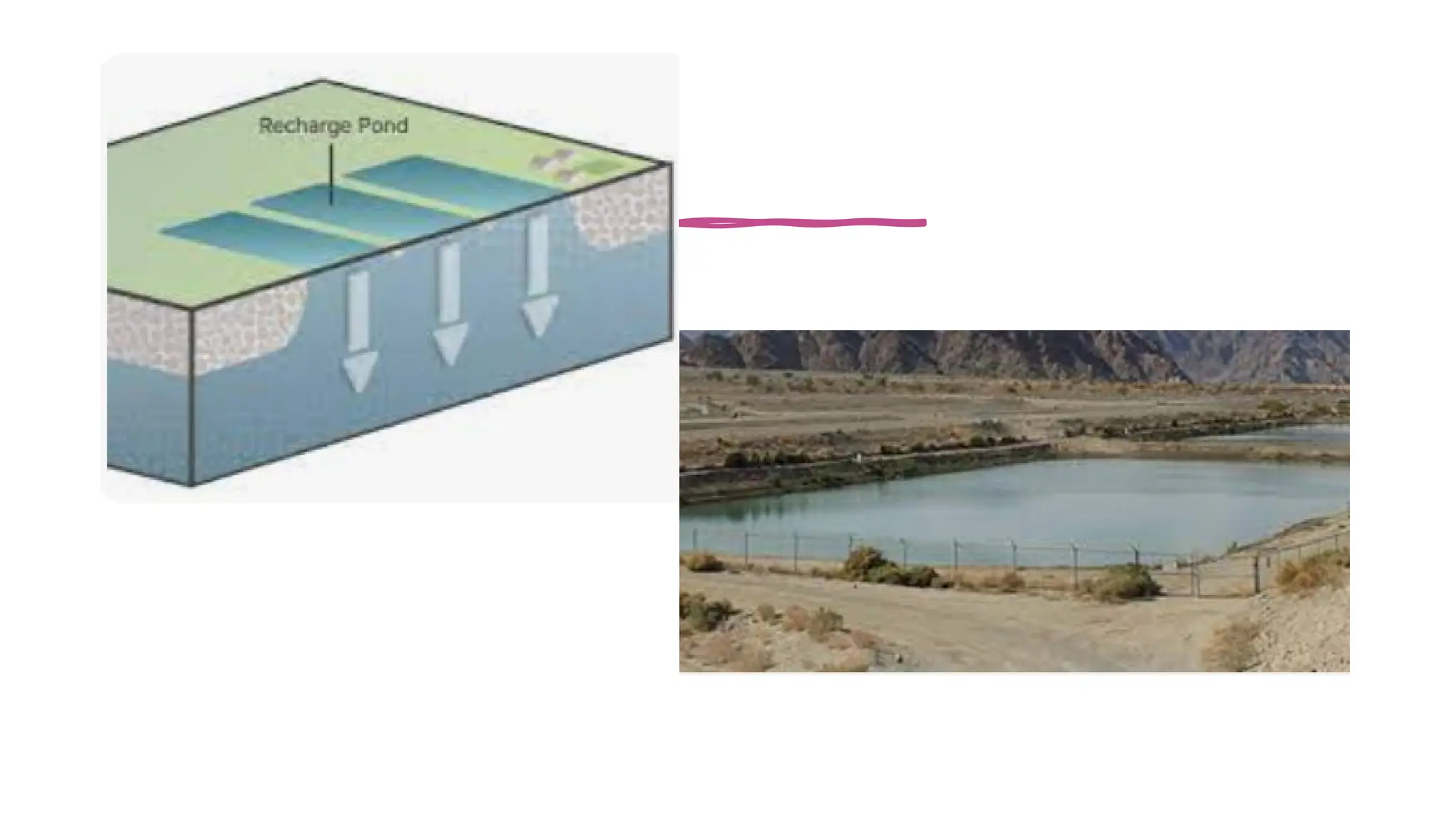
Recharge wells,
recharge ponds ,
check dams
Where will be the
sites for these
construction
Solution !
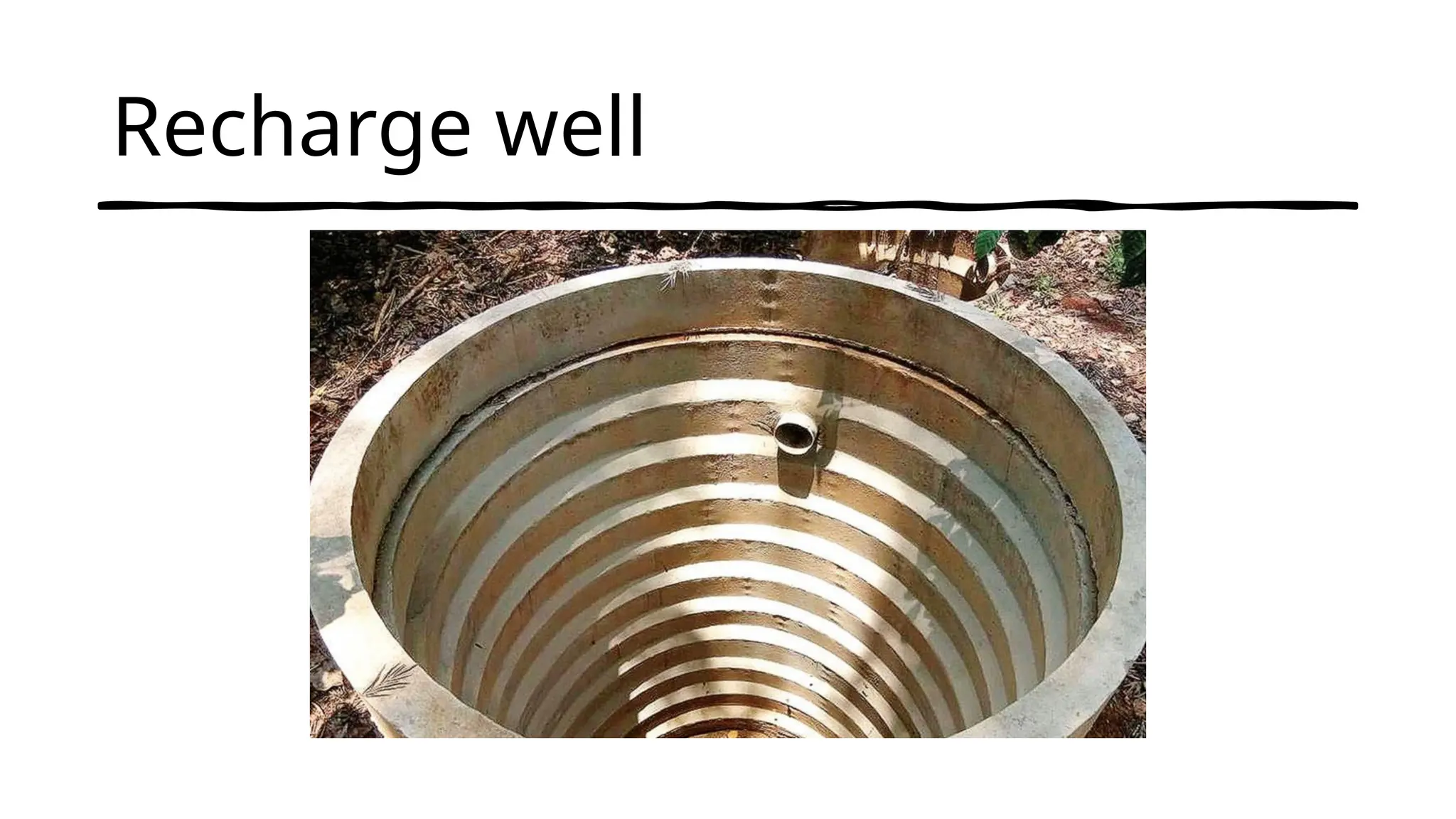
Recharge well
check dams
Continuous contour trenches
Who's this guy?
Ground Water
Potential
•What factors will affect GW Potential of
an area?
•Or what data would you require?
First one
would be ??
LULC
MAP OF
AREA
WHERE
WOULD
YOU GET
THAT
FROM?
Answer
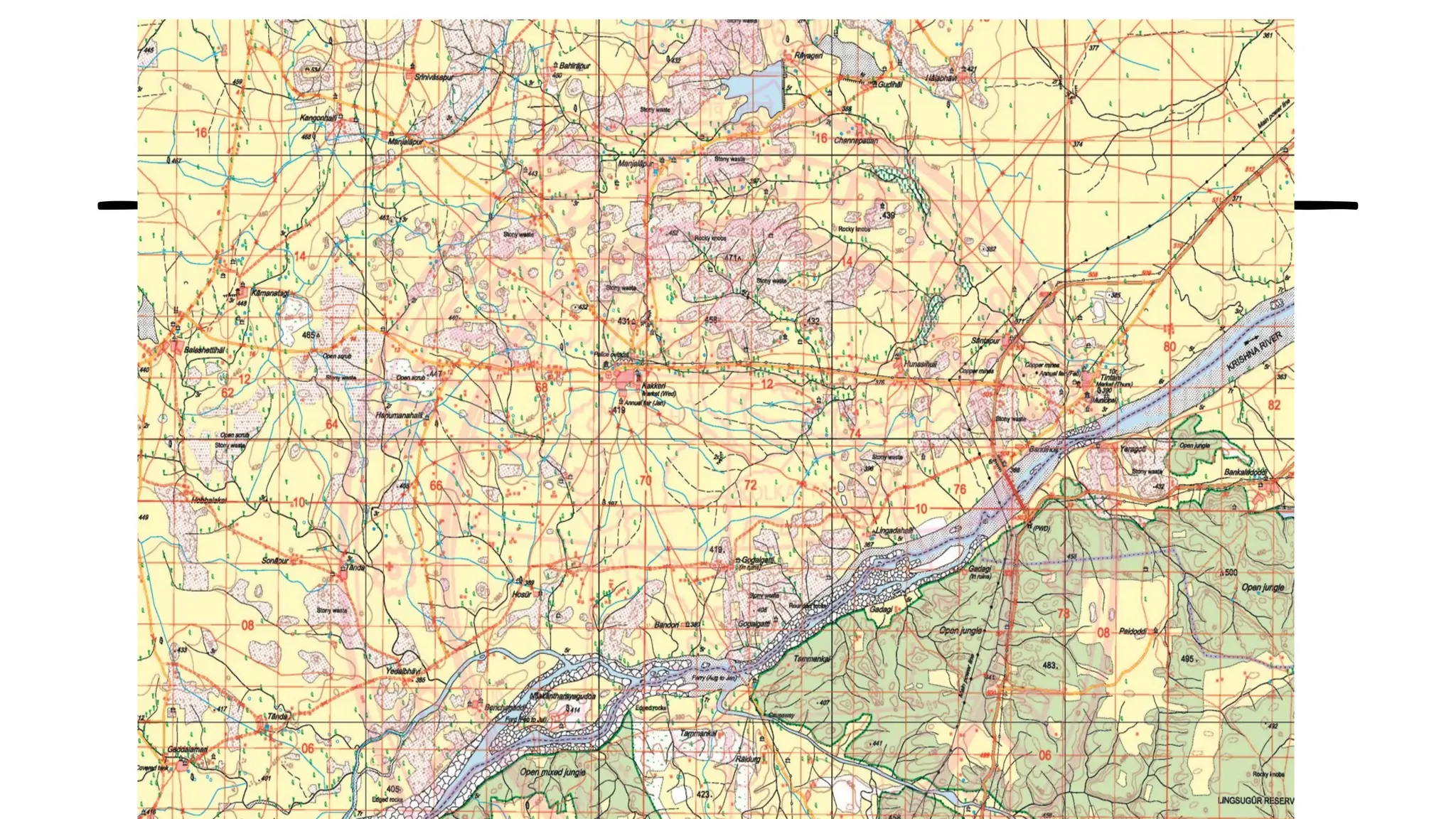
•SOI-Topographical Sheet
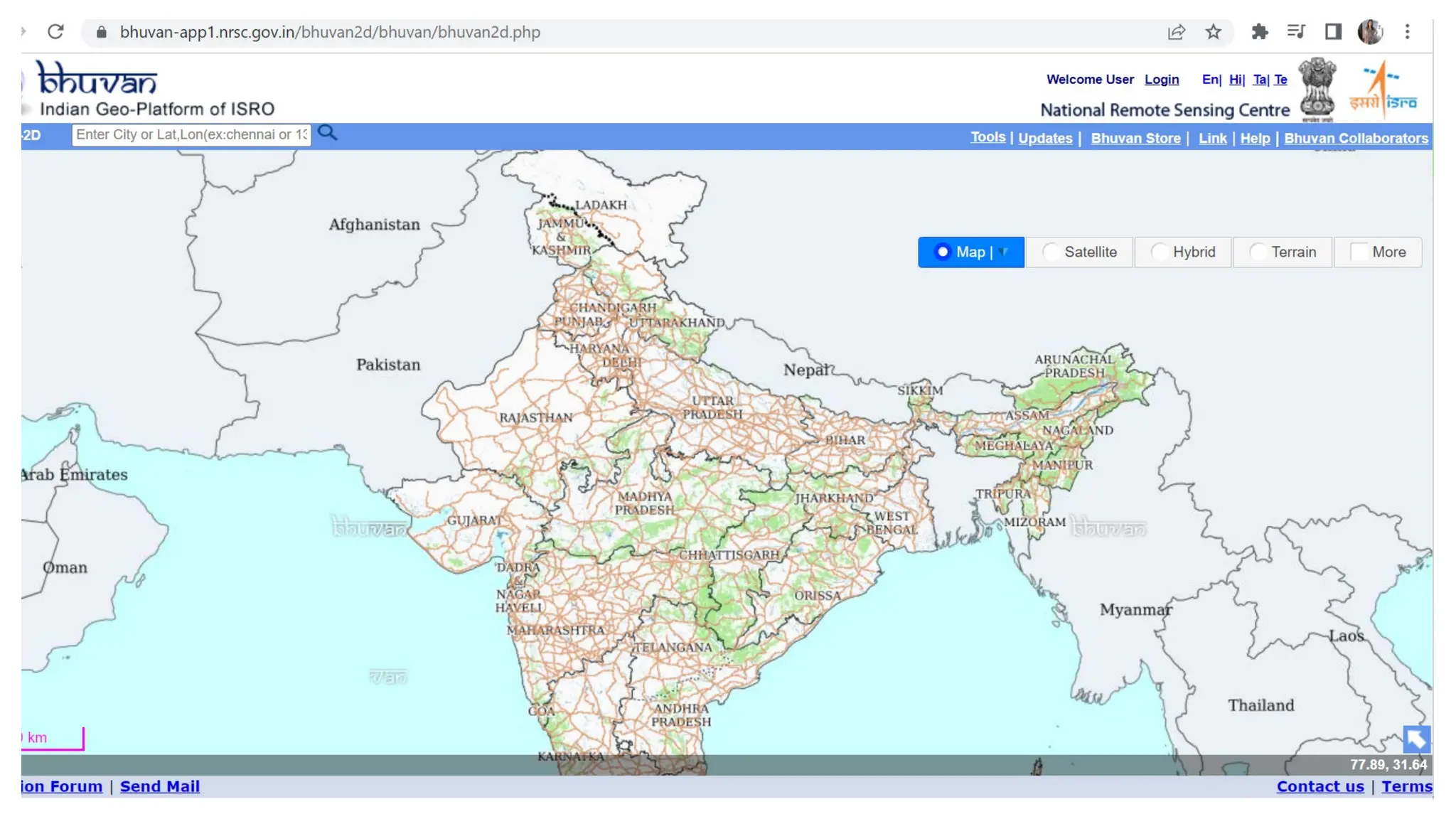
•Bhuvan-ISRO Website for
downloading RS Images
•USGS – NASA Website for
downloading RS Images
Next one?
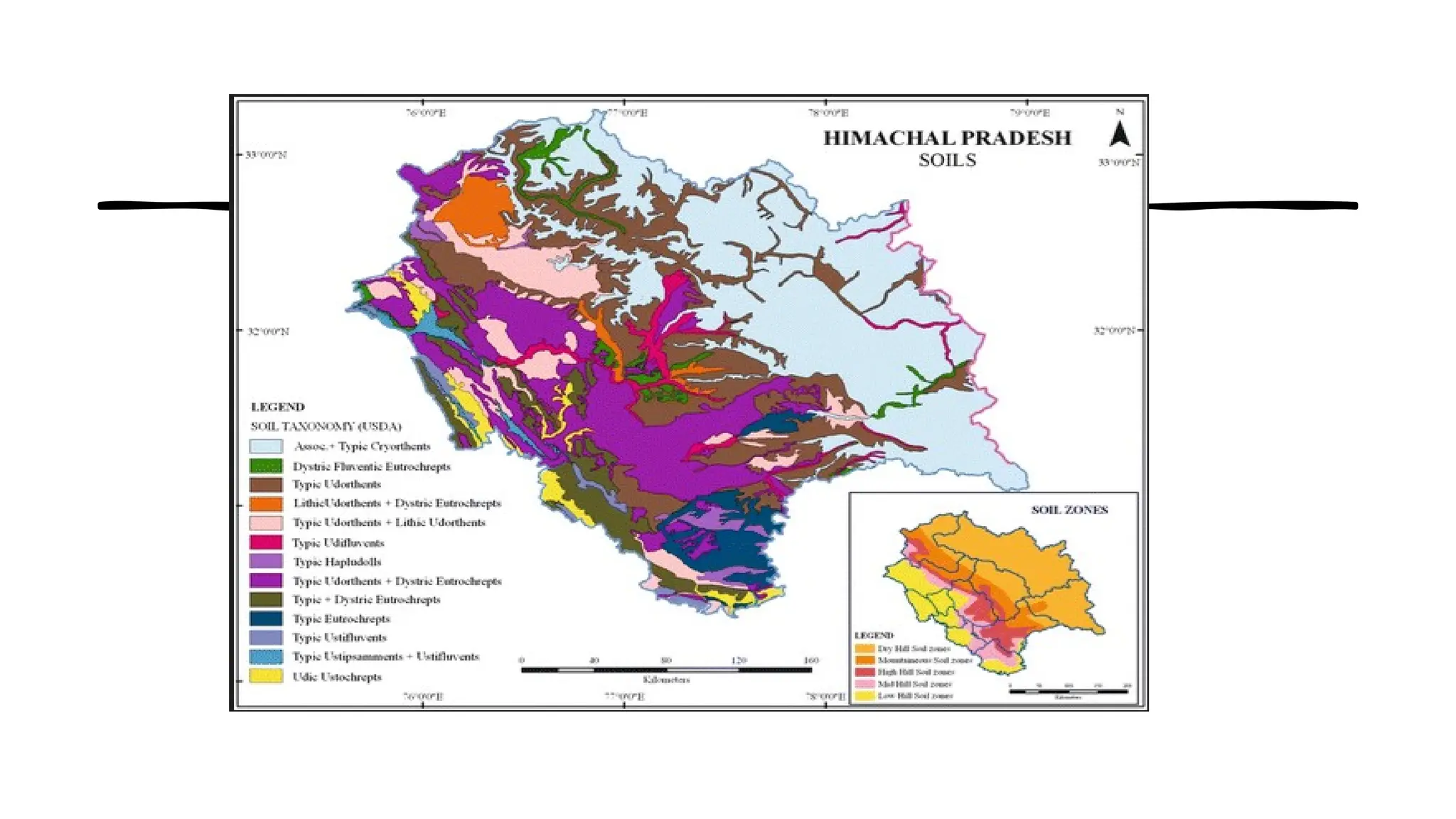
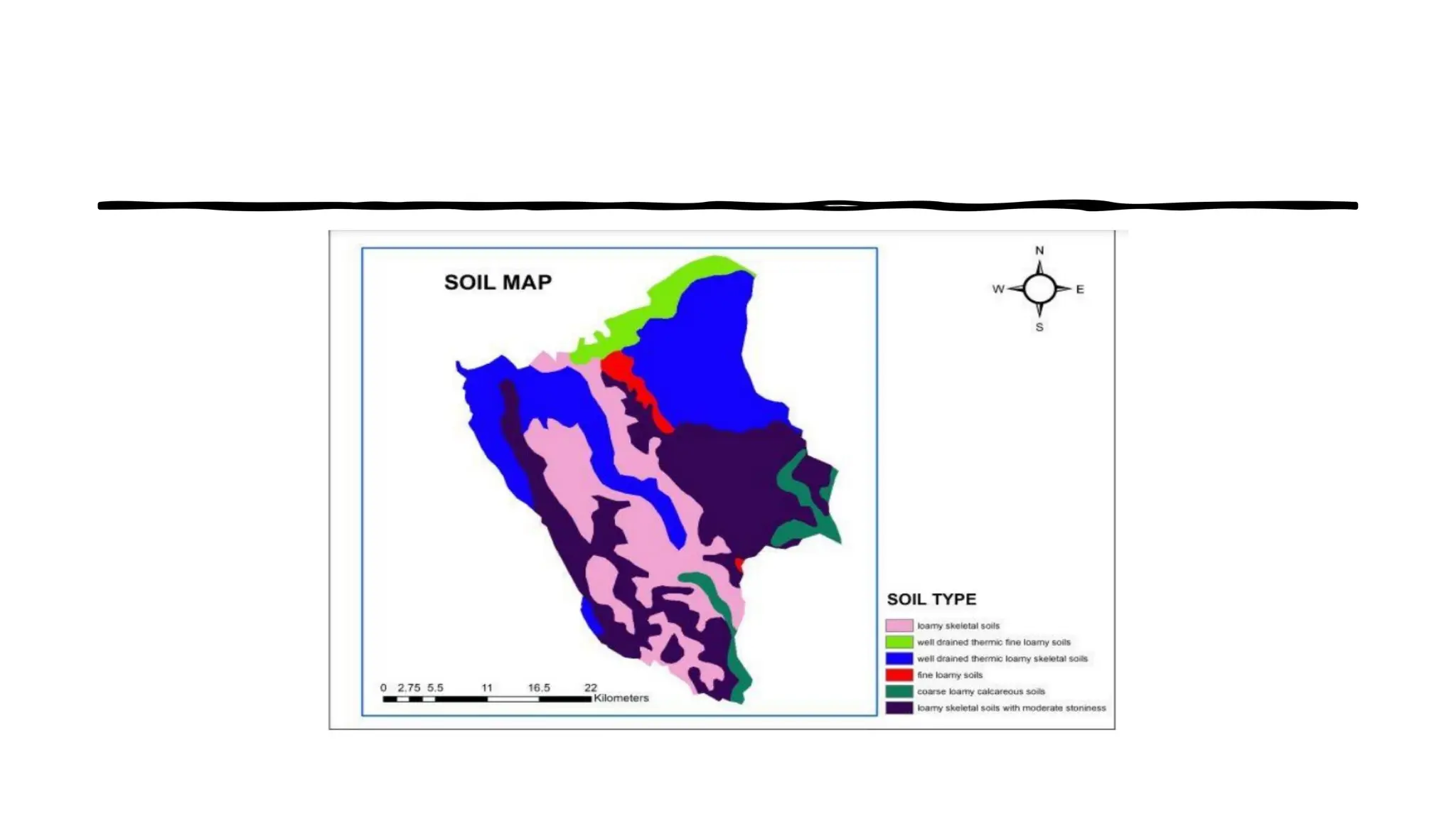
•Soil Data
•Where would you get that from?
Answer
• Soil and land use Survey of India
• ICAR-Indian Agricultural Research Institute
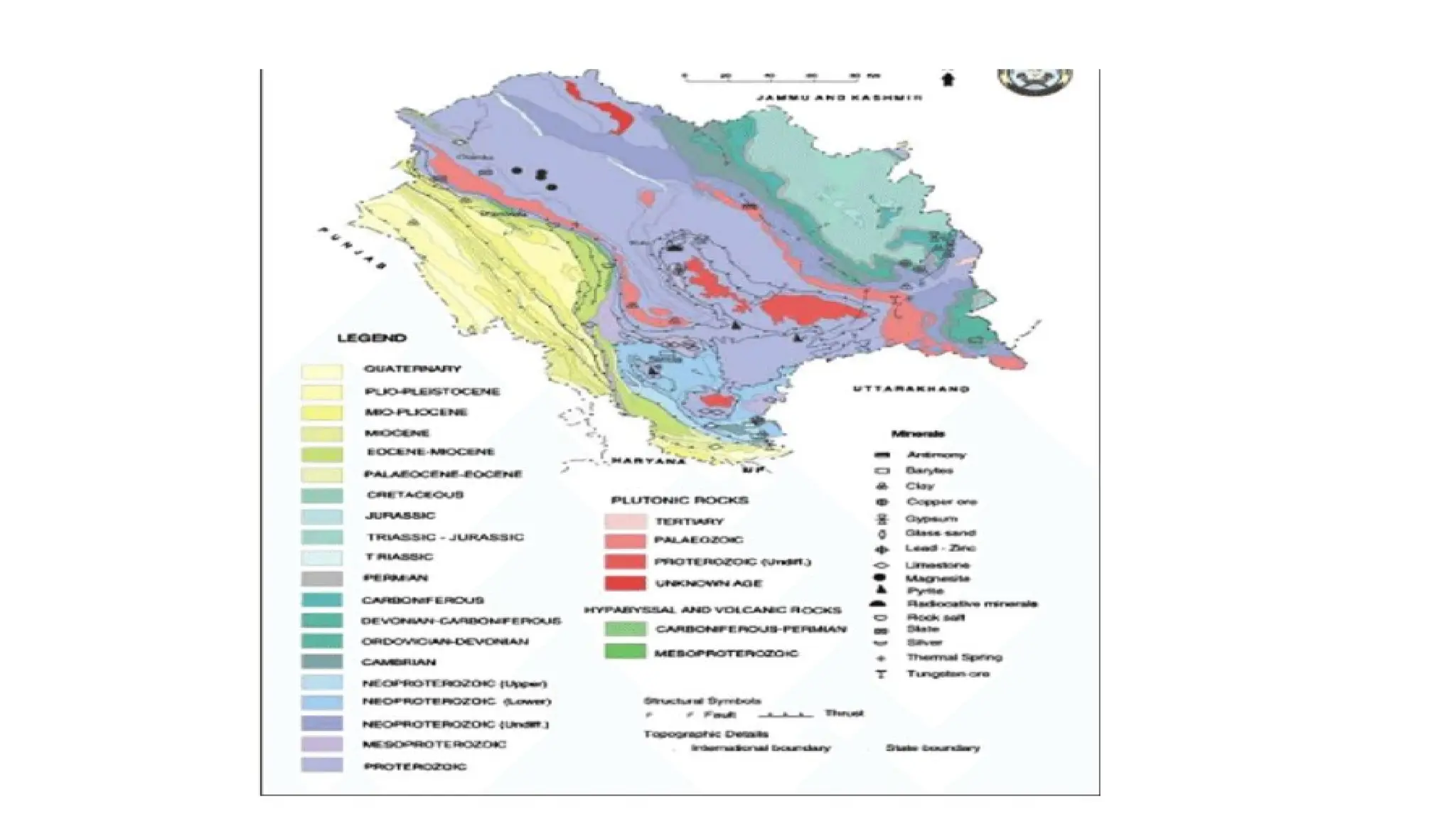
•Do we require geological map as
well?
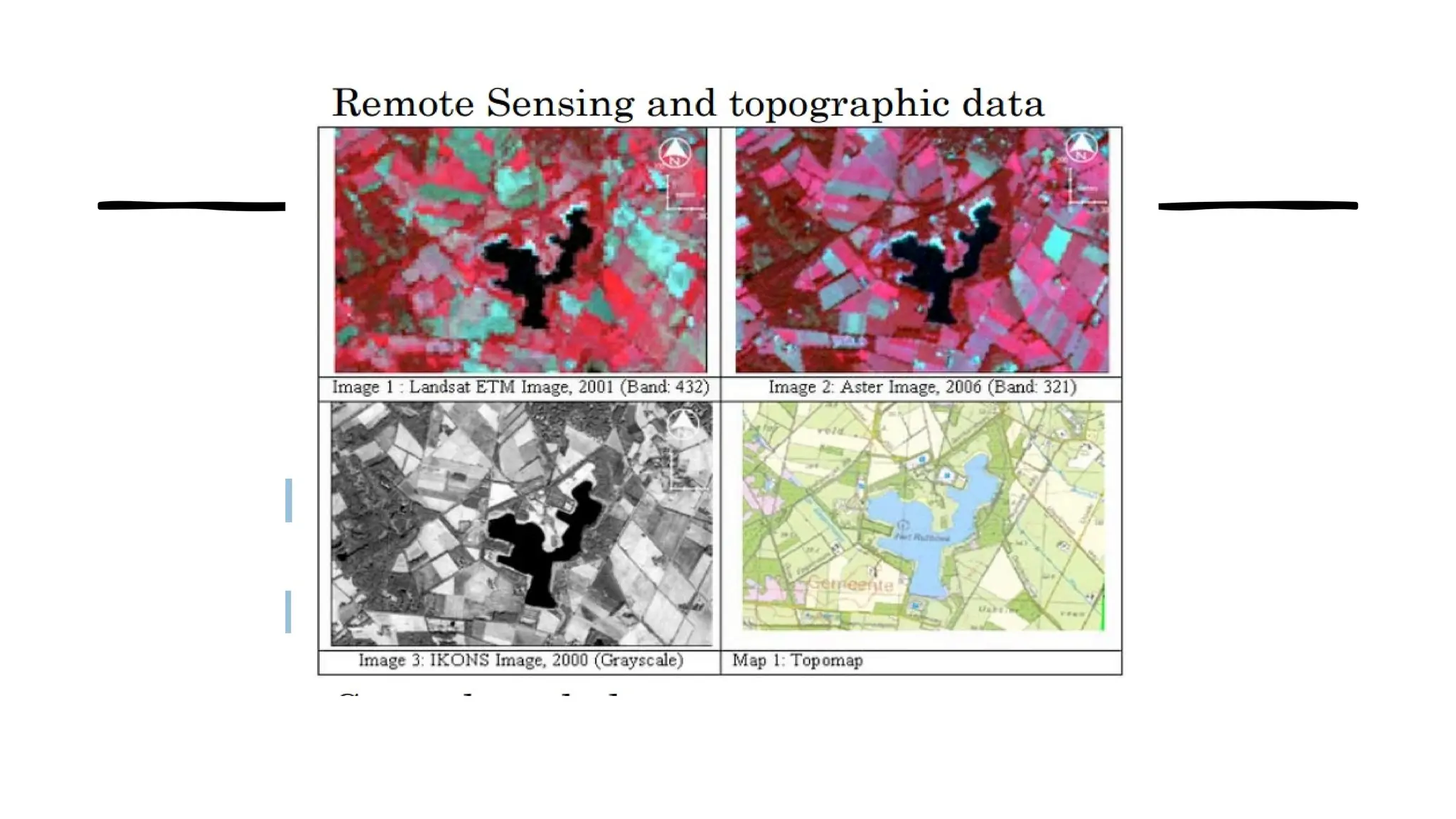
Topographic data
•Showing the Elevation
•Slopes
Misc.
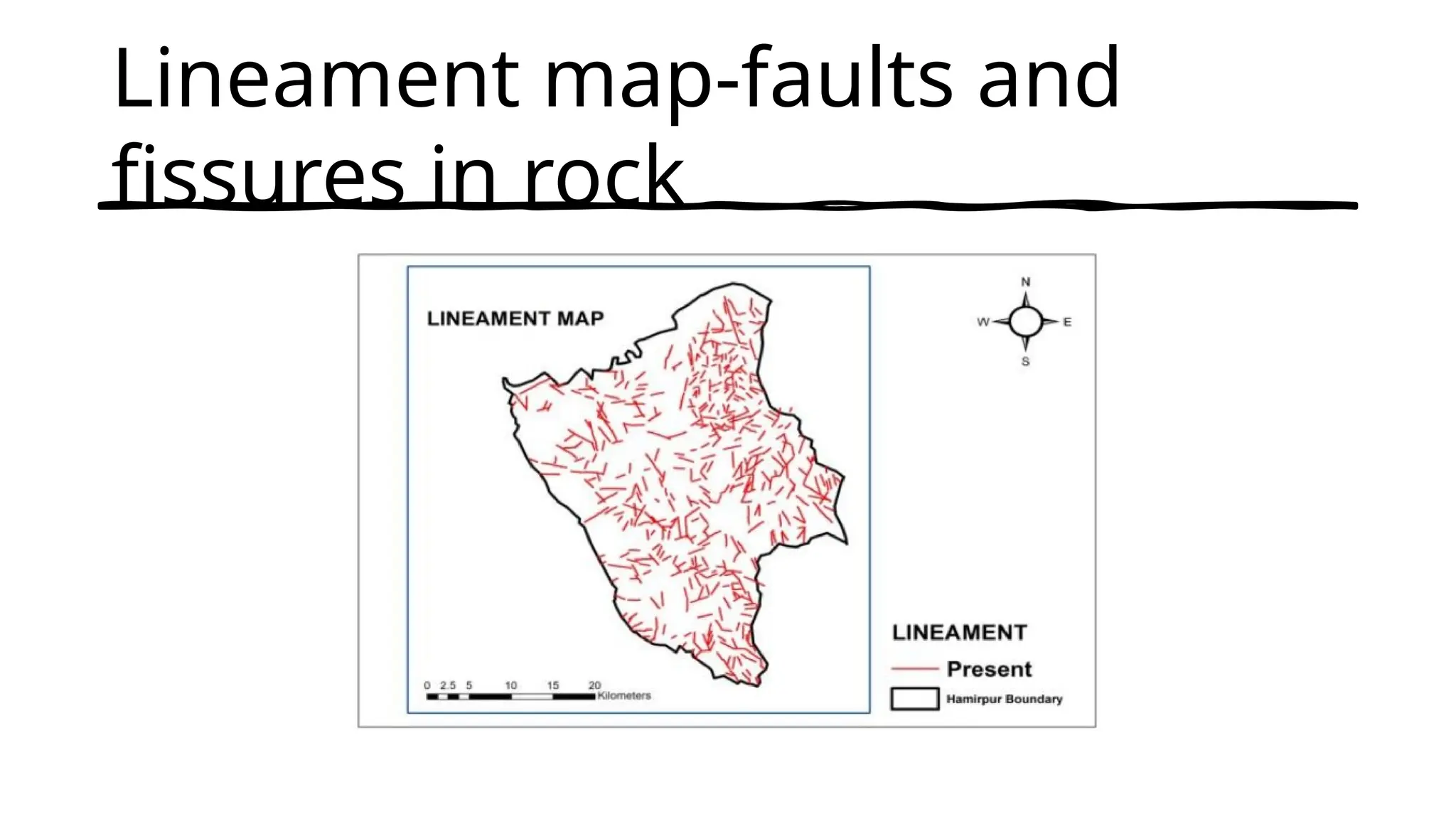
•Lineament maps- showing joints, fractures
and folds that are present beneath the
surface of earth .
•Water holding capacity of these lineaments
is very good and acts as a good conductor of
water transmission
Lineament map-faults and
fissures in rock
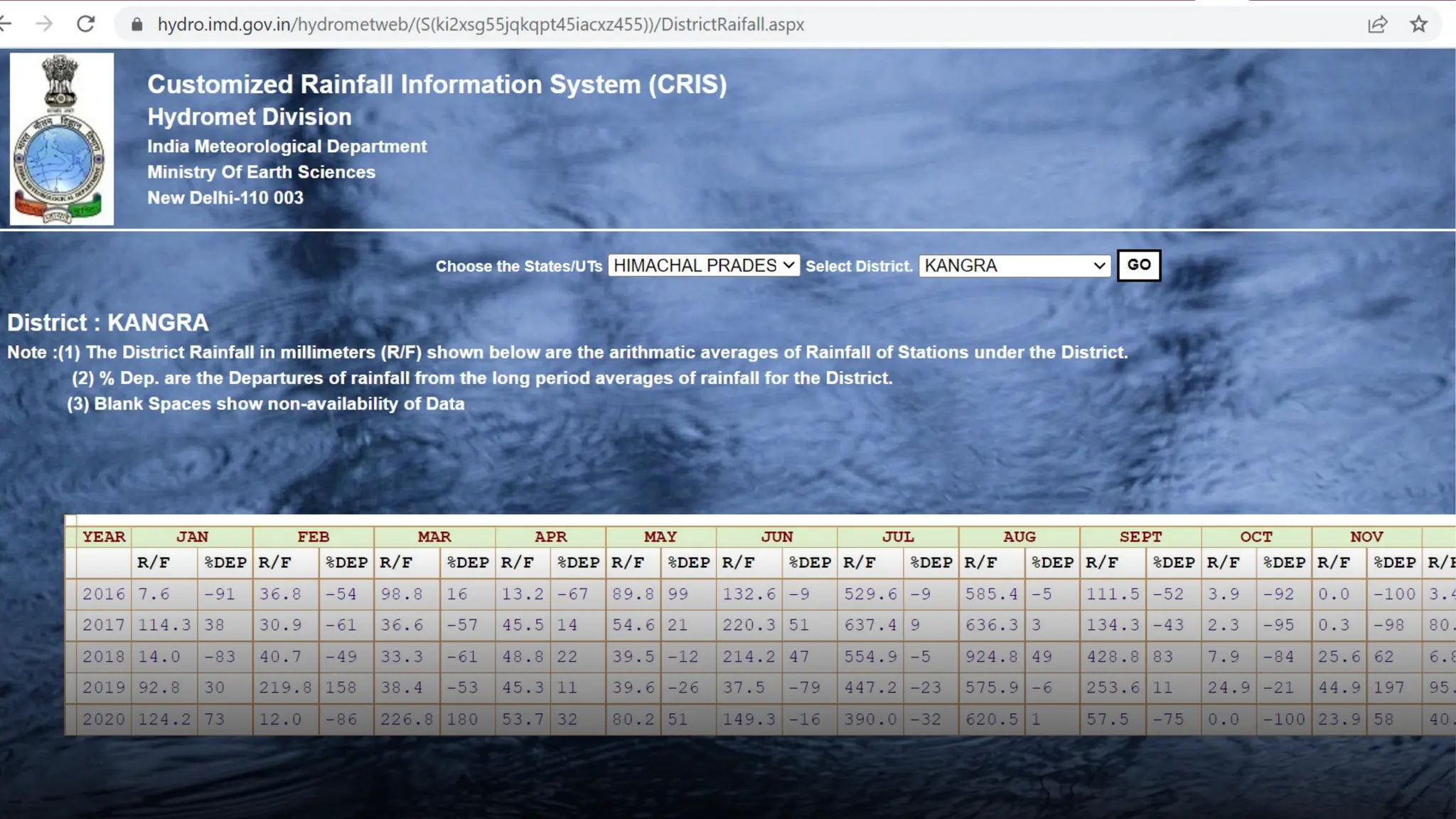
Hydrological/meterological data
Rainfall Temp.
Source of
this data
• IMD
• Hydromet
How will you
combine this data?
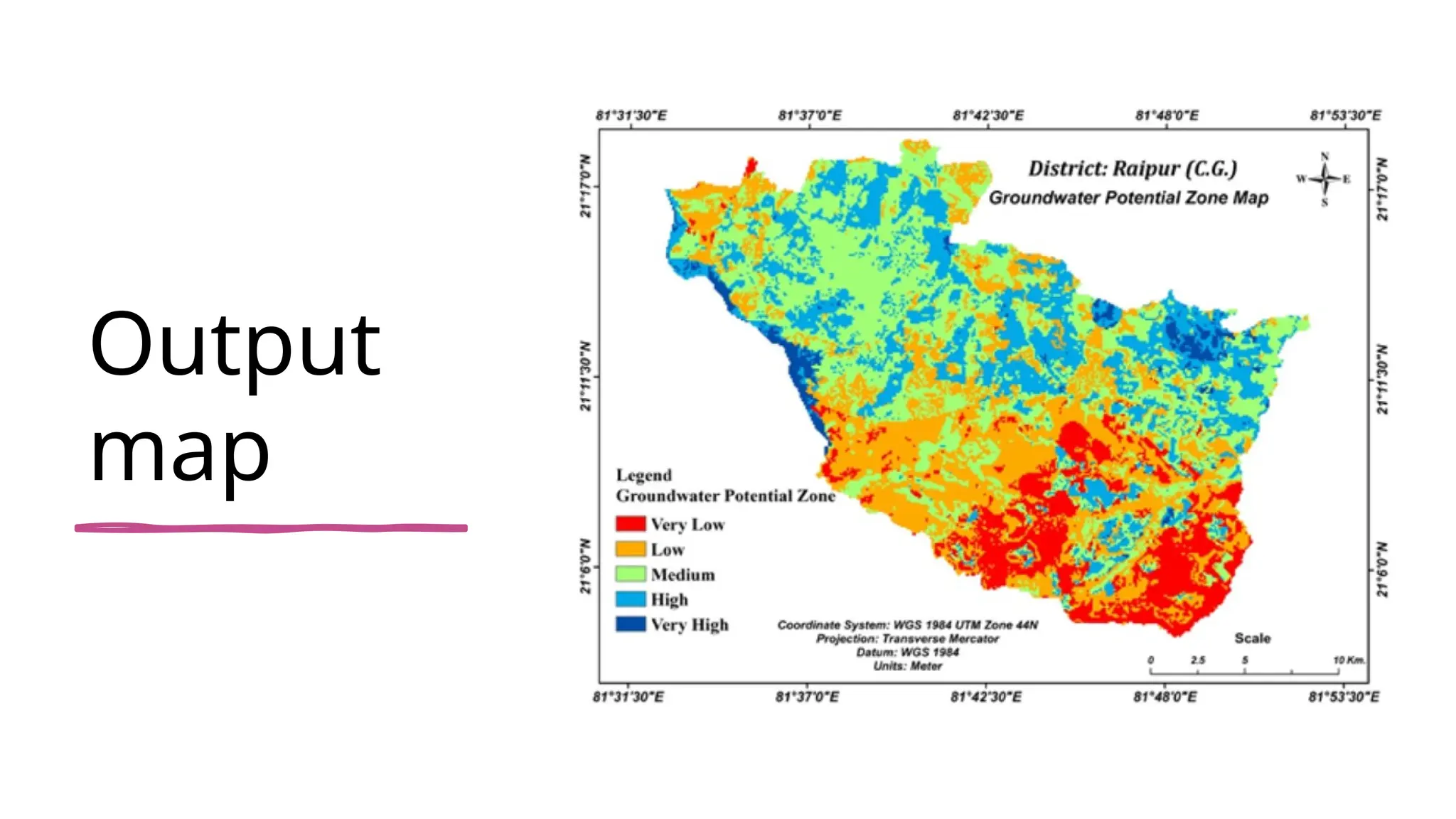
Output
map
GIS offers a solution
!
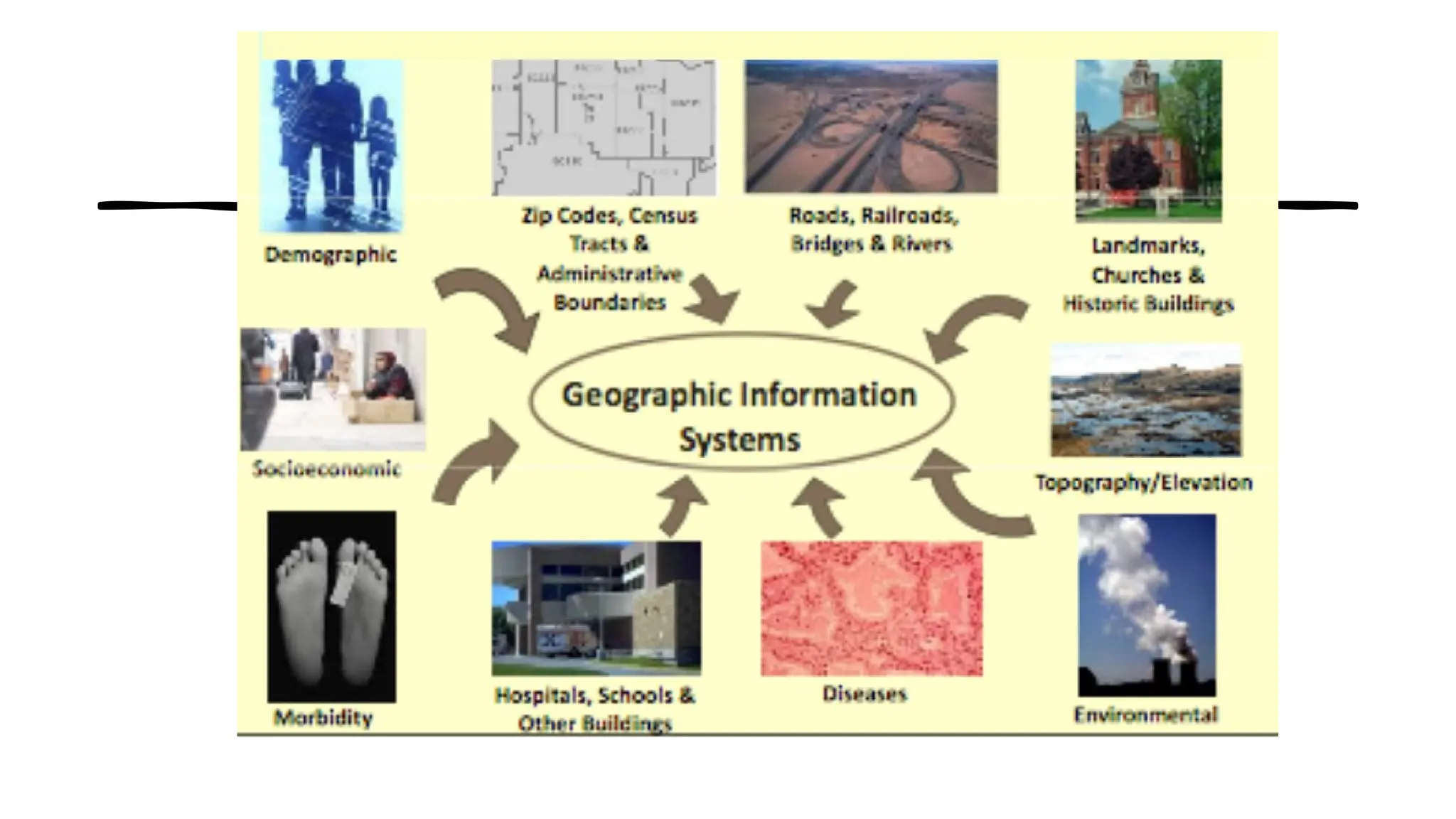
GIS
• Is a system designed for storing, analyzing, and
displaying spatial data.
• Geographic relates to the surface of the earth.
• Information is a knowledge derived from study,
experience, or instruction.
• System is a group of interacting, interrelated, or
interdependent elements forming a complex whole.
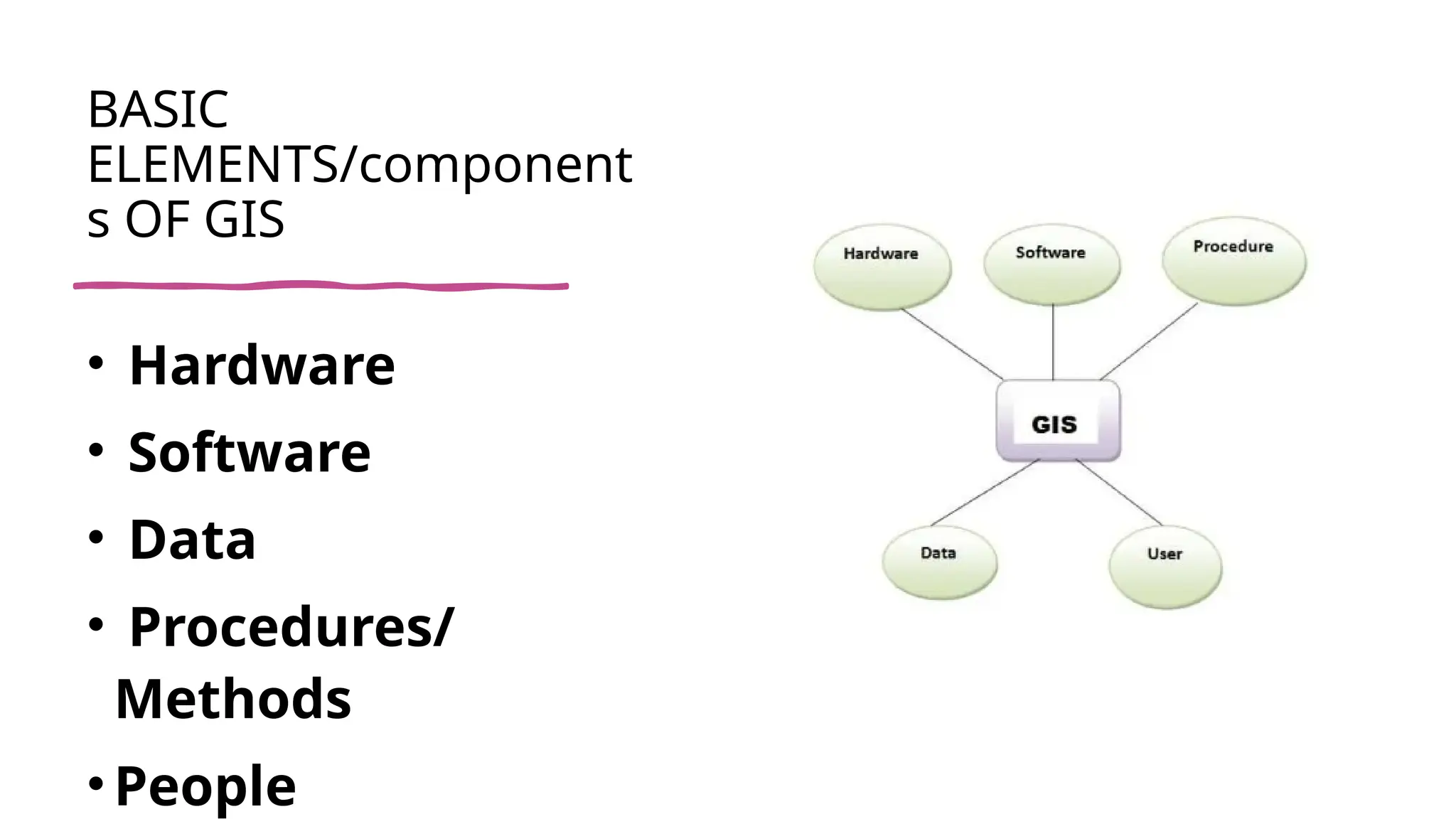
BASIC
ELEMENTS/component
s OF GIS
• Hardware
• Software
• Data
• Procedures/
Methods
•People
Hardware
•Any device (a computer, a
smartphone, a tablet, a
laptop, a monitor, a printer,
a scanner, etc.) that stores
large GIS datasets, GIS
software, and applications
can be referred to as the
hardware.
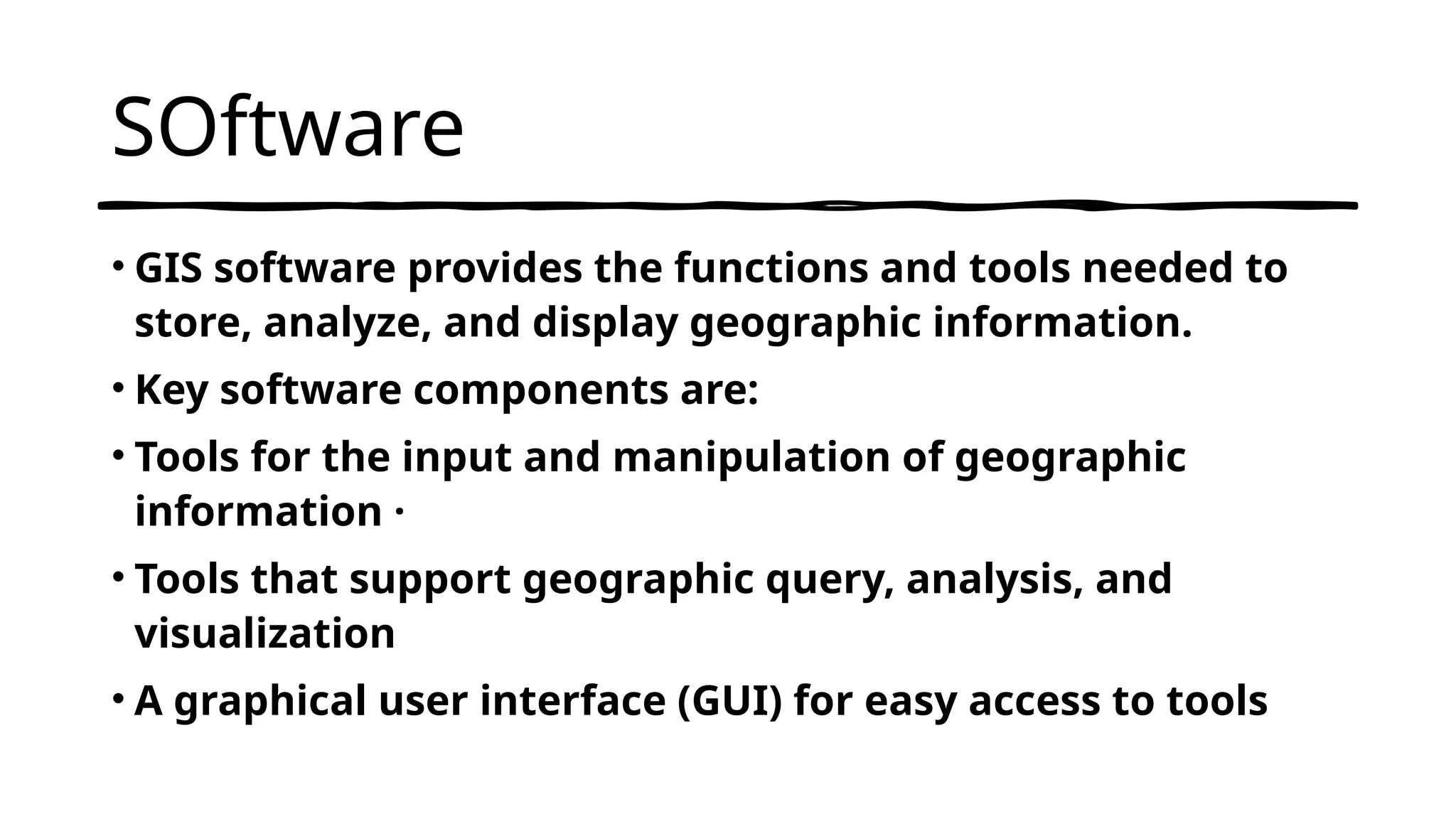
SOftware
• GIS software provides the functions and tools needed to
store, analyze, and display geographic information.
• Key software components are:
• Tools for the input and manipulation of geographic
information ·
• Tools that support geographic query, analysis, and
visualization
• A graphical user interface (GUI) for easy access to tools
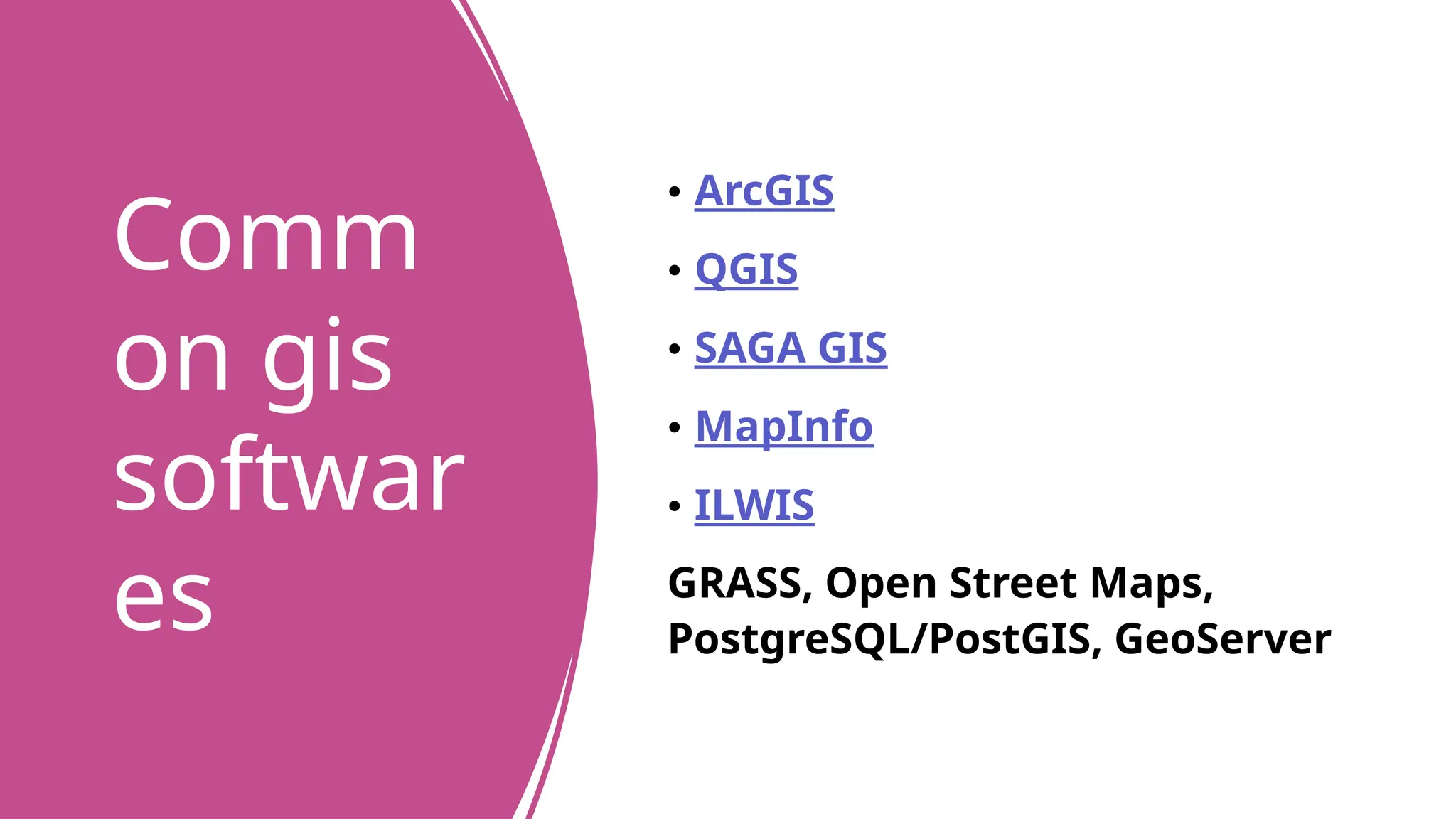
Comm
on gis
softwar
es
• ArcGIS
• QGIS
• SAGA GIS
• MapInfo
• ILWIS
GRASS, Open Street Maps,
PostgreSQL/PostGIS, GeoServer
methods/procedures
• An integral part of the GIS framework is the various
techniques used to turn data into digestible and
actionable information for easy interpretation.
• This may include algorithms, statistics, formulas,
and models that are predefined and unique to each
application.
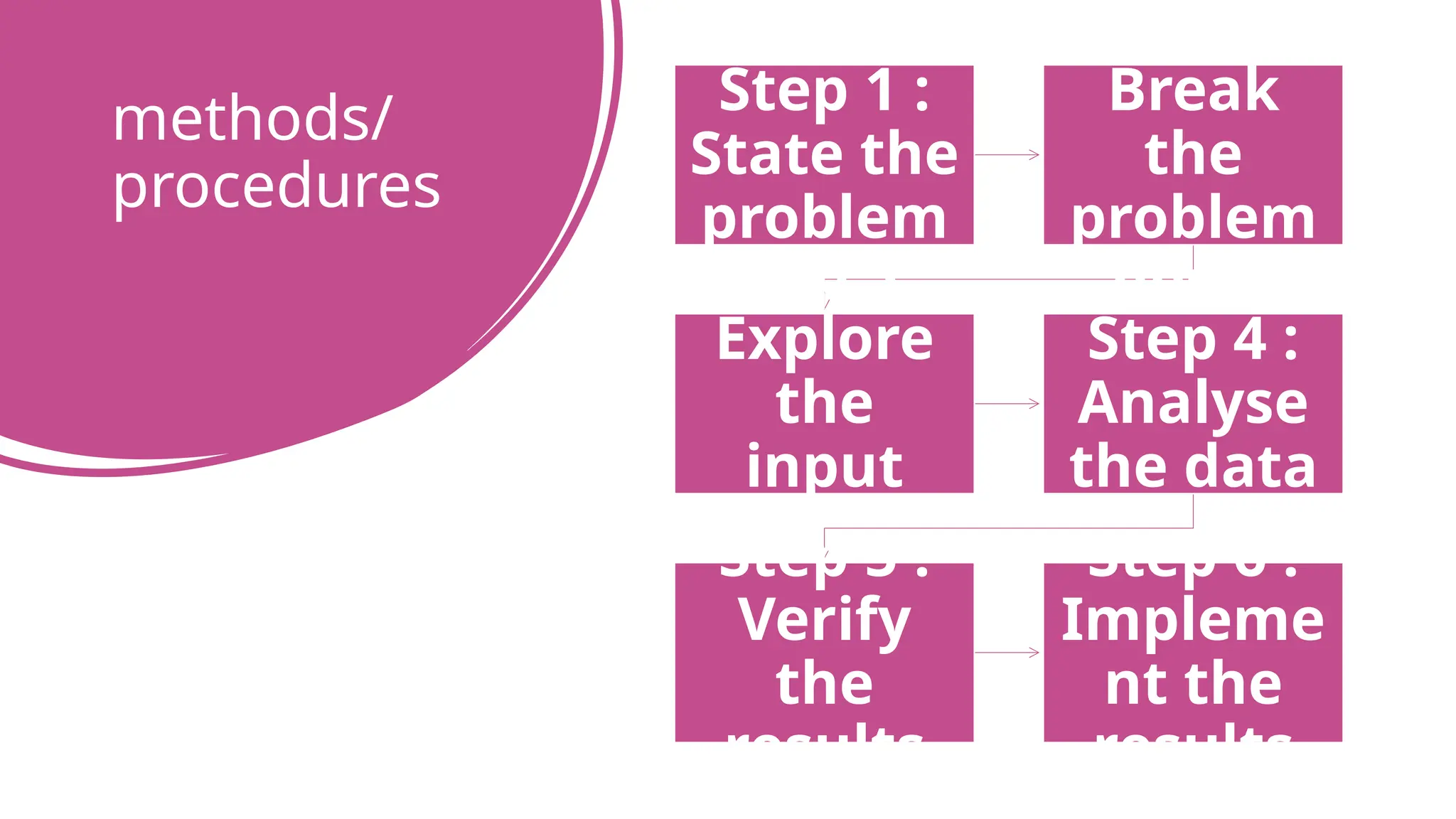
methods/
procedures
Step 1 :
State the
problem
Step 2:
Break
the
problem
down
Step 3 :
Explore
the
input
datasets
Step 4 :
Analyse
the data
Step 5 :
Verify
the
results
Step 6 :
Impleme
nt the
results
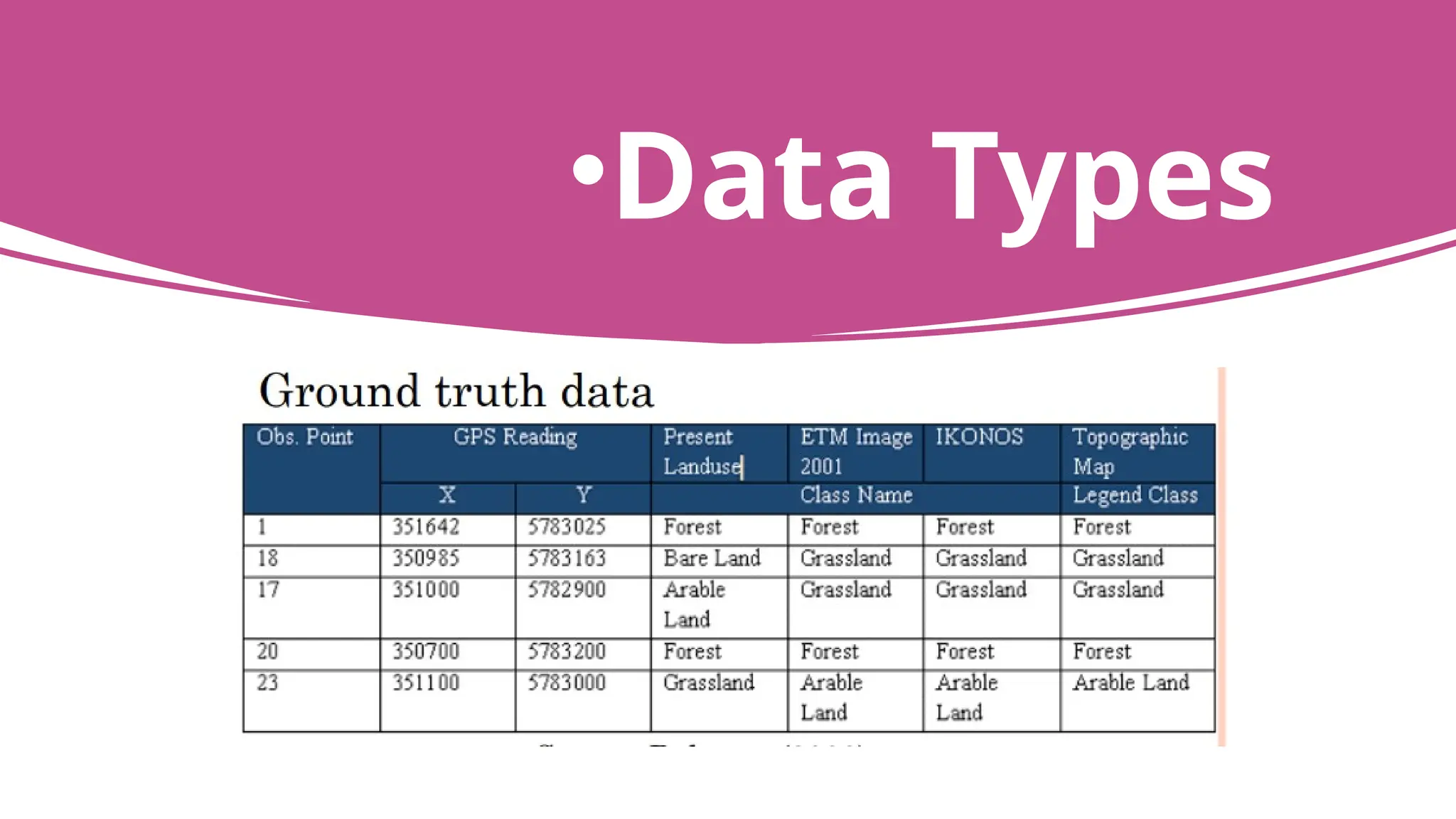
data
•Geographic data and related tabular data
(can be collected manually or purchased
from a commercial data provider)
• Since a GIS incorporates data from
multiple sources, its accuracy defines the
quality of the GIS.
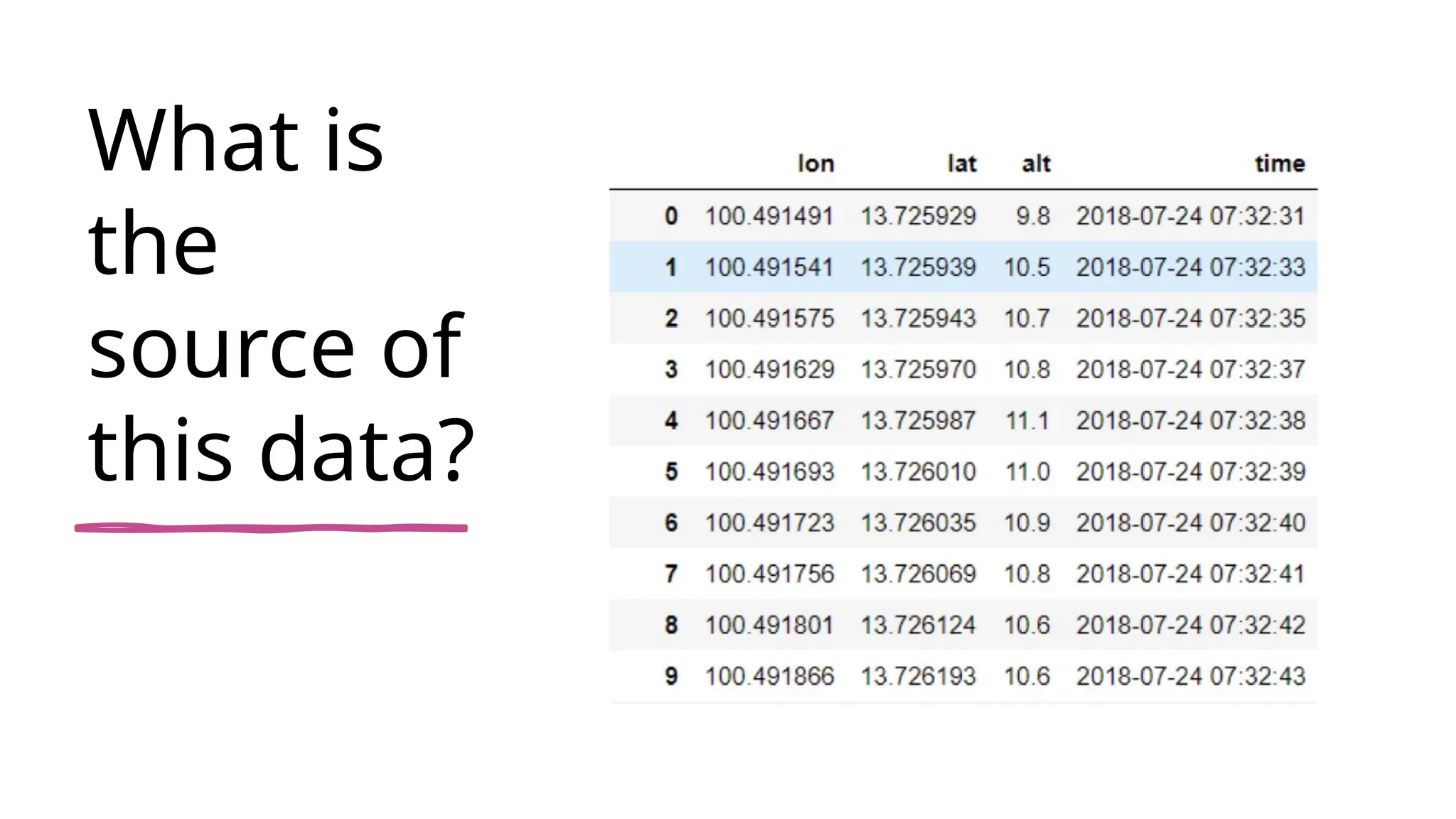
What is
the
source of
this data?
•Data Types
People
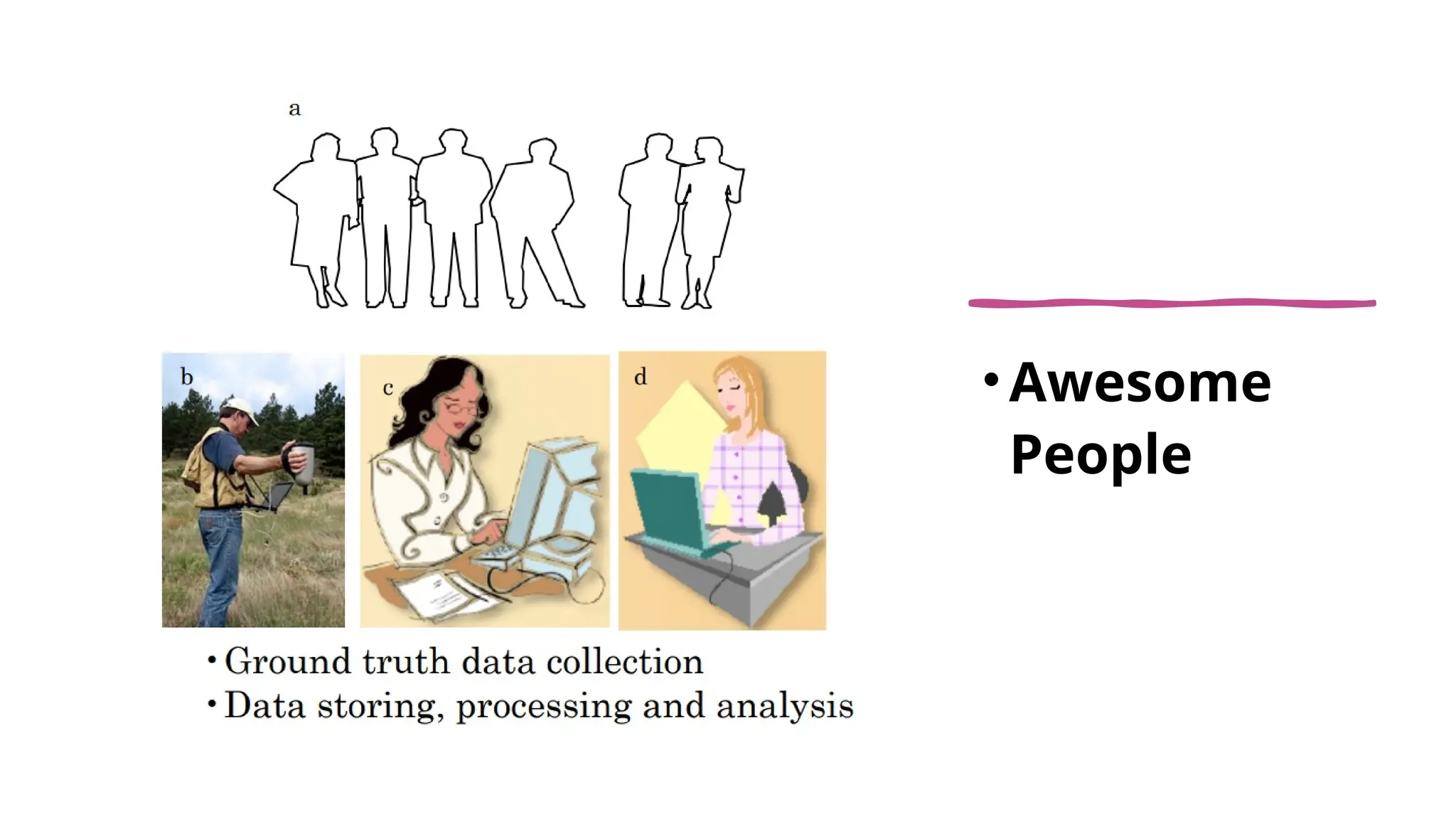
• Most important part of a GIS
• Includes decision makers, GIS software experts,
Ground data collection Teams
• Define and develop the procedures used by a GIS
•Awesome
People
Functions/OPERATIONS of GIS
• Data collection
• Capture data
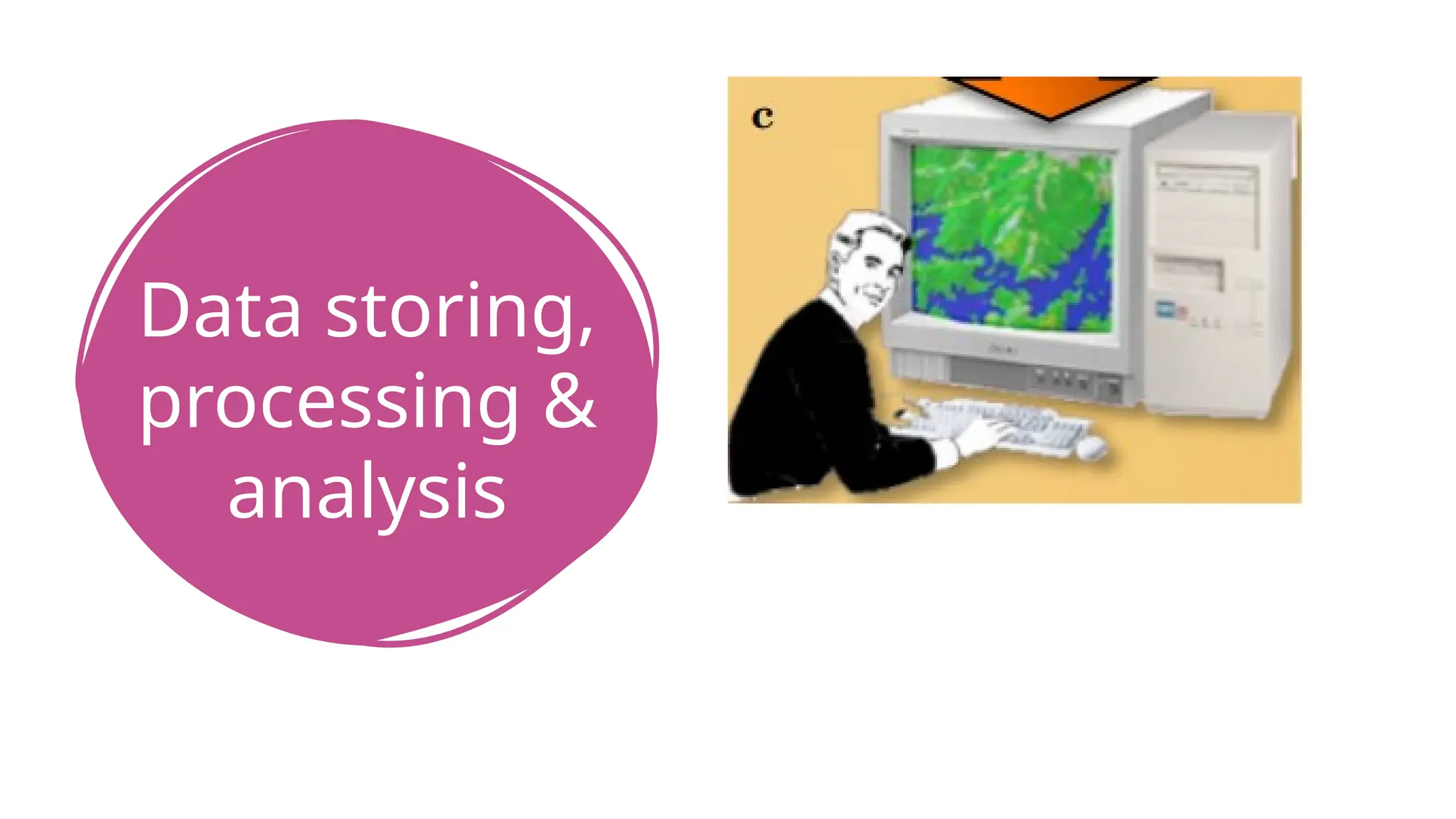
• Data storing, processing & analysis
• Store data ,Query data ,Analyze data
• Output production
• Display data
• Produce output
Data
collection
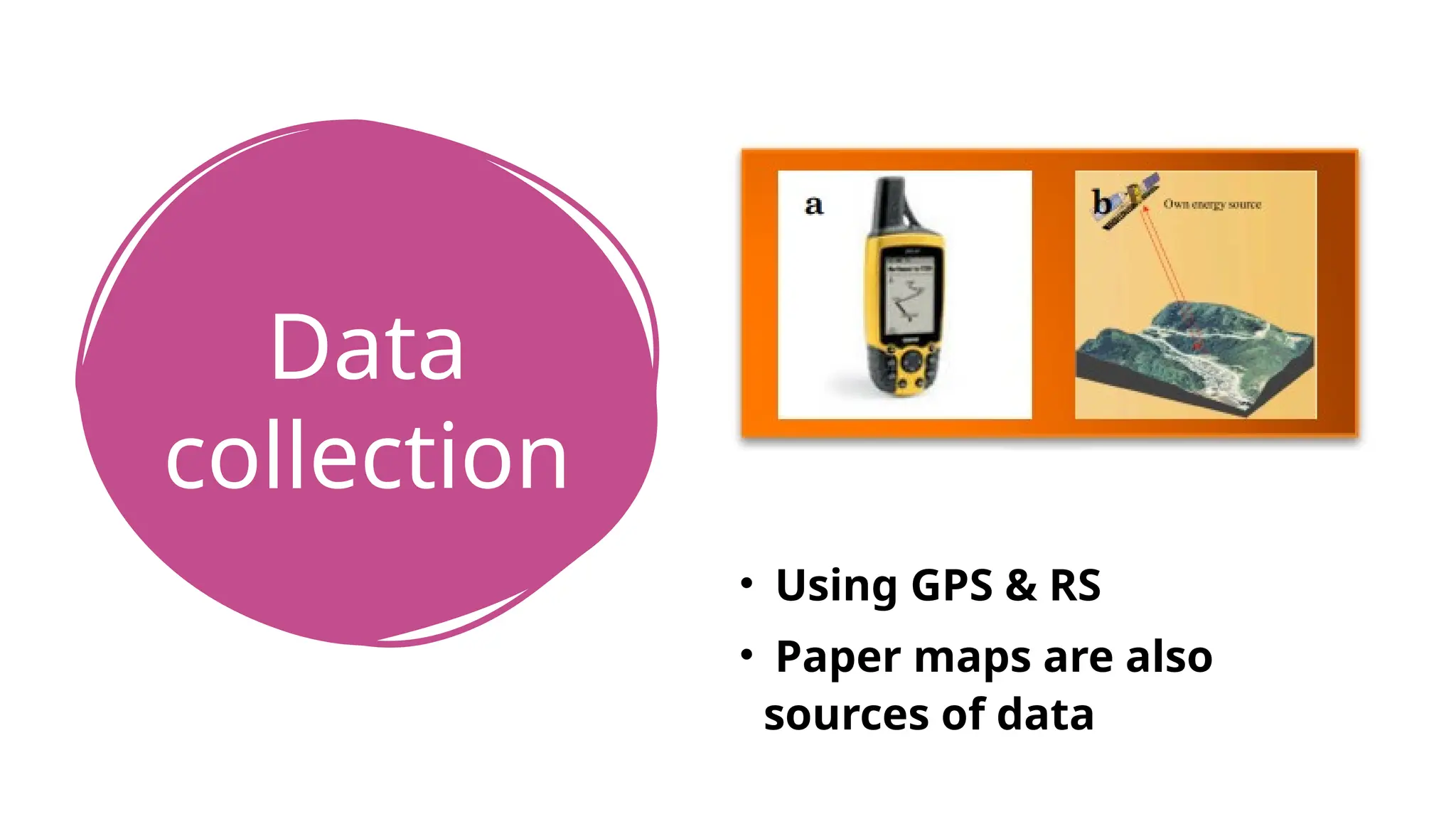
• Using GPS & RS
• Paper maps are also
sources of data
Data storing,
processing &
analysis
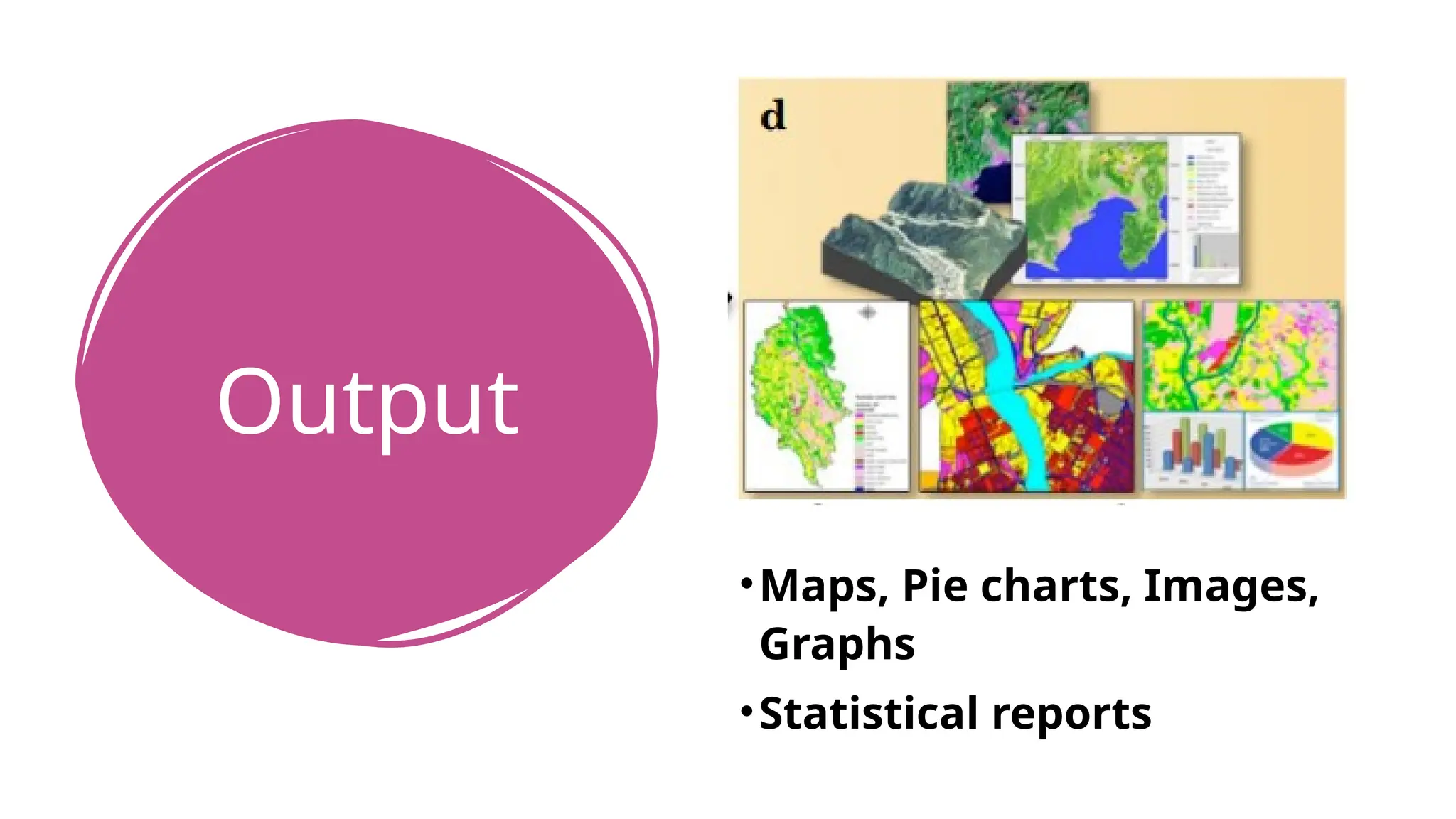
Output
•Maps, Pie charts, Images,
Graphs
•Statistical reports
DEFINITIONS
AND
TERMINOLOG
Y USED IN GIS
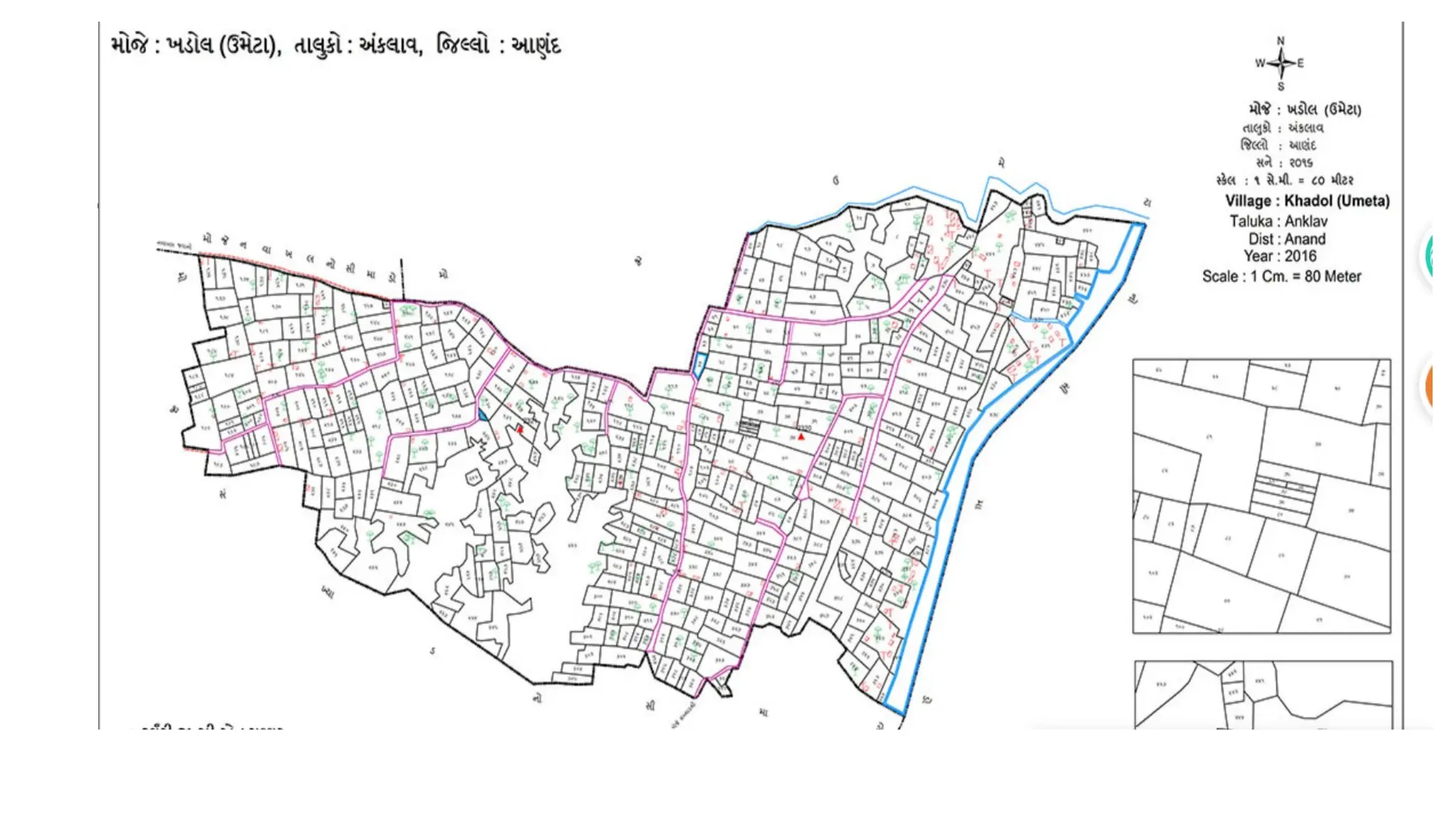
• Geographical Entity
• Entities are the things in the real
world
• Objects are the things in digital
world
•How do we
represent real world
entities in GIS?
Geogra
phic
Entity
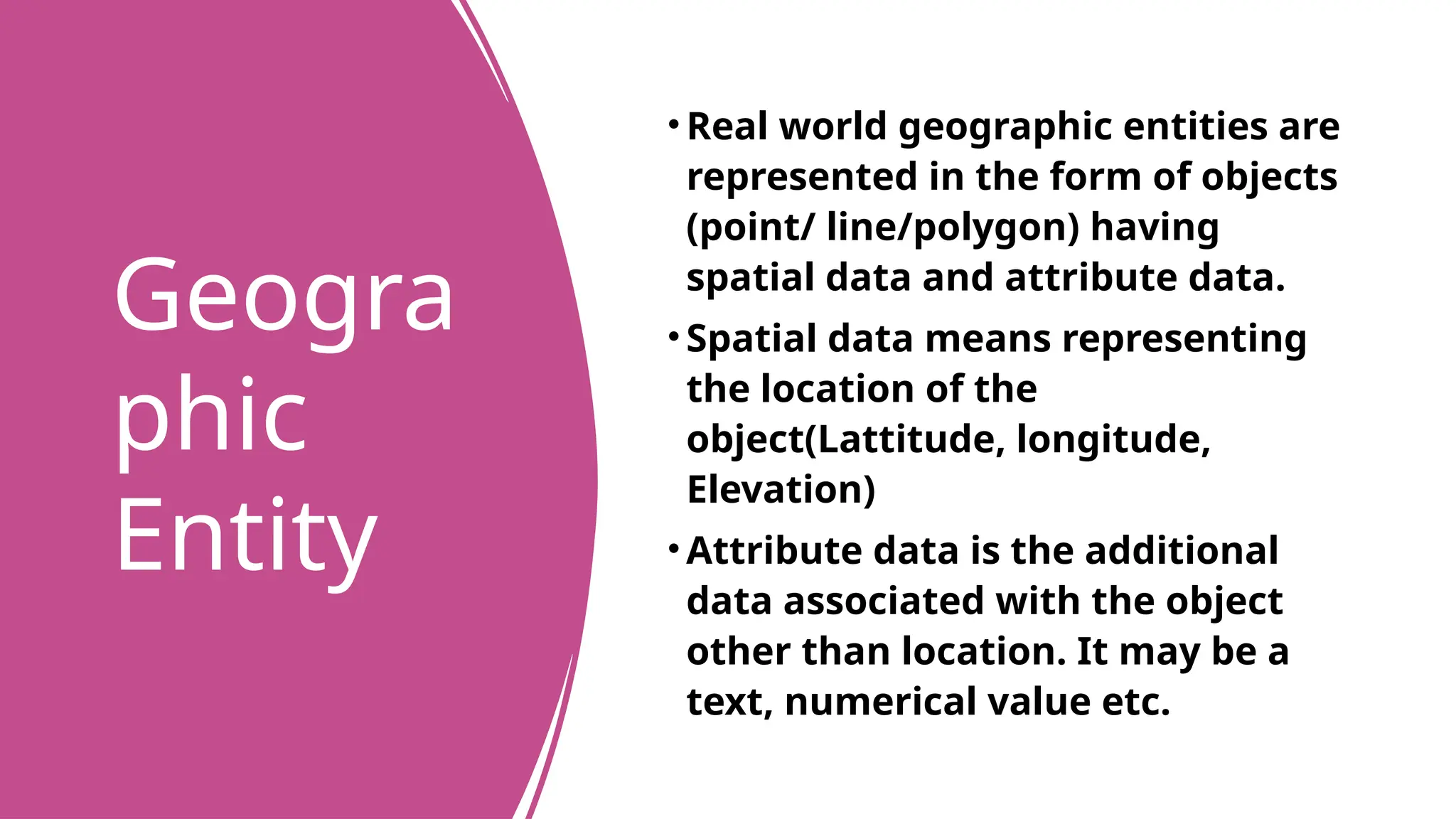
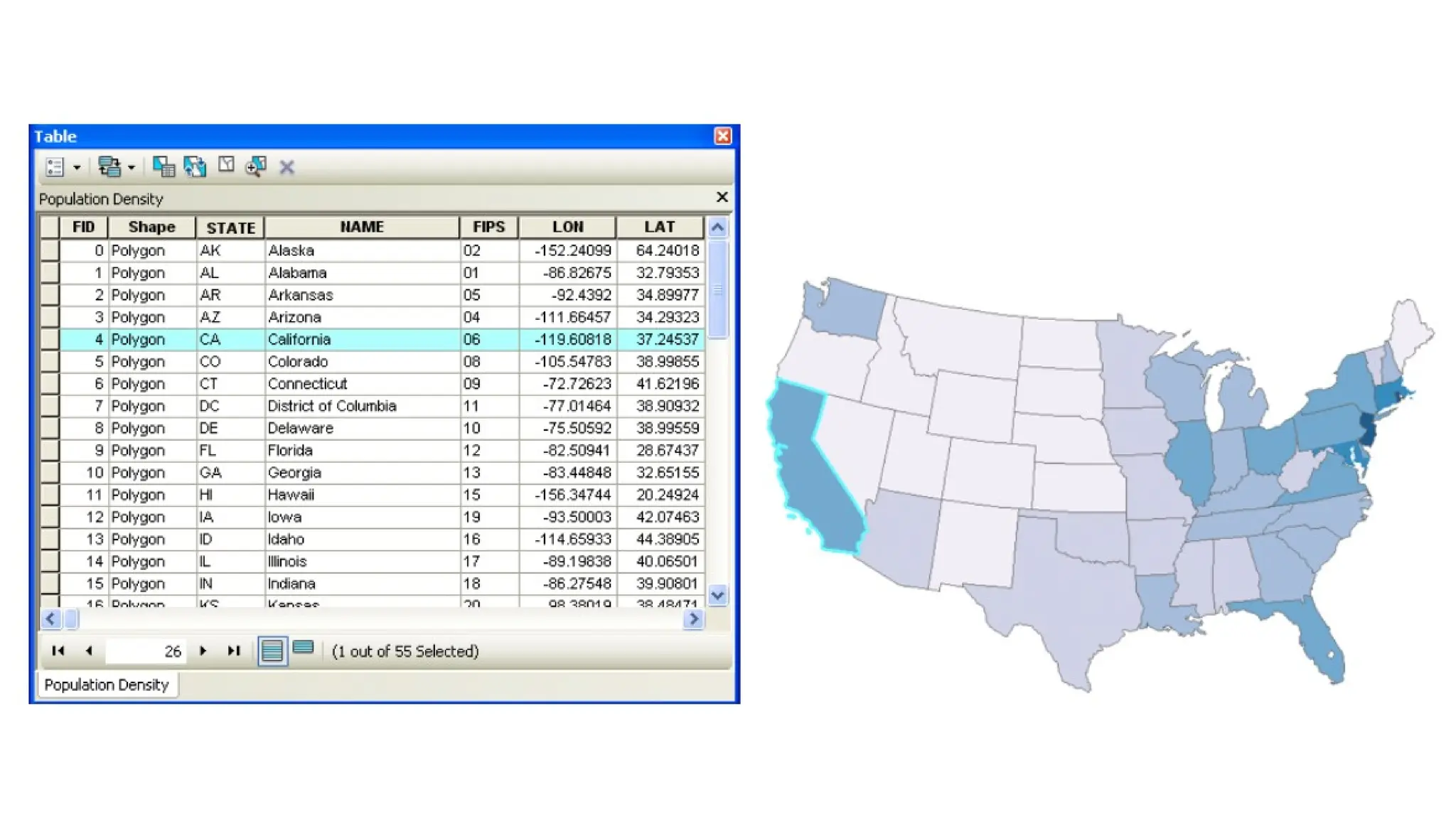
• Real world geographic entities are
represented in the form of objects
(point/ line/polygon) having
spatial data and attribute data.
• Spatial data means representing
the location of the
object(Lattitude, longitude,
Elevation)
• Attribute data is the additional
data associated with the object
other than location. It may be a
text, numerical value etc.
What
about
elevation?
•How would be
represent
elevation of a
particular
geographic area?
DEM
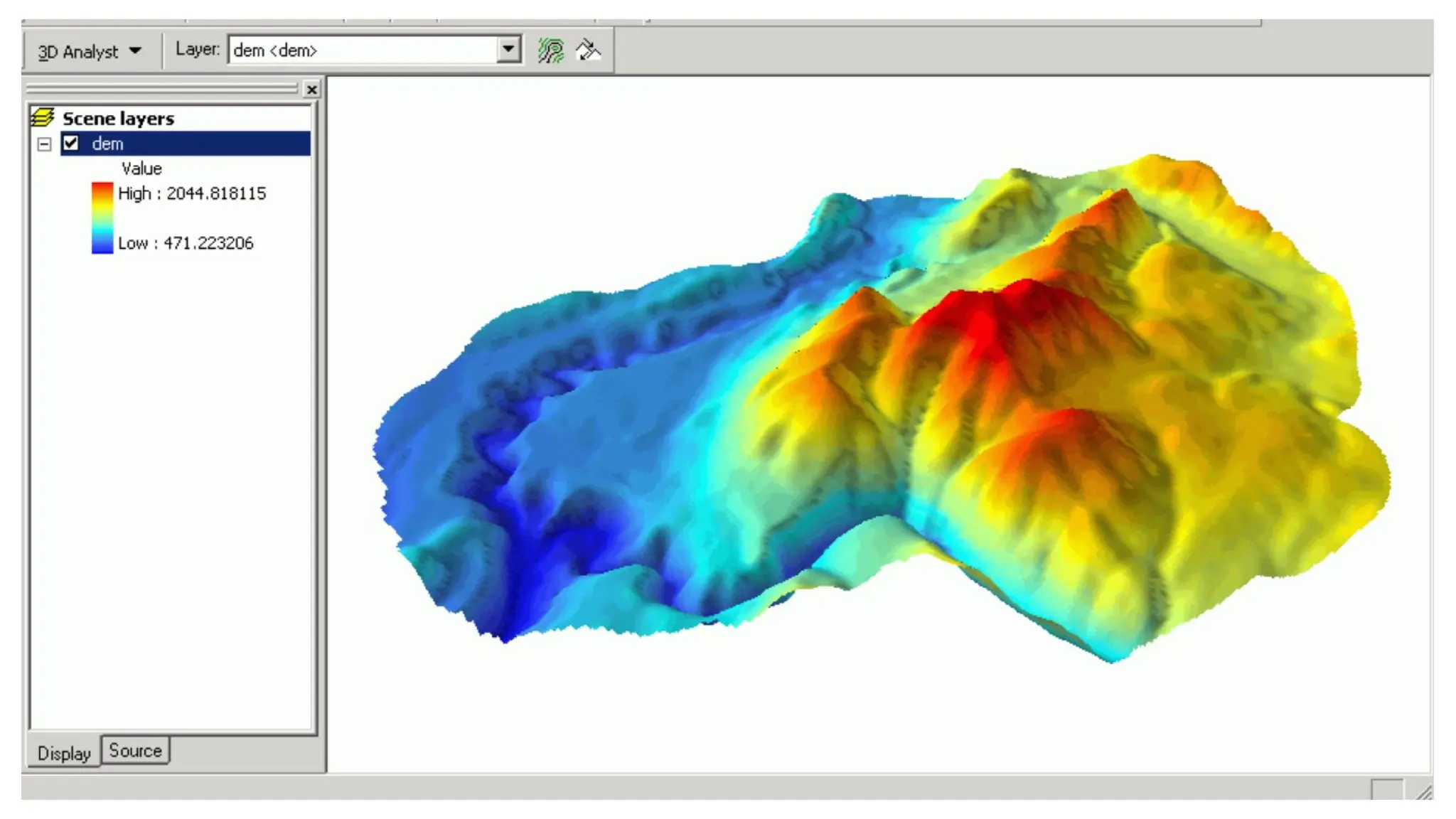
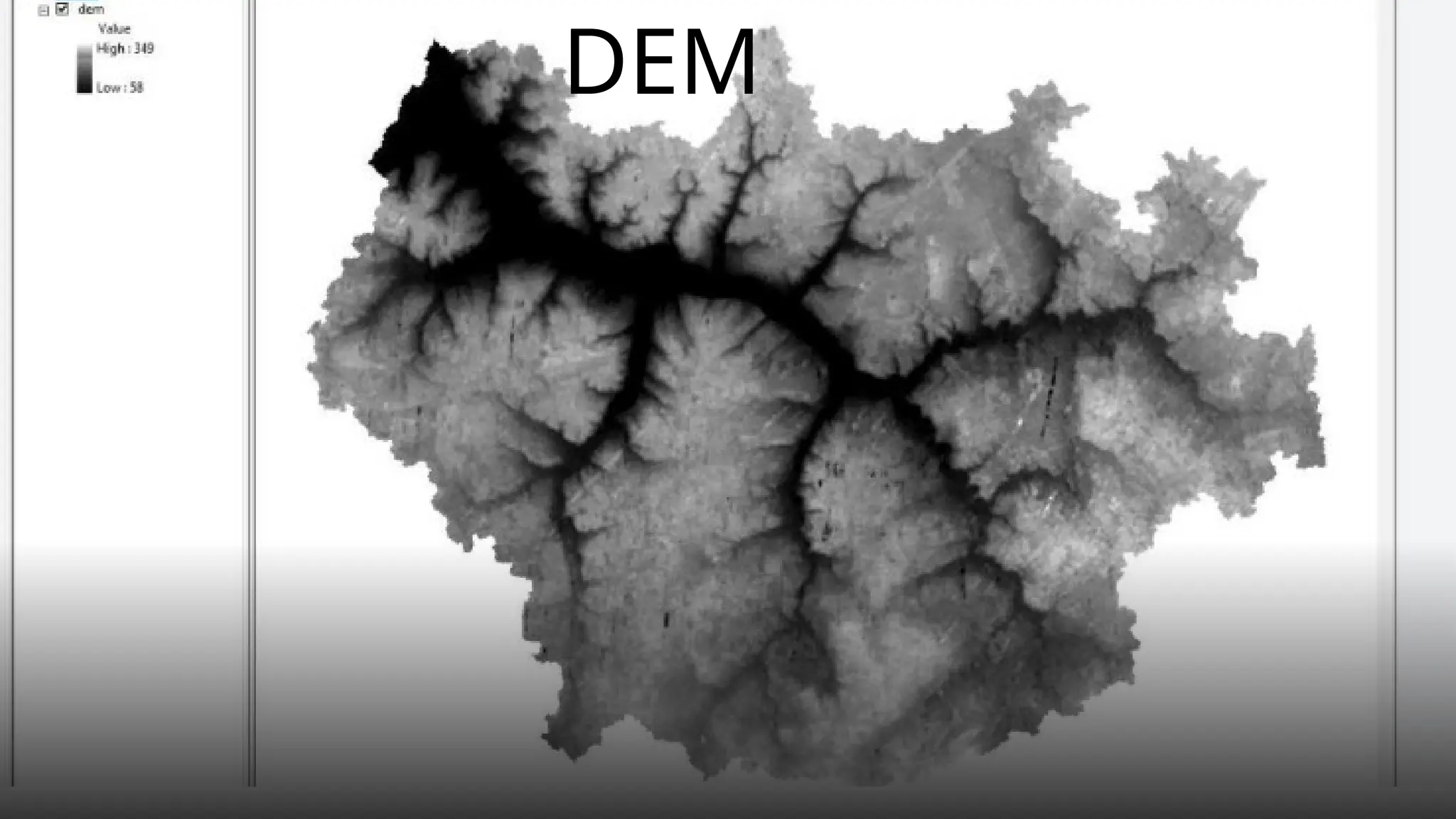
Digital Elevation Model (DEM)
• Simplest form of digital elevation of topography.
• Digital representation of elevation of earth.
• It gives elevation, slope , aspect.
• Where would be use DEM????
DEM
•Landslides vulnerability
•Hydrology
Attributes
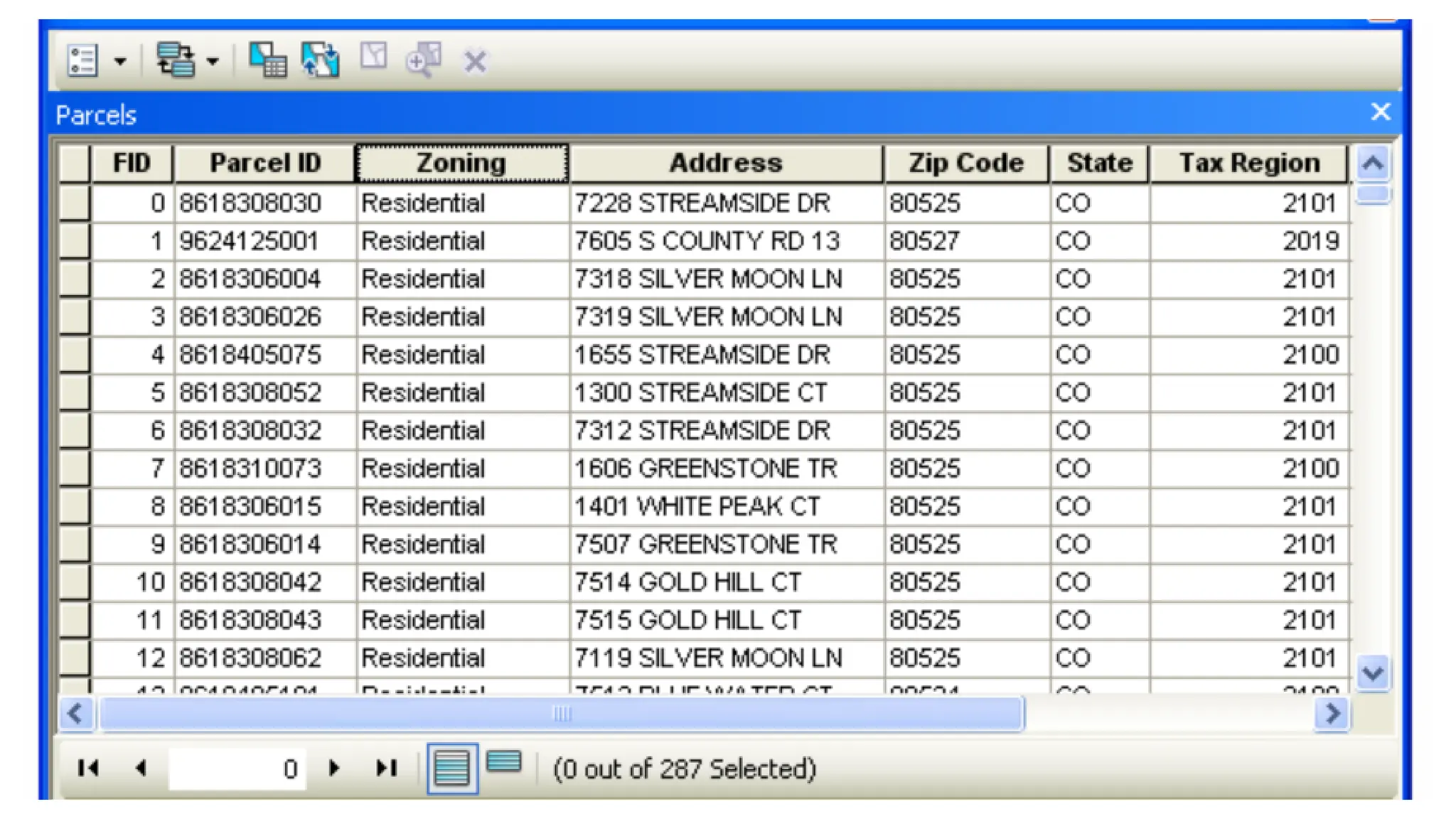
• Attributes are the characteristics of the map features.
• Hold the descriptive information about the geographic
features.
• Attributes are the non-spatial data(location is not
attched to them direcly) .They are considered
characteristics of entity ..
• Also feed the information in the tabular form in GIS
Attributes
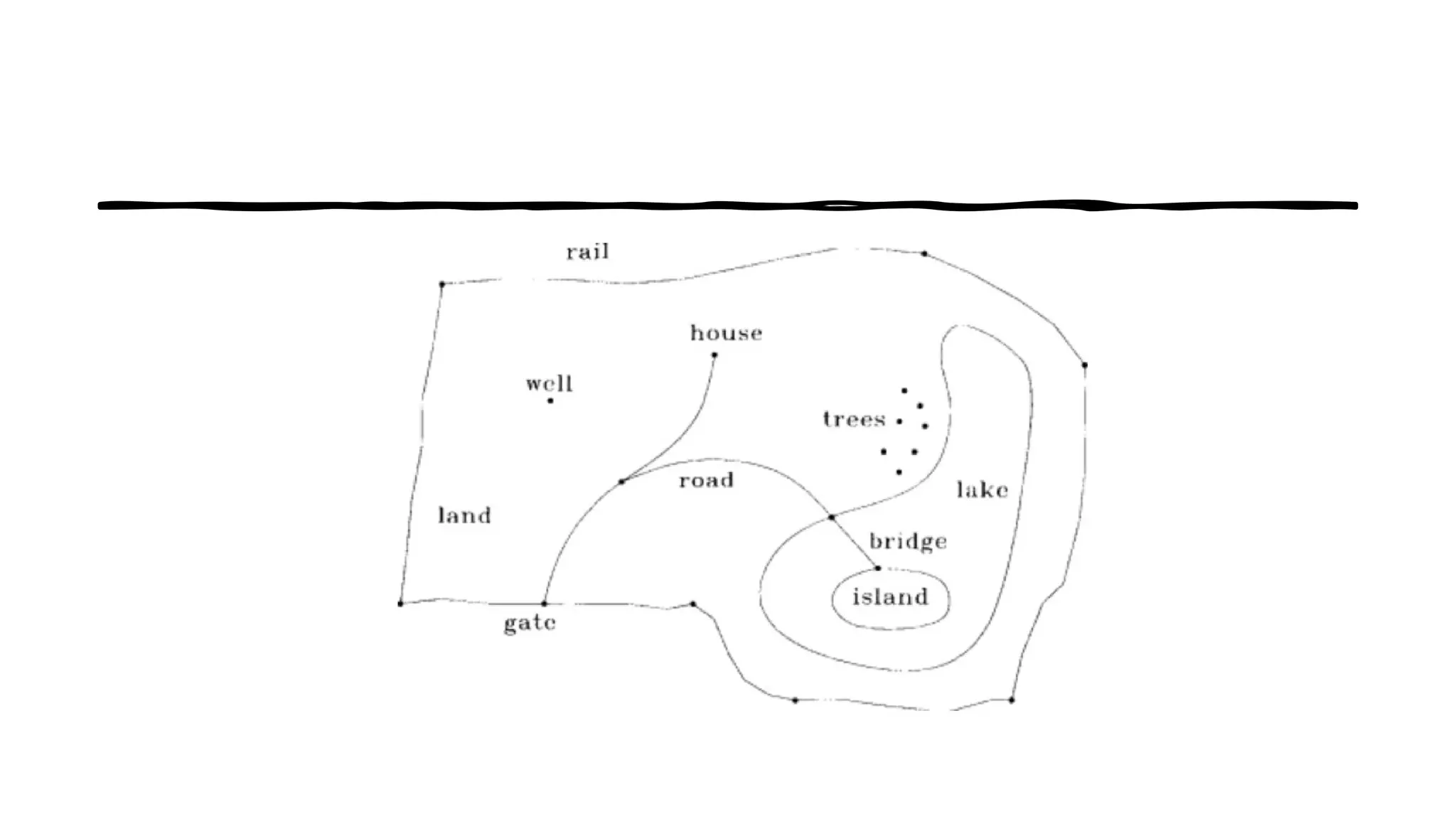
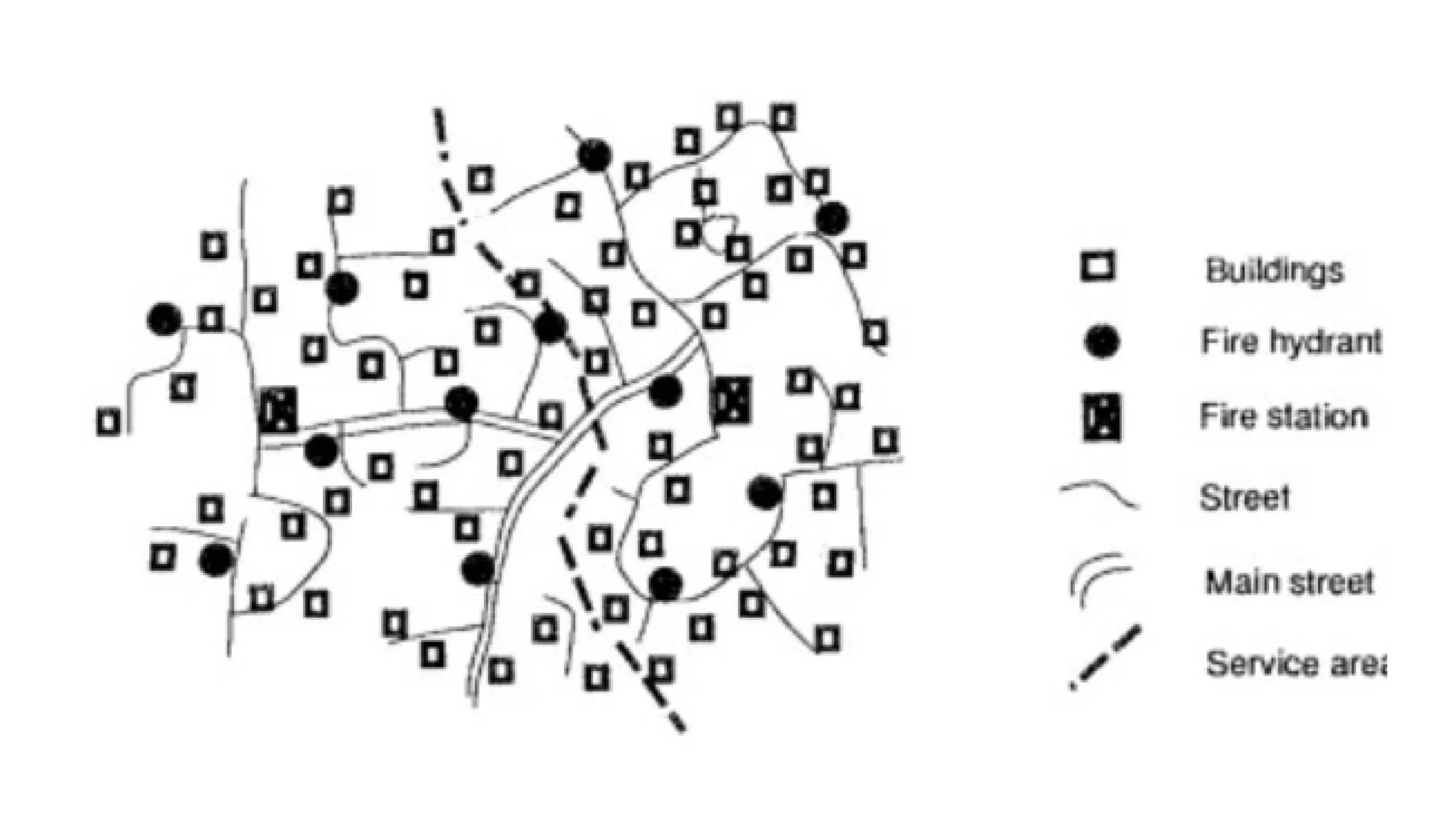
• A point represents a hotel, a line represents the road
and area represents the boundaries of the lake.
• Each spatial entity may have more than one
attribute associated with it , that is, a point
representing the hotel may have a number of rooms,
standard of accommodation and other related info.
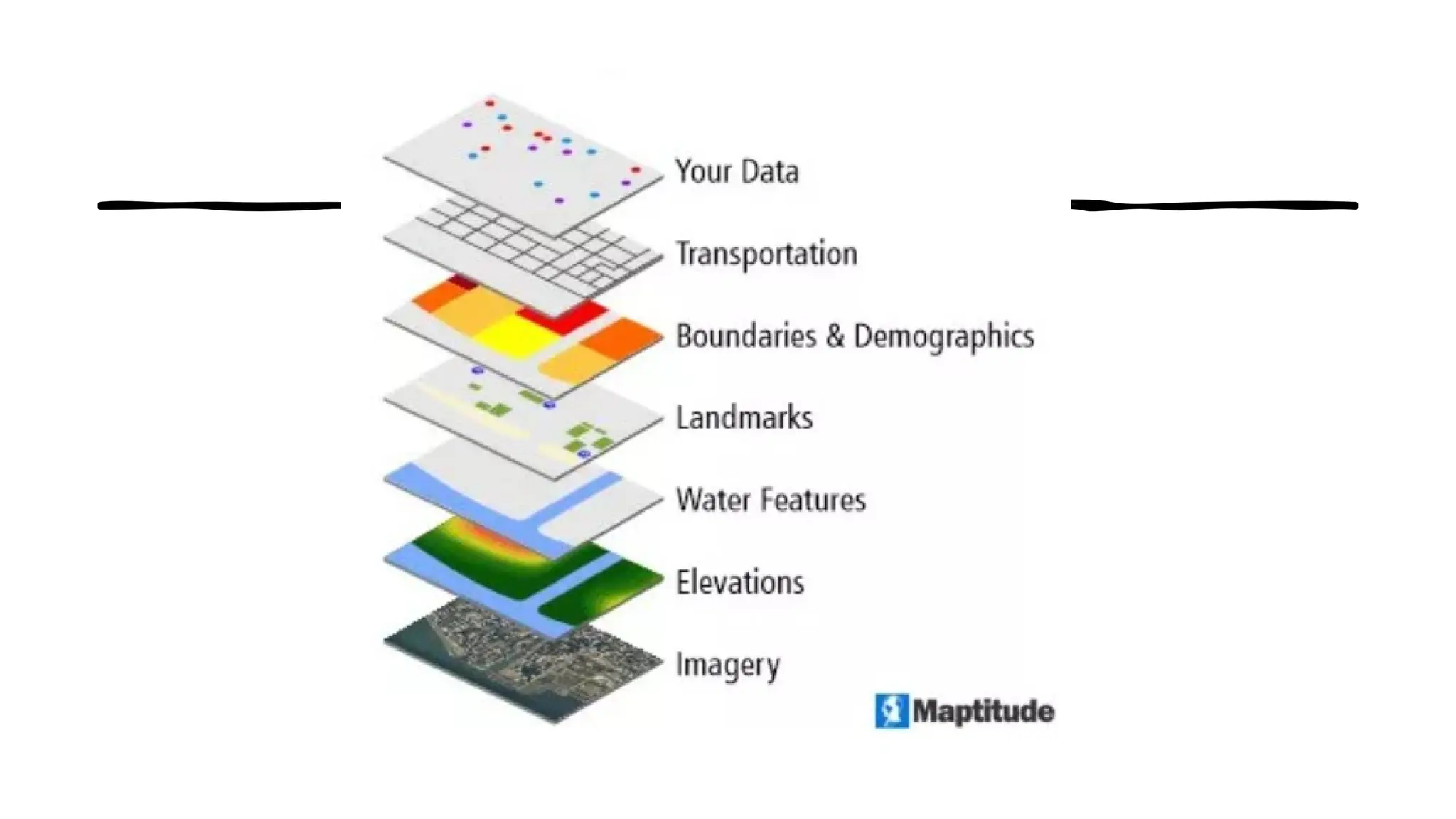
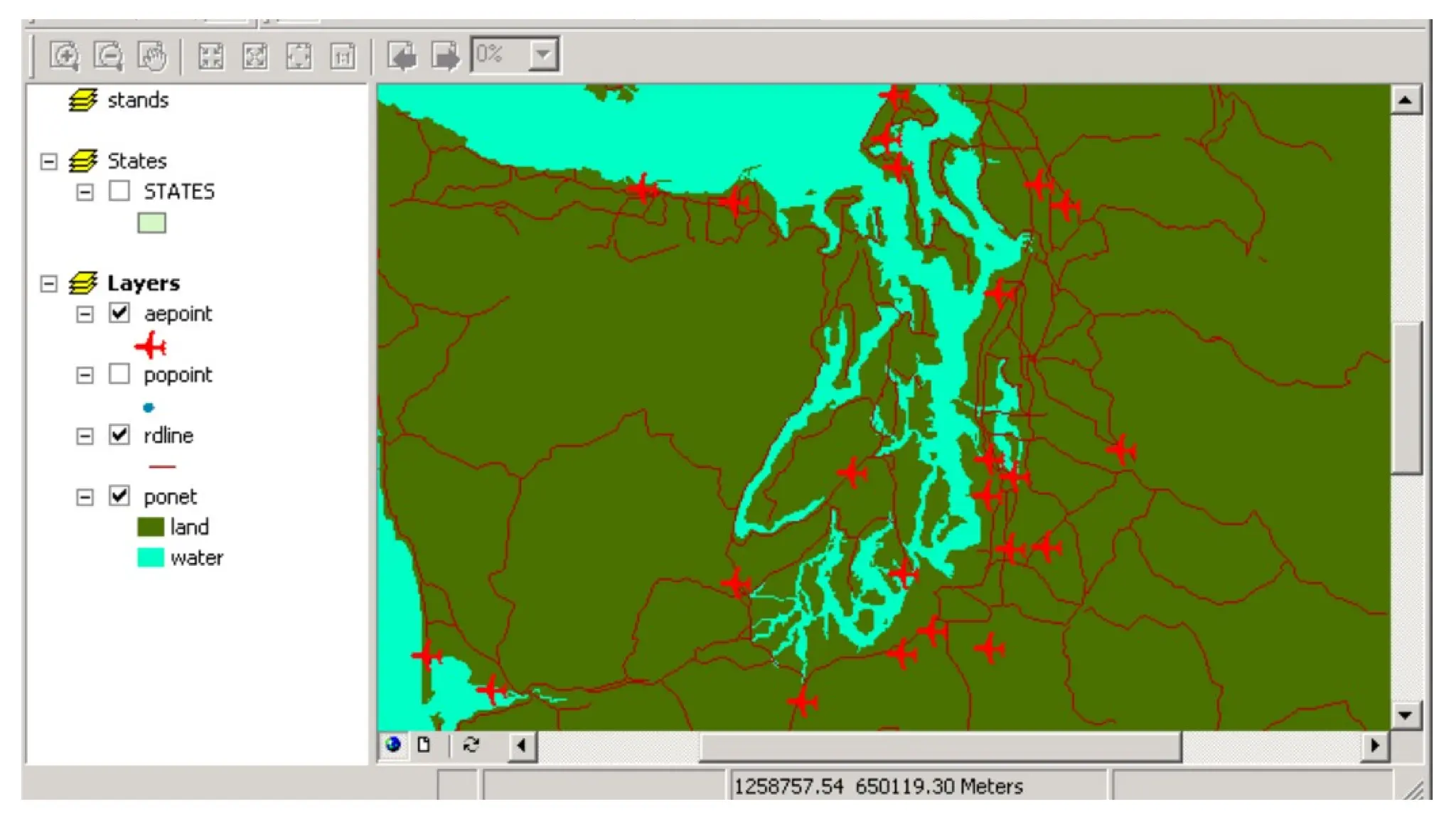
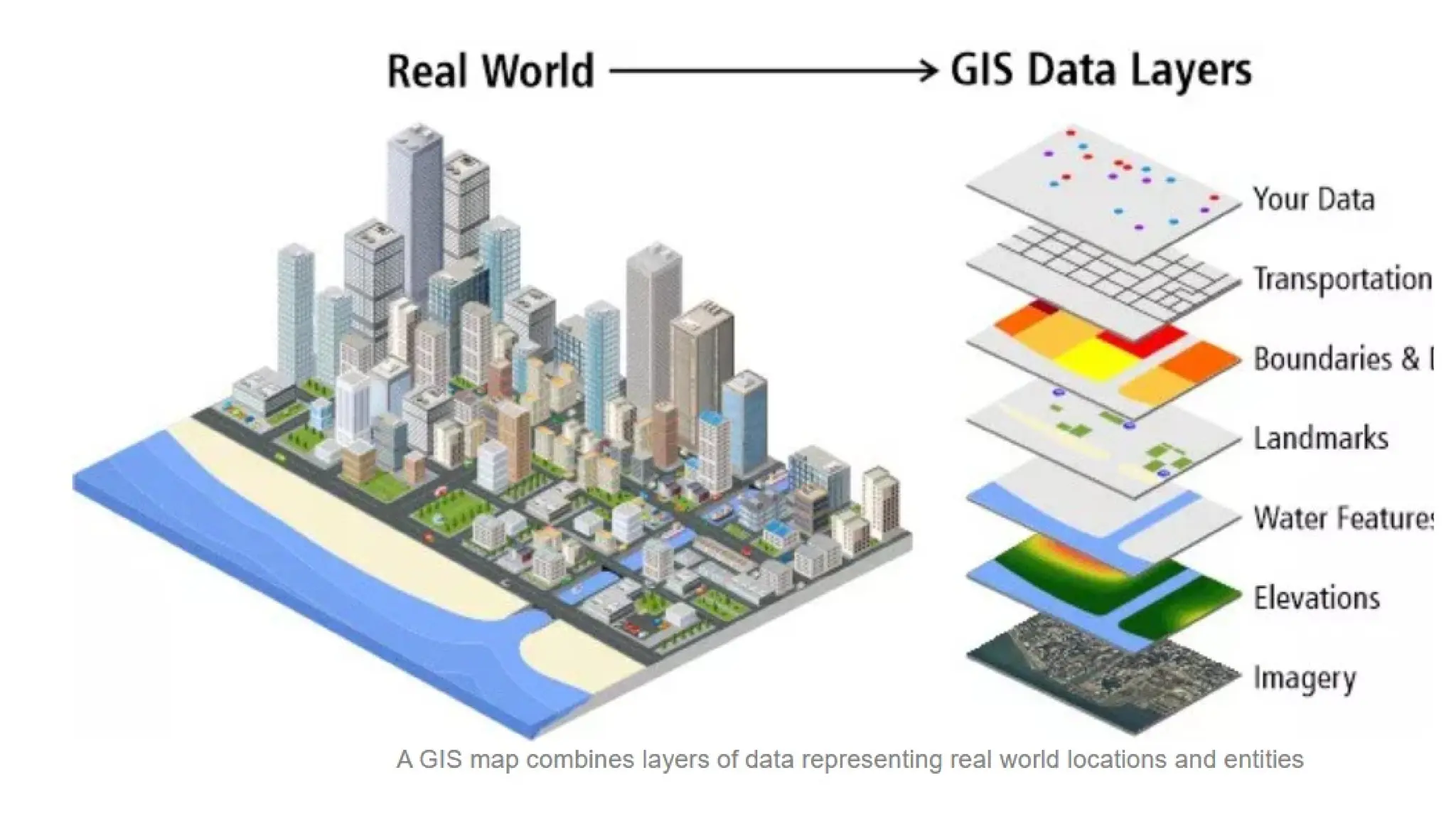
Layer
• The visual representation of a geographic dataset
in any digital map.
• Data in a layer is represented with points, lines,
shapes (polygons), or surfaces.
•Layer can be a satellite image as well.
• Maps in a Geographic Information System are
made by combining multiple layers
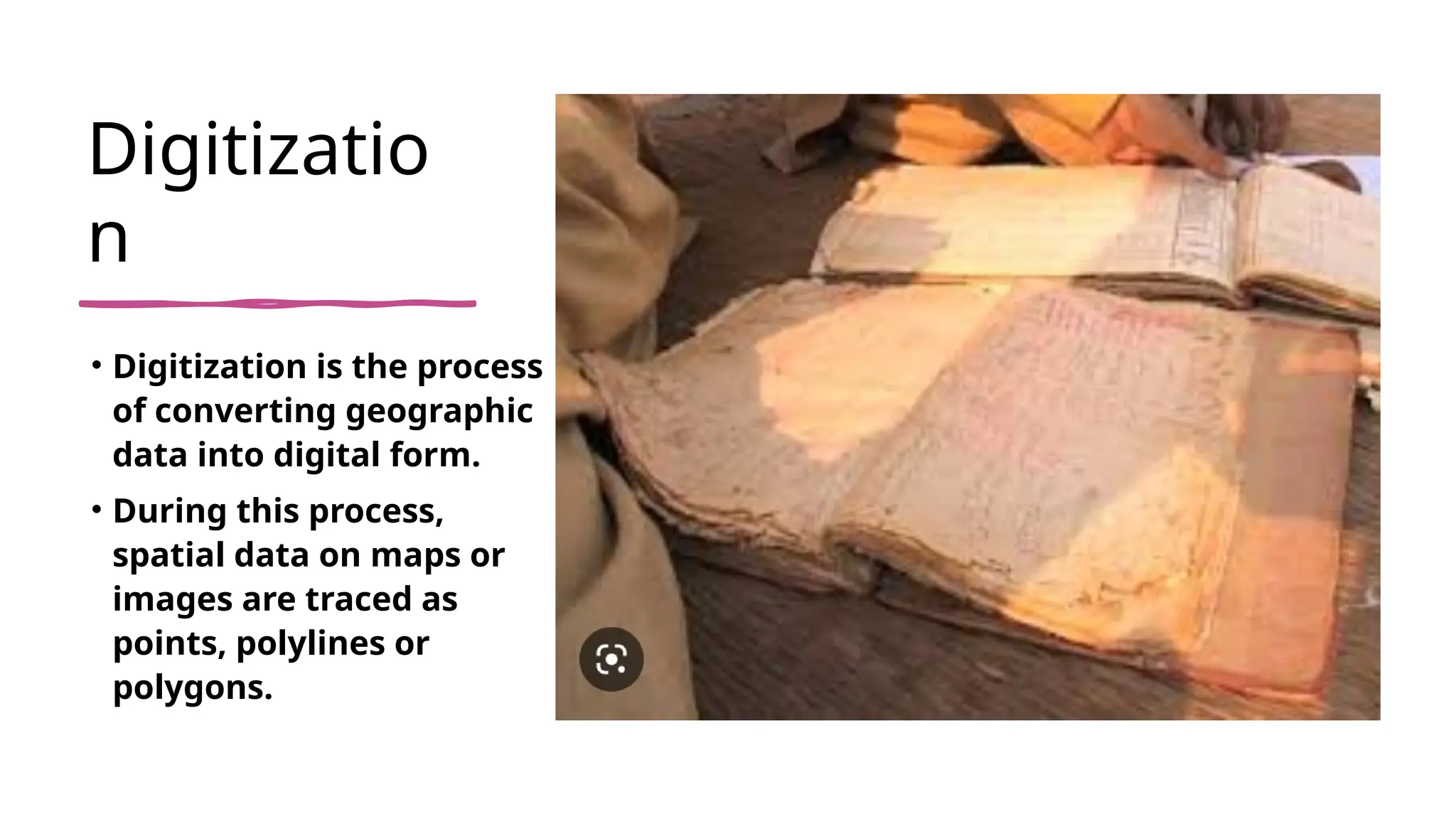
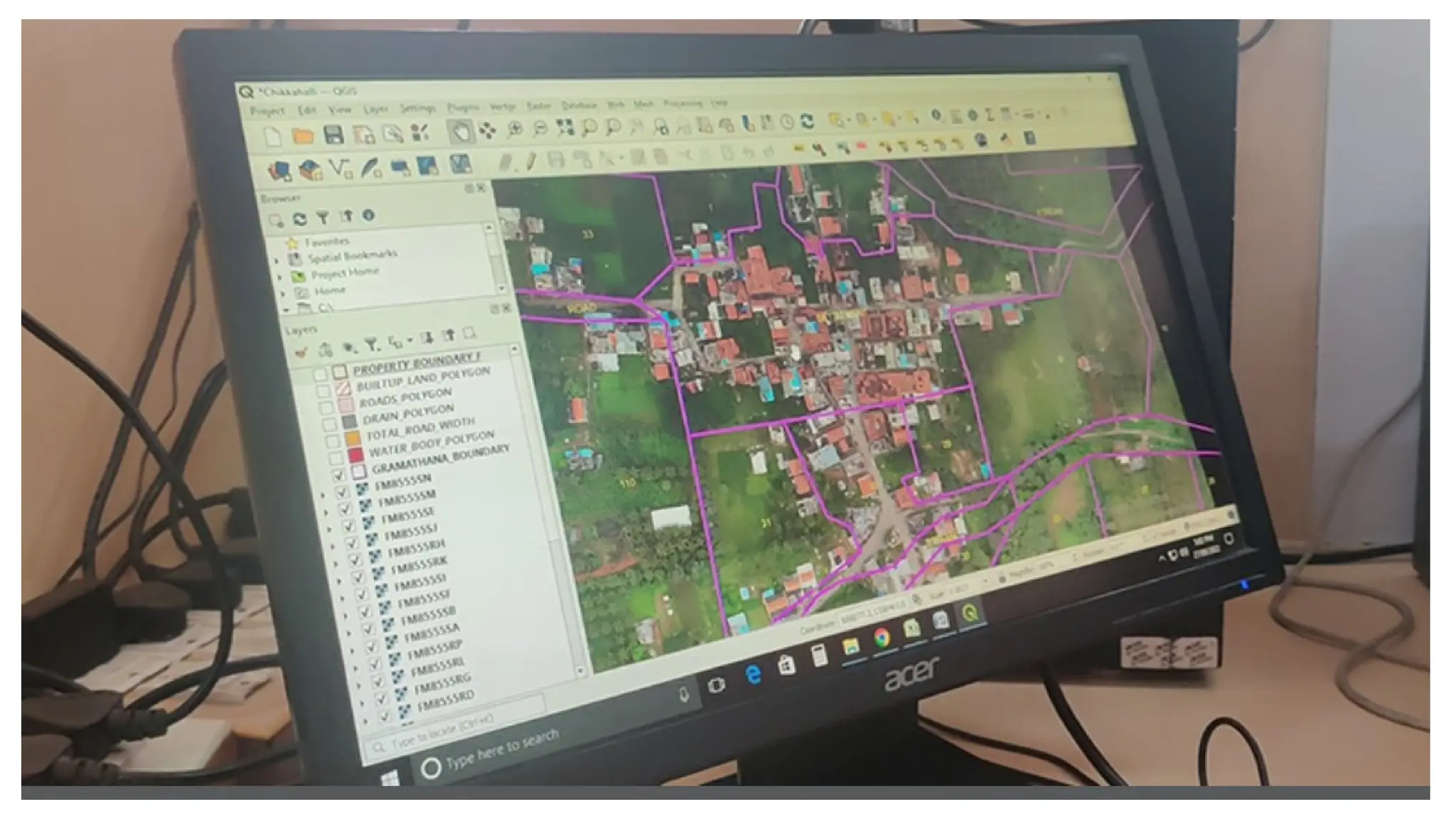
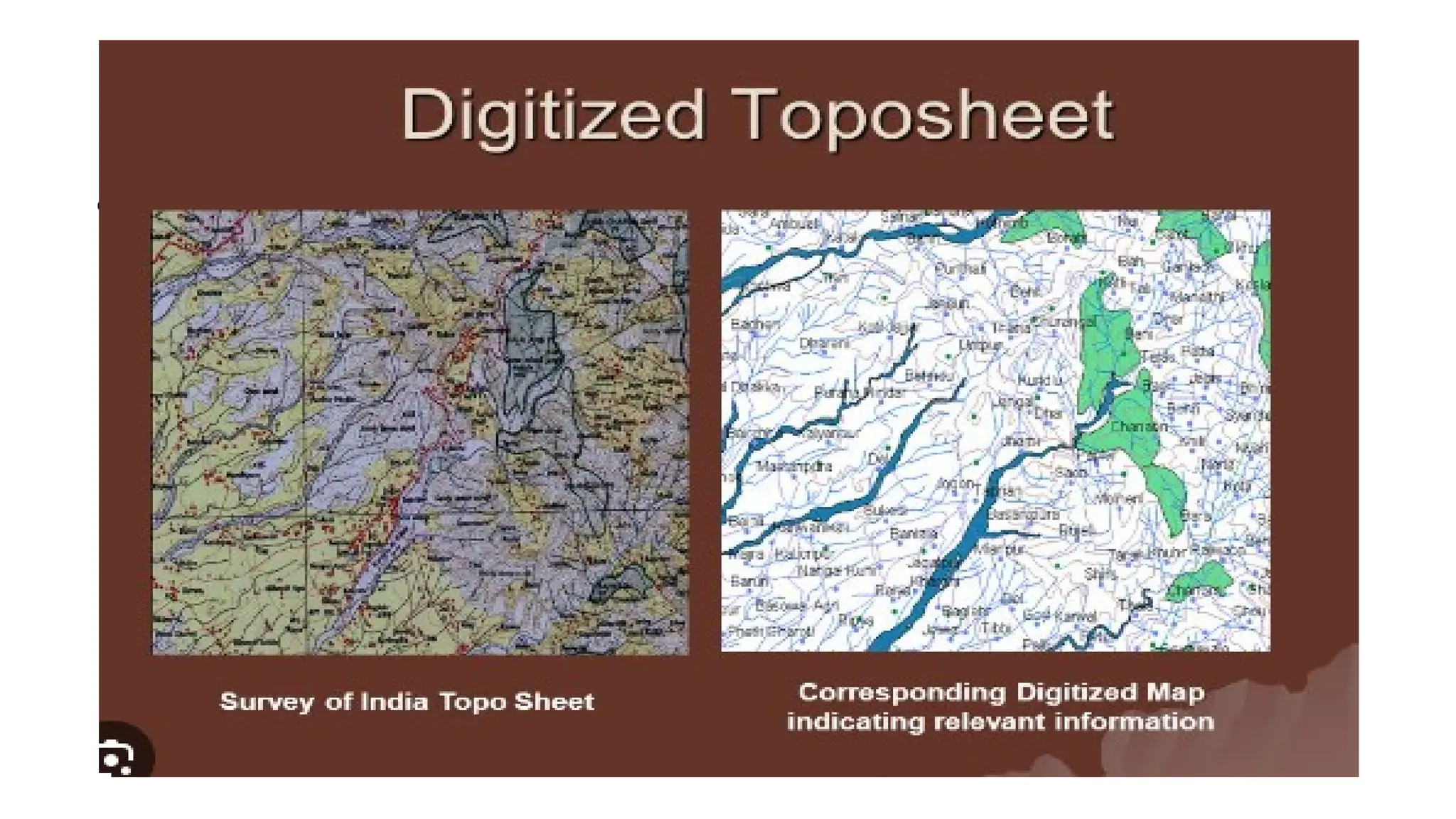
Digitizatio
n
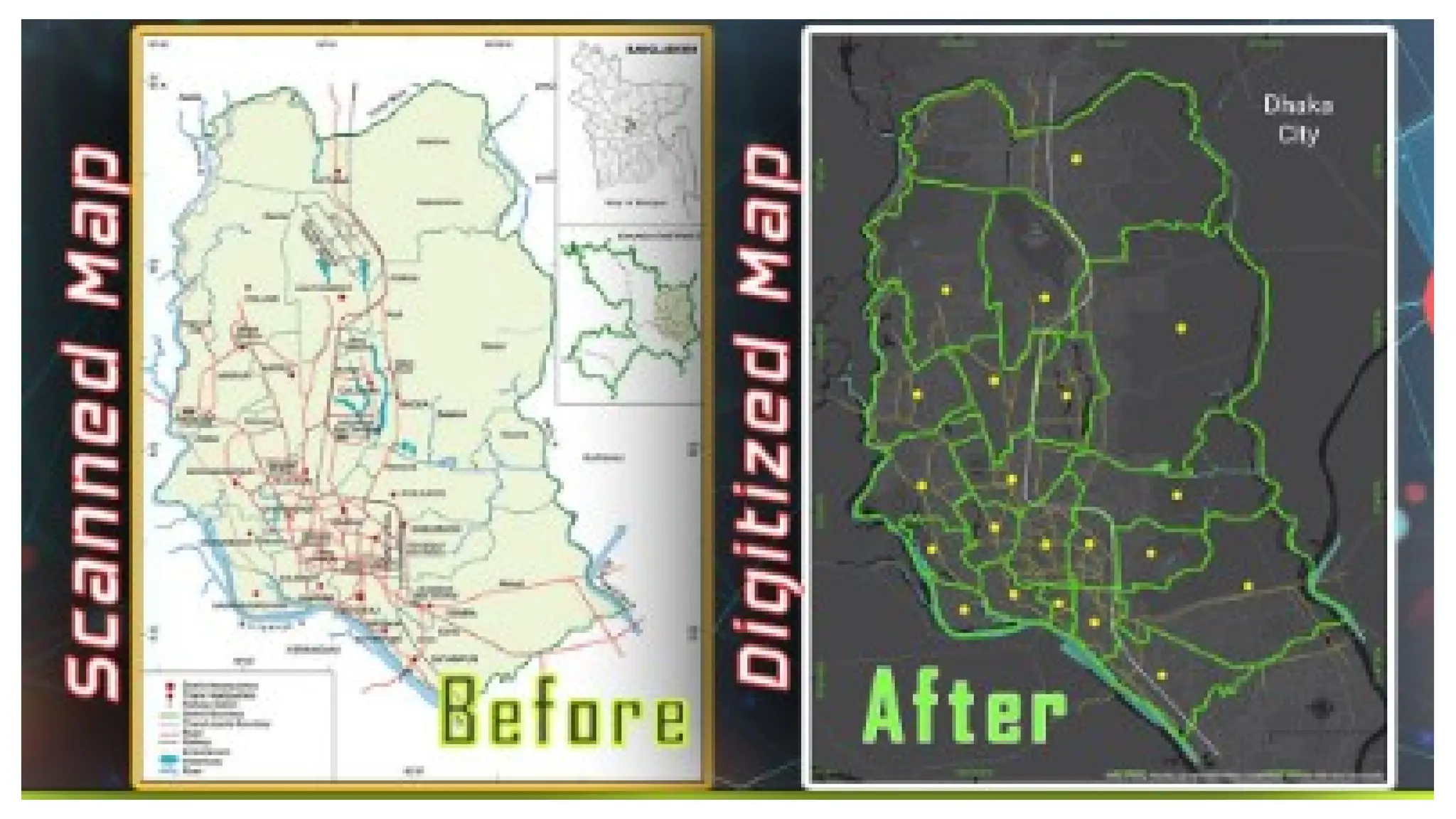
• Digitization is the process
of converting geographic
data into digital form.
• During this process,
spatial data on maps or
images are traced as
points, polylines or
polygons.
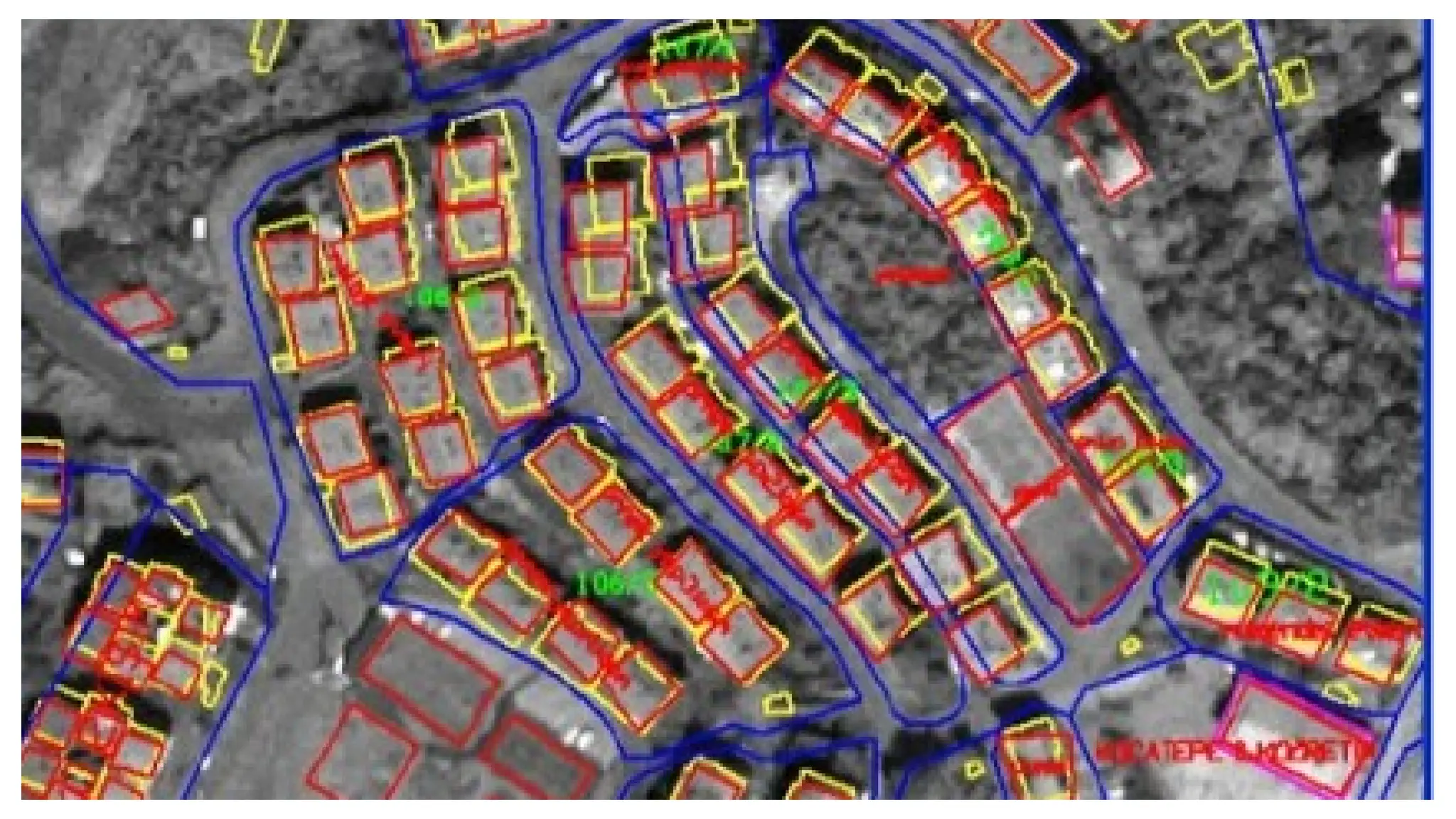
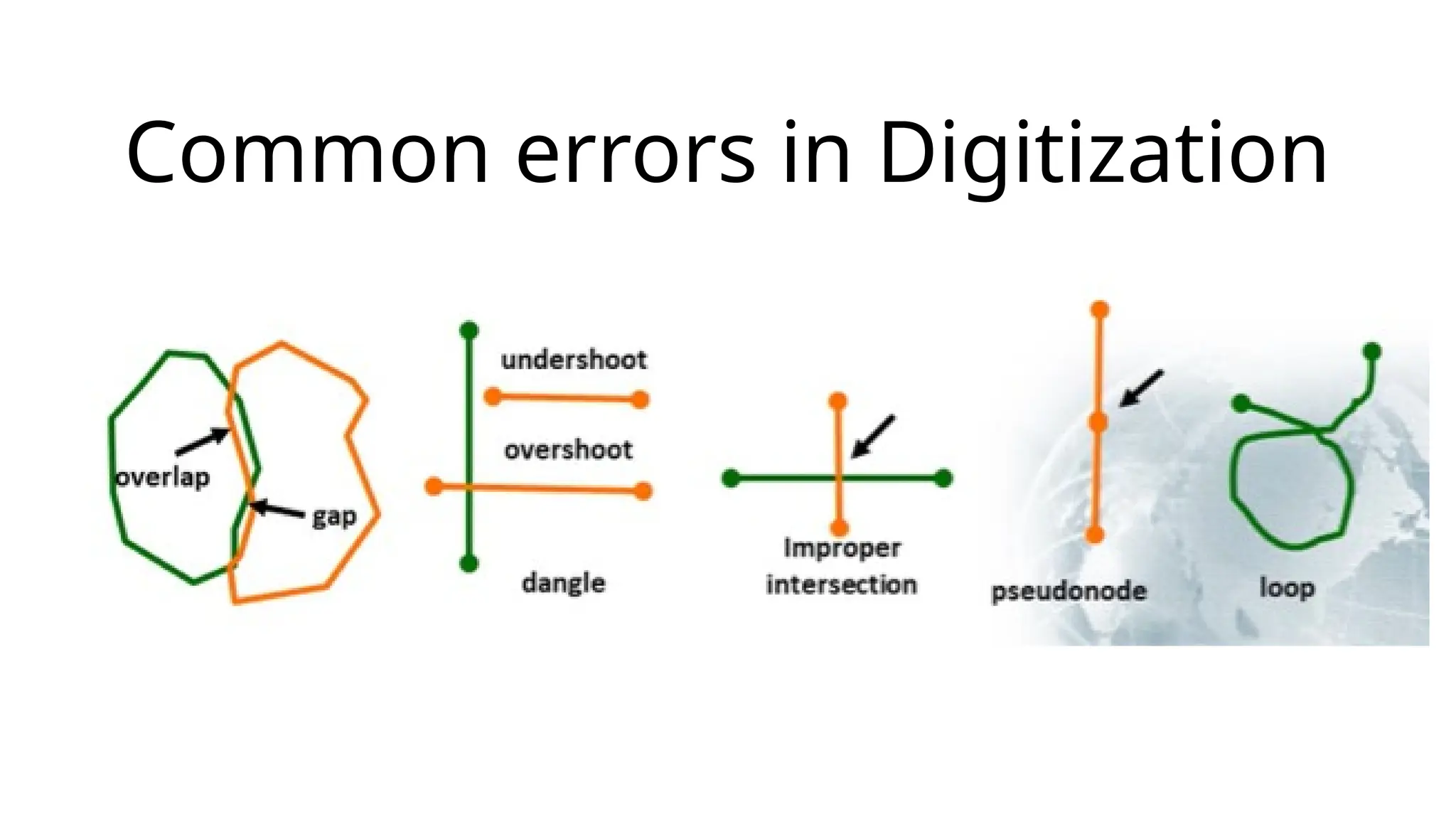
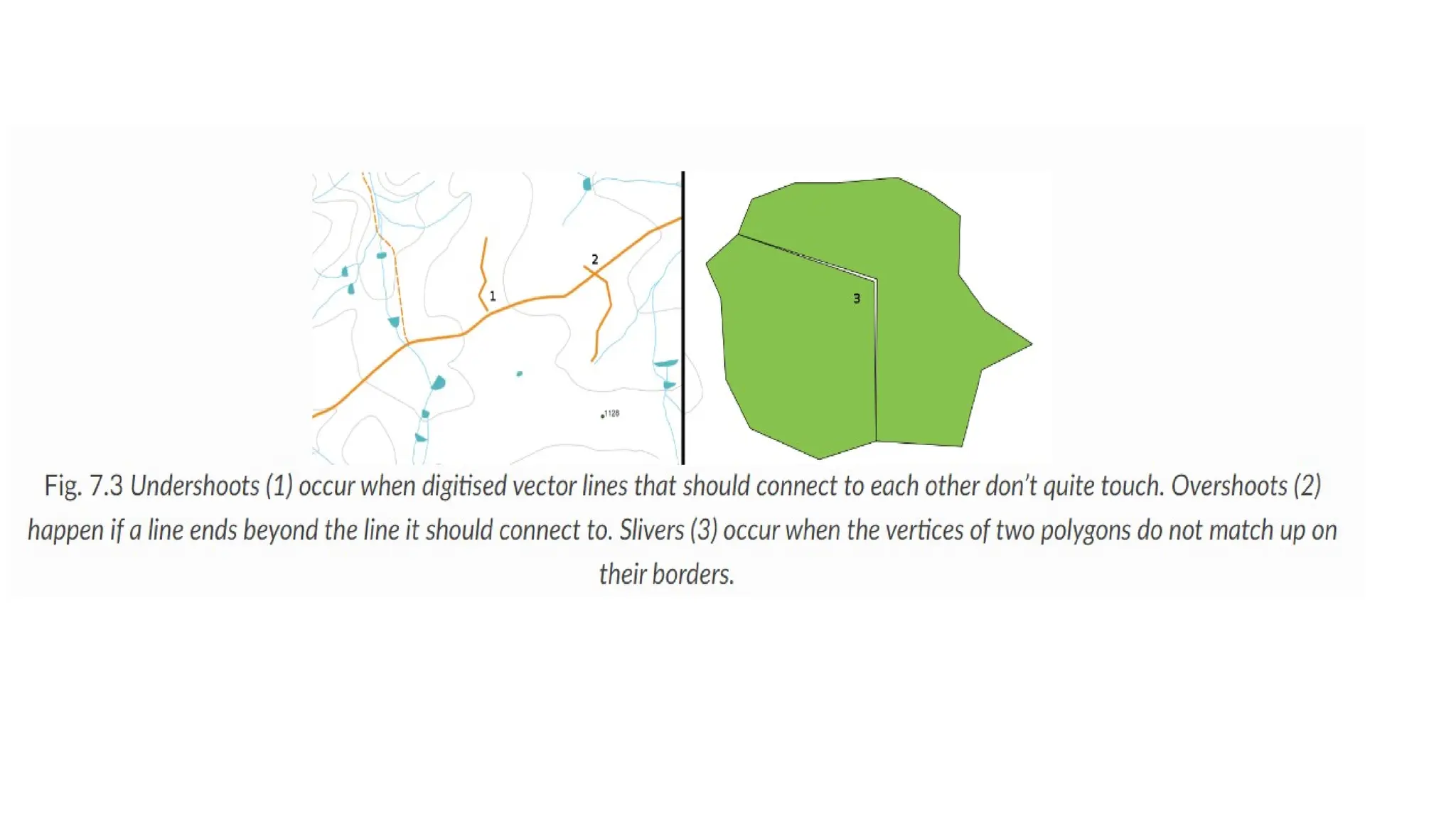
Common errors in Digitization
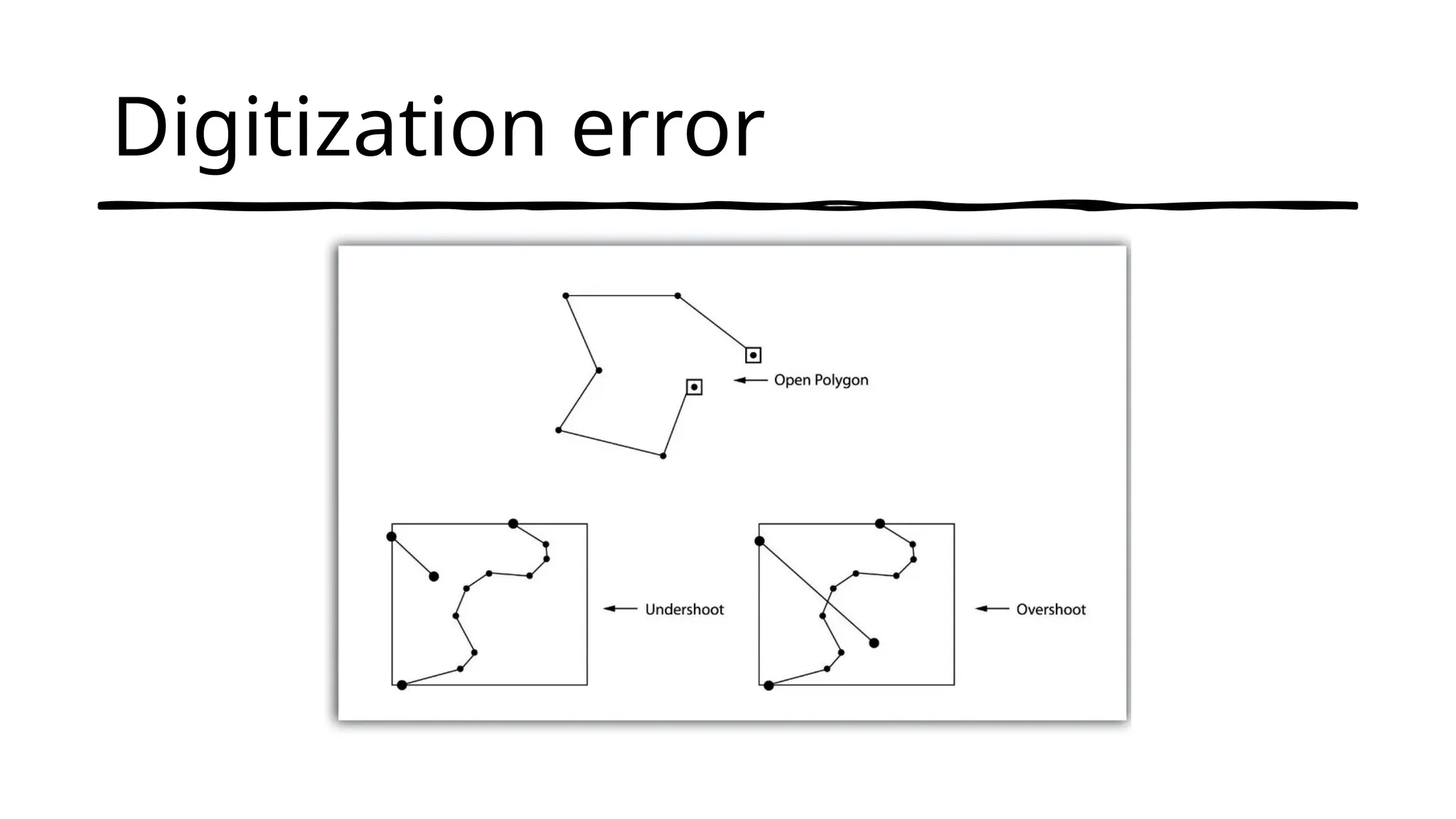
Digitization error
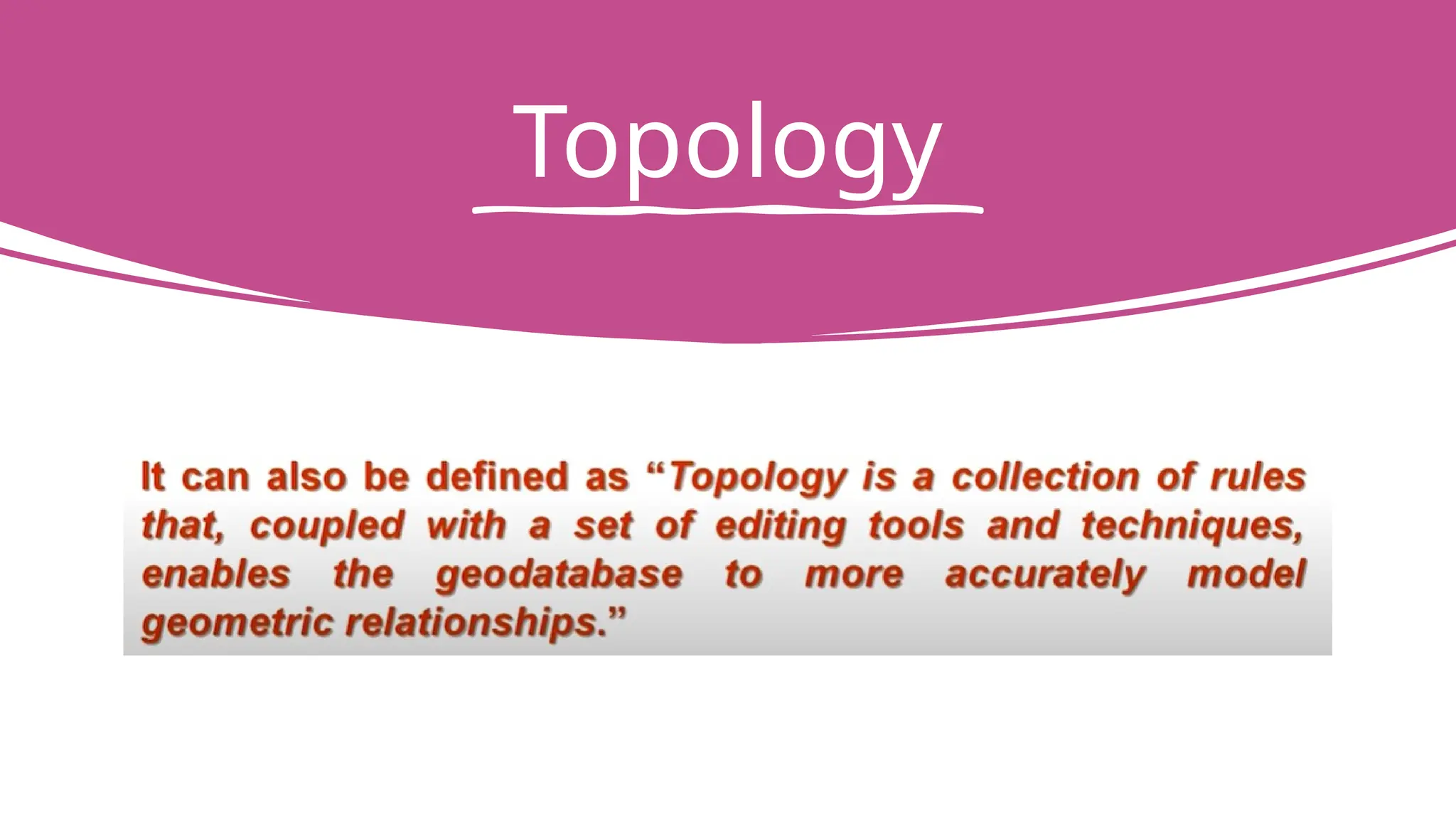
Topology
Spatial relationships between adjacent or neighboring features
which do not change under any transformation.
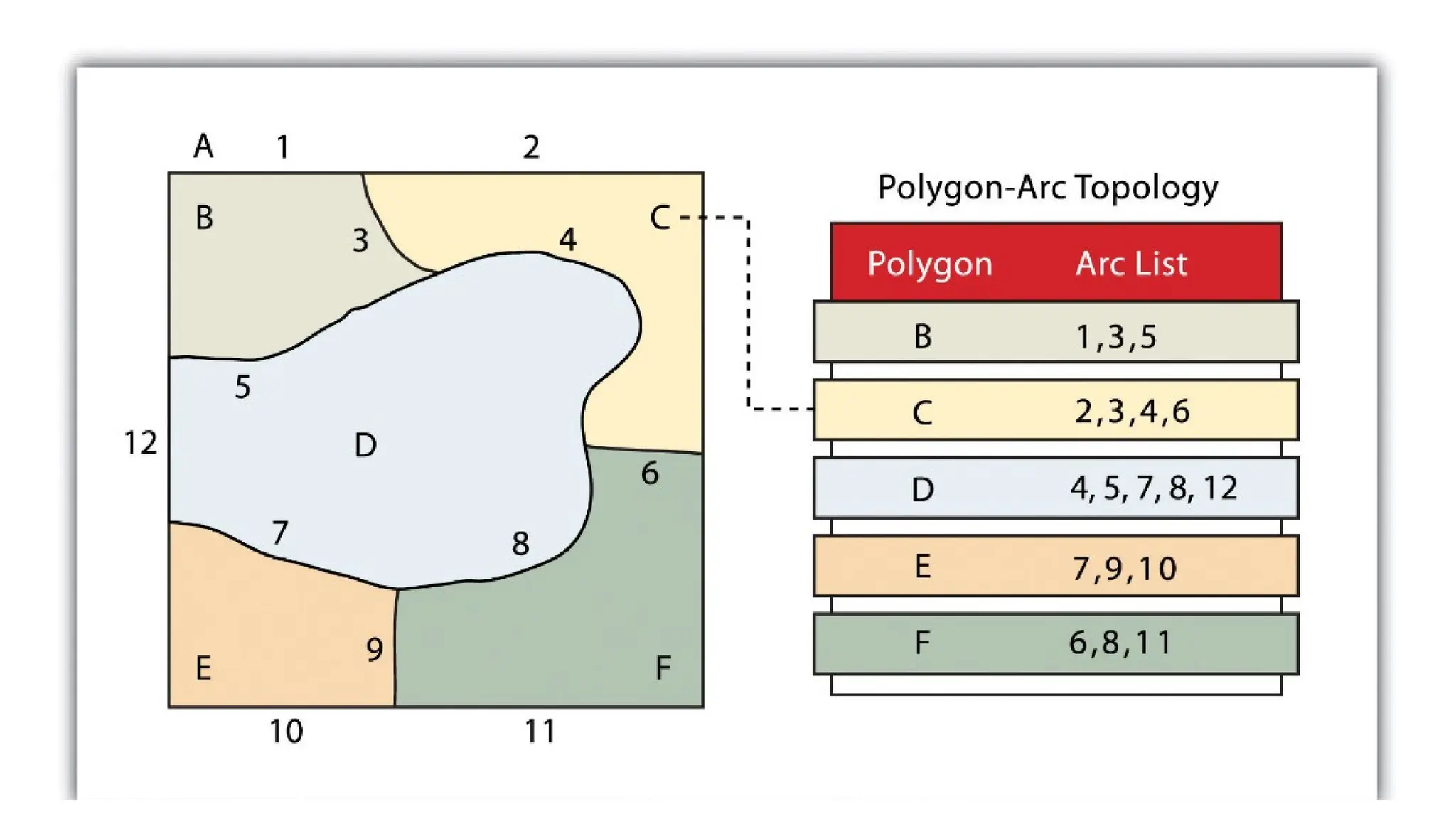
Adjacency and containment describe the geometric relationships which
exist between area features. Areas can be described as being adjacent
when they share a common boundary.
Containment is an extension of the adjacency that describes area
features which may be wholly contained within another area feature,
such as, an island within a lake.
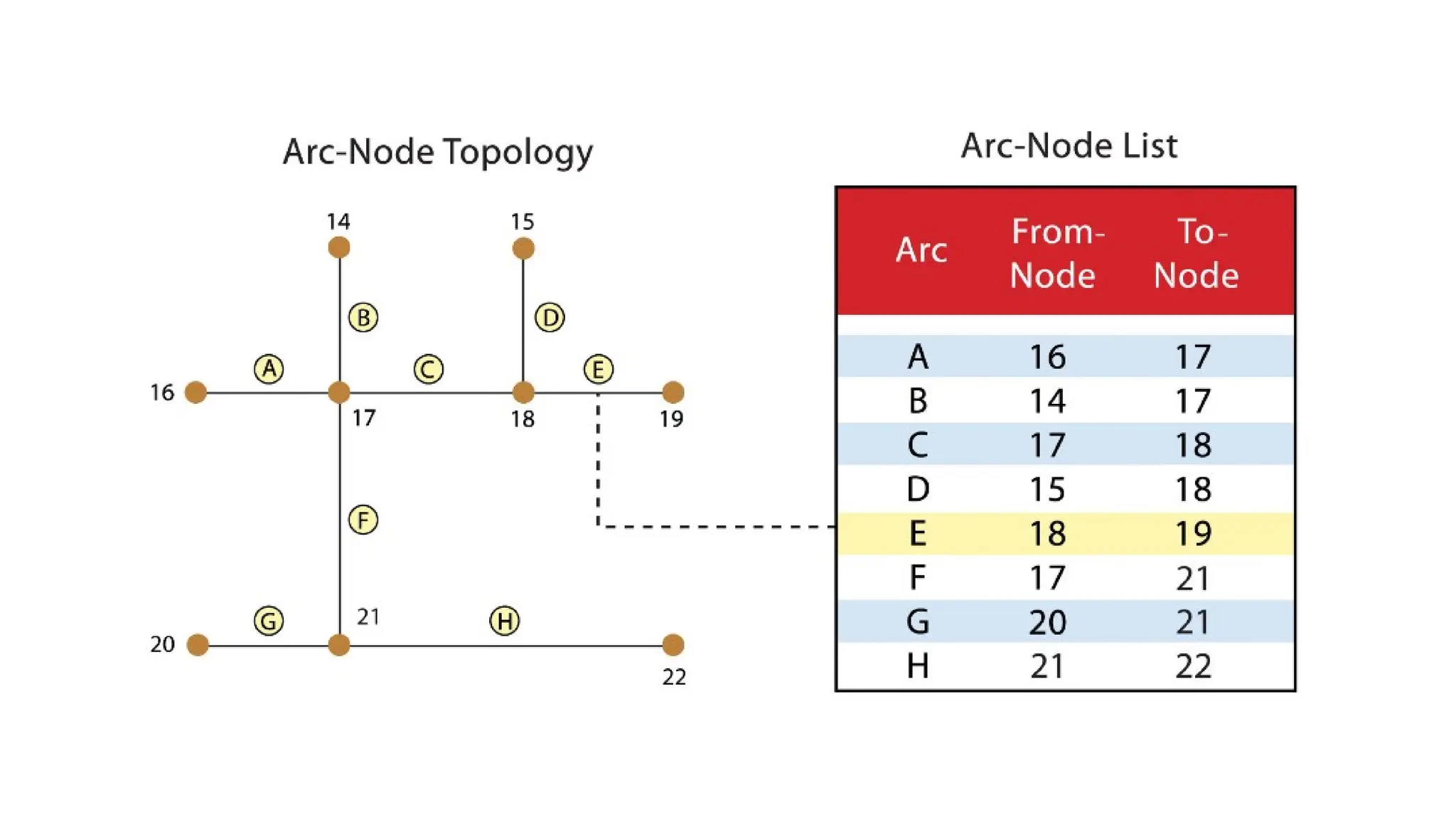
Connectivity is a geometric property used to describe the linkages
between line features, like road network.
Topology
•Are there any disadvantage of
topological model ?
Categories/
Types of GIS
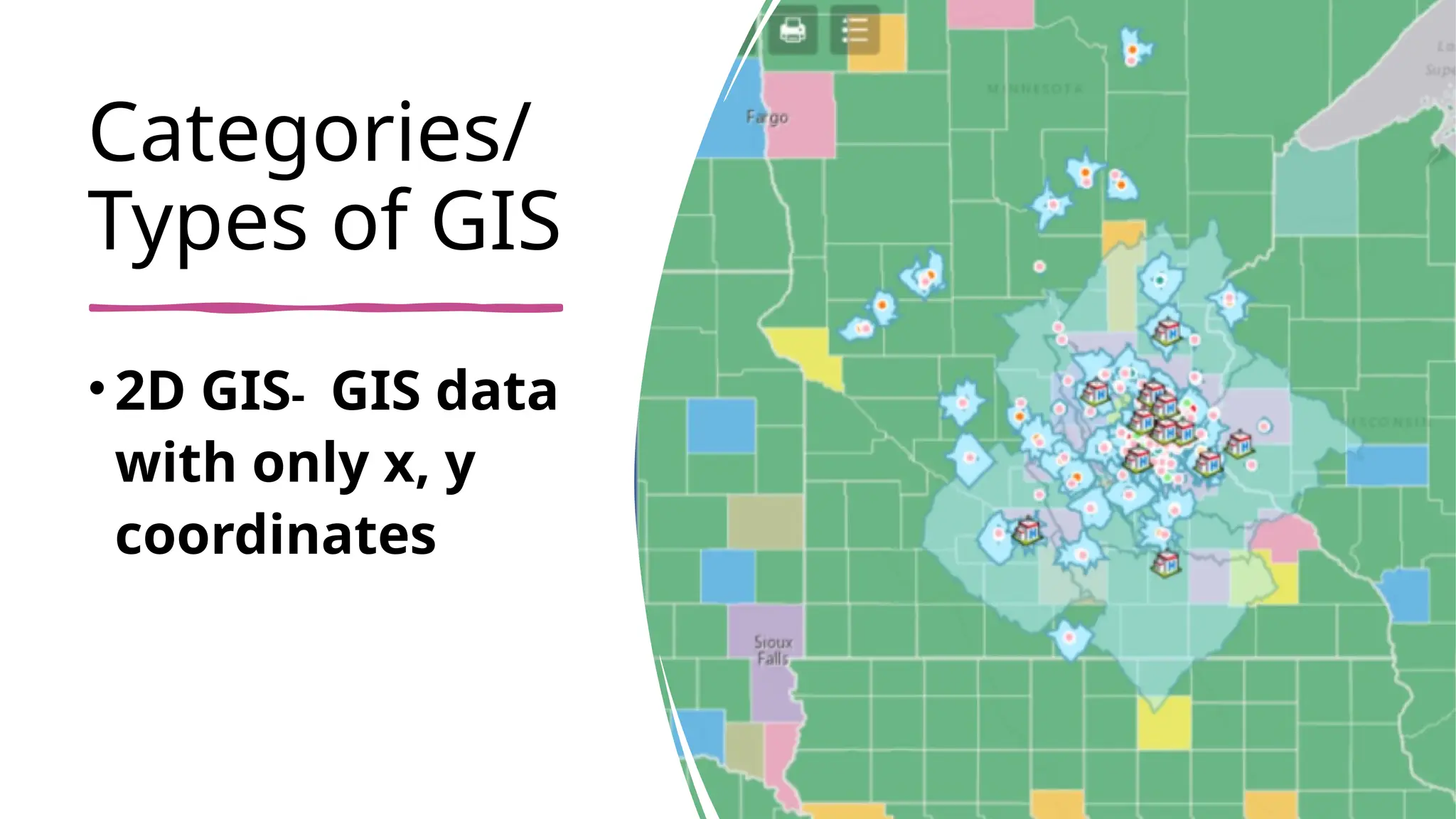
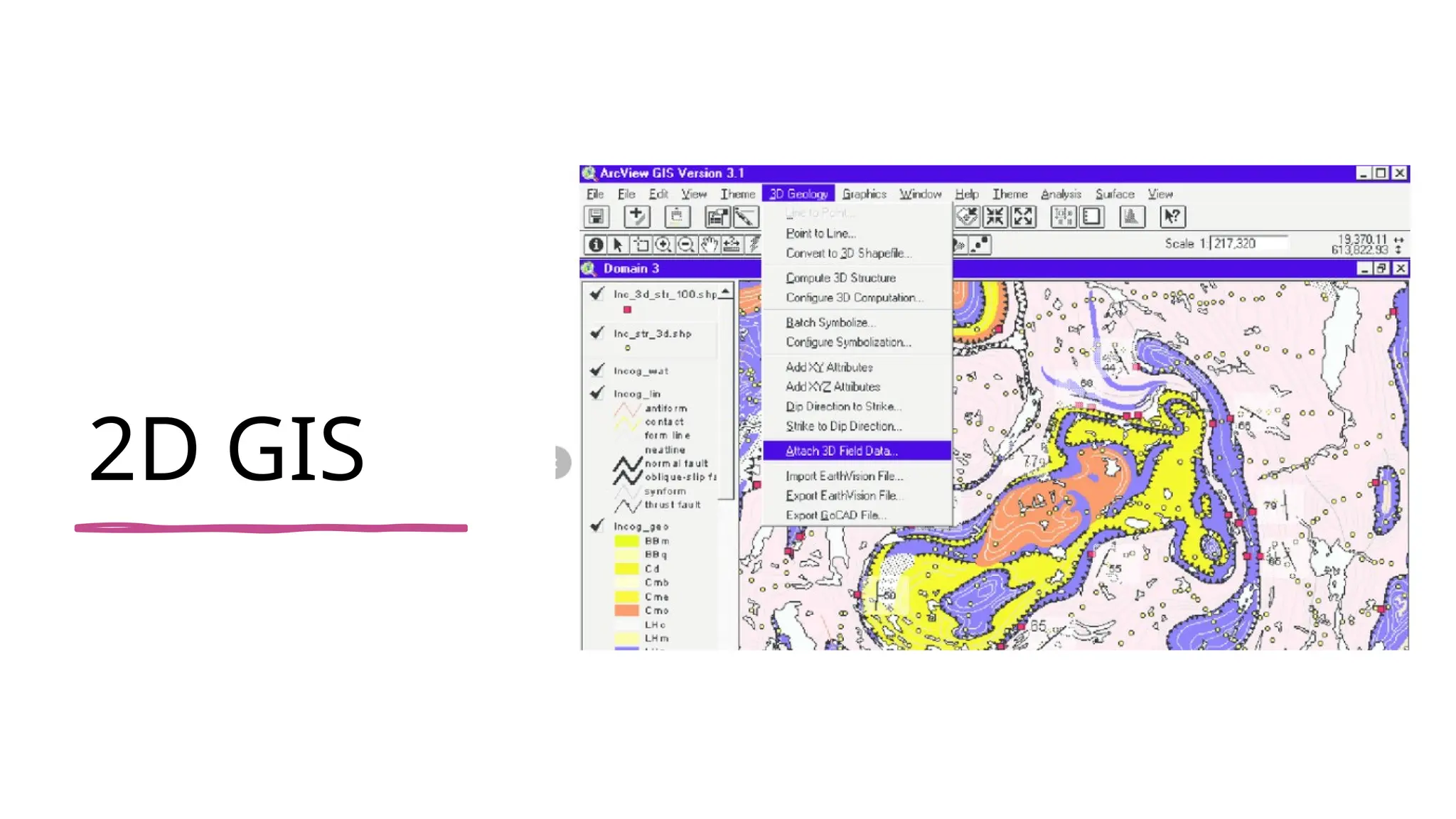
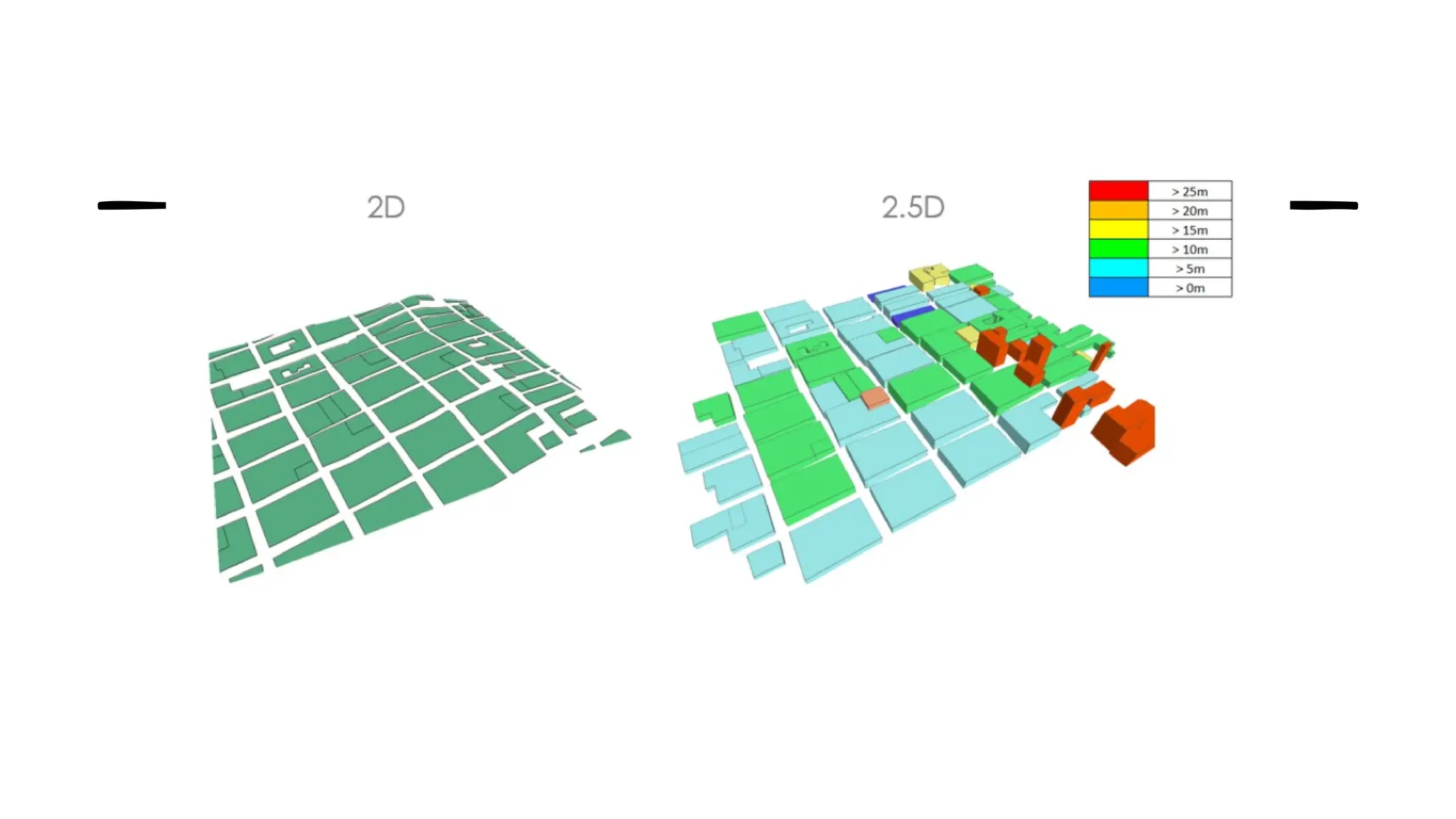
•2D GIS- GIS data
with only x, y
coordinates
2D GIS
2.5 D
GIS
• 2.5D maps are an upgrade of
2D maps
• In the 2.5 D case, for the pair of x, y
co-ordinates, a third dimension is
integrated which is dependent
upon the x, y cod.
• Third dimension is defined by
predetermined equation:
• z = f (x, y)
• This third dimension could be
anything like height, soil data,
temp data, rainfall data
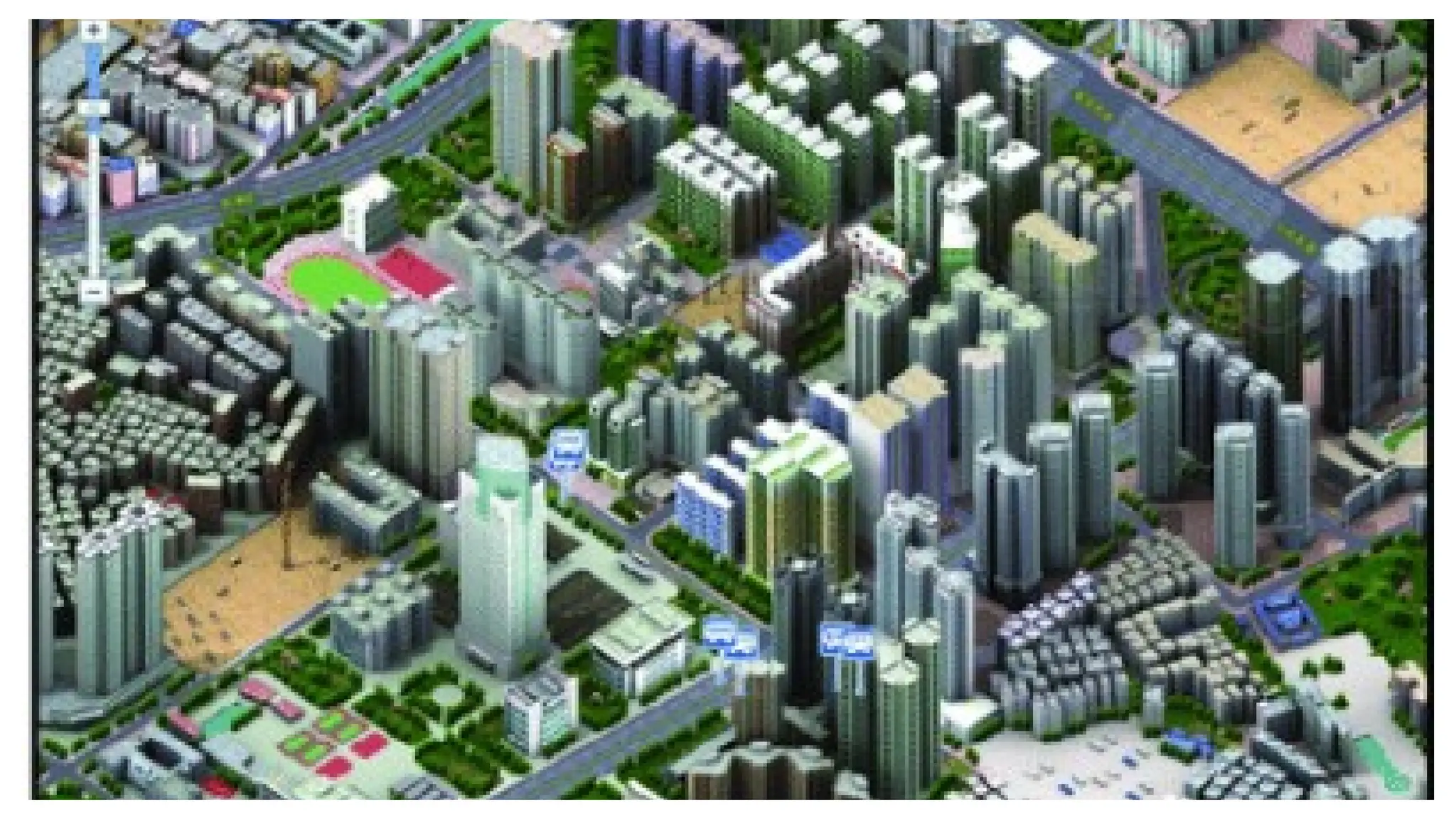
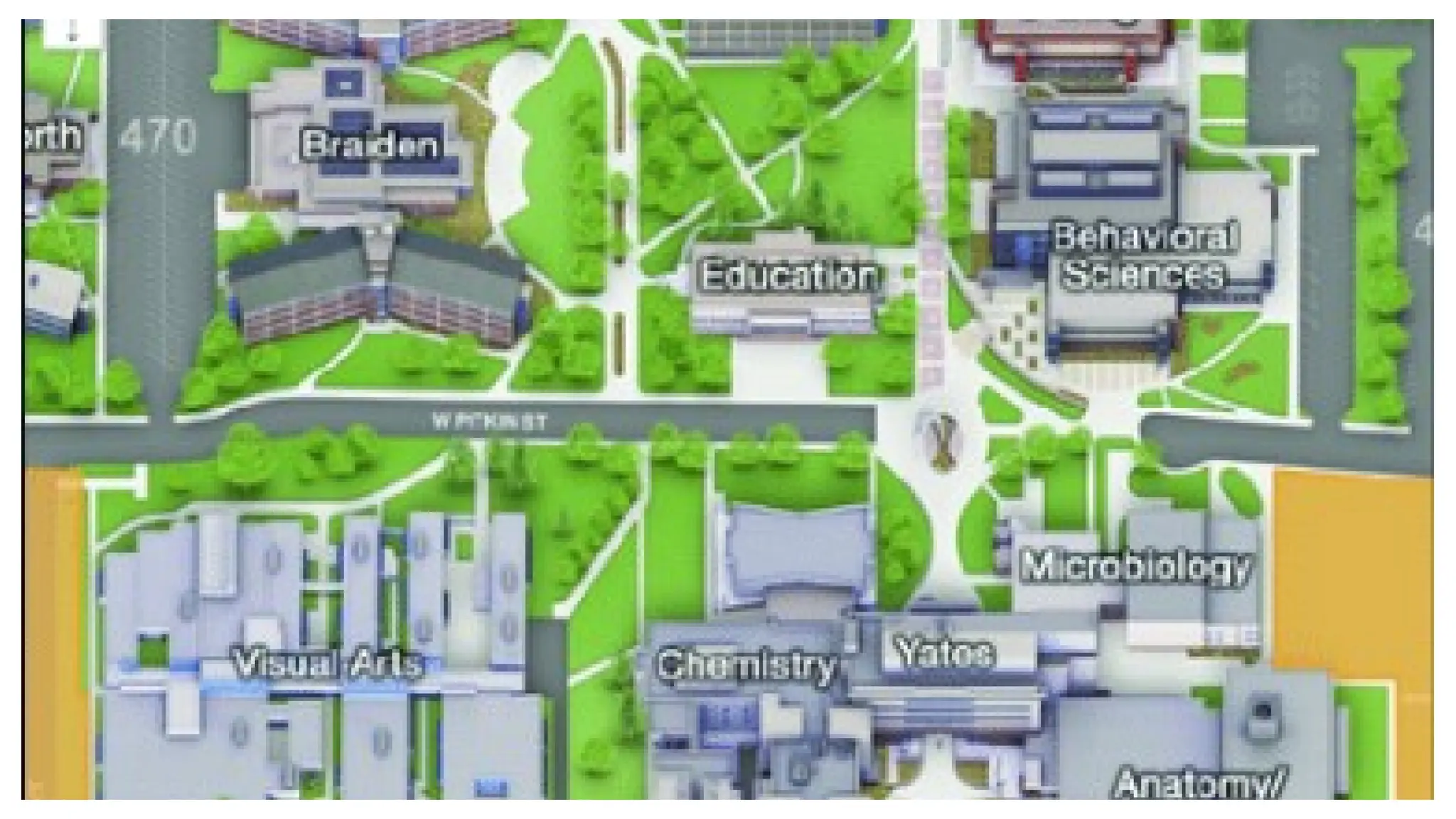
•In 2.5 D ,objects appear to be in 3D, but
in reality map is not 3D.
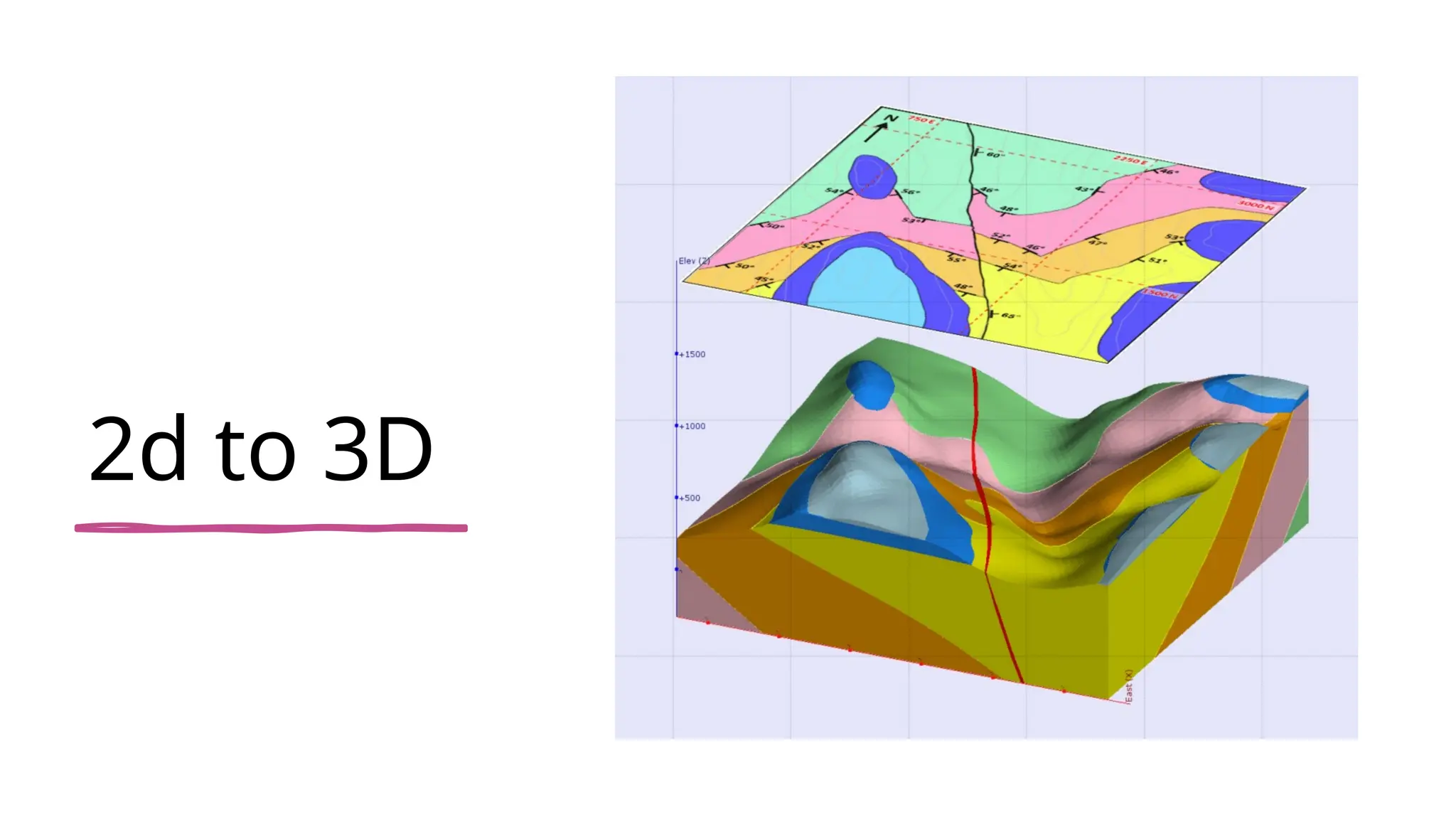
3D GIS
• In the 3-D case, for the same pair of x, y co-
ordinates,~ z co-ordinate is calculated
independently from the x, y pair.
• Example - Terrain Elevation Models(DEM), TIN
2d to 3D
Question
•Is Google street view a 2D, 3D or 2.5 D??
•Is google maps 2d, 2.5D or 3D?
• Can there be a 4D GIS?
• If yes, what could be the 4th dimension?
It's
Time !
In 4D GIS, file formats
support the collection
of time data—
(Temporal Data)
In the vector data file
type (Google maps),
you can add
timestamps as
attributes in the layer
name.
With raster data files,
(Google earth image)
time information is
usually put into the file
WhAt's the use of
4D GIS in civil
engineering?
4D GIS – an alternative to
conventional PERt &cpm
• Construction progress of the project should be
monitored at every time.
• Project monitoring acts as safety step in construction
projects which alerts and advices the organizations
about occurrence of construction failures and delays.
• It includes the process of collecting, analysing, and
recording information regarding the project.
4D GIs in construction planning
and monitoring
• For better understanding of construction sequence
and for providing better visualization of the
construction progress planner makes use of 2D
drawings and integrates it with their corresponding
component schedules in GIS software .
• New advancements in GIS software are use of time
component which helps planners in depicting real
world components.
• More the no. Of dimensions, more will be the
data and more complex the algorithms !
Gis Introduction related to remote sensing

  • 1.
  • 2.
    Let's consider a problem! Ground Water Depletion !
  • 3.
  • 4.
    More demand ofwater Less recharge of GW resources
  • 5.
    • Irregular rainfallpatterns • High Living standards-high water demand • Urbanization- More runoff than infiltration • Irrigation
  • 6.
    Can you guessHow many litres of water is required to make a pair of jeans?
  • 7.
  • 8.
  • 9.
    As An administra tor •Make surewhatever rainfall we are having , as much as possible of it infilters into ground surface and do not flow as runoff (which is a waste as from our problem standpoint) •How to do that ?
  • 10.
    Recharge wells, recharge ponds, check dams Where will be the sites for these construction Solution !
  • 11.
  • 12.
  • 13.
  • 15.
  • 16.
  • 17.
    •What factors willaffect GW Potential of an area? •Or what data would you require?
  • 18.
  • 19.
  • 20.
    Answer •SOI-Topographical Sheet •Bhuvan-ISRO Websitefor downloading RS Images •USGS – NASA Website for downloading RS Images
  • 23.
  • 24.
    •Soil Data •Where wouldyou get that from?
  • 25.
    Answer • Soil andland use Survey of India • ICAR-Indian Agricultural Research Institute
  • 28.
    •Do we requiregeological map as well?
  • 30.
  • 31.
    Misc. •Lineament maps- showingjoints, fractures and folds that are present beneath the surface of earth . •Water holding capacity of these lineaments is very good and acts as a good conductor of water transmission
  • 32.
  • 33.
  • 34.
    Source of this data •IMD • Hydromet
  • 36.
  • 37.
  • 38.
    GIS offers asolution !
  • 39.
    GIS • Is asystem designed for storing, analyzing, and displaying spatial data. • Geographic relates to the surface of the earth. • Information is a knowledge derived from study, experience, or instruction. • System is a group of interacting, interrelated, or interdependent elements forming a complex whole.
  • 41.
    BASIC ELEMENTS/component s OF GIS •Hardware • Software • Data • Procedures/ Methods •People
  • 42.
    Hardware •Any device (acomputer, a smartphone, a tablet, a laptop, a monitor, a printer, a scanner, etc.) that stores large GIS datasets, GIS software, and applications can be referred to as the hardware.
  • 43.
    SOftware • GIS softwareprovides the functions and tools needed to store, analyze, and display geographic information. • Key software components are: • Tools for the input and manipulation of geographic information · • Tools that support geographic query, analysis, and visualization • A graphical user interface (GUI) for easy access to tools
  • 44.
    Comm on gis softwar es • ArcGIS •QGIS • SAGA GIS • MapInfo • ILWIS GRASS, Open Street Maps, PostgreSQL/PostGIS, GeoServer
  • 45.
    methods/procedures • An integralpart of the GIS framework is the various techniques used to turn data into digestible and actionable information for easy interpretation. • This may include algorithms, statistics, formulas, and models that are predefined and unique to each application.
  • 46.
    methods/ procedures Step 1 : Statethe problem Step 2: Break the problem down Step 3 : Explore the input datasets Step 4 : Analyse the data Step 5 : Verify the results Step 6 : Impleme nt the results
  • 47.
    data •Geographic data andrelated tabular data (can be collected manually or purchased from a commercial data provider) • Since a GIS incorporates data from multiple sources, its accuracy defines the quality of the GIS.
  • 50.
  • 51.
  • 53.
    People • Most importantpart of a GIS • Includes decision makers, GIS software experts, Ground data collection Teams • Define and develop the procedures used by a GIS
  • 54.
  • 56.
    Functions/OPERATIONS of GIS •Data collection • Capture data • Data storing, processing & analysis • Store data ,Query data ,Analyze data • Output production • Display data • Produce output
  • 57.
    Data collection • Using GPS& RS • Paper maps are also sources of data
  • 58.
  • 59.
    Output •Maps, Pie charts,Images, Graphs •Statistical reports
  • 60.
    DEFINITIONS AND TERMINOLOG Y USED INGIS • Geographical Entity • Entities are the things in the real world • Objects are the things in digital world •How do we represent real world entities in GIS?
  • 61.
    Geogra phic Entity • Real worldgeographic entities are represented in the form of objects (point/ line/polygon) having spatial data and attribute data. • Spatial data means representing the location of the object(Lattitude, longitude, Elevation) • Attribute data is the additional data associated with the object other than location. It may be a text, numerical value etc.
  • 66.
  • 68.
  • 69.
    Digital Elevation Model(DEM) • Simplest form of digital elevation of topography. • Digital representation of elevation of earth. • It gives elevation, slope , aspect. • Where would be use DEM????
  • 70.
  • 71.
    Attributes • Attributes arethe characteristics of the map features. • Hold the descriptive information about the geographic features. • Attributes are the non-spatial data(location is not attched to them direcly) .They are considered characteristics of entity .. • Also feed the information in the tabular form in GIS
  • 72.
    Attributes • A pointrepresents a hotel, a line represents the road and area represents the boundaries of the lake. • Each spatial entity may have more than one attribute associated with it , that is, a point representing the hotel may have a number of rooms, standard of accommodation and other related info.
  • 75.
    Layer • The visualrepresentation of a geographic dataset in any digital map. • Data in a layer is represented with points, lines, shapes (polygons), or surfaces. •Layer can be a satellite image as well. • Maps in a Geographic Information System are made by combining multiple layers
  • 77.
    Digitizatio n • Digitization isthe process of converting geographic data into digital form. • During this process, spatial data on maps or images are traced as points, polylines or polygons.
  • 82.
    Common errors inDigitization
  • 84.
  • 85.
    Topology Spatial relationships betweenadjacent or neighboring features which do not change under any transformation. Adjacency and containment describe the geometric relationships which exist between area features. Areas can be described as being adjacent when they share a common boundary. Containment is an extension of the adjacency that describes area features which may be wholly contained within another area feature, such as, an island within a lake. Connectivity is a geometric property used to describe the linkages between line features, like road network.
  • 86.
  • 89.
    •Are there anydisadvantage of topological model ?
  • 90.
    Categories/ Types of GIS •2DGIS- GIS data with only x, y coordinates
  • 91.
  • 92.
    2.5 D GIS • 2.5Dmaps are an upgrade of 2D maps • In the 2.5 D case, for the pair of x, y co-ordinates, a third dimension is integrated which is dependent upon the x, y cod. • Third dimension is defined by predetermined equation: • z = f (x, y) • This third dimension could be anything like height, soil data, temp data, rainfall data
  • 96.
    •In 2.5 D,objects appear to be in 3D, but in reality map is not 3D.
  • 97.
    3D GIS • Inthe 3-D case, for the same pair of x, y co- ordinates,~ z co-ordinate is calculated independently from the x, y pair. • Example - Terrain Elevation Models(DEM), TIN
  • 98.
  • 100.
    Question •Is Google streetview a 2D, 3D or 2.5 D?? •Is google maps 2d, 2.5D or 3D?
  • 101.
    • Can therebe a 4D GIS? • If yes, what could be the 4th dimension?
  • 102.
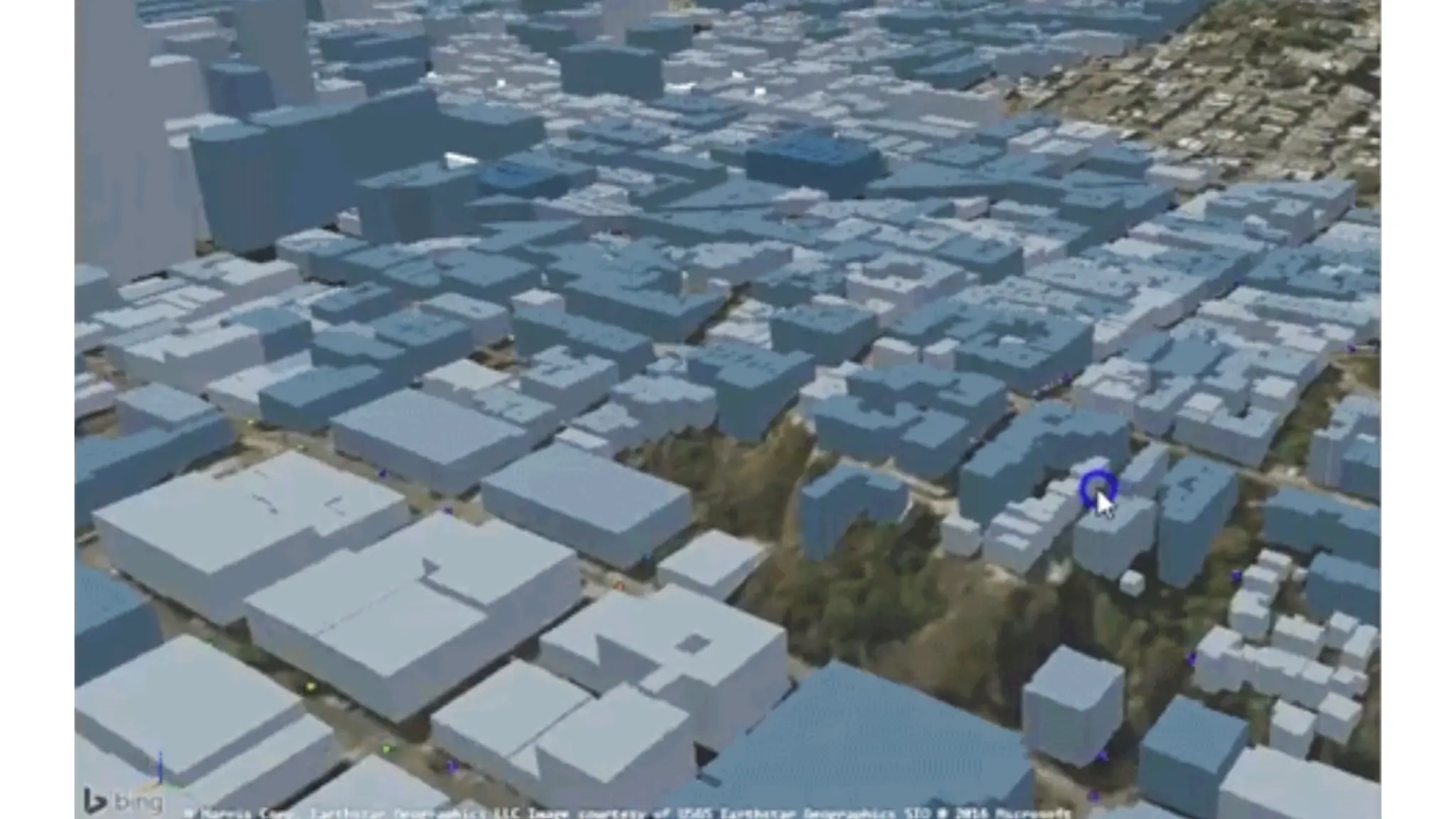
    It's Time ! In 4DGIS, file formats support the collection of time data— (Temporal Data) In the vector data file type (Google maps), you can add timestamps as attributes in the layer name. With raster data files, (Google earth image) time information is usually put into the file
  • 103.
    WhAt's the useof 4D GIS in civil engineering?
  • 104.
    4D GIS –an alternative to conventional PERt &cpm • Construction progress of the project should be monitored at every time. • Project monitoring acts as safety step in construction projects which alerts and advices the organizations about occurrence of construction failures and delays. • It includes the process of collecting, analysing, and recording information regarding the project.
  • 105.
    4D GIs inconstruction planning and monitoring • For better understanding of construction sequence and for providing better visualization of the construction progress planner makes use of 2D drawings and integrates it with their corresponding component schedules in GIS software . • New advancements in GIS software are use of time component which helps planners in depicting real world components.
  • 106.
    • More theno. Of dimensions, more will be the data and more complex the algorithms !