Activating Strategy 
Take 5 minutes to think about the following and answer 
on sticky notes: 
1. How do you write questions for tests? 
2. How do you ask questions in class? 
3. What do you do with the information you gather 
from these questions? 
Put your sticky notes on the appropriate poster. We will 
come back to these later in the PD.
3 Volunteers to share: 
How do you write questions for 
assessments? 
3 Volunteers to share: 
How do you ask questions in class? 
3 Volunteers to share: 
What do you do with the information you gather from 
these questions?
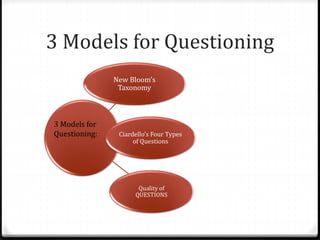
3 Models for Questioning 
New Bloom’s 
Taxonomy 
Ciardello’s Four Types 
of Questions 
Quality of 
QUESTIONS 
3 Models for 
Questioning:
: 
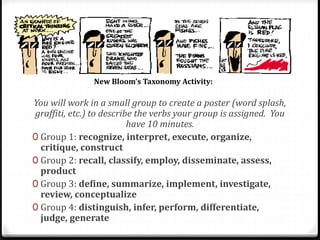
New Bloom’s Taxonomy Activity: 
You will work in a small group to create a poster (word splash, 
graffiti, etc.) to describe the verbs your group is assigned. You 
have 10 minutes. 
0 Group 1: recognize, interpret, execute, organize, 
critique, construct 
0 Group 2: recall, classify, employ, disseminate, assess, 
product 
0 Group 3: define, summarize, implement, investigate, 
review, conceptualize 
0 Group 4: distinguish, infer, perform, differentiate, 
judge, generate
We will share each of these 
shar posters and leave them up through 
today’s PD to refer back to them. 
Group 1 (also known as Factual)-2 min to share 
Group 2 (also known as Conceptual)-2 min to share 
Group 3 (also known as Procedural)-2 min to share 
Group 4 (also known as Metacognitive)-2 min to share
We have all heard of Bloom’s Taxonomy and most likely 
used it in our classrooms. Today we will spend some 
time with the Revised Version. 
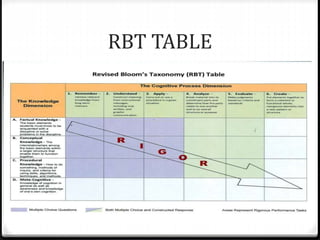
In 2001, researchers revised the 1956 version of 
Bloom’s Taxonomy. Now RBT (Revised Bloom’s 
Taxonomy) has rows for Knowledge Dimension and a 
column for Cognitive Process Dimension. By crossing 
the knowledge row the process column, you can plan 
objectives, activities, and assessments that allow 
students to learn different types of knowledge using a 
variety of processes (Blackburn 2013 p. 16).
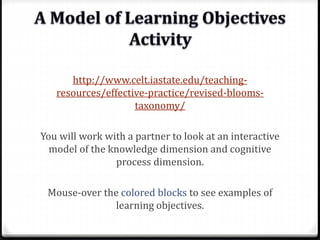
http://www.celt.iastate.edu/teaching-resources/ 
effective-practice/revised-blooms-taxonomy/ 
You will work with a partner to look at an interactive 
model of the knowledge dimension and cognitive 
process dimension. 
Mouse-over the colored blocks to see examples of 
learning objectives.
RBT TABLE
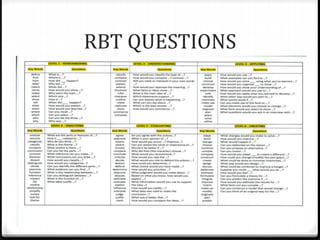
RBT QUESTIONS
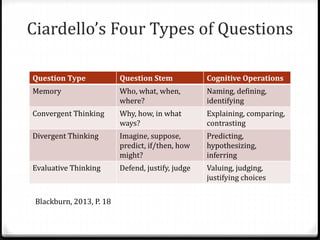
Ciardello’s Four Types of Questions 
Question Type Question Stem Cognitive Operations 
Memory Who, what, when, 
where? 
Naming, defining, 
identifying 
Convergent Thinking Why, how, in what 
ways? 
Explaining, comparing, 
contrasting 
Divergent Thinking Imagine, suppose, 
predict, if/then, how 
might? 
Predicting, 
hypothesizing, 
inferring 
Evaluative Thinking Defend, justify, judge Valuing, judging, 
justifying choices 
Blackburn, 2013, P. 18
Activity: 
0At your table, align Ciardello’s four types 
of questions with sections from the 
Revised Bloom’s Taxonomy. You will 
have 5 minutes to compare and match 
the two. 
0What do you notice? Be thinking of 
ways you can incorporate them into 
your class.
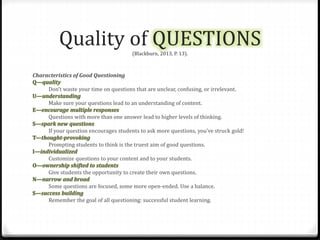
Quality of QUESTIONS 
(Blackburn, 2013, P. 13). 
Characteristics of Good Questioning 
Q—quality 
Don’t waste your time on questions that are unclear, confusing, or irrelevant. 
U—understanding 
Make sure your questions lead to an understanding of content. 
E—encourage multiple responses 
Questions with more than one answer lead to higher levels of thinking. 
S—spark new questions 
If your question encourages students to ask more questions, you’ve struck gold! 
T—thought-provoking 
Prompting students to think is the truest aim of good questions. 
I—individualized 
Customize questions to your content and to your students. 
O—ownership shifted to students 
Give students the opportunity to create their own questions. 
N—narrow and broad 
Some questions are focused, some more open-ended. Use a balance. 
S—success building 
Remember the goal of all questioning: successful student learning.
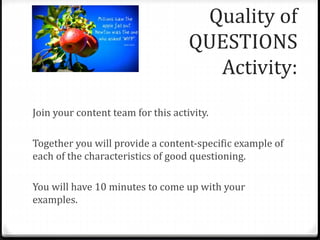
Quality of 
QUESTIONS 
Activity: 
Join your content team for this activity. 
Together you will provide a content-specific example of 
each of the characteristics of good questioning. 
You will have 10 minutes to come up with your 
examples.
Math will have 3 minutes to share. 
Language Arts will have 3 minutes to share. 
Social Studies will have 3 minutes to share. 
Science will have 3 minutes to share. 
Electives will have 3 minutes to share.
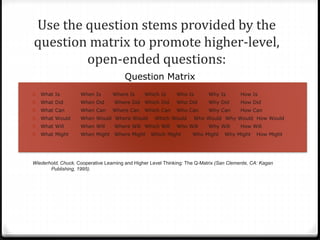
Use the question stems provided by the 
question matrix to promote higher-level, 
open-ended questions: 
Question Matrix 
0 What Is When Is Where Is Which Is Who Is Why Is How Is 
0 What Did When Did Where Did Which Did Who Did Why Did How Did 
0 What Can When Can Where Can Which Can Who Can Why Can How Can 
0 What Would When Would Where Would Which Would Who Would Why Would How Would 
0 What Will When Will Where Will Which Will Who Will Why Will How Will 
0 What Might When Might Where Might Which Might Who Might Why Might How Might 
Wiederhold, Chuck. Cooperative Learning and Higher Level Thinking: The Q-Matrix (San Clemente, CA: Kagan 
Publishing, 1995).
Accommodations for Diverse 
Groups 
How can we use these 3 models of questioning for two 
diverse populations: 
EC Students ESL Students
Involving English language learners in the discussions 
in their content area classes can be frustrating if 
teachers do not develop strategies for asking questions. 
0 Choose easy questions for your ELLs and structure the 
form of the question to their current language ability. 
Accept single word/phrases as correct answers. Do 
not insist that students speak in full sentences. 
0 Let ESL students know which questions they will be 
responsible for answering in advance. Allow for think 
time and preparation of answers.
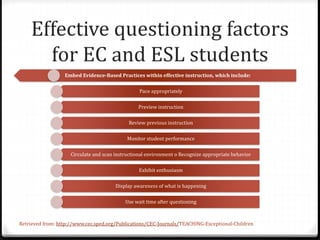
Effective questioning factors 
for EC and ESL students 
Embed Evidence-Based Practices within effective instruction, which include: 
Pace appropriately 
Preview instruction 
Review previous instruction 
Monitor student performance 
Circulate and scan instructional environment o Recognize appropriate behavior 
Exhibit enthusiasm 
Display awareness of what is happening 
Use wait time after questioning 
Retrieved from: http://www.cec.sped.org/Publications/CEC-Journals/TEACHING-Exceptional-Children
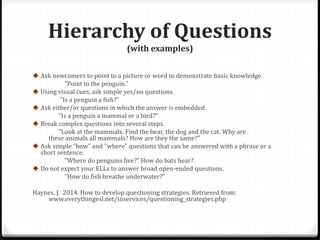
Hierarchy of Questions 
(with examples) 
 Ask newcomers to point to a picture or word to demonstrate basic knowledge. 
"Point to the penguin." 
 Using visual cues, ask simple yes/no questions. 
"Is a penguin a fish?" 
 Ask either/or questions in which the answer is embedded. 
"Is a penguin a mammal or a bird?” 
 Break complex questions into several steps. 
"Look at the mammals. Find the bear, the dog and the cat. Why are 
these animals all mammals? How are they the same?" 
 Ask simple "how" and "where" questions that can be answered with a phrase or a 
short sentence. 
"Where do penguins live?" How do bats hear? 
 Do not expect your ELLs to answer broad open-ended questions. 
"How do fish breathe underwater?” 
Haynes, J. 2014. How to develop questioning strategies. Retrieved from: 
www.everythingesl.net/inservices/questioning_strategies.php
15 minute Activity 
Select a partner and discuss which questioning 
factor you think is most important when 
incorporating rigor into your EC or ESL classrooms 
using each of the 3 questioning strategies. 
Spend about 5 minutes on each questioning strategy. 
Apply each strategy to EC and ESL students.
Which factors will you 
incorporate into your EC and ESL 
classes? 
Let’s share 
Each group will share one questioning strategy they 
have accommodated to fit the needs of an EC student 
and the needs of an ESL student.
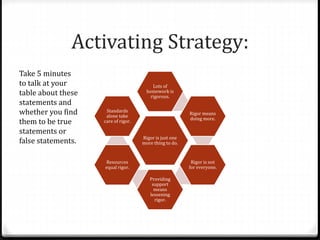
Activating Strategy: 
Lots of 
homework is 
rigorous. 
Rigor is just one 
more thing to do. 
Rigor means 
doing more. 
Rigor is not 
for everyone. 
Providing 
support 
means 
lessening 
rigor. 
Standards 
alone take 
care of rigor. 
Resources 
equal rigor. 
Take 5 minutes 
to talk at your 
table about these 
statements and 
whether you find 
them to be true 
statements or 
false statements.
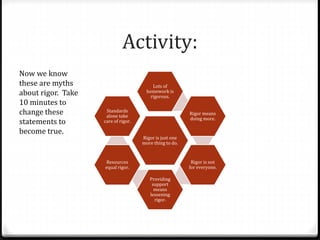
Activity: 
Lots of 
homework is 
rigorous. 
Rigor is just one 
more thing to do. 
Rigor means 
doing more. 
Rigor is not 
for everyone. 
Providing 
support 
means 
lessening 
rigor. 
Standards 
alone take 
care of rigor. 
Resources 
equal rigor. 
Now we know 
these are myths 
about rigor. Take 
10 minutes to 
change these 
statements to 
become true.
“Increasing complexity means moving beyond activities 
that require students to recall information to asking 
students to apply that knowledge in multifaceted ways.” 
(Blackburn, 2013, P. 53).
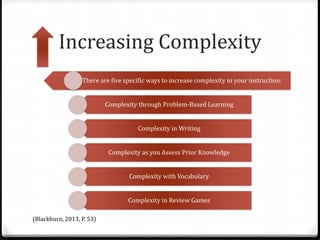
Increasing Complexity 
There are five specific ways to increase complexity in your instruction: 
Complexity through Problem-Based Learning 
Complexity in Writing 
Complexity as you Assess Prior Knowledge 
Complexity with Vocabulary 
Complexity in Review Games 
(Blackburn, 2013, P. 53)
Problem-Based versus Project-Based 
In project-based learning, the teacher directs 
the questions and assigns the final product. 
In problem-based learning, the students are 
more self-directed and come up with many of 
their own questions (Blackburn, 2013, P. 54).
Problem-Based Learning 
In 1995, Barrel took the KWL chart and adapted it to a model 
for posing problems. The result was a KWHLAQ Model: 
K-What do we think we already KNOW? 
W-What do we WANT to find out in order to solve the 
problem? 
H-HOW and where will we find the answer? 
L-What do we think we will LEARN? What did we LEARN? 
A-How will we APPLY what we learned? 
Q-What are our QUESTIONS now that we have finished 
our inquiry? 
Blackburn, 2013, P. 54
Activity: 
With your grade-level content members, come up with 
an activity for a problem-based learning scenario for 
the current unit you are working on. You will have 20 
minutes. Plan to use this activity in your classroom 
before our follow-up session. 
Example: In social studies, students create a separate 
administration or government that pertains to their 
grade level only.
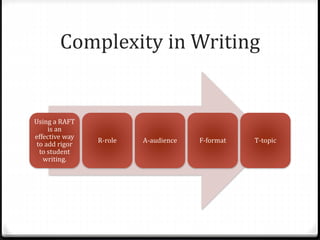
Complexity in Writing 
Using a RAFT 
is an 
effective way 
to add rigor 
to student 
writing. 
R-role A-audience F-format T-topic
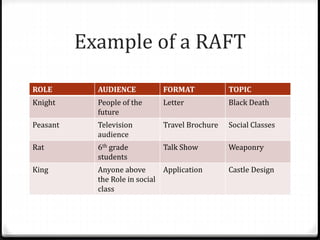
Example of a RAFT 
ROLE AUDIENCE FORMAT TOPIC 
Knight People of the 
future 
Letter Black Death 
Peasant Television 
audience 
Travel Brochure Social Classes 
Rat 6th grade 
students 
Talk Show Weaponry 
King Anyone above 
the Role in social 
class 
Application Castle Design
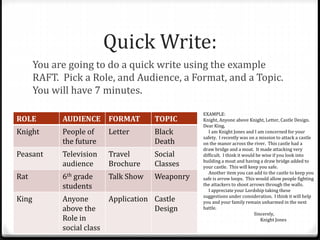
Quick Write: 
You are going to do a quick write using the example 
RAFT. Pick a Role, and Audience, a Format, and a Topic. 
You will have 7 minutes. 
ROLE AUDIENCE FORMAT TOPIC 
Knight People of 
the future 
Letter Black 
Death 
Peasant Television 
audience 
Travel 
Brochure 
Social 
Classes 
Rat 6th grade 
students 
Talk Show Weaponry 
King Anyone 
above the 
Role in 
social class 
Application Castle 
Design 
EXAMPLE: 
Knight, Anyone above Knight, Letter, Castle Design. 
Dear King, 
I am Knight Jones and I am concerned for your 
safety. I recently was on a mission to attack a castle 
on the manor across the river. This castle had a 
draw bridge and a moat. It made attacking very 
difficult. I think it would be wise if you look into 
building a moat and having a draw bridge added to 
your castle. This will keep you safe. 
Another item you can add to the castle to keep you 
safe is arrow loops. This would allow people fighting 
the attackers to shoot arrows through the walls. 
I appreciate your Lordship taking these 
suggestions under consideration. I think it will help 
you and your family remain unharmed in the next 
battle. 
Sincerely, 
Knight Jones
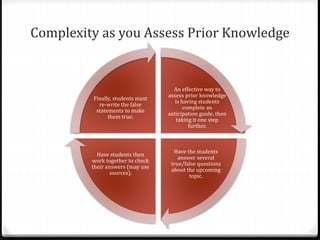
Complexity as you Assess Prior Knowledge 
An effective way to 
assess prior knowledge 
is having students 
complete an 
anticipation guide, then 
taking it one step 
further. 
Have the students 
answer several 
true/false questions 
about the upcoming 
topic. 
Finally, students must 
re-write the false 
statements to make 
them true. 
Have students then 
work together to check 
their answers (may use 
sources).
Complexity as you Assess Prior Knowledge 
Another way to effectively assess prior knowledge is by 
having students create an alphabet of terms for a particular 
topic. This allows the teacher to gain understanding how 
deep a students’ knowledge goes on a topic. 
To gain understanding of a how much knowledge a class 
has, start a topic paper and send it around and have 
students add ideas to it. Also have them check each other’s 
comments for misinformation.
Activating prior knowledge is 
important for EC and ESL students 
Including a strategy to activate prior knowledge 
benefits ELL students and EC students because: 
 students have the opportunity to dialogue 
 they express their ideas 
 promotes collaborate with each other 
 students connect what they already know to the new 
concepts 
 facilitates learning and comprehension
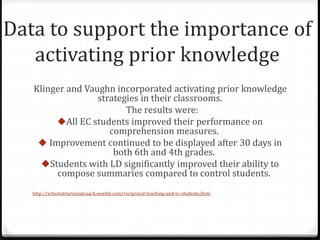
Data to support the importance of 
activating prior knowledge 
Klinger and Vaughn incorporated activating prior knowledge 
strategies in their classrooms. 
The results were: 
All EC students improved their performance on 
comprehension measures. 
 Improvement continued to be displayed after 30 days in 
both 6th and 4th grades. 
Students with LD significantly improved their ability to 
compose summaries compared to control students. 
http://schsinstructionalcoach.weebly.com/reciprocal-teaching-and-ec-students.html
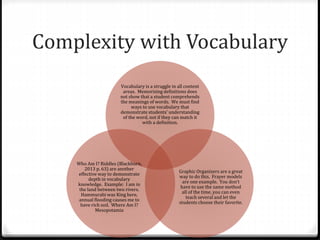
Complexity with Vocabulary 
Vocabulary is a struggle in all content 
areas. Memorizing definitions does 
not show that a student comprehends 
the meanings of words. We must find 
ways to use vocabulary that 
demonstrate students’ understanding 
of the word, not if they can match it 
with a definition. 
Graphic Organizers are a great 
way to do this. Frayer models 
are one example. You don’t 
have to use the same method 
all of the time, you can even 
teach several and let the 
students choose their favorite. 
Who Am I? Riddles (Blackburn, 
2013 p. 63) are another 
effective way to demonstrate 
depth in vocabulary 
knowledge. Example: I am in 
the land between two rivers. 
Hammurabi was King here, 
annual flooding causes me to 
have rich soil. Where Am I? 
Mesopotamia
Complexity in Review Games 
Jeopardy is a popular way to review before an 
assessment. Two ways to make Jeopardy more rigorous 
for your students: 
Have them create the questions and categories. 
Have each person answer on a white board and each 
person gets points for correct answers even though 
only one group or one person answers aloud.
Vocabulary with EC and ESL 
learners 
ESL Vocabulary Activities for All Levels 
Teachers can use variations of these core activities to develop 
vocabulary at all levels across content areas. 
1. Flashcards and games/contests as icebreakers or wrap ups 
2. Pre-teaching Vocabulary for Reading or Listening Assignments 
3. Personal Vocabulary Lists 
4. Quizzes/Self-Study Worksheets/ Cloze Activities 
5. Contact Assignments 
Retrieved from: http://hubpages.com/hub/Strategies-for-Teaching-ESL-Vocabulary
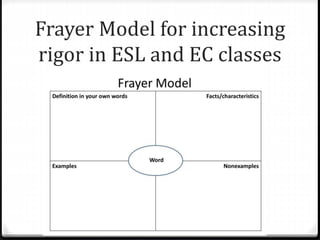
Frayer Model for increasing 
rigor in ESL and EC classes
How can games increase 
complexity and rigor for EC and 
ESL learners? 
Improve student proficiency by using : 
Visual aids 
Incorporating drama 
Role playing 
Promoting vocabulary use 
Promotes participation/ communication 
Lowers students’ stress 
Captures students’ attention 
Note: be sure to follow student accommodations and IEP’s. For 
example, increase wait time for responses.
A Fun, Rigorous Game 
Resource ! 
http://www.edteck.com/rigor/lessons/detective/
Remember! 
Rigor is a word used often in teaching, but many don't 
quite understand what rigor means. Rigorous learning 
is not a measure of the quantity of material covered or 
the number of times it is covered. Rigor is an element of 
the learning environment that promotes an in-depth, 
active, and engaged learning process for students. 
Teachers should attempt to incorporate rigor into as 
many of their teachings as possible. Rigor creates 
excitement and enthusiasm for learning that students 
can get in few other places.
Summarizing Strategy: 
Exit Ticket 
Please take a few minutes to write 3 new ways you will 
incorporate rigor into your classroom based on the 
information you learned from today’s PD. 
Thank you!
HOMEWORK 
0 TASK ONE: 
Take the RBT (Revised Bloom’s Taxonomy) table and the RBT questions and come up 
with an assessment for your next unit. It can be a mini assessment after a concept or a 
unit assessment. Bring your assessment to the follow-up session. 
0 TASK TWO: 
Take the RAFT model and create a writing activity for 
a concept you are going to teach. Include at least 4 of 
each category. Bring two student examples to our follow-up session. 
0 TASK THREE (EC and ESL Teachers): 
Using the template provided in the link, create a graphic organizer to 
introduce an important vocabulary word in your classes. Be prepared to discuss the 
benefits of using the graphic organizer in our follow-up session. 
http://www.worksheetworks.com/miscellanea/graphic-organizers/ frayer.html
Activating Strategy: 
 Role-play in groups of two. 
 One person should play the role of reporter while the other plays the role of 
interviewee. 
 Reporters ask interviewees to state a specific event in their lives but to give no details. 
 Next, reporters should use the wh- question stems to find out more information about 
the event. 
 Switch roles and repeat the activity. 
Note: this is a great game for your students, too
Remember… 
In order to get information, ESL students will have to 
learn basic investigative questions --- who, what, where, 
when, why and how. While native speakers need little 
help with this concept because they tend to "pick it up" 
during childhood language acquisition, ESL students 
require specific activities designed to teach these words 
and their uses. These techniques are also useful for EC 
students.
Rigor Video 
https://www.youtube.com/watch?v=XxMh4vGRTwU#t=30 
After watching the video, turn to a 
partner and discuss student 
motivation in your class since 
incorporating rigor. You have 3 
minutes.
Refer to this activity 
from our original PD: 
With your grade-level content members, come up with an 
activity for a problem-based learning scenario for the 
current unit you are working on. 
NOW: 
Take 15 minutes to explain your activity to a non-content 
partner. You and your partner need to then 
reflect on the challenges and successes you faced with 
this activity.
Homework follow-up 
0 Fill in the RBT Table from your guided notes with the 
number of questions from your assessment that fit 
into each category. 
0 Take 10 minutes with a partner to discuss the 
completed table. Make sure to include why each 
question fits into each category. Ask your partner if 
they agree or disagree.
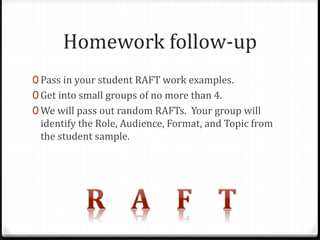
Homework follow-up 
0 Pass in your student RAFT work examples. 
0 Get into small groups of no more than 4. 
0We will pass out random RAFTs. Your group will 
identify the Role, Audience, Format, and Topic from 
the student sample.
Homework follow-up 
0 EC and ESL teachers pair up with one general 
education teacher. 
0 The gen ed teacher will fill out a Frayer Model for the 
word “RIGOR”. 
0 All teachers will next discuss how the use of graphic 
organizers benefit vocabulary comprehension. ESL 
and EC teachers can share the benefits they 
experienced in their classes from using the Frayer 
Model. You will have 10 minutes.
Q & A Session
Summarizing Strategy: 
3-2-1 
3 ways you will incorporate rigor in your classroom 
2 favorite questioning strategies 
1 strategy you think students will engage in the most.
References 
Blackburn, B. (2013). RIGOR is not a four-letter word. Routledge; NY, NY. 
Haynes, J. 2014. How to develop questioning strategies. Retrieved from: 
www.everythingesl.net/inservices/questioning_strategies.php. 
Wiederhold, Chuck. Cooperative Learning and Higher Level Thinking: The Q-Matrix 
(San Clemente, CA: Kagan Publishing, 1995). 
Retrieved from: http://www.cec.sped.org/Publications/CEC-Journals/ 
TEACHING- Exceptional-Children 
Retrieved from: http://www.celt.iastate.edu/teaching-resources/effective-practice/ 
revised-blooms-taxonomy/. 
Retrieved from: http://hubpages.com/hub/Strategies-for-Teaching-ESL-Vocabulary.

Professional Development: RIGOR

  • 2.
    Activating Strategy Take5 minutes to think about the following and answer on sticky notes: 1. How do you write questions for tests? 2. How do you ask questions in class? 3. What do you do with the information you gather from these questions? Put your sticky notes on the appropriate poster. We will come back to these later in the PD.
  • 3.
    3 Volunteers toshare: How do you write questions for assessments? 3 Volunteers to share: How do you ask questions in class? 3 Volunteers to share: What do you do with the information you gather from these questions?
  • 5.
    3 Models forQuestioning New Bloom’s Taxonomy Ciardello’s Four Types of Questions Quality of QUESTIONS 3 Models for Questioning:
  • 6.
    : New Bloom’sTaxonomy Activity: You will work in a small group to create a poster (word splash, graffiti, etc.) to describe the verbs your group is assigned. You have 10 minutes. 0 Group 1: recognize, interpret, execute, organize, critique, construct 0 Group 2: recall, classify, employ, disseminate, assess, product 0 Group 3: define, summarize, implement, investigate, review, conceptualize 0 Group 4: distinguish, infer, perform, differentiate, judge, generate
  • 7.
    We will shareeach of these shar posters and leave them up through today’s PD to refer back to them. Group 1 (also known as Factual)-2 min to share Group 2 (also known as Conceptual)-2 min to share Group 3 (also known as Procedural)-2 min to share Group 4 (also known as Metacognitive)-2 min to share
  • 8.
    We have allheard of Bloom’s Taxonomy and most likely used it in our classrooms. Today we will spend some time with the Revised Version. In 2001, researchers revised the 1956 version of Bloom’s Taxonomy. Now RBT (Revised Bloom’s Taxonomy) has rows for Knowledge Dimension and a column for Cognitive Process Dimension. By crossing the knowledge row the process column, you can plan objectives, activities, and assessments that allow students to learn different types of knowledge using a variety of processes (Blackburn 2013 p. 16).
  • 9.
    http://www.celt.iastate.edu/teaching-resources/ effective-practice/revised-blooms-taxonomy/ Youwill work with a partner to look at an interactive model of the knowledge dimension and cognitive process dimension. Mouse-over the colored blocks to see examples of learning objectives.
  • 10.
  • 11.
  • 12.
    Ciardello’s Four Typesof Questions Question Type Question Stem Cognitive Operations Memory Who, what, when, where? Naming, defining, identifying Convergent Thinking Why, how, in what ways? Explaining, comparing, contrasting Divergent Thinking Imagine, suppose, predict, if/then, how might? Predicting, hypothesizing, inferring Evaluative Thinking Defend, justify, judge Valuing, judging, justifying choices Blackburn, 2013, P. 18
  • 13.
    Activity: 0At yourtable, align Ciardello’s four types of questions with sections from the Revised Bloom’s Taxonomy. You will have 5 minutes to compare and match the two. 0What do you notice? Be thinking of ways you can incorporate them into your class.
  • 14.
    Quality of QUESTIONS (Blackburn, 2013, P. 13). Characteristics of Good Questioning Q—quality Don’t waste your time on questions that are unclear, confusing, or irrelevant. U—understanding Make sure your questions lead to an understanding of content. E—encourage multiple responses Questions with more than one answer lead to higher levels of thinking. S—spark new questions If your question encourages students to ask more questions, you’ve struck gold! T—thought-provoking Prompting students to think is the truest aim of good questions. I—individualized Customize questions to your content and to your students. O—ownership shifted to students Give students the opportunity to create their own questions. N—narrow and broad Some questions are focused, some more open-ended. Use a balance. S—success building Remember the goal of all questioning: successful student learning.
  • 15.
    Quality of QUESTIONS Activity: Join your content team for this activity. Together you will provide a content-specific example of each of the characteristics of good questioning. You will have 10 minutes to come up with your examples.
  • 16.
    Math will have3 minutes to share. Language Arts will have 3 minutes to share. Social Studies will have 3 minutes to share. Science will have 3 minutes to share. Electives will have 3 minutes to share.
  • 17.
    Use the questionstems provided by the question matrix to promote higher-level, open-ended questions: Question Matrix 0 What Is When Is Where Is Which Is Who Is Why Is How Is 0 What Did When Did Where Did Which Did Who Did Why Did How Did 0 What Can When Can Where Can Which Can Who Can Why Can How Can 0 What Would When Would Where Would Which Would Who Would Why Would How Would 0 What Will When Will Where Will Which Will Who Will Why Will How Will 0 What Might When Might Where Might Which Might Who Might Why Might How Might Wiederhold, Chuck. Cooperative Learning and Higher Level Thinking: The Q-Matrix (San Clemente, CA: Kagan Publishing, 1995).
  • 18.
    Accommodations for Diverse Groups How can we use these 3 models of questioning for two diverse populations: EC Students ESL Students
  • 19.
    Involving English languagelearners in the discussions in their content area classes can be frustrating if teachers do not develop strategies for asking questions. 0 Choose easy questions for your ELLs and structure the form of the question to their current language ability. Accept single word/phrases as correct answers. Do not insist that students speak in full sentences. 0 Let ESL students know which questions they will be responsible for answering in advance. Allow for think time and preparation of answers.
  • 20.
    Effective questioning factors for EC and ESL students Embed Evidence-Based Practices within effective instruction, which include: Pace appropriately Preview instruction Review previous instruction Monitor student performance Circulate and scan instructional environment o Recognize appropriate behavior Exhibit enthusiasm Display awareness of what is happening Use wait time after questioning Retrieved from: http://www.cec.sped.org/Publications/CEC-Journals/TEACHING-Exceptional-Children
  • 21.
    Hierarchy of Questions (with examples)  Ask newcomers to point to a picture or word to demonstrate basic knowledge. "Point to the penguin."  Using visual cues, ask simple yes/no questions. "Is a penguin a fish?"  Ask either/or questions in which the answer is embedded. "Is a penguin a mammal or a bird?”  Break complex questions into several steps. "Look at the mammals. Find the bear, the dog and the cat. Why are these animals all mammals? How are they the same?"  Ask simple "how" and "where" questions that can be answered with a phrase or a short sentence. "Where do penguins live?" How do bats hear?  Do not expect your ELLs to answer broad open-ended questions. "How do fish breathe underwater?” Haynes, J. 2014. How to develop questioning strategies. Retrieved from: www.everythingesl.net/inservices/questioning_strategies.php
  • 22.
    15 minute Activity Select a partner and discuss which questioning factor you think is most important when incorporating rigor into your EC or ESL classrooms using each of the 3 questioning strategies. Spend about 5 minutes on each questioning strategy. Apply each strategy to EC and ESL students.
  • 23.
    Which factors willyou incorporate into your EC and ESL classes? Let’s share Each group will share one questioning strategy they have accommodated to fit the needs of an EC student and the needs of an ESL student.
  • 25.
    Activating Strategy: Lotsof homework is rigorous. Rigor is just one more thing to do. Rigor means doing more. Rigor is not for everyone. Providing support means lessening rigor. Standards alone take care of rigor. Resources equal rigor. Take 5 minutes to talk at your table about these statements and whether you find them to be true statements or false statements.
  • 26.
    Activity: Lots of homework is rigorous. Rigor is just one more thing to do. Rigor means doing more. Rigor is not for everyone. Providing support means lessening rigor. Standards alone take care of rigor. Resources equal rigor. Now we know these are myths about rigor. Take 10 minutes to change these statements to become true.
  • 27.
    “Increasing complexity meansmoving beyond activities that require students to recall information to asking students to apply that knowledge in multifaceted ways.” (Blackburn, 2013, P. 53).
  • 28.
    Increasing Complexity Thereare five specific ways to increase complexity in your instruction: Complexity through Problem-Based Learning Complexity in Writing Complexity as you Assess Prior Knowledge Complexity with Vocabulary Complexity in Review Games (Blackburn, 2013, P. 53)
  • 29.
    Problem-Based versus Project-Based In project-based learning, the teacher directs the questions and assigns the final product. In problem-based learning, the students are more self-directed and come up with many of their own questions (Blackburn, 2013, P. 54).
  • 30.
    Problem-Based Learning In1995, Barrel took the KWL chart and adapted it to a model for posing problems. The result was a KWHLAQ Model: K-What do we think we already KNOW? W-What do we WANT to find out in order to solve the problem? H-HOW and where will we find the answer? L-What do we think we will LEARN? What did we LEARN? A-How will we APPLY what we learned? Q-What are our QUESTIONS now that we have finished our inquiry? Blackburn, 2013, P. 54
  • 31.
    Activity: With yourgrade-level content members, come up with an activity for a problem-based learning scenario for the current unit you are working on. You will have 20 minutes. Plan to use this activity in your classroom before our follow-up session. Example: In social studies, students create a separate administration or government that pertains to their grade level only.
  • 32.
    Complexity in Writing Using a RAFT is an effective way to add rigor to student writing. R-role A-audience F-format T-topic
  • 33.
    Example of aRAFT ROLE AUDIENCE FORMAT TOPIC Knight People of the future Letter Black Death Peasant Television audience Travel Brochure Social Classes Rat 6th grade students Talk Show Weaponry King Anyone above the Role in social class Application Castle Design
  • 34.
    Quick Write: Youare going to do a quick write using the example RAFT. Pick a Role, and Audience, a Format, and a Topic. You will have 7 minutes. ROLE AUDIENCE FORMAT TOPIC Knight People of the future Letter Black Death Peasant Television audience Travel Brochure Social Classes Rat 6th grade students Talk Show Weaponry King Anyone above the Role in social class Application Castle Design EXAMPLE: Knight, Anyone above Knight, Letter, Castle Design. Dear King, I am Knight Jones and I am concerned for your safety. I recently was on a mission to attack a castle on the manor across the river. This castle had a draw bridge and a moat. It made attacking very difficult. I think it would be wise if you look into building a moat and having a draw bridge added to your castle. This will keep you safe. Another item you can add to the castle to keep you safe is arrow loops. This would allow people fighting the attackers to shoot arrows through the walls. I appreciate your Lordship taking these suggestions under consideration. I think it will help you and your family remain unharmed in the next battle. Sincerely, Knight Jones
  • 35.
    Complexity as youAssess Prior Knowledge An effective way to assess prior knowledge is having students complete an anticipation guide, then taking it one step further. Have the students answer several true/false questions about the upcoming topic. Finally, students must re-write the false statements to make them true. Have students then work together to check their answers (may use sources).
  • 36.
    Complexity as youAssess Prior Knowledge Another way to effectively assess prior knowledge is by having students create an alphabet of terms for a particular topic. This allows the teacher to gain understanding how deep a students’ knowledge goes on a topic. To gain understanding of a how much knowledge a class has, start a topic paper and send it around and have students add ideas to it. Also have them check each other’s comments for misinformation.
  • 37.
    Activating prior knowledgeis important for EC and ESL students Including a strategy to activate prior knowledge benefits ELL students and EC students because:  students have the opportunity to dialogue  they express their ideas  promotes collaborate with each other  students connect what they already know to the new concepts  facilitates learning and comprehension
  • 38.
    Data to supportthe importance of activating prior knowledge Klinger and Vaughn incorporated activating prior knowledge strategies in their classrooms. The results were: All EC students improved their performance on comprehension measures.  Improvement continued to be displayed after 30 days in both 6th and 4th grades. Students with LD significantly improved their ability to compose summaries compared to control students. http://schsinstructionalcoach.weebly.com/reciprocal-teaching-and-ec-students.html
  • 39.
    Complexity with Vocabulary Vocabulary is a struggle in all content areas. Memorizing definitions does not show that a student comprehends the meanings of words. We must find ways to use vocabulary that demonstrate students’ understanding of the word, not if they can match it with a definition. Graphic Organizers are a great way to do this. Frayer models are one example. You don’t have to use the same method all of the time, you can even teach several and let the students choose their favorite. Who Am I? Riddles (Blackburn, 2013 p. 63) are another effective way to demonstrate depth in vocabulary knowledge. Example: I am in the land between two rivers. Hammurabi was King here, annual flooding causes me to have rich soil. Where Am I? Mesopotamia
  • 40.
    Complexity in ReviewGames Jeopardy is a popular way to review before an assessment. Two ways to make Jeopardy more rigorous for your students: Have them create the questions and categories. Have each person answer on a white board and each person gets points for correct answers even though only one group or one person answers aloud.
  • 41.
    Vocabulary with ECand ESL learners ESL Vocabulary Activities for All Levels Teachers can use variations of these core activities to develop vocabulary at all levels across content areas. 1. Flashcards and games/contests as icebreakers or wrap ups 2. Pre-teaching Vocabulary for Reading or Listening Assignments 3. Personal Vocabulary Lists 4. Quizzes/Self-Study Worksheets/ Cloze Activities 5. Contact Assignments Retrieved from: http://hubpages.com/hub/Strategies-for-Teaching-ESL-Vocabulary
  • 42.
    Frayer Model forincreasing rigor in ESL and EC classes
  • 43.
    How can gamesincrease complexity and rigor for EC and ESL learners? Improve student proficiency by using : Visual aids Incorporating drama Role playing Promoting vocabulary use Promotes participation/ communication Lowers students’ stress Captures students’ attention Note: be sure to follow student accommodations and IEP’s. For example, increase wait time for responses.
  • 44.
    A Fun, RigorousGame Resource ! http://www.edteck.com/rigor/lessons/detective/
  • 45.
    Remember! Rigor isa word used often in teaching, but many don't quite understand what rigor means. Rigorous learning is not a measure of the quantity of material covered or the number of times it is covered. Rigor is an element of the learning environment that promotes an in-depth, active, and engaged learning process for students. Teachers should attempt to incorporate rigor into as many of their teachings as possible. Rigor creates excitement and enthusiasm for learning that students can get in few other places.
  • 46.
    Summarizing Strategy: ExitTicket Please take a few minutes to write 3 new ways you will incorporate rigor into your classroom based on the information you learned from today’s PD. Thank you!
  • 47.
    HOMEWORK 0 TASKONE: Take the RBT (Revised Bloom’s Taxonomy) table and the RBT questions and come up with an assessment for your next unit. It can be a mini assessment after a concept or a unit assessment. Bring your assessment to the follow-up session. 0 TASK TWO: Take the RAFT model and create a writing activity for a concept you are going to teach. Include at least 4 of each category. Bring two student examples to our follow-up session. 0 TASK THREE (EC and ESL Teachers): Using the template provided in the link, create a graphic organizer to introduce an important vocabulary word in your classes. Be prepared to discuss the benefits of using the graphic organizer in our follow-up session. http://www.worksheetworks.com/miscellanea/graphic-organizers/ frayer.html
  • 49.
    Activating Strategy: Role-play in groups of two.  One person should play the role of reporter while the other plays the role of interviewee.  Reporters ask interviewees to state a specific event in their lives but to give no details.  Next, reporters should use the wh- question stems to find out more information about the event.  Switch roles and repeat the activity. Note: this is a great game for your students, too
  • 50.
    Remember… In orderto get information, ESL students will have to learn basic investigative questions --- who, what, where, when, why and how. While native speakers need little help with this concept because they tend to "pick it up" during childhood language acquisition, ESL students require specific activities designed to teach these words and their uses. These techniques are also useful for EC students.
  • 51.
    Rigor Video https://www.youtube.com/watch?v=XxMh4vGRTwU#t=30 After watching the video, turn to a partner and discuss student motivation in your class since incorporating rigor. You have 3 minutes.
  • 52.
    Refer to thisactivity from our original PD: With your grade-level content members, come up with an activity for a problem-based learning scenario for the current unit you are working on. NOW: Take 15 minutes to explain your activity to a non-content partner. You and your partner need to then reflect on the challenges and successes you faced with this activity.
  • 53.
    Homework follow-up 0Fill in the RBT Table from your guided notes with the number of questions from your assessment that fit into each category. 0 Take 10 minutes with a partner to discuss the completed table. Make sure to include why each question fits into each category. Ask your partner if they agree or disagree.
  • 54.
    Homework follow-up 0Pass in your student RAFT work examples. 0 Get into small groups of no more than 4. 0We will pass out random RAFTs. Your group will identify the Role, Audience, Format, and Topic from the student sample.
  • 55.
    Homework follow-up 0EC and ESL teachers pair up with one general education teacher. 0 The gen ed teacher will fill out a Frayer Model for the word “RIGOR”. 0 All teachers will next discuss how the use of graphic organizers benefit vocabulary comprehension. ESL and EC teachers can share the benefits they experienced in their classes from using the Frayer Model. You will have 10 minutes.
  • 56.
    Q & ASession
  • 57.
    Summarizing Strategy: 3-2-1 3 ways you will incorporate rigor in your classroom 2 favorite questioning strategies 1 strategy you think students will engage in the most.
  • 58.
    References Blackburn, B.(2013). RIGOR is not a four-letter word. Routledge; NY, NY. Haynes, J. 2014. How to develop questioning strategies. Retrieved from: www.everythingesl.net/inservices/questioning_strategies.php. Wiederhold, Chuck. Cooperative Learning and Higher Level Thinking: The Q-Matrix (San Clemente, CA: Kagan Publishing, 1995). Retrieved from: http://www.cec.sped.org/Publications/CEC-Journals/ TEACHING- Exceptional-Children Retrieved from: http://www.celt.iastate.edu/teaching-resources/effective-practice/ revised-blooms-taxonomy/. Retrieved from: http://hubpages.com/hub/Strategies-for-Teaching-ESL-Vocabulary.