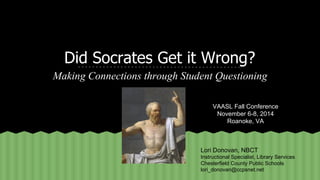
Did Socrates Get it Wrong? 
Making Connections through Student Questioning 
VAASL Fall Conference 
November 6-8, 2014 
Roanoke, VA 
Lori Donovan, NBCT 
Instructional Specialist, Library Services 
Chesterfield County Public Schools 
lori_donovan@ccpsnet.net
Socratic Teaching 
● Socratic teaching focuses on giving students questions, not answers. 
● Teacher models an inquiring, probing mind by continually probing into the 
subject with questions [directed at students]. 
● A Socratic questioner (teacher) should: 
a) keep the discussion focused 
b) keep the discussion intellectually responsible 
c) stimulate the discussion with probing questions 
d) periodically summarize what has and what has not been dealt with 
and/or resolved 
e) draw as many students as possible into the discussion. 
Paul, R., & Elder, L. (2007, April). Socratic Teaching. Retrieved June 16, 2014, from http://www.criticalthinking.org/pages/socratic-teaching/606
And what is wrong with this time honored 
method?
Nothing, But Often Our Students Wonder....
And then they sometimes feel
So how do we move them to that stage? 
By getting them to formulate their own questions 
around a topic of study.
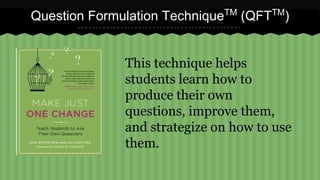
Question Formulation TechniqueTM (QFTTM) 
This technique helps 
students learn how to 
produce their own 
questions, improve them, 
and strategize on how to use 
them.
USING STUDENT QUESTIONS 
Students can use their questions for many purposes, 
including the following: 
➔ Conduct Research 
➔ Reports 
➔ Conduct Experiments 
➔ Independent Projects 
➔ Write Papers/Essays 
➔ Group and Individual Projects 
➔ Socratic Seminars/Debates 
➔ Prepare for Presentations/Interviews
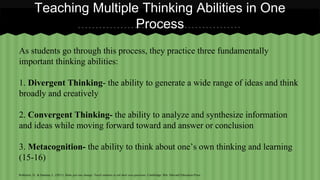
Teaching Multiple Thinking Abilities in One 
Process 
As students go through this process, they practice three fundamentally 
important thinking abilities: 
1. Divergent Thinking- the ability to generate a wide range of ideas and think 
broadly and creatively 
2. Convergent Thinking- the ability to analyze and synthesize information 
and ideas while moving forward toward and answer or conclusion 
3. Metacognition- the ability to think about one’s own thinking and learning 
(15-16) 
Rothstein, D., & Santana, L. (2011). Make just one change: Teach students to ask their own questions. Cambridge, MA: Harvard Education Press.
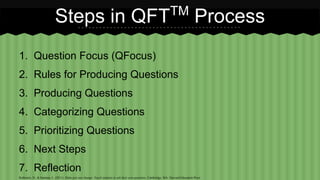
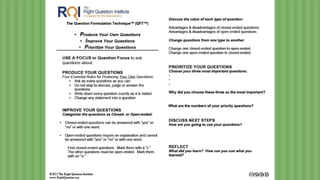
Steps in QFTTM Process 
1. Question Focus (QFocus) 
2. Rules for Producing Questions 
3. Producing Questions 
4. Categorizing Questions 
5. Prioritizing Questions 
6. Next Steps 
7. Reflection 
Rothstein, D., & Santana, L. (2011). Make just one change: Teach students to ask their own questions. Cambridge, MA: Harvard Education Press.
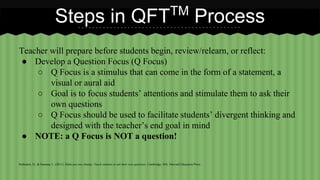
Steps in QFTTM Process 
Teacher will prepare before students begin, review/relearn, or reflect: 
● Develop a Question Focus (Q Focus) 
○ Q Focus is a stimulus that can come in the form of a statement, a 
visual or aural aid 
○ Goal is to focus students’ attentions and stimulate them to ask their 
own questions 
○ Q Focus should be used to facilitate students’ divergent thinking and 
designed with the teacher’s end goal in mind 
● NOTE: a Q Focus is NOT a question! 
Rothstein, D., & Santana, L. (2011). Make just one change: Teach students to ask their own questions. Cambridge, MA: Harvard Education Press.
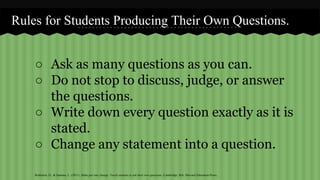
Rules for Students Producing Their Own Questions. 
○ Ask as many questions as you can. 
○ Do not stop to discuss, judge, or answer 
the questions. 
○ Write down every question exactly as it is 
stated. 
○ Change any statement into a question. 
Rothstein, D., & Santana, L. (2011). Make just one change: Teach students to ask their own questions. Cambridge, MA: Harvard Education Press.
Q Focus
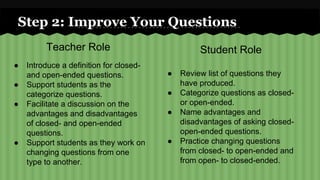
Step 2: Improve Your Questions 
Teacher Role 
● Introduce a definition for closed-and 
open-ended questions. 
● Support students as the 
categorize questions. 
● Facilitate a discussion on the 
advantages and disadvantages 
of closed- and open-ended 
questions. 
● Support students as they work on 
changing questions from one 
type to another. 
Student Role 
● Review list of questions they 
have produced. 
● Categorize questions as closed-or 
open-ended. 
● Name advantages and 
disadvantages of asking closed-open- 
ended questions. 
● Practice changing questions 
from closed- to open-ended and 
from open- to closed-ended.
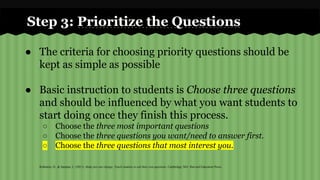
Step 3: Prioritize the Questions 
● The criteria for choosing priority questions should be 
kept as simple as possible 
● Basic instruction to students is Choose three questions 
and should be influenced by what you want students to 
start doing once they finish this process. 
○ Choose the three most important questions 
○ Choose the three questions you want/need to answer first. 
○ Choose the three questions that most interest you. 
Rothstein, D., & Santana, L. (2011). Make just one change: Teach students to ask their own questions. Cambridge, MA: Harvard Education Press.
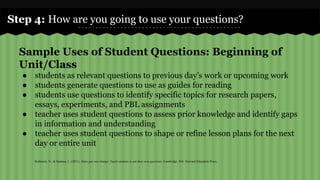
Step 4: How are you going to use your questions? 
Sample Uses of Student Questions: Beginning of 
Unit/Class 
● students as relevant questions to previous day’s work or upcoming work 
● students generate questions to use as guides for reading 
● students use questions to identify specific topics for research papers, 
essays, experiments, and PBL assignments 
● teacher uses student questions to assess prior knowledge and identify gaps 
in information and understanding 
● teacher uses student questions to shape or refine lesson plans for the next 
day or entire unit 
Rothstein, D., & Santana, L. (2011). Make just one change: Teach students to ask their own questions. Cambridge, MA: Harvard Education Press.
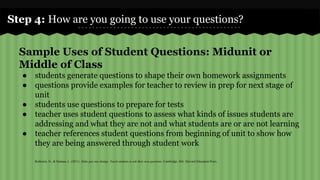
Step 4: How are you going to use your questions? 
Sample Uses of Student Questions: Midunit or 
Middle of Class 
● students generate questions to shape their own homework assignments 
● questions provide examples for teacher to review in prep for next stage of 
unit 
● students use questions to prepare for tests 
● teacher uses student questions to assess what kinds of issues students are 
addressing and what they are not and what students are or are not learning 
● teacher references student questions from beginning of unit to show how 
they are being answered through student work 
Rothstein, D., & Santana, L. (2011). Make just one change: Teach students to ask their own questions. Cambridge, MA: Harvard Education Press.
Step 4: How are you going to use your questions? 
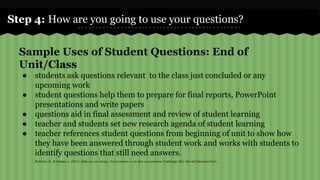
Sample Uses of Student Questions: End of 
Unit/Class 
● students ask questions relevant to the class just concluded or any 
upcoming work 
● student questions help them to prepare for final reports, PowerPoint 
presentations and write papers 
● questions aid in final assessment and review of student learning 
● teacher and students set new research agenda of student learning 
● teacher references student questions from beginning of unit to show how 
they have been answered through student work and works with students to 
identify questions that still need answers. 
Rothstein, D., & Santana, L. (2011). Make just one change: Teach students to ask their own questions. Cambridge, MA: Harvard Education Press.
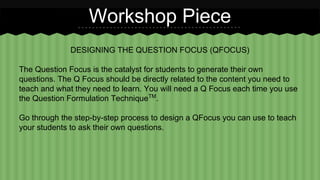
Workshop Piece 
DESIGNING THE QUESTION FOCUS (QFOCUS) 
The Question Focus is the catalyst for students to generate their own 
questions. The Q Focus should be directly related to the content you need to 
teach and what they need to learn. You will need a Q Focus each time you use 
the Question Formulation TechniqueTM. 
Go through the step-by-step process to design a QFocus you can use to teach 
your students to ask their own questions.
• 
• 
•
Resources 
Resources from this session can be found at http://libguides.ccpsnet.net/qft 
or
References 
Iranian hostage crisis. Image. Bettmann/Corbis. (2014). In Pop Culture Universe: Icons, Idols, Ideas. Retrieved July 8, 2014, from 
http://popculture.abc-clio.com/ 
Make Just One Change - Right Question Institute. (2014). Retrieved May 22, 2014, from http://rightquestion.org/make-just-one-change/ 
Paul, R., & Elder, L. (2007, April). Socratic Teaching. Retrieved June 16, 2014, from http://www.criticalthinking. 
org/pages/socratic-teaching/606 
Rothstein, D., & Santana, L. (2011). Make just one change: Teach students to ask their own questions. Cambridge, MA: Harvard 
Education Press. 
Rothstein, D., & Santana, L. (2011, September/October). Teaching Students to Ask Their Own Questions. Retrieved May 22, 2014, 
from http://hepg.org/hel-home/issues/27_5/helarticle/teaching-students-to-ask-their-own-questions_507 
The Rules for Producing Questions [Pdf]. (2014). Cambridge, MA: The Right Question Institute. 
Teach Students to Ask Their Own Questions. (2014). Retrieved May 22, 2014, from http://rightquestion.org/education/

Vaasl 2014

  • 1.
    Did Socrates Getit Wrong? Making Connections through Student Questioning VAASL Fall Conference November 6-8, 2014 Roanoke, VA Lori Donovan, NBCT Instructional Specialist, Library Services Chesterfield County Public Schools lori_donovan@ccpsnet.net
  • 3.
    Socratic Teaching ●Socratic teaching focuses on giving students questions, not answers. ● Teacher models an inquiring, probing mind by continually probing into the subject with questions [directed at students]. ● A Socratic questioner (teacher) should: a) keep the discussion focused b) keep the discussion intellectually responsible c) stimulate the discussion with probing questions d) periodically summarize what has and what has not been dealt with and/or resolved e) draw as many students as possible into the discussion. Paul, R., & Elder, L. (2007, April). Socratic Teaching. Retrieved June 16, 2014, from http://www.criticalthinking.org/pages/socratic-teaching/606
  • 4.
    And what iswrong with this time honored method?
  • 5.
    Nothing, But OftenOur Students Wonder....
  • 6.
    And then theysometimes feel
  • 8.
    So how dowe move them to that stage? By getting them to formulate their own questions around a topic of study.
  • 10.
    Question Formulation TechniqueTM(QFTTM) This technique helps students learn how to produce their own questions, improve them, and strategize on how to use them.
  • 11.
    USING STUDENT QUESTIONS Students can use their questions for many purposes, including the following: ➔ Conduct Research ➔ Reports ➔ Conduct Experiments ➔ Independent Projects ➔ Write Papers/Essays ➔ Group and Individual Projects ➔ Socratic Seminars/Debates ➔ Prepare for Presentations/Interviews
  • 12.
    Teaching Multiple ThinkingAbilities in One Process As students go through this process, they practice three fundamentally important thinking abilities: 1. Divergent Thinking- the ability to generate a wide range of ideas and think broadly and creatively 2. Convergent Thinking- the ability to analyze and synthesize information and ideas while moving forward toward and answer or conclusion 3. Metacognition- the ability to think about one’s own thinking and learning (15-16) Rothstein, D., & Santana, L. (2011). Make just one change: Teach students to ask their own questions. Cambridge, MA: Harvard Education Press.
  • 13.
    Steps in QFTTMProcess 1. Question Focus (QFocus) 2. Rules for Producing Questions 3. Producing Questions 4. Categorizing Questions 5. Prioritizing Questions 6. Next Steps 7. Reflection Rothstein, D., & Santana, L. (2011). Make just one change: Teach students to ask their own questions. Cambridge, MA: Harvard Education Press.
  • 14.
    Steps in QFTTMProcess Teacher will prepare before students begin, review/relearn, or reflect: ● Develop a Question Focus (Q Focus) ○ Q Focus is a stimulus that can come in the form of a statement, a visual or aural aid ○ Goal is to focus students’ attentions and stimulate them to ask their own questions ○ Q Focus should be used to facilitate students’ divergent thinking and designed with the teacher’s end goal in mind ● NOTE: a Q Focus is NOT a question! Rothstein, D., & Santana, L. (2011). Make just one change: Teach students to ask their own questions. Cambridge, MA: Harvard Education Press.
  • 15.
    Rules for StudentsProducing Their Own Questions. ○ Ask as many questions as you can. ○ Do not stop to discuss, judge, or answer the questions. ○ Write down every question exactly as it is stated. ○ Change any statement into a question. Rothstein, D., & Santana, L. (2011). Make just one change: Teach students to ask their own questions. Cambridge, MA: Harvard Education Press.
  • 16.
  • 17.
    Step 2: ImproveYour Questions Teacher Role ● Introduce a definition for closed-and open-ended questions. ● Support students as the categorize questions. ● Facilitate a discussion on the advantages and disadvantages of closed- and open-ended questions. ● Support students as they work on changing questions from one type to another. Student Role ● Review list of questions they have produced. ● Categorize questions as closed-or open-ended. ● Name advantages and disadvantages of asking closed-open- ended questions. ● Practice changing questions from closed- to open-ended and from open- to closed-ended.
  • 18.
    Step 3: Prioritizethe Questions ● The criteria for choosing priority questions should be kept as simple as possible ● Basic instruction to students is Choose three questions and should be influenced by what you want students to start doing once they finish this process. ○ Choose the three most important questions ○ Choose the three questions you want/need to answer first. ○ Choose the three questions that most interest you. Rothstein, D., & Santana, L. (2011). Make just one change: Teach students to ask their own questions. Cambridge, MA: Harvard Education Press.
  • 19.
    Step 4: Howare you going to use your questions? Sample Uses of Student Questions: Beginning of Unit/Class ● students as relevant questions to previous day’s work or upcoming work ● students generate questions to use as guides for reading ● students use questions to identify specific topics for research papers, essays, experiments, and PBL assignments ● teacher uses student questions to assess prior knowledge and identify gaps in information and understanding ● teacher uses student questions to shape or refine lesson plans for the next day or entire unit Rothstein, D., & Santana, L. (2011). Make just one change: Teach students to ask their own questions. Cambridge, MA: Harvard Education Press.
  • 20.
    Step 4: Howare you going to use your questions? Sample Uses of Student Questions: Midunit or Middle of Class ● students generate questions to shape their own homework assignments ● questions provide examples for teacher to review in prep for next stage of unit ● students use questions to prepare for tests ● teacher uses student questions to assess what kinds of issues students are addressing and what they are not and what students are or are not learning ● teacher references student questions from beginning of unit to show how they are being answered through student work Rothstein, D., & Santana, L. (2011). Make just one change: Teach students to ask their own questions. Cambridge, MA: Harvard Education Press.
  • 21.
    Step 4: Howare you going to use your questions? Sample Uses of Student Questions: End of Unit/Class ● students ask questions relevant to the class just concluded or any upcoming work ● student questions help them to prepare for final reports, PowerPoint presentations and write papers ● questions aid in final assessment and review of student learning ● teacher and students set new research agenda of student learning ● teacher references student questions from beginning of unit to show how they have been answered through student work and works with students to identify questions that still need answers. Rothstein, D., & Santana, L. (2011). Make just one change: Teach students to ask their own questions. Cambridge, MA: Harvard Education Press.
  • 22.
    Workshop Piece DESIGNINGTHE QUESTION FOCUS (QFOCUS) The Question Focus is the catalyst for students to generate their own questions. The Q Focus should be directly related to the content you need to teach and what they need to learn. You will need a Q Focus each time you use the Question Formulation TechniqueTM. Go through the step-by-step process to design a QFocus you can use to teach your students to ask their own questions.
  • 24.
  • 25.
    Resources Resources fromthis session can be found at http://libguides.ccpsnet.net/qft or
  • 26.
    References Iranian hostagecrisis. Image. Bettmann/Corbis. (2014). In Pop Culture Universe: Icons, Idols, Ideas. Retrieved July 8, 2014, from http://popculture.abc-clio.com/ Make Just One Change - Right Question Institute. (2014). Retrieved May 22, 2014, from http://rightquestion.org/make-just-one-change/ Paul, R., & Elder, L. (2007, April). Socratic Teaching. Retrieved June 16, 2014, from http://www.criticalthinking. org/pages/socratic-teaching/606 Rothstein, D., & Santana, L. (2011). Make just one change: Teach students to ask their own questions. Cambridge, MA: Harvard Education Press. Rothstein, D., & Santana, L. (2011, September/October). Teaching Students to Ask Their Own Questions. Retrieved May 22, 2014, from http://hepg.org/hel-home/issues/27_5/helarticle/teaching-students-to-ask-their-own-questions_507 The Rules for Producing Questions [Pdf]. (2014). Cambridge, MA: The Right Question Institute. Teach Students to Ask Their Own Questions. (2014). Retrieved May 22, 2014, from http://rightquestion.org/education/