1
What Is This Module About?
While we are a nation of many subcultures, there are dominant traits, practices
and beliefs that are common to all people. This is what we refer to as the culture of
the Philippines.
Are you a true Filipino? Why do you think so?
Are you proud of your culture? What makes you proud of it?
Do you love your country, the Philippines? Why?
In this module, you will learn about the desirable traits of a true Filipino. It will
help you answer questions about your role and duties as a citizen of this country. It
will also enable you to practice and strengthen the values that you should have as a
Filipino. This module highlights the desirable traits of Filipinos. It will give you an
opportunity to demonstrate and practice the desirable traits you will learn in this
module.
This module is divided into three lessons:
Lesson 1 – We Are Filipinos
Lesson 2 – The Mark of a True Filipino
Lesson 3 – Filipino in Thought, Word and Deed
What Will You Learn From This Module?
After studying this module, you should be able to:
♦ show pride in the Filipino culture;
♦ show respect and appreciation for the Philippine flag, national anthem,
national language and other national symbols of the Philippines;
♦ discuss desirable Filipino traits and values;
♦ show appreciation for desirable Filipino traditions; and
♦ give your own opinion based on a story/song/play read or heard.
2
Let’s See What You Already Know
Before studying this module, answer the questions below to determine how much
you already know about the topic.
Put a check mark (4) opposite each statement that shows a good Filipino trait
and an X-mark (8) before each statement that does not.
_____ 1. A true Filipino stands at attention whenever he/she hears the
Philippine National Anthem.
_____ 2. Filipino is encouraged in the elementary, secondary and college
levels as a medium of instruction.
_____ 3. Traditionally, many Filipinos pause to say a prayer at angelus time.
_____ 4. In a village that practices bayanihan, Filipinos help each other
in constructing the village church.
_____ 5. Kissing the hands or pagmamano is currently considered out of
fashion.
_____ 6. OPM or Original Pilipino Music must make up half the
airtime of local musical radio programs.
_____ 7. A true Filipino believes that a favor granted has to be repaid.
_____ 8. Filipino grooms-to-be traditionally visit the parents of their
fiancées to perform a pre-betrothal ceremony called
pamamanhikan.
_____ 9. Giving donations to a bereaved family is a foreign tradition that
was not adopted by Filipinos.
_____10. Pakikisama—or the ability to get along with others to avoid
conflict—is not being demonstrated by Filipinos anymore.
Well, how was it? Was it difficult? Compare your answers with those in the
Answer Key on page 30.
If all your answers are correct, very good! This shows that you already know
much about the topic. You may still study the module to review what you already
know. Who knows, you might learn some new things as well.
If you got a low score, don’t feel bad. This means that this module is for you. It
will help you understand good Filipino traits that you can practice in your daily life. If
you study this module carefully, you will learn the answers to all the items in the test
and a lot more! Are you ready?
You may now go to the next page to begin Lesson 1.
3
LESSON 1
We Are Filipinos
What are the desirable traits of a Filipino? What values are native to our Filipino
culture.
In this lesson, you will learn different Filipino values such as those that promote
harmonious and peaceful relationships, close family ties, respect for elders and trust
in a Supreme Being.
After studying this lesson, you should be able to:
♦ identify and provide examples of the desirable traits of a Filipino; and
♦ show pride in the Filipino culture.
Let’s Study and Analyze
Ricardo holds on to desirable Filipino values and pratices both as an individual
and as a member of the community. You are going to find out what these traits are and
how Ricardo practices them in his daily life.
Try to match the desirable Filipino traits in the box below with the actions and
behavior of Ricardo. Write the letter of your answer in the blank before each number.
a. Trust in God f. Bayanihan
(Cooperation)
b. Hospitality g. Pakikisama
(ability to get along with others)
c. Respect for Elders h. Close Family Ties
d. Utang na loob i. Patience/Optimism
(Debt of gratitude)
e. Resourcefulness/ j. Respect for Womanhood
Creativity
____1. Ricardo kisses the hands of his parents, grandparents and older
relatives. He listens and gives importance to their advice and helps them
in any way he can. He plans to take care of his parents when they grow
old.
____2. Ricardo loves to be with his family at all times. He goes to church with
them, joins them for regular get-togethers, and celebrates holidays with
them as much as he can. He would love to live with his family even as
he gets older.
4
____3. Ricardo’s belief in God is very strong. He does not complain much
because he knows that God will take care of everything. He keeps and
venerates religious symbols in his house.
____4. Ricardo is always there to help his neighbors and other members of his
community. He joined and supported the People Power 2 uprising at
Edsa in January 2001. Aside from participating in national projects, he
is always available whenever his barangay needs his help and support in
implementing its projects.
____5. Ricardo sees things through until the end. He always has hope and looks
at the brighter side of things. He does not get discouraged when
confronted with problems. In fact, no matter how miserable his life is,
he moves on, knowing that in the end, the sun will shine again. He
remains calm even if he has a hard time commuting, or when he deals
with everyday problems like pollution, traffic, lack of water and
electricity, bad roads and poor telephone services.
____6. When someone does Ricardo a favor or helps him in his hour of need,
he feels that he needs to return a favor to that person. He would not
feel comfortable if he does not repay that person in any way that he can.
____7. You will always see cheerfulness in Ricardo’s face wherever he goes.
He tries to maintain harmonious and peaceful relationships with
everyone, even if he sees the faults of his enemies, friends, or family.
For him, not being friendly and cooperative with others would bring
negative results.
____8. Ricardo loves to entertain guests, friends and even strangers. He is very
warm-hearted and generous in receiving visitors at home, in the
office, or wherever he meets people.
____9. Ricardo is very good at inventing new things. He makes decorations out
of old newspapers and used soft drink cans. He saves used paper and
empty bottles for future use.
___10. Ricardo respects his mother and this respect is extended to his sisters,
female friends, and colleagues. He opens doors, gives up his seat, and
carries bags for women. He also assists them when boarding or
alighting from vehicles.
How did you find the exercise? Compare your answers with the Answer Key on
pages 30–31.
5
Let’s Try This
Give an example of each desirable trait you just learned in the exercise. Apply
that example at home, at work or in the community. How did you feel after
demonstrating each desirable Filipino trait? Write down your observations and
discuss them with your co-learners and Instructional Manager.
Let’s Read
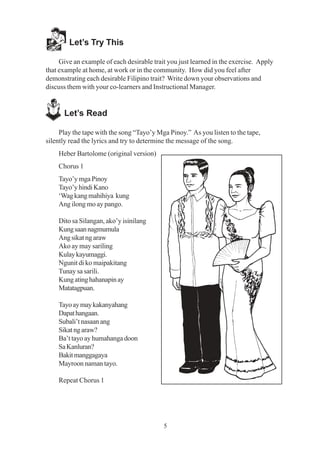
Play the tape with the song “Tayo’y Mga Pinoy.” As you listen to the tape,
silently read the lyrics and try to determine the message of the song.
Heber Bartolome (original version)
Chorus 1
Tayo’y mga Pinoy
Tayo’yhindiKano
‘Wagkangmahihiya kung
Ang ilong mo ay pango.
Dito sa Silangan, ako’y isinilang
Kungsaannagmumula
Angsikatngaraw
Ako ay may sariling
Kulaykayumaggi.
Ngunit di ko maipakitang
Tunay sa sarili.
Kungatinghahanapinay
Matatagpuan.
Tayoaymaykakanyahang
Dapathangaan.
Subali’tnasaanang
Sikatngaraw?
Ba’t tayo ay humahanga doon
SaKanluran?
Bakitmanggagaya
Mayroon naman tayo.
Repeat Chorus 1
6
Dito sa Silangan,
Tayo’y isinilang
Kungsaannagmumulaang
Sikatngaraw
Subali’t nasaan ang sikat ng araw
Ba’t tayo ay humahanga doon sa
Kanluran?
Repeat Chorus 1
Chorus 2
Mayro’ng isang aso, daig pa ang ulol
Sya’yngumingiyaw
Hindi tumatahol
Katulad ng iba
Pa-Inglis-Inglis pa
Nakungpakikinggan,
Mali-mali naman
‘Wagnalang.
Repeat Chorus 2 except the last line
‘Wag na, oy oy
Oy, ika’y Pinoy
Oy, oy, ika’y Pinoy.”
Let’s Talk About This
Did you like the song? Did you understand its message? Try answering the
following questions:
1. What is the message of the song?
_________________________________________________________
_________________________________________________________
_________________________________________________________
2. Are you ashamed of being a Filipino? Explain your answer.
_________________________________________________________
_________________________________________________________
_________________________________________________________
7
3. How do you understand the line: “Mayro’ng isang aso, daig pa ang ulol.
Siya’y ngumingiyaw, hindi tumatahol.” (There is a dog, crazier than a crazy
dog. He meows instead of barking).
_________________________________________________________
_________________________________________________________
_________________________________________________________
4. What traits and attitudes portrayed in the song do you feel apply to you?
_________________________________________________________
_________________________________________________________
_________________________________________________________
5. If, by chance, you are brown-skinned and flat-nosed, would you be ashamed?
Why or why not?
_________________________________________________________
_________________________________________________________
_________________________________________________________
Compare your answers with those found in the Answer Key on page 31.
Let’s Learn
You should always be proud of being a Filipino.You should not be ashamed of
your culture because God has given you talents, skills and physical characteristics that
are uniquely Filipino, which you should always cherish and be proud of.
Here are some of the most-well known desirable Filipino traits.
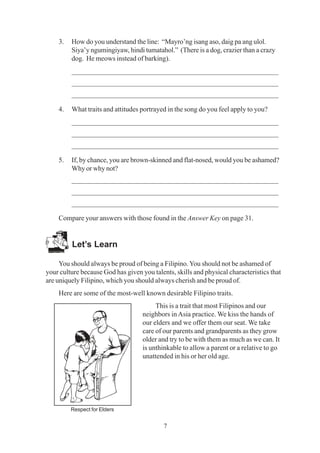
This is a trait that most Filipinos and our
neighbors inAsia practice. We kiss the hands of
our elders and we offer them our seat. We take
care of our parents and grandparents as they grow
older and try to be with them as much as we can. It
is unthinkable to allow a parent or a relative to go
unattended in his or her old age.
Respect for Elders
8
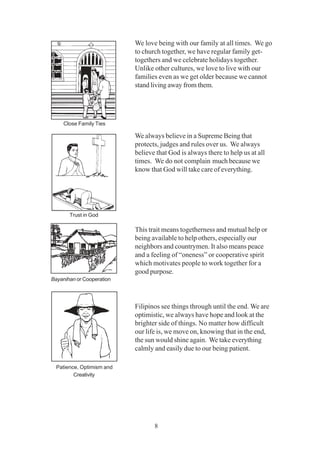
We love being with our family at all times. We go
to church together, we have regular family get-
togethers and we celebrate holidays together.
Unlike other cultures, we love to live with our
families even as we get older because we cannot
stand living away from them.
We always believe in a Supreme Being that
protects, judges and rules over us. We always
believe that God is always there to help us at all
times. We do not complain much because we
know that God will take care of everything.
This trait means togetherness and mutual help or
being available to help others, especially our
neighbors and countrymen. It also means peace
and a feeling of “oneness” or cooperative spirit
which motivates people to work together for a
good purpose.
Filipinos see things through until the end. We are
optimistic, we always have hope and look at the
brighter side of things. No matter how difficult
our life is, we move on, knowing that in the end,
the sun would shine again. We take everything
calmly and easily due to our being patient.
Close Family Ties
Trust in God
Bayanihan or Cooperation
Patience, Optimism and
Creativity
9
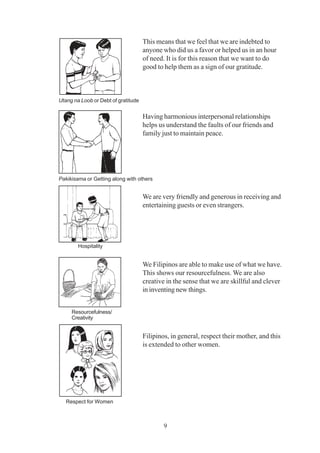
This means that we feel that we are indebted to
anyone who did us a favor or helped us in an hour
of need. It is for this reason that we want to do
good to help them as a sign of our gratitude.
Having harmonious interpersonal relationships
helps us understand the faults of our friends and
family just to maintain peace.
We are very friendly and generous in receiving and
entertaining guests or even strangers.
We Filipinos are able to make use of what we have.
This shows our resourcefulness. We are also
creative in the sense that we are skillful and clever
in inventing new things.
Filipinos, in general, respect their mother, and this
is extended to other women.
Utang na Loob or Debt of gratitude
Pakikisama or Getting along with others
Hospitality
Resourcefulness/
Creativity
Respect for Women
10
Let’s See What You Have Learned
Study the following situations. What desirable Filipino trait should you show in
each situation? How would you show it? Write your answers in the spaces provided.
1. Afriend of your mother’s paid a visit to your family.
_________________________________________________________
_________________________________________________________
_________________________________________________________
2. Your neighbor is fixing the roof of his house.You noticed that he is having a
difficult time.
_________________________________________________________
_________________________________________________________
_________________________________________________________
3. You just got home.You found your parents in the living room.
_________________________________________________________
_________________________________________________________
_________________________________________________________
4. Your friend lent you money when you ran out of cash one time.
_________________________________________________________
_________________________________________________________
_________________________________________________________
5. You have a problem. It seems difficult to solve.
_________________________________________________________
_________________________________________________________
_________________________________________________________
Compare your answers with those in the Answer Key on page 31.
Well, how did you do? Did you get all the right answers? If you did, very good! If
not, just review the lesson again and try to understand it better.
Let’s Remember
In this lesson, you learned about the following desirable Filipino traits:
♦ Filipinos are known for trusting in God and putting faith in Him.
♦ Family traits include close family ties, respect for elders and respect
for women.
♦ Filipinos are also known for their hospitality, the spirit of bayanihan,
pakikisama and utang na loob.
♦ Filipinos are resourceful, creative, patient and optimistic. These
traits help the Filipino in his daily life.
11
LESSON 2
The Mark of a True Filipino
How should you sing the Philippine National Anthem? What are the different
Philippine national symbols? What makes us uniquely Filipino? These questions will
be answered in this lesson.
After studying this lesson, you should be able to:
♦ identify the different Philippine national symbols;
♦ demonstrate the proper way of showing respect for the Philippine National
Anthem;
♦ show understanding and respect for Philippine national symbols; and
♦ demonstrate love for our culture and national identity.
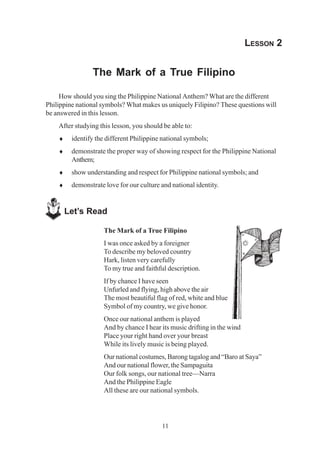
Let’s Read
The Mark of a True Filipino
I was once asked by a foreigner
To describe my beloved country
Hark, listen very carefully
To my true and faithful description.
If by chance I have seen
Unfurled and flying, high above the air
The most beautiful flag of red, white and blue
Symbol of my country, we give honor.
Once our national anthem is played
And by chance I hear its music drifting in the wind
Place your right hand over your breast
While its lively music is being played.
Our national costumes, Barong tagalog and “Baro at Saya”
And our national flower, the Sampaguita
Our folk songs, our national tree—Narra
And the Philippine Eagle
All these are our national symbols.
12
Should anybody make fun
Of the color of your skin
Be proud, don’t be ashamed
Hold your head high, it is God-given
Our heroes never feared
To shed their blood and give their life
For freedom most revered
They’re our pride, let us not forget them.
Anonymous
Let’s Try This
Did you like the poem? Did you understand it? If you did, try answering the
following questions:
1. Do you stand at attention and place your right hand over your breast when
you hear or sing the Philippine National Anthem?
_________________________________________________________
2. What other Philippine national symbols do you know that are not mentioned
in the poem?
_________________________________________________________
_________________________________________________________
_________________________________________________________
3. Mention as many national heroes that the author refers to in the last stanza
of the poem as you can.
_________________________________________________________
_________________________________________________________
_________________________________________________________
4. How can you be a hero in your own way with your friends?Your neighbors?
Your colleagues at work?
_________________________________________________________
_________________________________________________________
_________________________________________________________
13
5. Why is it important to know your culture? Why is it important to love your
culture?
_________________________________________________________
_________________________________________________________
_________________________________________________________
Now you can compare your answers with those in the Answer Key on page 32.
Let’s Learn
How do you sing the “Lupang Hinirang,” the Philippine National Anthem?
You should show respect to the Philippine NationalAnthem by standing at
attention and placing your right hand on the left side of your chest when singing it.
You should look at the National flag with sincerity and respect.
The Philippine flag is only one of the many Philippine national symbols.You have
read in the poem about other symbols. Our national costumes are the barong-Tagalog
and the Baro’t Saya. Our national flower is the Sampaguita. The Narra is our
national tree. The Philippine eagle is the symbol of Filipino strength.
You can also be a hero like Dr. Jose Rizal.You can do this simply by helping your
family, friends and neighbors and not expecting anything in return.
The Philippine culture is very rich. You should learn more about it so that you can
apply and strengthen the Filipino traits that are desirable. This will help you become a
better person and a true Filipino.
Let’s See What You Have Learned
A. Identify the Philippine national symbols being described in each statement.
Write your answer in the blank before each number.
_______________ 1. Philippine national anthem
_______________ 2. National hero
_______________ 3. Philippine costume for men
_______________ 4. National tree
_______________ 5. National flower
14
B. Answer these questions:
1. How should you sing the Philippine National Anthem?
_____________________________________________________
______________________________________________________
______________________________________________________
2. Why do you need to learn more about your culture?
______________________________________________________
______________________________________________________
______________________________________________________
Compare your answers with those in the Answer Key on page 32.
Well, how was it? Did you get all the correct answers? If you did, very good! If
not, review the parts of this lesson that were not clear to you.
Let’s Remember
What you have learned are the desirable traits of a true Filipino. They simply
show the way we Filipinos are. Don’t forget that:
♦ you should learn to respect the Philippine National Anthem by standing at
attention and placing your right hand on the left side of your chest;
♦ you should be aware of the Philippine national symbols, so that when you
meet new friends from other countries, you can proudly share these with
them;
♦ you can be a hero to your friends, neighbors and colleagues by helping them
when they have problems and not expecting to be repaid; and
♦ you should learn more about your culture so that you can apply and reinforce
the desirable Filipino traits. In turn, you can be a better person and member
of the community.
Just remember to retain and reinforce these desirable Filipino traits and don’t
forget to pass them on!
15
LESSON 3
Filipino in Thought, Word and Deed
Which Filipino traits are truly desirable? How and when are these shown? How
can we show that we are indeed Filipinos?
In this lesson, you will find out how desirable Filipino traits can be shown in
certain situations.
After studying this lesson, you should be able to:
♦ identify Filipino characteristics, values, practices and traditions; and
♦ form your own opinion on how to show loyalty to your country.
Let’s Listen to This
Get your cassette tape and listen to the dialogue. If a cassette player is not
available, you can just read the dialogue that follows.
Characters:
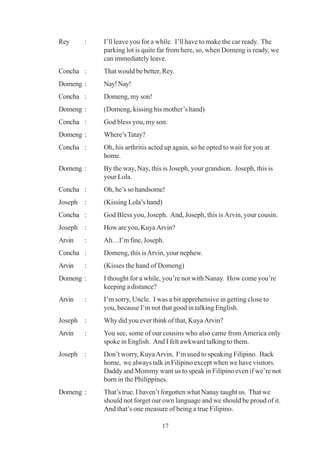
Domeng – a 48 year old balikbayan from the United States
Joseph – a teenage son of Domeng
Concha – the 70-year old mother of Domeng
Honesto – the 75-year old father of Domeng
Rey – a neighbor and good friend of Domeng
Arvin – a teenage adopted son of Honesto and Concha
Narrator
Scene 1 : At the Airport
Concha : Arvin, how come the plane has not arrived yet? It’s already an
hour late, I’m getting worried. Something might have happened
to them.
Arvin : Nana Concha. Please calm yourself. Haven’t you heard the
announcement? The plane from San Francisco has just arrived.
Concha : Really,Arvin?
Arvin : That’s true! Nana Concha!.
Concha : ThankGod!
16
Arvin : Nana Concha! Mang Rey! Let’s move over there so we can see
them immediately.
Concha : I think that’s better. With my poor eyesight, I may not be able to
recognize Domeng and his son Joseph from afar.
Arvin : Nana Concha, about how many years has Uncle Domeng been
away from the Philippines?
Concha : Oh, he was still young then. He was about twenty years old.
Rey : That’s right,Arvin. We’re of the same age and I’m 48 years old
now.
Arvin : You’re 48 years old now, Mang Rey? In that case, Uncle
Domeng has been away for 28 years now.
Concha : You’re right,Arvin.
Rey : Arvin, look! Look at that lady! She has plenty of luggage, she
can hardly carry all of them.
Arvin : She’s not the only one who’s like that, Mang Rey. Look at the
others. I bet, most of their luggage are for pasalubong. Isn’t
Nanay Concha like them? Every time she travels, she always
brings pasalubong.
Rey : Ah, yes. Even when she’s just from the market, she still brings
pasalubong.
Concha : So, what’s wrong with that? That’s being a Filipino. We’re fond
of giving something as pasalubong.
Arvin : You’re right. Almost every balikbayan I see has plenty of
baggages.
Concha : That’s because, most of us Filipinos are thoughtful and generous.
Arvin : Will Uncle Domeng have plenty of baggages, too?
Concha : Rey, Rey! Look! Isn’t that Domeng who’s just come out of the
door?
Rey : That’s him! And he saw us, too!
Concha : Domeng! Domeng, my son!
Arvin : Nanay Concha, with 28 years being in America, do you think
Uncle Domeng has changed his nickname to.. maybe “Dom”
or“Domy”?
Concha : It doesn’t really matter whether he has changed his nickname or
not. To me, he is still my Domeng!
17
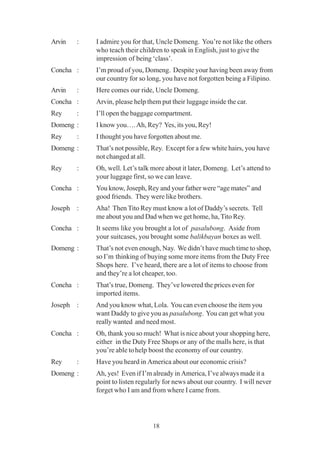
Rey : I’ll leave you for a while. I’ll have to make the car ready. The
parking lot is quite far from here, so, when Domeng is ready, we
can immediately leave.
Concha : That would be better, Rey.
Domeng : Nay!Nay!
Concha : Domeng, my son!
Domeng : (Domeng, kissing his mother’s hand)
Concha : God bless you, my son.
Domeng : Where’sTatay?
Concha : Oh, his arthritis acted up again, so he opted to wait for you at
home.
Domeng : By the way, Nay, this is Joseph, your grandson. Joseph, this is
your Lola.
Concha : Oh, he’s so handsome!
Joseph : (Kissing Lola’s hand)
Concha : God Bless you, Joseph. And, Joseph, this is Arvin, your cousin.
Joseph : How are you, Kuya Arvin?
Arvin : Ah…I’m fine, Joseph.
Concha : Domeng, this isArvin, your nephew.
Arvin : (Kisses the hand of Domeng)
Domeng : I thought for a while, you’re not with Nanay. How come you’re
keeping a distance?
Arvin : I’m sorry, Uncle. I was a bit apprehensive in getting close to
you, because I’m not that good in talking English.
Joseph : Why did you ever think of that, Kuya Arvin?
Arvin : You see, some of our cousins who also came from America only
spoke in English. And I felt awkward talking to them.
Joseph : Don’t worry, KuyaArvin, I’m used to speaking Filipino. Back
home, we always talk in Filipino except when we have visitors.
Daddy and Mommy want us to speak in Filipino even if we’re not
born in the Philippines.
Domeng : That’s true. I haven’t forgotten what Nanay taught us. That we
should not forget our own language and we should be proud of it.
And that’s one measure of being a true Filipino.
18
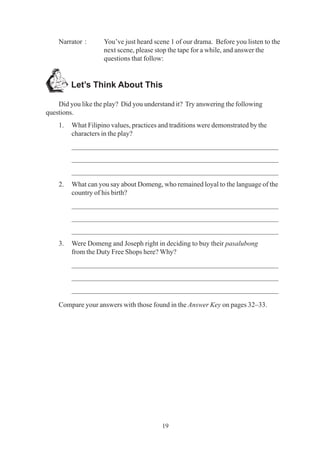
Arvin : I admire you for that, Uncle Domeng. You’re not like the others
who teach their children to speak in English, just to give the
impression of being ‘class’.
Concha : I’m proud of you, Domeng. Despite your having been away from
our country for so long, you have not forgotten being a Filipino.
Arvin : Here comes our ride, Uncle Domeng.
Concha : Arvin, please help them put their luggage inside the car.
Rey : I’ll open the baggage compartment.
Domeng : I know you….Ah, Rey? Yes, its you, Rey!
Rey : I thought you have forgotten about me.
Domeng : That’s not possible, Rey. Except for a few white hairs, you have
not changed at all.
Rey : Oh, well. Let’s talk more about it later, Domeng. Let’s attend to
your luggage first, so we can leave.
Concha : You know, Joseph, Rey and your father were “age mates” and
good friends. They were like brothers.
Joseph : Aha! Then Tito Rey must know a lot of Daddy’s secrets. Tell
me about you and Dad when we get home, ha, Tito Rey.
Concha : It seems like you brought a lot of pasalubong. Aside from
your suitcases, you brought some balikbayan boxes as well.
Domeng : That’s not even enough, Nay. We didn’t have much time to shop,
so I’m thinking of buying some more items from the Duty Free
Shops here. I’ve heard, there are a lot of items to choose from
and they’re a lot cheaper, too.
Concha : That’s true, Domeng. They’ve lowered the prices even for
imported items.
Joseph : And you know what, Lola. You can even choose the item you
want Daddy to give you as pasalubong. You can get what you
really wanted and need most.
Concha : Oh, thank you so much! What is nice about your shopping here,
either in the Duty Free Shops or any of the malls here, is that
you’re able tohelp boost the economy of our country.
Rey : Have you heard in America about our economic crisis?
Domeng : Ah, yes! Even if I’m already in America, I’ve always made it a
point to listen regularly for news about our country. I will never
forget who I am and from where I came from.
19
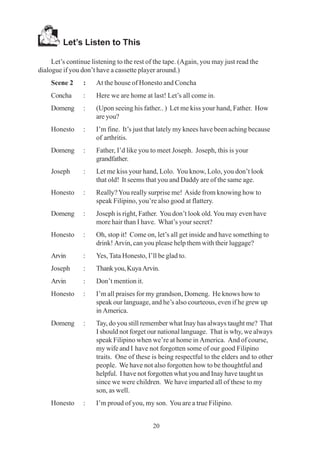
Narrator : You’ve just heard scene 1 of our drama. Before you listen to the
next scene, please stop the tape for a while, and answer the
questions that follow:
Let’s Think About This
Did you like the play? Did you understand it? Try answering the following
questions.
1. What Filipino values, practices and traditions were demonstrated by the
characters in the play?
_________________________________________________________
_________________________________________________________
_________________________________________________________
2. What can you say about Domeng, who remained loyal to the language of the
country of his birth?
_________________________________________________________
_________________________________________________________
_________________________________________________________
3. Were Domeng and Joseph right in deciding to buy their pasalubong
from the Duty Free Shops here? Why?
_________________________________________________________
_________________________________________________________
_________________________________________________________
Compare your answers with those found in the Answer Key on pages 32–33.
20
Let’s Listen to This
Let’s continue listening to the rest of the tape. (Again, you may just read the
dialogue if you don’t have a cassette player around.)
Scene 2 : At the house of Honesto and Concha
Concha : Here we are home at last! Let’s all come in.
Domeng : (Upon seeing his father.. ) Let me kiss your hand, Father. How
are you?
Honesto : I’m fine. It’s just that lately my knees have been aching because
of arthritis.
Domeng : Father, I’d like you to meet Joseph. Joseph, this is your
grandfather.
Joseph : Let me kiss your hand, Lolo. You know, Lolo, you don’t look
that old! It seems that you and Daddy are of the same age.
Honesto : Really?You really surprise me! Aside from knowing how to
speak Filipino, you’re also good at flattery.
Domeng : Joseph is right, Father. You don’t look old.You may even have
more hair than I have. What’s your secret?
Honesto : Oh, stop it! Come on, let’s all get inside and have something to
drink! Arvin, can you please help them with their luggage?
Arvin : Yes, Tata Honesto, I’ll be glad to.
Joseph : Thankyou,KuyaArvin.
Arvin : Don’t mention it.
Honesto : I’m all praises for my grandson, Domeng. He knows how to
speak our language, and he’s also courteous, even if he grew up
in America.
Domeng : Tay, do you still remember what Inay has always taught me? That
I should not forget our national language. That is why, we always
speak Filipino when we’re at home in America. And of course,
my wife and I have not forgotten some of our good Filipino
traits. One of these is being respectful to the elders and to other
people. We have not also forgotten how to be thoughtful and
helpful. I have not forgotten what you and Inay have taught us
since we were children. We have imparted all of these to my
son, as well.
Honesto : I’m proud of you, my son. You are a true Filipino.
21
Domeng : Thank you, Father! I have tried my best to keep my promise to
be a true Filipino always.
Joseph : Excuse me, Lolo! Daddy, can we now open our luggage and
distribute our pasalubong to them? I’m already excited!
Domeng : Oh, yes! Go ahead, son.
Joseph : Lolo, please accept our pasalubong for you.
Honesto : Thank you, Joseph.
Joseph : Please open it!
Concha : Well, what are we waiting for? Come, everybody! Let’s all eat
first.
Joseph : Lola, here’s our pasalubong for you!
Concha : Oh, thank you, Joseph. Thank you very much. I thought we
would still be going to the Duty Free Shop to buy your
pasalubong for me. But here, you already have a pasalubong
for me.
Domeng : Yes, Inay. We’re still going to the Duty Free Shop, this
afternoon. We’ll still buy additional pasalubong for you.
Honesto : And, whatever for? This is already enough, my son.
Concha : And this is very beautiful! Now, I have a new sweater, Honesto!
Honesto : This is enough for me, too, Domeng. This is just right for the
cold weather.
Joseph : We are happy, Lolo and Lola, that you like what we have brought
for you. And for you, Kuya Arvin, this is for you.
Arvin : Thank you, Joseph for remembering me.
Joseph : Of course! How can we not remember you, Kuya? Lola and
Lolo are always mentioning your name in their letters and in
their telephone calls.
Arvin : Really? What are they saying about me?
Joseph : That you’re obedient and industrious, like me. Ha! Ha! Ha! Open
your pasalubong now, Kuya. I hope you’ll like it!
Arvin : Wow! Anew shirt and pants! Thank you, Joseph. Thank you,
Uncle Domeng.
Concha : Okay. Maybe we’ll just continue with our conversation over
dinner.
22
Domeng : Inay, where’s Rey? Has he gone home?
Concha : No, he’s just around. And he has a surprise for you!
Domeng : A surprise? Lending us his vehicle and driving for us are more
than enough.(Rey suddenly comes in with a tray of food.)
Joseph : There’s Tito Rey. He’s coming. Tito Rey, this is our
pasalubong for you.
Rey : Thank you, Joseph.
Joseph : Mmmm…. The food you’re bringing smells good.
Rey : Of course, I prepared this especially for you and your Dad.
Domeng : Mmmm… broiled tilapia and squid. Wow, these are my
favorites, Rey!
Rey : I still cannot forget what your favorites are, pal! Hey, what’s this
you brought for me? An imported shirt! Why, you should have
bought me a local one instead! Not that I don’t like what you gave
me but …You know, Philippine-made products are comparable
to imported ones.
Domeng : Really?
Rey : Yes! I even hear some balikbayans say that products they buy in
other countries are marked, “Made in the Philippines.”
Domeng : Well, then. We don’t have to go to the Duty Free Shop in that
case. (Whispering) And Rey, here’s something for you…. (at the
same time giving Rey some money.)
Rey : What’s this? No! I cannot accept this!
Domeng : Come on, pal. This really comes with your pasalubong. By the
way, thank you for lending us your car and driving for us,
too.(Upon Domeng’s insistence, Rey accepted the money.)
Domeng : Rey, don’t be offended. I know that debt of gratitude cannot be
repaid with money. You can use it to bring your kids to the
movie.
Honesto : What are you whispering about over there? Come on, let’s all
pray before we eat.
Concha : I have a suggestion, Joseph, can you say the grace before meals?
Joseph : Yes. Lola. Bless us O Lord…
23
Let’s Talk About This
Did you like the rest of the play? Try answering the following questions.
1. What Filipino traits were portrayed by the characters?
_________________________________________________________
_________________________________________________________
_________________________________________________________
2. Which ones would you like to emulate or reinforce? How are you going to
do this?
_________________________________________________________
_________________________________________________________
_________________________________________________________
3. Do you agree with Domeng that a debt of gratitude cannot be repaid with
money? Please explain your answer.
_________________________________________________________
_________________________________________________________
_________________________________________________________
If you are done with your answers, compare them with those found in the Answer
Key on page 33.
Let’s Remember
We should be proud of our desirable Filipino traits. They bring about harmonious
relationships between neighbors, as well as desirable and peaceful relationships
among individuals and the community in general.
24
Let’s Read
Do you truly love your country? Here is a short essay about how to be a true
Filipino. Read it carefully.
I Am a Filipino
I am a Filipino. I am a poet and a dreamer. In good
times and in bad, I persevere with open arms and an open
heart. I constantly pray for peace and I am willing to risk
my life for freedom and justice. I would like to shout to
the world “I am the hope of our fatherland.” These words
should come from my heart — a heart of a Filipino who
truly loves his country.
My love for my country is not proven through mere words but through
my actions as well. Some of our national heroes have written poems and
essays also entitled “I am a Filipino.” They have contributed to our country’s
progress at one point in time. Jose Rizal’s fight for justice would never be
forgotten even after he was killed by the Spaniards. Apolinario Mabini’s
literary piece made him “The Great Paralytic.” Ramon Magsaysay was
motivated by Mabini to serve his countrymen well.
Our fate depends not only on the leaders of our country but also on our
countrymen. Each one of us has a role to play in helping our country.
I am a true Filipino. What does this mean to our youth? What does this
mean to you?
Let’s Try This
Did you like the essay? Did you understand it? Try answering the following
questions.
1. What is the essay about?
_________________________________________________________
_________________________________________________________
_________________________________________________________
2. What did the writer mean by putting words into action based on the poems
and essays written by our national heroes in the past?
_________________________________________________________
_________________________________________________________
_________________________________________________________
25
3. How can you prove your love for your country in times of war? In times of
peace?
_________________________________________________________
_________________________________________________________
_________________________________________________________
4. Make believe that you are one of the following:
a. teacher
b. policeman
c. doctor
d. businessman
How can you show that you are a true Filipino in terms of solving
community and national problems?
_________________________________________________________
_________________________________________________________
_________________________________________________________
_________________________________________________________
_________________________________________________________
_________________________________________________________
_________________________________________________________
_________________________________________________________
_________________________________________________________
5. Identify organizations in your community that help in maintaining
cleanliness in the environment, peace and order, etc. Have you joined any of
these organizations? Do you intend to join any of these organizations?
Why?
_________________________________________________________
_________________________________________________________
_________________________________________________________
_________________________________________________________
_________________________________________________________
_________________________________________________________
6. Analyze the current political situation of our country. What insights have
you gained? Among the desirable Filipino traits you have learned, which
should be reinforced by a good Filipino leader?
_________________________________________________________
_________________________________________________________
_________________________________________________________
26
7. Read the “Panatang Makabayan”. It is about how and why you should love
and be proud of your country—the Philippines. Copy it on a small piece of
paper and keep it in your wallet, purse or bag. Remember to study and
understand it, and, most importantly, apply what it means.You may substitute
the word paaralan on line 7 with the words for the community, work place
or institution you belong to. Share it with your friends, neighbors and
colleagues.
Ang Panatang Makabayan
Iniibig ko ang Pilipinas.
Ito ang aking lupang sinilangan;
Ito ang tahanan ng aking lahi;
Ako’ykanyangkinukupkopattinutulungan;
Upangmagingmalakas,maligayaatkapakipakinabang.
Bilang ganti, diringgin ko ang payo ng aking mga magulang;
Susundin ko ang mga tuntunin ng aking paaralan;
Tutuparinkoangmgatungkulinngisangmamamayangmakabayan
at masunurin sa batas;
Paglilingkuran ko ang aking bayan nang walang pag-iimbot
at ng buong katapatan
Sisikapin kong maging tunay na Pilipino sa isip, sa salita at sa
gawa.
Compare your answers with those found in the Answer Key on pages 33–34.
Let’s See What You Have Learned
A. Fill in the blanks with the correct answer. Choose your answer from the
list of words below.
1. Giving ________________ is a sign of a Filipino’s genorosity and
thoughtfulness.
2. The ________________ teaches us how and why one should love and
be proud of one’s country.
3. Love for country is not proven through mere words, but through
________________ as well.
4. You can show your loyalty to your country by _____________.
5–6.A true Filipino is a Filipino in ________________, word and
________________.
Actions Thought Speaking
Deed Pasalubong Panatang Makabayan
27
B. As an NFEA&E learner, how can you show that you are a true Filipino – in
thought, word and deed?
_________________________________________________________
_________________________________________________________
_________________________________________________________
_________________________________________________________
_________________________________________________________
_________________________________________________________
Compare your answers with those in the Answer Key on pages 34–35.
Let’s Remember
You will often hear and read about our many desirable traits as a people. It is not
enough that you know about these traits. It is important that you practice these traits
— in your every thought, word and deed.
One of the traits that you should always practice is the love and respect for our
elders, because their wisdom and experience can guide us in our everyday lives.
Another equally important trait that you should foster and develop is loyalty to
our country.You can show this by speaking our national language, giving importance
to our heroes, national symbols and our national anthem, and by doing your part in
helping our country grow and develop.
28
Let’s Sum Up
In this module, you have learned the desirable Filipino traits which we can foster.
Don’t forget to practice the following in your daily activities:
♦ Respect your elders at all times–Take good care of your parents and
grandparents as they grow older and try to be with them always.
♦ Maintain Close Family Ties – Try to be with your family as much as you can.
Give them the love and support you can offer.
♦ Always trust in God.– Pray regularly and thank Him for all the blessings that
He has bestowed upon you.
♦ Practice Bayanihan – Help and support your neighbors and community by
making it a better place to live in.
♦ Be Patient and Optimistic – Remain calm whenever you have problems.
Don’t lose hope and look at the brighter side of things during difficult times.
♦ Have Utang na Loob – If someone has helped you in your hour of need, help
him back in anyway you can. When a loved one is in need of help, be there at
all times and don’t expect anything in return.
♦ Practice Pakikisama – Maintain peace by having harmonious relationships
with your friends, family and colleagues. Try to undesrtand their bad traits
and appreciate their good qualities.
♦ Be Hospitable – Be friendly and generous when receiving guests.
Entertaining people you have just met will show how warm-hearted we
Filipinos are.
♦ Be resourceful and creative –Try to make do with what you have. Develop
your skills in inventing new things that can make your life easier at home or
at work.
♦ Respect Women – Show respect to all women whether at home, or in other
places. They deserve as much respect as our elders.
Having learned the desirable Filipino traits mentioned above, it is hoped that
these will be cultivated and reinforced so that you will become a better person and a
better Filipino citizen. We Filipinos will truly stand out if we reinforce or apply these
traits in our daily lives. Even in a strange land and far from home, the Filipino spirit
often prevails, thanks to an optimistic outlook that is deeply ingrained in our culture.
29
What Have You Learned?
Put a check mark (4) opposite the statement if it is correct and an X-mark (8) if
it is wrong.
_____ 1. Filipinos love to be with their parents, sisters and brothers even as
they get older.
_____ 2. Filipinos are pessimistic. They don’t look at the brighter side of
things.
_____ 3. Traveling within the Philippines instead of outside the
Philippines is a way of showing one’s love for his/her country.
_____ 4. You do not respect the Philippine NationalAnthem if you do not
stand at attention or place your hand on the left side of your chest
when you hear it being played.
_____ 5. A farmer who works hard tilling his farm in order to send his
children to school is a mark of a true Filipino.
_____ 6. The song “Tayo’y Mga Pinoy” emphasizes the need for Filipinos
to be proud of learning and speaking languages of other countries.
_____ 7. Kissing the hands of elders should not be practiced anymore as
this is considered out of fashion.
_____ 8. Filipinos are marked by skill and cleverness in inventing new
things.
_____ 9. Our national costumes are the barong-Tagalog and the Baro at
Saya.
_____10. In this generation, Filipinos have forgotten the habit of bringing
home gifts or pasalubong for their friends and family when
they come back from another place or country.
Compare your answers with those found in the Answer Key on page 35.
If you got a score of:
8–10 Very Good! You learned a lot from this module.
5–7 Good! Just review the items which you did not get right.
2–4 Review the part of the module which you did not understand.
0–1 You should study the whole module again.
30
Answer Key
A. Let’s See What You Already Know (page 2)
1. 4 It shows respect to our national song and flag.
2. 4 It encourages love for our language.
3. 4 It reflects one’s love for God.
4. 4 It encourages togetherness and cooperation among Filipinos.
5. 8 It destroys one form of respect for elders by Filipinos.
6. 4 It encourages love for Filipino music.
7. 8 Expecting something in return for a favor done is not a good trait.
It shows that the help given is insincere.
8. 4 It honors the bride-to-be’s parents and shows respect or gratitude
for their permission to marry their daughter.
9. 8 Giving donations to a bereaved family is a very Filipino tradition
that has always been practiced.
10. 8 Pakikisama is still practiced by Filipinos. It is especially seen
among family members and friends.
B. Lesson 1
Let’s Study and Analyze (pages 3–4)
1. (c) Kissing our parents’ and older relatives’ hands, listening and giving
importance to their advice, and taking care of our parents when
they grow old are all examples of respect for elders.
2. (h) Spending time with our family, like going to church and celebrating
holidays together, reflects close family ties.
3. (a) The belief that God will always take care of us shows trust in
God.
4. (f) Helping our fellow Filipinos and making ourselves available to
them, especially in times of need, shows the spirit of bayanihan.
5. (i) Seeing things through until the end and always looking at the
brighter side of things show a Filipino’s patience and optimism.
31
6. (d) Returning a favor, especially help given in an hour of need, reflects
the Filipino value of utang na loob.
7. (g) Maintaining harmonious and peaceful relationships with everyone
shows pakikisama.
8. (b) Entertaining guests and being generous to visitors shows
hospitality.
9. (e) The ability of Filipinos to invent, create or make things shows
resourcefulness and creativity.
10. (j) Respecting our mothers, other female relatives and friends shows
respect for women.
Let’s Talk About This (pages 6–7)
1. The message of the song is that we should be proud of our nationality.
Filipinos should not try to look and act like foreigners.
2. No, because based on the song, we have our own culture which we
should be proud of.
3. The meaning of the phrase mentioned is: there are some Filipinos who
try hard to look and act like foreigners, but they end up looking stupid.
In other words, some Filipinos are ashamed of their own nationality.
4. The following are some possible answers:
♦ flat nose
♦ brown skin
♦ curly or kinky hair
5. No, because I am proud of who I am.
Let’s See What You have Learned (page 10)
1. I will show my hospitality. I will have the visitor sit on the sofa. I will
offer him/her a snack and make his/her stay with my family as
comfortable as possible.
2. I will show the spirit of bayanihan. I will help my neighbor fix the roof
of his house. I will also encourage our other neighbors to help us.
3. I will show respect for elders. I will immediately greet them and kiss
their hands.
4. I will show utang na loob. I will promise to pay him as soon as I can and
I will express my gratitude and appreciation for what he has done.
5. I will practice patience and optimism. I will think of a solution. I
will bear in mind that all problems can be solved and that I will be able
to solve my problem in time.
32
C. Lesson 2
Let’s Try This (pages 12–13)
1. To give honor to the Filipino flag you should stand at attention and place
your right hand on the left side of your chest whenever you sing the
Philippine National Anthem. If you don’t do this, try to make it a
regular practice.
2. jeepney, maya
3. Jose Rizal,Andres Bonifacio, del Pilar, Mabini, Quezon
4. There are many possible answers to this question.You can consult your
Instructional Manager about this. One answer may be to help them
in times of need. Another is to respect their opinions and beliefs.
5. It is important to know and love our culture, especially if this
reinforces our desirable traits. This would also help us become better
people, and people from other countries would respect us as well.
Let’s See What You Have Learned (pages 13–14)
A. 1. The “Lupang Hinirang” is the Philippine national anthem
2. Dr. Jose Rizal is our national hero.
3. The barong-Tagalog is the Philippine costume for men.
4. The narra is our national tree.
5. The sampaguita is our national flower.
B. 1. I should stand at attention and place my right hand on my left chest.
I should look at the flag and sing with sincerity.
2. This is a sample answer.Your answer may be a bit different.You
may show your answer to your Instructional Manager for additional
feedback.
I need to learn more about my culture to help me become a better
Filipino. I need to learn more about the desirable traits and values
in a Filipino so that my country and my fellowmen can be proud of
me.
D. Lesson 3
Let’s Think About This (page 19)
1. Some desirable traits portrayed by the characters in the play:
♦ showing respect for elders
♦ hospitable to guests and visitors
♦ strong faith in God
33
♦ thoughtfulness and generosity
♦ love for country
♦ respect for elders
2. Domeng is a true Filipino as he is proud of his nationality and the
country of his birth. He is not like other Filipinos who easily forget
their culture.
3. Yes, because purchasing from duty free shops is one way of helping the
country.
Let’s Talk About This (page 23)
1. Some desirable traits portrayed by the characters:
♦ Love for country
♦ Respect for elders
♦ Utang na loob
2. There are many possible answers to this question. One trait that should
be reinforced is our love for country. In the age of globalization, where
there is a sharing of cultures throughout the world, we tend to lose our
identity. Therefore, we need to rediscover and love our culture. We can
also be respectful to others or be hospitable to visitors.
3. Yes, because money loses its value over time but the sincere return of
kindness and generosity is timeless and can be treasured forever. Any
good deed done has no money equivalent, nor can it be repaid with
material things.
Let’s Try This (pages 24–26)
1. The essay is about being a true Filipino. It discusses how our national
heroes showed their love for our country, which all Filipinos should
emulate.
2. Based on the essay, our national heroes gave their lives because of their
true love for our country. This love was shown in deeds and
actions, not just in words.
3. Some possible answers are the following:
♦ In times of war, love for our country can be demonstrated by
voluntarily enlisting in the armed forces to defend our
country or providing voluntary service as a nurse or aide in an
army hospital.
34
♦ In times of peace, love for country can be shown by being
nationalistic through responsible actions and patronage of our
products. One can also participate in peaceful rallies such as the
recent EDSA Revolution Part II.
You might have answered the question differently. Discuss your
answer with your Instructional Manager or Facilitator for additional
feedback.
4. Some possible answers are the following:
Teacher: teaching the students to love their country, use the
national language, respect the national flag and anthem,
etc.
Policeman: strict and fair implementation of the law and
apprehension of violators, protecting human rights,
maintaining peace and order in the community, etc.
Doctor: wholeheartedly serving the patients and helping to
keep people healthy. Or, working in the Philippines
rather than in other countries.
Businessman:selling Philippine-made products, encouraging
Filipinos to buy local goods, and paying the right
amount of tax.
You might have answered the question differently. Discuss your
answer with your Instructional Manager or Facilitator for additional
feedback.
5. You must try joining organizations that aim to protect the environment,
make the community or country more peaceful (peace councils) or
respect the rights of other citizens such as disadvantaged groups
(indigenous, women, gays, etc.) This will help make you feel like you
are really participating and contributing to the betterment of the
country.
6. One insight that we gained is to choose qualified leaders in order to
have peace throughout the country. Good and effective leaders
should be honest, patient, optimistic, and should demonstrate
pakikisama and bayanihan.
Let’s See What You Have Learned (pages 26–27)
A. 1. Giving pasalubong is a sign of a Filipino’s generosity and
thoughtfulness.
2. The Panatang Makabayan teaches us how and why one should
love and be proud of our country.
35
3. Love for country is not proven through mere words, but through
actions as well.
4. You can show your loyalty to your country by speaking your own
language.
5.–6. A true Filipino is a Filipino in thought, word and deed.
B. Here is a sample answer. Your answer may be different from the one
given below.You should discuss your answers with your Instructional
Manager for additional feedback.
As an NFEA&E learner, I can show that I’m a true Filipino by
studying the modules that will help me enrich my knowldege and
applying the lessons and values that I will learn from them in my every-
day life. In this way, my thoughts, words and actions will be guided by
important lessons in Filipino values.
E. What Have You Learned? (pages 28–29)
1. 4 Filipinos are known for their close family ties. Most still prefer
living with their parents and siblings even when they get older.
2. 8 Filipinos are not pessimistic, but are optimistic. They look at the
brighter side of things and believe that all problems have solutions.
3. 4 A Filipino way of showing love for his country is by visiting the
different places in the Philippines.
4. 4 To show respect to the Philippine NationalAnthem, one should
stand at attention and place his/her right hand on the left side of
his/her chest upon hearing it being played.
5. 4 Working hard for one’s own family is a mark of a true Filipino.
6. 8 The song “Tayo’y Mga Pinoy” encourages a Filipino’s pride in his
own language, not in the languages of other countries.
7. 8 Kissing the hands of elders should still be practiced because it is
one way of showing respect for elders.
8. 4 Filipinos are known for their skill and cleverness in inventing,
creating and making things.
9. 4 Our national costumes are the barong-Tagalog for men and the
Baro’t Saya for women.
10. 8 Filipinos still make a habit of bringing home gifts or pasalubong
for their friends and family when they return to the Philippines.
36
Glossary
Harmonious Marked by agreement in sentiment or action
Optimism Positive outlook in life
Pre-betrothal Ceremony or affair where the groom and his family ask
permission to marry the bride
Resourcefulness Ability to devise ways and means to meet situations
Subcultures Ethnic, regional, economic or social groups exhibiting
characteristics distinguished from others within the same culture or society
Trait Adistinguishing quality
References
Cordero-Fernando, G. (Ed.). Being Filipino. Quezon City: GCF Books. 1981.
Coates,A. Phoenix in December, in Roces,A. (Ed). Filipino Heritage: The
Making of a Nation (Vol. 7). Manila: Lahing Pilipino Publishing. 1978.
Moral Recovery Program National Secretariat. Filipino Values and National
Development: Readings on the Moral Recovery Program. Manila, MRP
National Secretariat. 1996.

GRADE 7: English quarter 3

  • 1.
    1 What Is ThisModule About? While we are a nation of many subcultures, there are dominant traits, practices and beliefs that are common to all people. This is what we refer to as the culture of the Philippines. Are you a true Filipino? Why do you think so? Are you proud of your culture? What makes you proud of it? Do you love your country, the Philippines? Why? In this module, you will learn about the desirable traits of a true Filipino. It will help you answer questions about your role and duties as a citizen of this country. It will also enable you to practice and strengthen the values that you should have as a Filipino. This module highlights the desirable traits of Filipinos. It will give you an opportunity to demonstrate and practice the desirable traits you will learn in this module. This module is divided into three lessons: Lesson 1 – We Are Filipinos Lesson 2 – The Mark of a True Filipino Lesson 3 – Filipino in Thought, Word and Deed What Will You Learn From This Module? After studying this module, you should be able to: ♦ show pride in the Filipino culture; ♦ show respect and appreciation for the Philippine flag, national anthem, national language and other national symbols of the Philippines; ♦ discuss desirable Filipino traits and values; ♦ show appreciation for desirable Filipino traditions; and ♦ give your own opinion based on a story/song/play read or heard.
  • 2.
    2 Let’s See WhatYou Already Know Before studying this module, answer the questions below to determine how much you already know about the topic. Put a check mark (4) opposite each statement that shows a good Filipino trait and an X-mark (8) before each statement that does not. _____ 1. A true Filipino stands at attention whenever he/she hears the Philippine National Anthem. _____ 2. Filipino is encouraged in the elementary, secondary and college levels as a medium of instruction. _____ 3. Traditionally, many Filipinos pause to say a prayer at angelus time. _____ 4. In a village that practices bayanihan, Filipinos help each other in constructing the village church. _____ 5. Kissing the hands or pagmamano is currently considered out of fashion. _____ 6. OPM or Original Pilipino Music must make up half the airtime of local musical radio programs. _____ 7. A true Filipino believes that a favor granted has to be repaid. _____ 8. Filipino grooms-to-be traditionally visit the parents of their fiancées to perform a pre-betrothal ceremony called pamamanhikan. _____ 9. Giving donations to a bereaved family is a foreign tradition that was not adopted by Filipinos. _____10. Pakikisama—or the ability to get along with others to avoid conflict—is not being demonstrated by Filipinos anymore. Well, how was it? Was it difficult? Compare your answers with those in the Answer Key on page 30. If all your answers are correct, very good! This shows that you already know much about the topic. You may still study the module to review what you already know. Who knows, you might learn some new things as well. If you got a low score, don’t feel bad. This means that this module is for you. It will help you understand good Filipino traits that you can practice in your daily life. If you study this module carefully, you will learn the answers to all the items in the test and a lot more! Are you ready? You may now go to the next page to begin Lesson 1.
  • 3.
    3 LESSON 1 We AreFilipinos What are the desirable traits of a Filipino? What values are native to our Filipino culture. In this lesson, you will learn different Filipino values such as those that promote harmonious and peaceful relationships, close family ties, respect for elders and trust in a Supreme Being. After studying this lesson, you should be able to: ♦ identify and provide examples of the desirable traits of a Filipino; and ♦ show pride in the Filipino culture. Let’s Study and Analyze Ricardo holds on to desirable Filipino values and pratices both as an individual and as a member of the community. You are going to find out what these traits are and how Ricardo practices them in his daily life. Try to match the desirable Filipino traits in the box below with the actions and behavior of Ricardo. Write the letter of your answer in the blank before each number. a. Trust in God f. Bayanihan (Cooperation) b. Hospitality g. Pakikisama (ability to get along with others) c. Respect for Elders h. Close Family Ties d. Utang na loob i. Patience/Optimism (Debt of gratitude) e. Resourcefulness/ j. Respect for Womanhood Creativity ____1. Ricardo kisses the hands of his parents, grandparents and older relatives. He listens and gives importance to their advice and helps them in any way he can. He plans to take care of his parents when they grow old. ____2. Ricardo loves to be with his family at all times. He goes to church with them, joins them for regular get-togethers, and celebrates holidays with them as much as he can. He would love to live with his family even as he gets older.
  • 4.
    4 ____3. Ricardo’s beliefin God is very strong. He does not complain much because he knows that God will take care of everything. He keeps and venerates religious symbols in his house. ____4. Ricardo is always there to help his neighbors and other members of his community. He joined and supported the People Power 2 uprising at Edsa in January 2001. Aside from participating in national projects, he is always available whenever his barangay needs his help and support in implementing its projects. ____5. Ricardo sees things through until the end. He always has hope and looks at the brighter side of things. He does not get discouraged when confronted with problems. In fact, no matter how miserable his life is, he moves on, knowing that in the end, the sun will shine again. He remains calm even if he has a hard time commuting, or when he deals with everyday problems like pollution, traffic, lack of water and electricity, bad roads and poor telephone services. ____6. When someone does Ricardo a favor or helps him in his hour of need, he feels that he needs to return a favor to that person. He would not feel comfortable if he does not repay that person in any way that he can. ____7. You will always see cheerfulness in Ricardo’s face wherever he goes. He tries to maintain harmonious and peaceful relationships with everyone, even if he sees the faults of his enemies, friends, or family. For him, not being friendly and cooperative with others would bring negative results. ____8. Ricardo loves to entertain guests, friends and even strangers. He is very warm-hearted and generous in receiving visitors at home, in the office, or wherever he meets people. ____9. Ricardo is very good at inventing new things. He makes decorations out of old newspapers and used soft drink cans. He saves used paper and empty bottles for future use. ___10. Ricardo respects his mother and this respect is extended to his sisters, female friends, and colleagues. He opens doors, gives up his seat, and carries bags for women. He also assists them when boarding or alighting from vehicles. How did you find the exercise? Compare your answers with the Answer Key on pages 30–31.
  • 5.
    5 Let’s Try This Givean example of each desirable trait you just learned in the exercise. Apply that example at home, at work or in the community. How did you feel after demonstrating each desirable Filipino trait? Write down your observations and discuss them with your co-learners and Instructional Manager. Let’s Read Play the tape with the song “Tayo’y Mga Pinoy.” As you listen to the tape, silently read the lyrics and try to determine the message of the song. Heber Bartolome (original version) Chorus 1 Tayo’y mga Pinoy Tayo’yhindiKano ‘Wagkangmahihiya kung Ang ilong mo ay pango. Dito sa Silangan, ako’y isinilang Kungsaannagmumula Angsikatngaraw Ako ay may sariling Kulaykayumaggi. Ngunit di ko maipakitang Tunay sa sarili. Kungatinghahanapinay Matatagpuan. Tayoaymaykakanyahang Dapathangaan. Subali’tnasaanang Sikatngaraw? Ba’t tayo ay humahanga doon SaKanluran? Bakitmanggagaya Mayroon naman tayo. Repeat Chorus 1
  • 6.
    6 Dito sa Silangan, Tayo’yisinilang Kungsaannagmumulaang Sikatngaraw Subali’t nasaan ang sikat ng araw Ba’t tayo ay humahanga doon sa Kanluran? Repeat Chorus 1 Chorus 2 Mayro’ng isang aso, daig pa ang ulol Sya’yngumingiyaw Hindi tumatahol Katulad ng iba Pa-Inglis-Inglis pa Nakungpakikinggan, Mali-mali naman ‘Wagnalang. Repeat Chorus 2 except the last line ‘Wag na, oy oy Oy, ika’y Pinoy Oy, oy, ika’y Pinoy.” Let’s Talk About This Did you like the song? Did you understand its message? Try answering the following questions: 1. What is the message of the song? _________________________________________________________ _________________________________________________________ _________________________________________________________ 2. Are you ashamed of being a Filipino? Explain your answer. _________________________________________________________ _________________________________________________________ _________________________________________________________
  • 7.
    7 3. How doyou understand the line: “Mayro’ng isang aso, daig pa ang ulol. Siya’y ngumingiyaw, hindi tumatahol.” (There is a dog, crazier than a crazy dog. He meows instead of barking). _________________________________________________________ _________________________________________________________ _________________________________________________________ 4. What traits and attitudes portrayed in the song do you feel apply to you? _________________________________________________________ _________________________________________________________ _________________________________________________________ 5. If, by chance, you are brown-skinned and flat-nosed, would you be ashamed? Why or why not? _________________________________________________________ _________________________________________________________ _________________________________________________________ Compare your answers with those found in the Answer Key on page 31. Let’s Learn You should always be proud of being a Filipino.You should not be ashamed of your culture because God has given you talents, skills and physical characteristics that are uniquely Filipino, which you should always cherish and be proud of. Here are some of the most-well known desirable Filipino traits. This is a trait that most Filipinos and our neighbors inAsia practice. We kiss the hands of our elders and we offer them our seat. We take care of our parents and grandparents as they grow older and try to be with them as much as we can. It is unthinkable to allow a parent or a relative to go unattended in his or her old age. Respect for Elders
  • 8.
    8 We love beingwith our family at all times. We go to church together, we have regular family get- togethers and we celebrate holidays together. Unlike other cultures, we love to live with our families even as we get older because we cannot stand living away from them. We always believe in a Supreme Being that protects, judges and rules over us. We always believe that God is always there to help us at all times. We do not complain much because we know that God will take care of everything. This trait means togetherness and mutual help or being available to help others, especially our neighbors and countrymen. It also means peace and a feeling of “oneness” or cooperative spirit which motivates people to work together for a good purpose. Filipinos see things through until the end. We are optimistic, we always have hope and look at the brighter side of things. No matter how difficult our life is, we move on, knowing that in the end, the sun would shine again. We take everything calmly and easily due to our being patient. Close Family Ties Trust in God Bayanihan or Cooperation Patience, Optimism and Creativity
  • 9.
    9 This means thatwe feel that we are indebted to anyone who did us a favor or helped us in an hour of need. It is for this reason that we want to do good to help them as a sign of our gratitude. Having harmonious interpersonal relationships helps us understand the faults of our friends and family just to maintain peace. We are very friendly and generous in receiving and entertaining guests or even strangers. We Filipinos are able to make use of what we have. This shows our resourcefulness. We are also creative in the sense that we are skillful and clever in inventing new things. Filipinos, in general, respect their mother, and this is extended to other women. Utang na Loob or Debt of gratitude Pakikisama or Getting along with others Hospitality Resourcefulness/ Creativity Respect for Women
  • 10.
    10 Let’s See WhatYou Have Learned Study the following situations. What desirable Filipino trait should you show in each situation? How would you show it? Write your answers in the spaces provided. 1. Afriend of your mother’s paid a visit to your family. _________________________________________________________ _________________________________________________________ _________________________________________________________ 2. Your neighbor is fixing the roof of his house.You noticed that he is having a difficult time. _________________________________________________________ _________________________________________________________ _________________________________________________________ 3. You just got home.You found your parents in the living room. _________________________________________________________ _________________________________________________________ _________________________________________________________ 4. Your friend lent you money when you ran out of cash one time. _________________________________________________________ _________________________________________________________ _________________________________________________________ 5. You have a problem. It seems difficult to solve. _________________________________________________________ _________________________________________________________ _________________________________________________________ Compare your answers with those in the Answer Key on page 31. Well, how did you do? Did you get all the right answers? If you did, very good! If not, just review the lesson again and try to understand it better. Let’s Remember In this lesson, you learned about the following desirable Filipino traits: ♦ Filipinos are known for trusting in God and putting faith in Him. ♦ Family traits include close family ties, respect for elders and respect for women. ♦ Filipinos are also known for their hospitality, the spirit of bayanihan, pakikisama and utang na loob. ♦ Filipinos are resourceful, creative, patient and optimistic. These traits help the Filipino in his daily life.
  • 11.
    11 LESSON 2 The Markof a True Filipino How should you sing the Philippine National Anthem? What are the different Philippine national symbols? What makes us uniquely Filipino? These questions will be answered in this lesson. After studying this lesson, you should be able to: ♦ identify the different Philippine national symbols; ♦ demonstrate the proper way of showing respect for the Philippine National Anthem; ♦ show understanding and respect for Philippine national symbols; and ♦ demonstrate love for our culture and national identity. Let’s Read The Mark of a True Filipino I was once asked by a foreigner To describe my beloved country Hark, listen very carefully To my true and faithful description. If by chance I have seen Unfurled and flying, high above the air The most beautiful flag of red, white and blue Symbol of my country, we give honor. Once our national anthem is played And by chance I hear its music drifting in the wind Place your right hand over your breast While its lively music is being played. Our national costumes, Barong tagalog and “Baro at Saya” And our national flower, the Sampaguita Our folk songs, our national tree—Narra And the Philippine Eagle All these are our national symbols.
  • 12.
    12 Should anybody makefun Of the color of your skin Be proud, don’t be ashamed Hold your head high, it is God-given Our heroes never feared To shed their blood and give their life For freedom most revered They’re our pride, let us not forget them. Anonymous Let’s Try This Did you like the poem? Did you understand it? If you did, try answering the following questions: 1. Do you stand at attention and place your right hand over your breast when you hear or sing the Philippine National Anthem? _________________________________________________________ 2. What other Philippine national symbols do you know that are not mentioned in the poem? _________________________________________________________ _________________________________________________________ _________________________________________________________ 3. Mention as many national heroes that the author refers to in the last stanza of the poem as you can. _________________________________________________________ _________________________________________________________ _________________________________________________________ 4. How can you be a hero in your own way with your friends?Your neighbors? Your colleagues at work? _________________________________________________________ _________________________________________________________ _________________________________________________________
  • 13.
    13 5. Why isit important to know your culture? Why is it important to love your culture? _________________________________________________________ _________________________________________________________ _________________________________________________________ Now you can compare your answers with those in the Answer Key on page 32. Let’s Learn How do you sing the “Lupang Hinirang,” the Philippine National Anthem? You should show respect to the Philippine NationalAnthem by standing at attention and placing your right hand on the left side of your chest when singing it. You should look at the National flag with sincerity and respect. The Philippine flag is only one of the many Philippine national symbols.You have read in the poem about other symbols. Our national costumes are the barong-Tagalog and the Baro’t Saya. Our national flower is the Sampaguita. The Narra is our national tree. The Philippine eagle is the symbol of Filipino strength. You can also be a hero like Dr. Jose Rizal.You can do this simply by helping your family, friends and neighbors and not expecting anything in return. The Philippine culture is very rich. You should learn more about it so that you can apply and strengthen the Filipino traits that are desirable. This will help you become a better person and a true Filipino. Let’s See What You Have Learned A. Identify the Philippine national symbols being described in each statement. Write your answer in the blank before each number. _______________ 1. Philippine national anthem _______________ 2. National hero _______________ 3. Philippine costume for men _______________ 4. National tree _______________ 5. National flower
  • 14.
    14 B. Answer thesequestions: 1. How should you sing the Philippine National Anthem? _____________________________________________________ ______________________________________________________ ______________________________________________________ 2. Why do you need to learn more about your culture? ______________________________________________________ ______________________________________________________ ______________________________________________________ Compare your answers with those in the Answer Key on page 32. Well, how was it? Did you get all the correct answers? If you did, very good! If not, review the parts of this lesson that were not clear to you. Let’s Remember What you have learned are the desirable traits of a true Filipino. They simply show the way we Filipinos are. Don’t forget that: ♦ you should learn to respect the Philippine National Anthem by standing at attention and placing your right hand on the left side of your chest; ♦ you should be aware of the Philippine national symbols, so that when you meet new friends from other countries, you can proudly share these with them; ♦ you can be a hero to your friends, neighbors and colleagues by helping them when they have problems and not expecting to be repaid; and ♦ you should learn more about your culture so that you can apply and reinforce the desirable Filipino traits. In turn, you can be a better person and member of the community. Just remember to retain and reinforce these desirable Filipino traits and don’t forget to pass them on!
  • 15.
    15 LESSON 3 Filipino inThought, Word and Deed Which Filipino traits are truly desirable? How and when are these shown? How can we show that we are indeed Filipinos? In this lesson, you will find out how desirable Filipino traits can be shown in certain situations. After studying this lesson, you should be able to: ♦ identify Filipino characteristics, values, practices and traditions; and ♦ form your own opinion on how to show loyalty to your country. Let’s Listen to This Get your cassette tape and listen to the dialogue. If a cassette player is not available, you can just read the dialogue that follows. Characters: Domeng – a 48 year old balikbayan from the United States Joseph – a teenage son of Domeng Concha – the 70-year old mother of Domeng Honesto – the 75-year old father of Domeng Rey – a neighbor and good friend of Domeng Arvin – a teenage adopted son of Honesto and Concha Narrator Scene 1 : At the Airport Concha : Arvin, how come the plane has not arrived yet? It’s already an hour late, I’m getting worried. Something might have happened to them. Arvin : Nana Concha. Please calm yourself. Haven’t you heard the announcement? The plane from San Francisco has just arrived. Concha : Really,Arvin? Arvin : That’s true! Nana Concha!. Concha : ThankGod!
  • 16.
    16 Arvin : NanaConcha! Mang Rey! Let’s move over there so we can see them immediately. Concha : I think that’s better. With my poor eyesight, I may not be able to recognize Domeng and his son Joseph from afar. Arvin : Nana Concha, about how many years has Uncle Domeng been away from the Philippines? Concha : Oh, he was still young then. He was about twenty years old. Rey : That’s right,Arvin. We’re of the same age and I’m 48 years old now. Arvin : You’re 48 years old now, Mang Rey? In that case, Uncle Domeng has been away for 28 years now. Concha : You’re right,Arvin. Rey : Arvin, look! Look at that lady! She has plenty of luggage, she can hardly carry all of them. Arvin : She’s not the only one who’s like that, Mang Rey. Look at the others. I bet, most of their luggage are for pasalubong. Isn’t Nanay Concha like them? Every time she travels, she always brings pasalubong. Rey : Ah, yes. Even when she’s just from the market, she still brings pasalubong. Concha : So, what’s wrong with that? That’s being a Filipino. We’re fond of giving something as pasalubong. Arvin : You’re right. Almost every balikbayan I see has plenty of baggages. Concha : That’s because, most of us Filipinos are thoughtful and generous. Arvin : Will Uncle Domeng have plenty of baggages, too? Concha : Rey, Rey! Look! Isn’t that Domeng who’s just come out of the door? Rey : That’s him! And he saw us, too! Concha : Domeng! Domeng, my son! Arvin : Nanay Concha, with 28 years being in America, do you think Uncle Domeng has changed his nickname to.. maybe “Dom” or“Domy”? Concha : It doesn’t really matter whether he has changed his nickname or not. To me, he is still my Domeng!
  • 17.
    17 Rey : I’llleave you for a while. I’ll have to make the car ready. The parking lot is quite far from here, so, when Domeng is ready, we can immediately leave. Concha : That would be better, Rey. Domeng : Nay!Nay! Concha : Domeng, my son! Domeng : (Domeng, kissing his mother’s hand) Concha : God bless you, my son. Domeng : Where’sTatay? Concha : Oh, his arthritis acted up again, so he opted to wait for you at home. Domeng : By the way, Nay, this is Joseph, your grandson. Joseph, this is your Lola. Concha : Oh, he’s so handsome! Joseph : (Kissing Lola’s hand) Concha : God Bless you, Joseph. And, Joseph, this is Arvin, your cousin. Joseph : How are you, Kuya Arvin? Arvin : Ah…I’m fine, Joseph. Concha : Domeng, this isArvin, your nephew. Arvin : (Kisses the hand of Domeng) Domeng : I thought for a while, you’re not with Nanay. How come you’re keeping a distance? Arvin : I’m sorry, Uncle. I was a bit apprehensive in getting close to you, because I’m not that good in talking English. Joseph : Why did you ever think of that, Kuya Arvin? Arvin : You see, some of our cousins who also came from America only spoke in English. And I felt awkward talking to them. Joseph : Don’t worry, KuyaArvin, I’m used to speaking Filipino. Back home, we always talk in Filipino except when we have visitors. Daddy and Mommy want us to speak in Filipino even if we’re not born in the Philippines. Domeng : That’s true. I haven’t forgotten what Nanay taught us. That we should not forget our own language and we should be proud of it. And that’s one measure of being a true Filipino.
  • 18.
    18 Arvin : Iadmire you for that, Uncle Domeng. You’re not like the others who teach their children to speak in English, just to give the impression of being ‘class’. Concha : I’m proud of you, Domeng. Despite your having been away from our country for so long, you have not forgotten being a Filipino. Arvin : Here comes our ride, Uncle Domeng. Concha : Arvin, please help them put their luggage inside the car. Rey : I’ll open the baggage compartment. Domeng : I know you….Ah, Rey? Yes, its you, Rey! Rey : I thought you have forgotten about me. Domeng : That’s not possible, Rey. Except for a few white hairs, you have not changed at all. Rey : Oh, well. Let’s talk more about it later, Domeng. Let’s attend to your luggage first, so we can leave. Concha : You know, Joseph, Rey and your father were “age mates” and good friends. They were like brothers. Joseph : Aha! Then Tito Rey must know a lot of Daddy’s secrets. Tell me about you and Dad when we get home, ha, Tito Rey. Concha : It seems like you brought a lot of pasalubong. Aside from your suitcases, you brought some balikbayan boxes as well. Domeng : That’s not even enough, Nay. We didn’t have much time to shop, so I’m thinking of buying some more items from the Duty Free Shops here. I’ve heard, there are a lot of items to choose from and they’re a lot cheaper, too. Concha : That’s true, Domeng. They’ve lowered the prices even for imported items. Joseph : And you know what, Lola. You can even choose the item you want Daddy to give you as pasalubong. You can get what you really wanted and need most. Concha : Oh, thank you so much! What is nice about your shopping here, either in the Duty Free Shops or any of the malls here, is that you’re able tohelp boost the economy of our country. Rey : Have you heard in America about our economic crisis? Domeng : Ah, yes! Even if I’m already in America, I’ve always made it a point to listen regularly for news about our country. I will never forget who I am and from where I came from.
  • 19.
    19 Narrator : You’vejust heard scene 1 of our drama. Before you listen to the next scene, please stop the tape for a while, and answer the questions that follow: Let’s Think About This Did you like the play? Did you understand it? Try answering the following questions. 1. What Filipino values, practices and traditions were demonstrated by the characters in the play? _________________________________________________________ _________________________________________________________ _________________________________________________________ 2. What can you say about Domeng, who remained loyal to the language of the country of his birth? _________________________________________________________ _________________________________________________________ _________________________________________________________ 3. Were Domeng and Joseph right in deciding to buy their pasalubong from the Duty Free Shops here? Why? _________________________________________________________ _________________________________________________________ _________________________________________________________ Compare your answers with those found in the Answer Key on pages 32–33.
  • 20.
    20 Let’s Listen toThis Let’s continue listening to the rest of the tape. (Again, you may just read the dialogue if you don’t have a cassette player around.) Scene 2 : At the house of Honesto and Concha Concha : Here we are home at last! Let’s all come in. Domeng : (Upon seeing his father.. ) Let me kiss your hand, Father. How are you? Honesto : I’m fine. It’s just that lately my knees have been aching because of arthritis. Domeng : Father, I’d like you to meet Joseph. Joseph, this is your grandfather. Joseph : Let me kiss your hand, Lolo. You know, Lolo, you don’t look that old! It seems that you and Daddy are of the same age. Honesto : Really?You really surprise me! Aside from knowing how to speak Filipino, you’re also good at flattery. Domeng : Joseph is right, Father. You don’t look old.You may even have more hair than I have. What’s your secret? Honesto : Oh, stop it! Come on, let’s all get inside and have something to drink! Arvin, can you please help them with their luggage? Arvin : Yes, Tata Honesto, I’ll be glad to. Joseph : Thankyou,KuyaArvin. Arvin : Don’t mention it. Honesto : I’m all praises for my grandson, Domeng. He knows how to speak our language, and he’s also courteous, even if he grew up in America. Domeng : Tay, do you still remember what Inay has always taught me? That I should not forget our national language. That is why, we always speak Filipino when we’re at home in America. And of course, my wife and I have not forgotten some of our good Filipino traits. One of these is being respectful to the elders and to other people. We have not also forgotten how to be thoughtful and helpful. I have not forgotten what you and Inay have taught us since we were children. We have imparted all of these to my son, as well. Honesto : I’m proud of you, my son. You are a true Filipino.
  • 21.
    21 Domeng : Thankyou, Father! I have tried my best to keep my promise to be a true Filipino always. Joseph : Excuse me, Lolo! Daddy, can we now open our luggage and distribute our pasalubong to them? I’m already excited! Domeng : Oh, yes! Go ahead, son. Joseph : Lolo, please accept our pasalubong for you. Honesto : Thank you, Joseph. Joseph : Please open it! Concha : Well, what are we waiting for? Come, everybody! Let’s all eat first. Joseph : Lola, here’s our pasalubong for you! Concha : Oh, thank you, Joseph. Thank you very much. I thought we would still be going to the Duty Free Shop to buy your pasalubong for me. But here, you already have a pasalubong for me. Domeng : Yes, Inay. We’re still going to the Duty Free Shop, this afternoon. We’ll still buy additional pasalubong for you. Honesto : And, whatever for? This is already enough, my son. Concha : And this is very beautiful! Now, I have a new sweater, Honesto! Honesto : This is enough for me, too, Domeng. This is just right for the cold weather. Joseph : We are happy, Lolo and Lola, that you like what we have brought for you. And for you, Kuya Arvin, this is for you. Arvin : Thank you, Joseph for remembering me. Joseph : Of course! How can we not remember you, Kuya? Lola and Lolo are always mentioning your name in their letters and in their telephone calls. Arvin : Really? What are they saying about me? Joseph : That you’re obedient and industrious, like me. Ha! Ha! Ha! Open your pasalubong now, Kuya. I hope you’ll like it! Arvin : Wow! Anew shirt and pants! Thank you, Joseph. Thank you, Uncle Domeng. Concha : Okay. Maybe we’ll just continue with our conversation over dinner.
  • 22.
    22 Domeng : Inay,where’s Rey? Has he gone home? Concha : No, he’s just around. And he has a surprise for you! Domeng : A surprise? Lending us his vehicle and driving for us are more than enough.(Rey suddenly comes in with a tray of food.) Joseph : There’s Tito Rey. He’s coming. Tito Rey, this is our pasalubong for you. Rey : Thank you, Joseph. Joseph : Mmmm…. The food you’re bringing smells good. Rey : Of course, I prepared this especially for you and your Dad. Domeng : Mmmm… broiled tilapia and squid. Wow, these are my favorites, Rey! Rey : I still cannot forget what your favorites are, pal! Hey, what’s this you brought for me? An imported shirt! Why, you should have bought me a local one instead! Not that I don’t like what you gave me but …You know, Philippine-made products are comparable to imported ones. Domeng : Really? Rey : Yes! I even hear some balikbayans say that products they buy in other countries are marked, “Made in the Philippines.” Domeng : Well, then. We don’t have to go to the Duty Free Shop in that case. (Whispering) And Rey, here’s something for you…. (at the same time giving Rey some money.) Rey : What’s this? No! I cannot accept this! Domeng : Come on, pal. This really comes with your pasalubong. By the way, thank you for lending us your car and driving for us, too.(Upon Domeng’s insistence, Rey accepted the money.) Domeng : Rey, don’t be offended. I know that debt of gratitude cannot be repaid with money. You can use it to bring your kids to the movie. Honesto : What are you whispering about over there? Come on, let’s all pray before we eat. Concha : I have a suggestion, Joseph, can you say the grace before meals? Joseph : Yes. Lola. Bless us O Lord…
  • 23.
    23 Let’s Talk AboutThis Did you like the rest of the play? Try answering the following questions. 1. What Filipino traits were portrayed by the characters? _________________________________________________________ _________________________________________________________ _________________________________________________________ 2. Which ones would you like to emulate or reinforce? How are you going to do this? _________________________________________________________ _________________________________________________________ _________________________________________________________ 3. Do you agree with Domeng that a debt of gratitude cannot be repaid with money? Please explain your answer. _________________________________________________________ _________________________________________________________ _________________________________________________________ If you are done with your answers, compare them with those found in the Answer Key on page 33. Let’s Remember We should be proud of our desirable Filipino traits. They bring about harmonious relationships between neighbors, as well as desirable and peaceful relationships among individuals and the community in general.
  • 24.
    24 Let’s Read Do youtruly love your country? Here is a short essay about how to be a true Filipino. Read it carefully. I Am a Filipino I am a Filipino. I am a poet and a dreamer. In good times and in bad, I persevere with open arms and an open heart. I constantly pray for peace and I am willing to risk my life for freedom and justice. I would like to shout to the world “I am the hope of our fatherland.” These words should come from my heart — a heart of a Filipino who truly loves his country. My love for my country is not proven through mere words but through my actions as well. Some of our national heroes have written poems and essays also entitled “I am a Filipino.” They have contributed to our country’s progress at one point in time. Jose Rizal’s fight for justice would never be forgotten even after he was killed by the Spaniards. Apolinario Mabini’s literary piece made him “The Great Paralytic.” Ramon Magsaysay was motivated by Mabini to serve his countrymen well. Our fate depends not only on the leaders of our country but also on our countrymen. Each one of us has a role to play in helping our country. I am a true Filipino. What does this mean to our youth? What does this mean to you? Let’s Try This Did you like the essay? Did you understand it? Try answering the following questions. 1. What is the essay about? _________________________________________________________ _________________________________________________________ _________________________________________________________ 2. What did the writer mean by putting words into action based on the poems and essays written by our national heroes in the past? _________________________________________________________ _________________________________________________________ _________________________________________________________
  • 25.
    25 3. How canyou prove your love for your country in times of war? In times of peace? _________________________________________________________ _________________________________________________________ _________________________________________________________ 4. Make believe that you are one of the following: a. teacher b. policeman c. doctor d. businessman How can you show that you are a true Filipino in terms of solving community and national problems? _________________________________________________________ _________________________________________________________ _________________________________________________________ _________________________________________________________ _________________________________________________________ _________________________________________________________ _________________________________________________________ _________________________________________________________ _________________________________________________________ 5. Identify organizations in your community that help in maintaining cleanliness in the environment, peace and order, etc. Have you joined any of these organizations? Do you intend to join any of these organizations? Why? _________________________________________________________ _________________________________________________________ _________________________________________________________ _________________________________________________________ _________________________________________________________ _________________________________________________________ 6. Analyze the current political situation of our country. What insights have you gained? Among the desirable Filipino traits you have learned, which should be reinforced by a good Filipino leader? _________________________________________________________ _________________________________________________________ _________________________________________________________
  • 26.
    26 7. Read the“Panatang Makabayan”. It is about how and why you should love and be proud of your country—the Philippines. Copy it on a small piece of paper and keep it in your wallet, purse or bag. Remember to study and understand it, and, most importantly, apply what it means.You may substitute the word paaralan on line 7 with the words for the community, work place or institution you belong to. Share it with your friends, neighbors and colleagues. Ang Panatang Makabayan Iniibig ko ang Pilipinas. Ito ang aking lupang sinilangan; Ito ang tahanan ng aking lahi; Ako’ykanyangkinukupkopattinutulungan; Upangmagingmalakas,maligayaatkapakipakinabang. Bilang ganti, diringgin ko ang payo ng aking mga magulang; Susundin ko ang mga tuntunin ng aking paaralan; Tutuparinkoangmgatungkulinngisangmamamayangmakabayan at masunurin sa batas; Paglilingkuran ko ang aking bayan nang walang pag-iimbot at ng buong katapatan Sisikapin kong maging tunay na Pilipino sa isip, sa salita at sa gawa. Compare your answers with those found in the Answer Key on pages 33–34. Let’s See What You Have Learned A. Fill in the blanks with the correct answer. Choose your answer from the list of words below. 1. Giving ________________ is a sign of a Filipino’s genorosity and thoughtfulness. 2. The ________________ teaches us how and why one should love and be proud of one’s country. 3. Love for country is not proven through mere words, but through ________________ as well. 4. You can show your loyalty to your country by _____________. 5–6.A true Filipino is a Filipino in ________________, word and ________________. Actions Thought Speaking Deed Pasalubong Panatang Makabayan
  • 27.
    27 B. As anNFEA&E learner, how can you show that you are a true Filipino – in thought, word and deed? _________________________________________________________ _________________________________________________________ _________________________________________________________ _________________________________________________________ _________________________________________________________ _________________________________________________________ Compare your answers with those in the Answer Key on pages 34–35. Let’s Remember You will often hear and read about our many desirable traits as a people. It is not enough that you know about these traits. It is important that you practice these traits — in your every thought, word and deed. One of the traits that you should always practice is the love and respect for our elders, because their wisdom and experience can guide us in our everyday lives. Another equally important trait that you should foster and develop is loyalty to our country.You can show this by speaking our national language, giving importance to our heroes, national symbols and our national anthem, and by doing your part in helping our country grow and develop.
  • 28.
    28 Let’s Sum Up Inthis module, you have learned the desirable Filipino traits which we can foster. Don’t forget to practice the following in your daily activities: ♦ Respect your elders at all times–Take good care of your parents and grandparents as they grow older and try to be with them always. ♦ Maintain Close Family Ties – Try to be with your family as much as you can. Give them the love and support you can offer. ♦ Always trust in God.– Pray regularly and thank Him for all the blessings that He has bestowed upon you. ♦ Practice Bayanihan – Help and support your neighbors and community by making it a better place to live in. ♦ Be Patient and Optimistic – Remain calm whenever you have problems. Don’t lose hope and look at the brighter side of things during difficult times. ♦ Have Utang na Loob – If someone has helped you in your hour of need, help him back in anyway you can. When a loved one is in need of help, be there at all times and don’t expect anything in return. ♦ Practice Pakikisama – Maintain peace by having harmonious relationships with your friends, family and colleagues. Try to undesrtand their bad traits and appreciate their good qualities. ♦ Be Hospitable – Be friendly and generous when receiving guests. Entertaining people you have just met will show how warm-hearted we Filipinos are. ♦ Be resourceful and creative –Try to make do with what you have. Develop your skills in inventing new things that can make your life easier at home or at work. ♦ Respect Women – Show respect to all women whether at home, or in other places. They deserve as much respect as our elders. Having learned the desirable Filipino traits mentioned above, it is hoped that these will be cultivated and reinforced so that you will become a better person and a better Filipino citizen. We Filipinos will truly stand out if we reinforce or apply these traits in our daily lives. Even in a strange land and far from home, the Filipino spirit often prevails, thanks to an optimistic outlook that is deeply ingrained in our culture.
  • 29.
    29 What Have YouLearned? Put a check mark (4) opposite the statement if it is correct and an X-mark (8) if it is wrong. _____ 1. Filipinos love to be with their parents, sisters and brothers even as they get older. _____ 2. Filipinos are pessimistic. They don’t look at the brighter side of things. _____ 3. Traveling within the Philippines instead of outside the Philippines is a way of showing one’s love for his/her country. _____ 4. You do not respect the Philippine NationalAnthem if you do not stand at attention or place your hand on the left side of your chest when you hear it being played. _____ 5. A farmer who works hard tilling his farm in order to send his children to school is a mark of a true Filipino. _____ 6. The song “Tayo’y Mga Pinoy” emphasizes the need for Filipinos to be proud of learning and speaking languages of other countries. _____ 7. Kissing the hands of elders should not be practiced anymore as this is considered out of fashion. _____ 8. Filipinos are marked by skill and cleverness in inventing new things. _____ 9. Our national costumes are the barong-Tagalog and the Baro at Saya. _____10. In this generation, Filipinos have forgotten the habit of bringing home gifts or pasalubong for their friends and family when they come back from another place or country. Compare your answers with those found in the Answer Key on page 35. If you got a score of: 8–10 Very Good! You learned a lot from this module. 5–7 Good! Just review the items which you did not get right. 2–4 Review the part of the module which you did not understand. 0–1 You should study the whole module again.
  • 30.
    30 Answer Key A. Let’sSee What You Already Know (page 2) 1. 4 It shows respect to our national song and flag. 2. 4 It encourages love for our language. 3. 4 It reflects one’s love for God. 4. 4 It encourages togetherness and cooperation among Filipinos. 5. 8 It destroys one form of respect for elders by Filipinos. 6. 4 It encourages love for Filipino music. 7. 8 Expecting something in return for a favor done is not a good trait. It shows that the help given is insincere. 8. 4 It honors the bride-to-be’s parents and shows respect or gratitude for their permission to marry their daughter. 9. 8 Giving donations to a bereaved family is a very Filipino tradition that has always been practiced. 10. 8 Pakikisama is still practiced by Filipinos. It is especially seen among family members and friends. B. Lesson 1 Let’s Study and Analyze (pages 3–4) 1. (c) Kissing our parents’ and older relatives’ hands, listening and giving importance to their advice, and taking care of our parents when they grow old are all examples of respect for elders. 2. (h) Spending time with our family, like going to church and celebrating holidays together, reflects close family ties. 3. (a) The belief that God will always take care of us shows trust in God. 4. (f) Helping our fellow Filipinos and making ourselves available to them, especially in times of need, shows the spirit of bayanihan. 5. (i) Seeing things through until the end and always looking at the brighter side of things show a Filipino’s patience and optimism.
  • 31.
    31 6. (d) Returninga favor, especially help given in an hour of need, reflects the Filipino value of utang na loob. 7. (g) Maintaining harmonious and peaceful relationships with everyone shows pakikisama. 8. (b) Entertaining guests and being generous to visitors shows hospitality. 9. (e) The ability of Filipinos to invent, create or make things shows resourcefulness and creativity. 10. (j) Respecting our mothers, other female relatives and friends shows respect for women. Let’s Talk About This (pages 6–7) 1. The message of the song is that we should be proud of our nationality. Filipinos should not try to look and act like foreigners. 2. No, because based on the song, we have our own culture which we should be proud of. 3. The meaning of the phrase mentioned is: there are some Filipinos who try hard to look and act like foreigners, but they end up looking stupid. In other words, some Filipinos are ashamed of their own nationality. 4. The following are some possible answers: ♦ flat nose ♦ brown skin ♦ curly or kinky hair 5. No, because I am proud of who I am. Let’s See What You have Learned (page 10) 1. I will show my hospitality. I will have the visitor sit on the sofa. I will offer him/her a snack and make his/her stay with my family as comfortable as possible. 2. I will show the spirit of bayanihan. I will help my neighbor fix the roof of his house. I will also encourage our other neighbors to help us. 3. I will show respect for elders. I will immediately greet them and kiss their hands. 4. I will show utang na loob. I will promise to pay him as soon as I can and I will express my gratitude and appreciation for what he has done. 5. I will practice patience and optimism. I will think of a solution. I will bear in mind that all problems can be solved and that I will be able to solve my problem in time.
  • 32.
    32 C. Lesson 2 Let’sTry This (pages 12–13) 1. To give honor to the Filipino flag you should stand at attention and place your right hand on the left side of your chest whenever you sing the Philippine National Anthem. If you don’t do this, try to make it a regular practice. 2. jeepney, maya 3. Jose Rizal,Andres Bonifacio, del Pilar, Mabini, Quezon 4. There are many possible answers to this question.You can consult your Instructional Manager about this. One answer may be to help them in times of need. Another is to respect their opinions and beliefs. 5. It is important to know and love our culture, especially if this reinforces our desirable traits. This would also help us become better people, and people from other countries would respect us as well. Let’s See What You Have Learned (pages 13–14) A. 1. The “Lupang Hinirang” is the Philippine national anthem 2. Dr. Jose Rizal is our national hero. 3. The barong-Tagalog is the Philippine costume for men. 4. The narra is our national tree. 5. The sampaguita is our national flower. B. 1. I should stand at attention and place my right hand on my left chest. I should look at the flag and sing with sincerity. 2. This is a sample answer.Your answer may be a bit different.You may show your answer to your Instructional Manager for additional feedback. I need to learn more about my culture to help me become a better Filipino. I need to learn more about the desirable traits and values in a Filipino so that my country and my fellowmen can be proud of me. D. Lesson 3 Let’s Think About This (page 19) 1. Some desirable traits portrayed by the characters in the play: ♦ showing respect for elders ♦ hospitable to guests and visitors ♦ strong faith in God
  • 33.
    33 ♦ thoughtfulness andgenerosity ♦ love for country ♦ respect for elders 2. Domeng is a true Filipino as he is proud of his nationality and the country of his birth. He is not like other Filipinos who easily forget their culture. 3. Yes, because purchasing from duty free shops is one way of helping the country. Let’s Talk About This (page 23) 1. Some desirable traits portrayed by the characters: ♦ Love for country ♦ Respect for elders ♦ Utang na loob 2. There are many possible answers to this question. One trait that should be reinforced is our love for country. In the age of globalization, where there is a sharing of cultures throughout the world, we tend to lose our identity. Therefore, we need to rediscover and love our culture. We can also be respectful to others or be hospitable to visitors. 3. Yes, because money loses its value over time but the sincere return of kindness and generosity is timeless and can be treasured forever. Any good deed done has no money equivalent, nor can it be repaid with material things. Let’s Try This (pages 24–26) 1. The essay is about being a true Filipino. It discusses how our national heroes showed their love for our country, which all Filipinos should emulate. 2. Based on the essay, our national heroes gave their lives because of their true love for our country. This love was shown in deeds and actions, not just in words. 3. Some possible answers are the following: ♦ In times of war, love for our country can be demonstrated by voluntarily enlisting in the armed forces to defend our country or providing voluntary service as a nurse or aide in an army hospital.
  • 34.
    34 ♦ In timesof peace, love for country can be shown by being nationalistic through responsible actions and patronage of our products. One can also participate in peaceful rallies such as the recent EDSA Revolution Part II. You might have answered the question differently. Discuss your answer with your Instructional Manager or Facilitator for additional feedback. 4. Some possible answers are the following: Teacher: teaching the students to love their country, use the national language, respect the national flag and anthem, etc. Policeman: strict and fair implementation of the law and apprehension of violators, protecting human rights, maintaining peace and order in the community, etc. Doctor: wholeheartedly serving the patients and helping to keep people healthy. Or, working in the Philippines rather than in other countries. Businessman:selling Philippine-made products, encouraging Filipinos to buy local goods, and paying the right amount of tax. You might have answered the question differently. Discuss your answer with your Instructional Manager or Facilitator for additional feedback. 5. You must try joining organizations that aim to protect the environment, make the community or country more peaceful (peace councils) or respect the rights of other citizens such as disadvantaged groups (indigenous, women, gays, etc.) This will help make you feel like you are really participating and contributing to the betterment of the country. 6. One insight that we gained is to choose qualified leaders in order to have peace throughout the country. Good and effective leaders should be honest, patient, optimistic, and should demonstrate pakikisama and bayanihan. Let’s See What You Have Learned (pages 26–27) A. 1. Giving pasalubong is a sign of a Filipino’s generosity and thoughtfulness. 2. The Panatang Makabayan teaches us how and why one should love and be proud of our country.
  • 35.
    35 3. Love forcountry is not proven through mere words, but through actions as well. 4. You can show your loyalty to your country by speaking your own language. 5.–6. A true Filipino is a Filipino in thought, word and deed. B. Here is a sample answer. Your answer may be different from the one given below.You should discuss your answers with your Instructional Manager for additional feedback. As an NFEA&E learner, I can show that I’m a true Filipino by studying the modules that will help me enrich my knowldege and applying the lessons and values that I will learn from them in my every- day life. In this way, my thoughts, words and actions will be guided by important lessons in Filipino values. E. What Have You Learned? (pages 28–29) 1. 4 Filipinos are known for their close family ties. Most still prefer living with their parents and siblings even when they get older. 2. 8 Filipinos are not pessimistic, but are optimistic. They look at the brighter side of things and believe that all problems have solutions. 3. 4 A Filipino way of showing love for his country is by visiting the different places in the Philippines. 4. 4 To show respect to the Philippine NationalAnthem, one should stand at attention and place his/her right hand on the left side of his/her chest upon hearing it being played. 5. 4 Working hard for one’s own family is a mark of a true Filipino. 6. 8 The song “Tayo’y Mga Pinoy” encourages a Filipino’s pride in his own language, not in the languages of other countries. 7. 8 Kissing the hands of elders should still be practiced because it is one way of showing respect for elders. 8. 4 Filipinos are known for their skill and cleverness in inventing, creating and making things. 9. 4 Our national costumes are the barong-Tagalog for men and the Baro’t Saya for women. 10. 8 Filipinos still make a habit of bringing home gifts or pasalubong for their friends and family when they return to the Philippines.
  • 36.
    36 Glossary Harmonious Marked byagreement in sentiment or action Optimism Positive outlook in life Pre-betrothal Ceremony or affair where the groom and his family ask permission to marry the bride Resourcefulness Ability to devise ways and means to meet situations Subcultures Ethnic, regional, economic or social groups exhibiting characteristics distinguished from others within the same culture or society Trait Adistinguishing quality References Cordero-Fernando, G. (Ed.). Being Filipino. Quezon City: GCF Books. 1981. Coates,A. Phoenix in December, in Roces,A. (Ed). Filipino Heritage: The Making of a Nation (Vol. 7). Manila: Lahing Pilipino Publishing. 1978. Moral Recovery Program National Secretariat. Filipino Values and National Development: Readings on the Moral Recovery Program. Manila, MRP National Secretariat. 1996.