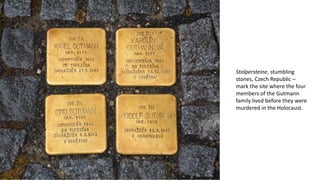
Stolpersteine, stumbling
stones, Czech Republic –
mark the site where the four
members of the Gutmann
family lived before they were
murdered in the Holocaust.
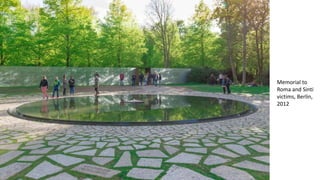
Memorial to
Roma and Sinti
victims, Berlin,
2012
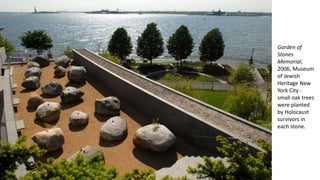
Garden of
Stones
Memorial,
2006, Museum
of Jewish
Heritage New
York City -
small oak trees
were planted
by Holocaust
survivors in
each stone.
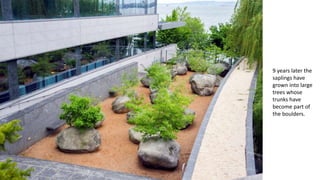
9 years later the
saplings have
grown into large
trees whose
trunks have
become part of
the boulders.
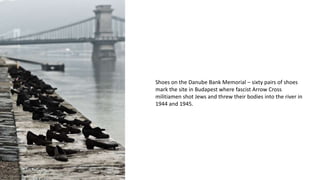
Shoes on the Danube Bank Memorial – sixty pairs of shoes
mark the site in Budapest where fascist Arrow Cross
militiamen shot Jews and threw their bodies into the river in
1944 and 1945.
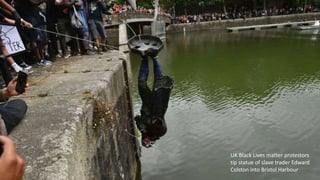
UK Black Lives matter protestors
tip statue of slave trader Edward
Colston into Bristol Harbour
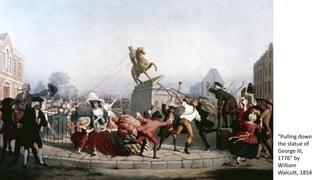
“Pulling down
the statue of
George III,
1776” by
William
Walcutt, 1854
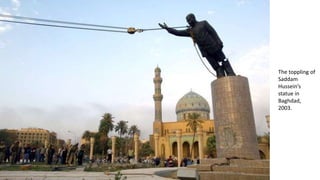
The toppling of
Saddam
Hussein’s
statue in
Baghdad,
2003.
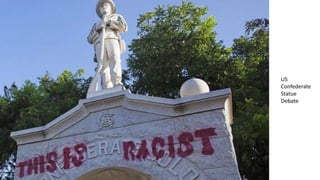
US
Confederate
Statue
Debate
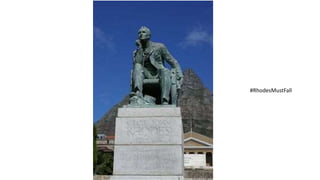
#RhodesMustFall
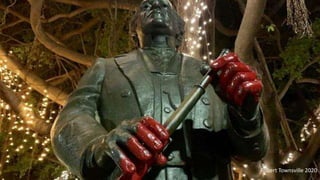
Robert Townsville 2020
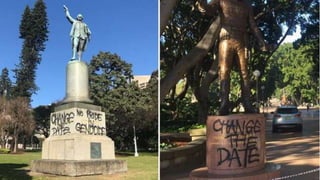
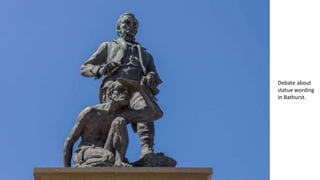
Debate about
statue wording
in Bathurst.
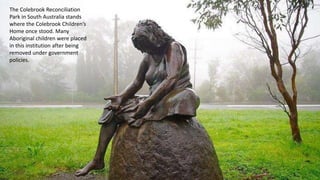
The Colebrook Reconciliation
Park in South Australia stands
where the Colebrook Children’s
Home once stood. Many
Aboriginal children were placed
in this institution after being
removed under government
policies.
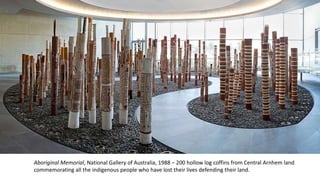
Aboriginal Memorial, National Gallery of Australia, 1988 – 200 hollow log coffins from Central Arnhem land
commemorating all the indigenous people who have lost their lives defending their land.
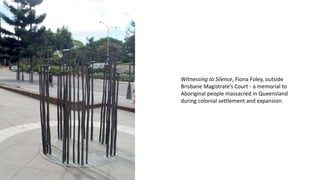
Witnessing to Silence, Fiona Foley, outside
Brisbane Magistrate’s Court - a memorial to
Aboriginal people massacred in Queensland
during colonial settlement and expansion.
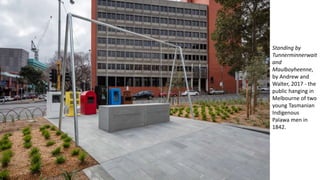
Standing by
Tunnerminnerwait
and
Maulboyheenne,
by Andrew and
Walter, 2017 - the
public hanging in
Melbourne of two
young Tasmanian
Indigenous
Palawa men in
1842.
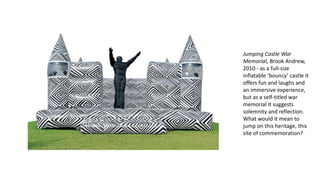
Jumping Castle War
Memorial, Brook Andrew,
2010 - as a full-size
inflatable ‘bouncy’ castle it
offers fun and laughs and
an immersive experience,
but as a self-titled war
memorial it suggests
solemnity and reflection.
What would it mean to
jump on this heritage, this
site of commemoration?
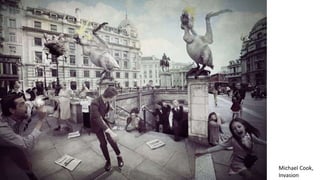
Michael Cook,
Invasion
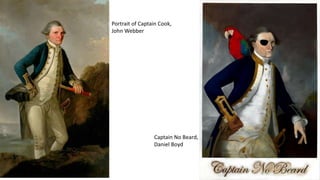
Portrait of Captain Cook,
John Webber
Captain No Beard,
Daniel Boyd
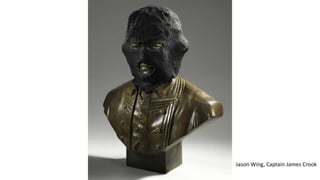
Jason Wing, Captain James Crook
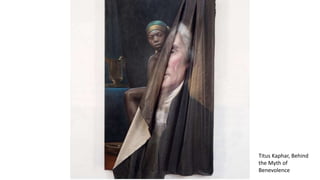
Titus Kaphar, Behind
the Myth of
Benevolence
Critical Historical Mending
• Mending together stories that challenge each other in a way that
does not obscure or patch over their conflict.
• Ask students to tell the history of the systems, affirm the entirety of
the struggle(s) and take their own stand.
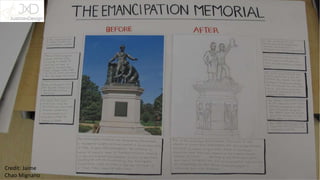
Credit: Jaime
Chao Mignano
QHTA
QHTA

QHTA