ENGLISH 7
STRATEGIES FOR EFFECTIVE
COMMUNICATION
Prepared by: Russel M. Paganao
Teacher I
LEARNING COMPETENCY
MELC: EN7OL-I-b1.14: Employ a variety of strategies for
effective interpersonal communication (Interview, Dialogue,
Conversation)
Specific Objectives
• Define what is communication and its three types;
• Distinguish the strategies in interpersonal communication;
• Apply strategies to create an effective conversation or
dialogue; and
• Employ strategies for an effective interview.
Do you believe that
communication is part of
essential part in our
everyday life? Why or not?
MOTIVATION
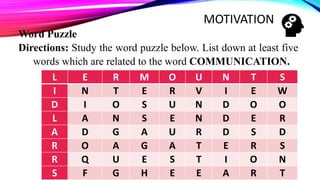
Word Puzzle
Directions: Study the word puzzle below. List down at least five
words which are related to the word COMMUNICATION.
MOTIVATION
L E R M O U N T S
I N T E R V I E W
D I O S U N D O O
L A N S E N D E R
A D G A U R D S D
R O A G A T E R S
R Q U E S T I O N
S F G H E E A R T
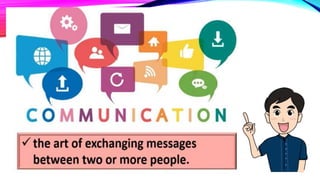
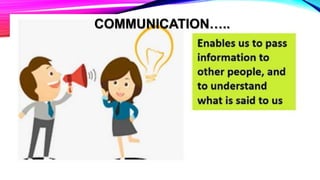
COMMUNICATION…..
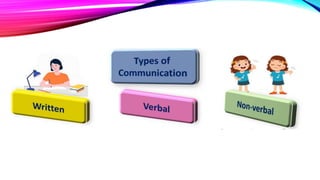
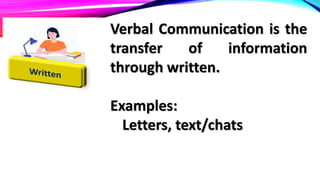
Verbal Communication is the
transfer of information
through written.
Examples:
Letters, text/chats
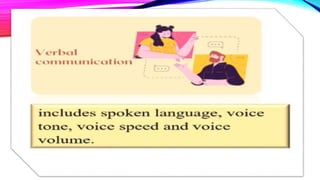
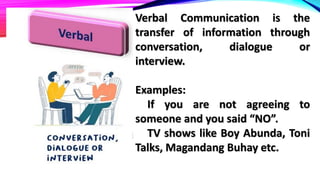
Verbal Communication is the
transfer of information through
conversation, dialogue or
interview.
Examples:
If you are not agreeing to
someone and you said “NO”.
TV shows like Boy Abunda, Toni
Talks, Magandang Buhay etc.
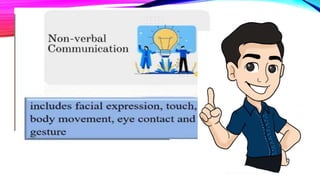
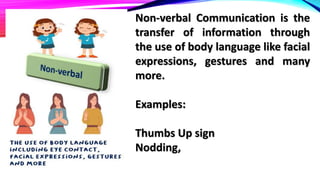
Non-verbal Communication is the
transfer of information through
the use of body language like facial
expressions, gestures and many
more.
Examples:
Thumbs Up sign
Nodding,
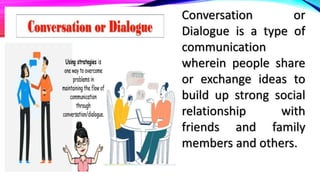
Conversation or
Dialogue is a type of
communication
wherein people share
or exchange ideas to
build up strong social
relationship with
friends and family
members and others.
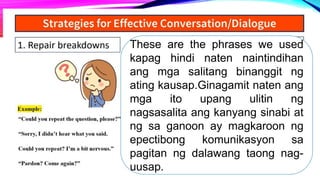
These are the phrases we used
kapag hindi naten naintindihan
ang mga salitang binanggit ng
ating kausap.Ginagamit naten ang
mga ito upang ulitin ng
nagsasalita ang kanyang sinabi at
ng sa ganoon ay magkaroon ng
epectibong komunikasyon sa
pagitan ng dalawang taong nag-
uusap.
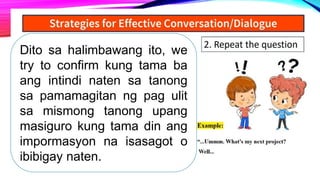
Dito sa halimbawang ito, we
try to confirm kung tama ba
ang intindi naten sa tanong
sa pamamagitan ng pag ulit
sa mismong tanong upang
masiguro kung tama din ang
impormasyon na isasagot o
ibibigay naten.
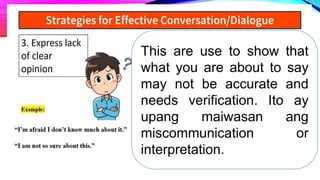
This are use to show that
what you are about to say
may not be accurate and
needs verification. Ito ay
upang maiwasan ang
miscommunication or
interpretation.
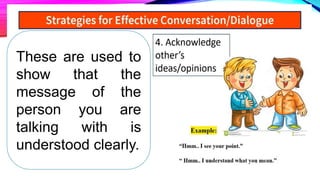
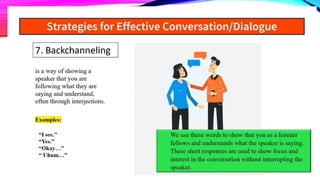
These are used to
show that the
message of the
person you are
talking with is
understood clearly.
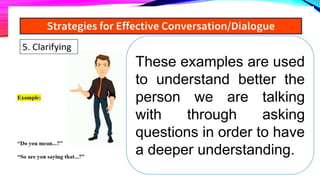
These examples are used
to understand better the
person we are talking
with through asking
questions in order to have
a deeper understanding.
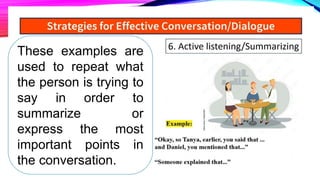
These examples are
used to repeat what
the person is trying to
say in order to
summarize or
express the most
important points in
the conversation.
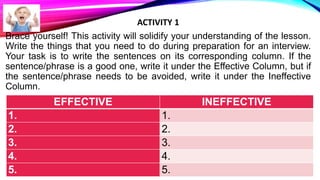
ACTIVITY 1
Brace yourself! This activity will solidify your understanding of the lesson.
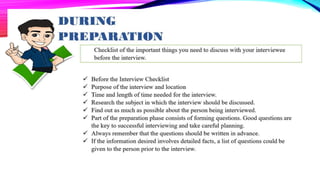
Write the things that you need to do during preparation for an interview.
Your task is to write the sentences on its corresponding column. If the
sentence/phrase is a good one, write it under the Effective Column, but if
the sentence/phrase needs to be avoided, write it under the Ineffective
Column.
EFFECTIVE INEFFECTIVE
1. 1.
2. 2.
3. 3.
4. 4.
5. 5.
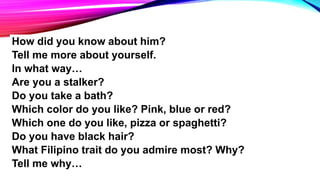
How did you know about him?
Tell me more about yourself.
In what way…
Are you a stalker?
Do you take a bath?
Which color do you like? Pink, blue or red?
Which one do you like, pizza or spaghetti?
Do you have black hair?
What Filipino trait do you admire most? Why?
Tell me why…
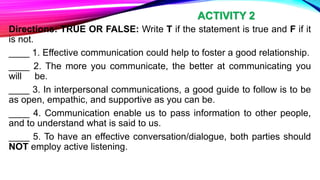
Directions: TRUE OR FALSE: Write T if the statement is true and F if it
is not.
____ 1. Effective communication could help to foster a good relationship.
____ 2. The more you communicate, the better at communicating you
will be.
____ 3. In interpersonal communications, a good guide to follow is to be
as open, empathic, and supportive as you can be.
____ 4. Communication enable us to pass information to other people,
and to understand what is said to us.
____ 5. To have an effective conversation/dialogue, both parties should
NOT employ active listening.
ACTIVITY 2
____ 6. To become an effective interviewer, first start an easy
questions and ask the right questions and prompts and avoid
leading questions.
____ 7. Good interpersonal skill means you know what to say
and how to respond.
____ 8. During an interview or dialogue, it is allowed to use
gestures and facial expressions.
____ 9. It is effective to use closed-ended questions like yes/no
questions.
____ 10. During preparation, a checklist of the important details
is important as it will be your guide whether you achieve your
purpose or not.
You are tasked to interview a KPOP Star about what he/she
thinks about the Philippines as a tourist spot via Zoom or
Google meet. During the preparation stage, what are the things
you need to prepare? List at least five questions that you will
use in the interview.
1.
2.
3.
4.
5.
ASSESSMENT
Directions: Let us see how well you have understood the lesson
discussed in this module. Be ready with a paper and pen. Multiple
choice: Select the best answer.
1. _______________ is a way of showing a speaker that you are
following what they are saying and understand, often through
interjections.
a. summarizing c. clarifying
b. backchanneling d. repeating questions
2. ________________is the use of words to express yourself.
a. non-verbal communication c. verbal communication
b. interpersonal communication d. open-ended questions
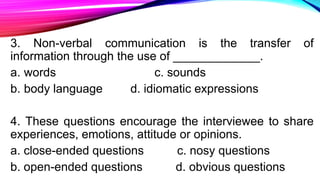
3. Non-verbal communication is the transfer of
information through the use of _____________.
a. words c. sounds
b. body language d. idiomatic expressions
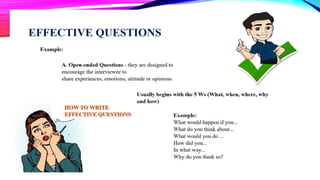
4. These questions encourage the interviewee to share
experiences, emotions, attitude or opinions.
a. close-ended questions c. nosy questions
b. open-ended questions d. obvious questions
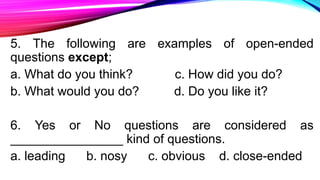
5. The following are examples of open-ended
questions except;
a. What do you think? c. How did you do?
b. What would you do? d. Do you like it?
6. Yes or No questions are considered as
________________ kind of questions.
a. leading b. nosy c. obvious d. close-ended
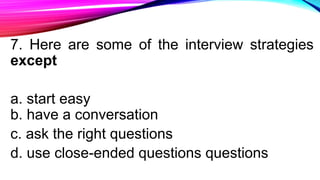
7. Here are some of the interview strategies
except
a. start easy
b. have a conversation
c. ask the right questions
d. use close-ended questions questions
8. Nena plans to interview her teacher for her school
project. Below are the things Nena should do before the
interview except;
a. request for a formal interview through phone or email
b. discuss the purpose of the interview
c. inform the interviewee about the time needed for the
interview
d. prepare obvious and nosy questions
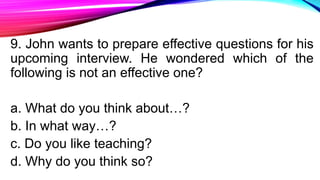
9. John wants to prepare effective questions for his
upcoming interview. He wondered which of the
following is not an effective one?
a. What do you think about…?
b. In what way…?
c. Do you like teaching?
d. Why do you think so?
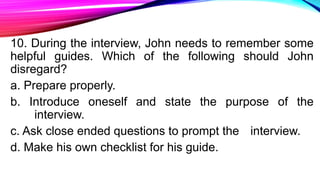
10. During the interview, John needs to remember some
helpful guides. Which of the following should John
disregard?
a. Prepare properly.
b. Introduce oneself and state the purpose of the
interview.
c. Ask close ended questions to prompt the interview.
d. Make his own checklist for his guide.
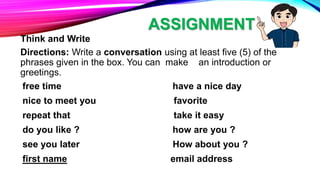
ASSIGNMENT
Think and Write
Directions: Write a conversation using at least five (5) of the
phrases given in the box. You can make an introduction or
greetings.
free time have a nice day
nice to meet you favorite
repeat that take it easy
do you like ? how are you ?
see you later How about you ?
first name email address
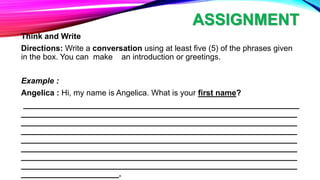
ASSIGNMENT
Think and Write
Directions: Write a conversation using at least five (5) of the phrases given
in the box. You can make an introduction or greetings.
Example :
Angelica : Hi, my name is Angelica. What is your first name?
______________________________________________________________
______________________________________________________________
______________________________________________________________
______________________________________________________________
______________________________________________________________
______________________________________________________________
______________________________________________________________
______________________________________________________________
______________________.

COMMUNICATION.pptx

  • 1.
    ENGLISH 7 STRATEGIES FOREFFECTIVE COMMUNICATION Prepared by: Russel M. Paganao Teacher I
  • 3.
    LEARNING COMPETENCY MELC: EN7OL-I-b1.14:Employ a variety of strategies for effective interpersonal communication (Interview, Dialogue, Conversation) Specific Objectives • Define what is communication and its three types; • Distinguish the strategies in interpersonal communication; • Apply strategies to create an effective conversation or dialogue; and • Employ strategies for an effective interview.
  • 4.
    Do you believethat communication is part of essential part in our everyday life? Why or not? MOTIVATION
  • 5.
    Word Puzzle Directions: Studythe word puzzle below. List down at least five words which are related to the word COMMUNICATION. MOTIVATION L E R M O U N T S I N T E R V I E W D I O S U N D O O L A N S E N D E R A D G A U R D S D R O A G A T E R S R Q U E S T I O N S F G H E E A R T
  • 7.
  • 14.
    Verbal Communication isthe transfer of information through written. Examples: Letters, text/chats
  • 15.
    Verbal Communication isthe transfer of information through conversation, dialogue or interview. Examples: If you are not agreeing to someone and you said “NO”. TV shows like Boy Abunda, Toni Talks, Magandang Buhay etc.
  • 16.
    Non-verbal Communication isthe transfer of information through the use of body language like facial expressions, gestures and many more. Examples: Thumbs Up sign Nodding,
  • 17.
    Conversation or Dialogue isa type of communication wherein people share or exchange ideas to build up strong social relationship with friends and family members and others.
  • 18.
    These are thephrases we used kapag hindi naten naintindihan ang mga salitang binanggit ng ating kausap.Ginagamit naten ang mga ito upang ulitin ng nagsasalita ang kanyang sinabi at ng sa ganoon ay magkaroon ng epectibong komunikasyon sa pagitan ng dalawang taong nag- uusap.
  • 19.
    Dito sa halimbawangito, we try to confirm kung tama ba ang intindi naten sa tanong sa pamamagitan ng pag ulit sa mismong tanong upang masiguro kung tama din ang impormasyon na isasagot o ibibigay naten.
  • 20.
    This are useto show that what you are about to say may not be accurate and needs verification. Ito ay upang maiwasan ang miscommunication or interpretation.
  • 21.
    These are usedto show that the message of the person you are talking with is understood clearly.
  • 22.
    These examples areused to understand better the person we are talking with through asking questions in order to have a deeper understanding.
  • 23.
    These examples are usedto repeat what the person is trying to say in order to summarize or express the most important points in the conversation.
  • 31.
    ACTIVITY 1 Brace yourself!This activity will solidify your understanding of the lesson. Write the things that you need to do during preparation for an interview. Your task is to write the sentences on its corresponding column. If the sentence/phrase is a good one, write it under the Effective Column, but if the sentence/phrase needs to be avoided, write it under the Ineffective Column. EFFECTIVE INEFFECTIVE 1. 1. 2. 2. 3. 3. 4. 4. 5. 5.
  • 32.
    How did youknow about him? Tell me more about yourself. In what way… Are you a stalker? Do you take a bath? Which color do you like? Pink, blue or red? Which one do you like, pizza or spaghetti? Do you have black hair? What Filipino trait do you admire most? Why? Tell me why…
  • 33.
    Directions: TRUE ORFALSE: Write T if the statement is true and F if it is not. ____ 1. Effective communication could help to foster a good relationship. ____ 2. The more you communicate, the better at communicating you will be. ____ 3. In interpersonal communications, a good guide to follow is to be as open, empathic, and supportive as you can be. ____ 4. Communication enable us to pass information to other people, and to understand what is said to us. ____ 5. To have an effective conversation/dialogue, both parties should NOT employ active listening. ACTIVITY 2
  • 34.
    ____ 6. Tobecome an effective interviewer, first start an easy questions and ask the right questions and prompts and avoid leading questions. ____ 7. Good interpersonal skill means you know what to say and how to respond. ____ 8. During an interview or dialogue, it is allowed to use gestures and facial expressions. ____ 9. It is effective to use closed-ended questions like yes/no questions. ____ 10. During preparation, a checklist of the important details is important as it will be your guide whether you achieve your purpose or not.
  • 35.
    You are taskedto interview a KPOP Star about what he/she thinks about the Philippines as a tourist spot via Zoom or Google meet. During the preparation stage, what are the things you need to prepare? List at least five questions that you will use in the interview. 1. 2. 3. 4. 5.
  • 36.
    ASSESSMENT Directions: Let ussee how well you have understood the lesson discussed in this module. Be ready with a paper and pen. Multiple choice: Select the best answer. 1. _______________ is a way of showing a speaker that you are following what they are saying and understand, often through interjections. a. summarizing c. clarifying b. backchanneling d. repeating questions 2. ________________is the use of words to express yourself. a. non-verbal communication c. verbal communication b. interpersonal communication d. open-ended questions
  • 37.
    3. Non-verbal communicationis the transfer of information through the use of _____________. a. words c. sounds b. body language d. idiomatic expressions 4. These questions encourage the interviewee to share experiences, emotions, attitude or opinions. a. close-ended questions c. nosy questions b. open-ended questions d. obvious questions
  • 38.
    5. The followingare examples of open-ended questions except; a. What do you think? c. How did you do? b. What would you do? d. Do you like it? 6. Yes or No questions are considered as ________________ kind of questions. a. leading b. nosy c. obvious d. close-ended
  • 39.
    7. Here aresome of the interview strategies except a. start easy b. have a conversation c. ask the right questions d. use close-ended questions questions
  • 40.
    8. Nena plansto interview her teacher for her school project. Below are the things Nena should do before the interview except; a. request for a formal interview through phone or email b. discuss the purpose of the interview c. inform the interviewee about the time needed for the interview d. prepare obvious and nosy questions
  • 41.
    9. John wantsto prepare effective questions for his upcoming interview. He wondered which of the following is not an effective one? a. What do you think about…? b. In what way…? c. Do you like teaching? d. Why do you think so?
  • 42.
    10. During theinterview, John needs to remember some helpful guides. Which of the following should John disregard? a. Prepare properly. b. Introduce oneself and state the purpose of the interview. c. Ask close ended questions to prompt the interview. d. Make his own checklist for his guide.
  • 43.
    ASSIGNMENT Think and Write Directions:Write a conversation using at least five (5) of the phrases given in the box. You can make an introduction or greetings. free time have a nice day nice to meet you favorite repeat that take it easy do you like ? how are you ? see you later How about you ? first name email address
  • 44.
    ASSIGNMENT Think and Write Directions:Write a conversation using at least five (5) of the phrases given in the box. You can make an introduction or greetings. Example : Angelica : Hi, my name is Angelica. What is your first name? ______________________________________________________________ ______________________________________________________________ ______________________________________________________________ ______________________________________________________________ ______________________________________________________________ ______________________________________________________________ ______________________________________________________________ ______________________________________________________________ ______________________.

Editor's Notes

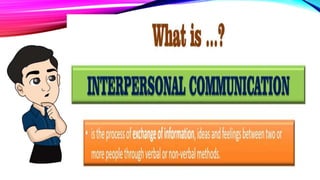
  • #7 Being able to communicate effectively is perhaps the most important of all life’s skills.
  • #8 In communication, it is not about how the information is being delivered or passed but how it is being said. It is important to communicate effectively to achieve our purpose why we communicate.
  • #9 Correct! If there is effective communication between two people or a group of people, a good relationship is build up.
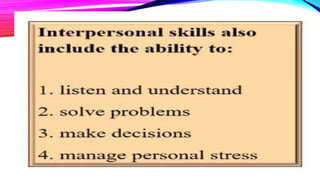
  • #13 The level of one’s interpersonal communication skills is measured through the effectiveness of transferring messages to others.
  • #16 Verbal Communication is the transfer of information through conversation, dialogue or interview.
  • #17 Verbal Communication is the transfer of information through conversation, dialogue or interview.
  • #18 Tayong mga Pilipino na gumagamit ng Second language (the English Language), minsan mahirap magpatuloy makipag usap gamit itong lengwahe.
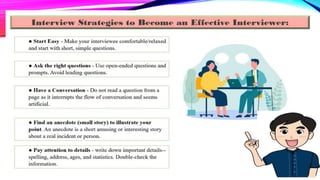
  • #27 Start Easy- Minsan ninenerbyos ang mga naiinterview sa kadahilanang first time nila ito. So mahalaga na komportable kayo sa isat isa. Pwedeng kamustahan muna or bigyan ng kahit ilang minuto para makapagprepare ng maayos. Tanungin lamang ng mga relevant questions, kung ano lang ang importanteng pakay sa kausap. Iwasan ang mga leading questions like are you going to have a job after college? So leading questions are answerable by YES/NO. Instead use questions like this: After graduation, what are your plans? Make the conversation natural. So parang nagpapalitan kayo ng impormasyon na walang naiinterupt. Do not read the questions. For example: Tell me about a time when….. Allow your interview to express himself without judgement.
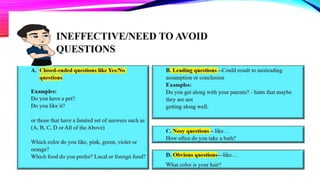
  • #30 NOSY Questions- meaning annoying someone by interfering with their privacy. Offensive questions.