Link to presentation/resources
https://goo.gl/qWnRu3
http://libguides.ccpsnet.net/qft
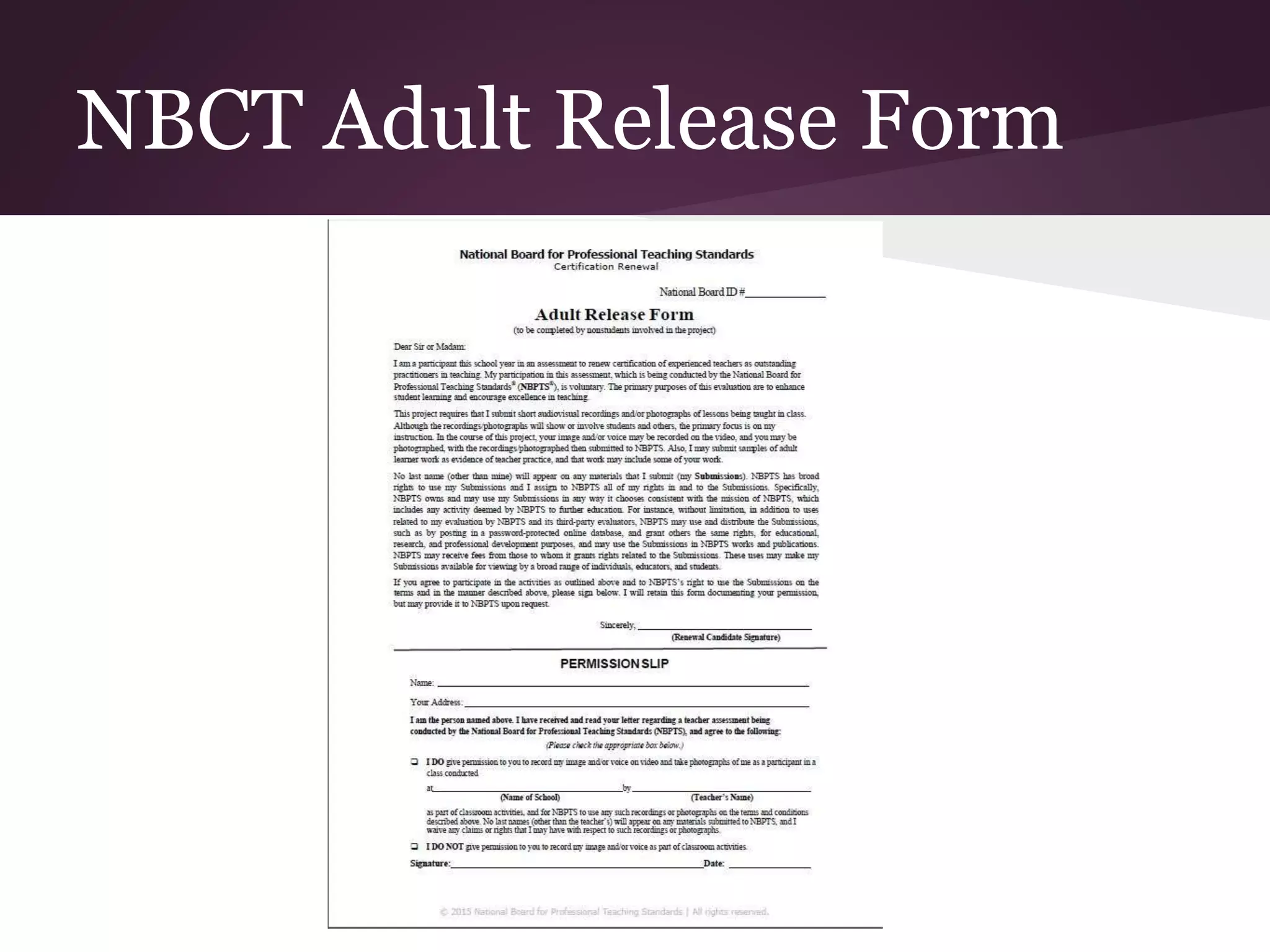
NBCT Adult Release Form
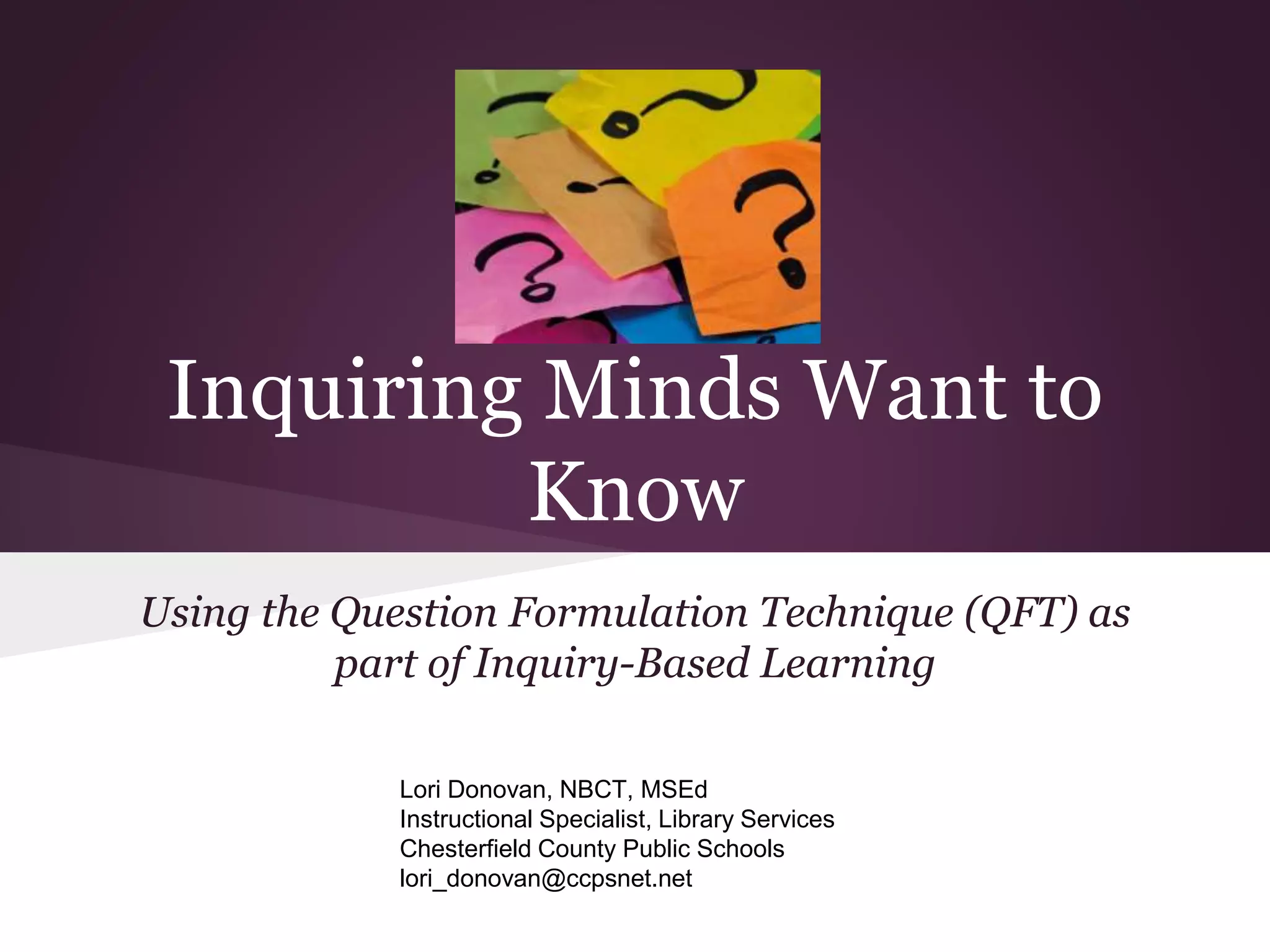
Inquiring Minds Want to
Know
Using the Question Formulation Technique (QFT) as
part of Inquiry-Based Learning
Lori Donovan, NBCT, MSEd
Instructional Specialist, Library Services
Chesterfield County Public Schools
lori_donovan@ccpsnet.net
AASL Standards state....
Students should use an “inquiry-based process”
to “inquire, think critically, and gain
knowledge”; “draw conclusions, make informed
decisions, apply knowledge to new situations,
and create new knowledge”; and “share
knowledge and participate ethically and
productively as members of our democratic
society” (AASL 2007, 4,5,6)
Age of Data
Inquiry-based research models allow for data to
show:
1.Development of information literacy skills
2.Growth of knowledge in curriculum topic
3.Student reflections of interests, feelings and
experiences on learning.
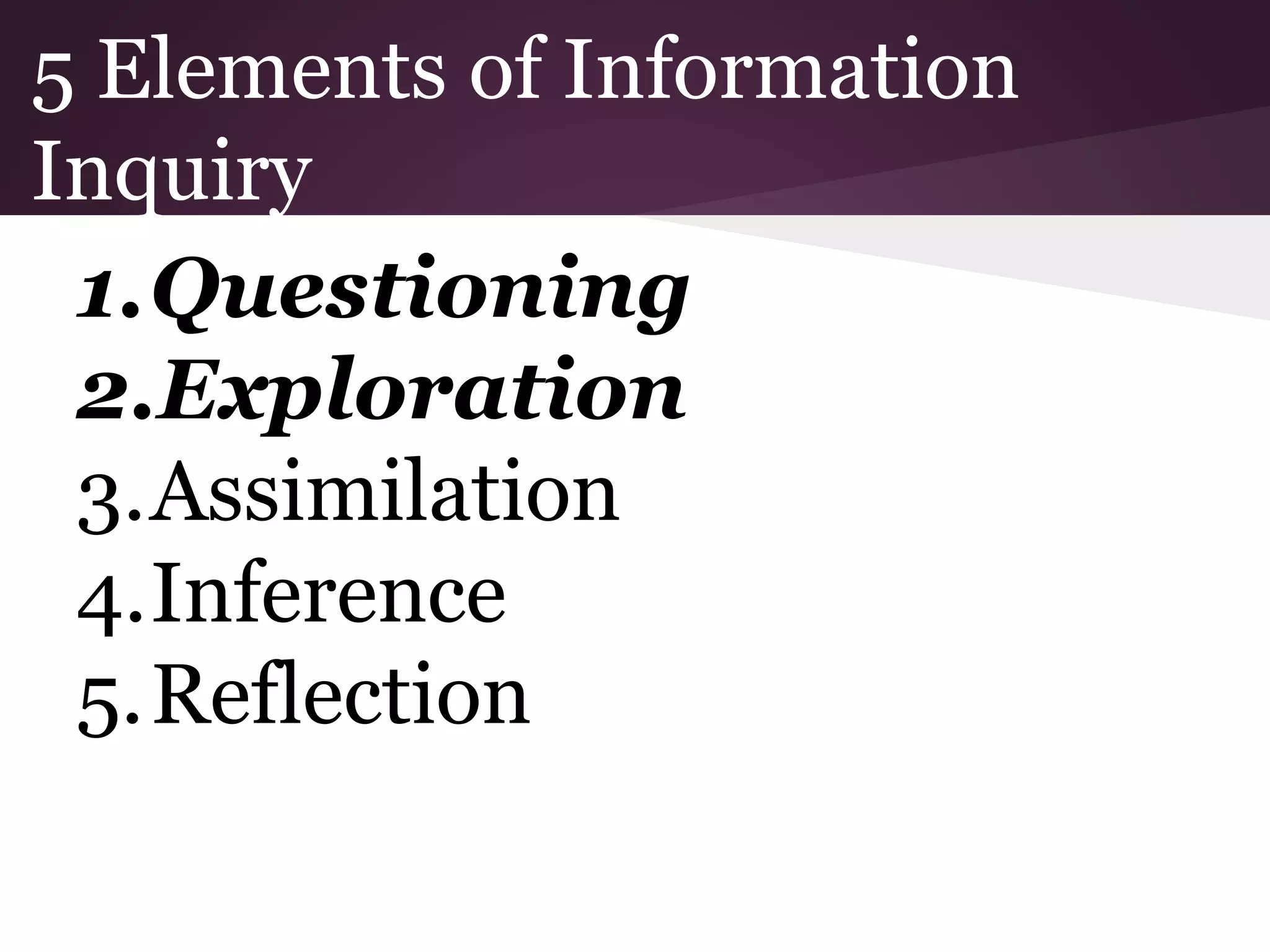
5 Elements of Information
Inquiry
1.Questioning
2.Exploration
3.Assimilation
4.Inference
5.Reflection
What kills questioning?
“Time really conspires against questioning. In the
classroom there often isn’t time to let kids ask their
questions.”
“As we know more, or feel we know more, we may be less
inclined to question.”
Many kids don’t see asking questions as “cool.” And the
perception that question askers are suck-ups or dorks
probably also comes from fear. Many people feel vulnerable
admitting they don’t know something.
-Warren Berger, author A More Beautiful Question
Schwartz, Katrina. "How to Bring ‘More Beautiful’ Questions Back to School." MindShift. KQED News, 9 Feb. 2016. Web. 16 Feb.
2016.
How to Bring ‘More Beautiful’ Questions Back
to School
Feeling confident to question the systems of power around
us is one of the key jobs of an informed citizenry.
Kids need to learn during their time at school that they
have the right to know, to challenge assumptions and to
dig deeper.
Fostering this mentality in students can be challenging for
teachers who are often complicit in systems of control
over students.
But often when teachers open the space for these
questions, value them and explore them with students, a
deep trust is built.
Should educators design Google-proof
questions?
Teacher question: How do modern novels represent the characteristics of
humanity?
Intended outcome of teacher: Students to take a moment to think, figure
out what type of information they needed, how to evaluate the data and how to
reconcile conflicting viewpoints.
What really happened....
Students started Googling the question, 'How does a novel represent
humanity?'
He did not intend for them to immediately Google the question, word by word
— eliminating the process of critical thinking.
Tan, Zhai Yun. "OK, Google, Where Did I Put My Thinking Cap?" All Tech Considered TECH, CULTURE AND CONNECTION. NPR, 5 Feb. 2016. Web. 17 Feb. 2016.
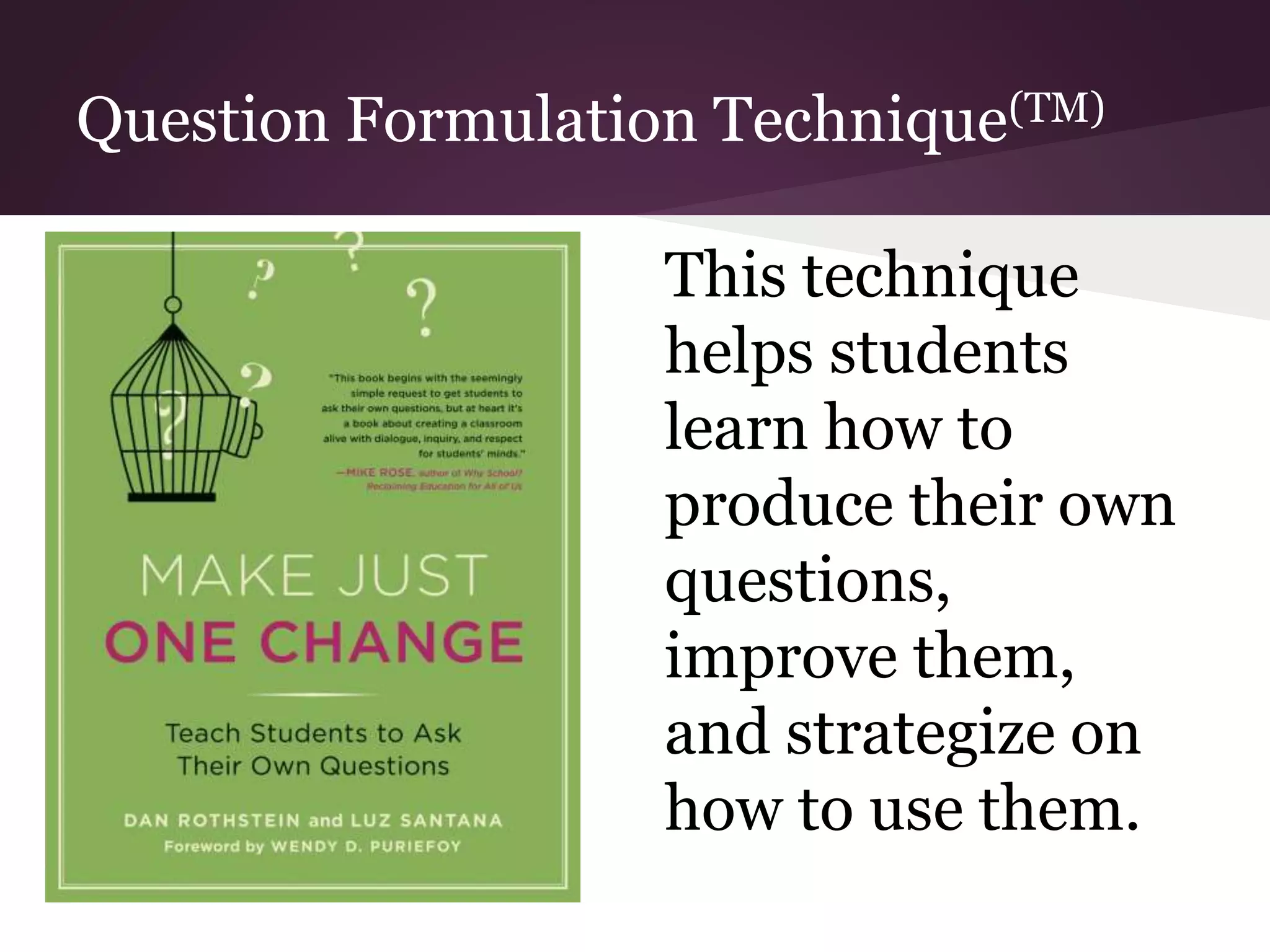
Question Formulation Technique(TM)
This technique
helps students
learn how to
produce their own
questions,
improve them,
and strategize on
how to use them.
Inquiry = Curiosity
Through inquiry students discover:
1.Real questions about academic topics, which
blossom into research;
2.Inquiry supports deep understandings
within the content of the curriculum; and
3.Allows students to create products worth
sharing (Maniotes and Kuhlthau 8-17)
Teaching Multiple Thinking Abilities in One
Process
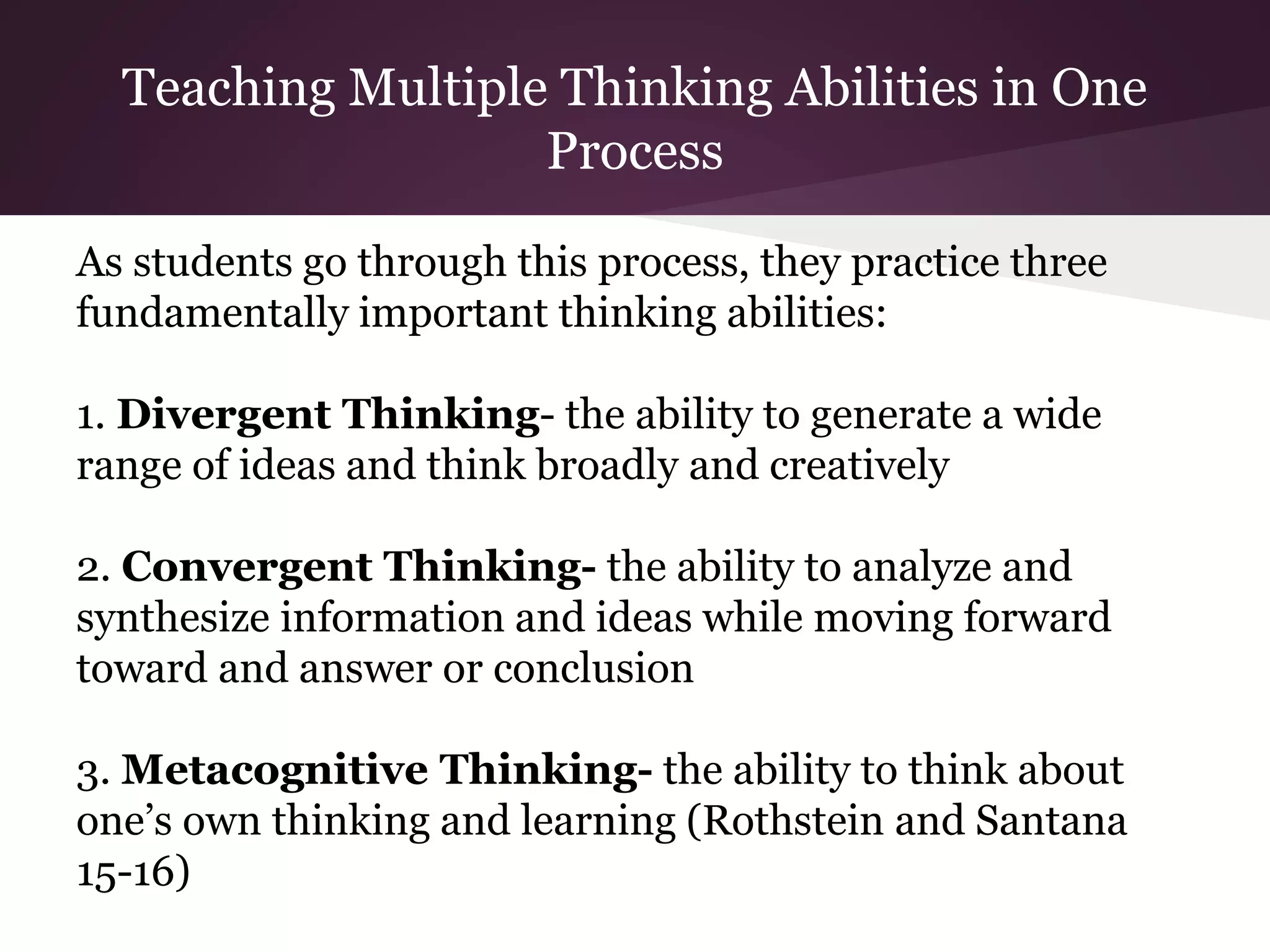
As students go through this process, they practice three
fundamentally important thinking abilities:
1. Divergent Thinking- the ability to generate a wide
range of ideas and think broadly and creatively
2. Convergent Thinking- the ability to analyze and
synthesize information and ideas while moving forward
toward and answer or conclusion
3. Metacognitive Thinking- the ability to think about
one’s own thinking and learning (Rothstein and Santana
15-16)
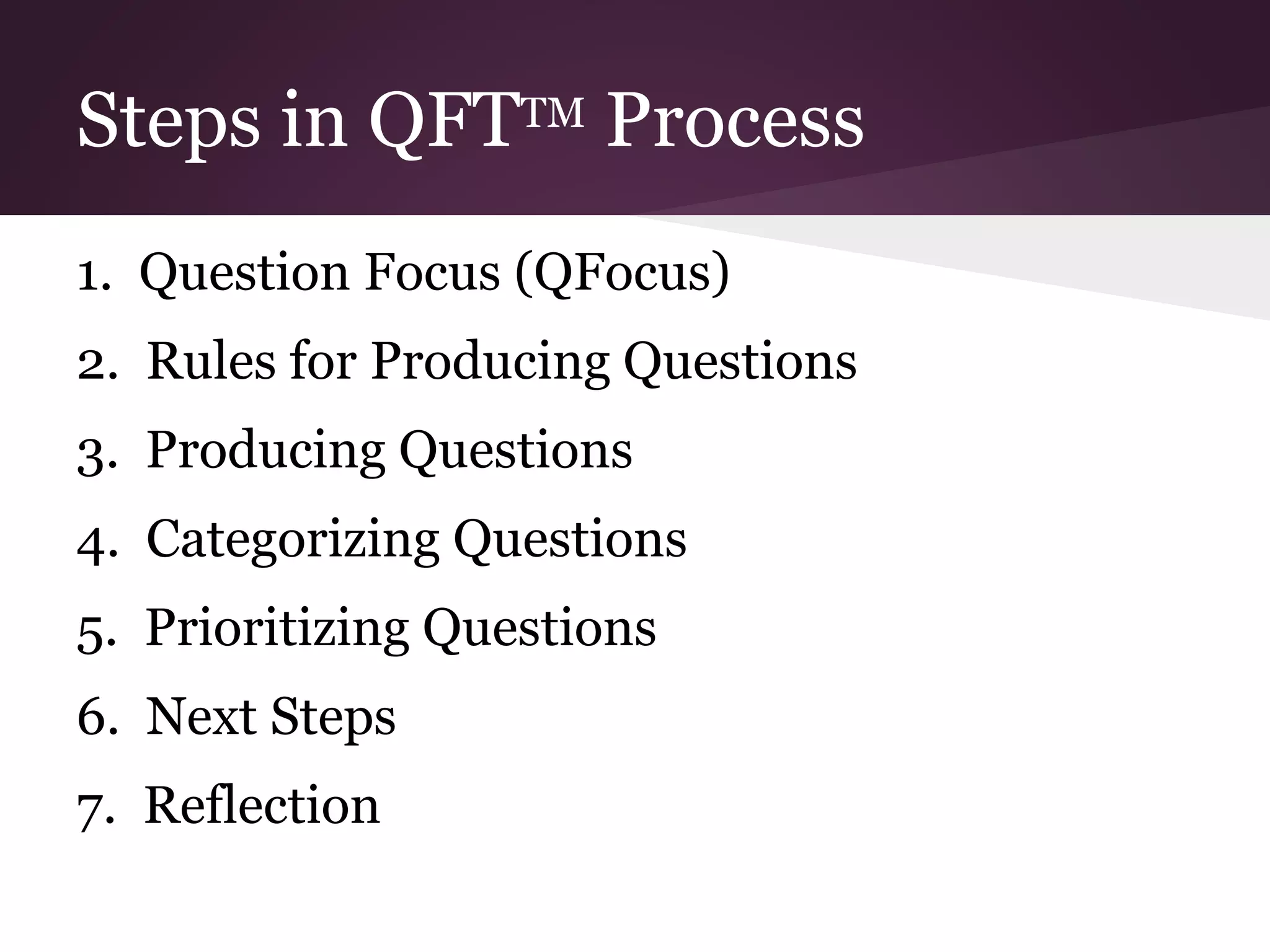
Steps in QFTTM Process
1. Question Focus (QFocus)
2. Rules for Producing Questions
3. Producing Questions
4. Categorizing Questions
5. Prioritizing Questions
6. Next Steps
7. Reflection
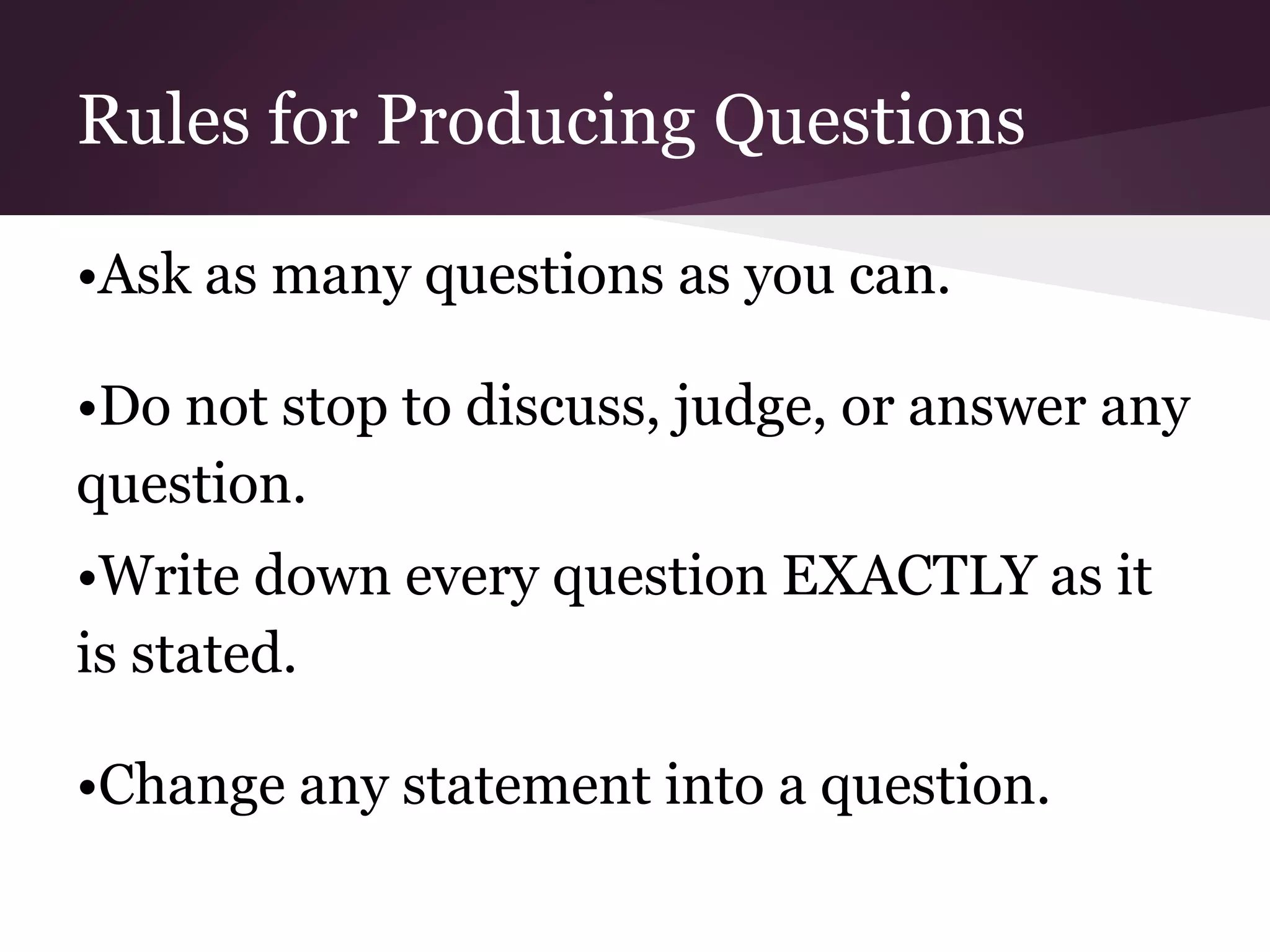
Rules for Producing Questions
•Ask as many questions as you can.
•Do not stop to discuss, judge, or answer any
question.
•Write down every question EXACTLY as it
is stated.
•Change any statement into a question.
Q Focus
Good questions should
lead to more questions,
not just answers.
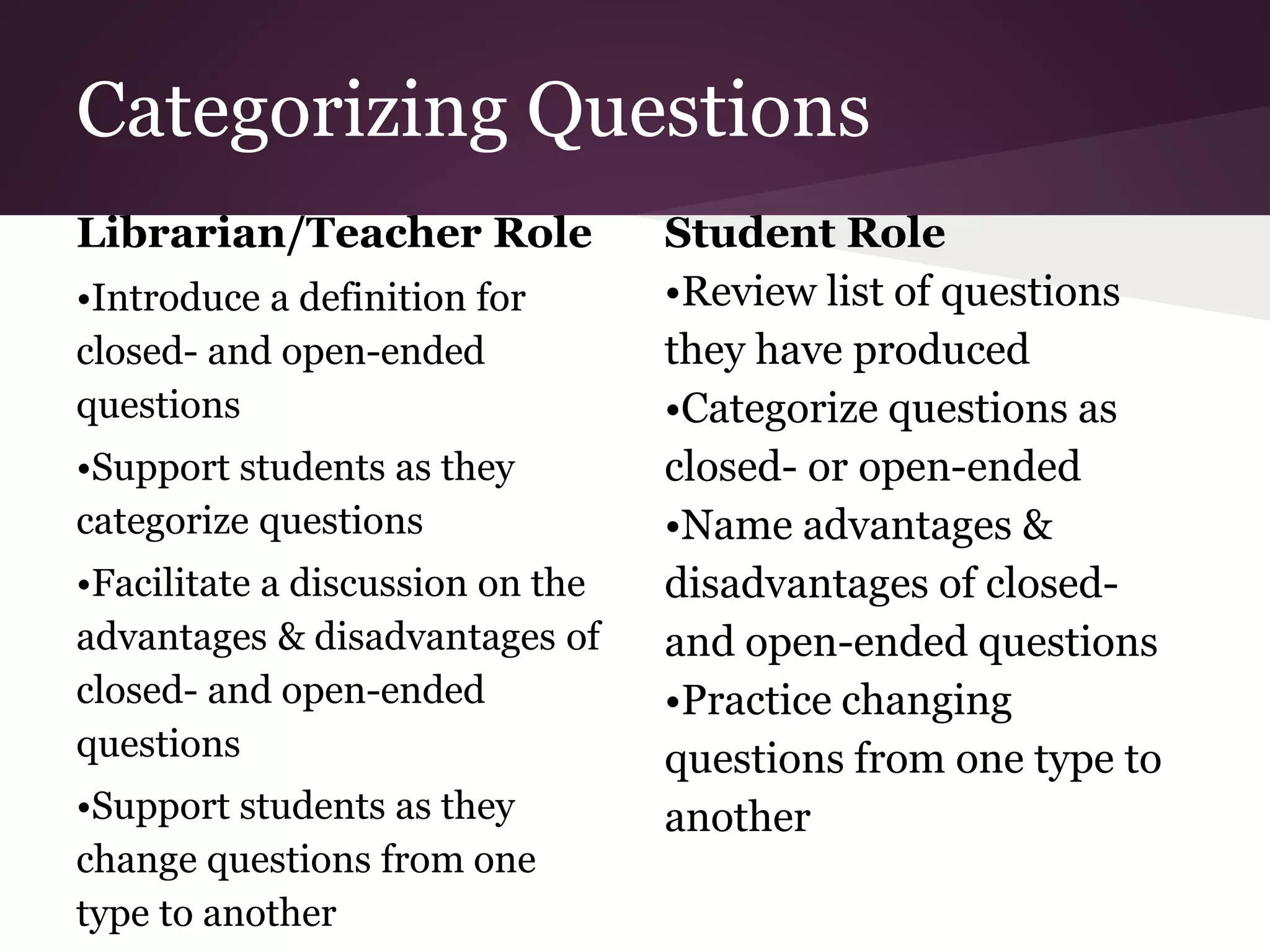
Categorizing Questions
Librarian/Teacher Role
•Introduce a definition for
closed- and open-ended
questions
•Support students as they
categorize questions
•Facilitate a discussion on the
advantages & disadvantages of
closed- and open-ended
questions
•Support students as they
change questions from one
type to another
Student Role
•Review list of questions
they have produced
•Categorize questions as
closed- or open-ended
•Name advantages &
disadvantages of closed-
and open-ended questions
•Practice changing
questions from one type to
another
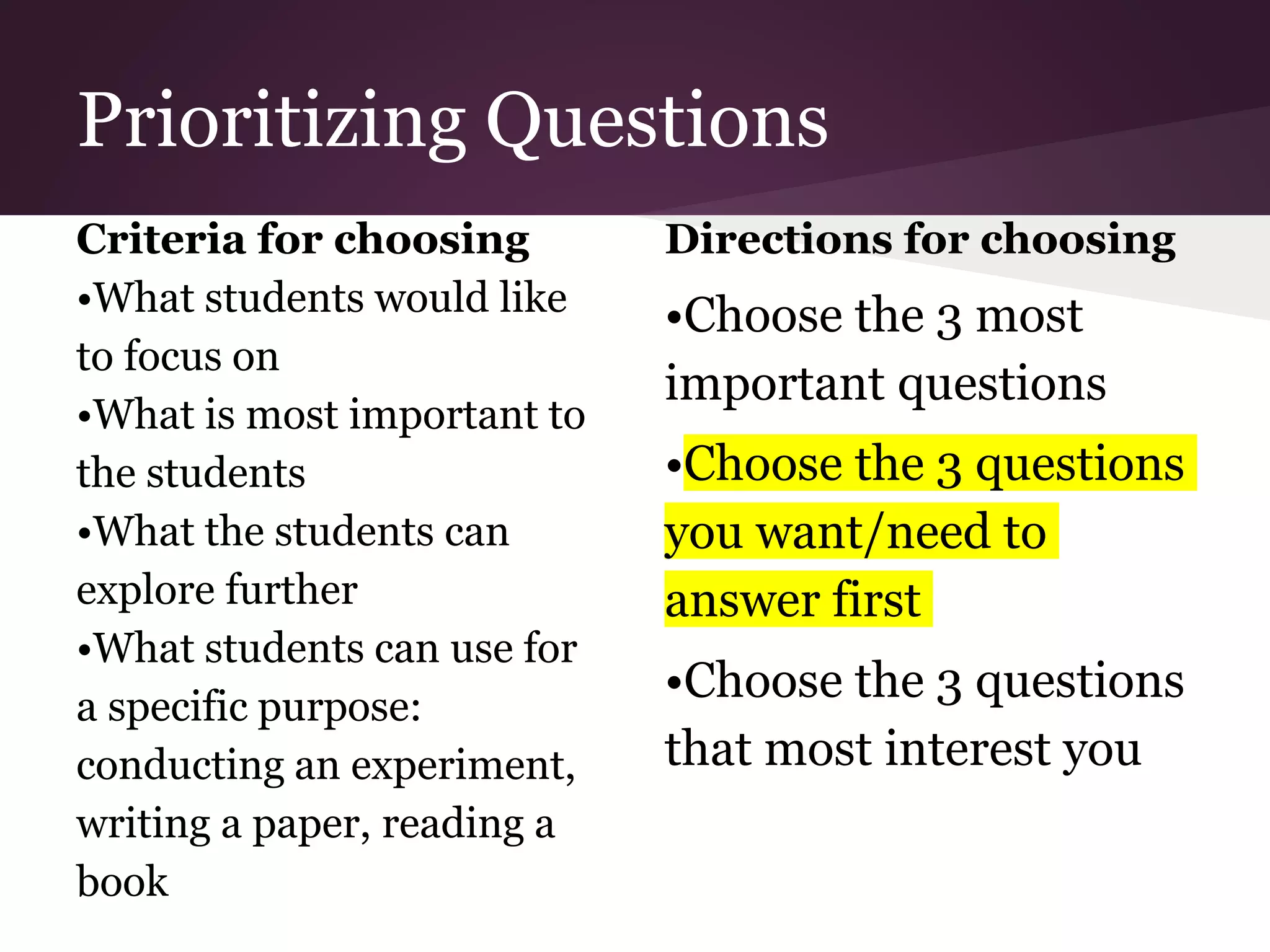
Prioritizing Questions
Criteria for choosing
•What students would like
to focus on
•What is most important to
the students
•What the students can
explore further
•What students can use for
a specific purpose:
conducting an experiment,
writing a paper, reading a
book
Directions for choosing
•Choose the 3 most
important questions
•Choose the 3 questions
you want/need to
answer first
•Choose the 3 questions
that most interest you
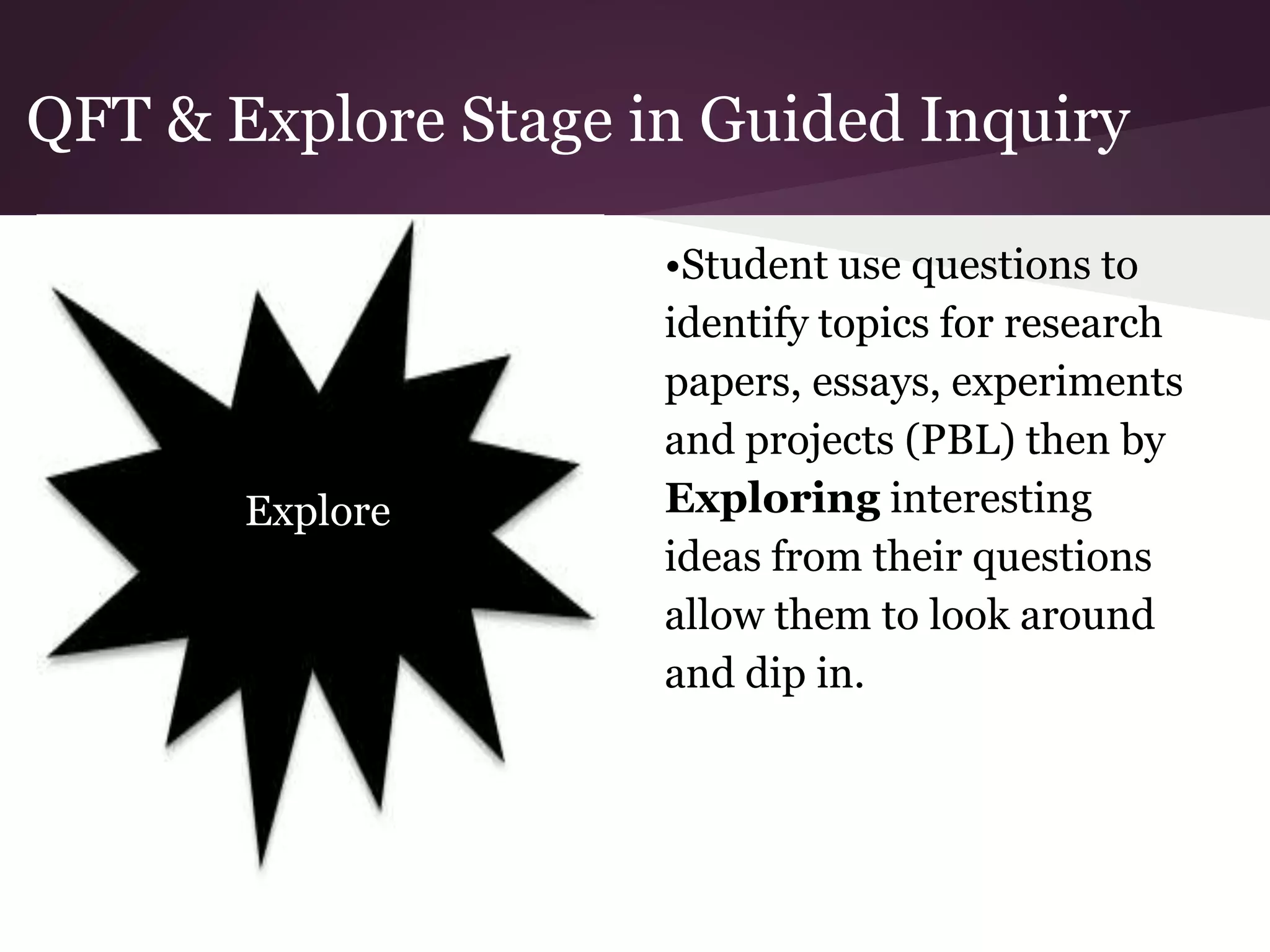
QFT & Explore Stage in Guided Inquiry
•Student use questions to
identify topics for research
papers, essays, experiments
and projects (PBL) then by
Exploring interesting
ideas from their questions
allow them to look around
and dip in.
Explore
Curiosity =Authentic Questions
Students who use questioning
techniques often:
1. Begin to see authentic purposes for
their questions;
2. Ask more questions using higher
order thinking skills; and [most
importantly]
3. Allow students to tap into their
natural curiosity (Ness 76)
5 Elements of Information
Inquiry
1.Questioning
2.Exploration
3.Assimilation
4.Inference
5.Reflection
Right Question Institute
http://rightquestion.org/education/
Please join the Educators’ Network to:
download free resources
gain access to a library of examples
peer-to-peer sharing
Exit Ticket - Twitter Challenge
How will you incorporate QFT in your library lessons?
Works Cited
AASL Standards for the 21st-Century Learner. Chicago: American Association of School Librarians, 2007. PDF.
Callison, Daniel, and Katie Baker. "Elements of Information Inquiry, Evolution of Models and Measured Reflection."
Knowledge Quest 43.2 (Nov/Dec 2014): 18-24. Print.
Everette, Meghan. "8 Essential Elements of Project Based Learning | Scholastic.com." Scholastic Teachers. Scholastic
Publishing, 11 Mar. 2015. Web. 12 Mar. 2015.
Foote, Carolyn. "Empowering Students for Life." Multimedia & Internet @Schools 17.2 (Mar/Apr 2010): 28-31. EBSCO
Education Research Complete. Web. 28 Jan. 2015.
Giordano, Emilia, and Randell K. Schmidt. "Structured Comprehensiveness and Compassion in Guided Inquiry." School Library
Monthly 30.2 (April 2014): 30-32. Print.
Gutierrez. "Why We Need Common Core: "I Choose C."" YouTube. Palm Springs Unified, 27 Aug. 2012. Web. 29 Jan. 2015.
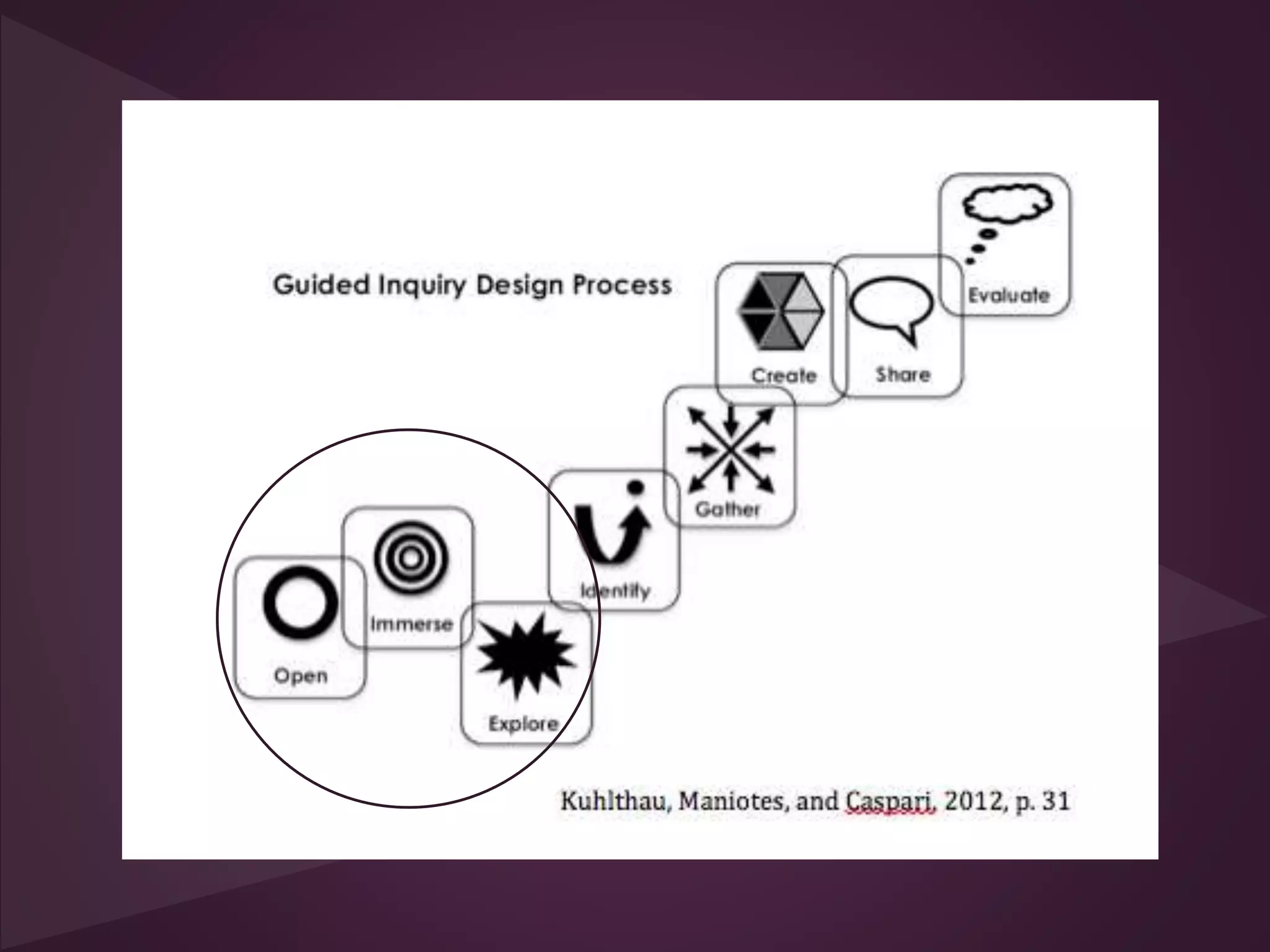
Kulthau, Carol C., PhD, Leslie K. Maniotes, PhD, and Ann K. Caspari. Guided Inquiry Process. Digital image. Rutgers
University, 2012. Web. 29 Jan. 2015.
Library Hub. Digital image. Central York School District. N.p., 2015. Web. 29 Jan. 2015.
Maniotes, Leslie K., PhD, and Carol C. Kuhlthau, PhD. "Making the Shift From Traditional Research Assignments to Guided
Inquiry Learning." Knowledge Quest 43.2 (Nov/Dec 2014): 8-17. Print.
Ness, Molly. "Unpark Those Questions: Use Students' Own Curiosity to Get Them to Investigate Informational Text."
Educational Leadership 71.3 (November 2013): 74-76. EBSCO Educational Research Complete. Web. 28 Jan. 2015.
"Right Question Institute - A Catalyst for Microdemocracy." Right Question Institute. Harvard University, 2015. Web.
29 Jan. 2015.
Rothstein, Dan, and Luz Santana. Make Just One Change: Teach Students to Ask Their Own Questions. Cambridge,
MA: Harvard Education, 2011. Print.
Schwartz, Katrina. "How to Bring ‘More Beautiful’ Questions Back to School." MindShift. KQED News, 9 Feb. 2016.
Web. 16 Feb. 2016.
Tan, Zhai Yun. "OK, Google, Where Did I Put My Thinking Cap?" All Tech Considered TECH, CULTURE AND
CONNECTION. NPR, 5 Feb. 2016. Web. 17 Feb. 2016.
<http://www.npr.org/sections/alltechconsidered/2016/02/05/465699380/ok-google-where-did-i-put-my-thinking-cap>.
Inquiring Minds Want to
Know
Using the Question Formulation Technique (QFT) as
part of Inquiry-Based Learning
Lori Donovan, NBCT, MSEd
Instructional Specialist, Library Services
Chesterfield County Public Schools
lori_donovan@ccpsnet.net

Inquiring Minds Want to Know: How to Use the Question Formulation Technique to Jump Start Research

  • 2.
  • 3.
  • 4.
    Inquiring Minds Wantto Know Using the Question Formulation Technique (QFT) as part of Inquiry-Based Learning Lori Donovan, NBCT, MSEd Instructional Specialist, Library Services Chesterfield County Public Schools lori_donovan@ccpsnet.net
  • 5.
    AASL Standards state.... Studentsshould use an “inquiry-based process” to “inquire, think critically, and gain knowledge”; “draw conclusions, make informed decisions, apply knowledge to new situations, and create new knowledge”; and “share knowledge and participate ethically and productively as members of our democratic society” (AASL 2007, 4,5,6)
  • 6.
    Age of Data Inquiry-basedresearch models allow for data to show: 1.Development of information literacy skills 2.Growth of knowledge in curriculum topic 3.Student reflections of interests, feelings and experiences on learning.
  • 7.
    5 Elements ofInformation Inquiry 1.Questioning 2.Exploration 3.Assimilation 4.Inference 5.Reflection
  • 8.
    What kills questioning? “Timereally conspires against questioning. In the classroom there often isn’t time to let kids ask their questions.” “As we know more, or feel we know more, we may be less inclined to question.” Many kids don’t see asking questions as “cool.” And the perception that question askers are suck-ups or dorks probably also comes from fear. Many people feel vulnerable admitting they don’t know something. -Warren Berger, author A More Beautiful Question Schwartz, Katrina. "How to Bring ‘More Beautiful’ Questions Back to School." MindShift. KQED News, 9 Feb. 2016. Web. 16 Feb. 2016.
  • 9.
    How to Bring‘More Beautiful’ Questions Back to School Feeling confident to question the systems of power around us is one of the key jobs of an informed citizenry. Kids need to learn during their time at school that they have the right to know, to challenge assumptions and to dig deeper. Fostering this mentality in students can be challenging for teachers who are often complicit in systems of control over students. But often when teachers open the space for these questions, value them and explore them with students, a deep trust is built.
  • 10.
    Should educators designGoogle-proof questions? Teacher question: How do modern novels represent the characteristics of humanity? Intended outcome of teacher: Students to take a moment to think, figure out what type of information they needed, how to evaluate the data and how to reconcile conflicting viewpoints. What really happened.... Students started Googling the question, 'How does a novel represent humanity?' He did not intend for them to immediately Google the question, word by word — eliminating the process of critical thinking. Tan, Zhai Yun. "OK, Google, Where Did I Put My Thinking Cap?" All Tech Considered TECH, CULTURE AND CONNECTION. NPR, 5 Feb. 2016. Web. 17 Feb. 2016.
  • 11.
    Question Formulation Technique(TM) Thistechnique helps students learn how to produce their own questions, improve them, and strategize on how to use them.
  • 12.
    Inquiry = Curiosity Throughinquiry students discover: 1.Real questions about academic topics, which blossom into research; 2.Inquiry supports deep understandings within the content of the curriculum; and 3.Allows students to create products worth sharing (Maniotes and Kuhlthau 8-17)
  • 13.
    Teaching Multiple ThinkingAbilities in One Process As students go through this process, they practice three fundamentally important thinking abilities: 1. Divergent Thinking- the ability to generate a wide range of ideas and think broadly and creatively 2. Convergent Thinking- the ability to analyze and synthesize information and ideas while moving forward toward and answer or conclusion 3. Metacognitive Thinking- the ability to think about one’s own thinking and learning (Rothstein and Santana 15-16)
  • 14.
    Steps in QFTTMProcess 1. Question Focus (QFocus) 2. Rules for Producing Questions 3. Producing Questions 4. Categorizing Questions 5. Prioritizing Questions 6. Next Steps 7. Reflection
  • 15.
    Rules for ProducingQuestions •Ask as many questions as you can. •Do not stop to discuss, judge, or answer any question. •Write down every question EXACTLY as it is stated. •Change any statement into a question.
  • 16.
    Q Focus Good questionsshould lead to more questions, not just answers.
  • 17.
    Categorizing Questions Librarian/Teacher Role •Introducea definition for closed- and open-ended questions •Support students as they categorize questions •Facilitate a discussion on the advantages & disadvantages of closed- and open-ended questions •Support students as they change questions from one type to another Student Role •Review list of questions they have produced •Categorize questions as closed- or open-ended •Name advantages & disadvantages of closed- and open-ended questions •Practice changing questions from one type to another
  • 18.
    Prioritizing Questions Criteria forchoosing •What students would like to focus on •What is most important to the students •What the students can explore further •What students can use for a specific purpose: conducting an experiment, writing a paper, reading a book Directions for choosing •Choose the 3 most important questions •Choose the 3 questions you want/need to answer first •Choose the 3 questions that most interest you
  • 20.
    QFT & ExploreStage in Guided Inquiry •Student use questions to identify topics for research papers, essays, experiments and projects (PBL) then by Exploring interesting ideas from their questions allow them to look around and dip in. Explore
  • 21.
    Curiosity =Authentic Questions Studentswho use questioning techniques often: 1. Begin to see authentic purposes for their questions; 2. Ask more questions using higher order thinking skills; and [most importantly] 3. Allow students to tap into their natural curiosity (Ness 76)
  • 22.
    5 Elements ofInformation Inquiry 1.Questioning 2.Exploration 3.Assimilation 4.Inference 5.Reflection
  • 23.
    Right Question Institute http://rightquestion.org/education/ Pleasejoin the Educators’ Network to: download free resources gain access to a library of examples peer-to-peer sharing
  • 24.
    Exit Ticket -Twitter Challenge How will you incorporate QFT in your library lessons?
  • 25.
    Works Cited AASL Standardsfor the 21st-Century Learner. Chicago: American Association of School Librarians, 2007. PDF. Callison, Daniel, and Katie Baker. "Elements of Information Inquiry, Evolution of Models and Measured Reflection." Knowledge Quest 43.2 (Nov/Dec 2014): 18-24. Print. Everette, Meghan. "8 Essential Elements of Project Based Learning | Scholastic.com." Scholastic Teachers. Scholastic Publishing, 11 Mar. 2015. Web. 12 Mar. 2015. Foote, Carolyn. "Empowering Students for Life." Multimedia & Internet @Schools 17.2 (Mar/Apr 2010): 28-31. EBSCO Education Research Complete. Web. 28 Jan. 2015. Giordano, Emilia, and Randell K. Schmidt. "Structured Comprehensiveness and Compassion in Guided Inquiry." School Library Monthly 30.2 (April 2014): 30-32. Print. Gutierrez. "Why We Need Common Core: "I Choose C."" YouTube. Palm Springs Unified, 27 Aug. 2012. Web. 29 Jan. 2015. Kulthau, Carol C., PhD, Leslie K. Maniotes, PhD, and Ann K. Caspari. Guided Inquiry Process. Digital image. Rutgers University, 2012. Web. 29 Jan. 2015. Library Hub. Digital image. Central York School District. N.p., 2015. Web. 29 Jan. 2015. Maniotes, Leslie K., PhD, and Carol C. Kuhlthau, PhD. "Making the Shift From Traditional Research Assignments to Guided Inquiry Learning." Knowledge Quest 43.2 (Nov/Dec 2014): 8-17. Print.
  • 26.
    Ness, Molly. "UnparkThose Questions: Use Students' Own Curiosity to Get Them to Investigate Informational Text." Educational Leadership 71.3 (November 2013): 74-76. EBSCO Educational Research Complete. Web. 28 Jan. 2015. "Right Question Institute - A Catalyst for Microdemocracy." Right Question Institute. Harvard University, 2015. Web. 29 Jan. 2015. Rothstein, Dan, and Luz Santana. Make Just One Change: Teach Students to Ask Their Own Questions. Cambridge, MA: Harvard Education, 2011. Print. Schwartz, Katrina. "How to Bring ‘More Beautiful’ Questions Back to School." MindShift. KQED News, 9 Feb. 2016. Web. 16 Feb. 2016. Tan, Zhai Yun. "OK, Google, Where Did I Put My Thinking Cap?" All Tech Considered TECH, CULTURE AND CONNECTION. NPR, 5 Feb. 2016. Web. 17 Feb. 2016. <http://www.npr.org/sections/alltechconsidered/2016/02/05/465699380/ok-google-where-did-i-put-my-thinking-cap>.
  • 27.
    Inquiring Minds Wantto Know Using the Question Formulation Technique (QFT) as part of Inquiry-Based Learning Lori Donovan, NBCT, MSEd Instructional Specialist, Library Services Chesterfield County Public Schools lori_donovan@ccpsnet.net