What makes effective
questioning?
Source: ‘What makes effective questioning? David Drake 2011
Why question?
• Questioning is a key aspect of the teaching and learning process.
• There is evidence that teachers can improve their use of questions
by focusing on types of questions and strategies for using them.
• Questions should draw students into the learning process as well
as checking acquisition of knowledge.
Research shows that effective teachers use more
higher order questions and open questions than less
effective teachers do.
Are we using questions
effectively?
• Most teachers’ questions are answered in less than a second,
often by the teacher themselves. Increasing wait time to 3
seconds for lower-order and 10 seconds for higher-order
questions improves the quality of answers.
• Students fear being made to look silly and this inhibits them in
answering. Strategies are needed to overcome this.
• The importance of students articulating ideas themselves means
that it is also important to try to get them to ask questions.
Improving questioning was one of the keys to raising attainment
identified by Black and Wiliam in Inside the Black Box.
Is my use of questioning
effective?
• Questioning techniques need to be varied. Over reliance on the
‘volunteer’ method is to be avoided.
• Questioning is a key tool in Assessment for Learning strategies:
• For allowing the teacher to assess learning
• For involving students in applying assessment criteria
• For developing listening skills
• Crucially, students need time to think.
Questions to avoid
Do you (all) understand?
Does that make sense?
Everybody okay with that?
Any questions?
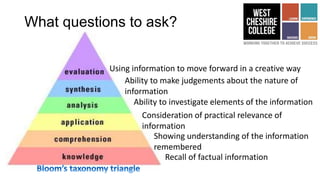
What questions to ask?
Using information to move forward in a creative way
Ability to make judgements about the nature of
information
Ability to investigate elements of the information
Consideration of practical relevance of
information
Showing understanding of the information
remembered
Recall of factual information
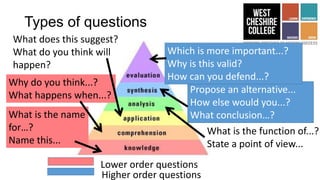
Types of questions
Why do you think...?
What happens when...?
What does this suggest?
What do you think will
happen?
What is the function of...?
State a point of view...
Propose an alternative...
How else would you...?
What conclusion…?
Which is more important...?
Why is this valid?
How can you defend...?
What is the name
for…?
Name this...
Lower order questions
Higher order questions
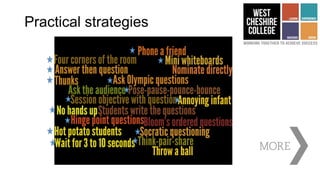
Practical strategies
Increase ‘Wait Time’
• Most teachers’ questions are answered in less than a second,
often by the teacher themselves.
• Increasing wait time to 3 seconds for lower order questions and
10 seconds for higher order ones improves the quality of
answers.
No Hands up
• Students cannot shout out OR put theirs hands up to indicate
that they know the answer to the question.
• Teacher chooses the students to answer question.
• Keep them on their toes!
• Students can use a phone a friend if they are really struggling.
Phone a friend
• Empower a struggling student, who does not
have the answer to your question, by asking
them to choose three students, who have an
answer ready
• Students give their answers
• The struggling student chooses the ‘best’
answer and explains their reasons for their
choice.
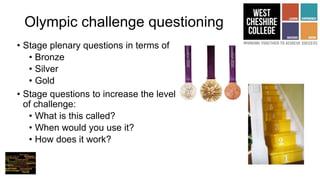
Olympic challenge questioning
• Stage plenary questions in terms of
• Bronze
• Silver
• Gold
• Stage questions to increase the level
of challenge:
• What is this called?
• When would you use it?
• How does it work?
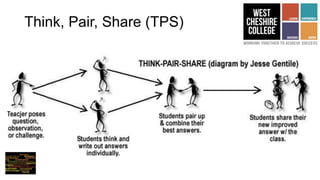
Think, Pair, Share (TPS)
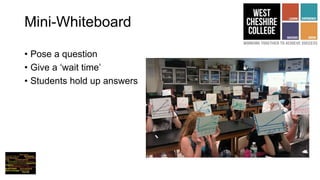
Mini-Whiteboard
• Pose a question
• Give a ‘wait time’
• Students hold up answers
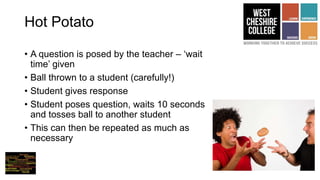
Hot Potato
• A question is posed by the teacher – ‘wait
time’ given
• Ball thrown to a student (carefully!)
• Student gives response
• Student poses question, waits 10 seconds
and tosses ball to another student
• This can then be repeated as much as
necessary
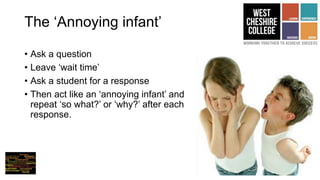
The ‘Annoying infant’
• Ask a question
• Leave ‘wait time’
• Ask a student for a response
• Then act like an ‘annoying infant’ and
repeat ‘so what?’ or ‘why?’ after each
response.
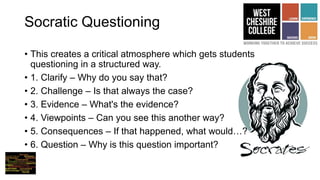
Socratic Questioning
• This creates a critical atmosphere which gets students
questioning in a structured way.
• 1. Clarify – Why do you say that?
• 2. Challenge – Is that always the case?
• 3. Evidence – What's the evidence?
• 4. Viewpoints – Can you see this another way?
• 5. Consequences – If that happened, what would…?
• 6. Question – Why is this question important?
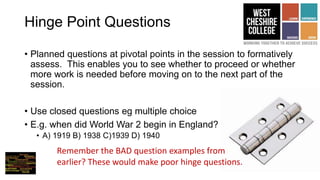
Hinge Point Questions
• Planned questions at pivotal points in the session to formatively
assess. This enables you to see whether to proceed or whether
more work is needed before moving on to the next part of the
session.
• Use closed questions eg multiple choice
• E.g. when did World War 2 begin in England?
• A) 1919 B) 1938 C)1939 D) 1940
Remember the BAD question examples from
earlier? These would make poor hinge questions.
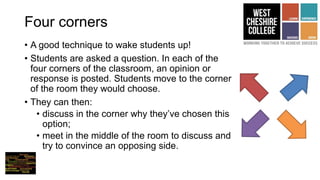
Four corners
• A good technique to wake students up!
• Students are asked a question. In each of the
four corners of the classroom, an opinion or
response is posted. Students move to the corner
of the room they would choose.
• They can then:
• discuss in the corner why they’ve chosen this
option;
• meet in the middle of the room to discuss and
try to convince an opposing side.
If this is the answer, what is the
question?
• Works well to recap key information.
• Used on Mock the Week and other game shows so is a familiar
format for students.
• Provide an answer. Students work together to construct the
question that goes with this.
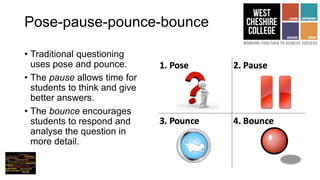
Pose-pause-pounce-bounce
• Traditional questioning
uses pose and pounce.
• The pause allows time for
students to think and give
better answers.
• The bounce encourages
students to respond and
analyse the question in
more detail.
Session objective with question
• Pose a question in conjunction with a session objective.
For example:
Explain the impact that effective questioning has on quality
of learning, teaching and assessment.
(How) is it that better questions make
for better learning?
Teaching others – Practical
Strategies
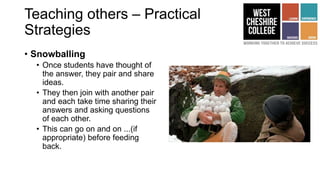
• Snowballing
• Once students have thought of
the answer, they pair and share
ideas.
• They then join with another pair
and each take time sharing their
answers and asking questions
of each other.
• This can go on and on ...(if
appropriate) before feeding
back.
Teaching others – Practical
Strategies
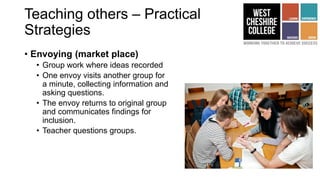
• Envoying (market place)
• Group work where ideas recorded
• One envoy visits another group for
a minute, collecting information and
asking questions.
• The envoy returns to original group
and communicates findings for
inclusion.
• Teacher questions groups.
Too much?
Homework:
• Don't try them all!
• Just choose one strategy
you don’t already use and
try it.

Effective questioning - abridged version

  • 1.
    What makes effective questioning? Source:‘What makes effective questioning? David Drake 2011
  • 2.
    Why question? • Questioningis a key aspect of the teaching and learning process. • There is evidence that teachers can improve their use of questions by focusing on types of questions and strategies for using them. • Questions should draw students into the learning process as well as checking acquisition of knowledge. Research shows that effective teachers use more higher order questions and open questions than less effective teachers do.
  • 3.
    Are we usingquestions effectively? • Most teachers’ questions are answered in less than a second, often by the teacher themselves. Increasing wait time to 3 seconds for lower-order and 10 seconds for higher-order questions improves the quality of answers. • Students fear being made to look silly and this inhibits them in answering. Strategies are needed to overcome this. • The importance of students articulating ideas themselves means that it is also important to try to get them to ask questions. Improving questioning was one of the keys to raising attainment identified by Black and Wiliam in Inside the Black Box.
  • 4.
    Is my useof questioning effective? • Questioning techniques need to be varied. Over reliance on the ‘volunteer’ method is to be avoided. • Questioning is a key tool in Assessment for Learning strategies: • For allowing the teacher to assess learning • For involving students in applying assessment criteria • For developing listening skills • Crucially, students need time to think.
  • 5.
    Questions to avoid Doyou (all) understand? Does that make sense? Everybody okay with that? Any questions?
  • 6.
    What questions toask? Using information to move forward in a creative way Ability to make judgements about the nature of information Ability to investigate elements of the information Consideration of practical relevance of information Showing understanding of the information remembered Recall of factual information
  • 7.
    Types of questions Whydo you think...? What happens when...? What does this suggest? What do you think will happen? What is the function of...? State a point of view... Propose an alternative... How else would you...? What conclusion…? Which is more important...? Why is this valid? How can you defend...? What is the name for…? Name this... Lower order questions Higher order questions
  • 8.
  • 9.
    Increase ‘Wait Time’ •Most teachers’ questions are answered in less than a second, often by the teacher themselves. • Increasing wait time to 3 seconds for lower order questions and 10 seconds for higher order ones improves the quality of answers.
  • 10.
    No Hands up •Students cannot shout out OR put theirs hands up to indicate that they know the answer to the question. • Teacher chooses the students to answer question. • Keep them on their toes! • Students can use a phone a friend if they are really struggling.
  • 11.
    Phone a friend •Empower a struggling student, who does not have the answer to your question, by asking them to choose three students, who have an answer ready • Students give their answers • The struggling student chooses the ‘best’ answer and explains their reasons for their choice.
  • 12.
    Olympic challenge questioning •Stage plenary questions in terms of • Bronze • Silver • Gold • Stage questions to increase the level of challenge: • What is this called? • When would you use it? • How does it work?
  • 13.
  • 14.
    Mini-Whiteboard • Pose aquestion • Give a ‘wait time’ • Students hold up answers
  • 15.
    Hot Potato • Aquestion is posed by the teacher – ‘wait time’ given • Ball thrown to a student (carefully!) • Student gives response • Student poses question, waits 10 seconds and tosses ball to another student • This can then be repeated as much as necessary
  • 16.
    The ‘Annoying infant’ •Ask a question • Leave ‘wait time’ • Ask a student for a response • Then act like an ‘annoying infant’ and repeat ‘so what?’ or ‘why?’ after each response.
  • 17.
    Socratic Questioning • Thiscreates a critical atmosphere which gets students questioning in a structured way. • 1. Clarify – Why do you say that? • 2. Challenge – Is that always the case? • 3. Evidence – What's the evidence? • 4. Viewpoints – Can you see this another way? • 5. Consequences – If that happened, what would…? • 6. Question – Why is this question important?
  • 18.
    Hinge Point Questions •Planned questions at pivotal points in the session to formatively assess. This enables you to see whether to proceed or whether more work is needed before moving on to the next part of the session. • Use closed questions eg multiple choice • E.g. when did World War 2 begin in England? • A) 1919 B) 1938 C)1939 D) 1940 Remember the BAD question examples from earlier? These would make poor hinge questions.
  • 19.
    Four corners • Agood technique to wake students up! • Students are asked a question. In each of the four corners of the classroom, an opinion or response is posted. Students move to the corner of the room they would choose. • They can then: • discuss in the corner why they’ve chosen this option; • meet in the middle of the room to discuss and try to convince an opposing side.
  • 20.
    If this isthe answer, what is the question? • Works well to recap key information. • Used on Mock the Week and other game shows so is a familiar format for students. • Provide an answer. Students work together to construct the question that goes with this.
  • 21.
    Pose-pause-pounce-bounce • Traditional questioning usespose and pounce. • The pause allows time for students to think and give better answers. • The bounce encourages students to respond and analyse the question in more detail.
  • 22.
    Session objective withquestion • Pose a question in conjunction with a session objective. For example: Explain the impact that effective questioning has on quality of learning, teaching and assessment. (How) is it that better questions make for better learning?
  • 23.
    Teaching others –Practical Strategies • Snowballing • Once students have thought of the answer, they pair and share ideas. • They then join with another pair and each take time sharing their answers and asking questions of each other. • This can go on and on ...(if appropriate) before feeding back.
  • 24.
    Teaching others –Practical Strategies • Envoying (market place) • Group work where ideas recorded • One envoy visits another group for a minute, collecting information and asking questions. • The envoy returns to original group and communicates findings for inclusion. • Teacher questions groups.
  • 25.
    Too much? Homework: • Don'ttry them all! • Just choose one strategy you don’t already use and try it.

Editor's Notes

  • #3 Point out that open questions (ie not y/n questions) is different to open questioning (where tutors do not nominate individuals)
  • #8 Activity – Matching questions to the different levels of BLOOMS. Hand out cards. Check answers and feedback.
  • #9 Hand out Question Technique Postcards Staff to discuss in pairs which techniques they know/can figure out and how these question techniques work/which work best in different situations. Techniques with a star next to them are hyperlinked – click the text of the strategy within the word cloud here. To then return back to this slide, click the mini graphic in the bottom left-hand corner of any of the explanation slides. THEN – invite any further strategies that teachers use which they’d like to share. Click the ‘more’ graphic to look at two other effective strategies commonly used (if you think the group can take any more ideas).