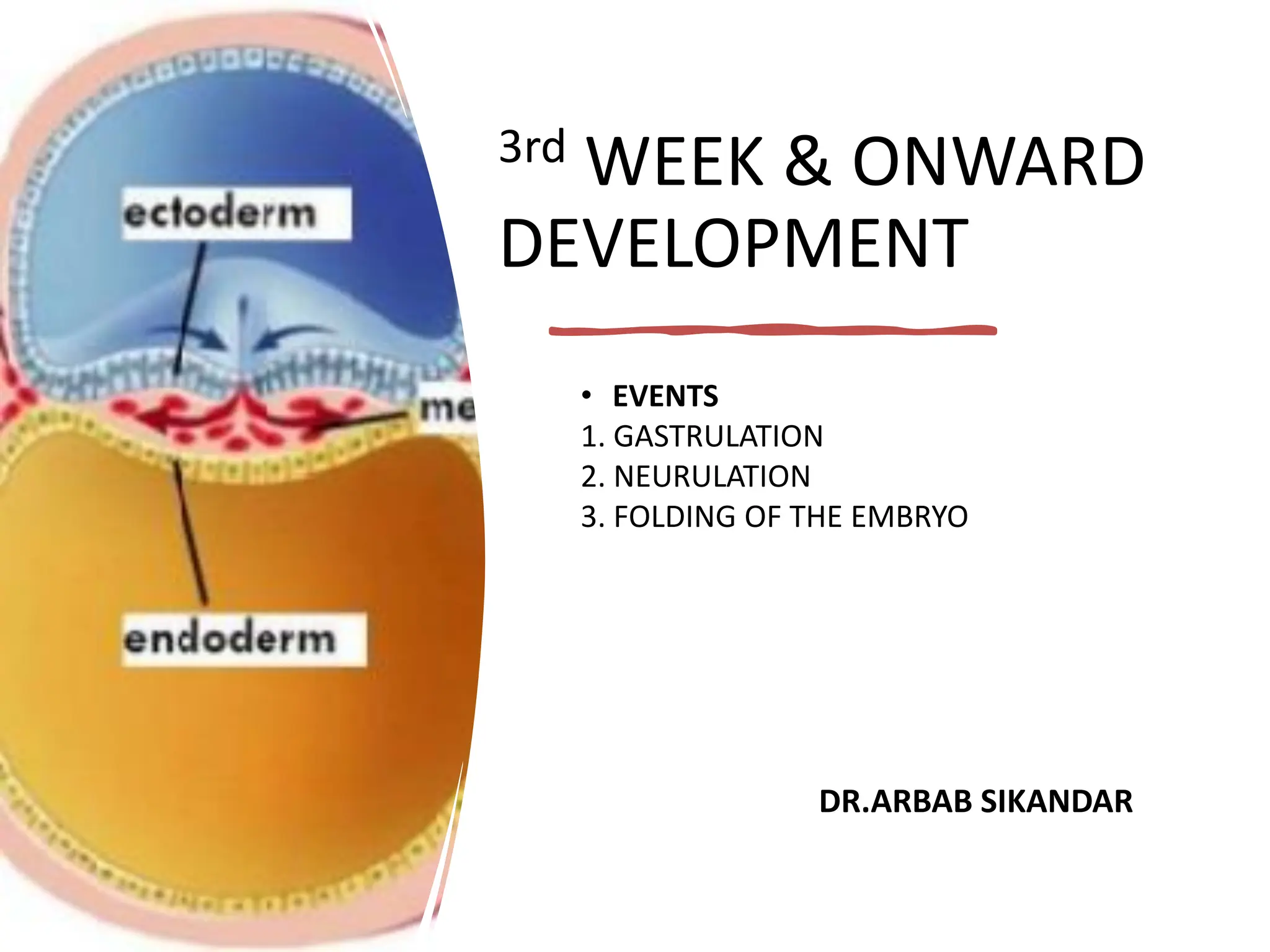
3rd WEEK & ONWARD
DEVELOPMENT
• EVENTS
1. GASTRULATION
2. NEURULATION
3. FOLDING OF THE EMBRYO
DR.ARBAB SIKANDAR
Learning outcomes
• By the end of this lecture the students will be
able to describe
• Gastrulation
• Primitive streak and node
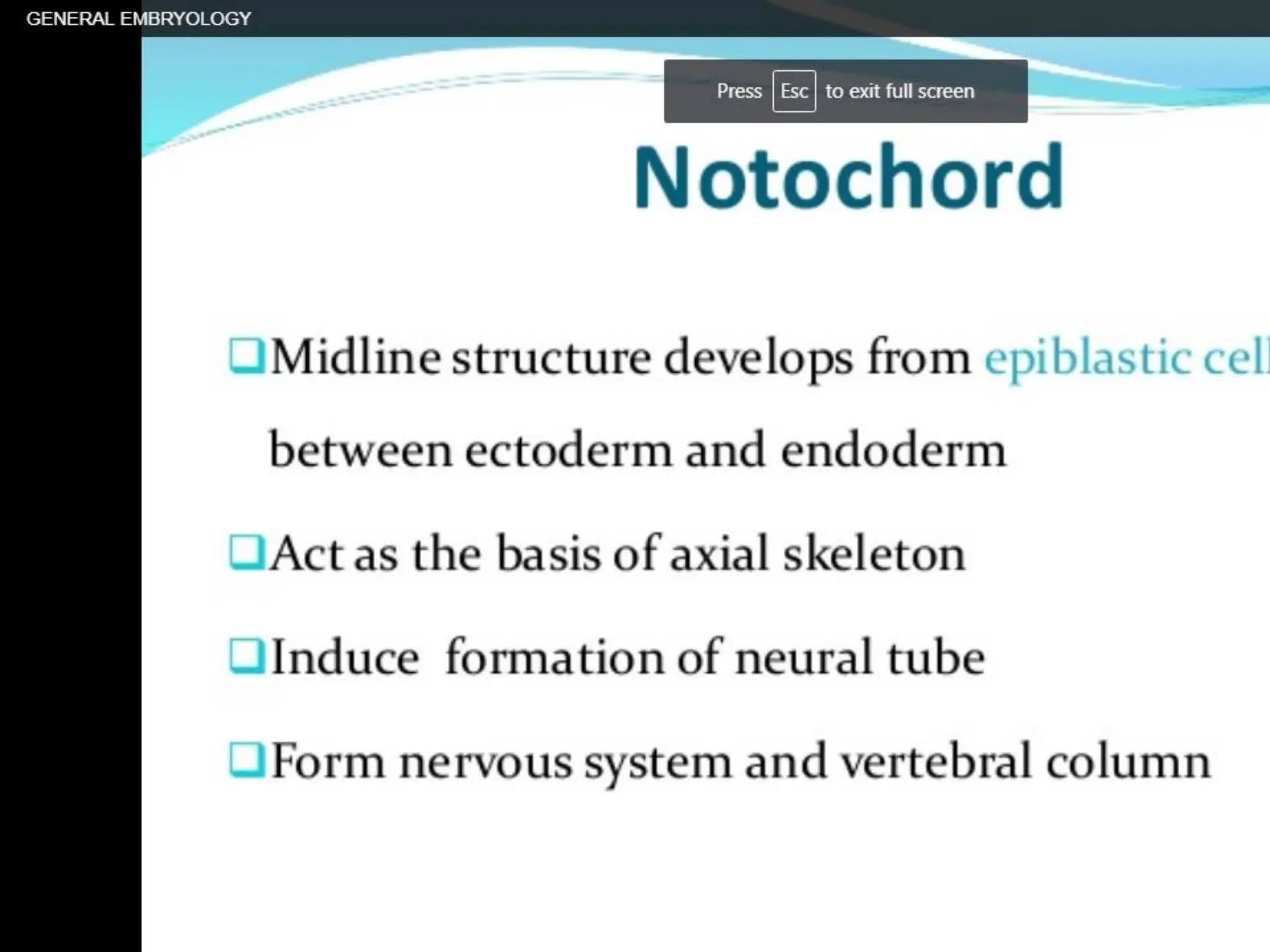
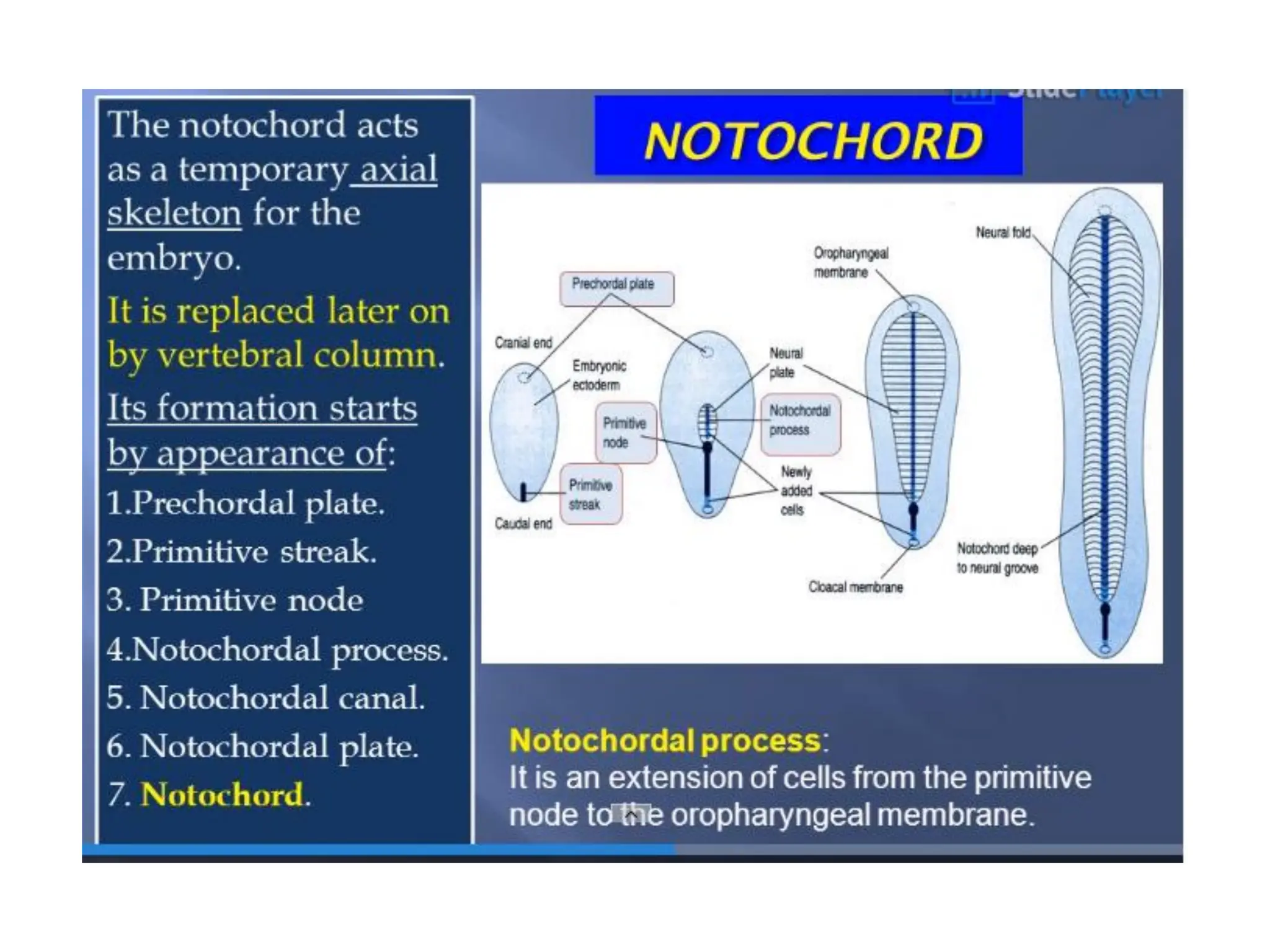
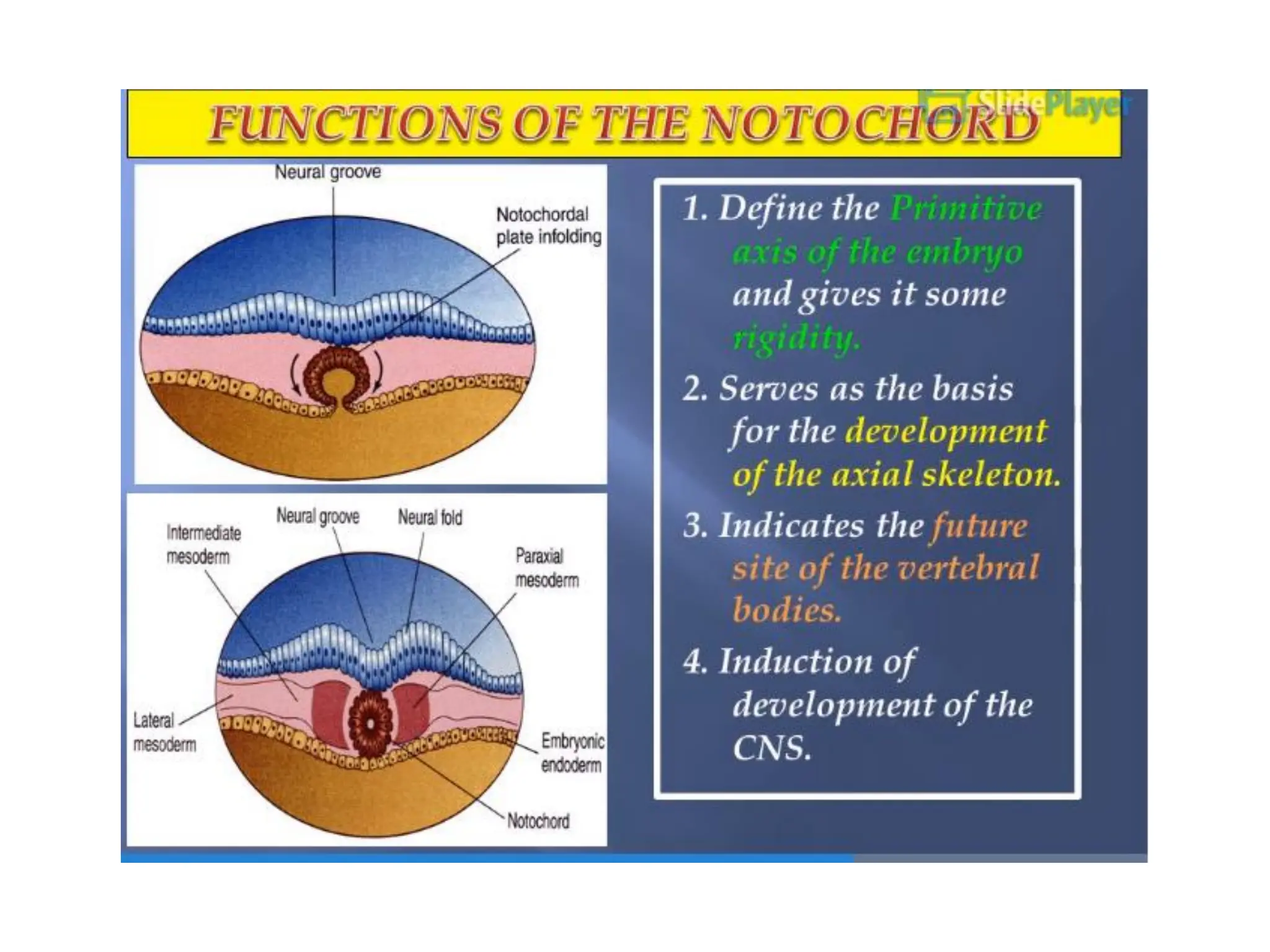
• Formation and function of notocord
• Fate map establishes during the gastrulation
• Somatomers and somites
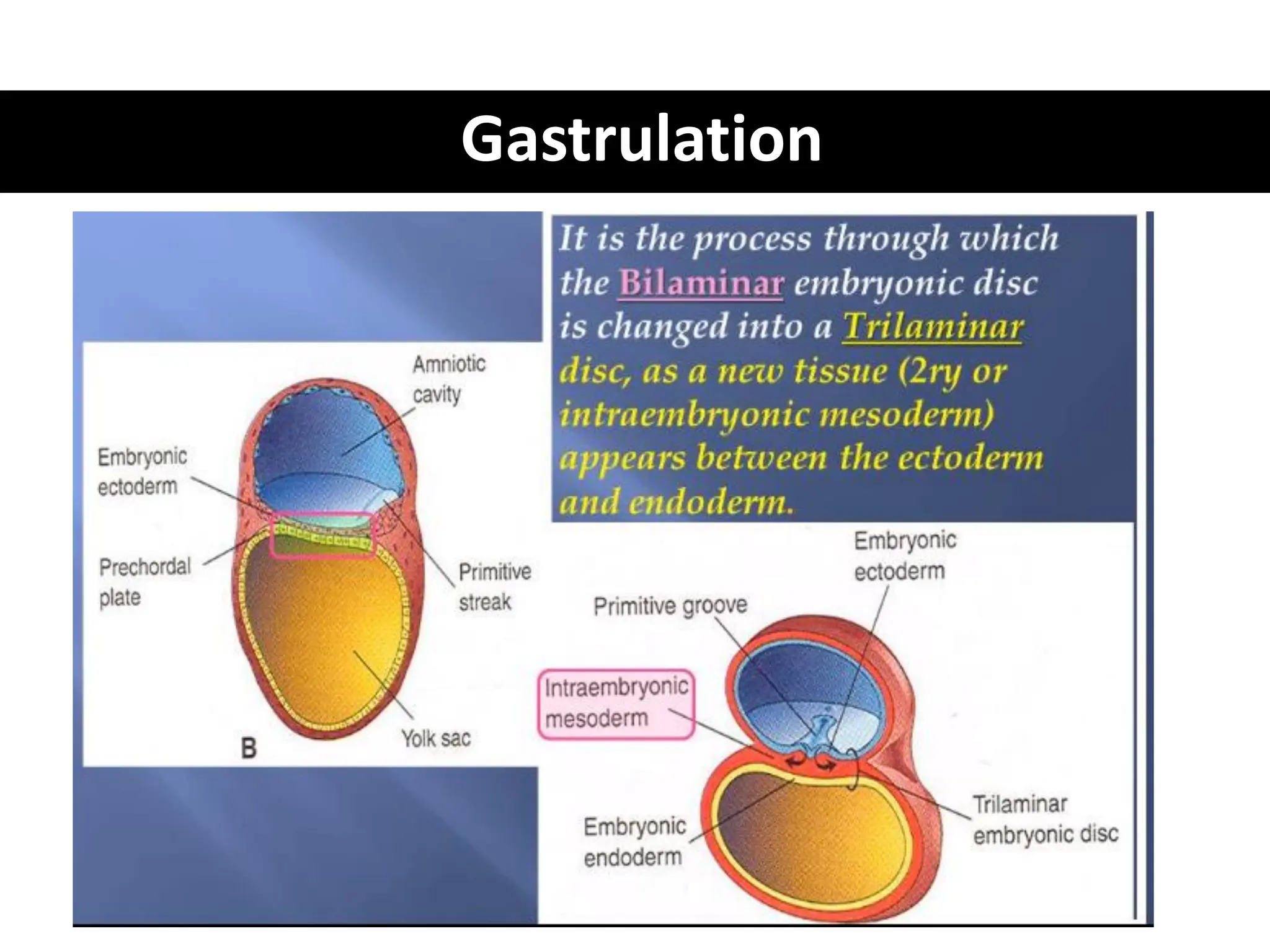
Gastrulation
s
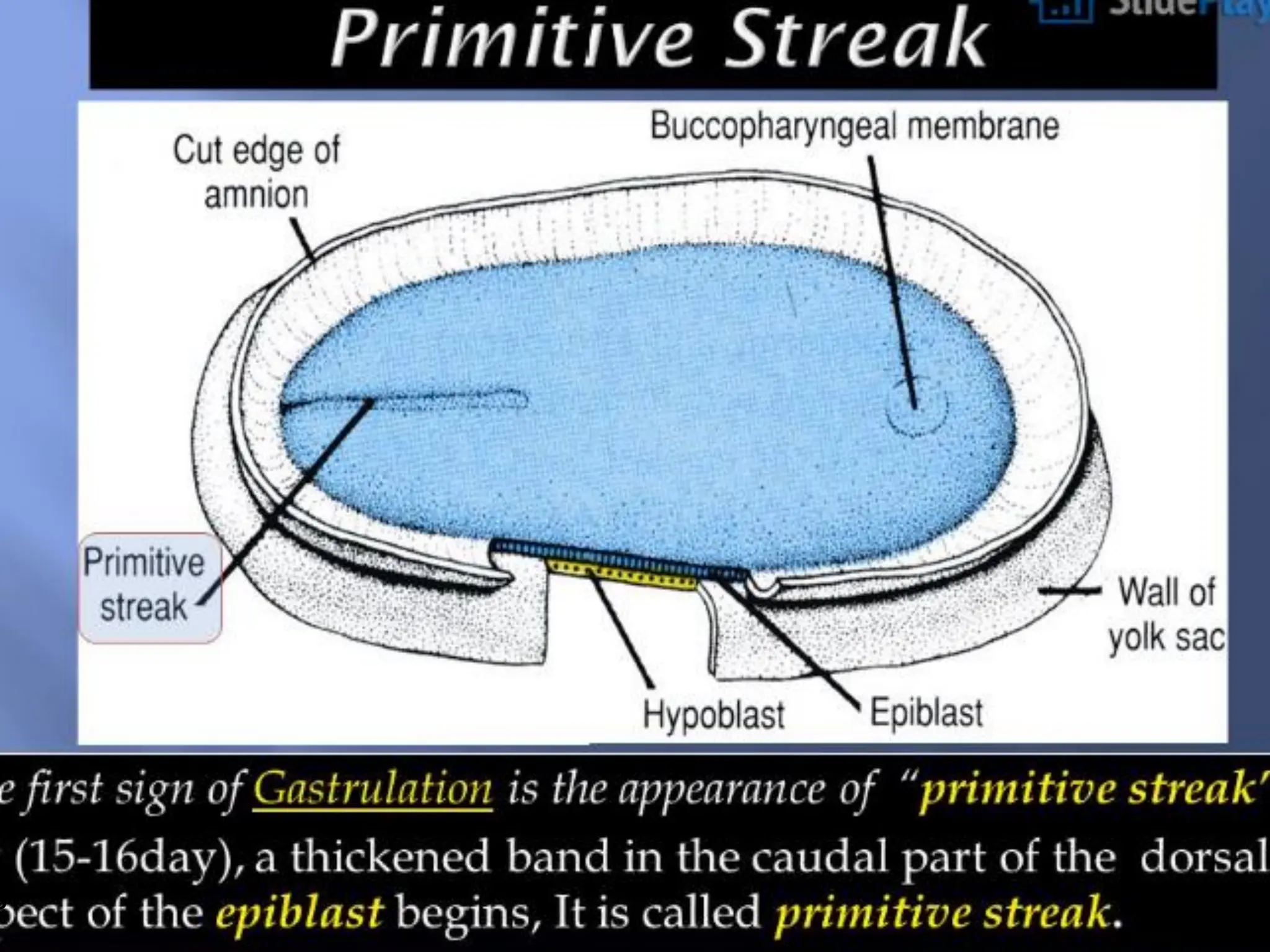
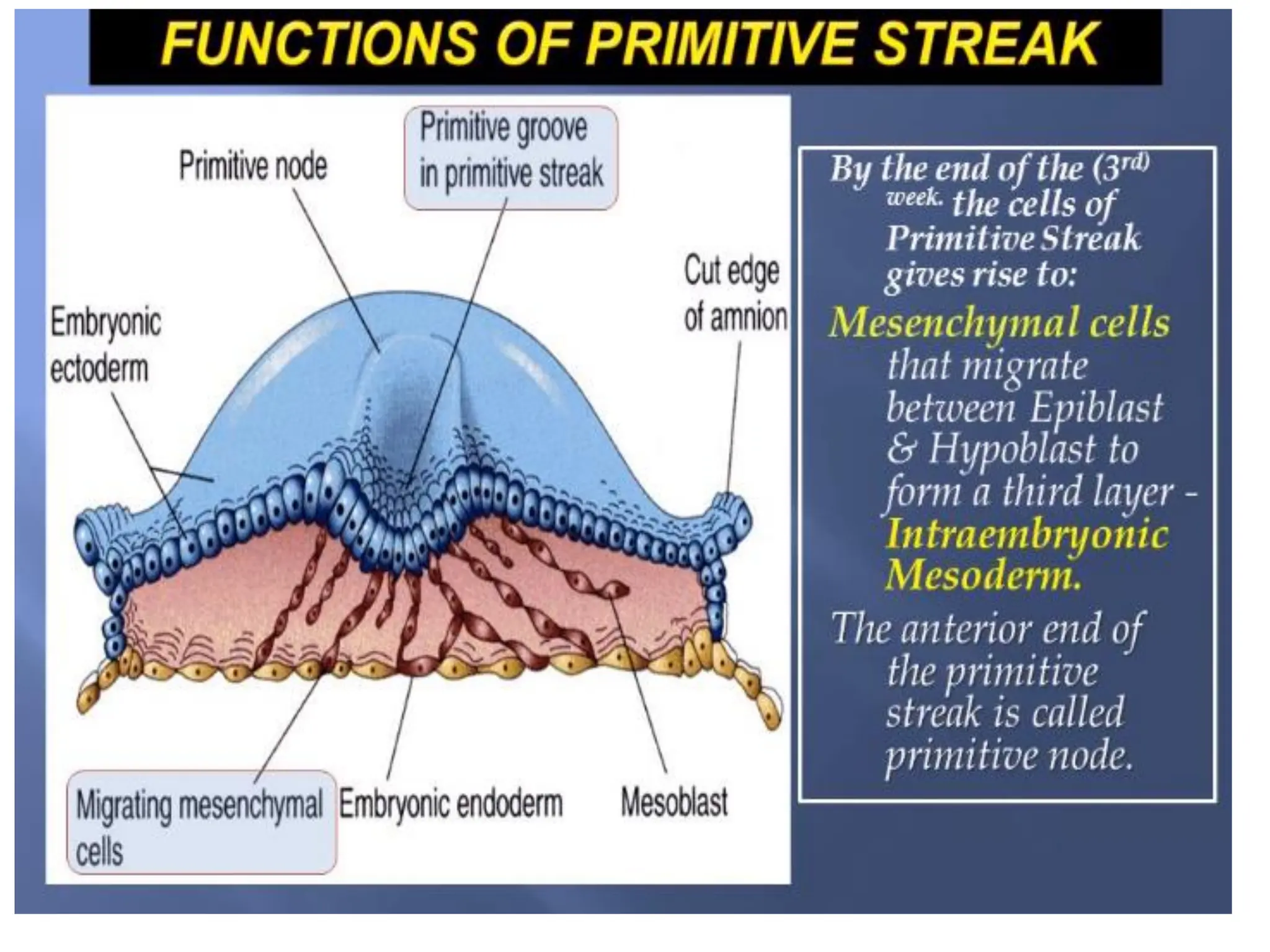
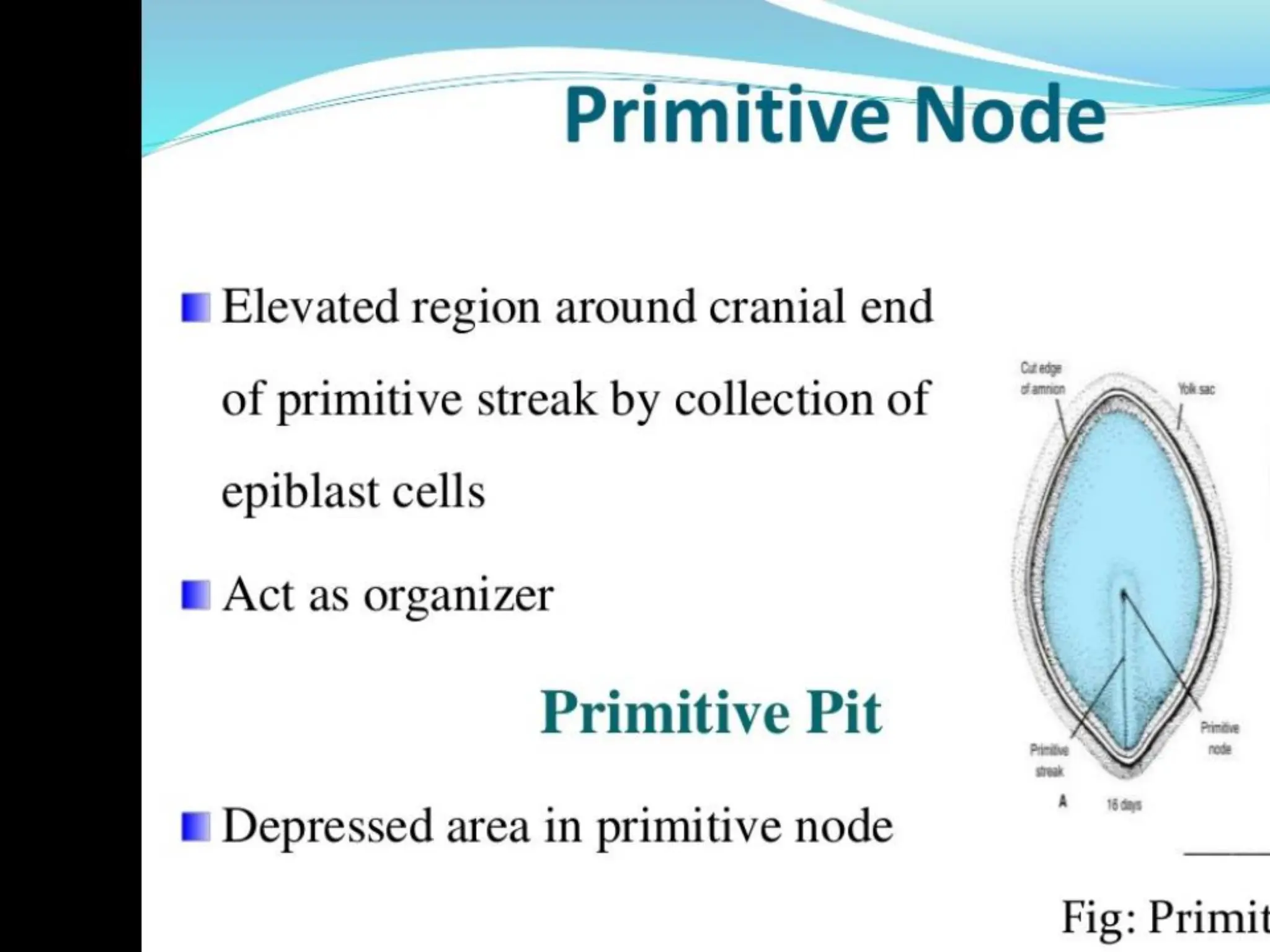
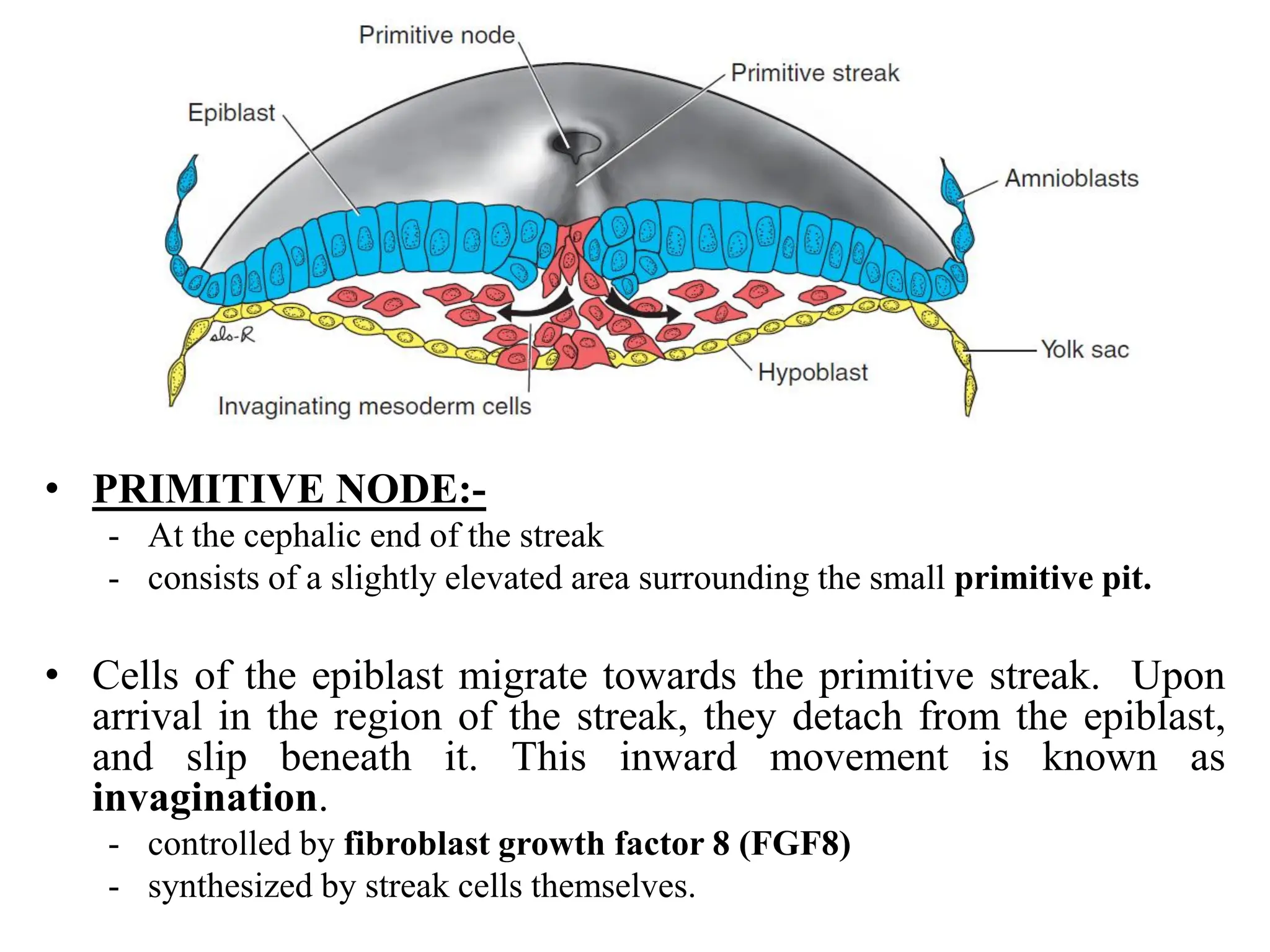
• PRIMITIVE NODE:-
- At the cephalic end of the streak
- consists of a slightly elevated area surrounding the small primitive pit.
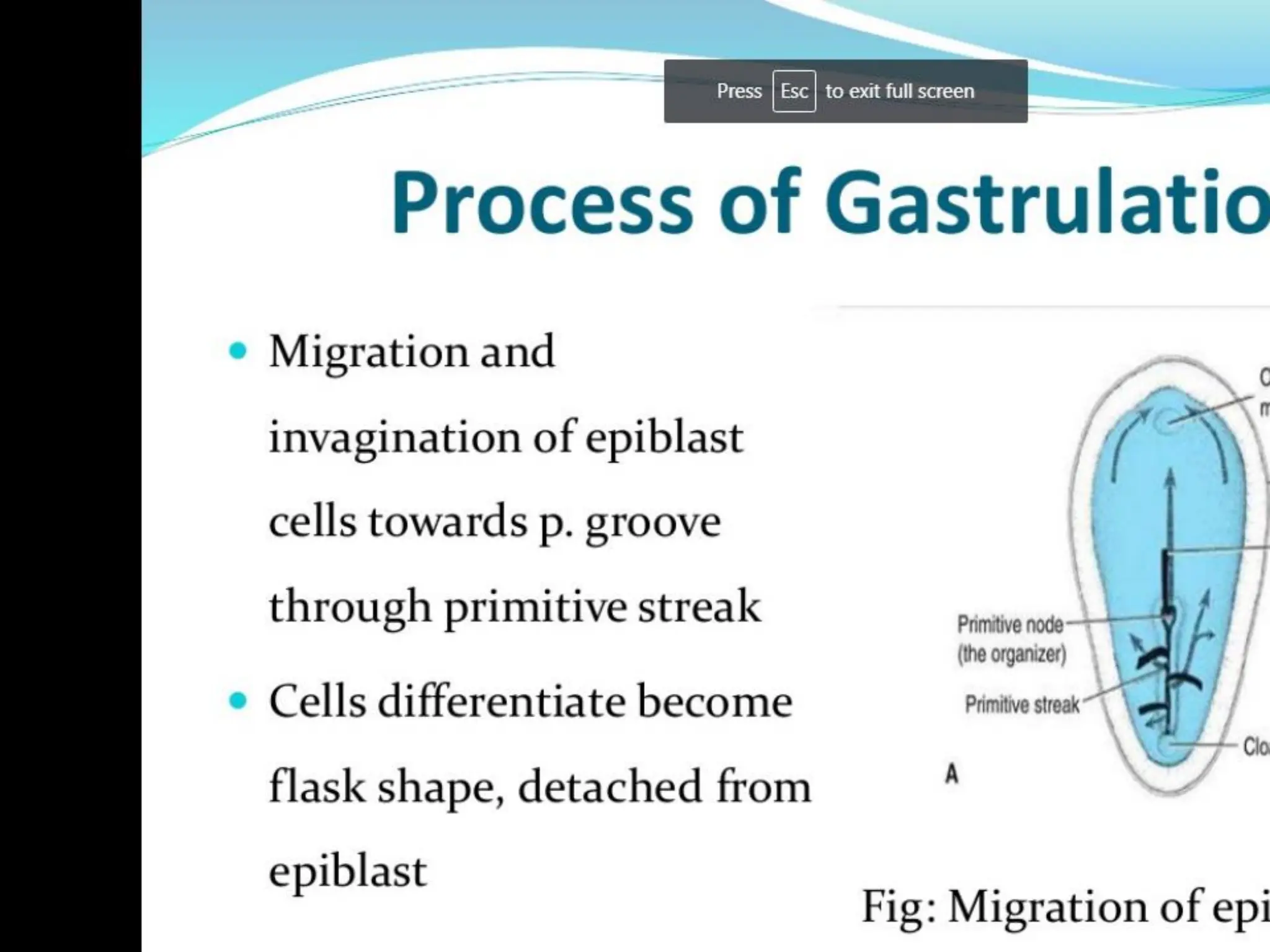
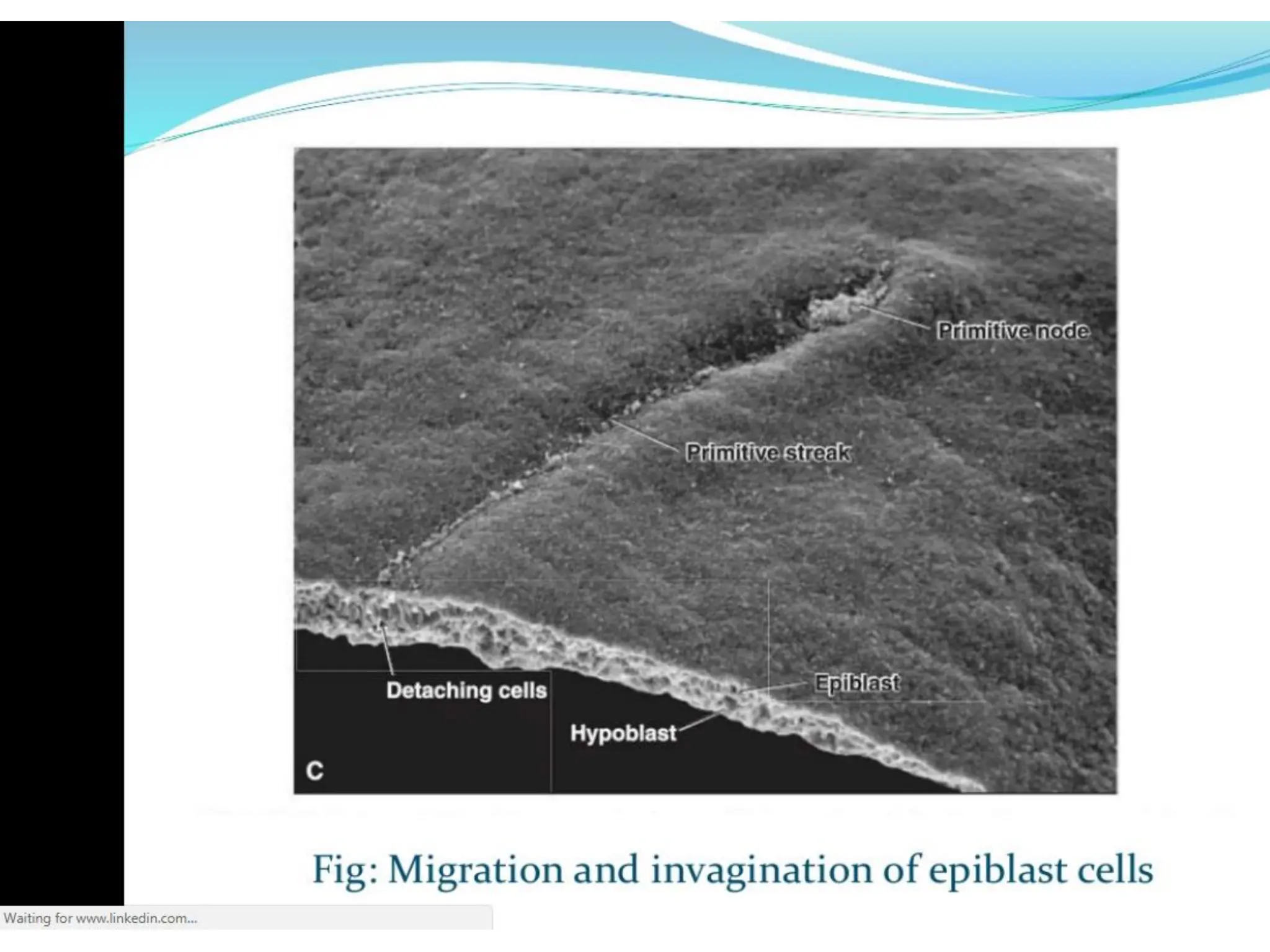
• Cells of the epiblast migrate towards the primitive streak. Upon
arrival in the region of the streak, they detach from the epiblast,
and slip beneath it. This inward movement is known as
invagination.
- controlled by fibroblast growth factor 8 (FGF8)
- synthesized by streak cells themselves.
INVAGINATION RESULTS IN THE
FORMATION OF GERM LAYERS
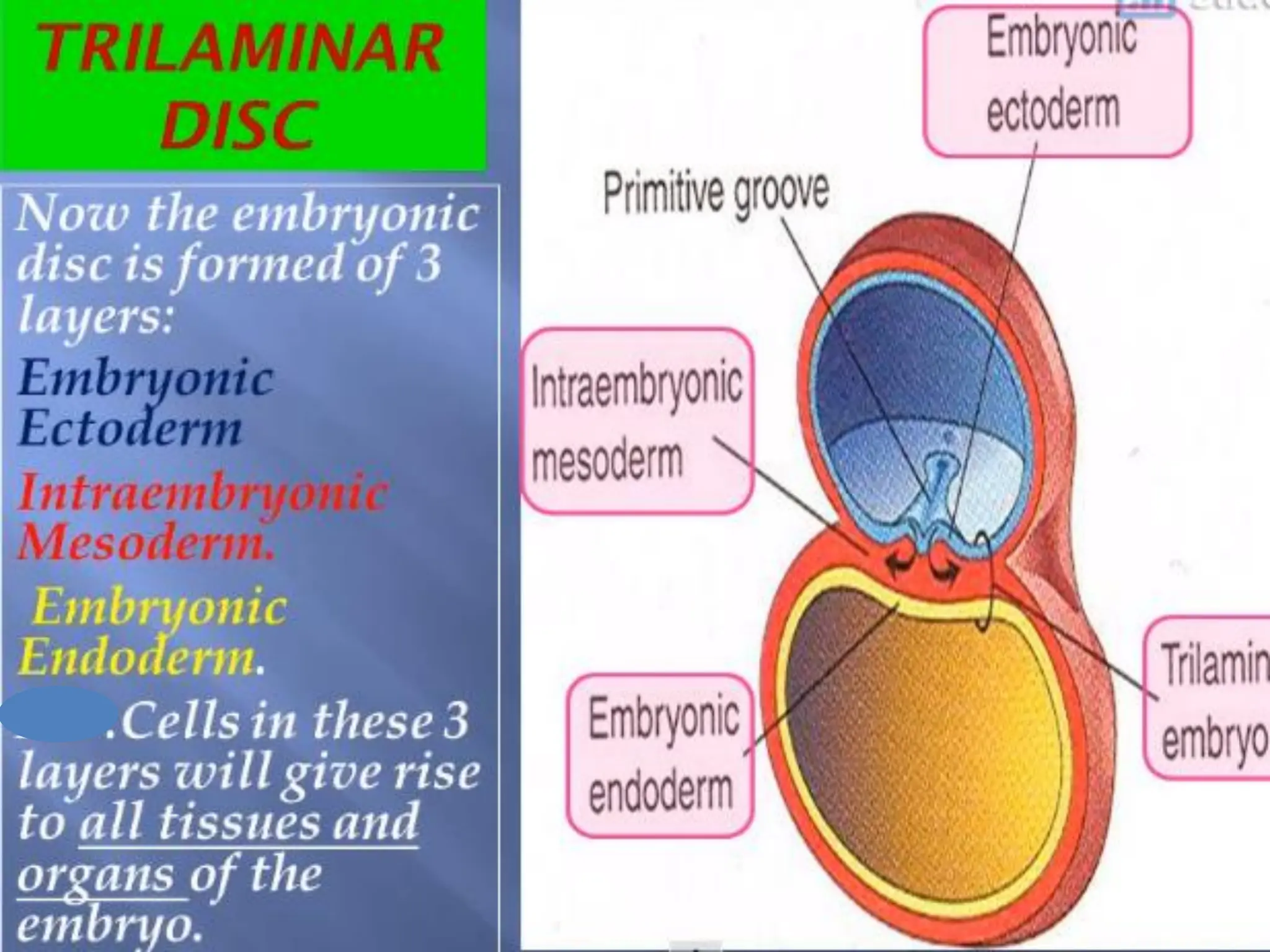
Once the cells have invaginated:-
• Some displace the hypoblast, creating the embryonic
endoderm.
• Others come to lie between the epiblast and newly
created endoderm to form mesoderm.
• Cells remaining in the epiblast then form ectoderm.
• Thus, the epiblast, through the process of gastrulation,
is the source of all of the germ layers
• Cells in these layers will give rise to all of the tissues
and organs in the embryo.
Oropharyngeal membrane
• A small region of tightly adherent ectoderm
and endoderm cells at the cranial end of disc
with no intervening mesoderm.
• Future opening of the oral cavity
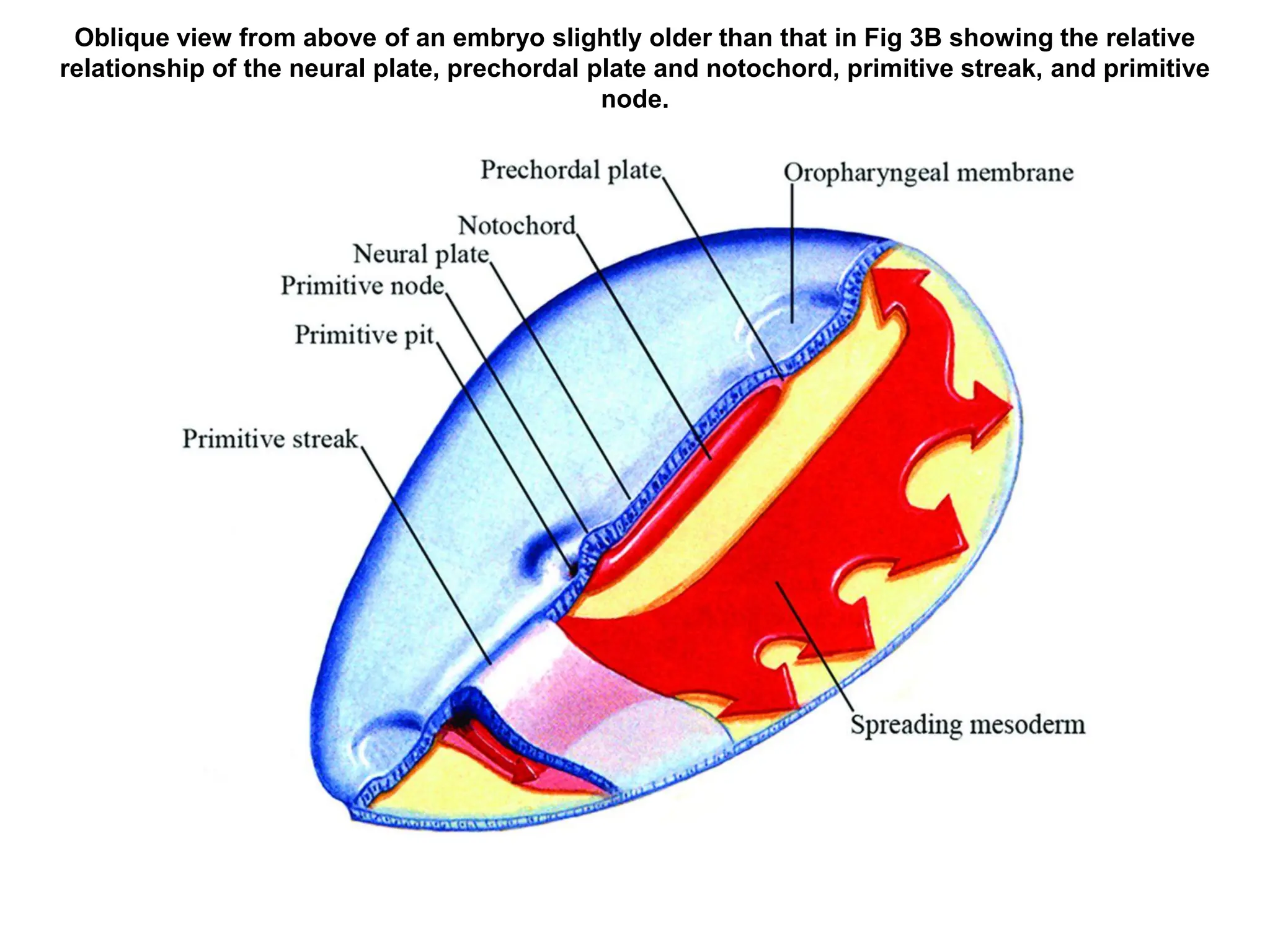
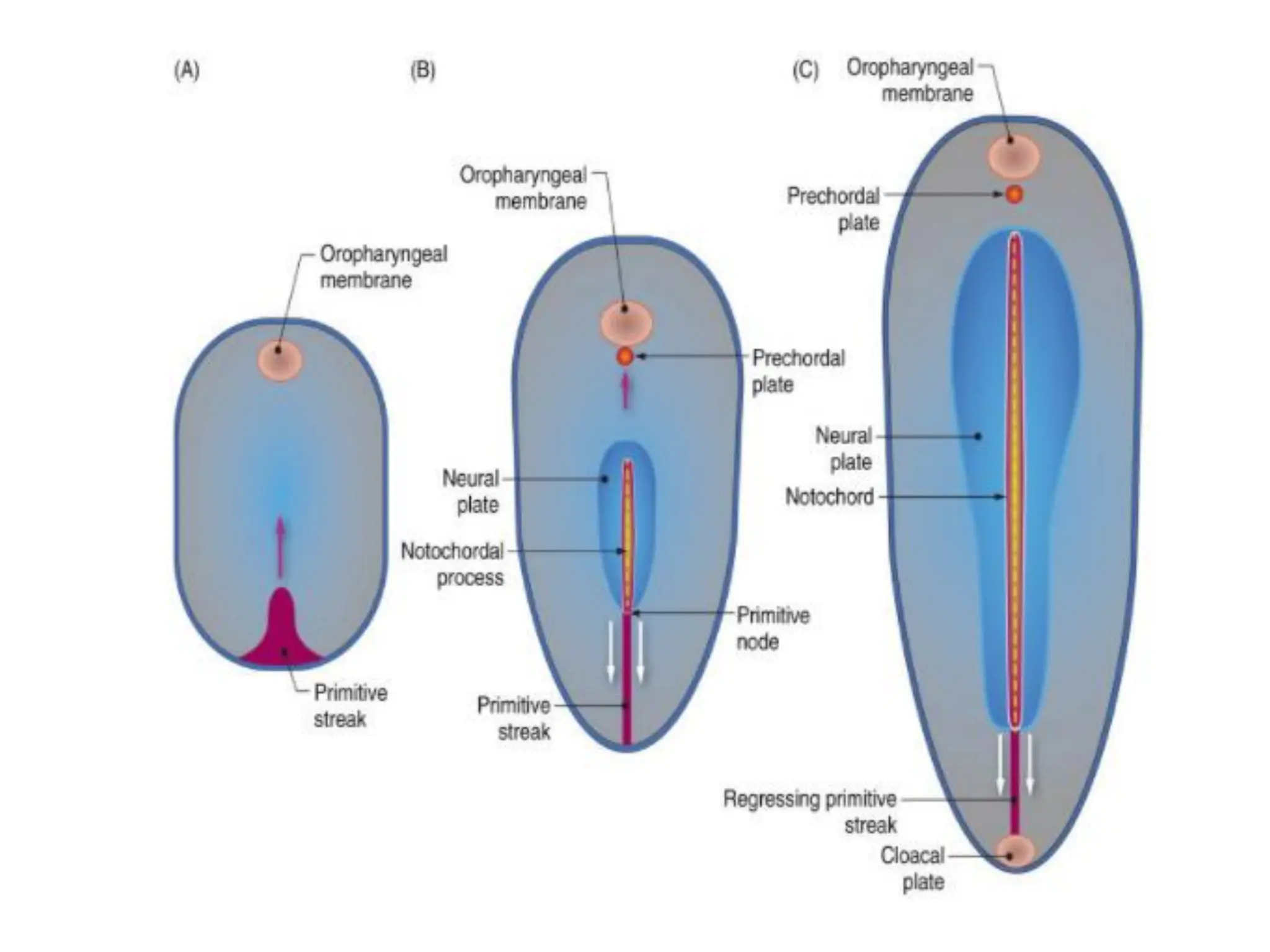
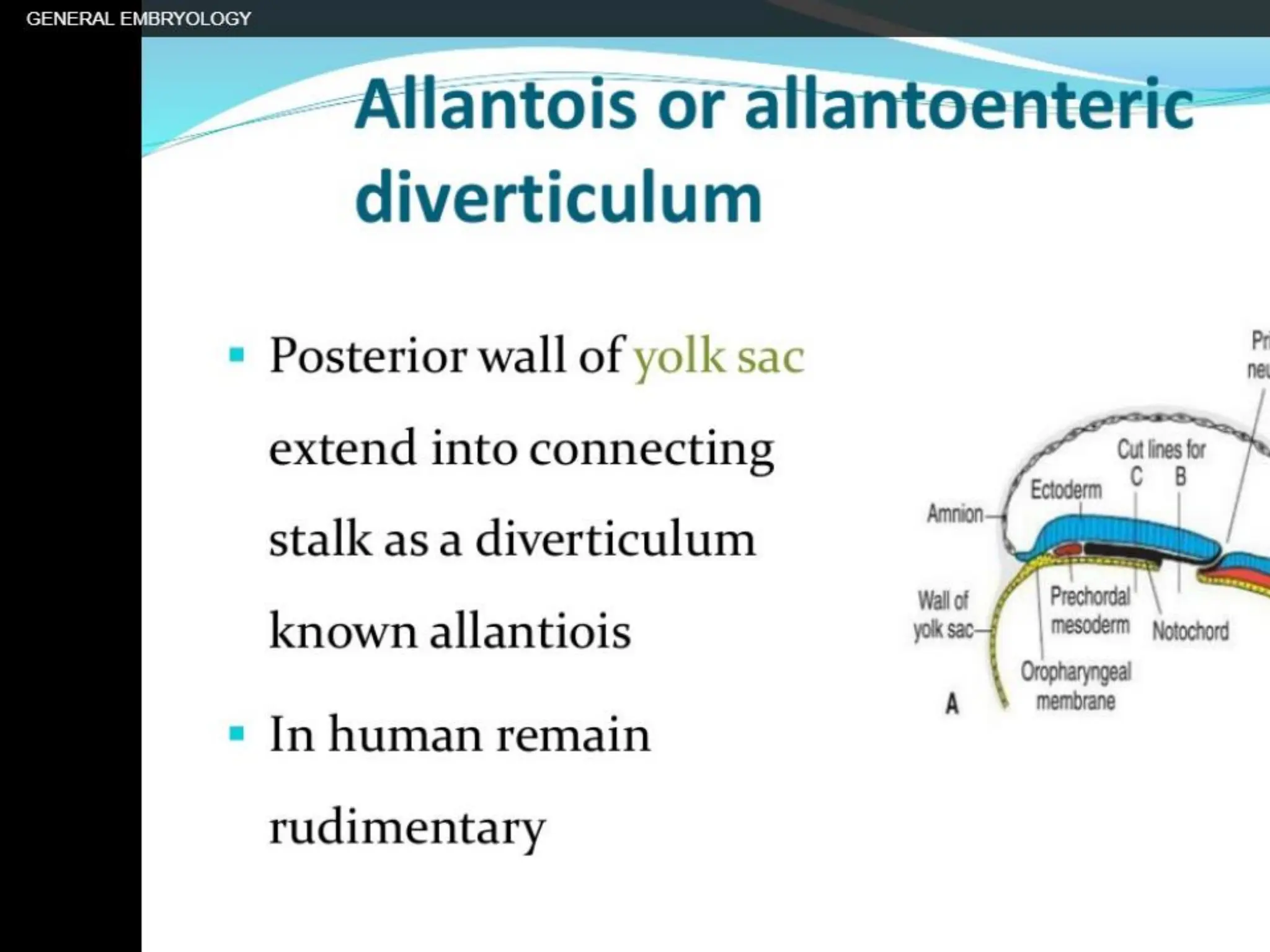
Oblique view from above of an embryo slightly older than that in Fig 3B showing the relative
relationship of the neural plate, prechordal plate and notochord, primitive streak, and primitive
node.
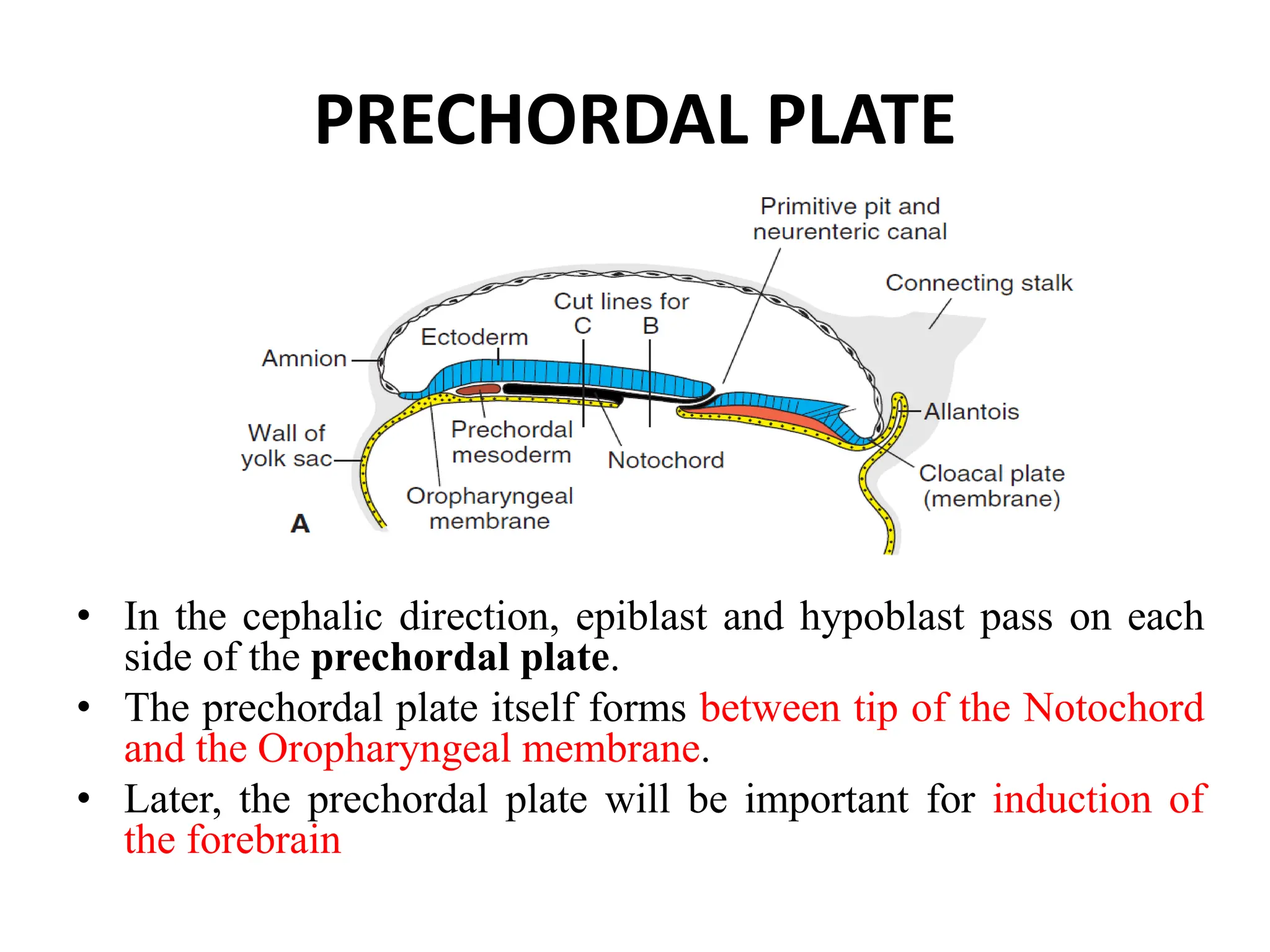
PRECHORDAL PLATE
• In the cephalic direction, epiblast and hypoblast pass on each
side of the prechordal plate.
• The prechordal plate itself forms between tip of the Notochord
and the Oropharyngeal membrane.
• Later, the prechordal plate will be important for induction of
the forebrain
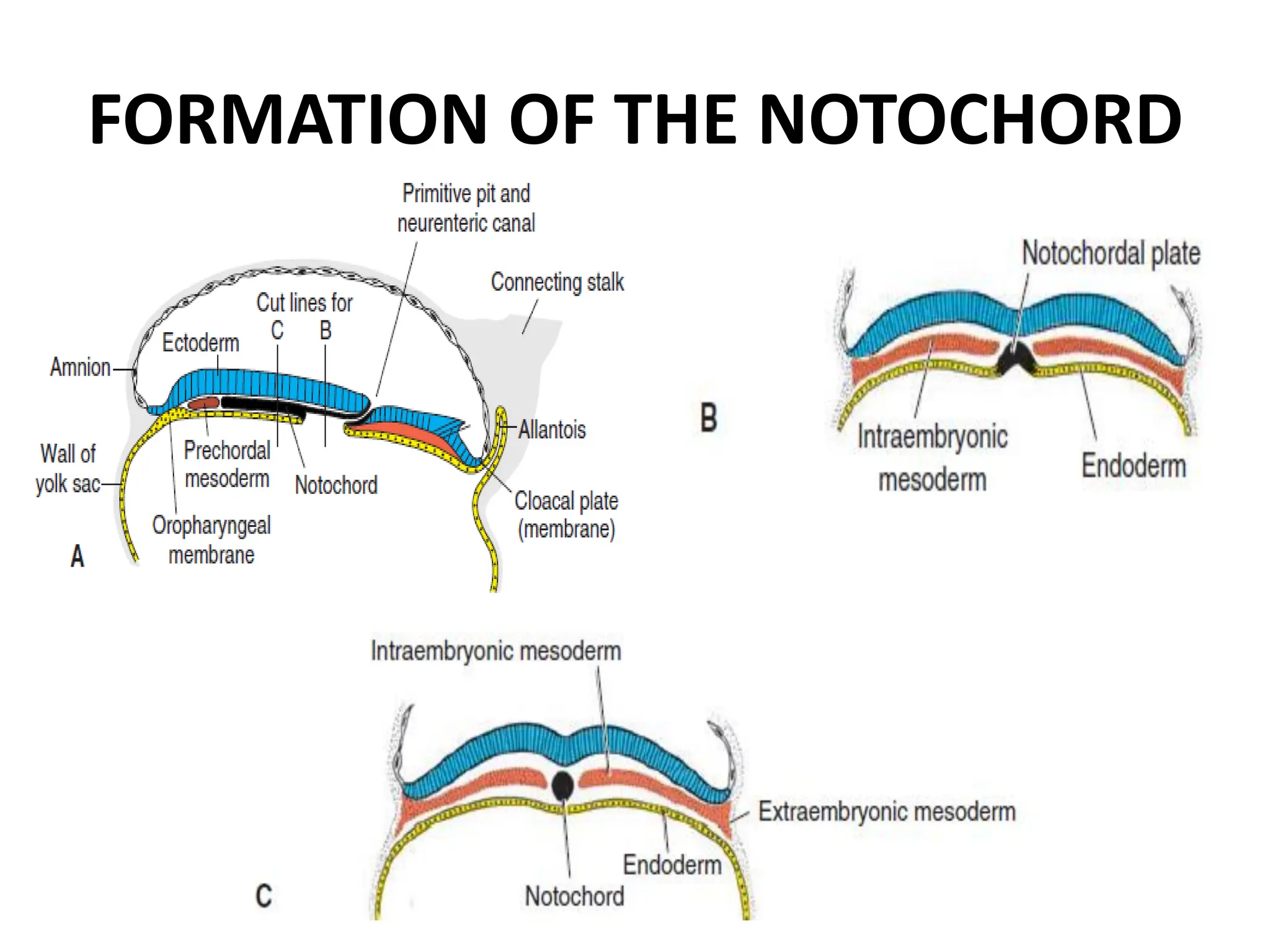
FORMATION OF THE NOTOCHORD
FORMATION OF THE NOTOCHORD…
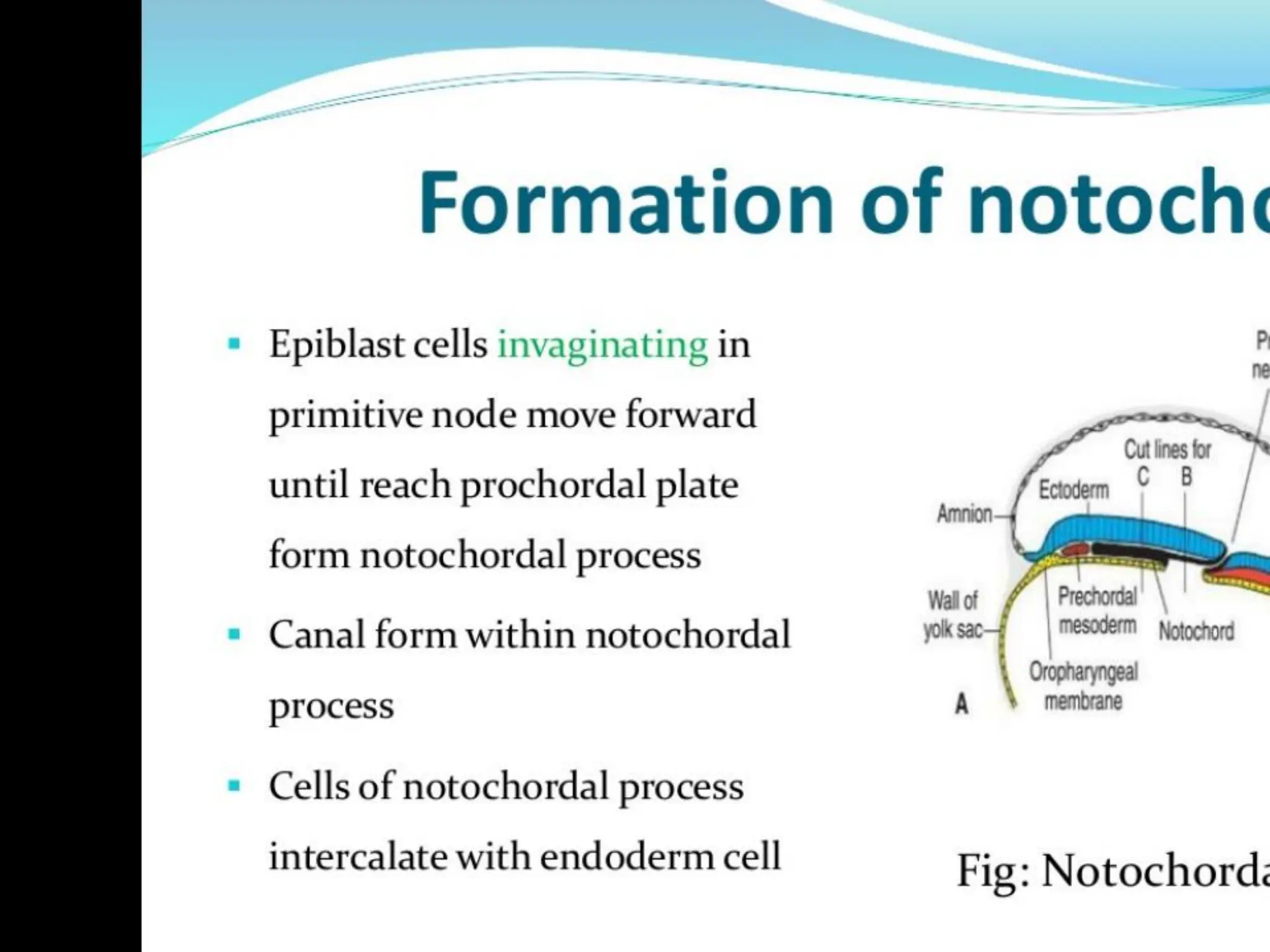
• Prenotochordal cells migrate through the
primitive streak, become intercalated in the
endoderm to form the notochordal plate, and
finally detach from the endoderm to form the
definitive notochord.
• Because these events occur in a cranial-to-
caudal sequence, portions of the definitive
notochord are established in the head region
first.
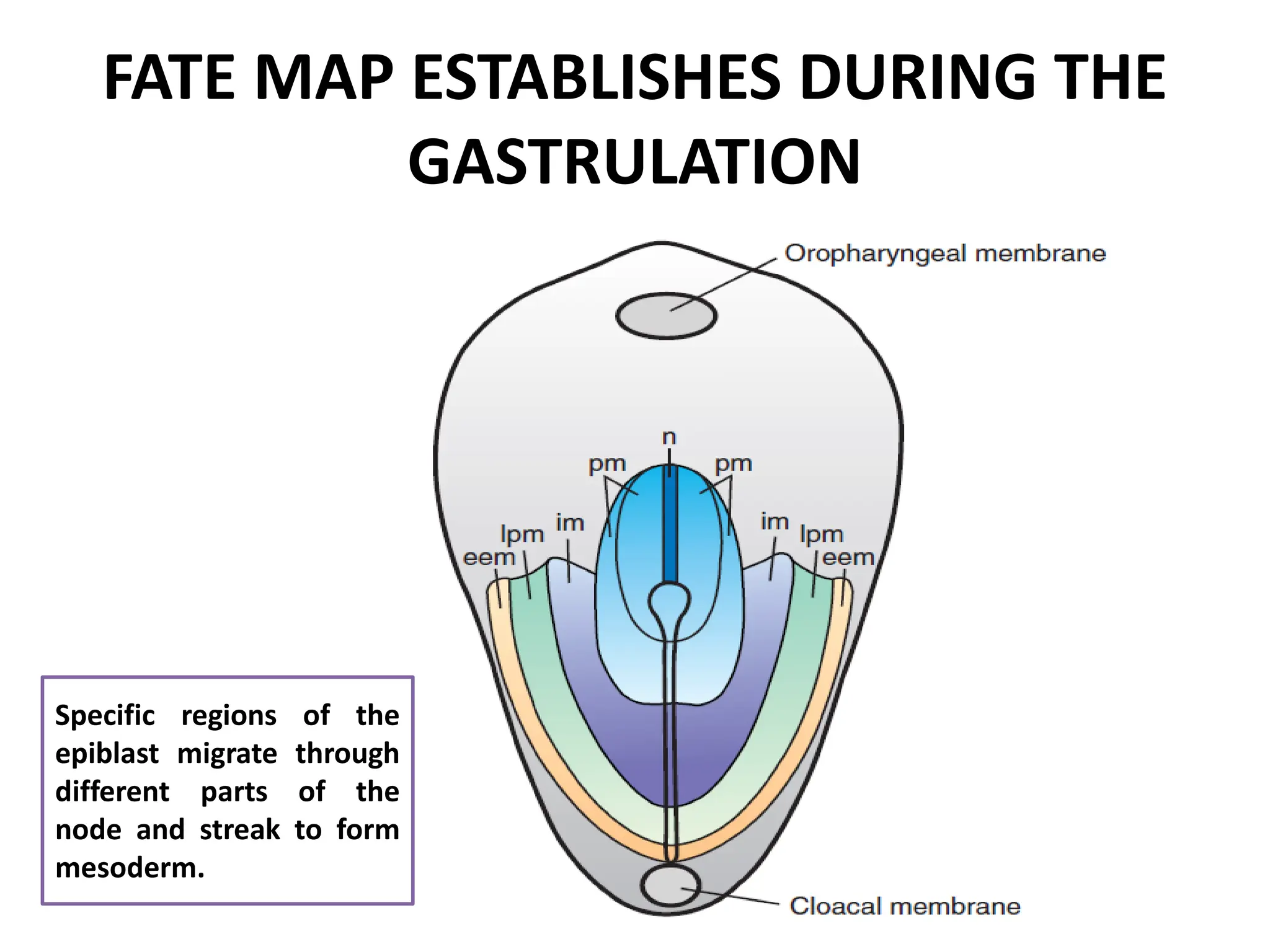
FATE MAP ESTABLISHES DURING THE
GASTRULATION
Specific regions of the
epiblast migrate through
different parts of the
node and streak to form
mesoderm.
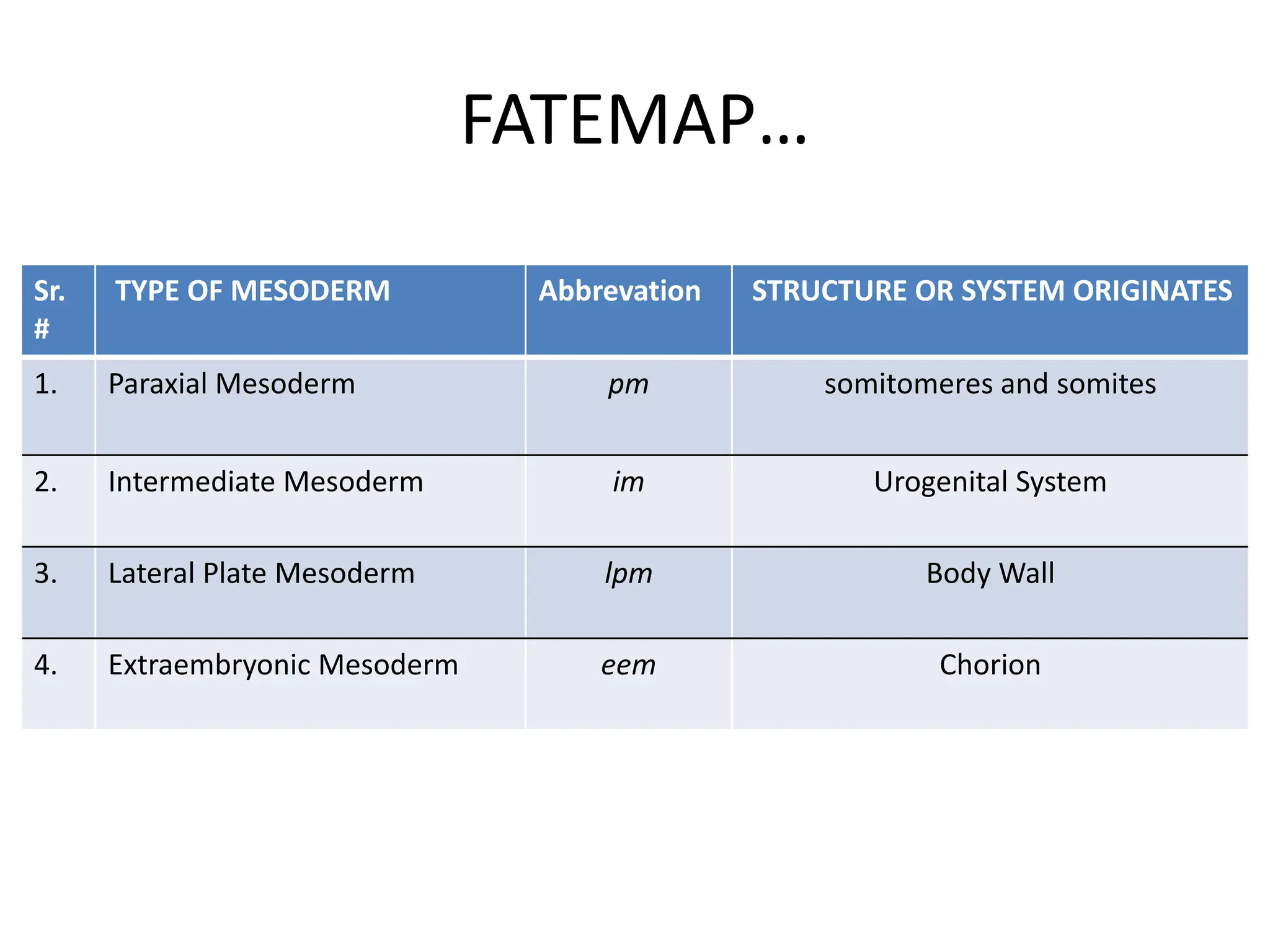
FATE MAP…
• Cells migrating at the cranial most part of the node will
form the notochord (n)
• Those migrating more posteriorly through the node and
cranial most aspect of the streak will form paraxial
mesoderm (pm)
• Those migrating through the next portion of the streak
will form intermediate mesoderm (im)
• Those migrating through the more caudal part of the
streak will form lateral plate mesoderm (lpm)
• Those migrating through the most caudal part will
contribute to extraembryonic mesoderm (eem)
FATEMAP…
Sr.
#
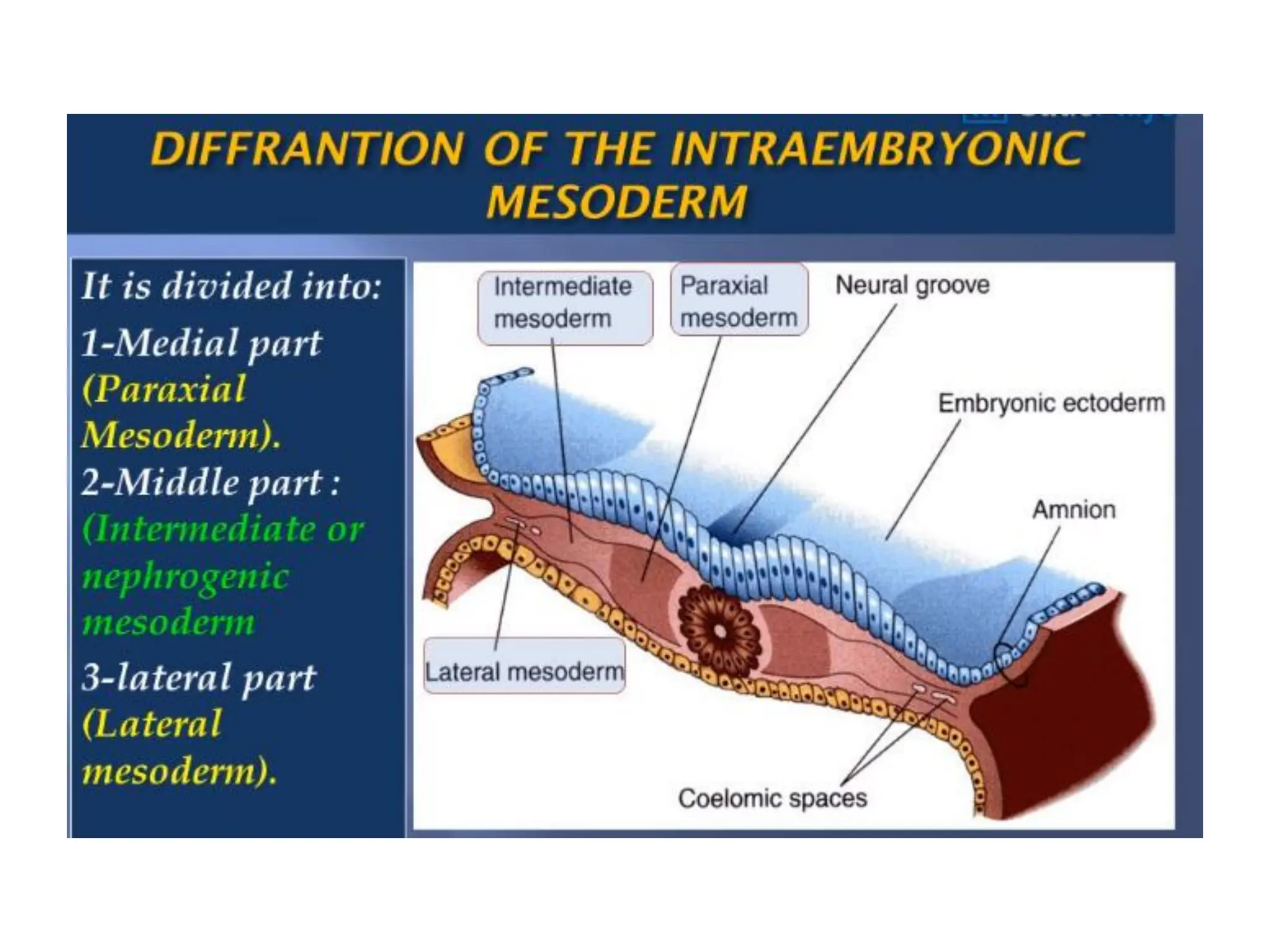
TYPE OF MESODERM Abbrevation STRUCTURE OR SYSTEM ORIGINATES
1. Paraxial Mesoderm pm somitomeres and somites
2. Intermediate Mesoderm im Urogenital System
3. Lateral Plate Mesoderm lpm Body Wall
4. Extraembryonic Mesoderm eem Chorion
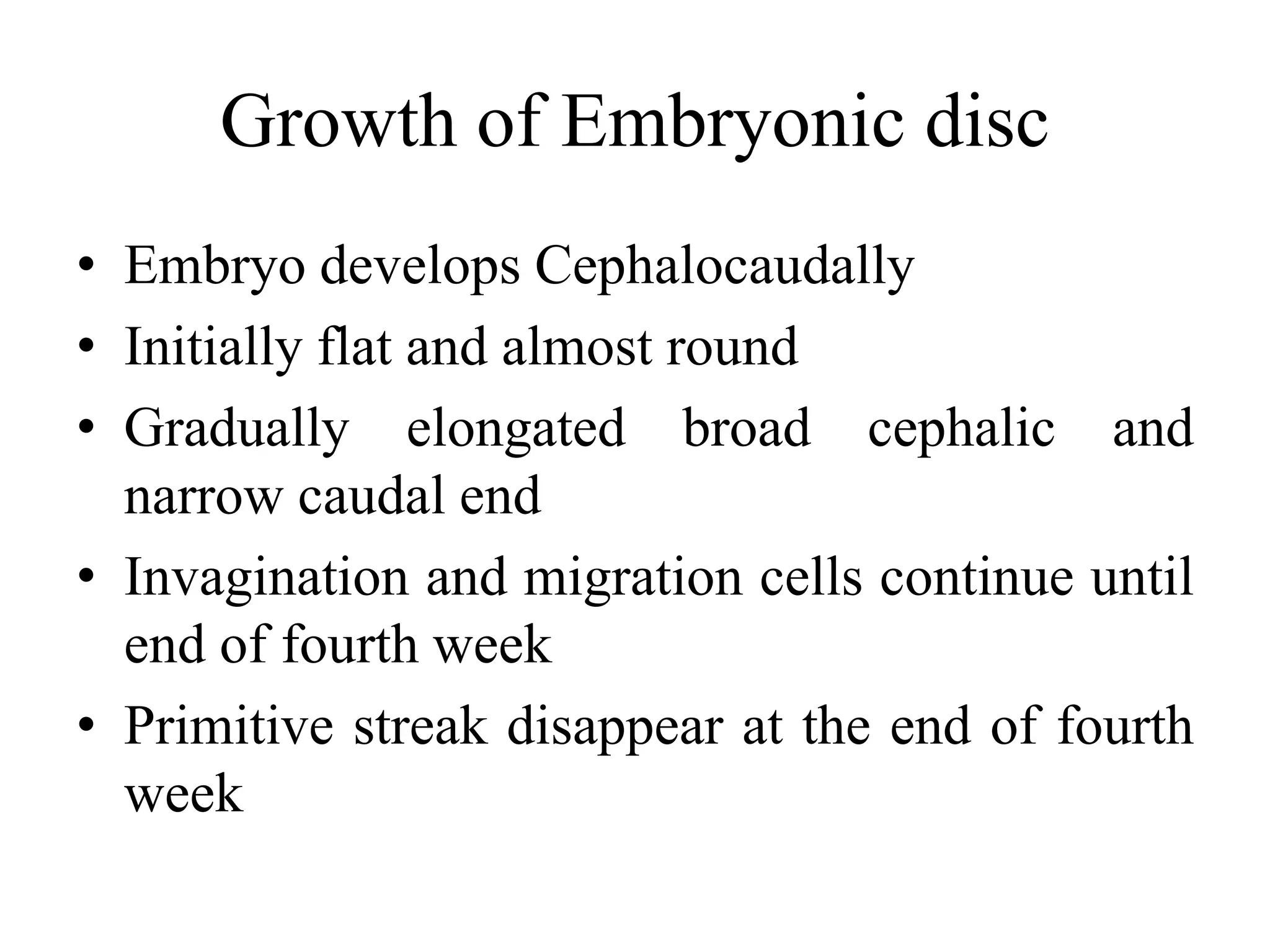
Growth of Embryonic disc
• Embryo develops Cephalocaudally
• Initially flat and almost round
• Gradually elongated broad cephalic and
narrow caudal end
• Invagination and migration cells continue until
end of fourth week
• Primitive streak disappear at the end of fourth
week
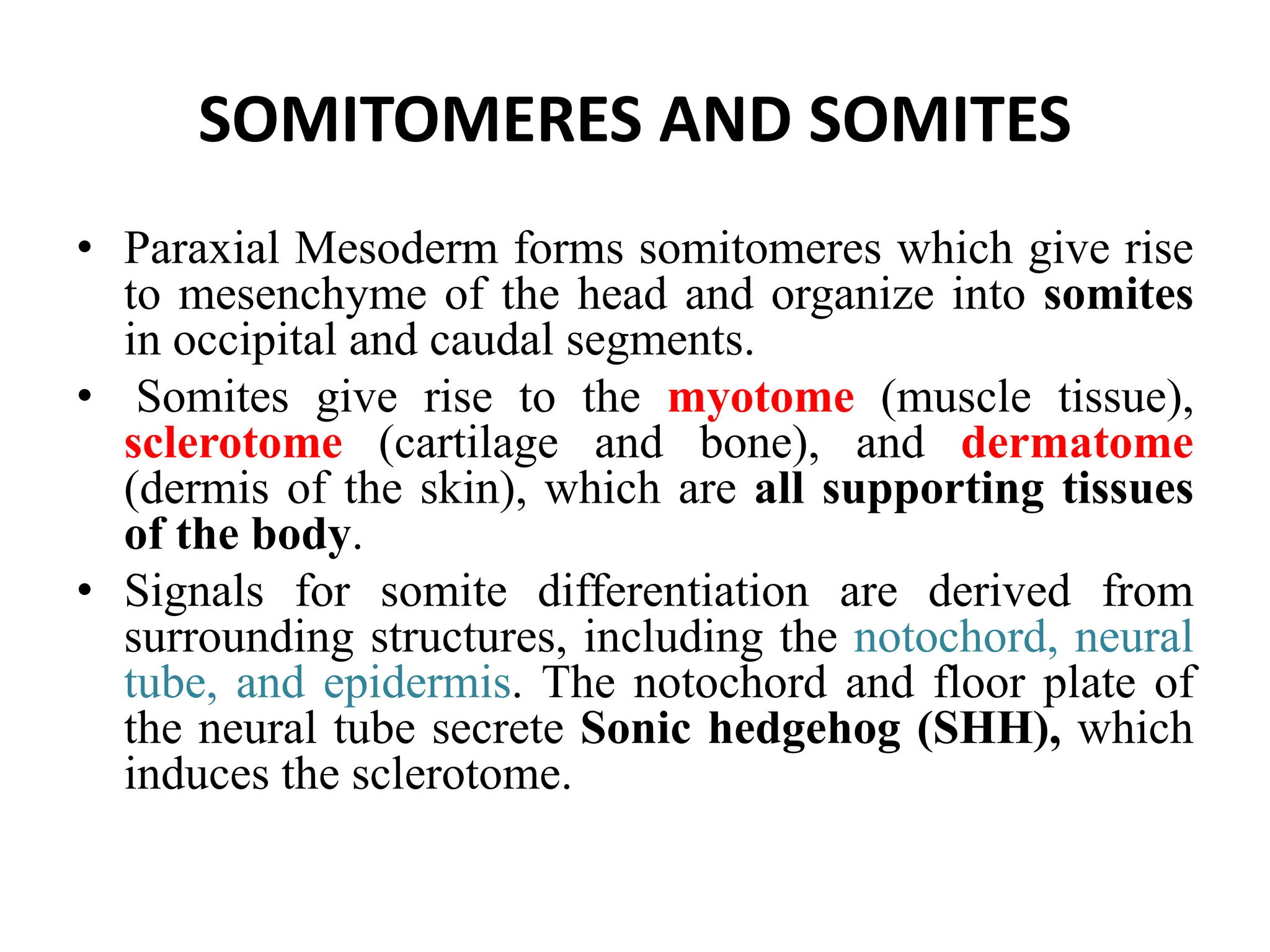
SOMITOMERES AND SOMITES
• Paraxial Mesoderm forms somitomeres which give rise
to mesenchyme of the head and organize into somites
in occipital and caudal segments.
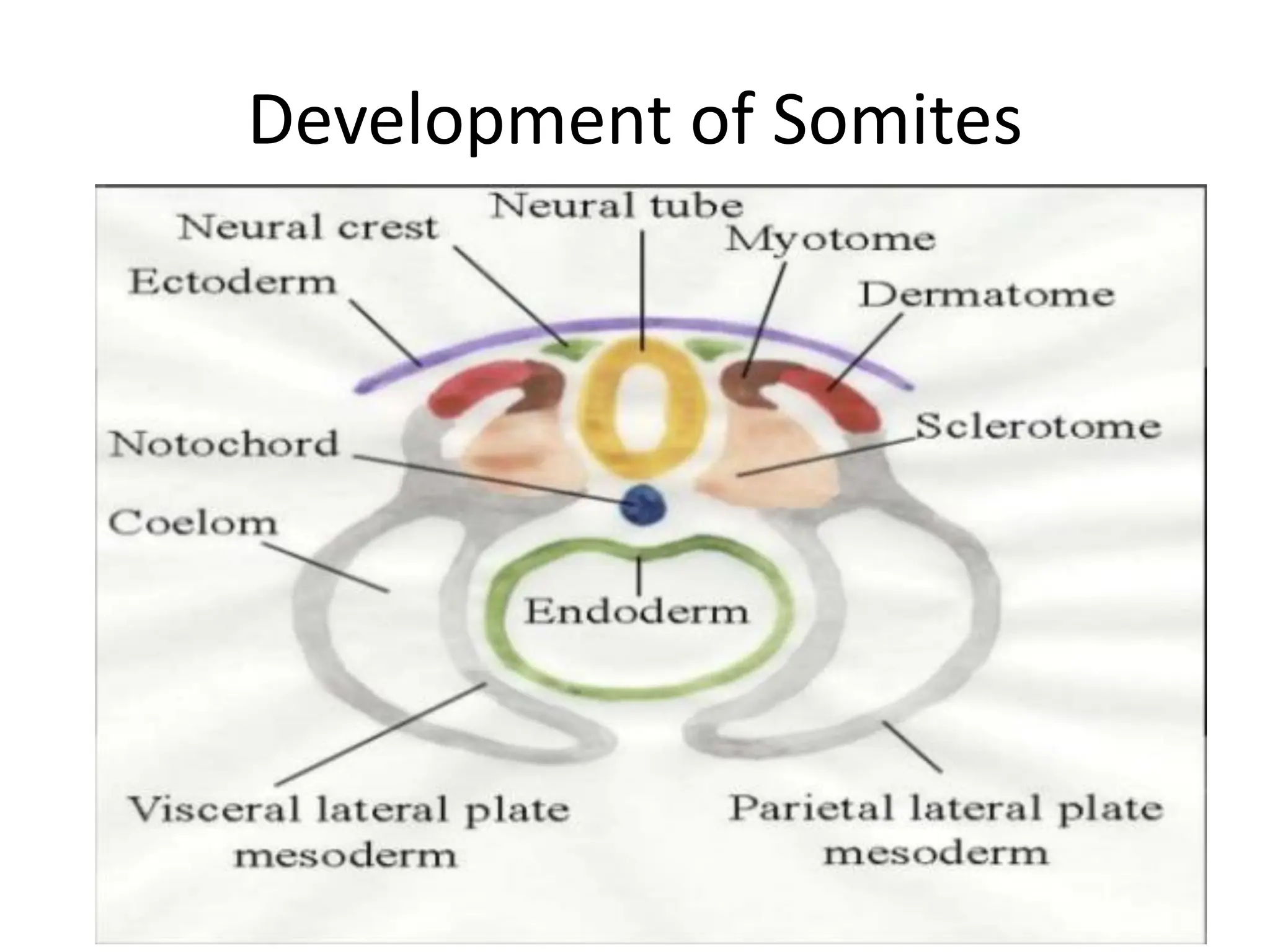
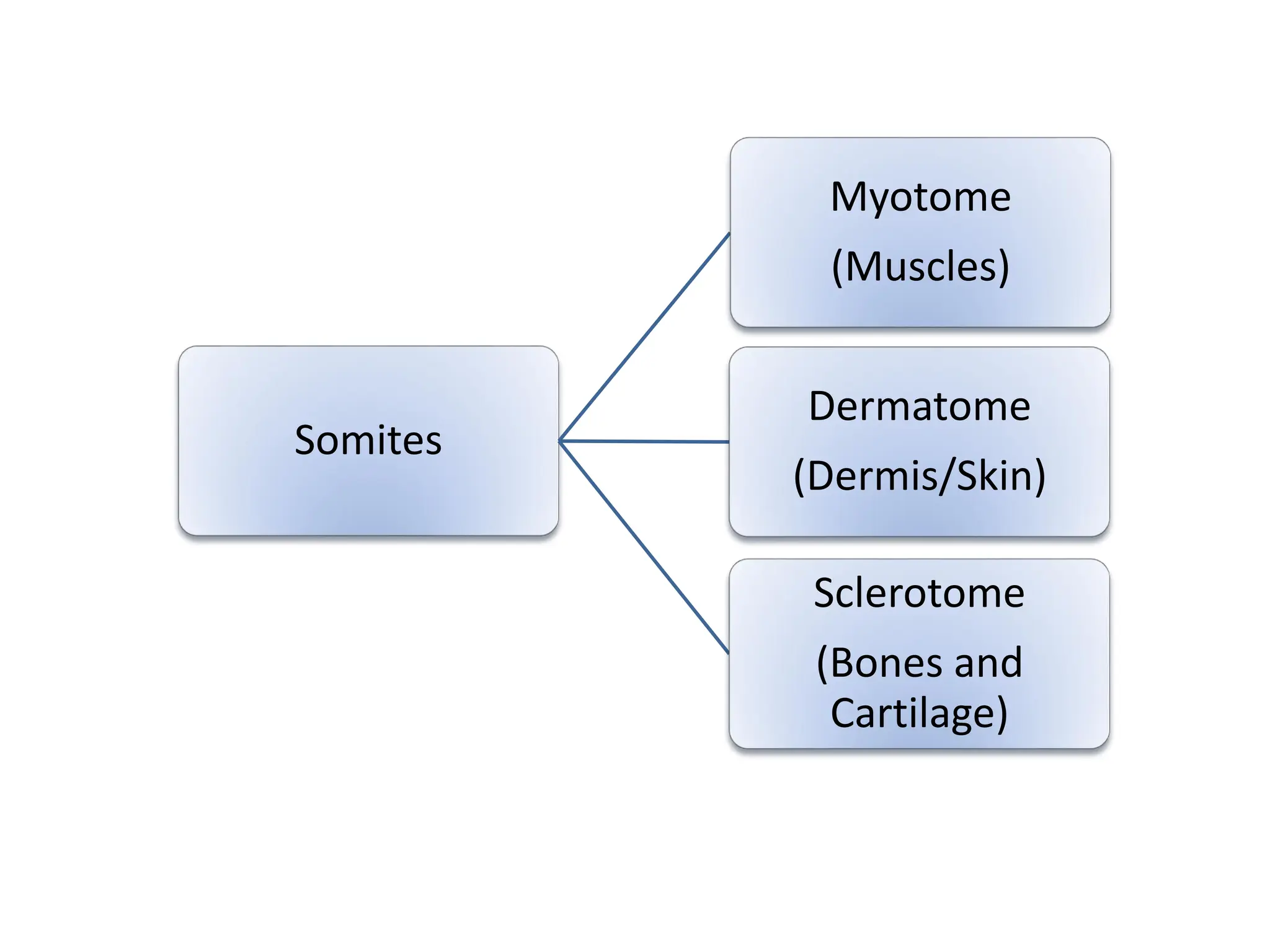
• Somites give rise to the myotome (muscle tissue),
sclerotome (cartilage and bone), and dermatome
(dermis of the skin), which are all supporting tissues
of the body.
• Signals for somite differentiation are derived from
surrounding structures, including the notochord, neural
tube, and epidermis. The notochord and floor plate of
the neural tube secrete Sonic hedgehog (SHH), which
induces the sclerotome.
Development of Somites
Somites
Myotome
(Muscles)
Dermatome
(Dermis/Skin)
Sclerotome
(Bones and
Cartilage)
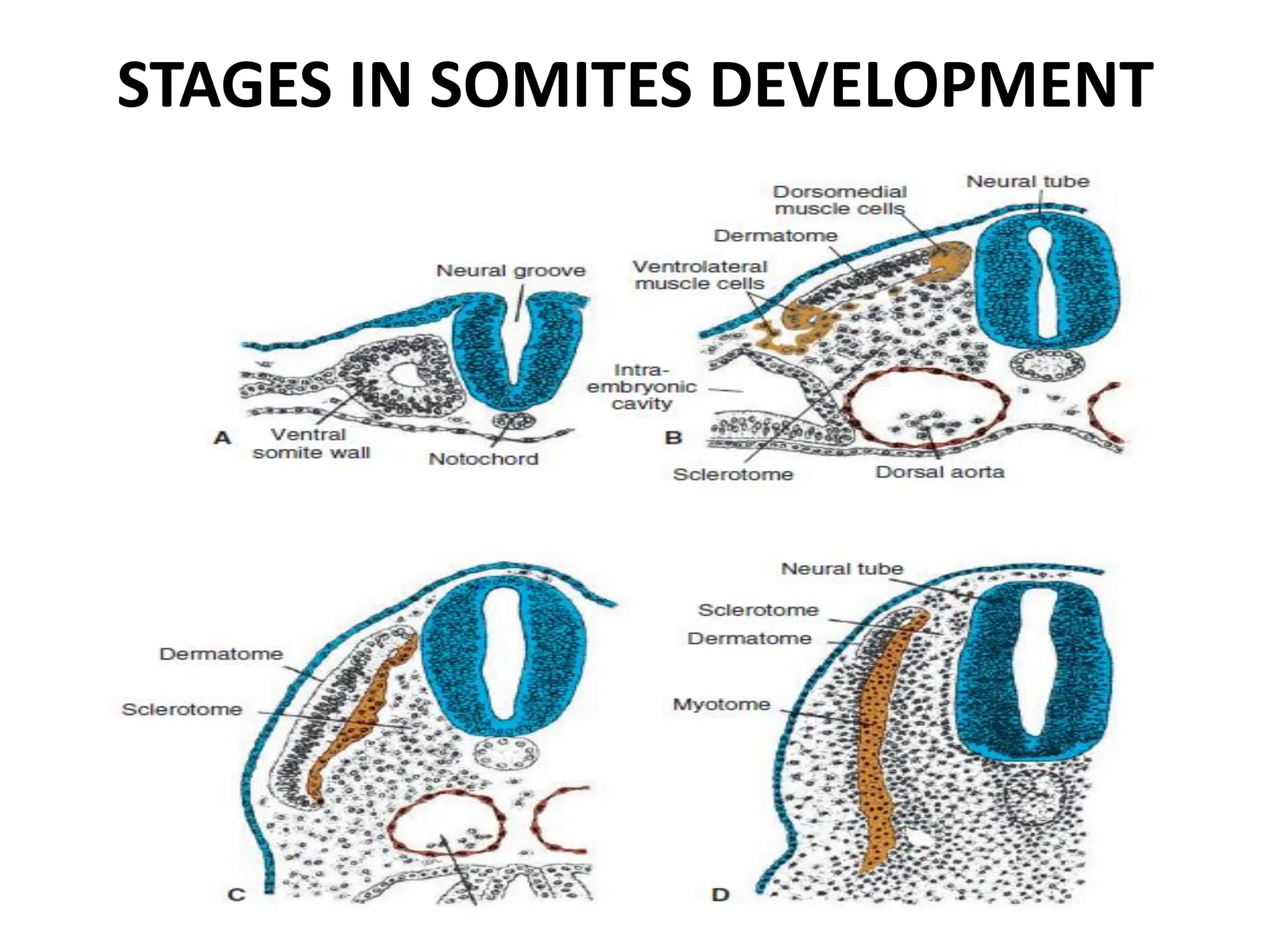
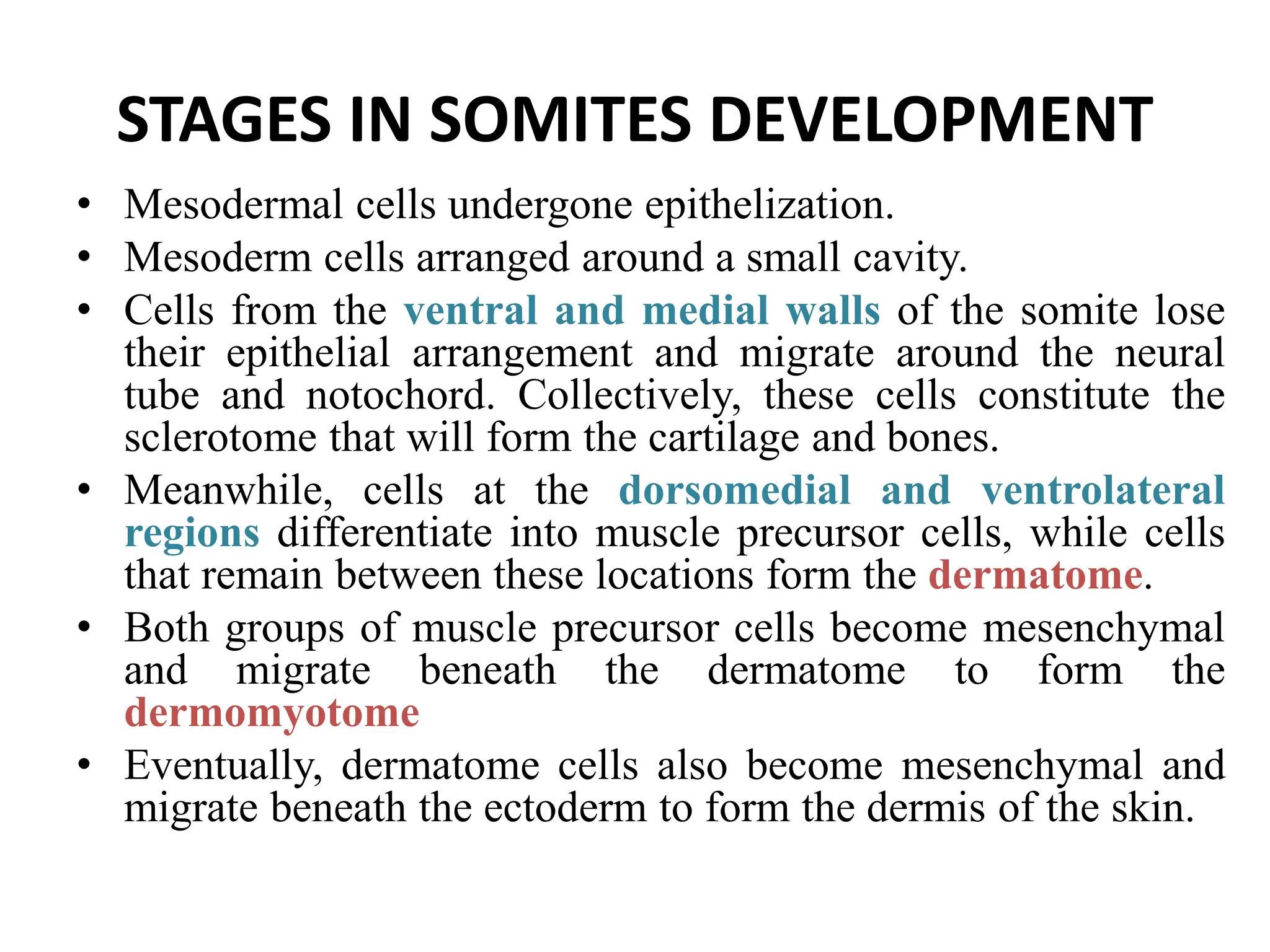
STAGES IN SOMITES DEVELOPMENT
• Mesodermal cells undergone epithelization.
• Mesoderm cells arranged around a small cavity.
• Cells from the ventral and medial walls of the somite lose
their epithelial arrangement and migrate around the neural
tube and notochord. Collectively, these cells constitute the
sclerotome that will form the cartilage and bones.
• Meanwhile, cells at the dorsomedial and ventrolateral
regions differentiate into muscle precursor cells, while cells
that remain between these locations form the dermatome.
• Both groups of muscle precursor cells become mesenchymal
and migrate beneath the dermatome to form the
dermomyotome
• Eventually, dermatome cells also become mesenchymal and
migrate beneath the ectoderm to form the dermis of the skin.
Events during 3rd appears to occur in
threes
• 3 germ layers of derived from bilaminar
embryonic disc
• 3 new structures appear
– Primitive streak
– Notochord &
– Allantois
• 3 layers appear in chorionic villi
– Syncytiotrophoblast,
– Intermediate cytotrophoblast,
– Inner mesodermal layer
THANK YOU ☺

3rd week development.pdf

  • 1.
    3rd WEEK &ONWARD DEVELOPMENT • EVENTS 1. GASTRULATION 2. NEURULATION 3. FOLDING OF THE EMBRYO DR.ARBAB SIKANDAR
  • 2.
    Learning outcomes • Bythe end of this lecture the students will be able to describe • Gastrulation • Primitive streak and node • Formation and function of notocord • Fate map establishes during the gastrulation • Somatomers and somites
  • 4.
  • 7.
  • 13.
    • PRIMITIVE NODE:- -At the cephalic end of the streak - consists of a slightly elevated area surrounding the small primitive pit. • Cells of the epiblast migrate towards the primitive streak. Upon arrival in the region of the streak, they detach from the epiblast, and slip beneath it. This inward movement is known as invagination. - controlled by fibroblast growth factor 8 (FGF8) - synthesized by streak cells themselves.
  • 14.
    INVAGINATION RESULTS INTHE FORMATION OF GERM LAYERS Once the cells have invaginated:- • Some displace the hypoblast, creating the embryonic endoderm. • Others come to lie between the epiblast and newly created endoderm to form mesoderm. • Cells remaining in the epiblast then form ectoderm. • Thus, the epiblast, through the process of gastrulation, is the source of all of the germ layers • Cells in these layers will give rise to all of the tissues and organs in the embryo.
  • 15.
    Oropharyngeal membrane • Asmall region of tightly adherent ectoderm and endoderm cells at the cranial end of disc with no intervening mesoderm. • Future opening of the oral cavity
  • 20.
    Oblique view fromabove of an embryo slightly older than that in Fig 3B showing the relative relationship of the neural plate, prechordal plate and notochord, primitive streak, and primitive node.
  • 22.
    PRECHORDAL PLATE • Inthe cephalic direction, epiblast and hypoblast pass on each side of the prechordal plate. • The prechordal plate itself forms between tip of the Notochord and the Oropharyngeal membrane. • Later, the prechordal plate will be important for induction of the forebrain
  • 24.
  • 25.
    FORMATION OF THENOTOCHORD… • Prenotochordal cells migrate through the primitive streak, become intercalated in the endoderm to form the notochordal plate, and finally detach from the endoderm to form the definitive notochord. • Because these events occur in a cranial-to- caudal sequence, portions of the definitive notochord are established in the head region first.
  • 27.
    FATE MAP ESTABLISHESDURING THE GASTRULATION Specific regions of the epiblast migrate through different parts of the node and streak to form mesoderm.
  • 28.
    FATE MAP… • Cellsmigrating at the cranial most part of the node will form the notochord (n) • Those migrating more posteriorly through the node and cranial most aspect of the streak will form paraxial mesoderm (pm) • Those migrating through the next portion of the streak will form intermediate mesoderm (im) • Those migrating through the more caudal part of the streak will form lateral plate mesoderm (lpm) • Those migrating through the most caudal part will contribute to extraembryonic mesoderm (eem)
  • 29.
    FATEMAP… Sr. # TYPE OF MESODERMAbbrevation STRUCTURE OR SYSTEM ORIGINATES 1. Paraxial Mesoderm pm somitomeres and somites 2. Intermediate Mesoderm im Urogenital System 3. Lateral Plate Mesoderm lpm Body Wall 4. Extraembryonic Mesoderm eem Chorion
  • 30.
    Growth of Embryonicdisc • Embryo develops Cephalocaudally • Initially flat and almost round • Gradually elongated broad cephalic and narrow caudal end • Invagination and migration cells continue until end of fourth week • Primitive streak disappear at the end of fourth week
  • 31.
    SOMITOMERES AND SOMITES •Paraxial Mesoderm forms somitomeres which give rise to mesenchyme of the head and organize into somites in occipital and caudal segments. • Somites give rise to the myotome (muscle tissue), sclerotome (cartilage and bone), and dermatome (dermis of the skin), which are all supporting tissues of the body. • Signals for somite differentiation are derived from surrounding structures, including the notochord, neural tube, and epidermis. The notochord and floor plate of the neural tube secrete Sonic hedgehog (SHH), which induces the sclerotome.
  • 32.
  • 33.
  • 34.
    STAGES IN SOMITESDEVELOPMENT
  • 35.
    STAGES IN SOMITESDEVELOPMENT • Mesodermal cells undergone epithelization. • Mesoderm cells arranged around a small cavity. • Cells from the ventral and medial walls of the somite lose their epithelial arrangement and migrate around the neural tube and notochord. Collectively, these cells constitute the sclerotome that will form the cartilage and bones. • Meanwhile, cells at the dorsomedial and ventrolateral regions differentiate into muscle precursor cells, while cells that remain between these locations form the dermatome. • Both groups of muscle precursor cells become mesenchymal and migrate beneath the dermatome to form the dermomyotome • Eventually, dermatome cells also become mesenchymal and migrate beneath the ectoderm to form the dermis of the skin.
  • 36.
    Events during 3rdappears to occur in threes • 3 germ layers of derived from bilaminar embryonic disc • 3 new structures appear – Primitive streak – Notochord & – Allantois • 3 layers appear in chorionic villi – Syncytiotrophoblast, – Intermediate cytotrophoblast, – Inner mesodermal layer
  • 37.