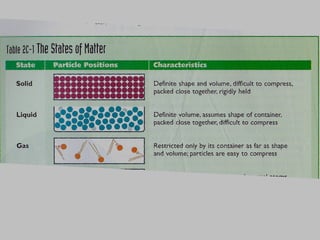
Science, Chemistry and You
Chemistry
• Definition – study of the composition and
properties of matter and the energy
transformations accompanying changes in the
structure of matter
Major Branches of Chemistry
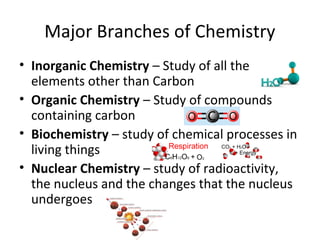
• Inorganic Chemistry – Study of all the
elements other than Carbon
• Organic Chemistry – Study of compounds
containing carbon
• Biochemistry – study of chemical processes in
living things
• Nuclear Chemistry – study of radioactivity,
the nucleus and the changes that the nucleus
undergoes
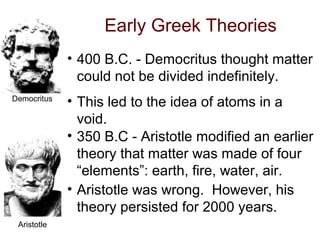
Aristotle
Early Greek Theories
• 400 B.C. - Democritus thought matter
could not be divided indefinitely.
• 350 B.C - Aristotle modified an earlier
theory that matter was made of four
“elements”: earth, fire, water, air.
Democritus
• Aristotle was wrong. However, his
theory persisted for 2000 years.
• This led to the idea of atoms in a
void.

The Rise of Modern Chemistry
• The Greek idea of the 4 basic elements
was not disputed until the mid 1600s
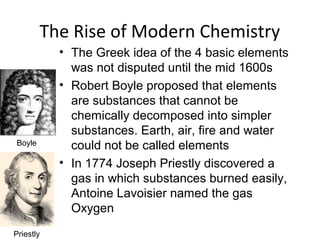
• Robert Boyle proposed that elements
are substances that cannot be
chemically decomposed into simpler
substances. Earth, air, fire and water
could not be called elements
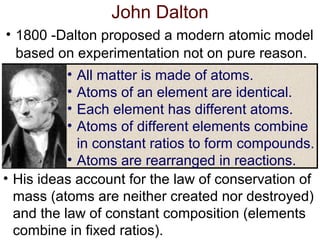
• In 1774 Joseph Priestly discovered a
gas in which substances burned easily,
Antoine Lavoisier named the gas
Oxygen
Boyle
Priestly
John Dalton
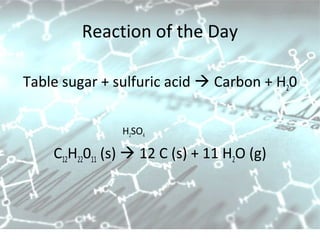
• 1800 -Dalton proposed a modern atomic model
based on experimentation not on pure reason.
• All matter is made of atoms.
• Atoms of an element are identical.
• Each element has different atoms.
• Atoms of different elements combine
in constant ratios to form compounds.
• Atoms are rearranged in reactions.
• His ideas account for the law of conservation of
mass (atoms are neither created nor destroyed)
and the law of constant composition (elements
combine in fixed ratios).
Reaction of the Day
Table sugar + sulfuric acid  Carbon + H20
H2SO4
C12H22011 (s)  12 C (s) + 11 H2O (g)
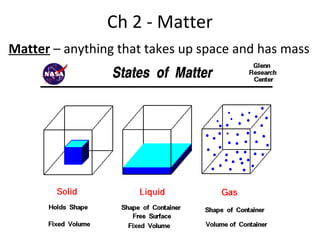
Ch 2 - Matter
Matter – anything that takes up space and has mass
Chemical and Physical
Properties of Matter
Physical properties – color, shape, texture, odor,
taste, electrical conductivity, and density
density – how closely packed the molecules are
malleable – substances that can be easily
hammered into shapes
ductility – substances that can be stretched into
wires
conductivity – substances that can transfer heat
or electricity
Chemical properties – describe how matter acts in
the presence of other materials
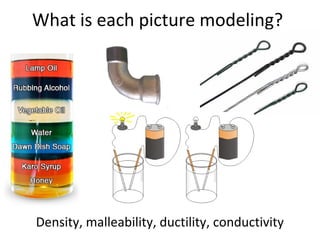
What is each picture modeling?
Density, malleability, ductility, conductivity
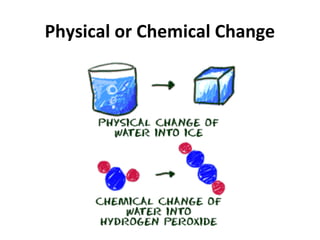
Physical or Chemical Change
Physical vs. Chemical Change
Physical Change
• Atoms do not rearrange
• Only physical properties change. Chemical properties do not
change.
• Physical changes are generally easy to reverse.
• No energy is produced by the substance.
Chemical Change
• Atoms are rearranged into different molecules
• Both physical and chemical properties are changed
• Changes are not reversible without another reaction
• Energy is often produced ( fire or heat, for example)
Identify each of the following as a Physical or Chemical Change.
Put a P next to Physical Changes and a C next to Chemical Changes
1. A piece of wood burns to form
ash.
2. Water evaporates into steam.
3. A piece of cork is cut in half.
4. A bicycle chain rusts.
5. Food is digested in the
stomach.
6. Water is absorbed by a paper
towel.
7. Hydrochloric Acid reacts with
zinc.
8. A piece of an apple rots on the
ground.
9. A tire is inflated with air.
10. A plant turns sunlight, CO2,
and water into sugar and
oxygen.
11. Sugar dissolves in water.
12. Eggs turn into an omelette.
13. Milk sours.
14. A popsicle melts.
15. Turning brownie mix into
brownies.
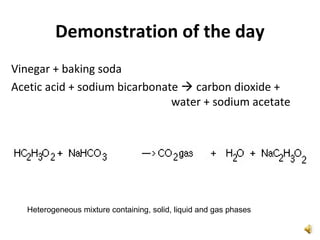
Demonstration of the day
Vinegar + baking soda
Acetic acid + sodium bicarbonate  carbon dioxide +
water + sodium acetate
Heterogeneous mixture containing, solid, liquid and gas phases
The Division of Matter
Two major categories:
1) pure substances - consists of only one type
of matter, which cannot be separated into
other kinds of matter by any physical
processes. Ex: Olive oil
2) mixtures – material that can be separated
by physical means into two or more pure
substances. Ex: Oil and vinegar salad dressing
Two Types of Mixtures
• Heterogeneous – a mixture in which
the substances are not uniformly
mixed
Ex: oil & vinegar dressing, granite
has quartz & mica
• Homogeneous – a substance in
which the particles are uniformly
mixed
Ex: dough & air
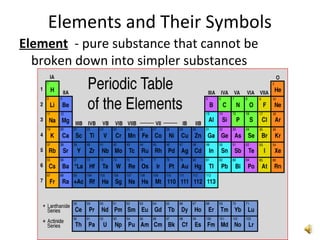
Elements and Their Symbols
Element - pure substance that cannot be
broken down into simpler substances
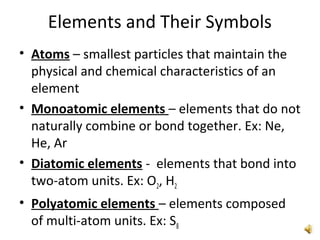
Elements and Their Symbols
• Atoms – smallest particles that maintain the
physical and chemical characteristics of an
element
• Monoatomic elements – elements that do not
naturally combine or bond together. Ex: Ne,
He, Ar
• Diatomic elements - elements that bond into
two-atom units. Ex: O2, H2
• Polyatomic elements – elements composed
of multi-atom units. Ex: S8
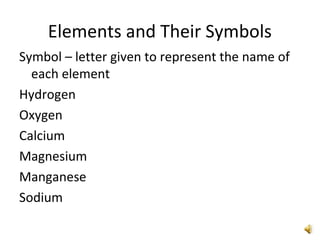
Elements and Their Symbols
Symbol – letter given to represent the name of
each element
Hydrogen
Oxygen
Calcium
Magnesium
Manganese
Sodium
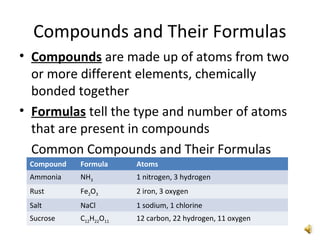
Compounds and Their Formulas
• Compounds are made up of atoms from two
or more different elements, chemically
bonded together
• Formulas tell the type and number of atoms
that are present in compounds
Common Compounds and Their Formulas
Compound Formula Atoms
Ammonia NH3 1 nitrogen, 3 hydrogen
Rust Fe2O3 2 iron, 3 oxygen
Salt NaCl 1 sodium, 1 chlorine
Sucrose C12H22O11 12 carbon, 22 hydrogen, 11 oxygen
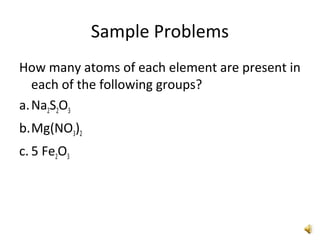
Sample Problems
How many atoms of each element are present in
each of the following groups?
a.Na2S2O3
b.Mg(NO3)2
c. 5 Fe2O3
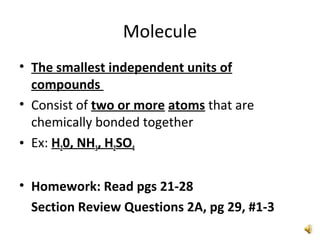
Molecule
• The smallest independent units of
compounds
• Consist of two or more atoms that are
chemically bonded together
• Ex: H20, NH3, H2SO4
• Homework: Read pgs 21-28
Section Review Questions 2A, pg 29, #1-3
Tuesday September 14, 2010
• Go over homework problems
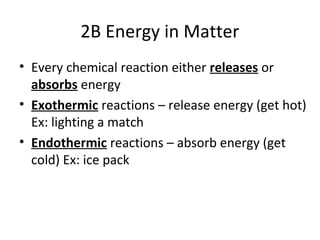
2B Energy in Matter
• Every chemical reaction either releases or
absorbs energy
• Exothermic reactions – release energy (get hot)
Ex: lighting a match
• Endothermic reactions – absorb energy (get
cold) Ex: ice pack
Energy – the ability to do work
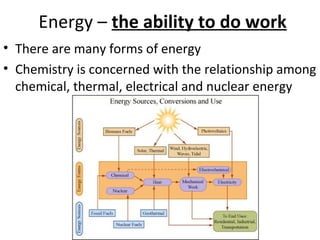
• There are many forms of energy
• Chemistry is concerned with the relationship among
chemical, thermal, electrical and nuclear energy
Energy Conservation
• Thermodynamics – the study of energy flow
• First Law of Thermodynamics or Law of
Conservation of Mass-Energy –matter and
energy can neither be created nor destroyed,
simply changed from one form to another
• Second Law of Thermodynamics – during any
energy transformation, some energy goes to
an unusable form
Energy Conservation
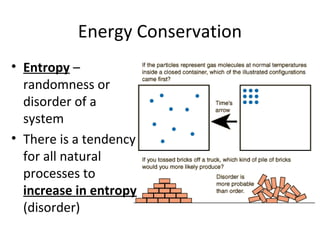
• Entropy –
randomness or
disorder of a
system
• There is a tendency
for all natural
processes to
increase in entropy
(disorder)
Heat, Energy & Temperature
• Kinetic Energy – energy of motion
All matter contains particles that are moving
• Thermal Energy – sum of all the kinetic energy
of an object
• Temperature measures the average kinetic
energy of all the particles in a sample
• Heat – thermal energy that is transferred from
one object to another
• Amount of heat transferred between objects is determined
by the temperature difference between them and the mass of
the hotter object
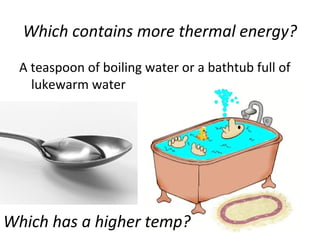
Which contains more thermal energy?
A teaspoon of boiling water or a bathtub full of
lukewarm water
Which has a higher temp?
The Measurement of Energy
• Joule – standard unit of measurement for
energy
• BTU – English unit of measurement for
thermal energy, the amount of heat required
to raise one pound of water by one degree
Fahrenheit
• Calorie – amount of energy required to raise
the temperature of one gram of water one
degree Celsius
• 1 cal = 4.184 J
Temperature Scales
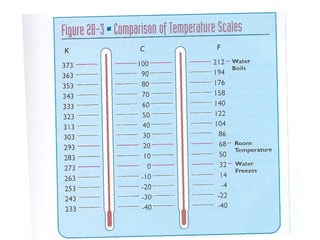
Celsius scale – freezing point of water is 0◦
C
boiling point of water is 100◦
C
Kelvin scale – uses absolute zero (point at which
molecules no longer move) as the zero point
freezing point of water is 273 K
boiling point of water is 373 K
Fahrenheit scale – freezing point of water is
32◦
F
boiling point of water is 212◦
F
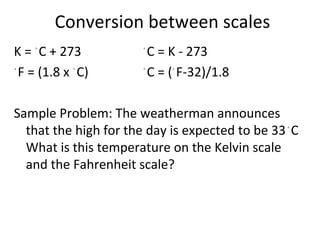
Conversion between scales
K = ◦
C + 273 ◦
C = K - 273
◦
F = (1.8 x ◦
C) ◦
C = (◦
F-32)/1.8
Sample Problem: The weatherman announces
that the high for the day is expected to be 33◦
C
What is this temperature on the Kelvin scale
and the Fahrenheit scale?
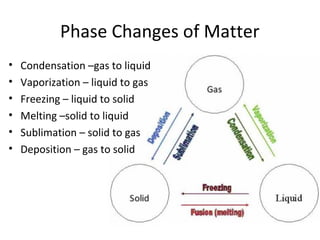
Phase Changes of Matter
• Condensation –gas to liquid
• Vaporization – liquid to gas
• Freezing – liquid to solid
• Melting –solid to liquid
• Sublimation – solid to gas
• Deposition – gas to solid
Tuesday Homework
Read pgs 29 – 39
Section Review Questions 2B
Pg 36, questions 1 - 4
Wednesday
• Do Review Questions pg 40 & 41
Thursday Go Over Review
Friday
• Test Ch 1&2

Ch 1 and 2 ppt

  • 1.
  • 2.
    Chemistry • Definition –study of the composition and properties of matter and the energy transformations accompanying changes in the structure of matter
  • 3.
    Major Branches ofChemistry • Inorganic Chemistry – Study of all the elements other than Carbon • Organic Chemistry – Study of compounds containing carbon • Biochemistry – study of chemical processes in living things • Nuclear Chemistry – study of radioactivity, the nucleus and the changes that the nucleus undergoes
  • 4.
    Aristotle Early Greek Theories •400 B.C. - Democritus thought matter could not be divided indefinitely. • 350 B.C - Aristotle modified an earlier theory that matter was made of four “elements”: earth, fire, water, air. Democritus • Aristotle was wrong. However, his theory persisted for 2000 years. • This led to the idea of atoms in a void.
  • 5.
    The Rise ofModern Chemistry • The Greek idea of the 4 basic elements was not disputed until the mid 1600s • Robert Boyle proposed that elements are substances that cannot be chemically decomposed into simpler substances. Earth, air, fire and water could not be called elements • In 1774 Joseph Priestly discovered a gas in which substances burned easily, Antoine Lavoisier named the gas Oxygen Boyle Priestly
  • 6.
    John Dalton • 1800-Dalton proposed a modern atomic model based on experimentation not on pure reason. • All matter is made of atoms. • Atoms of an element are identical. • Each element has different atoms. • Atoms of different elements combine in constant ratios to form compounds. • Atoms are rearranged in reactions. • His ideas account for the law of conservation of mass (atoms are neither created nor destroyed) and the law of constant composition (elements combine in fixed ratios).
  • 7.
    Reaction of theDay Table sugar + sulfuric acid  Carbon + H20 H2SO4 C12H22011 (s)  12 C (s) + 11 H2O (g)
  • 8.
    Ch 2 -Matter Matter – anything that takes up space and has mass
  • 9.
    Chemical and Physical Propertiesof Matter Physical properties – color, shape, texture, odor, taste, electrical conductivity, and density density – how closely packed the molecules are malleable – substances that can be easily hammered into shapes ductility – substances that can be stretched into wires conductivity – substances that can transfer heat or electricity Chemical properties – describe how matter acts in the presence of other materials
  • 10.
    What is eachpicture modeling? Density, malleability, ductility, conductivity
  • 11.
  • 12.
    Physical vs. ChemicalChange Physical Change • Atoms do not rearrange • Only physical properties change. Chemical properties do not change. • Physical changes are generally easy to reverse. • No energy is produced by the substance. Chemical Change • Atoms are rearranged into different molecules • Both physical and chemical properties are changed • Changes are not reversible without another reaction • Energy is often produced ( fire or heat, for example)
  • 13.
    Identify each ofthe following as a Physical or Chemical Change. Put a P next to Physical Changes and a C next to Chemical Changes 1. A piece of wood burns to form ash. 2. Water evaporates into steam. 3. A piece of cork is cut in half. 4. A bicycle chain rusts. 5. Food is digested in the stomach. 6. Water is absorbed by a paper towel. 7. Hydrochloric Acid reacts with zinc. 8. A piece of an apple rots on the ground. 9. A tire is inflated with air. 10. A plant turns sunlight, CO2, and water into sugar and oxygen. 11. Sugar dissolves in water. 12. Eggs turn into an omelette. 13. Milk sours. 14. A popsicle melts. 15. Turning brownie mix into brownies.
  • 14.
    Demonstration of theday Vinegar + baking soda Acetic acid + sodium bicarbonate  carbon dioxide + water + sodium acetate Heterogeneous mixture containing, solid, liquid and gas phases
  • 15.
    The Division ofMatter Two major categories: 1) pure substances - consists of only one type of matter, which cannot be separated into other kinds of matter by any physical processes. Ex: Olive oil 2) mixtures – material that can be separated by physical means into two or more pure substances. Ex: Oil and vinegar salad dressing
  • 16.
    Two Types ofMixtures • Heterogeneous – a mixture in which the substances are not uniformly mixed Ex: oil & vinegar dressing, granite has quartz & mica • Homogeneous – a substance in which the particles are uniformly mixed Ex: dough & air
  • 17.
    Elements and TheirSymbols Element - pure substance that cannot be broken down into simpler substances
  • 18.
    Elements and TheirSymbols • Atoms – smallest particles that maintain the physical and chemical characteristics of an element • Monoatomic elements – elements that do not naturally combine or bond together. Ex: Ne, He, Ar • Diatomic elements - elements that bond into two-atom units. Ex: O2, H2 • Polyatomic elements – elements composed of multi-atom units. Ex: S8
  • 19.
    Elements and TheirSymbols Symbol – letter given to represent the name of each element Hydrogen Oxygen Calcium Magnesium Manganese Sodium
  • 20.
    Compounds and TheirFormulas • Compounds are made up of atoms from two or more different elements, chemically bonded together • Formulas tell the type and number of atoms that are present in compounds Common Compounds and Their Formulas Compound Formula Atoms Ammonia NH3 1 nitrogen, 3 hydrogen Rust Fe2O3 2 iron, 3 oxygen Salt NaCl 1 sodium, 1 chlorine Sucrose C12H22O11 12 carbon, 22 hydrogen, 11 oxygen
  • 21.
    Sample Problems How manyatoms of each element are present in each of the following groups? a.Na2S2O3 b.Mg(NO3)2 c. 5 Fe2O3
  • 22.
    Molecule • The smallestindependent units of compounds • Consist of two or more atoms that are chemically bonded together • Ex: H20, NH3, H2SO4 • Homework: Read pgs 21-28 Section Review Questions 2A, pg 29, #1-3
  • 23.
    Tuesday September 14,2010 • Go over homework problems
  • 24.
    2B Energy inMatter • Every chemical reaction either releases or absorbs energy • Exothermic reactions – release energy (get hot) Ex: lighting a match • Endothermic reactions – absorb energy (get cold) Ex: ice pack
  • 25.
    Energy – theability to do work • There are many forms of energy • Chemistry is concerned with the relationship among chemical, thermal, electrical and nuclear energy
  • 26.
    Energy Conservation • Thermodynamics– the study of energy flow • First Law of Thermodynamics or Law of Conservation of Mass-Energy –matter and energy can neither be created nor destroyed, simply changed from one form to another • Second Law of Thermodynamics – during any energy transformation, some energy goes to an unusable form
  • 27.
    Energy Conservation • Entropy– randomness or disorder of a system • There is a tendency for all natural processes to increase in entropy (disorder)
  • 28.
    Heat, Energy &Temperature • Kinetic Energy – energy of motion All matter contains particles that are moving • Thermal Energy – sum of all the kinetic energy of an object • Temperature measures the average kinetic energy of all the particles in a sample • Heat – thermal energy that is transferred from one object to another • Amount of heat transferred between objects is determined by the temperature difference between them and the mass of the hotter object
  • 29.
    Which contains morethermal energy? A teaspoon of boiling water or a bathtub full of lukewarm water Which has a higher temp?
  • 30.
    The Measurement ofEnergy • Joule – standard unit of measurement for energy • BTU – English unit of measurement for thermal energy, the amount of heat required to raise one pound of water by one degree Fahrenheit • Calorie – amount of energy required to raise the temperature of one gram of water one degree Celsius • 1 cal = 4.184 J
  • 31.
    Temperature Scales Celsius scale– freezing point of water is 0◦ C boiling point of water is 100◦ C Kelvin scale – uses absolute zero (point at which molecules no longer move) as the zero point freezing point of water is 273 K boiling point of water is 373 K Fahrenheit scale – freezing point of water is 32◦ F boiling point of water is 212◦ F
  • 33.
    Conversion between scales K= ◦ C + 273 ◦ C = K - 273 ◦ F = (1.8 x ◦ C) ◦ C = (◦ F-32)/1.8 Sample Problem: The weatherman announces that the high for the day is expected to be 33◦ C What is this temperature on the Kelvin scale and the Fahrenheit scale?
  • 35.
    Phase Changes ofMatter • Condensation –gas to liquid • Vaporization – liquid to gas • Freezing – liquid to solid • Melting –solid to liquid • Sublimation – solid to gas • Deposition – gas to solid
  • 36.
    Tuesday Homework Read pgs29 – 39 Section Review Questions 2B Pg 36, questions 1 - 4
  • 37.
    Wednesday • Do ReviewQuestions pg 40 & 41
  • 38.
  • 39.

Editor's Notes

  • #14 STOP
  • #18 Handout Chemistry Reference Table
  • #22 2 Na, 2 S, 3 O 1 Mg, 2 N, 6 O 10 Fe, 15 O
  • #30 A bathtub filled with lukewarm water contains more thermal energy than a teaspoon of boiling water Teaspoon has a higher temperature
  • #34 K = 33 + 273 = 306 K F = (1.8x33) = 59.4 ◦ F