Thinking Outside the Storytime Box:! 
Building Your Preschool Programming 
Repertoire 
Amy Commers 
Amy Koester 
Melissa Depper 
Marge Loch-Wouters
Welcome! 
• We want to explore: 
• Why it’s important to expand beyond 
storytime for preschoolers 
• Program ideas, rationales, & resources 
! 
• Then, we want to hear from YOU!
Why Program Beyond Storytime? 
• Draw particular focus to 1-2 of the 5 
practices
Why Program Beyond Storytime? 
• Draw particular focus to 1-2 of the 5 
practices 
• Reach different types of kids
Why Program Beyond Storytime? 
• Draw particular focus to 1-2 of the 5 
practices 
• Reach different types of kids 
• Provide different learning experiences
Why Program Beyond Storytime? 
• Draw particular focus to 1-2 of the 5 
practices 
• Reach different types of kids 
• Provide different learning experiences 
• Highlight pockets of the collection
Why Program Beyond Storytime? 
• Draw particular focus to 1-2 of the 5 
practices 
• Reach different types of kids 
• Provide different learning experiences 
• Highlight pockets of the collection 
• Model a range of early literacy-positive 
activities for caregivers
Let’s talk programs!
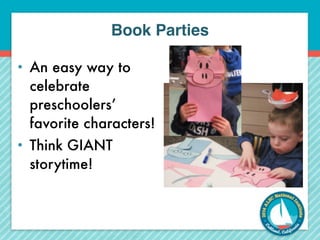
Book Parties 
• An easy way to 
celebrate 
preschoolers’ 
favorite characters! 
• Think GIANT 
storytime!
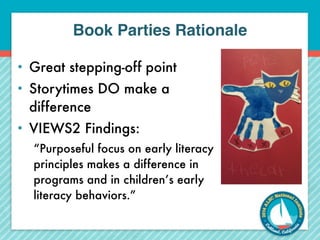
Book Parties Rationale 
• Great stepping-off point 
• Storytimes DO make a 
difference 
• VIEWS2 Findings: 
“Purposeful focus on early literacy 
principles makes a difference in 
programs and in children’s early 
literacy behaviors.”
Book Parties Resources 
• “Book Character Parties: A Round Up” by 
Jbrary 
http://jbrary.com/book-character-parties-round/ 
• “A Seuss-tastical Celebration” by From the 
Short Stacks 
http://fromtheshortstacks.blogspot.com/2013/03/a-suess-tastical-celebration. 
html 
• “Big Character Programs” by library bonanza 
http://librarybonanza.com/big-character-programs/
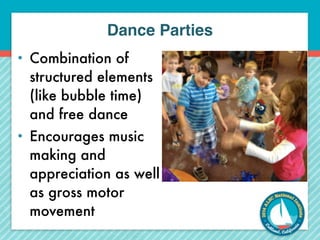
Dance Parties 
• Combination of 
structured elements 
(like bubble time) 
and free dance 
• Encourages music 
making and 
appreciation as well 
as gross motor 
movement
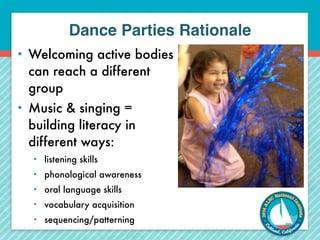
Dance Parties Rationale 
• Welcoming active bodies 
can reach a different 
group 
• Music & singing = 
building literacy in 
different ways: 
• listening skills 
• phonological awareness 
• oral language skills 
• vocabulary acquisition 
• sequencing/patterning
Dance Parties Resources 
• “Bibliobop” posts by Storytiming 
http://storytiming.com/category/bibliobop/ 
• “Music & Movement — BABY DANCE!” by 
fat girl reading 
http://fatgirlreading.com/music-movement-baby-dance/ 
• Preschool Dance Party by The Show Me 
Librarian 
http://showmelibrarian.blogspot.com/2013/01/in-which-i-share- 
details-of-my-first.html
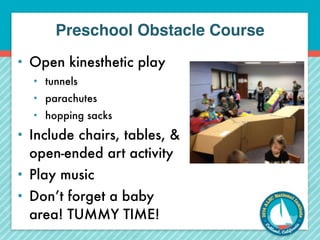
Preschool Obstacle Course 
• Open kinesthetic play 
• tunnels 
• parachutes 
• hopping sacks 
• Include chairs, tables, & 
open-ended art activity 
• Play music 
• Don’t forget a baby 
area! TUMMY TIME!
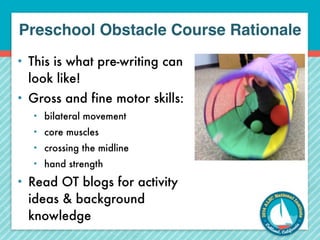
Preschool Obstacle Course Rationale 
• This is what pre-writing can 
look like! 
• Gross and fine motor skills: 
• bilateral movement 
• core muscles 
• crossing the midline 
• hand strength 
• Read OT blogs for activity 
ideas & background 
knowledge
Preschool Obstacle Course Resources 
• “Pool Noodle Obstacle Course” by PBS 
Parents 
http://www.pbs.org/parents/crafts-for-kids/pool-noodle-obstacle- 
course/ 
• “Indoor Obstacle Course” by Sarah 
Richards 
http://www.education.com/activity/article/ 
overandout_preschool/
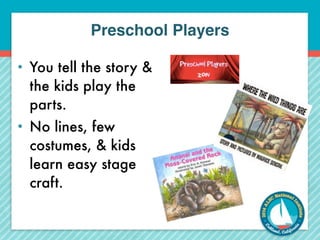
Preschool Players 
• You tell the story & 
the kids play the 
parts. 
• No lines, few 
costumes, & kids 
learn easy stage 
craft.
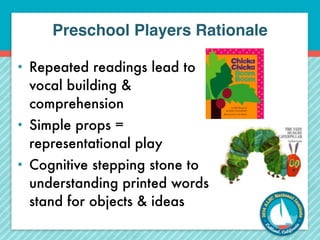
Preschool Players Rationale 
• Repeated readings lead to 
vocal building & 
comprehension 
• Simple props = 
representational play 
• Cognitive stepping stone to 
understanding printed words 
stand for objects & ideas
Preschool Players Resources 
• “Preschool Players” at Menasha Library 
http://www.menashalibrary.org/node/3041 
• “Book Plus Theater = Literacy 
Excitement” by Tiny Tips for Library Fun 
http://tinytipsforlibraryfun.blogspot.com/2010/03/books-plus- 
theater-literacy-excitement.html 
• “Write This Down: Story Dictation” by 
Storytiming 
http://storytiming.com/2014/09/05/write-this-down-story-dictation- 
in-the-library-is-awesome-and-vivian-gussin-paley-is- 
a-goddess/
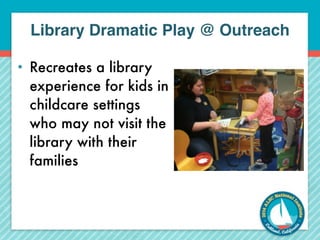
Library Dramatic Play @ Outreach 
• Recreates a library 
experience for kids in 
childcare settings 
who may not visit the 
library with their 
families
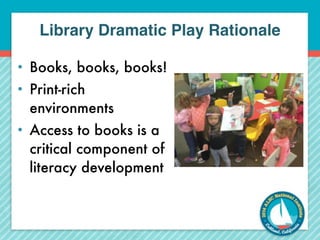
Library Dramatic Play Rationale 
• Books, books, books! 
• Print-rich 
environments 
• Access to books is a 
critical component of 
literacy development
Library Dramatic Play Resources 
• “Play Literacy” from Madison Public 
Library 
http://www.nfls.lib.wi.us/Play_Literacy_green_bay.pdf 
• “Teaching Tools: Dramatic Play 
Center” by Digital Kindergarten 
http://www.adigitalkindergarten.com/2011/05/teaching-tools- 
dramatic-play-center.html 
• “Dramatic Play” posts by Getting 
Giggles 
https://gettinggiggles.wordpress.com/tag/dramatic-play/
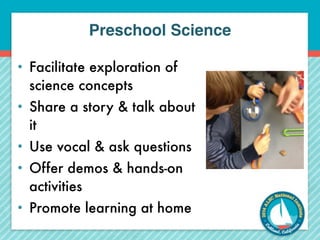
Preschool Science 
• Facilitate exploration of 
science concepts 
• Share a story & talk about 
it 
• Use vocal & ask questions 
• Offer demos & hands-on 
activities 
• Promote learning at home
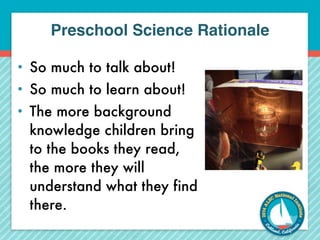
Preschool Science Rationale 
• So much to talk about! 
• So much to learn about! 
• The more background 
knowledge children bring 
to the books they read, 
the more they will 
understand what they find 
there.
Preschool Science Resources 
• “Preschool Lab” by Abby the Librarian 
http://www.abbythelibrarian.com/search/label/steam 
%20programs 
• “Explore! Preschool STEAM” by Read 
Sing Play 
http://klmpeace.wordpress.com/category/steam/ 
• “All Things STEAM” from The Show Me 
Librarian 
http://showmelibrarian.blogspot.com/p/all-things-steam. 
html
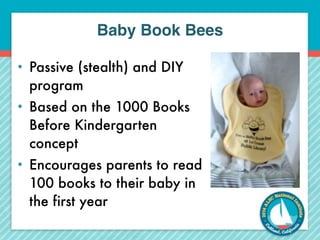
Baby Book Bees 
• Passive (stealth) and DIY 
program 
• Based on the 1000 Books 
Before Kindergarten 
concept 
• Encourages parents to read 
100 books to their baby in 
the first year
Baby Book Bees Rationale 
• “The benefits of [shared 
reading] increased the 
earlier [they] were 
started and the longer 
they were 
implemented.” 
- CELLreview, Vol. 5, No. 4
Baby Book Bees Resources 
• “Baby Book Bees” by Reading with Red 
http://readingwithred.blogspot.com/2013/11/baby-book-bees. 
html 
• “Goal: 1000 Books Before 
Kindergarten” from SLJ 
http://www.slj.com/2014/01/standards/early-learning/ 
vivacious-vocabulary-turning-little-ones-into-strong-readers-first-steps/#_ 
• “Let 1000 Books Bloom” 
http://www.pinterest.com/lochwouters/let-1000-books-bloom/
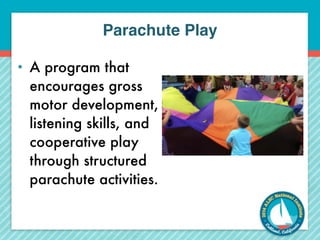
Parachute Play 
• A program that 
encourages gross 
motor development, 
listening skills, and 
cooperative play 
through structured 
parachute activities.
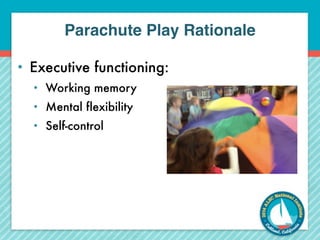
Parachute Play Rationale 
• Executive functioning: 
• Working memory 
• Mental flexibility 
• Self-control
Parachute Play Resources 
• “Parachute Games” by Libraryland 
http://lisaslibraryland.blogspot.com/2013/07/parachute-games- 
2013-edition.html 
• “Program Idea: Parachute Playtime” from 
so tomorrow 
http://www.sotomorrowblog.com/2013/08/program-idea-parachute- 
playtime.html 
• “Baby Parachute Playtime!” by Narrating 
Tales of Preschool Storytime 
http://nikarella.wordpress.com/2013/11/22/baby-parachute- 
playtime/
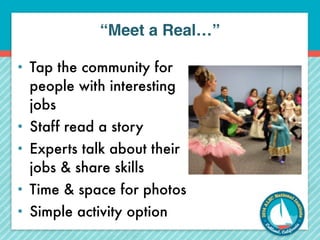
“Meet a Real…” 
• Tap the community for 
people with interesting 
jobs 
• Staff read a story 
• Experts talk about their 
jobs & share skills 
• Time & space for photos 
• Simple activity option
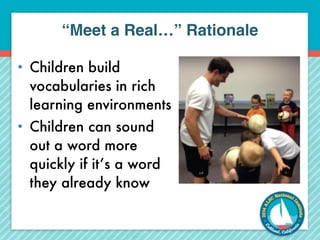
“Meet a Real…” Rationale 
• Children build 
vocabularies in rich 
learning environments 
• Children can sound 
out a word more 
quickly if it’s a word 
they already know
“Meet a Real…” Resources 
• “Marching Band Storytime” by Future 
Librarian Superhero 
http://www.futurelibrariansuperhero.com/2013/05/marching-band-storytime. 
html 
• “Ballet Storytime” by The Show Me Librarian 
http://showmelibrarian.blogspot.com/2014/02/thinking-outside-book- 
ballet-storytime.html 
• “Soccer Storytime” by The Show Me Librarian 
http://showmelibrarian.blogspot.com/2014/06/thinking-outside- 
book-soccer-storytime.html
Now it’s your turn to share! 
• How do you program beyond storytime 
for preschoolers?
To Wrap Up… 
• Go beyond storytime for preschoolers. 
• Be intentional about your goals for all 
preschool programs. 
• Use the resources available to you.
Questions & Closing 
• Questions? 
? ? ? 
! 
! 
! 
• Find all our resources on our Pinterest 
board for this presentation: 
http://goo.gl/6EUs1c
Thanks! 
• Amy Commers, South St. Paul Public Library, 
@choosejoytoday 
• Melissa Depper, Arapahoe Library District, 
@MelissaZD 
• Amy Koester, Skokie Public Library, 
@amyeileenk 
• Marge Loch-Wouters, La Crosse Public 
Library, @lochwouters
Additional Resources: Reading 
• Children’s Access to Print Material and Education-Related Outcomes, 
from RIF, http://bit.ly/1AeoiZ4 
• National Reading Panel Report, http://www.nichd.nih.gov/research/ 
supported/Pages/nrp.aspx/ 
• “Books in home as important as parents' education in determining 
children's education level,” http://www.eurekalert.org/pub_releases/ 
2010-05/uonr-bih052010.php 
• A research overview about repeated book readings, from CELLreview, 
www.earlyliteracylearning.org/cellreviews/cellreviews_v5_n5.pdf 
• “Proof of benefits of reading to children,” http:// 
www.theage.com.au/national/proof-of-benefits-of-reading-to-children- 
20130302-2fd7s.html
Additional Resources: Writing 
• OT Mom Learning Activities for Kids, http://www.ot-mom- 
learning-activities.com/ 
• Therapy Street for Kids, http:// 
www.therapystreetforkids.com/Skills2.html 
• Early Literacy--Pre-Writing Skills posts from Family 
Child Care Academy, http:// 
familychildcareacademy.com/early-literacy-pre-writing- 
skills/ 
• The Motor Story, http://themotorstory.org/
Additional Resources: Singing 
• Beyond Twinkle Twinkle: Using Music with Infants and Toddlers, by 
Parlakian and Lerner, https://www.naeyc.org/files/yc/file/ 
201003/ParlakianWeb0310.pdf 
• Music and Early Childhood Literacy: Why Sing? by Stewart, 
http://www.nancymusic.com/music-why-sing.htm 
• Musical Storytelling Blog from MELSA, http://www.melsa.org/ 
melsa/index.cfm/for-library-staff/legacy-amendment/musical-storytelling/ 
• A research overview about nursery rhyme knowledge, from 
CELLreviews, http://www.earlyliteracylearning.org/cellreviews/ 
cellreviews_v4_n1.pdf
Additional Resources: Talking 
• Project VIEWS2 (3-year IMLS grant measuring early literacy 
outcomes), https://www.facebook.com/VIEWS2/info 
• The Early Catastrophe: The 30 Million Word Gap by Age 3 
(Hart & Risley), http://www.aft.org/newspubs/periodicals/ 
ae/spring2003/hart.cfm 
• Child Talk (speech therapist blog), http:// 
www.talkingkids.org/ 
• Playing with Words 365 (speech therapist blog), http:// 
www.playingwithwords365.com/
Additional Resources: Playing 
• Building Language & Literacy Through Play, by Leong and Bodrova, 
http://www.scholastic.com/teachers/article/building-language-literacy- 
through-play 
• Oral Storytelling: Building Community through Dialog, Engagement, 
and Problem Solving, http://www.naeyc.org/tyc/files/tyc/file/V5I2/ 
Oral%20Storytelling.pdf 
• Telling and Retelling Stories: Learning Language and Literacy, http:// 
www.naeyc.org/yc/files/yc/file/200203/ 
Isbell_article_March_2002.pdf 
• Key Concepts: Executive Function, Harvard Center on the Developing 
Child, http://developingchild.harvard.edu/key_concepts/ 
executive_function/

Thinking Outside the Storytime Box

  • 1.
    Thinking Outside theStorytime Box:! Building Your Preschool Programming Repertoire Amy Commers Amy Koester Melissa Depper Marge Loch-Wouters
  • 2.
    Welcome! • Wewant to explore: • Why it’s important to expand beyond storytime for preschoolers • Program ideas, rationales, & resources ! • Then, we want to hear from YOU!
  • 3.
    Why Program BeyondStorytime? • Draw particular focus to 1-2 of the 5 practices
  • 4.
    Why Program BeyondStorytime? • Draw particular focus to 1-2 of the 5 practices • Reach different types of kids
  • 5.
    Why Program BeyondStorytime? • Draw particular focus to 1-2 of the 5 practices • Reach different types of kids • Provide different learning experiences
  • 6.
    Why Program BeyondStorytime? • Draw particular focus to 1-2 of the 5 practices • Reach different types of kids • Provide different learning experiences • Highlight pockets of the collection
  • 7.
    Why Program BeyondStorytime? • Draw particular focus to 1-2 of the 5 practices • Reach different types of kids • Provide different learning experiences • Highlight pockets of the collection • Model a range of early literacy-positive activities for caregivers
  • 8.
  • 9.
    Book Parties •An easy way to celebrate preschoolers’ favorite characters! • Think GIANT storytime!
  • 10.
    Book Parties Rationale • Great stepping-off point • Storytimes DO make a difference • VIEWS2 Findings: “Purposeful focus on early literacy principles makes a difference in programs and in children’s early literacy behaviors.”
  • 11.
    Book Parties Resources • “Book Character Parties: A Round Up” by Jbrary http://jbrary.com/book-character-parties-round/ • “A Seuss-tastical Celebration” by From the Short Stacks http://fromtheshortstacks.blogspot.com/2013/03/a-suess-tastical-celebration. html • “Big Character Programs” by library bonanza http://librarybonanza.com/big-character-programs/
  • 12.
    Dance Parties •Combination of structured elements (like bubble time) and free dance • Encourages music making and appreciation as well as gross motor movement
  • 13.
    Dance Parties Rationale • Welcoming active bodies can reach a different group • Music & singing = building literacy in different ways: • listening skills • phonological awareness • oral language skills • vocabulary acquisition • sequencing/patterning
  • 14.
    Dance Parties Resources • “Bibliobop” posts by Storytiming http://storytiming.com/category/bibliobop/ • “Music & Movement — BABY DANCE!” by fat girl reading http://fatgirlreading.com/music-movement-baby-dance/ • Preschool Dance Party by The Show Me Librarian http://showmelibrarian.blogspot.com/2013/01/in-which-i-share- details-of-my-first.html
  • 15.
    Preschool Obstacle Course • Open kinesthetic play • tunnels • parachutes • hopping sacks • Include chairs, tables, & open-ended art activity • Play music • Don’t forget a baby area! TUMMY TIME!
  • 16.
    Preschool Obstacle CourseRationale • This is what pre-writing can look like! • Gross and fine motor skills: • bilateral movement • core muscles • crossing the midline • hand strength • Read OT blogs for activity ideas & background knowledge
  • 17.
    Preschool Obstacle CourseResources • “Pool Noodle Obstacle Course” by PBS Parents http://www.pbs.org/parents/crafts-for-kids/pool-noodle-obstacle- course/ • “Indoor Obstacle Course” by Sarah Richards http://www.education.com/activity/article/ overandout_preschool/
  • 18.
    Preschool Players •You tell the story & the kids play the parts. • No lines, few costumes, & kids learn easy stage craft.
  • 19.
    Preschool Players Rationale • Repeated readings lead to vocal building & comprehension • Simple props = representational play • Cognitive stepping stone to understanding printed words stand for objects & ideas
  • 20.
    Preschool Players Resources • “Preschool Players” at Menasha Library http://www.menashalibrary.org/node/3041 • “Book Plus Theater = Literacy Excitement” by Tiny Tips for Library Fun http://tinytipsforlibraryfun.blogspot.com/2010/03/books-plus- theater-literacy-excitement.html • “Write This Down: Story Dictation” by Storytiming http://storytiming.com/2014/09/05/write-this-down-story-dictation- in-the-library-is-awesome-and-vivian-gussin-paley-is- a-goddess/
  • 21.
    Library Dramatic Play@ Outreach • Recreates a library experience for kids in childcare settings who may not visit the library with their families
  • 22.
    Library Dramatic PlayRationale • Books, books, books! • Print-rich environments • Access to books is a critical component of literacy development
  • 23.
    Library Dramatic PlayResources • “Play Literacy” from Madison Public Library http://www.nfls.lib.wi.us/Play_Literacy_green_bay.pdf • “Teaching Tools: Dramatic Play Center” by Digital Kindergarten http://www.adigitalkindergarten.com/2011/05/teaching-tools- dramatic-play-center.html • “Dramatic Play” posts by Getting Giggles https://gettinggiggles.wordpress.com/tag/dramatic-play/
  • 24.
    Preschool Science •Facilitate exploration of science concepts • Share a story & talk about it • Use vocal & ask questions • Offer demos & hands-on activities • Promote learning at home
  • 25.
    Preschool Science Rationale • So much to talk about! • So much to learn about! • The more background knowledge children bring to the books they read, the more they will understand what they find there.
  • 26.
    Preschool Science Resources • “Preschool Lab” by Abby the Librarian http://www.abbythelibrarian.com/search/label/steam %20programs • “Explore! Preschool STEAM” by Read Sing Play http://klmpeace.wordpress.com/category/steam/ • “All Things STEAM” from The Show Me Librarian http://showmelibrarian.blogspot.com/p/all-things-steam. html
  • 27.
    Baby Book Bees • Passive (stealth) and DIY program • Based on the 1000 Books Before Kindergarten concept • Encourages parents to read 100 books to their baby in the first year
  • 28.
    Baby Book BeesRationale • “The benefits of [shared reading] increased the earlier [they] were started and the longer they were implemented.” - CELLreview, Vol. 5, No. 4
  • 29.
    Baby Book BeesResources • “Baby Book Bees” by Reading with Red http://readingwithred.blogspot.com/2013/11/baby-book-bees. html • “Goal: 1000 Books Before Kindergarten” from SLJ http://www.slj.com/2014/01/standards/early-learning/ vivacious-vocabulary-turning-little-ones-into-strong-readers-first-steps/#_ • “Let 1000 Books Bloom” http://www.pinterest.com/lochwouters/let-1000-books-bloom/
  • 30.
    Parachute Play •A program that encourages gross motor development, listening skills, and cooperative play through structured parachute activities.
  • 31.
    Parachute Play Rationale • Executive functioning: • Working memory • Mental flexibility • Self-control
  • 32.
    Parachute Play Resources • “Parachute Games” by Libraryland http://lisaslibraryland.blogspot.com/2013/07/parachute-games- 2013-edition.html • “Program Idea: Parachute Playtime” from so tomorrow http://www.sotomorrowblog.com/2013/08/program-idea-parachute- playtime.html • “Baby Parachute Playtime!” by Narrating Tales of Preschool Storytime http://nikarella.wordpress.com/2013/11/22/baby-parachute- playtime/
  • 33.
    “Meet a Real…” • Tap the community for people with interesting jobs • Staff read a story • Experts talk about their jobs & share skills • Time & space for photos • Simple activity option
  • 34.
    “Meet a Real…”Rationale • Children build vocabularies in rich learning environments • Children can sound out a word more quickly if it’s a word they already know
  • 35.
    “Meet a Real…”Resources • “Marching Band Storytime” by Future Librarian Superhero http://www.futurelibrariansuperhero.com/2013/05/marching-band-storytime. html • “Ballet Storytime” by The Show Me Librarian http://showmelibrarian.blogspot.com/2014/02/thinking-outside-book- ballet-storytime.html • “Soccer Storytime” by The Show Me Librarian http://showmelibrarian.blogspot.com/2014/06/thinking-outside- book-soccer-storytime.html
  • 36.
    Now it’s yourturn to share! • How do you program beyond storytime for preschoolers?
  • 37.
    To Wrap Up… • Go beyond storytime for preschoolers. • Be intentional about your goals for all preschool programs. • Use the resources available to you.
  • 38.
    Questions & Closing • Questions? ? ? ? ! ! ! • Find all our resources on our Pinterest board for this presentation: http://goo.gl/6EUs1c
  • 39.
    Thanks! • AmyCommers, South St. Paul Public Library, @choosejoytoday • Melissa Depper, Arapahoe Library District, @MelissaZD • Amy Koester, Skokie Public Library, @amyeileenk • Marge Loch-Wouters, La Crosse Public Library, @lochwouters
  • 40.
    Additional Resources: Reading • Children’s Access to Print Material and Education-Related Outcomes, from RIF, http://bit.ly/1AeoiZ4 • National Reading Panel Report, http://www.nichd.nih.gov/research/ supported/Pages/nrp.aspx/ • “Books in home as important as parents' education in determining children's education level,” http://www.eurekalert.org/pub_releases/ 2010-05/uonr-bih052010.php • A research overview about repeated book readings, from CELLreview, www.earlyliteracylearning.org/cellreviews/cellreviews_v5_n5.pdf • “Proof of benefits of reading to children,” http:// www.theage.com.au/national/proof-of-benefits-of-reading-to-children- 20130302-2fd7s.html
  • 41.
    Additional Resources: Writing • OT Mom Learning Activities for Kids, http://www.ot-mom- learning-activities.com/ • Therapy Street for Kids, http:// www.therapystreetforkids.com/Skills2.html • Early Literacy--Pre-Writing Skills posts from Family Child Care Academy, http:// familychildcareacademy.com/early-literacy-pre-writing- skills/ • The Motor Story, http://themotorstory.org/
  • 42.
    Additional Resources: Singing • Beyond Twinkle Twinkle: Using Music with Infants and Toddlers, by Parlakian and Lerner, https://www.naeyc.org/files/yc/file/ 201003/ParlakianWeb0310.pdf • Music and Early Childhood Literacy: Why Sing? by Stewart, http://www.nancymusic.com/music-why-sing.htm • Musical Storytelling Blog from MELSA, http://www.melsa.org/ melsa/index.cfm/for-library-staff/legacy-amendment/musical-storytelling/ • A research overview about nursery rhyme knowledge, from CELLreviews, http://www.earlyliteracylearning.org/cellreviews/ cellreviews_v4_n1.pdf
  • 43.
    Additional Resources: Talking • Project VIEWS2 (3-year IMLS grant measuring early literacy outcomes), https://www.facebook.com/VIEWS2/info • The Early Catastrophe: The 30 Million Word Gap by Age 3 (Hart & Risley), http://www.aft.org/newspubs/periodicals/ ae/spring2003/hart.cfm • Child Talk (speech therapist blog), http:// www.talkingkids.org/ • Playing with Words 365 (speech therapist blog), http:// www.playingwithwords365.com/
  • 44.
    Additional Resources: Playing • Building Language & Literacy Through Play, by Leong and Bodrova, http://www.scholastic.com/teachers/article/building-language-literacy- through-play • Oral Storytelling: Building Community through Dialog, Engagement, and Problem Solving, http://www.naeyc.org/tyc/files/tyc/file/V5I2/ Oral%20Storytelling.pdf • Telling and Retelling Stories: Learning Language and Literacy, http:// www.naeyc.org/yc/files/yc/file/200203/ Isbell_article_March_2002.pdf • Key Concepts: Executive Function, Harvard Center on the Developing Child, http://developingchild.harvard.edu/key_concepts/ executive_function/