

Developmentally Appropriate
Programming for Babies & Toddlers
Brooke Newberry & Amy Koester
Hello!
I’m Brooke from La Crosse. And I’m Amy from Skokie.
On Our Agenda Today
• Developmentally Appropriate Programming for 0-23 months
• Great Programming for Babies & Infants
• Developmentally Appropriate Programming for 24-35 months
• Great Programming for Toddlers
• Great Resources
• Time for Questions
Developmentally
Appropriate
Programming for
Children 0-23 Months
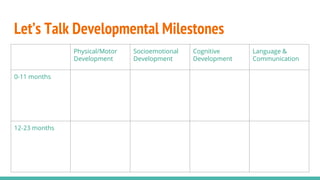
Physical/Motor
Development
Socioemotional
Development
Cognitive
Development
Language &
Communication
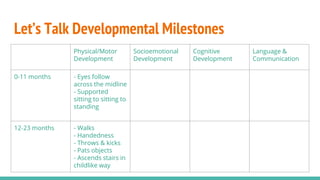
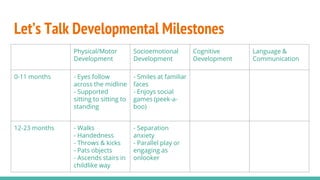
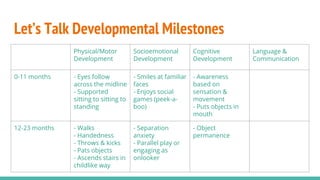
0-11 months - Eyes follow
across the midline
- Supported
sitting to sitting to
standing
- Smiles at familiar
faces
- Enjoys social
games (peek-a-
boo)
- Awareness
based on
sensation &
movement
- Puts objects in
mouth
- Babbles ~6mo
- Responds to
repeated stimuli
(“How big is baby?
So big!”)
12-23 months - Walks
- Handedness
- Throws & kicks
- Pats objects
- Ascends stairs in
childlike way
- Separation
anxiety
- Parallel play or
engaging as
onlooker
- Object
permanence
- Uses 10 words
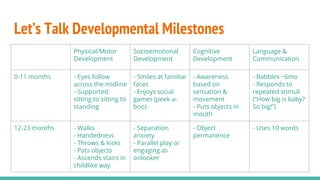
Let’s Talk Developmental Milestones
Physical/Motor
Development
Socioemotional
Development
Cognitive
Development
Language &
Communication
0-11 months - Eyes follow
across the midline
- Supported
sitting to sitting to
standing
- Smiles at familiar
faces
- Enjoys social
games (peek-a-
boo)
- Awareness
based on
sensation &
movement
- Puts objects in
mouth
- Babbles ~6mo
- Responds to
repeated stimuli
(“How big is baby?
So big!”)
12-23 months - Walks
- Handedness
- Throws & kicks
- Pats objects
- Ascends stairs in
childlike way
- Separation
anxiety
- Parallel play or
engaging as
onlooker
- Object
permanence
- Uses 10 words
Let’s Talk Developmental Milestones
Physical/Motor
Development
Socioemotional
Development
Cognitive
Development
Language &
Communication
0-11 months - Eyes follow
across the midline
- Supported
sitting to sitting to
standing
- Smiles at familiar
faces
- Enjoys social
games (peek-a-
boo)
- Awareness
based on
sensation &
movement
- Puts objects in
mouth
- Babbles ~6mo
- Responds to
repeated stimuli
(“How big is baby?
So big!”)
12-23 months - Walks
- Handedness
- Throws & kicks
- Pats objects
- Ascends stairs in
childlike way
- Separation
anxiety
- Parallel play or
engaging as
onlooker
- Object
permanence
- Uses 10 words
Let’s Talk Developmental Milestones
Physical/Motor
Development
Socioemotional
Development
Cognitive
Development
Language &
Communication
0-11 months - Eyes follow
across the midline
- Supported
sitting to sitting to
standing
- Smiles at familiar
faces
- Enjoys social
games (peek-a-
boo)
- Awareness
based on
sensation &
movement
- Puts objects in
mouth
- Babbles ~6mo
- Responds to
repeated stimuli
(“How big is baby?
So big!”)
12-23 months - Walks
- Handedness
- Throws & kicks
- Pats objects
- Ascends stairs in
childlike way
- Separation
anxiety
- Parallel play or
engaging as
onlooker
- Object
permanence
- Uses 10 words
Let’s Talk Developmental Milestones
Physical/Motor
Development
Socioemotional
Development
Cognitive
Development
Language &
Communication
0-11 months - Eyes follow
across the midline
- Supported
sitting to sitting to
standing
- Smiles at familiar
faces
- Enjoys social
games (peek-a-
boo)
- Awareness
based on
sensation &
movement
- Puts objects in
mouth
- Babbles ~6mo
- Responds to
repeated stimuli
(“How big is baby?
So big!”)
12-23 months - Walks
- Handedness
- Throws & kicks
- Pats objects
- Ascends stairs in
childlike way
- Separation
anxiety
- Parallel play or
engaging as
onlooker
- Object
permanence
- Uses 10 words
Let’s Talk Developmental Milestones
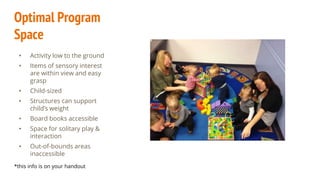
Optimal Program
Space
• Activity low to the ground
• Items of sensory interest
are within view and easy
grasp
• Child-sized
• Structures can support
child’s weight
• Board books accessible
• Space for solitary play &
interaction
• Out-of-bounds areas
inaccessible
*this info is on your handout
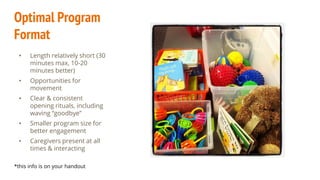
Optimal Program
Format
• Length relatively short (30
minutes max, 10-20
minutes better)
• Opportunities for
movement
• Clear & consistent
opening rituals, including
waving “goodbye”
• Smaller program size for
better engagement
• Caregivers present at all
times & interacting
*this info is on your handout
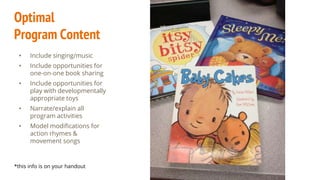
Optimal
Program Content
• Include singing/music
• Include opportunities for
one-on-one book sharing
• Include opportunities for
play with developmentally
appropriate toys
• Narrate/explain all
program activities
• Model modifications for
action rhymes &
movement songs
*this info is on your handout
Optimal
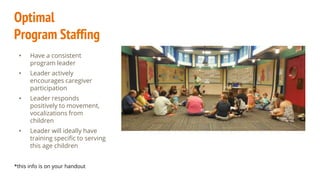
Program Staffing
• Have a consistent
program leader
• Leader actively
encourages caregiver
participation
• Leader responds
positively to movement,
vocalizations from
children
• Leader will ideally have
training specific to serving
this age children
*this info is on your handout
Great Programming for
Babies & Infants
POLL:
How long is your typical program for
babies/infants?
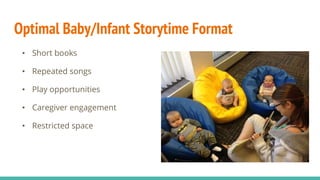
Optimal Baby/Infant Storytime Format
• Short books
• Repeated songs
• Play opportunities
• Caregiver engagement
• Restricted space
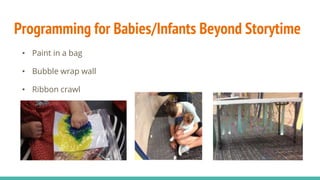
Programming for Babies/Infants Beyond Storytime
• Paint in a bag
• Bubble wrap wall
• Ribbon crawl
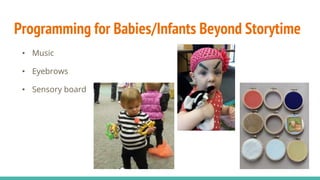
Programming for Babies/Infants Beyond Storytime
• Music
• Eyebrows
• Sensory board
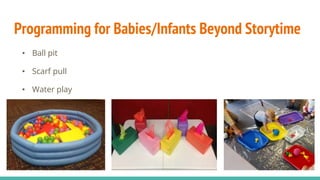
Programming for Babies/Infants Beyond Storytime
• Ball pit
• Scarf pull
• Water play
Optimal Parent/Caregiver Messages
• Singing slows down langauge. This allows children to build vocabulary
and identify that language is made of parts.
• Every time you read the same book, your child is learning new things.
Repetition is key!
• When your baby babbles, talk back to him! It’s his way of communicating
with you and you are increasing his conversational skills and vocabulary.
• Narrate your day to your child. This increases her vocabulary and the
knowledge of the world around her.
Developmentally
Appropriate
Programming for
Children 24-35
Months
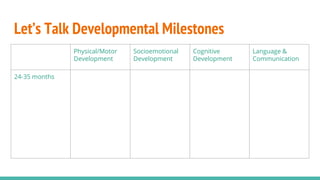
Physical/Motor
Development
Socioemotional
Development
Cognitive
Development
Language &
Communication
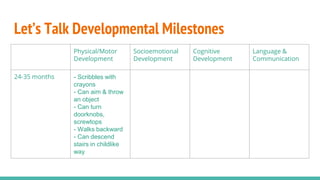
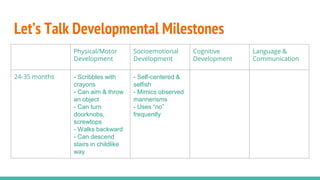
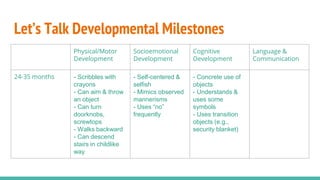
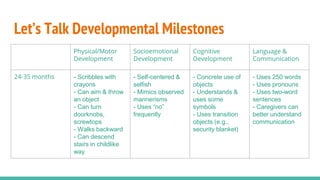
24-35 months - Scribbles with
crayons
- Can aim & throw
an object
- Can turn
doorknobs,
screwtops
- Walks backward
- Can descend
stairs in childlike
way
- Self-centered &
selfish
- Mimics observed
mannerisms
- Uses “no”
frequently
- Concrete use of
objects
- Understands &
uses some
symbols
- Uses transition
objects (e.g.,
security blanket)
- Uses 250 words
- Uses pronouns
- Uses two-word
sentences
- Caregivers can
better understand
communication
Let’s Talk Developmental Milestones
Physical/Motor
Development
Socioemotional
Development
Cognitive
Development
Language &
Communication
24-35 months - Scribbles with
crayons
- Can aim & throw
an object
- Can turn
doorknobs,
screwtops
- Walks backward
- Can descend
stairs in childlike
way
- Self-centered &
selfish
- Mimics observed
mannerisms
- Uses “no”
frequently
- Concrete use of
objects
- Understands &
uses some
symbols
- Uses transition
objects (e.g.,
security blanket)
- Uses 250 words
- Uses pronouns
- Uses two-word
sentences
- Caregivers can
better understand
communication
Let’s Talk Developmental Milestones
Physical/Motor
Development
Socioemotional
Development
Cognitive
Development
Language &
Communication
24-35 months - Scribbles with
crayons
- Can aim & throw
an object
- Can turn
doorknobs,
screwtops
- Walks backward
- Can descend
stairs in childlike
way
- Self-centered &
selfish
- Mimics observed
mannerisms
- Uses “no”
frequently
- Concrete use of
objects
- Understands &
uses some
symbols
- Uses transition
objects (e.g.,
security blanket)
- Uses 250 words
- Uses pronouns
- Uses two-word
sentences
- Caregivers can
better understand
communication
Let’s Talk Developmental Milestones
Physical/Motor
Development
Socioemotional
Development
Cognitive
Development
Language &
Communication
24-35 months - Scribbles with
crayons
- Can aim & throw
an object
- Can turn
doorknobs,
screwtops
- Walks backward
- Can descend
stairs in childlike
way
- Self-centered &
selfish
- Mimics observed
mannerisms
- Uses “no”
frequently
- Concrete use of
objects
- Understands &
uses some
symbols
- Uses transition
objects (e.g.,
security blanket)
- Uses 250 words
- Uses pronouns
- Uses two-word
sentences
- Caregivers can
better understand
communication
Let’s Talk Developmental Milestones
Physical/Motor
Development
Socioemotional
Development
Cognitive
Development
Language &
Communication
24-35 months - Scribbles with
crayons
- Can aim & throw
an object
- Can turn
doorknobs,
screwtops
- Walks backward
- Can descend
stairs in childlike
way
- Self-centered &
selfish
- Mimics observed
mannerisms
- Uses “no”
frequently
- Concrete use of
objects
- Understands &
uses some
symbols
- Uses transition
objects (e.g.,
security blanket)
- Uses 250 words
- Uses pronouns
- Uses two-word
sentences
- Caregivers can
better understand
communication
Let’s Talk Developmental Milestones
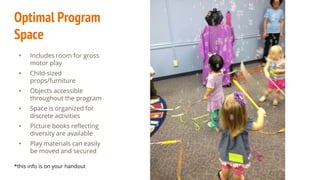
Optimal Program
Space
• Includes room for gross
motor play
• Child-sized
props/furniture
• Objects accessible
throughout the program
• Space is organized for
discrete activities
• Picture books reflecting
diversity are available
• Play materials can easily
be moved and secured
*this info is on your handout
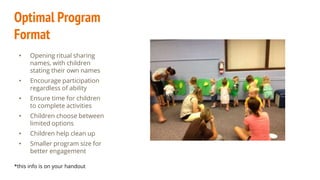
Optimal Program
Format
• Opening ritual sharing
names, with children
stating their own names
• Encourage participation
regardless of ability
• Ensure time for children
to complete activities
• Children choose between
limited options
• Children help clean up
• Smaller program size for
better engagement
*this info is on your handout
POLL:
What activities do you regularly include in your
two-year-old programs?
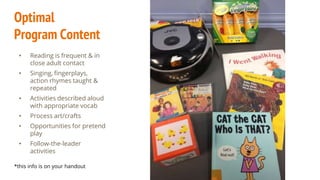
Optimal
Program Content
• Reading is frequent & in
close adult contact
• Singing, fingerplays,
action rhymes taught &
repeated
• Activities described aloud
with appropriate vocab
• Process art/crafts
• Opportunities for pretend
play
• Follow-the-leader
activities
*this info is on your handout
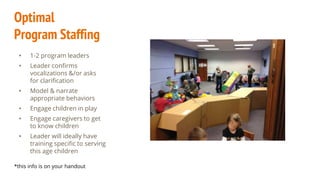
Optimal
Program Staffing
• 1-2 program leaders
• Leader confirms
vocalizations &/or asks
for clarification
• Model & narrate
appropriate behaviors
• Engage children in play
• Engage caregivers to get
to know children
• Leader will ideally have
training specific to serving
this age children
*this info is on your handout
Great Programming for
Toddlers
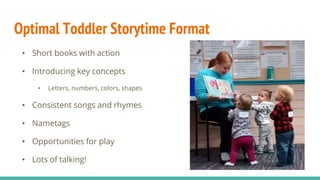
Optimal Toddler Storytime Format
• Short books with action
• Introducing key concepts
• Letters, numbers, colors, shapes
• Consistent songs and rhymes
• Nametags
• Opportunities for play
• Lots of talking!
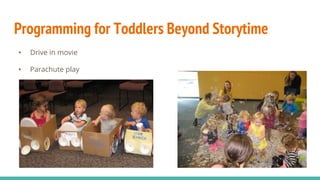
Programming for Toddlers Beyond Storytime
• Drive in movie
• Parachute play
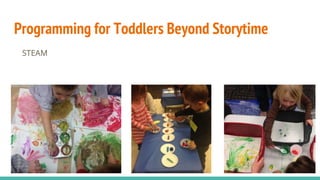
Programming for Toddlers Beyond Storytime
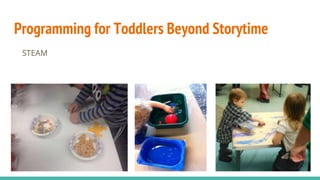
STEAM
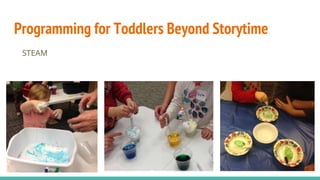
Programming for Toddlers Beyond Storytime
STEAM
Programming for Toddlers Beyond Storytime
STEAM
Optimal Parent/Caregiver Messages
• Is your child not enjoying a book? Stop reading it! It’s better to have 5
minutes of good reading time, rather than 5 minutes of forcing a child to
finish a book.
• A child who can identify shapes has an easier time with letter recognition.
• Freeze songs are a great way to start practicing self control and bodily
awareness.
• One way to encourage a love of reading in your child is to let them see
you reading.
Great Resources for
Serving Babies &
Toddlers
Policy & Research Groups
• Zero to Three
• Erikson Institute
• American Academy of Pediatrics
• Centers for Disease Control & Prevention
*this info is on your handout
Professional Resources
• Association for Library Service to Children
• Colorado Libraries for Early Literacy
• Every Child Ready to Read, 2nd Edition
• National Association for the Education of Young Children
• Supercharged Storytimes
• Your state library
*this info is on your handout
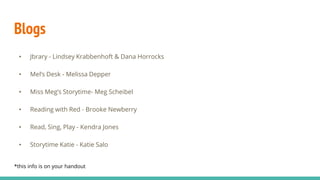
Blogs
• Jbrary - Lindsey Krabbenhoft & Dana Horrocks
• Mel’s Desk - Melissa Depper
• Miss Meg’s Storytime- Meg Scheibel
• Reading with Red - Brooke Newberry
• Read, Sing, Play - Kendra Jones
• Storytime Katie - Katie Salo
*this info is on your handout
What are your
questions?
Thank you!Brooke Newberry | brooke@lacrosselibrary.org | readingwithred.blogspot.com
Amy Koester | amy.e.koester@gmail.com | showmelibrarian.blogspot.com

Developmentally Appropriate Programming for Babies & Toddlers

  • 1.
    Developmentally Appropriate Programming forBabies & Toddlers Brooke Newberry & Amy Koester
  • 2.
    Hello! I’m Brooke fromLa Crosse. And I’m Amy from Skokie.
  • 3.
    On Our AgendaToday • Developmentally Appropriate Programming for 0-23 months • Great Programming for Babies & Infants • Developmentally Appropriate Programming for 24-35 months • Great Programming for Toddlers • Great Resources • Time for Questions
  • 4.
  • 5.
    Physical/Motor Development Socioemotional Development Cognitive Development Language & Communication 0-11 months- Eyes follow across the midline - Supported sitting to sitting to standing - Smiles at familiar faces - Enjoys social games (peek-a- boo) - Awareness based on sensation & movement - Puts objects in mouth - Babbles ~6mo - Responds to repeated stimuli (“How big is baby? So big!”) 12-23 months - Walks - Handedness - Throws & kicks - Pats objects - Ascends stairs in childlike way - Separation anxiety - Parallel play or engaging as onlooker - Object permanence - Uses 10 words Let’s Talk Developmental Milestones
  • 6.
    Physical/Motor Development Socioemotional Development Cognitive Development Language & Communication 0-11 months- Eyes follow across the midline - Supported sitting to sitting to standing - Smiles at familiar faces - Enjoys social games (peek-a- boo) - Awareness based on sensation & movement - Puts objects in mouth - Babbles ~6mo - Responds to repeated stimuli (“How big is baby? So big!”) 12-23 months - Walks - Handedness - Throws & kicks - Pats objects - Ascends stairs in childlike way - Separation anxiety - Parallel play or engaging as onlooker - Object permanence - Uses 10 words Let’s Talk Developmental Milestones
  • 7.
    Physical/Motor Development Socioemotional Development Cognitive Development Language & Communication 0-11 months- Eyes follow across the midline - Supported sitting to sitting to standing - Smiles at familiar faces - Enjoys social games (peek-a- boo) - Awareness based on sensation & movement - Puts objects in mouth - Babbles ~6mo - Responds to repeated stimuli (“How big is baby? So big!”) 12-23 months - Walks - Handedness - Throws & kicks - Pats objects - Ascends stairs in childlike way - Separation anxiety - Parallel play or engaging as onlooker - Object permanence - Uses 10 words Let’s Talk Developmental Milestones
  • 8.
    Physical/Motor Development Socioemotional Development Cognitive Development Language & Communication 0-11 months- Eyes follow across the midline - Supported sitting to sitting to standing - Smiles at familiar faces - Enjoys social games (peek-a- boo) - Awareness based on sensation & movement - Puts objects in mouth - Babbles ~6mo - Responds to repeated stimuli (“How big is baby? So big!”) 12-23 months - Walks - Handedness - Throws & kicks - Pats objects - Ascends stairs in childlike way - Separation anxiety - Parallel play or engaging as onlooker - Object permanence - Uses 10 words Let’s Talk Developmental Milestones
  • 9.
    Physical/Motor Development Socioemotional Development Cognitive Development Language & Communication 0-11 months- Eyes follow across the midline - Supported sitting to sitting to standing - Smiles at familiar faces - Enjoys social games (peek-a- boo) - Awareness based on sensation & movement - Puts objects in mouth - Babbles ~6mo - Responds to repeated stimuli (“How big is baby? So big!”) 12-23 months - Walks - Handedness - Throws & kicks - Pats objects - Ascends stairs in childlike way - Separation anxiety - Parallel play or engaging as onlooker - Object permanence - Uses 10 words Let’s Talk Developmental Milestones
  • 10.
    Optimal Program Space • Activitylow to the ground • Items of sensory interest are within view and easy grasp • Child-sized • Structures can support child’s weight • Board books accessible • Space for solitary play & interaction • Out-of-bounds areas inaccessible *this info is on your handout
  • 11.
    Optimal Program Format • Lengthrelatively short (30 minutes max, 10-20 minutes better) • Opportunities for movement • Clear & consistent opening rituals, including waving “goodbye” • Smaller program size for better engagement • Caregivers present at all times & interacting *this info is on your handout
  • 12.
    Optimal Program Content • Includesinging/music • Include opportunities for one-on-one book sharing • Include opportunities for play with developmentally appropriate toys • Narrate/explain all program activities • Model modifications for action rhymes & movement songs *this info is on your handout
  • 13.
    Optimal Program Staffing • Havea consistent program leader • Leader actively encourages caregiver participation • Leader responds positively to movement, vocalizations from children • Leader will ideally have training specific to serving this age children *this info is on your handout
  • 14.
  • 15.
    POLL: How long isyour typical program for babies/infants?
  • 16.
    Optimal Baby/Infant StorytimeFormat • Short books • Repeated songs • Play opportunities • Caregiver engagement • Restricted space
  • 17.
    Programming for Babies/InfantsBeyond Storytime • Paint in a bag • Bubble wrap wall • Ribbon crawl
  • 18.
    Programming for Babies/InfantsBeyond Storytime • Music • Eyebrows • Sensory board
  • 19.
    Programming for Babies/InfantsBeyond Storytime • Ball pit • Scarf pull • Water play
  • 20.
    Optimal Parent/Caregiver Messages •Singing slows down langauge. This allows children to build vocabulary and identify that language is made of parts. • Every time you read the same book, your child is learning new things. Repetition is key! • When your baby babbles, talk back to him! It’s his way of communicating with you and you are increasing his conversational skills and vocabulary. • Narrate your day to your child. This increases her vocabulary and the knowledge of the world around her.
  • 21.
  • 22.
    Physical/Motor Development Socioemotional Development Cognitive Development Language & Communication 24-35 months- Scribbles with crayons - Can aim & throw an object - Can turn doorknobs, screwtops - Walks backward - Can descend stairs in childlike way - Self-centered & selfish - Mimics observed mannerisms - Uses “no” frequently - Concrete use of objects - Understands & uses some symbols - Uses transition objects (e.g., security blanket) - Uses 250 words - Uses pronouns - Uses two-word sentences - Caregivers can better understand communication Let’s Talk Developmental Milestones
  • 23.
    Physical/Motor Development Socioemotional Development Cognitive Development Language & Communication 24-35 months- Scribbles with crayons - Can aim & throw an object - Can turn doorknobs, screwtops - Walks backward - Can descend stairs in childlike way - Self-centered & selfish - Mimics observed mannerisms - Uses “no” frequently - Concrete use of objects - Understands & uses some symbols - Uses transition objects (e.g., security blanket) - Uses 250 words - Uses pronouns - Uses two-word sentences - Caregivers can better understand communication Let’s Talk Developmental Milestones
  • 24.
    Physical/Motor Development Socioemotional Development Cognitive Development Language & Communication 24-35 months- Scribbles with crayons - Can aim & throw an object - Can turn doorknobs, screwtops - Walks backward - Can descend stairs in childlike way - Self-centered & selfish - Mimics observed mannerisms - Uses “no” frequently - Concrete use of objects - Understands & uses some symbols - Uses transition objects (e.g., security blanket) - Uses 250 words - Uses pronouns - Uses two-word sentences - Caregivers can better understand communication Let’s Talk Developmental Milestones
  • 25.
    Physical/Motor Development Socioemotional Development Cognitive Development Language & Communication 24-35 months- Scribbles with crayons - Can aim & throw an object - Can turn doorknobs, screwtops - Walks backward - Can descend stairs in childlike way - Self-centered & selfish - Mimics observed mannerisms - Uses “no” frequently - Concrete use of objects - Understands & uses some symbols - Uses transition objects (e.g., security blanket) - Uses 250 words - Uses pronouns - Uses two-word sentences - Caregivers can better understand communication Let’s Talk Developmental Milestones
  • 26.
    Physical/Motor Development Socioemotional Development Cognitive Development Language & Communication 24-35 months- Scribbles with crayons - Can aim & throw an object - Can turn doorknobs, screwtops - Walks backward - Can descend stairs in childlike way - Self-centered & selfish - Mimics observed mannerisms - Uses “no” frequently - Concrete use of objects - Understands & uses some symbols - Uses transition objects (e.g., security blanket) - Uses 250 words - Uses pronouns - Uses two-word sentences - Caregivers can better understand communication Let’s Talk Developmental Milestones
  • 27.
    Optimal Program Space • Includesroom for gross motor play • Child-sized props/furniture • Objects accessible throughout the program • Space is organized for discrete activities • Picture books reflecting diversity are available • Play materials can easily be moved and secured *this info is on your handout
  • 28.
    Optimal Program Format • Openingritual sharing names, with children stating their own names • Encourage participation regardless of ability • Ensure time for children to complete activities • Children choose between limited options • Children help clean up • Smaller program size for better engagement *this info is on your handout
  • 29.
    POLL: What activities doyou regularly include in your two-year-old programs?
  • 30.
    Optimal Program Content • Readingis frequent & in close adult contact • Singing, fingerplays, action rhymes taught & repeated • Activities described aloud with appropriate vocab • Process art/crafts • Opportunities for pretend play • Follow-the-leader activities *this info is on your handout
  • 31.
    Optimal Program Staffing • 1-2program leaders • Leader confirms vocalizations &/or asks for clarification • Model & narrate appropriate behaviors • Engage children in play • Engage caregivers to get to know children • Leader will ideally have training specific to serving this age children *this info is on your handout
  • 32.
  • 33.
    Optimal Toddler StorytimeFormat • Short books with action • Introducing key concepts • Letters, numbers, colors, shapes • Consistent songs and rhymes • Nametags • Opportunities for play • Lots of talking!
  • 34.
    Programming for ToddlersBeyond Storytime • Drive in movie • Parachute play
  • 35.
    Programming for ToddlersBeyond Storytime STEAM
  • 36.
    Programming for ToddlersBeyond Storytime STEAM
  • 37.
    Programming for ToddlersBeyond Storytime STEAM
  • 38.
    Optimal Parent/Caregiver Messages •Is your child not enjoying a book? Stop reading it! It’s better to have 5 minutes of good reading time, rather than 5 minutes of forcing a child to finish a book. • A child who can identify shapes has an easier time with letter recognition. • Freeze songs are a great way to start practicing self control and bodily awareness. • One way to encourage a love of reading in your child is to let them see you reading.
  • 39.
    Great Resources for ServingBabies & Toddlers
  • 40.
    Policy & ResearchGroups • Zero to Three • Erikson Institute • American Academy of Pediatrics • Centers for Disease Control & Prevention *this info is on your handout
  • 41.
    Professional Resources • Associationfor Library Service to Children • Colorado Libraries for Early Literacy • Every Child Ready to Read, 2nd Edition • National Association for the Education of Young Children • Supercharged Storytimes • Your state library *this info is on your handout
  • 42.
    Blogs • Jbrary -Lindsey Krabbenhoft & Dana Horrocks • Mel’s Desk - Melissa Depper • Miss Meg’s Storytime- Meg Scheibel • Reading with Red - Brooke Newberry • Read, Sing, Play - Kendra Jones • Storytime Katie - Katie Salo *this info is on your handout
  • 43.
  • 44.
    Thank you!Brooke Newberry| brooke@lacrosselibrary.org | readingwithred.blogspot.com Amy Koester | amy.e.koester@gmail.com | showmelibrarian.blogspot.com