STEAM in the Library
MASL 2016
Amy Koester
A Bit About Me
Youth & Family Program Supervisor at Skokie
Public Library
Before that, a branch children’s librarian with
St. Charles City-County Library District
STEAM trainings include articles, webinars,
conference sessions, toolkit, & an online
course
Our Agenda
1. STEAM & the Library: Setting the
Foundation
2. STEAM for Elementary Students
3. STEAM for Teen Students
4. Major Takeaways
5. Time for Questions
STEAM & the Library
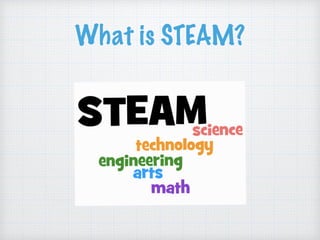
What is STEAM?
Adding the “A”
STEM learning emphasis (late 80s, early
90s)
“The arts and sciences are avatars of human
creativity.” ~Mae Jemison (early 2000s)
“The problem-solving, the fearlessness, and
the critical thinking and making skills.”
~John Maeda (early 2010s)
Adding the “A”
STEM learning emphasis (late 80s, early
90s)
“The arts and sciences are avatars of human
creativity.” ~Mae Jemison (early 2000s)
“The problem-solving, the fearlessness, and
the critical thinking and making skills.”
~John Maeda (early 2010s)
Adding the “A”
STEM learning emphasis (late 80s, early
90s)
“The arts and sciences are avatars of human
creativity.” ~Mae Jemison (early 2000s)
“The problem-solving, the fearlessness, and
the critical thinking and making skills.”
~John Maeda (early 2010s)
Arts ≠ Crafts
image from “Coloured Pencils” by openclipart user rewarriner, Creative Commons licensed
Arts ≠ Crafts
images from “Coloured Pencils” by openclipart user rewarriner, and “No-sign X” (modified) by openclipart user skotan, both Creative Commons licensed
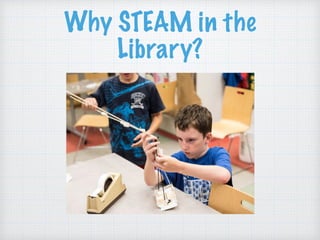
Why STEAM in the
Library?
Why STEAM in the
Library?
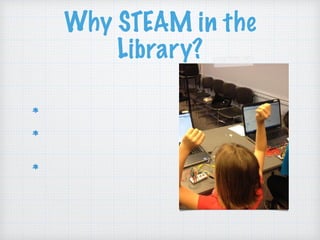
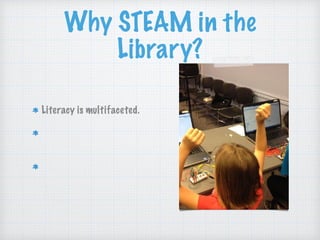
Literacy is multifaceted.
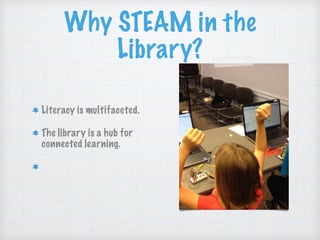
The library is a hub for
connected learning.
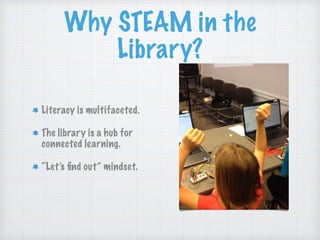
“Let’s find out” mindset.
Why STEAM in the
Library?
Literacy is multifaceted.
The library is a hub for
connected learning.
“Let’s find out” mindset.
Why STEAM in the
Library?
Literacy is multifaceted.
The library is a hub for
connected learning.
“Let’s find out” mindset.
Why STEAM in the
Library?
Literacy is multifaceted.
The library is a hub for
connected learning.
“Let’s find out” mindset.
Why STEAM in the
Library?
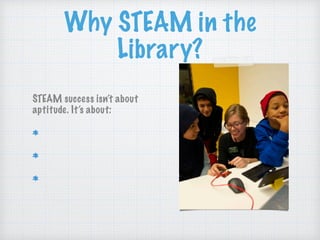
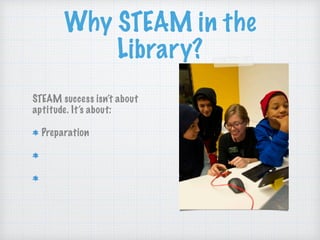
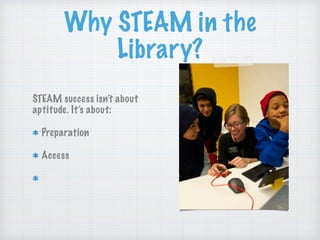
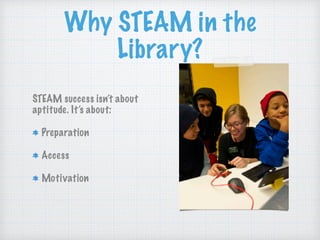
STEAM success isn’t about
aptitude. It’s about:
Preparation
Access
Motivation
Why STEAM in the
Library?
STEAM success isn’t about
aptitude. It’s about:
Preparation
Access
Motivation
Why STEAM in the
Library?
STEAM success isn’t about
aptitude. It’s about:
Preparation
Access
Motivation
Why STEAM in the
Library?
STEAM success isn’t about
aptitude. It’s about:
Preparation
Access
Motivation
Why STEAM in the
Library?
STEAM success isn’t about
aptitude. It’s about:
Preparation
Access
Motivation
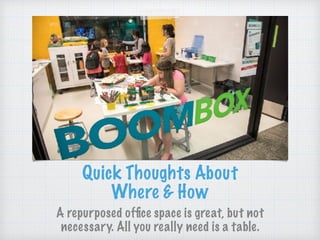
Quick Thoughts About
Where & How
A repurposed office space is great, but not
necessary. All you really need is a table.
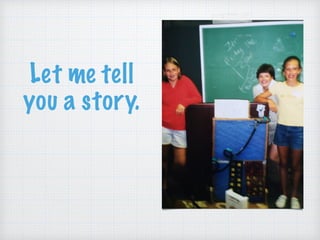
Let me tell
you a story.
You don’t need to be an expert.
You need to be an advocate.
You don’t need to be an expert.
You need to be an advocate.
STEAM for
Elementary Students
Why?
‣ Deepen concept knowledge.
‣ Promote the collection.
‣ Facilitate interest.
‣ Engage “reluctant” readers.
Where?
‣ Class activities
‣ “Station” activities
‣ Take-home activities
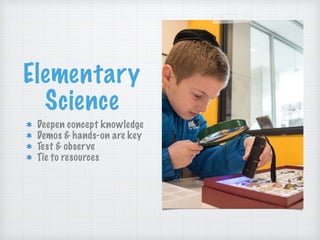
Elementary
Science
Deepen concept knowledge
Demos & hands-on are key
Test & observe
Tie to resources
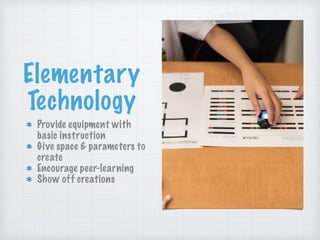
Elementary
Technology
Provide equipment with
basic instruction
Give space & parameters to
create
Encourage peer-learning
Show off creations
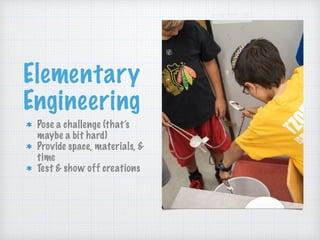
Elementary
Engineering
Pose a challenge (that’s
maybe a bit hard)
Provide space, materials, &
time
Test & show off creations
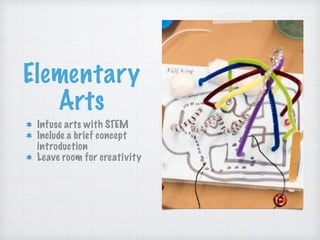
Elementary
Arts
Infuse arts with STEM
Include a brief concept
introduction
Leave room for creativity
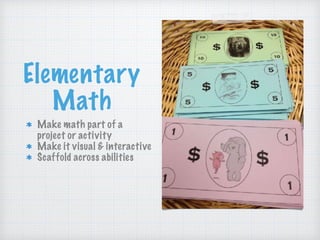
Elementary
Math
Make math part of a
project or activity
Make it visual & interactive
Scaffold across abilities
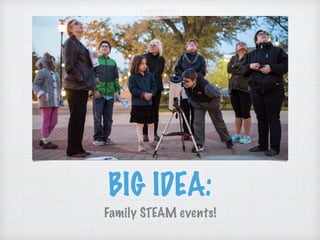
BIG IDEA:
Family STEAM events!
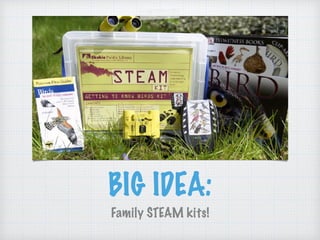
BIG IDEA:
Family STEAM kits!
STEAM for Teen
Students
Why?
‣ Deepen concept knowledge.
‣ Promote the collection & resources.
‣ Encourage personal interest.
‣ Enable seeing themselves as scientists.
Where?
‣ Class activities
‣ “Station” activities
‣ Afterschool activities & clubs
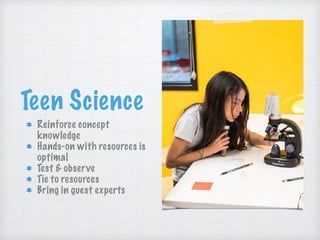
Teen Science
Reinforce concept
knowledge
Hands-on with resources is
optimal
Test & observe
Tie to resources
Bring in guest experts
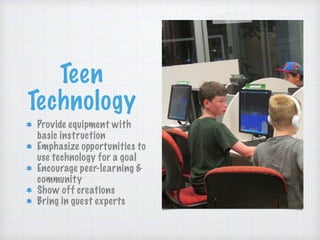
Teen
Technology
Provide equipment with
basic instruction
Emphasize opportunities to
use technology for a goal
Encourage peer-learning &
community
Show off creations
Bring in guest experts
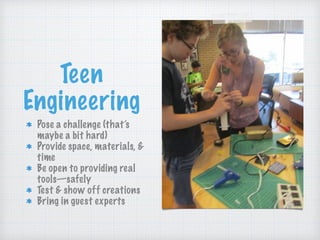
Teen
Engineering
Pose a challenge (that’s
maybe a bit hard)
Provide space, materials, &
time
Be open to providing real
tools—safely
Test & show off creations
Bring in guest experts
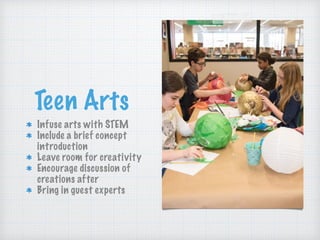
Teen Arts
Infuse arts with STEM
Include a brief concept
introduction
Leave room for creativity
Encourage discussion of
creations after
Bring in guest experts
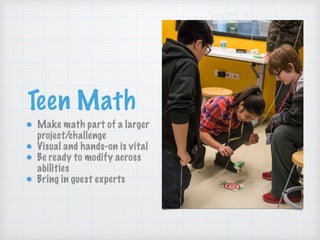
Teen Math
Make math part of a larger
project/challenge
Visual and hands-on is vital
Be ready to modify across
abilities
Bring in guest experts
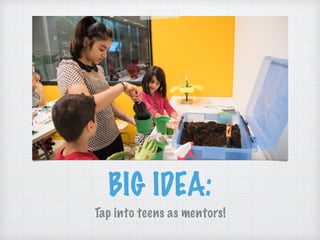
BIG IDEA:
Tap into teens as mentors!
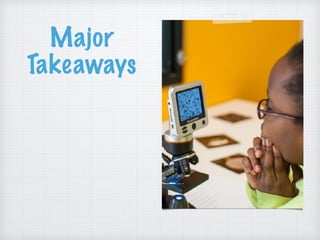
Major
Takeaways
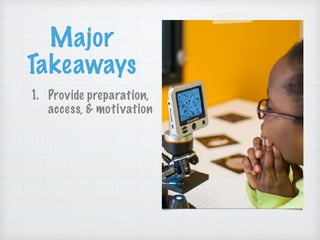
1. Provide preparation,
access, & motivation
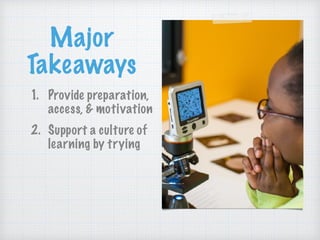
2. Support a culture of
learning by trying
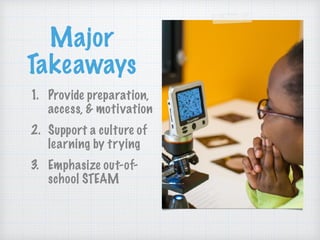
3. Emphasize out-of-
school STEAM
Major
Takeaways
1. Provide preparation,
access, & motivation
2. Support a culture of
learning by trying
3. Emphasize out-of-
school STEAM
Major
Takeaways
1. Provide preparation,
access, & motivation
2. Support a culture of
learning by trying
3. Emphasize out-of-
school STEAM
Major
Takeaways
1. Provide preparation,
access, & motivation
2. Support a culture of
learning by trying
3. Emphasize out-of-
school STEAM
Questions?
Contact Info
Amy Koester
amy.e.koester@gmail.com
http://showmelibrarian.blogspot.com
@amyeileenk
Further Reading
‣ “Every Child Is Born A Scientist” from Marcelo Gleiser on NPR 13.7 Cosmos And Culture
‣ “From STEM to STEAM: Science and Art Go Hand-in-Hand” from Steven Ross Pomeroy on
Scientific American
‣ “Full STEAM Ahead: Injecting Art and Creativity into STEM” from Amy Koester on
School Library Journal
‣ “How Minecraft & Duct Tape Wallets Prepare Our Kids for Jobs That Don’t Exist Yet” from
Zach Klein on EdSurge
‣ “Improving STEM Curriculum and Instruction: Engaging Students and Raising Standards”
from Successful STEM Education Initiative, a National Research Council report funded by
the National Science Foundation
‣ “Students Learn STEM Subjects Better When They’re Taught This Strange Detail in the
Process” from Kathleen Wong on Mic.com
‣ “Why Kids Need to Tinker to Learn” from Katrina Schwartz, on Mind/Shift

STEAM in the Library Keynote

  • 1.
    STEAM in theLibrary MASL 2016 Amy Koester
  • 2.
    A Bit AboutMe Youth & Family Program Supervisor at Skokie Public Library Before that, a branch children’s librarian with St. Charles City-County Library District STEAM trainings include articles, webinars, conference sessions, toolkit, & an online course
  • 3.
    Our Agenda 1. STEAM& the Library: Setting the Foundation 2. STEAM for Elementary Students 3. STEAM for Teen Students 4. Major Takeaways 5. Time for Questions
  • 4.
    STEAM & theLibrary
  • 5.
  • 6.
    Adding the “A” STEMlearning emphasis (late 80s, early 90s) “The arts and sciences are avatars of human creativity.” ~Mae Jemison (early 2000s) “The problem-solving, the fearlessness, and the critical thinking and making skills.” ~John Maeda (early 2010s)
  • 7.
    Adding the “A” STEMlearning emphasis (late 80s, early 90s) “The arts and sciences are avatars of human creativity.” ~Mae Jemison (early 2000s) “The problem-solving, the fearlessness, and the critical thinking and making skills.” ~John Maeda (early 2010s)
  • 8.
    Adding the “A” STEMlearning emphasis (late 80s, early 90s) “The arts and sciences are avatars of human creativity.” ~Mae Jemison (early 2000s) “The problem-solving, the fearlessness, and the critical thinking and making skills.” ~John Maeda (early 2010s)
  • 9.
    Arts ≠ Crafts imagefrom “Coloured Pencils” by openclipart user rewarriner, Creative Commons licensed
  • 10.
    Arts ≠ Crafts imagesfrom “Coloured Pencils” by openclipart user rewarriner, and “No-sign X” (modified) by openclipart user skotan, both Creative Commons licensed
  • 11.
    Why STEAM inthe Library?
  • 12.
    Why STEAM inthe Library? Literacy is multifaceted. The library is a hub for connected learning. “Let’s find out” mindset.
  • 13.
    Why STEAM inthe Library? Literacy is multifaceted. The library is a hub for connected learning. “Let’s find out” mindset.
  • 14.
    Why STEAM inthe Library? Literacy is multifaceted. The library is a hub for connected learning. “Let’s find out” mindset.
  • 15.
    Why STEAM inthe Library? Literacy is multifaceted. The library is a hub for connected learning. “Let’s find out” mindset.
  • 16.
    Why STEAM inthe Library? STEAM success isn’t about aptitude. It’s about: Preparation Access Motivation
  • 17.
    Why STEAM inthe Library? STEAM success isn’t about aptitude. It’s about: Preparation Access Motivation
  • 18.
    Why STEAM inthe Library? STEAM success isn’t about aptitude. It’s about: Preparation Access Motivation
  • 19.
    Why STEAM inthe Library? STEAM success isn’t about aptitude. It’s about: Preparation Access Motivation
  • 20.
    Why STEAM inthe Library? STEAM success isn’t about aptitude. It’s about: Preparation Access Motivation
  • 21.
    Quick Thoughts About Where& How A repurposed office space is great, but not necessary. All you really need is a table.
  • 22.
  • 23.
    You don’t needto be an expert. You need to be an advocate.
  • 24.
    You don’t needto be an expert. You need to be an advocate.
  • 25.
  • 26.
    Why? ‣ Deepen conceptknowledge. ‣ Promote the collection. ‣ Facilitate interest. ‣ Engage “reluctant” readers.
  • 27.
    Where? ‣ Class activities ‣“Station” activities ‣ Take-home activities
  • 28.
    Elementary Science Deepen concept knowledge Demos& hands-on are key Test & observe Tie to resources
  • 29.
    Elementary Technology Provide equipment with basicinstruction Give space & parameters to create Encourage peer-learning Show off creations
  • 30.
    Elementary Engineering Pose a challenge(that’s maybe a bit hard) Provide space, materials, & time Test & show off creations
  • 31.
    Elementary Arts Infuse arts withSTEM Include a brief concept introduction Leave room for creativity
  • 32.
    Elementary Math Make math partof a project or activity Make it visual & interactive Scaffold across abilities
  • 33.
  • 34.
  • 35.
  • 36.
    Why? ‣ Deepen conceptknowledge. ‣ Promote the collection & resources. ‣ Encourage personal interest. ‣ Enable seeing themselves as scientists.
  • 37.
    Where? ‣ Class activities ‣“Station” activities ‣ Afterschool activities & clubs
  • 38.
    Teen Science Reinforce concept knowledge Hands-onwith resources is optimal Test & observe Tie to resources Bring in guest experts
  • 39.
    Teen Technology Provide equipment with basicinstruction Emphasize opportunities to use technology for a goal Encourage peer-learning & community Show off creations Bring in guest experts
  • 40.
    Teen Engineering Pose a challenge(that’s maybe a bit hard) Provide space, materials, & time Be open to providing real tools—safely Test & show off creations Bring in guest experts
  • 41.
    Teen Arts Infuse artswith STEM Include a brief concept introduction Leave room for creativity Encourage discussion of creations after Bring in guest experts
  • 42.
    Teen Math Make mathpart of a larger project/challenge Visual and hands-on is vital Be ready to modify across abilities Bring in guest experts
  • 43.
    BIG IDEA: Tap intoteens as mentors!
  • 44.
    Major Takeaways 1. Provide preparation, access,& motivation 2. Support a culture of learning by trying 3. Emphasize out-of- school STEAM
  • 45.
    Major Takeaways 1. Provide preparation, access,& motivation 2. Support a culture of learning by trying 3. Emphasize out-of- school STEAM
  • 46.
    Major Takeaways 1. Provide preparation, access,& motivation 2. Support a culture of learning by trying 3. Emphasize out-of- school STEAM
  • 47.
    Major Takeaways 1. Provide preparation, access,& motivation 2. Support a culture of learning by trying 3. Emphasize out-of- school STEAM
  • 48.
  • 49.
  • 50.
    Further Reading ‣ “EveryChild Is Born A Scientist” from Marcelo Gleiser on NPR 13.7 Cosmos And Culture ‣ “From STEM to STEAM: Science and Art Go Hand-in-Hand” from Steven Ross Pomeroy on Scientific American ‣ “Full STEAM Ahead: Injecting Art and Creativity into STEM” from Amy Koester on School Library Journal ‣ “How Minecraft & Duct Tape Wallets Prepare Our Kids for Jobs That Don’t Exist Yet” from Zach Klein on EdSurge ‣ “Improving STEM Curriculum and Instruction: Engaging Students and Raising Standards” from Successful STEM Education Initiative, a National Research Council report funded by the National Science Foundation ‣ “Students Learn STEM Subjects Better When They’re Taught This Strange Detail in the Process” from Kathleen Wong on Mic.com ‣ “Why Kids Need to Tinker to Learn” from Katrina Schwartz, on Mind/Shift