Building STEAM with Día:
The Whys and Hows to
Getting Started
Amy Koester | March 2015
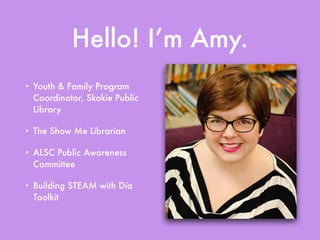
Hello! I’m Amy.
• Youth & Family Program
Coordinator, Skokie Public
Library
• The Show Me Librarian
• ALSC Public Awareness
Committee
• Building STEAM with Día
Toolkit
On Our Agenda
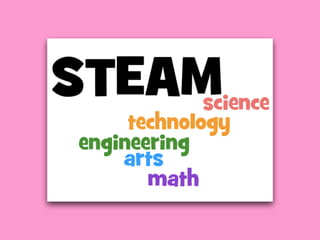
• What is STEAM, and how does diversity fit into the
conversation?
• Sample Programs by Age
• Five Tips for Diverse STEAM Programs
• Resources & Questions
What is STEAM, and
how does diversity fit
into the conversation?
STEAM Timeline
• 1983 - Educating Americans for the 21st Century
(National Science Board Commission on Precollege Education
in Mathematics, Science, and Technology)
• 1989 - Education Summit convened by President
George H.W. Bush
• 1994 - Goals 2000: Educate America signed into
law by President Bill Clinton
• 2001 - No Child Left Behind signed into law by
President George W. Bush
STEAM Timeline
• 1983 - Educating Americans for the 21st Century
(National Science Board Commission on Precollege Education
in Mathematics, Science, and Technology)
• 1989 - Education Summit convened by President
George H.W. Bush
• 1994 - Goals 2000: Educate America signed into
law by President Bill Clinton
• 2001 - No Child Left Behind signed into law by
President George W. Bush
STEAM Timeline
• 1983 - Educating Americans for the 21st Century
(National Science Board Commission on Precollege Education
in Mathematics, Science, and Technology)
• 1989 - Education Summit convened by President
George H.W. Bush
• 1994 - Goals 2000: Educate America signed into
law by President Bill Clinton
• 2001 - No Child Left Behind signed into law by
President George W. Bush
STEAM Timeline
• 1983 - Educating Americans for the 21st Century
(National Science Board Commission on Precollege Education
in Mathematics, Science, and Technology)
• 1989 - Education Summit convened by President
George H.W. Bush
• 1994 - Goals 2000: Educate America signed into
law by President Bill Clinton
• 2001 - No Child Left Behind signed into law by
President George W. Bush
STEAM Timeline (cont.)
• 2002 - “Teach arts and sciences together” TED Talk
by Mae Jemison
• 2007 - Rising Above the Gathering Storm (National
Academy of Sciences, National Academy of Engineering, and
Institute of Medicine)
• 2011 - Expanding Underrepresented Minority
Participation: American’s Science and Technology
Talent at the Crossroads (National Academy of Sciences,
National Academy of Engineering, and Institute of Medicine)
STEAM Timeline (cont.)
• 2002 - “Teach arts and sciences together” TED Talk
by Mae Jemison
• 2007 - Rising Above the Gathering Storm (National
Academy of Sciences, National Academy of Engineering, and
Institute of Medicine)
• 2011 - Expanding Underrepresented Minority
Participation: American’s Science and Technology
Talent at the Crossroads (National Academy of Sciences,
National Academy of Engineering, and Institute of Medicine)
STEAM Timeline (cont.)
• 2002 - “Teach arts and sciences together” TED Talk
by Mae Jemison
• 2007 - Rising Above the Gathering Storm (National
Academy of Sciences, National Academy of Engineering, and
Institute of Medicine)
• 2011 - Expanding Underrepresented Minority
Participation: American’s Science and Technology
Talent at the Crossroads (National Academy of Sciences,
National Academy of Engineering, and Institute of Medicine)
So why does this matter?
• Minorities are underrepresented in STEM fields.
• Minorities are underrepresented in STEM
education.
• Minority students’ STEM test scores are
consistently below their white peers’.
So why does this matter?
• Minorities are underrepresented in STEM fields.
• Minorities are underrepresented in STEM
education.
• Minority students’ STEM test scores are
consistently below their white peers’.
So why does this matter?
• Minorities are underrepresented in STEM fields.
• Minorities are underrepresented in STEM
education.
• Minority students’ STEM test scores are
consistently below their white peers’.
So why does this matter?
• It’s not about aptitude. It’s about:
• Preparation
• Access
• Motivation
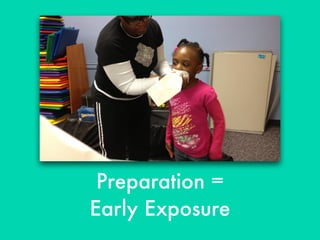
Preparation =
Early Exposure
Access =
Plentiful & Rich Options
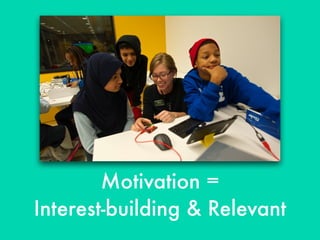
Motivation =
Interest-building & Relevant
Sample Programs
by Age
Shapes We Eat:
Preschool
• 20-30 minutes
• Round is a Tortilla and talking
about foods we love
• Measuring ingredients &
making play dough
• “Cooking” our favorite foods
• Other diverse food titles on
display
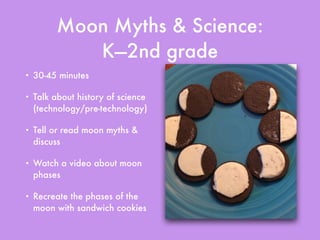
Moon Myths & Science:
K—2nd grade
• 30-45 minutes
• Talk about history of science
(technology/pre-technology)
• Tell or read moon myths &
discuss
• Watch a video about moon
phases
• Recreate the phases of the
moon with sandwich cookies
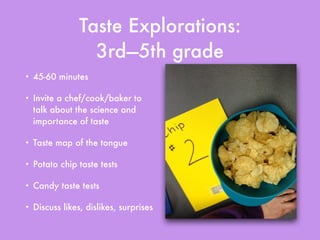
Taste Explorations:
3rd—5th grade
• 45-60 minutes
• Invite a chef/cook/baker to
talk about the science and
importance of taste
• Taste map of the tongue
• Potato chip taste tests
• Candy taste tests
• Discuss likes, dislikes, surprises
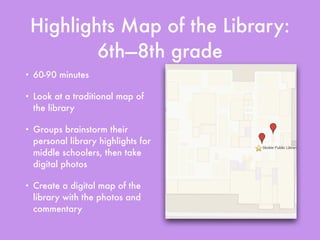
Highlights Map of the Library:
6th—8th grade
• 60-90 minutes
• Look at a traditional map of
the library
• Groups brainstorm their
personal library highlights for
middle schoolers, then take
digital photos
• Create a digital map of the
library with the photos and
commentary
Five Tips for Diverse STEAM
Programs
1. Make it engaging & participatory.
2. Make it motivating.
3. Highlight diverse STEAM.
4. Use all resources available.
5. Create partnerships & collaborations.
Five Tips for Diverse STEAM
Programs
1. Make it engaging & participatory.
2. Make it motivating.
3. Highlight diverse STEAM.
4. Use all resources available.
5. Create partnerships & collaborations.
Five Tips for Diverse STEAM
Programs
1. Make it engaging & participatory.
2. Make it motivating.
3. Highlight diverse STEAM.
4. Use all resources available.
5. Create partnerships & collaborations.
Five Tips for Diverse STEAM
Programs
1. Make it engaging & participatory.
2. Make it motivating.
3. Highlight diverse STEAM.
4. Use all resources available.
5. Create partnerships & collaborations.
Five Tips for Diverse STEAM
Programs
1. Make it engaging & participatory.
2. Make it motivating.
3. Highlight diverse STEAM.
4. Use all resources available.
5. Create partnerships & collaborations.
Five Tips for Diverse STEAM
Programs
1. Make it engaging & participatory.
2. Make it motivating.
3. Highlight diverse STEAM.
4. Use all resources available.
5. Create partnerships & collaborations.
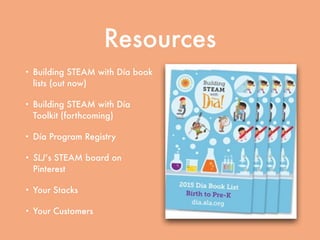
Resources
• Building STEAM with Día book
lists (out now)
• Building STEAM with Día
Toolkit (forthcoming)
• Día Program Registry
• SLJ’s STEAM board on
Pinterest
• Your Stacks
• Your Customers
Questions?
Let’s chat!
• amy.e.koester@gmail.com
• @amyeileenk
• http://showmelibrarian.blogspot.com

Building STEAM with Día ALSC Webinar

  • 1.
    Building STEAM withDía: The Whys and Hows to Getting Started Amy Koester | March 2015
  • 2.
    Hello! I’m Amy. •Youth & Family Program Coordinator, Skokie Public Library • The Show Me Librarian • ALSC Public Awareness Committee • Building STEAM with Día Toolkit
  • 3.
    On Our Agenda •What is STEAM, and how does diversity fit into the conversation? • Sample Programs by Age • Five Tips for Diverse STEAM Programs • Resources & Questions
  • 4.
    What is STEAM,and how does diversity fit into the conversation?
  • 6.
    STEAM Timeline • 1983- Educating Americans for the 21st Century (National Science Board Commission on Precollege Education in Mathematics, Science, and Technology) • 1989 - Education Summit convened by President George H.W. Bush • 1994 - Goals 2000: Educate America signed into law by President Bill Clinton • 2001 - No Child Left Behind signed into law by President George W. Bush
  • 7.
    STEAM Timeline • 1983- Educating Americans for the 21st Century (National Science Board Commission on Precollege Education in Mathematics, Science, and Technology) • 1989 - Education Summit convened by President George H.W. Bush • 1994 - Goals 2000: Educate America signed into law by President Bill Clinton • 2001 - No Child Left Behind signed into law by President George W. Bush
  • 8.
    STEAM Timeline • 1983- Educating Americans for the 21st Century (National Science Board Commission on Precollege Education in Mathematics, Science, and Technology) • 1989 - Education Summit convened by President George H.W. Bush • 1994 - Goals 2000: Educate America signed into law by President Bill Clinton • 2001 - No Child Left Behind signed into law by President George W. Bush
  • 9.
    STEAM Timeline • 1983- Educating Americans for the 21st Century (National Science Board Commission on Precollege Education in Mathematics, Science, and Technology) • 1989 - Education Summit convened by President George H.W. Bush • 1994 - Goals 2000: Educate America signed into law by President Bill Clinton • 2001 - No Child Left Behind signed into law by President George W. Bush
  • 10.
    STEAM Timeline (cont.) •2002 - “Teach arts and sciences together” TED Talk by Mae Jemison • 2007 - Rising Above the Gathering Storm (National Academy of Sciences, National Academy of Engineering, and Institute of Medicine) • 2011 - Expanding Underrepresented Minority Participation: American’s Science and Technology Talent at the Crossroads (National Academy of Sciences, National Academy of Engineering, and Institute of Medicine)
  • 11.
    STEAM Timeline (cont.) •2002 - “Teach arts and sciences together” TED Talk by Mae Jemison • 2007 - Rising Above the Gathering Storm (National Academy of Sciences, National Academy of Engineering, and Institute of Medicine) • 2011 - Expanding Underrepresented Minority Participation: American’s Science and Technology Talent at the Crossroads (National Academy of Sciences, National Academy of Engineering, and Institute of Medicine)
  • 12.
    STEAM Timeline (cont.) •2002 - “Teach arts and sciences together” TED Talk by Mae Jemison • 2007 - Rising Above the Gathering Storm (National Academy of Sciences, National Academy of Engineering, and Institute of Medicine) • 2011 - Expanding Underrepresented Minority Participation: American’s Science and Technology Talent at the Crossroads (National Academy of Sciences, National Academy of Engineering, and Institute of Medicine)
  • 13.
    So why doesthis matter? • Minorities are underrepresented in STEM fields. • Minorities are underrepresented in STEM education. • Minority students’ STEM test scores are consistently below their white peers’.
  • 14.
    So why doesthis matter? • Minorities are underrepresented in STEM fields. • Minorities are underrepresented in STEM education. • Minority students’ STEM test scores are consistently below their white peers’.
  • 15.
    So why doesthis matter? • Minorities are underrepresented in STEM fields. • Minorities are underrepresented in STEM education. • Minority students’ STEM test scores are consistently below their white peers’.
  • 16.
    So why doesthis matter? • It’s not about aptitude. It’s about: • Preparation • Access • Motivation
  • 17.
  • 18.
  • 19.
  • 20.
  • 21.
    Shapes We Eat: Preschool •20-30 minutes • Round is a Tortilla and talking about foods we love • Measuring ingredients & making play dough • “Cooking” our favorite foods • Other diverse food titles on display
  • 22.
    Moon Myths &Science: K—2nd grade • 30-45 minutes • Talk about history of science (technology/pre-technology) • Tell or read moon myths & discuss • Watch a video about moon phases • Recreate the phases of the moon with sandwich cookies
  • 23.
    Taste Explorations: 3rd—5th grade •45-60 minutes • Invite a chef/cook/baker to talk about the science and importance of taste • Taste map of the tongue • Potato chip taste tests • Candy taste tests • Discuss likes, dislikes, surprises
  • 24.
    Highlights Map ofthe Library: 6th—8th grade • 60-90 minutes • Look at a traditional map of the library • Groups brainstorm their personal library highlights for middle schoolers, then take digital photos • Create a digital map of the library with the photos and commentary
  • 25.
    Five Tips forDiverse STEAM Programs 1. Make it engaging & participatory. 2. Make it motivating. 3. Highlight diverse STEAM. 4. Use all resources available. 5. Create partnerships & collaborations.
  • 26.
    Five Tips forDiverse STEAM Programs 1. Make it engaging & participatory. 2. Make it motivating. 3. Highlight diverse STEAM. 4. Use all resources available. 5. Create partnerships & collaborations.
  • 27.
    Five Tips forDiverse STEAM Programs 1. Make it engaging & participatory. 2. Make it motivating. 3. Highlight diverse STEAM. 4. Use all resources available. 5. Create partnerships & collaborations.
  • 28.
    Five Tips forDiverse STEAM Programs 1. Make it engaging & participatory. 2. Make it motivating. 3. Highlight diverse STEAM. 4. Use all resources available. 5. Create partnerships & collaborations.
  • 29.
    Five Tips forDiverse STEAM Programs 1. Make it engaging & participatory. 2. Make it motivating. 3. Highlight diverse STEAM. 4. Use all resources available. 5. Create partnerships & collaborations.
  • 30.
    Five Tips forDiverse STEAM Programs 1. Make it engaging & participatory. 2. Make it motivating. 3. Highlight diverse STEAM. 4. Use all resources available. 5. Create partnerships & collaborations.
  • 31.
    Resources • Building STEAMwith Día book lists (out now) • Building STEAM with Día Toolkit (forthcoming) • Día Program Registry • SLJ’s STEAM board on Pinterest • Your Stacks • Your Customers
  • 32.
  • 33.
    Let’s chat! • amy.e.koester@gmail.com •@amyeileenk • http://showmelibrarian.blogspot.com