It’s OK to Play!
      How to recognize
 Developmentally Appropriate
          Practice
What is DAP?
Developmentally appropriate practice is based on:

• Knowledge about how children develop and learn

• What should be learned and how it would best be
  learned depending on developmental level

• Our understanding of the relationships between
  early experience and subsequent development

         – http://www.naeyc.org/about/positions/dap3.asp
Why use DAP?
• Areas of children's development
  physical, social, emotional, and
  cognitive are closely related.
  Development in one area influences
  and is influenced by development in
  other areas.
    http://www.naeyc.org/about/positions/dap3.asp
• Development and learning occur in
  and are influenced by multiple
  social and cultural contexts.


  – http://www.naeyc.org/about/positions/dap3.asp
• Children are active learners,
  drawing on direct physical and
  social experience as well as cul-
  turally transmitted knowledge to
  construct their own understandings
  of the world around them.

  http://www.naeyc.org/about/positions/dap3.asp
• Play is an important vehicle for
  children's social, emotional, and
  cognitive development, as well as a
  reflection of their development.


  – http://www.naeyc.org/about/positions/dap3.asp
Where is DAP?
               (Where should DAP be???)

• Anywhere!
• As parents it is your responsibility to
  ensure your child is receiving DAP:
  –   In a   center
  –   In a   home setting
  –   In a   classroom
  –   In a   group setting (afterschool, field
               trips, sports games, church, etc.)
Observing The Learning
    Environment
  Well defined centers/areas
  Materials for centers/areas
   Focus on literacy and fine motor skills
    and many print-rich opportunities!
  Room Arrangement
  Traffic Patterns
  Aesthetic Appeal 
Centers/Areas
  Large Group and Circle Time
  C Music and Silly Sounds
S Science and Math
S Blocks/Trucks
S Housekeeping
S Art

S Remember. . . Literacy and fine motor
  skills abound!
Literacy
       It’s EVERYWHERE!
•   Books
•   Puppets
•   Flannel Boards
•   Daily Schedule
•   Labels
•   Names
•   Fingerplays
•   Music and Dance
•   Rhymes
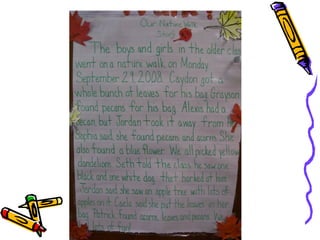
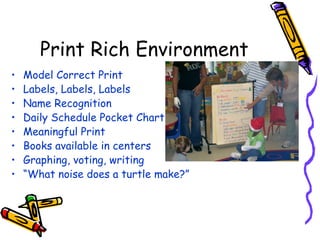
Print Rich Environment
•   Model Correct Print
•   Labels, Labels, Labels
•   Name Recognition
•   Daily Schedule Pocket Chart
•   Meaningful Print
•   Books available in centers
•   Graphing, voting, writing
•   “What noise does a turtle make?”
Fine Motor Development
• What - use of hand and finger
  muscles to increase dexterity
• Why – to increase ability to perform
  self help skills and later increase
  writing skills
• How. . .
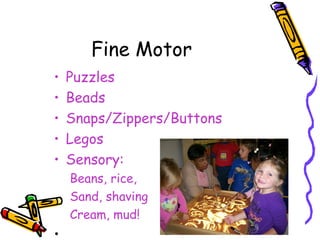
Fine Motor
•   Puzzles
•   Beads
•   Snaps/Zippers/Buttons
•   Legos
•   Sensory:
    Beans, rice,
    Sand, shaving
    Cream, mud!
•
Large Group
•   Books
•   Circle Time
•   Discussions
•   Class Rules
•   Games
•   Music/Dance
•   Large Motor Activities
•   Social Skills
Science and Math
•   Sensory table/tub
•   Experiments
•   Bubbles
•   Food color
•   Shaving cream
•   Simple Recipes
•   Plants & Animals
•   Small toys for
    – Counting, sorting, classifying, measuring
• Calendar and Weather
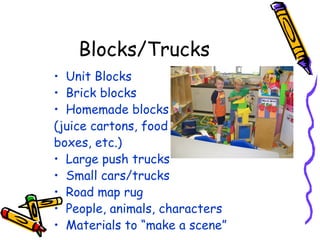
Blocks/Trucks
• Unit Blocks
• Brick blocks
• Homemade blocks
(juice cartons, food
boxes, etc.)
• Large push trucks
• Small cars/trucks
• Road map rug
• People, animals, characters
• Materials to “make a scene”
Housekeeping
•   Kitchen set
•   Food/Dishes
•   Variety of dolls
•   Broom/Mop/Vacuum
•   Dress up clothes/Shoes/Hats
•   Change often to fit theme (Pizza
    Parlor, Barber Shop, Camping…)
Music
• House hold items
• Pots, pans, spoons
• Bottle shakers
• Blank CDs
• Dance, clap, shake, sway, rock to
  rhythm
• How does the music make you feel?
• Close your eyes…What do you see?
Silly Sounds
•   Rhyme and Repetition
•   Animal Sounds
•   Nursery Rhymes and Finger Plays
•   Let child finish the line
    – “Hickory Dickory Dock, the mouse ran up
      the _____.”
“Process” Art
•   Tempera Paint
•   Finger Paint
•   Watercolors
•   Drawing
•   Easel
•   Collage
•   Stamps
•   NOT “PROJECT ART”
•   Limit “CRAFTS”
Softness
•   Couches
•   Cushions
•   Pillows
•   Rugs
•   Curtains
•   Textures
Aesthetic Appeal
What do you “C”?
 • Centers
 • Colorful
 • Clean
 • Clutter-free
 • Cozy
 • Child friendly

It's ok to play training module

  • 1.
    It’s OK toPlay! How to recognize Developmentally Appropriate Practice
  • 2.
    What is DAP? Developmentallyappropriate practice is based on: • Knowledge about how children develop and learn • What should be learned and how it would best be learned depending on developmental level • Our understanding of the relationships between early experience and subsequent development – http://www.naeyc.org/about/positions/dap3.asp
  • 3.
    Why use DAP? •Areas of children's development physical, social, emotional, and cognitive are closely related. Development in one area influences and is influenced by development in other areas. http://www.naeyc.org/about/positions/dap3.asp
  • 4.
    • Development andlearning occur in and are influenced by multiple social and cultural contexts. – http://www.naeyc.org/about/positions/dap3.asp
  • 5.
    • Children areactive learners, drawing on direct physical and social experience as well as cul- turally transmitted knowledge to construct their own understandings of the world around them. http://www.naeyc.org/about/positions/dap3.asp
  • 6.
    • Play isan important vehicle for children's social, emotional, and cognitive development, as well as a reflection of their development. – http://www.naeyc.org/about/positions/dap3.asp
  • 7.
    Where is DAP? (Where should DAP be???) • Anywhere! • As parents it is your responsibility to ensure your child is receiving DAP: – In a center – In a home setting – In a classroom – In a group setting (afterschool, field trips, sports games, church, etc.)
  • 8.
    Observing The Learning Environment  Well defined centers/areas  Materials for centers/areas Focus on literacy and fine motor skills and many print-rich opportunities!  Room Arrangement  Traffic Patterns  Aesthetic Appeal 
  • 9.
    Centers/Areas LargeGroup and Circle Time C Music and Silly Sounds S Science and Math S Blocks/Trucks S Housekeeping S Art S Remember. . . Literacy and fine motor skills abound!
  • 10.
    Literacy It’s EVERYWHERE! • Books • Puppets • Flannel Boards • Daily Schedule • Labels • Names • Fingerplays • Music and Dance • Rhymes
  • 12.
    Print Rich Environment • Model Correct Print • Labels, Labels, Labels • Name Recognition • Daily Schedule Pocket Chart • Meaningful Print • Books available in centers • Graphing, voting, writing • “What noise does a turtle make?”
  • 13.
    Fine Motor Development •What - use of hand and finger muscles to increase dexterity • Why – to increase ability to perform self help skills and later increase writing skills • How. . .
  • 14.
    Fine Motor • Puzzles • Beads • Snaps/Zippers/Buttons • Legos • Sensory: Beans, rice, Sand, shaving Cream, mud! •
  • 15.
    Large Group • Books • Circle Time • Discussions • Class Rules • Games • Music/Dance • Large Motor Activities • Social Skills
  • 16.
    Science and Math • Sensory table/tub • Experiments • Bubbles • Food color • Shaving cream • Simple Recipes • Plants & Animals • Small toys for – Counting, sorting, classifying, measuring • Calendar and Weather
  • 17.
    Blocks/Trucks • Unit Blocks •Brick blocks • Homemade blocks (juice cartons, food boxes, etc.) • Large push trucks • Small cars/trucks • Road map rug • People, animals, characters • Materials to “make a scene”
  • 18.
    Housekeeping • Kitchen set • Food/Dishes • Variety of dolls • Broom/Mop/Vacuum • Dress up clothes/Shoes/Hats • Change often to fit theme (Pizza Parlor, Barber Shop, Camping…)
  • 19.
    Music • House holditems • Pots, pans, spoons • Bottle shakers • Blank CDs • Dance, clap, shake, sway, rock to rhythm • How does the music make you feel? • Close your eyes…What do you see?
  • 20.
    Silly Sounds • Rhyme and Repetition • Animal Sounds • Nursery Rhymes and Finger Plays • Let child finish the line – “Hickory Dickory Dock, the mouse ran up the _____.”
  • 21.
    “Process” Art • Tempera Paint • Finger Paint • Watercolors • Drawing • Easel • Collage • Stamps • NOT “PROJECT ART” • Limit “CRAFTS”
  • 22.
    Softness • Couches • Cushions • Pillows • Rugs • Curtains • Textures
  • 23.
    Aesthetic Appeal What doyou “C”? • Centers • Colorful • Clean • Clutter-free • Cozy • Child friendly