Early childhood
Also called as
Exploratory age
Questioning age
Imitative age
Creative age
Importance of infancy and early childhood
First few years of life influence later period
Adult behavior and ways of thinking is traced to early childhood
experiences
Rate of development in all areas is most rapid during these years
Unfavorable experiences can hinder development
Favorable experience foster development which influence attitude of a
person towards life
Early childhood education
Needs of Preschoolers
3-4yrs old children require opportunity to
 Play with other children so they can learn
to listen, take turns and share
 Develop more physical coordination
 Develop their growing language abilities
through books, games, songs, science,
math’s and art activity
 Develop more self-reliance skills-for
example, learning to dress and undress
them selves
 Count and measure
 Participate actively with adults in reading-
aloud activities
 Explore the alphabet and print and
 Attempt to write messages
4-5 years old children need opportunities to
 Experiment and discover, within limits
 Develop their growing interest in school
subjects
 Enjoy activities that involve exploring and
investigating
 Group items those are similar (by size,
colour or shape)
 Use their imaginations and curiosity
 Develop their language skills b speaking
and listening
 See how reading and writing are both
enjoyable and useful (by listening to stories
and poems, seeing adults use books to find
information and dictating stories to adults)
What to expect from preschoolers?
 3-4 years
 Start to play with other children, instead
of next to them
 Are more likely to take turns and share
and begin to understand that other
people have feelings and rights
 Are increasingly self-reliant and
probably can dress with little help
 May develop fears (‘mom, there’s a
monster under my bed’) and have
imaginary companions
 Have greater large-muscle control and
love to run, skip, jump with both feet,
catch a ball, climb downstairs and dance
to music
 Have greater small-muscle control than
toddlers, which is reflected in their
drawing and scribbles
 Match and sort things that are alike and
unalike
 Recognize numerical
 Like silly humor
 Understand and follow spoken
directions
 Use new words and longer sentences
 Are aware of rhyming sounds in words
 May attempt to read, calling attention to
themselves and showing pride in their
accomplishment
 Recognize print around them on signs
or in logos
 Know that each alphabet letter had a
name and identify at least 10 alphabet
letters, especially those in their own
names
 Write or scribble messages
4-5years
 Are active and has lots of energy and may
be aggressive in their play
 Enjoy more group activities because they
have longer attention spans
 Like making faces and being silly
 May form cliques with friends and may
change friendships quickly
 Have better muscle control in running,
jumping and hopping
 Recognize and write the numerals
 Recognize shapes such as circles, squares,
rectangles, and triangles
 Love to make rhymes, say nonsense words
and tell jokes
 Know and use words that are important to
school work, such as the names for colors,
shapes and numbers, know and use words
that are important to daily life, such as
street names and address
 Know how books are held and read and
follow print from left to right and from top
to bottom of a page when listening to
stories read aloud
 Recognize the shapes and names of all
letters of the alphabet and know the sounds
of some letters Write some letters,
particularly those in his own name
Play way method
It is essentially child-centered and caters to
individual needs, interests and abilities
Why play way method?
 Play is second nature to a child
 It serves as a natural way for children t express ideas and abilities well to
explore and understand the world around them
 Supports all round development of children
 Provide learning experience to the child in a concrete from through play
situations so that the child becomes an active participant
 Provides a balance, process oriented programme which fulfills all
development objectives
 It nurtures development of learning process like observation,
experimentation, problem solving and creativity in children
 Facilitates individual attention and continuous evaluation of each child
 Group and individual activities provide immediate feedback to the teacher on
every child
 Makes learning enjoyable for children
 Develops a sustained motivation for school and schooling
What is play?
Play is fun
Play is enjoyable for its own sake; it is its own reward
Play is that activity in which participation is spontaneous
and of the child’s own will
Play is also been seen as an activity for relaxation
Through play children prepare for adult role
Children learn through play and that play fosters
development
Main characteristics of play
A natural expression of child’s life
A spontaneous expression of child’s life
A voluntary activity
A strong motivating force
 Without any deliberate purpose
Provides learning without tears
Touches all aspects of life
Helps children develop emotionally, physically and socially
A means of learning to live and not merely passing of time
Where does the child play?
-In and with his environment
-With living-pet animals
- With non living objects-dolls
-With other children
Essential requisites of play
-Space for play: space must be large enough
-Knowledge of how to play: through trial and error, through imitation and through
Activities that constitute play way method
Informal conversation
Rhymes
Story telling, puppetry
Out door and indoor play
Creative activity
Dramatization
Music and movement
Water and sand play
Field trips/Outings
Curriculum planning
Curriculum will give focus, a direction and purpose to the activities planned
Five stages in curriculum planning
1. Stating the long term goals depending on the areas of development
2. Breaking down each long term goal into short term goals
3. Identifying the play activities related to the short term goals
4. Formulating daily and weekly schedules
5. Evaluating play activities and children’s progress
Example of long term goal made short term goal
Long term goal:
developing conversational skills
Short term goals:
 Giving children opportunity to
talk with each other
Involving children in discussion
on a regular basis
Asking children questions related
to the activity they are doing
Helping them, know that they
must listen attentively to others
The ECE classroom
 Must have space for both large and small group activities
 Should have a large covered floor area for children to sit
 Must have small low tables and chairs
 The displayed items must be at eye level of children
 If space fund permit, the classroom should be set up with different corners as per the
age group
 A section for creative arts
 A cupboard for teacher to keep the teaching and learning material
 Specific space for keeping children’s lunch packs
 A black board for nursery and LKG and a white board for UKG
Most important considerations for material selection
Safety
Age appropriate
 In terms of Children’s interest
Learning abilities
Quality and durability
Flexibility of use/multipurpose
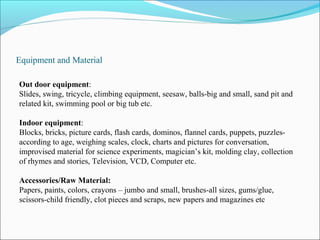
Equipment and Material
Out door equipment:
Slides, swing, tricycle, climbing equipment, seesaw, balls-big and small, sand pit and
related kit, swimming pool or big tub etc.
Indoor equipment:
Blocks, bricks, picture cards, flash cards, dominos, flannel cards, puppets, puzzles-
according to age, weighing scales, clock, charts and pictures for conversation,
improvised material for science experiments, magician’s kit, molding clay, collection
of rhymes and stories, Television, VCD, Computer etc.
Accessories/Raw Material:
Papers, paints, colors, crayons – jumbo and small, brushes-all sizes, gums/glue,
scissors-child friendly, clot pieces and scraps, new papers and magazines etc

Early childhood

  • 2.
    Early childhood Also calledas Exploratory age Questioning age Imitative age Creative age
  • 3.
    Importance of infancyand early childhood First few years of life influence later period Adult behavior and ways of thinking is traced to early childhood experiences Rate of development in all areas is most rapid during these years Unfavorable experiences can hinder development Favorable experience foster development which influence attitude of a person towards life
  • 4.
  • 5.
    Needs of Preschoolers 3-4yrsold children require opportunity to  Play with other children so they can learn to listen, take turns and share  Develop more physical coordination  Develop their growing language abilities through books, games, songs, science, math’s and art activity  Develop more self-reliance skills-for example, learning to dress and undress them selves  Count and measure  Participate actively with adults in reading- aloud activities  Explore the alphabet and print and  Attempt to write messages 4-5 years old children need opportunities to  Experiment and discover, within limits  Develop their growing interest in school subjects  Enjoy activities that involve exploring and investigating  Group items those are similar (by size, colour or shape)  Use their imaginations and curiosity  Develop their language skills b speaking and listening  See how reading and writing are both enjoyable and useful (by listening to stories and poems, seeing adults use books to find information and dictating stories to adults)
  • 6.
    What to expectfrom preschoolers?  3-4 years  Start to play with other children, instead of next to them  Are more likely to take turns and share and begin to understand that other people have feelings and rights  Are increasingly self-reliant and probably can dress with little help  May develop fears (‘mom, there’s a monster under my bed’) and have imaginary companions  Have greater large-muscle control and love to run, skip, jump with both feet, catch a ball, climb downstairs and dance to music  Have greater small-muscle control than toddlers, which is reflected in their drawing and scribbles  Match and sort things that are alike and unalike  Recognize numerical  Like silly humor  Understand and follow spoken directions  Use new words and longer sentences  Are aware of rhyming sounds in words  May attempt to read, calling attention to themselves and showing pride in their accomplishment  Recognize print around them on signs or in logos  Know that each alphabet letter had a name and identify at least 10 alphabet letters, especially those in their own names  Write or scribble messages
  • 7.
    4-5years  Are activeand has lots of energy and may be aggressive in their play  Enjoy more group activities because they have longer attention spans  Like making faces and being silly  May form cliques with friends and may change friendships quickly  Have better muscle control in running, jumping and hopping  Recognize and write the numerals  Recognize shapes such as circles, squares, rectangles, and triangles  Love to make rhymes, say nonsense words and tell jokes  Know and use words that are important to school work, such as the names for colors, shapes and numbers, know and use words that are important to daily life, such as street names and address  Know how books are held and read and follow print from left to right and from top to bottom of a page when listening to stories read aloud  Recognize the shapes and names of all letters of the alphabet and know the sounds of some letters Write some letters, particularly those in his own name
  • 8.
    Play way method Itis essentially child-centered and caters to individual needs, interests and abilities
  • 9.
    Why play waymethod?  Play is second nature to a child  It serves as a natural way for children t express ideas and abilities well to explore and understand the world around them  Supports all round development of children  Provide learning experience to the child in a concrete from through play situations so that the child becomes an active participant  Provides a balance, process oriented programme which fulfills all development objectives  It nurtures development of learning process like observation, experimentation, problem solving and creativity in children  Facilitates individual attention and continuous evaluation of each child  Group and individual activities provide immediate feedback to the teacher on every child  Makes learning enjoyable for children  Develops a sustained motivation for school and schooling
  • 10.
    What is play? Playis fun Play is enjoyable for its own sake; it is its own reward Play is that activity in which participation is spontaneous and of the child’s own will Play is also been seen as an activity for relaxation Through play children prepare for adult role Children learn through play and that play fosters development
  • 11.
    Main characteristics ofplay A natural expression of child’s life A spontaneous expression of child’s life A voluntary activity A strong motivating force  Without any deliberate purpose Provides learning without tears Touches all aspects of life Helps children develop emotionally, physically and socially A means of learning to live and not merely passing of time
  • 12.
    Where does thechild play? -In and with his environment -With living-pet animals - With non living objects-dolls -With other children Essential requisites of play -Space for play: space must be large enough -Knowledge of how to play: through trial and error, through imitation and through
  • 13.
    Activities that constituteplay way method Informal conversation Rhymes Story telling, puppetry Out door and indoor play Creative activity Dramatization Music and movement Water and sand play Field trips/Outings
  • 14.
    Curriculum planning Curriculum willgive focus, a direction and purpose to the activities planned Five stages in curriculum planning 1. Stating the long term goals depending on the areas of development 2. Breaking down each long term goal into short term goals 3. Identifying the play activities related to the short term goals 4. Formulating daily and weekly schedules 5. Evaluating play activities and children’s progress
  • 15.
    Example of longterm goal made short term goal Long term goal: developing conversational skills Short term goals:  Giving children opportunity to talk with each other Involving children in discussion on a regular basis Asking children questions related to the activity they are doing Helping them, know that they must listen attentively to others
  • 16.
    The ECE classroom Must have space for both large and small group activities  Should have a large covered floor area for children to sit  Must have small low tables and chairs  The displayed items must be at eye level of children  If space fund permit, the classroom should be set up with different corners as per the age group  A section for creative arts  A cupboard for teacher to keep the teaching and learning material  Specific space for keeping children’s lunch packs  A black board for nursery and LKG and a white board for UKG
  • 17.
    Most important considerationsfor material selection Safety Age appropriate  In terms of Children’s interest Learning abilities Quality and durability Flexibility of use/multipurpose
  • 18.
    Equipment and Material Outdoor equipment: Slides, swing, tricycle, climbing equipment, seesaw, balls-big and small, sand pit and related kit, swimming pool or big tub etc. Indoor equipment: Blocks, bricks, picture cards, flash cards, dominos, flannel cards, puppets, puzzles- according to age, weighing scales, clock, charts and pictures for conversation, improvised material for science experiments, magician’s kit, molding clay, collection of rhymes and stories, Television, VCD, Computer etc. Accessories/Raw Material: Papers, paints, colors, crayons – jumbo and small, brushes-all sizes, gums/glue, scissors-child friendly, clot pieces and scraps, new papers and magazines etc